
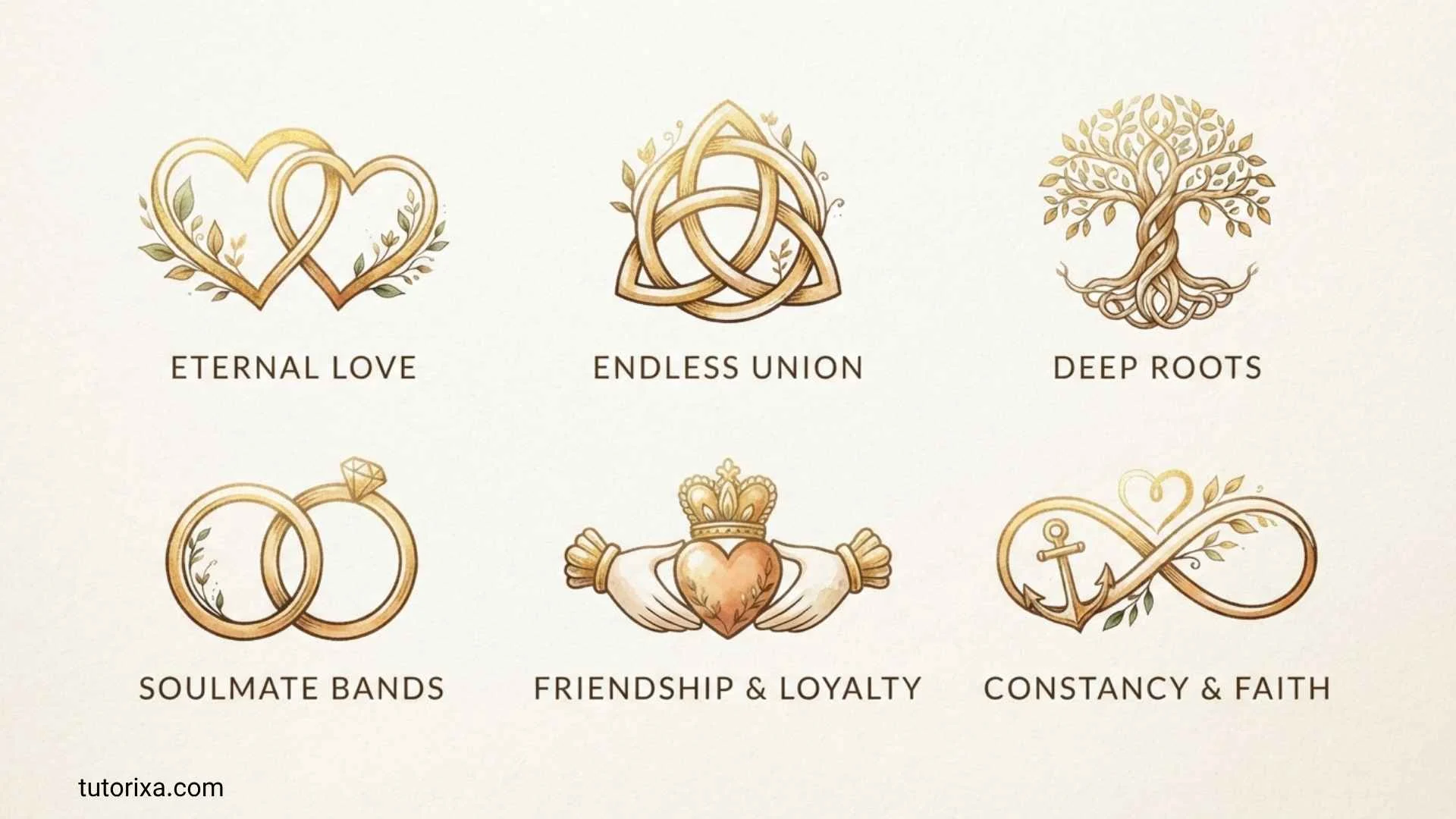
I believe love can be expressed in ways that go far beyond words, and marriage soulmate symbols can capture that deep connection beautifully. You may be curious about the signs, shapes, and meaningful symbols associated with lasting love and soulmate bonds.
You can discover how different symbols represent commitment, connection, unity, and lifelong affection. I’ll help you explore their meanings in a simple and engaging way, so you can understand which symbols truly speak to your idea of soulmate love.
Whether you’re looking for a meaningful symbol for marriage, a gift, artwork, or personal inspiration, you’ll find plenty of ideas to explore. I’ll break down their symbolism so you can choose something that feels meaningful to you.
Quick Meaning
Marriage soulmate symbols of love are visual representations of lasting affection, partnership, loyalty, and emotional connection. The wedding ring is especially associated with commitment because its continuous circular form suggests an unbroken bond. Hearts represent love, doves peace and devotion, knots enduring connection, and infinity symbols everlastingness. Together, these symbols communicate the ideals people associate with marriage and soulmate relationships.
Symbol Overview Table
| Symbol | Primary Meaning | Cultural/Historical Association | Common Modern Use |
| Wedding ring | Commitment, marriage, fidelity | Ancient and European traditions | Weddings, anniversaries, jewelry |
| Heart | Romantic love, affection | Medieval European love symbolism | Cards, jewelry, messages, art |
| Infinity symbol | Endlessness, continuity | Modern mathematical symbol adapted symbolically | Jewelry, tattoos, wedding designs |
| Love knot | Eternal connection, intertwined lives | European decorative and jewelry traditions | Wedding rings, artwork, gifts |
| Claddagh | Love, loyalty, friendship | Irish tradition | Rings, jewelry, gifts |
| Interlocking rings | Partnership and unity | European and modern wedding traditions | Invitations, logos, jewelry |
| Dove | Peace, devotion, love | Classical and Christian imagery | Weddings, stationery, artwork |
| Rose | Love, beauty, affection | Classical and European floral symbolism | Bouquets, jewelry, wedding décor |
| Clasped hands | Partnership, affection, agreement | European art and jewelry | Wedding motifs, memorials, jewelry |
| Two swans | Bond, partnership, devotion | European and broader romantic imagery | Wedding décor, illustrations |
| Orange blossom | Fertility, virtue, marriage | European bridal tradition | Bouquets, bridal clothing |
| Pearl | Purity, elegance, marriage | Longstanding jewelry traditions | Bridal jewelry |
| Pomegranate | Fertility, abundance, marriage | Mediterranean and West Asian traditions | Art, jewelry, wedding imagery |
What Do Marriage Soulmate Symbols of Love Mean?
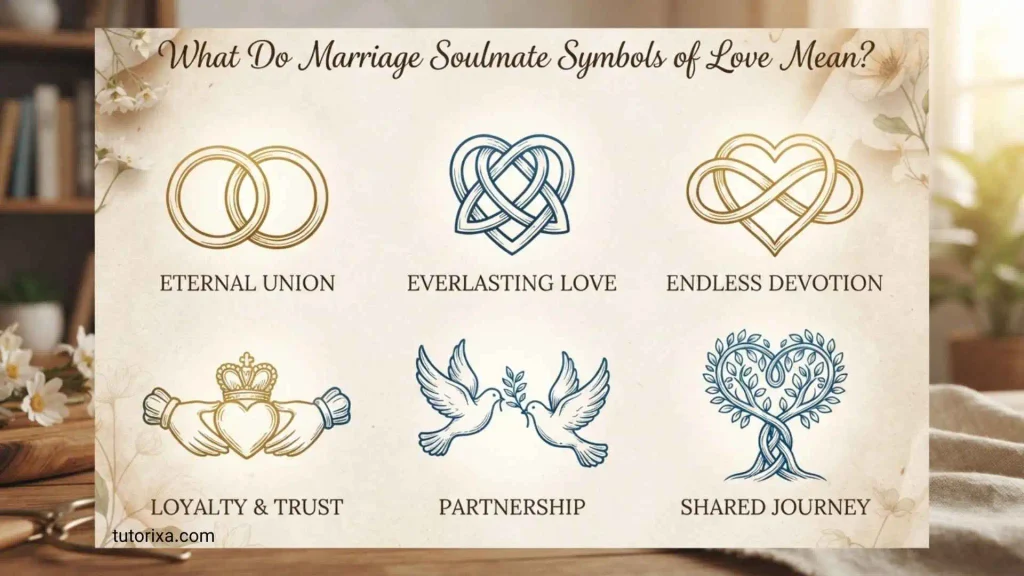
Marriage soulmate symbols of love generally communicate connection between two people, but each symbol emphasizes a different part of that relationship.
A wedding ring focuses on commitment. Its continuous shape has made the circle a powerful visual metaphor for continuity and an enduring relationship. Museums such as the Victoria and Albert Museum note that rings have been used as signs of love, loyalty, remembrance, faith, and marriage across different periods.
The heart focuses more directly on affection and emotional devotion. Medieval European culture helped establish the heart as a recognizable symbol of romantic feeling. The British Museum notes that medieval people associated the heart with emotion and portrayed the act of giving one’s heart as a sign of devotion, faithfulness, and loyalty.
A love knot emphasizes two lives becoming intertwined. An infinity sign suggests endlessness, although its original history is mathematical rather than specifically romantic. A dove can suggest peace and devotion, while a rose often communicates love through floral symbolism.
The important distinction is that these symbols do not scientifically prove that two people are “soulmates.” Instead, they are cultural and artistic ways of expressing beliefs about love, partnership, and lifelong connection.
History and Origin of Marriage Love Symbols
There is no single ancient civilization that created a universal “soulmate symbol.” Instead, romantic and marriage symbolism developed gradually through jewelry, religion, mythology, literature, art, ceremonies, and everyday objects.
Wedding Rings and the Circle
Rings have particularly deep historical connections with marriage. The V&A traces the story of the wedding ring to Roman times while also emphasizing that rings have acquired many meanings across history.
The circle is visually significant because it has no obvious beginning or end. Over time, that physical characteristic made the ring particularly suitable for expressing ideas of continuity and lasting commitment.
However, it is too simplistic to claim that every ancient ring represented romantic marriage. Historical rings served many purposes, including status, identity, religion, friendship, remembrance, and personal adornment.
The Heart and Romantic Love
The modern heart shape has a long cultural history, but its development as a symbol of romantic love was gradual.
Medieval European objects, poems, jewelry, and visual art increasingly connected the heart with emotional devotion. The British Museum describes medieval examples in which the heart represented giving oneself emotionally to another person.
By later centuries, heart-shaped jewelry, love tokens, cards, and decorative objects made the symbol increasingly recognizable as an expression of affection.
Knots and Interwoven Designs
Knots have long been visually useful for representing connection because strands become physically intertwined. In European jewelry, “lover’s knots” and related designs were used to communicate attachment and devotion.
A particularly interesting example is the early 16th-century Tudor Heart pendant associated with Henry VIII and Katherine of Aragon. The British Museum describes intertwined initials, a heart shape, Tudor and Aragonese imagery, and a lover’s-knot design within the object.
This illustrates an important point: historical love symbols often combined several symbols rather than relying on one isolated image.
Flowers and Marriage
Flowers have also played an important role in marriage symbolism. The V&A notes that flowers appeared in bridal traditions as tokens associated with luck, love, and fertility. Orange blossom became particularly important in European bridal fashion, especially from the 19th century onward.
Symbolism and Interpretation
Wedding Ring — Commitment and Fidelity
The wedding ring is perhaps the strongest conventional symbol of marriage in many contemporary Western societies.
Its circular form can be interpreted as continuity, while the act of exchanging rings represents a public promise. The exact meaning depends on the couple, ceremony, and culture.
Main associations:
- Marriage
- Commitment
- Loyalty
- Partnership
- Continuity
- Remembrance
Heart — Romantic Love
The heart is the most immediately recognizable modern symbol of love.
It commonly communicates:
- Romantic affection
- Emotional attachment
- Devotion
- Compassion
- Appreciation
A heart does not necessarily mean marriage. It can represent family love, friendship, compassion, or general affection. Historical love tokens demonstrate that heart imagery could communicate affection between spouses, lovers, relatives, and friends.
Infinity — Everlasting Connection
The infinity symbol, ∞, originated as a mathematical notation for something without bound. Its romantic meaning is a later symbolic adaptation.
Today, couples may use it to represent:
- Forever
- Endless love
- Continuity
- An enduring bond
Its mathematical origin should be distinguished from its modern romantic interpretation.
Love Knot — Intertwined Lives
A love knot visually suggests two paths becoming connected.
It can represent:
- Unity
- Partnership
- Fidelity
- Emotional connection
- Shared life
Because knots can also be difficult to untangle, they can metaphorically suggest a relationship that remains connected through difficulties.
Clasped Hands — Partnership
Two hands joined together can symbolize agreement, affection, friendship, cooperation, or marriage.
The meaning depends heavily on context. In historical art and jewelry, hands can represent relationships and promises rather than exclusively romantic love.
Cultural Significance
Marriage symbolism differs substantially between cultures.
European Traditions
European wedding culture contains numerous romantic symbols, including rings, hearts, flowers, doves, knots, clasped hands, and symbolic gemstones.
The V&A’s research into jewelry shows how love-related motifs were used creatively in rings and other objects, including clasped hands, lovers’ knots, hearts, Cupid imagery, flowers, and other romantic designs.
Irish Tradition: The Claddagh
The Claddagh is an Irish ring design featuring a heart, a crown, and two hands.
It is traditionally interpreted through three concepts:
- Heart — love
- Crown — loyalty
- Hands — friendship
It therefore works particularly well as a relationship symbol because it combines several qualities rather than reducing love to romance alone.
The Claddagh is associated specifically with Irish cultural tradition and should not be presented as an ancient universal Celtic symbol for soulmates.
Korean Bridal Symbolism
Traditional Korean bridal clothing and accessories also contain auspicious symbolism. The V&A describes a Korean bridal jokduri decorated with colorful gemstones and symbols associated with purity, loyalty, and marital bliss.
This demonstrates why marriage symbolism should be studied within cultural context rather than treated as a universal symbolic language.
Classical Greco-Roman Imagery
Classical mythology strongly influenced later European representations of love and marriage. Aphrodite/Venus became associated with love, while Hera/Juno was associated with marriage.
Artworks from the Renaissance and later periods frequently combined mythological figures with symbols of romantic and marital relationships. The Metropolitan Museum of Art, for example, preserves Renaissance imagery explicitly titled Allegory of Marriage and Love, featuring Juno and Venus alongside other symbolic figures.
Religious or Spiritual Meaning
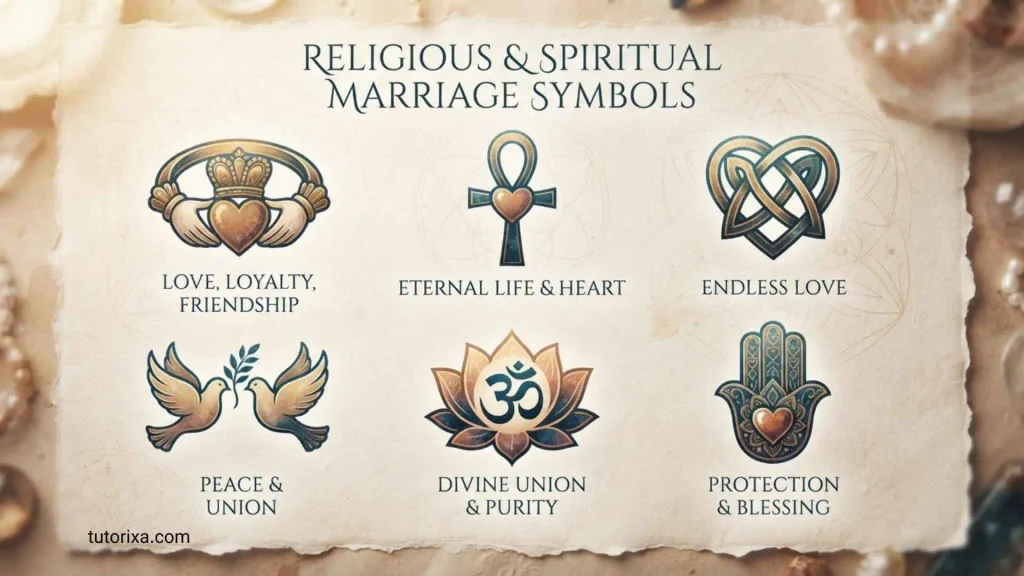
Marriage symbols can acquire religious meanings, but these meanings vary significantly among traditions.
In Christian art, rings may represent marital vows, while the dove can carry associations with peace and the Holy Spirit. The cross, meanwhile, is fundamentally a Christian religious symbol rather than a generic soulmate symbol.
In Hindu traditions, wedding ceremonies use specific ritual objects, colors, ornaments, and practices whose meanings depend on regional and community traditions. It is therefore better to discuss a particular Hindu marriage symbol within its ritual context rather than assign it a universal “soulmate” meaning.
Spiritual interpretations should also be distinguished from historical evidence. A modern belief that a particular crystal or symbol attracts a soulmate is a personal or spiritual interpretation, not an established scientific fact.
Where Marriage Soulmate Symbols Are Used
Marriage and love symbols appear in many settings:
- Wedding rings: commitment and marriage
- Engagement rings: promise and intended marriage
- Wedding invitations: romance and partnership
- Wedding cakes: hearts, flowers, initials, and rings
- Jewelry: personal expressions of affection
- Home décor: reminders of partnership
- Wedding bouquets: love, fertility, tradition, or remembrance
- Tattoos: personal representations of connection
- Greeting cards: affection and celebration
- Literature: metaphors for devotion and fate
- Paintings: allegories of love and marriage
- Religious ceremonies: vows and spiritual commitments
- Digital messages: hearts and related emoji
- Anniversary gifts: symbols of continuing commitment
Historical objects show that symbolic combinations can communicate surprisingly specific relationship messages. The Tudor Heart, for example, combined a heart, intertwined initials, heraldic plants, a hand, a knot, and an inscription to create a layered representation of a royal relationship.
Common Variations
Two Interlocking Rings
Two rings joined together emphasize partnership and equality.
Heart With Infinity
This modern combination combines emotional love with the concept of endlessness. It is especially common in jewelry and graphic designs.
Two Hearts
Two hearts may represent two people sharing love or a mutual emotional connection.
Heart and Arrow
The heart-and-arrow combination is associated with romantic desire and Cupid imagery. Historical love tokens show hearts pierced by arrows as established love iconography.
Double Swans
Two swans facing each other are a modern romantic motif often used to represent partnership and devotion. Their meaning is largely symbolic and artistic rather than a universal historical code.
Rose and Heart
The rose-heart combination intensifies the conventional message of romantic love by combining floral and heart symbolism.
Initials
Interlocking initials personalize a symbol by connecting the identities of two people. Historical examples demonstrate that initials could be incorporated into jewelry celebrating relationships.
Common Misconceptions
There Is One Universal Soulmate Symbol
There is no universally recognized historical symbol that proves two people are destined soulmates. “Soulmate symbol” is a modern descriptive category covering many cultural symbols.
Wedding Rings Always Had the Same Meaning
They did not. Rings have represented many things across history, including love, status, identity, faith, remembrance, and authority.
The Infinity Sign Was Originally a Love Symbol
No. Infinity is fundamentally a mathematical concept and notation. Its association with everlasting romantic love is a later symbolic use.
Every Celtic Knot Means Eternal Love
Celtic-inspired knots are widely used today as relationship symbols, but individual knot designs do not automatically possess one ancient, fixed meaning. Modern interpretations often differ from what can be securely established historically.
A Symbol Guarantees a Relationship
Symbols express beliefs or intentions. They cannot scientifically establish compatibility, destiny, or whether two people will remain together.
Interesting Facts About Marriage Soulmate Symbols
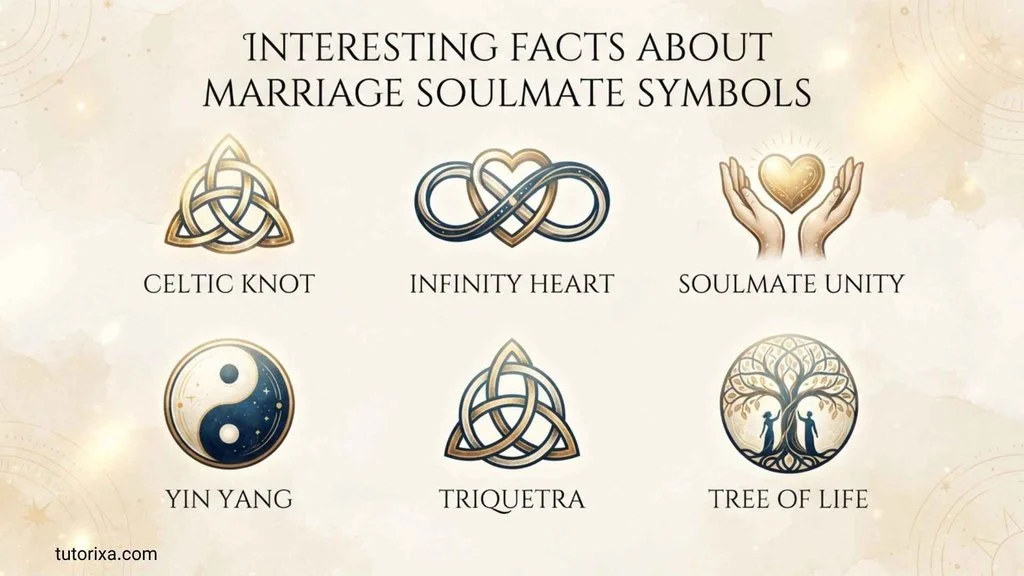
- The wedding ring has multiple meanings. Historical rings were not exclusively romantic objects; they could also communicate faith, identity, status, friendship, and remembrance.
- The heart became a powerful medieval love image. Medieval European culture helped connect the heart’s visual representation with devotion and emotional commitment.
- Historical love objects often combine symbols. The Tudor Heart combines hearts, initials, plants, a knot, a hand, and an inscription rather than relying on one motif.
- The rose can carry different meanings. Floral symbolism depends on historical and cultural context, which is why the same flower can communicate different ideas in different settings.
- Orange blossom became strongly associated with Western bridal fashion. Its association with virtue and fertility helped make it an important bridal flower.
- Hearts can represent more than romantic love. Historical heart-shaped love tokens were also used to communicate affection between relatives and friends.
- The Claddagh combines three relationship ideals. Its heart, crown, and hands allow love, loyalty, and friendship to be represented together.
- Marriage symbolism appears in museum collections worldwide. Rings, wedding objects, paintings, clothing, jewelry, and ceremonial items preserve evidence of how people have represented relationships.
- Mythology influenced Western wedding imagery. Juno and Venus frequently appear in European artistic representations of marriage and love.
- Modern soulmate symbolism is highly customizable. Couples can combine initials, rings, hearts, flowers, dates, cultural motifs, and religious symbols to create a personal emblem.
Related Symbols
Wedding Ring
The clearest conventional symbol of marriage and commitment.
Engagement Ring
Represents a promise or intention to marry and is distinct from the wedding ring.
Heart
Primarily communicates love, affection, and emotional devotion.
Claddagh
Combines love, loyalty, and friendship in an Irish design.
Love Knot
Emphasizes connection and intertwined lives.
Infinity Symbol
Suggests endlessness or continuity in modern romantic contexts.
Dove
Often represents peace, devotion, and harmony.
Rose
Commonly associated with romantic love and beauty.
Orange Blossom
Historically connected with bridal virtue and fertility in European traditions.
Pearl
Often associated with purity and elegance in bridal jewelry, although its exact symbolic meaning varies by culture.
Pomegranate
In some historical and cultural contexts, represents fertility, abundance, and prosperity; its meaning should be interpreted within its specific tradition.
Frequently Asked Questions
What is the best symbol for soulmate love?
There is no single universally accepted soulmate symbol. The heart is the clearest general symbol of romantic love, while an infinity sign can suggest enduring connection. A wedding ring is more specifically associated with marriage and commitment. For a culturally meaningful choice, the best symbol depends on the relationship, tradition, and personal meaning attached to it.
What symbol represents eternal love in marriage?
The circle and infinity symbol are commonly used to represent enduring love. A wedding ring is especially appropriate because its continuous circular form naturally lends itself to ideas of continuity and commitment. However, “eternal love” is a symbolic interpretation rather than a universal historical meaning shared by every culture.
What symbol represents two soulmates?
Interlocking rings, two hearts, a love knot, clasped hands, and paired swans can all represent two people connected in a relationship. None is a universal symbol of soulmates. The strongest choice depends on whether the intended message is marriage, emotional affection, loyalty, unity, or lifelong partnership.
What flower symbolizes soulmate love?
Roses are among the most recognizable flowers associated with romantic love, while other flowers can carry different meanings depending on cultural and historical context. Orange blossom has an especially strong connection with Western bridal tradition, where it became associated with virtue and fertility.
What does a heart symbolize in marriage?
A heart generally represents love, affection, devotion, and emotional connection. In historical European contexts, the heart could represent giving one’s heart to another person and therefore communicate faithfulness or devotion. In marriage imagery, it commonly reinforces the emotional dimension of the partnership.
What does an infinity symbol mean in a relationship?
In modern relationship symbolism, infinity usually means endless or continuing love. Its original meaning is mathematical: it describes something without a finite bound. Using it in romantic jewelry or artwork is therefore a symbolic adaptation rather than the symbol’s original historical purpose.
What does the Claddagh symbolize in love?
The Claddagh traditionally combines three ideas: the heart represents love, the crown represents loyalty, and the hands represent friendship. Together, these qualities make the Irish design particularly suitable for expressing a relationship built on affection, trust, and companionship.
Are Celtic knots symbols of love?
Celtic-inspired knots are frequently used today to symbolize eternal connection, continuity, and love. However, it is misleading to claim that every knot has one fixed ancient meaning. Many modern romantic interpretations are contemporary uses of interlaced designs rather than precisely documented meanings from a single ancient Celtic tradition.
What symbolizes lifelong marriage?
Wedding rings, interlocking rings, love knots, infinity designs, and clasped hands can all symbolize lifelong marriage. Among these, the wedding ring has the strongest direct association with marriage in many modern Western societies. Historical evidence also shows that rings have carried broader meanings beyond marriage.
Can symbols prove that someone is your soulmate?
No. Symbols can express affection, commitment, cultural identity, or a personal belief about a relationship, but they cannot prove that two people are destined to be soulmates. Their value is emotional and cultural rather than scientific. A meaningful symbol represents what people choose to communicate about their relationship.
Key Takeaways
- There is no single universal soulmate symbol.
- The wedding ring is strongly associated with marriage and commitment.
- The heart represents romantic love and emotional devotion.
- The infinity symbol commonly represents endless love in modern designs.
- The love knot symbolizes intertwined connection and partnership.
- The Claddagh combines love, loyalty, and friendship.
- Doves can represent peace, devotion, and harmony.
- Roses are widely associated with romantic love.
- Orange blossom has an important history in Western bridal symbolism.
- Historical symbols often work in combinations, creating more complex meanings.
- Symbolic meanings vary across cultures, religions, historical periods, and personal contexts.
- A soulmate symbol expresses a belief or feeling; it does not scientifically prove romantic destiny.
Conclusion
Marriage soulmate symbols of love give people a visual language for expressing feelings that can be difficult to put into words. Rings communicate commitment, hearts express affection, knots suggest connection, infinity signs evoke endlessness, and flowers bring cultural traditions into wedding celebrations.
Their meanings have developed through centuries of jewelry, art, religion, mythology, literature, ceremony, and personal expression. Historical evidence also shows that symbolic meaning is rarely fixed: the same object can represent love, loyalty, family, faith, friendship, status, or remembrance depending on its context.
For that reason, the most meaningful marriage symbol is not necessarily the oldest or most famous one. It is the symbol whose history, cultural meaning, and personal significance best communicate the relationship it represents.

I’m Rowan Whitaker, a British writer fascinated by the symbols surrounding us every day. I explore their meanings, origins, cultural significance, and changing interpretations. From ancient marks to modern signs, I enjoy making symbolism easier to understand. My writing helps curious readers discover the hidden messages behind familiar shapes, images, and signs.
Books:
- The Meaning Behind Symbols
- A Modern Guide to Symbolism
 Ellis Montgomery
 Freddie Beaumont