
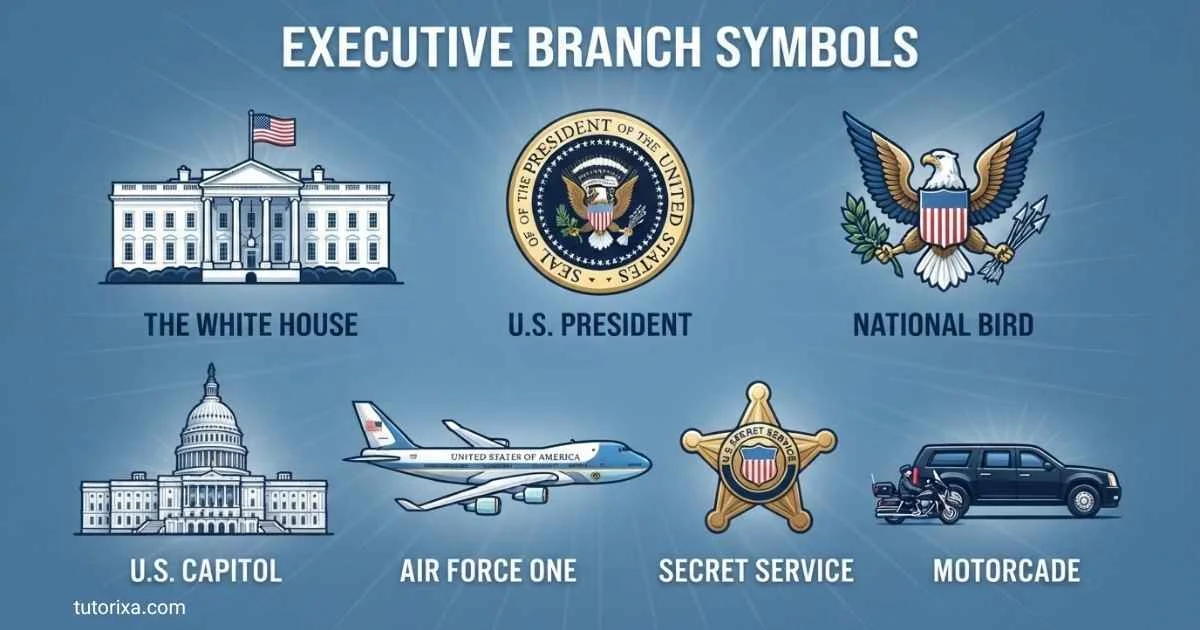
When you first look at Executive Branch Symbols, you may see more than just official images, seals, or emblems. Each symbol can reveal something about the history, authority, and role of the U.S. executive branch.In this guide, you’ll discover the meanings behind important symbols and why they continue to represent the power and responsibilities of the executive branch.
You might recognize some symbols right away, while others may be unfamiliar. I’ll help you understand what they represent in a clear and simple way.
Whether you’re a student, researcher, or simply curious, you’ll find practical explanations that make these government symbols easier to understand.
Quick Meaning
Executive branch symbols are visual representations associated with the President, Vice President, White House, and federal executive institutions. They communicate authority, national sovereignty, leadership, peace, defense, unity, and public service. The Presidential Seal and American eagle are especially important, while the White House and U.S. flag provide recognizable visual connections to presidential government.
Executive Branch Symbols Overview
| Symbol | Primary Meaning | Category | Historical Origin | Common Usage | Modern Meaning |
| Presidential Seal | Presidential authority and office | Government emblem | Developed from U.S. national heraldry | Presidential documents, events, communications | The office of the President |
| Great Seal of the United States | National sovereignty and self-government | National seal | Adopted June 20, 1782 | Treaties, proclamations, official documents | United States as a sovereign nation |
| American Bald Eagle | Strength, authority, independence | National emblem | Used on Great Seal since 1782 | Government insignia and ceremonial imagery | National power and independence |
| Olive Branch | Peace | Symbolic element | Part of Great Seal design, 1782 | Seals, presidential imagery | Preference for peace and diplomacy |
| Arrows | Defense and military readiness | Symbolic element | Part of Great Seal design, 1782 | Presidential and national heraldry | Ability to defend the nation |
| White House | Presidency and executive government | Building/symbol | Presidential residence since John Adams | Government, media, public events | Presidential leadership and administration |
| Presidential Flag | Office of the President | Official flag | Developed through 19th–20th centuries | Military and official settings | Presidential authority |
| U.S. Flag | Nation and constitutional government | National flag | Continental Congress, 1777 | Government buildings and ceremonies | National identity and unity |
| Vice Presidential Seal | Office of the Vice President | Government emblem | Officially prescribed in 1975 | Vice-presidential activities | Vice-presidential authority |
The executive branch itself consists of the President, Vice President, Cabinet, executive departments, independent agencies, and other federal organizations that administer and enforce federal law.
What Do Executive Branch Symbols Mean?
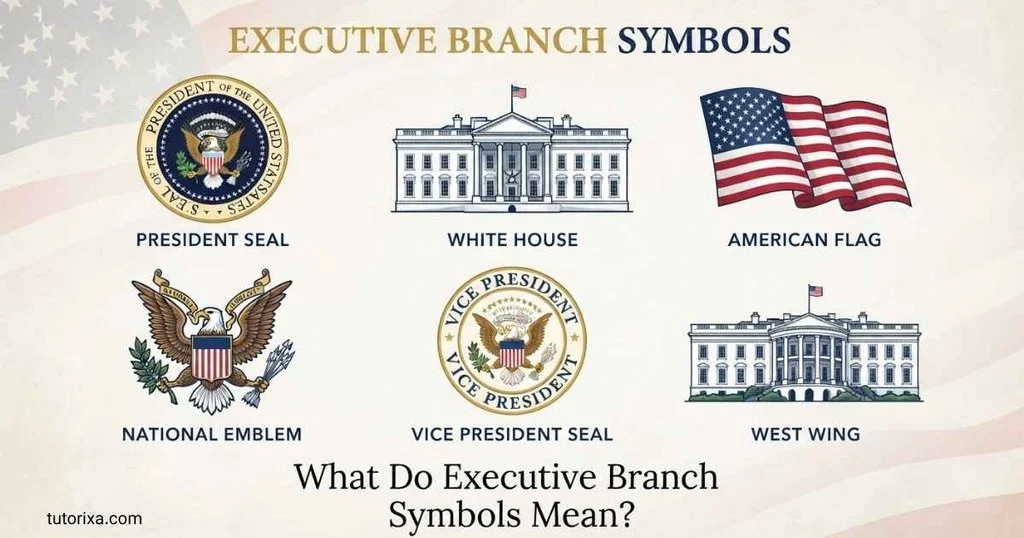
The primary meaning of executive branch symbols is governmental authority exercised through the presidency and the federal executive institutions.
Unlike ordinary decorative images, official government symbols often have specific historical and institutional purposes. A presidential seal identifies the office rather than the private individual holding it. The White House represents the physical center of presidential administration. The eagle connects the presidency with the broader identity of the United States.
Several recurring ideas appear across these symbols:
- Authority: The President exercises executive power under Article II of the Constitution.
- Sovereignty: The Great Seal represents the United States as an independent nation.
- Unity: The thirteen original states are represented repeatedly in Great Seal imagery.
- Peace: The olive branch symbolizes peaceful intentions.
- Defense: The arrows represent the nation’s capacity to defend itself.
- Continuity: Presidential symbols belong to the office, not permanently to one president.
- Public service: Government symbols distinguish official responsibilities from private activities.
This is why executive imagery often combines formal lettering, heraldic elements, stars, shields, eagles, flags, and architectural settings. The design language creates an immediate visual connection between an individual officeholder and a much larger constitutional institution.
History and Origin of Executive Branch Symbols
The history of executive branch symbols begins before the modern executive branch formally existed.
The Great Seal of the United States was officially adopted by the Continental Congress on June 20, 1782. The process began in 1776, when Benjamin Franklin, Thomas Jefferson, and John Adams were appointed to work on a national seal. Several designs and committees followed before Charles Thomson produced the design that Congress ultimately accepted.
This timeline matters because the Great Seal was created for the United States as a nation, not specifically for the presidency. After the Constitution established the federal government’s three-branch structure, the imagery became closely connected with federal authority, including the executive branch.
The Constitution established the executive branch through Article II, placing executive power in the President. The modern executive branch includes much more than the President alone: the Vice President, Cabinet departments, executive agencies, and other organizations all participate in carrying out federal responsibilities.
Over time, separate symbols developed for the President and Vice President. The National Archives records executive orders prescribing the President’s coat of arms, seal, and flag, as well as separate official designs for the Vice President.
The Great Seal of the United States
The Great Seal is one of the most important symbols connected with executive government, but it is not exclusively an executive-branch symbol. Its central meaning is the sovereignty of the United States.
Congress adopted the seal in 1782. Its obverse features an American bald eagle carrying an olive branch and a bundle of thirteen arrows. A shield with thirteen stripes rests on the eagle’s breast, while thirteen stars appear above its head. A scroll carries the Latin motto E Pluribus Unum, commonly translated as “Out of Many, One.”
The Great Seal is used on important federal documents, including treaties, proclamations, commissions, and certain presidential communications. The Secretary of State is its custodian.
Its connection to the executive branch is particularly visible because the seal authenticates certain documents associated with presidential authority and international relations.
The American Eagle as an Executive Symbol
The American bald eagle is the central figure of the Great Seal and has become one of the most recognizable symbols associated with American government.
Its symbolism includes strength, authority, independence, and national identity. The eagle’s importance to executive imagery comes largely from its role in the Great Seal and its later use in presidential seals, flags, buildings, furniture, military insignia, and official decoration. The bald eagle became the central image of the Great Seal in 1782.
The eagle is not exclusively an executive symbol. It represents the United States more broadly. However, because presidential and federal institutions repeatedly use the eagle, it has become strongly associated with governmental authority.
Olive Branch and Arrows
Two of the most meaningful details are held in the eagle’s talons.
The olive branch represents peace, while the thirteen arrows represent the power of war or defense. The combination communicates a balance: peaceful intentions do not mean an inability to defend the country.
The eagle’s orientation toward the olive branch is also important in modern interpretations. Presidential symbolism has emphasized the preference for peace and diplomacy while maintaining national defense capabilities.
The Presidential Seal
The Presidential Seal specifically represents the President of the United States and therefore has a much closer relationship to the executive branch than the Great Seal.
Its central imagery is derived from the national coat of arms: an eagle, shield, olive branch, arrows, stars, and the motto E Pluribus Unum. The presidential emblem is distinguished by the surrounding inscription identifying it as the seal of the President.
The federal government has formally prescribed the President’s coat of arms, seal, and flag through executive orders. Executive Order 10860, effective in 1960, specified that these designs represented the President of the United States exclusively.
The Presidential Seal can appear at official presidential events, lecterns, documents, communications, and other settings where the office is being represented.
The White House as a Symbol
The White House is more than a residence. It has become a powerful symbol of the American presidency and executive government.
George Washington selected the site in 1791, and construction began soon afterward. John Adams and Abigail Adams became the first presidential occupants. The building was later rebuilt after British forces burned it during the War of 1812.
The building’s symbolic meaning developed gradually. Today, phrases such as “the White House” can refer not only to the physical building but also to the President and presidential administration.
The White House therefore functions as a metonym: a place name used to represent the people and institution operating there.
President Theodore Roosevelt officially gave the building its current name, “White House,” in 1901.
The Presidential Flag
The presidential flag is an official visual representation of the President’s office.
Its design developed through several stages. A presidential flag using the U.S. coat of arms was prescribed by the Navy Department in 1882. Different military departments later used different designs, creating uncertainty about which presidential flag was official. In 1916, President Woodrow Wilson approved a standardized presidential flag featuring the Presidential Seal. President Harry Truman changed the design in 1945 so that the seal was surrounded by a circle of stars representing the states.
The flag therefore demonstrates how symbols can evolve while preserving the identity of an institution.
The U.S. Flag and the Executive Branch
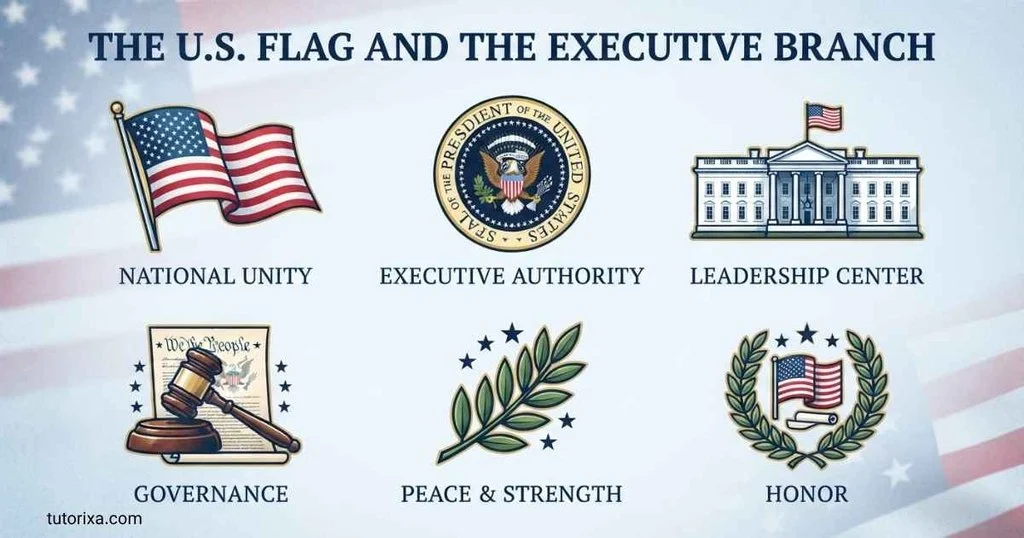
The American flag is a national symbol rather than an exclusive executive-branch symbol.
Nevertheless, it is closely associated with the President because the President is the nation’s head of state and commander in chief. The flag appears throughout the White House, executive offices, military settings, diplomatic environments, presidential ceremonies, and official communications.
Its thirteen stripes connect it historically with the original states, while the stars represent the states in the Union. The Second Continental Congress adopted the first national flag resolution on June 14, 1777.
The flag’s presence beside a presidential seal often communicates an important distinction: the President acts within an office representing the United States rather than as a private individual.
Vice Presidential Symbols
The Vice President has official symbols of the executive office as well.
These include a Vice Presidential Seal, coat of arms, and flag. Executive Order 11884, issued in 1975, prescribed the official designs and stated that they were to represent the Vice President exclusively.
The Vice Presidential coat of arms closely resembles the national coat of arms, including the eagle, shield, thirteen arrows, olive branch, stars, and motto. The surrounding design identifies the office of the Vice President.
These symbols reinforce an important constitutional relationship: the Vice President is part of the executive branch while also serving as president of the Senate.
Symbolism and Interpretation
Executive branch symbols combine several layers of meaning.
Authority
Seals and formal emblems communicate that an action is associated with an official government office. A presidential seal therefore carries institutional authority rather than simply personal prestige.
Peace and Diplomacy
The olive branch is one of the clearest symbols of peaceful intentions. Its presence alongside the arrows creates a visual contrast between diplomacy and defense.
Strength and Independence
The eagle represents national power and independence. Its use reflects the desire of the early United States to present itself as a sovereign nation.
Unity
The number thirteen appears repeatedly in the Great Seal. The thirteen stripes, arrows, and stars refer to the original thirteen states.
Continuity
A presidential seal does not change simply because one president leaves office. Its purpose is to represent the continuing institution of the presidency.
Cultural Significance
Executive symbols are interpreted differently depending on context.
In American political culture, the eagle often suggests national strength and independence. In diplomatic settings, the combination of the eagle, olive branch, and arrows can communicate both peaceful intentions and the ability to protect national interests.
In historical studies, the Great Seal is especially significant because its imagery reflects the political identity of a newly independent republic. Its designers used classical symbolism, heraldic conventions, and references to the thirteen original states.
In popular culture, the White House often becomes shorthand for presidential leadership. News reports may say that “the White House announced” something even though the physical building did not make the announcement. The phrase refers to the presidential administration and its staff.
Religious or Spiritual Meaning
Executive branch symbols are not religious symbols, although some of their historical imagery has connections to older religious, classical, and philosophical traditions.
The Great Seal’s reverse side includes an unfinished pyramid and an Eye of Providence. These elements have generated many modern interpretations, but they should not be confused with the executive branch’s primary symbols. The official historical record treats the Great Seal as a national emblem reflecting the values and aspirations of the new United States.
The motto E Pluribus Unum is Latin rather than a religious statement. It expresses the concept of unity emerging from many separate states.
Where Executive Branch Symbols Are Used
Executive branch symbols appear in many official and public settings, including:
- Presidential documents
- Executive orders
- White House communications
- Presidential speeches and ceremonies
- Diplomatic materials
- Government buildings
- Official presidential events
- Presidential flags
- Vice-presidential offices
- Federal publications
- Government websites
- Military and ceremonial settings
- Historical exhibits
- Museums and educational materials
The Great Seal has particularly formal uses. The National Archives notes that its obverse is used to authenticate the President’s signature on certain official documents and appears on proclamations, warrants, treaties, and commissions.
Common Variations
Executive symbols can vary according to the institution they represent.
The Presidential Seal identifies the President, while the Vice Presidential Seal identifies the Vice President. Federal departments and agencies also have their own seals, logos, and insignia.
The eagle may appear in a highly formal heraldic design or a simplified modern illustration. Government websites may use simplified versions for digital interfaces, while ceremonial environments often preserve detailed traditional designs.
The presidential flag also changed over time, demonstrating that official symbols can be redesigned without abandoning their historical foundations.
Common Misconceptions
Is the Great Seal the same as the Presidential Seal?
No. They are related but not identical in purpose. The Great Seal represents the United States as a sovereign nation. The Presidential Seal represents the office of the President.
Is the eagle only a symbol of the executive branch?
No. The eagle is a national symbol used throughout American government and public life. Its connection with the executive branch is especially strong because of its central role in presidential and federal imagery.
Is the White House itself the executive branch?
No. The executive branch is much larger. It includes the President, Vice President, Cabinet, executive departments, agencies, and other organizations. The White House is a central presidential residence and workplace and has become a symbol of the presidency.
Do the arrows mean that the United States prefers war?
Not by themselves. The arrows represent the power of war or defense, while the olive branch represents peace. Their combination communicates both peaceful intentions and the ability to defend the nation.
Does every presidential symbol belong exclusively to the President?
No. Some symbols, such as the American flag and Great Seal, are national symbols used throughout government. The Presidential Seal and presidential flag have a more specific connection to the President.
Interesting Facts About Executive Branch Symbols
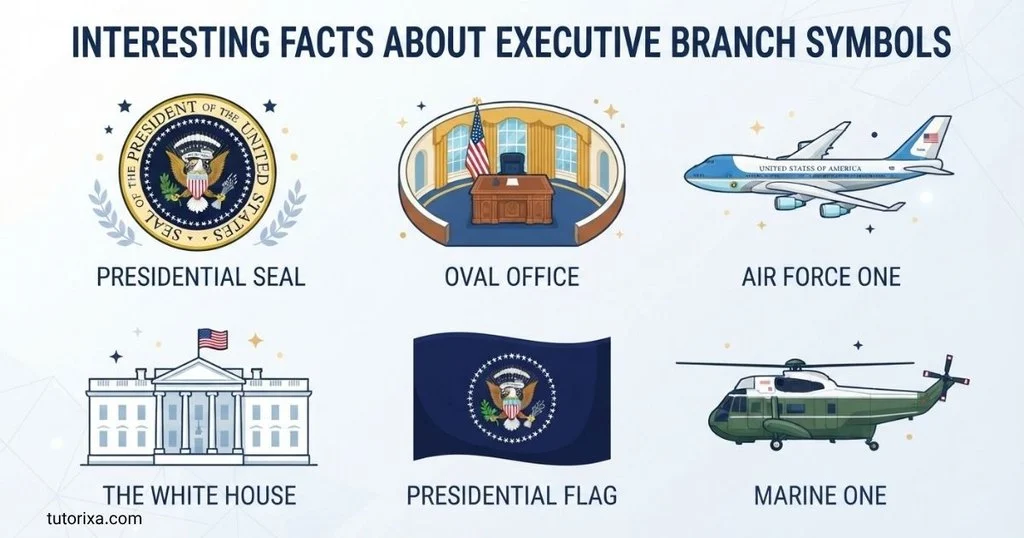
- The Great Seal predates the Constitution.
Congress adopted it in 1782, while the Constitution was not signed until 1787. This shows that national symbolism existed before the constitutional government took its current form. - The Great Seal took six years to complete.
The first design committee was appointed in 1776, but Congress did not adopt the final design until 1782. - Thirteen appears repeatedly.
The original thirteen states are represented through the arrows, stripes, and stars in the Great Seal. - The eagle replaced an earlier proposed bird design.
William Barton’s 1782 design included a crested white eagle, but Charles Thomson later selected the bald eagle for the final design. - The White House was not always called the White House.
Historical names included the President’s Palace, President’s House, and Executive Mansion. Theodore Roosevelt officially used “White House” as the name in 1901. - The Presidential Seal has legal protections.
Federal law regulates certain unauthorized uses and reproductions of the seals and coats of arms of the President and Vice President. - The presidential flag has changed over time.
Its history includes competing military designs before a standardized version was established in the early twentieth century. - The Vice President has a distinct official seal.
The federal government formally prescribed the Vice Presidential Seal and flag in Executive Order 11884 in 1975. - The Great Seal has two sides.
The familiar eagle appears on the obverse, while the reverse contains the unfinished pyramid and Eye of Providence. The reverse is not used as a seal in the same way as the obverse. - The Great Seal is connected to presidential diplomacy.
It appears on certain international documents and presidential communications with foreign governments, demonstrating its role in representing U.S. sovereignty abroad.
Related Symbols
Several symbols are closely connected with executive branch symbolism:
- Great Seal of the United States: Represents national sovereignty and unity.
- Presidential Seal: Represents the office of the President.
- Vice Presidential Seal: Represents the office of the Vice President.
- American Bald Eagle: Represents American strength, independence, and national identity.
- U.S. Flag: Represents the United States as a nation.
- White House: Represents the presidency and executive administration.
- Presidential Flag: Represents the President in official and ceremonial settings.
- E Pluribus Unum: Expresses unity from many parts.
- Olive Branch: Represents peace.
- Arrows: Represent the nation’s ability to defend itself.
- Stars: Represent the states, particularly the thirteen original states in the Great Seal.
- Shield: Represents the states united under the federal government.
The most useful distinction is between national symbols and executive-specific symbols. The Great Seal and U.S. flag belong to the broader national identity, while the Presidential Seal and presidential flag identify the executive office more directly.
Frequently Asked Questions
What are the main executive branch symbols?
The main symbols associated with the U.S. executive branch include the Presidential Seal, presidential flag, White House, American eagle, and U.S. flag. The Great Seal is also strongly connected with executive government but is technically a national symbol representing U.S. sovereignty rather than the executive branch alone.
What does the Presidential Seal symbolize?
The Presidential Seal represents the authority and continuity of the office of the President. Its eagle, shield, stars, olive branch, arrows, and motto connect the presidency with national unity, independence, peace, defense, and the history of the United States.
Why is the eagle used as an executive branch symbol?
The bald eagle became the central figure of the Great Seal in 1782 and subsequently became deeply associated with American government. Its visual qualities have traditionally been connected with strength, authority, independence, and national identity. Because presidential symbols use related imagery, the eagle is especially recognizable in executive settings.
What does the olive branch mean on the executive branch symbols?
The olive branch represents peace and peaceful intentions. In the Great Seal, it appears in the eagle’s talon opposite a bundle of arrows. Together, the two objects communicate a balance between the desire for peace and the ability to defend the nation when necessary.
What do the arrows mean on the Great Seal?
The thirteen arrows symbolize the power of war or national defense. Their presence alongside the olive branch creates a deliberate contrast between peace and the ability to protect the country. The number thirteen also refers to the original thirteen states.
Is the White House an executive branch symbol?
Yes, in a broad cultural and institutional sense. The White House is the President’s residence and workplace and has become a widely recognized symbol of presidential government. However, the executive branch includes many other institutions beyond the White House, including Cabinet departments and federal agencies.
What does E Pluribus Unum mean?
E Pluribus Unum is Latin for “Out of Many, One.” On the Great Seal, the motto expresses the idea that a unified nation emerged from the thirteen original states. It reinforces the seal’s broader themes of unity and national identity.
Why are there thirteen stars, arrows, and stripes?
The repeated use of thirteen refers to the thirteen original states of the United States. The number appears in several parts of the Great Seal, including the stars, arrows, and stripes, making the founding structure of the nation part of the seal’s visual language.
Is the Great Seal only used by the President?
No. The Great Seal represents the United States rather than the President alone. It is used for specified official purposes involving the federal government, including certain treaties, proclamations, commissions, and presidential communications. The Secretary of State is the custodian of the seal.
What is the difference between the Great Seal and the Presidential Seal?
The Great Seal is the official national seal representing the sovereignty of the United States. The Presidential Seal specifically represents the President. Their imagery is closely related, especially through the eagle, shield, stars, arrows, olive branch, and motto, but their institutional purposes are different.
Key Takeaways
- Executive branch symbols represent presidential authority, federal administration, national unity, and constitutional government.
- The Presidential Seal is the clearest symbol specifically associated with the President.
- The Great Seal of the United States represents national sovereignty and is not exclusive to the executive branch.
- The American bald eagle symbolizes strength, independence, and national identity.
- The olive branch represents peace and the arrows represent the power of defense.
- The number 13 recalls the original thirteen states.
- E Pluribus Unum expresses unity from many separate parts.
- The White House has become a powerful symbol of presidential government.
- The presidential flag visually identifies the President and has evolved through American history.
- The Vice Presidential Seal and flag represent the second-highest executive office.
- National symbols and executive-specific symbols should not be treated as exactly the same thing.
- These symbols combine history, constitutional authority, diplomacy, national identity, and public service.
Conclusion
Executive branch symbols tell a larger story than simple government decoration. The Presidential Seal connects the President to an enduring constitutional office, while the White House provides a physical symbol of presidential leadership. The American eagle expresses national strength and independence, and the olive branch and arrows communicate the continuing balance between peace and defense.
The Great Seal adds an even broader dimension. Adopted in 1782, it represents the sovereignty and unity of the United States and connects modern federal institutions with the country’s founding period.
Taken together, executive branch symbols show how images can communicate complex ideas quickly. A seal can represent authority, an eagle can suggest independence, an olive branch can express peace, and a building can stand for an entire administration. Understanding these symbols makes it easier to read the visual language of American government and recognize the difference between symbols of the presidency and symbols of the nation as a whole.

I’m Ellis Montgomery, a British writer interested in the powerful language of symbols. I explore everything from traditional emblems and cultural signs to contemporary symbols found in modern life. My aim is to explain their meanings clearly while revealing the stories and ideas behind them, making symbolism fascinating and accessible to everyone.
Books:
- The Complete Book of Symbols
- Hidden Messages in Everyday Symbols
 Rowan Whitaker
 Freddie Beaumont