
The Mexican peso symbol is $, a familiar currency sign used to represent money in Mexico. If you want to copy the Mexican peso symbol, understand its meaning, or learn how it differs from the US dollar symbol, this guide covers everything you need.
Mexico’s official currency is the Mexican peso, commonly abbreviated as MXN. Although it uses the same dollar sign ($) as the United States, the two currencies are different. Understanding the correct abbreviation and currency code helps you avoid confusion when writing prices, preparing financial documents, or making international transactions.
Below, you will find information about Mexican peso notes and coins, historical peso symbols, and ways to use the Mexican peso sign in Microsoft Excel. You will also learn how to compare Mexican pesos with US dollars and check the exchange rate.
Mexican Peso Symbols
The main Mexican peso symbol is $. It is used to represent prices, payments, salaries, and other monetary values in Mexico.
If you need the symbol for a document, message, website, or spreadsheet, you can copy it directly from here.
$
Mexican Peso Symbol
Copy and paste
Copy Mexican Peso Symbol
Common Mexican peso formats
| Format | Example |
| Basic symbol | $ |
| Symbol before amount | $100 |
| Symbol with decimals | $100.50 |
| Symbol with currency code | MXN $100 |
| International format | 100 MXN |
Copy Examples
The dollar sign is not exclusive to Mexico. Several countries use the same symbol, including the United States, Canada, and Australia. Therefore, adding the currency code MXN makes it easier to identify Mexican pesos in international communication.
Example: If a Mexican store lists a product for $500, the amount usually means 500 Mexican pesos when the local currency is understood.
Mexican Peso Abbreviation
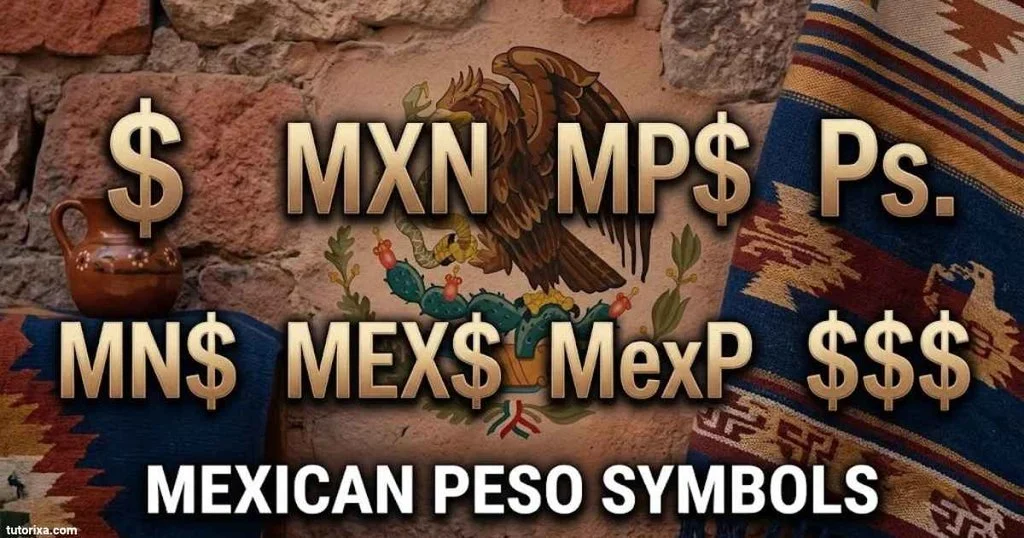
The standard abbreviation for the Mexican peso is MXN. It is commonly used in banking, currency exchange, international payments, financial reports, and online shopping.
MXN helps distinguish Mexican pesos from other currencies that also use the dollar sign.
Here are the common ways to write the Mexican peso abbreviation:
| Abbreviation | Meaning |
| MXN | Mexican peso currency code |
| Mex$ | Informal or clarifying Mexican peso notation |
| $ | Common peso symbol |
| N$ | Historical New Peso notation |
| M.N. | Mexican national currency notation in some Spanish-language financial contexts |
How To Use MXN In Writing
You can use MXN in different situations to make financial information clear.
Examples:
- MXN 100 — One hundred Mexican pesos.
- MXN 500 — Five hundred Mexican pesos.
- MXN 1,000 — One thousand Mexican pesos.
- MXN 5,000 — Five thousand Mexican pesos.
- 250 MXN — A price of 250 Mexican pesos.
For international audiences, using MXN is often clearer than writing only $ because readers may otherwise mistake the amount for US dollars.
Tip: Use the dollar sign ($) for ordinary Mexican prices when the context is clear. Use MXN when communicating with international customers, banks, or financial institutions.
Mexican Peso Code
The official three-letter currency code for the Mexican peso is MXN.
This code follows the international ISO 4217 currency-code system, which provides standardized codes for currencies around the world.
The letters have the following purpose:
- M — Identifies Mexico.
- X — Used in the international currency-code structure.
- N — Represents the new peso designation in the modern currency code.
The MXN code is especially useful when the same currency symbol is shared by multiple countries.
Mexican Peso Currency Details
| Currency information | Details |
| Currency name | Mexican peso |
| Currency code | MXN |
| Currency symbol | $ |
| Country | Mexico |
| Subunit | Centavo |
| One peso | 100 centavos |
| Common notation | MXN or $ |
Mexican Peso Code Examples
Here are some examples showing how MXN appears in financial information:
| Amount | Written format |
| 1 peso | MXN 1 |
| 10 pesos | MXN 10 |
| 50 pesos | MXN 50 |
| 100 pesos | MXN 100 |
| 500 pesos | MXN 500 |
| 1,000 pesos | MXN 1,000 |
If you are transferring money internationally, checking an exchange rate, or preparing an invoice, MXN is the safest way to identify Mexican currency.
Mexican Peso Symbol vs US Dollar
The Mexican peso and US dollar use the same basic currency symbol: $. However, they represent two different currencies with different currency codes and exchange values.
The Mexican peso is the official currency of Mexico, while the US dollar is the official currency of the United States.
Here is a simple comparison:
| Feature | Mexican Peso | US Dollar |
| Currency symbol | $ | $ |
| Currency code | MXN | USD |
| Country | Mexico | United States |
| Currency name | Mexican peso | US dollar |
| Subunit | Centavo | Cent |
| One unit | 100 centavos | 100 cents |
| Common format | MXN $100 | US$100 |
Why Do Both Currencies Use The Same Symbol?
The dollar sign has historical connections with the Spanish-American peso and other monetary traditions. Over time, it became widely used by different countries for their currencies.
Mexico and the United States both use this familiar symbol, but their currencies are not equal in value.
For this reason, international financial documents usually use MXN for Mexican pesos and USD for US dollars.
Mexican Peso vs US Dollar Examples
Consider these examples:
- $100 MXN — One hundred Mexican pesos.
- $100 USD — One hundred US dollars.
- MXN 500 — Five hundred Mexican pesos.
- USD 500 — Five hundred US dollars.
Notice that the number remains the same, but the currency changes.
If you are writing for an international audience, avoid using $ alone when the currency could be misunderstood. Adding MXN or USD makes the amount clear.
Mexico Currency to USD
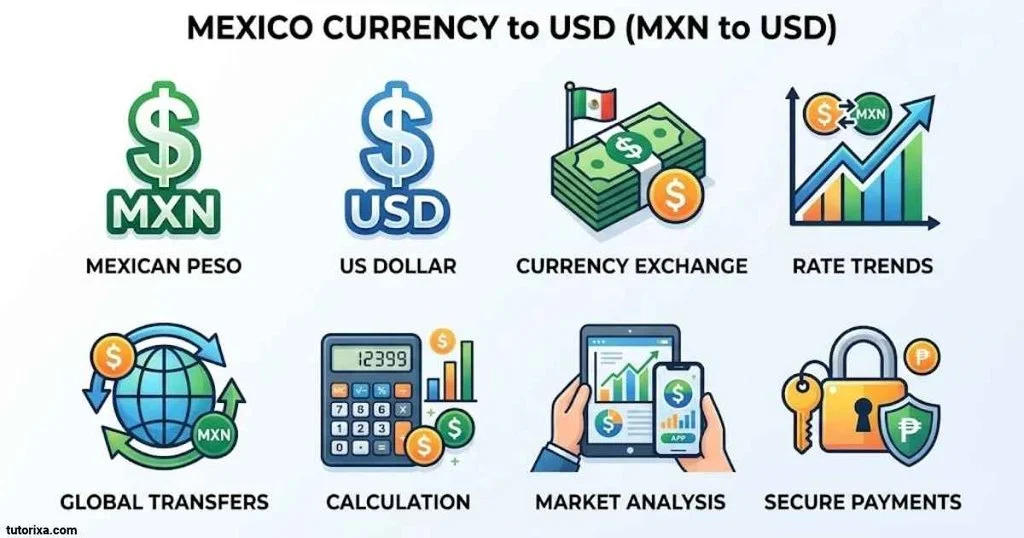
The Mexican peso can be converted into US dollars using the USD/MXN exchange rate.
The exchange rate tells you how many Mexican pesos are equal to one US dollar. It changes over time because of currency-market movements, economic conditions, interest rates, and other financial factors.
For example, if the exchange rate is 18.80 MXN for 1 USD, one US dollar is worth approximately 18.80 Mexican pesos.
Example exchange rate
1 USD = 18.7962 MXN
Banco de México settlement reference rate, November 4, 2026.
banxico.org.mx
| Mexican pesos | Approximate US dollars |
| 100 MXN | $5.32 |
| 500 MXN | $26.60 |
| 1,000 MXN | $53.20 |
| 2,000 MXN | $106.40 |
| 5,000 MXN | $265.87 |
| 10,000 MXN | $531.74 |
Illustrative conversions rounded to two decimal places using the reference rate above.
How To Convert Mexican Pesos To US Dollars
Use this simple formula:
US Dollars = Mexican Pesos ÷ Exchange Rate
For example:
If you have 1,000 Mexican pesos and the exchange rate is 18.80:
1,000 ÷ 18.80 = $53.19 USD (approximately).
How To Convert US Dollars To Mexican Pesos
Use the following formula:
Mexican Pesos = US Dollars × Exchange Rate
For example:
If you have $100 USD and the exchange rate is 18.80:
100 × 18.80 = 1,880 MXN.
Where Can You Check The Latest Exchange Rate?
You can check updated currency information through:
- Banco de México — Mexico’s central bank and official exchange-rate information.
- XE Currency Converter — Currency conversion and exchange-rate information.
- Google Finance — Currency-market information.
Remember that the reference exchange rate may differ from the rate offered by banks, exchange offices, and money-transfer services because of fees and transaction margins.
Mexican Peso Notes

Mexican peso banknotes are paper-based currency notes used for everyday payments and financial transactions in Mexico.
They feature different colors, sizes, historical figures, cultural designs, and national landmarks. Banco de México issues the country’s banknotes and manages their circulation.
Current Mexican Peso Banknote Denominations
Mexican banknotes are available in several denominations.
| Denomination | Written symbol format |
| 20 pesos | $20 |
| 50 pesos | $50 |
| 100 pesos | $100 |
| 200 pesos | $200 |
| 500 pesos | $500 |
| 1,000 pesos | $1,000 |
These denominations are part of the banknote families recognized by Banco de México. Designs and individual issues can vary.
banxico.org.mx+1
What Information Appears On Mexican Peso Notes?
Mexican banknotes contain several identifying features, including:
- Currency denomination.
- Mexican national symbols.
- Historical figures.
- Cultural and historical illustrations.
- Security features to help prevent counterfeiting.
- The name of the issuing institution.
The designs reflect different parts of Mexico’s history, culture, and natural heritage.
How To Write Mexican Peso Notes In Text
If you want to mention Mexican banknotes in an article, financial report, or social media post, you can use these formats:
- $20 Mexican pesos
- $50 Mexican pesos
- $100 Mexican pesos
- $200 Mexican pesos
- $500 Mexican pesos
- $1,000 Mexican pesos
These formats make the value easy to understand without needing an image of the actual banknote.
Mexican Peso Coins
Mexican peso coins are used for everyday purchases, small payments, and cash transactions. The currency also includes centavo coins, which represent fractions of one peso.
One Mexican peso is equal to 100 centavos.
Mexican Peso Coin Denominations
The following are common Mexican coin denominations:
| Coin denomination | Symbol format |
| 5 centavos | 5¢ |
| 10 centavos | 10¢ |
| 20 centavos | 20¢ |
| 50 centavos | 50¢ |
| 1 peso | $1 |
| 2 pesos | $2 |
| 5 pesos | $5 |
| 10 pesos | $10 |
Banco de México lists these denominations among its coin issues, although not every denomination is necessarily found in regular circulation everywhere.
banxico.org.mx+1
Mexican Centavo Symbol
The cent symbol is ¢.
It represents one hundredth of a peso when used for Mexican currency.
For example:
- 1¢ — One centavo.
- 5¢ — Five centavos.
- 10¢ — Ten centavos.
- 50¢ — Fifty centavos.
You can copy the cent symbol here:
¢
Cent Symbol
Copy Cent Symbol
The cent symbol is also used by other currencies, including the US dollar. Its meaning depends on the currency being discussed.
Old Mexican Peso Symbols

The Mexican peso has gone through important changes in its monetary system. One historical notation you may find on older banknotes and coins is N$, which stands for Nuevo Peso or New Peso.
Mexico introduced a new monetary unit on January 1, 1993. During this change, three zeros were removed from the previous currency.
One new peso was equivalent to 1,000 old pesos.
Historical Mexican Peso Symbols
Here are some important historical notations:
| Symbol | Name | Historical meaning |
| $ | Peso symbol | General peso notation |
| N$ | Nuevo peso symbol | New peso notation introduced in 1993 |
| Mex$ | Mexican peso notation | Clarifies that the amount is in Mexican pesos |
| MXN | Modern currency code | Standard international currency identifier |
What Did N$ Mean?
The N$ symbol was used to distinguish the New Peso from the older Mexican peso.
For example:
- N$1 — One New Peso.
- N$5 — Five New Pesos.
- N$10 — Ten New Pesos.
- N$100 — One hundred New Pesos.
The New Peso designation was eventually replaced by the regular peso designation.
Are Old Mexican Pesos Still Valuable?
This depends on the age and type of the banknote or coin.
Banco de México explains that the previous monetary unit was valid until December 31, 1992. Old-unit banknotes and coins were subsequently demonetized. Their face-value conversion is one thousand old pesos to one current peso, although collectible value may be different.
banxico.org.mx+1
For example:
- 1,000 old pesos = 1 current peso.
- 5,000 old pesos = 5 current pesos.
- 10,000 old pesos = 10 current pesos.
- 100,000 old pesos = 100 current pesos.
Some historical coins and banknotes may have additional value to collectors because of their age, rarity, condition, or design.
Mexican Peso Symbol in Excel
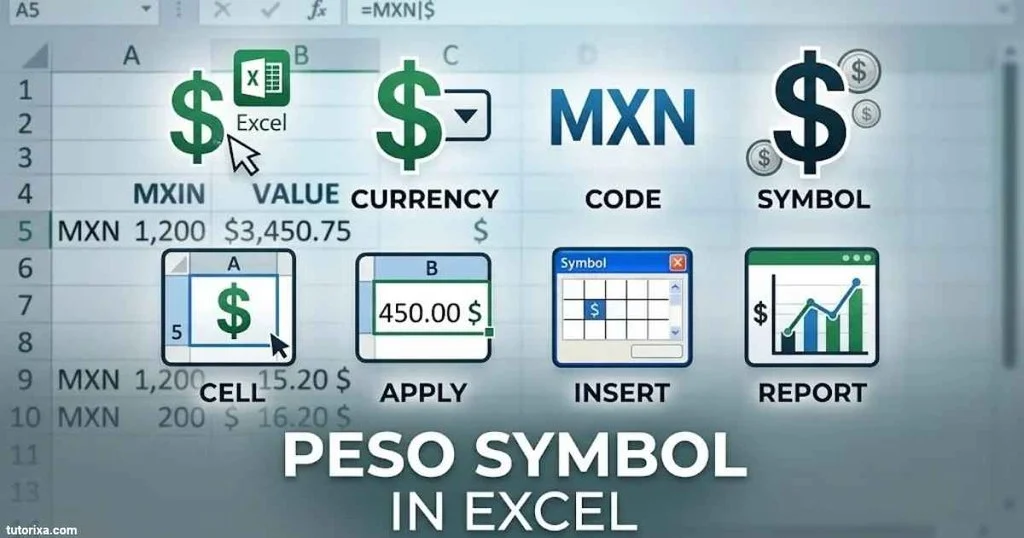
You can use the Mexican peso symbol ($) in Microsoft Excel to display financial amounts. This is useful for budgets, invoices, expense reports, business accounts, and currency-conversion worksheets.
However, simply typing $ into a cell does not automatically identify the amount as Mexican pesos. You should select an appropriate currency format or create a custom format.
Method 1: Insert The Mexican Peso Symbol Manually
The easiest method is to type the symbol directly into a cell.
- Open your Excel worksheet.
- Select the cell where you want the amount.
- Type the dollar sign ($).
- Enter your amount after the symbol.
- Press Enter.
Example:
- $100
- $250
- $500
- $1,000
This method is useful for simple lists and manually prepared documents.
Method 2: Apply Currency Formatting
You can also use Excel’s built-in currency formatting options.
Follow these steps:
- Select the cells containing your monetary values.
- Open the Home tab.
- Find the Number group.
- Open the number-format options.
- Select Currency or Accounting.
- Open the symbol selection menu.
- Choose the appropriate Mexican peso currency option if available in your regional settings.
- Click OK.
Excel lets you select a currency symbol and adjust decimal places through the Format Cells dialog box.
Microsoft Support
Method 3: Use A Custom Currency Format
If Excel does not display the exact format you want, you can create a custom number format.
For example, use:
“MXN $”#,##0.00
This displays numbers like:
- MXN $100.00
- MXN $250.50
- MXN $1,000.00
You can also use:
“$”#,##0.00
This displays the regular dollar sign before the amount.
To apply a custom format:
- Select your cells.
- Press Ctrl + 1.
- Select Custom.
- Enter your preferred format.
- Click OK.
Important: Currency formatting changes how a number appears. It does not convert US dollars into Mexican pesos. You must perform the currency conversion separately.
Frequently Asked Questions
What Is The Symbol For The Mexican Peso?
The symbol for the Mexican peso is $. It is commonly placed before a numerical amount, such as $100 or $500. The MXN currency code can be added to distinguish it from other dollar-based currencies.
Is The Mexican Peso Symbol The Same As The Dollar Sign?
Yes. The Mexican peso uses the same $ symbol as the US dollar. However, the currencies are different. MXN represents Mexican pesos, while USD represents US dollars.
What Is The Mexican Peso Unicode?
The Mexican peso does not have a separate dedicated Unicode currency character. Its commonly used symbol is the dollar sign ($), which has the Unicode code point U+0024 and the official Unicode name DOLLAR SIGN.
What Does N$ Mean In Mexican Currency?
N$ means Nuevo Peso or New Peso. Mexico introduced this monetary unit in 1993 after removing three zeros from the previous currency. It was a historical notation and is no longer the standard currency symbol.
How Do You Type The Mexican Peso Symbol On A Keyboard?
You can type the Mexican peso symbol by pressing the dollar sign key, usually Shift + 4 on a US keyboard layout. You can also copy and paste $ directly into your document.
Conclusion
The Mexican peso symbol ($) is the standard sign used to represent Mexico’s currency. Its international currency code is MXN, which helps distinguish it from the US dollar and other currencies that share the same symbol.
Understanding the differences between Mexican peso notes, coins, historical N$ notation, and the modern currency code makes it easier to work with Mexican financial information. You can also use the dollar sign in documents, websites, messages, and Excel spreadsheets.
For everyday writing, $ is usually enough when the Mexican currency is clear from the context. For international transactions, financial reports, and currency conversions, use MXN to avoid confusion. You can copy the symbol from this guide whenever you need it.

I’m Freddie Beaumont, a British author with a passion for discovering what symbols communicate without words. I write about their history, meanings, and everyday uses in an accessible way. I believe symbols tell fascinating stories about people, cultures, and ideas, and my work helps readers recognise and understand those stories more clearly.
Books:
- Symbols and Their Hidden Meanings
- Understanding Signs and Symbols
 Rowan Whitaker
 Ellis Montgomery