
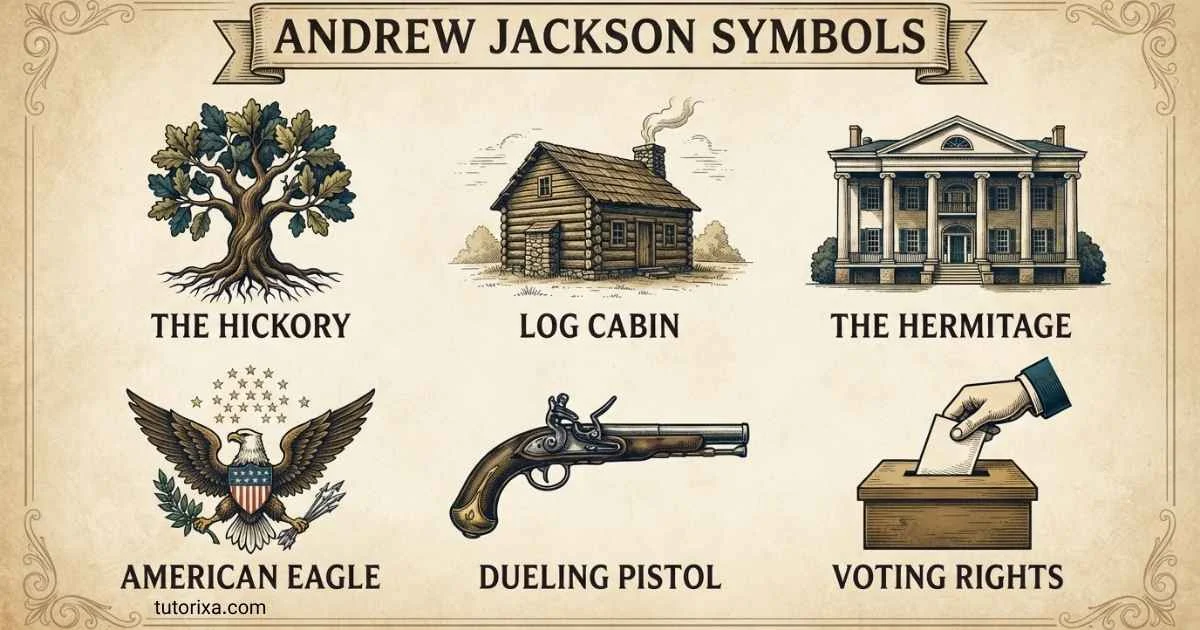
I’ve always found historical symbols fascinating because they can reveal stories that words alone cannot explain. Andrew Jackson symbols can connect his presidency, military career, personal identity, and the complicated history surrounding his legacy.
When you explore these symbols, you can see how history, culture, and political memory shape the way a person is remembered. I’ll help you understand what these symbols mean and why they became associated with Andrew Jackson.
You don’t need to be a history expert to explore them. By the end, you’ll have a clearer picture of the important symbols linked to Jackson and the historical context behind them.
Quick Meaning
Andrew Jackson symbols are historical images, objects, nicknames, and visual motifs connected with Andrew Jackson and his political era. The best-known is the hickory tree, representing the toughness associated with his nickname “Old Hickory.” His portrait on the $20 note is another familiar modern symbol, while campaign tickets, military imagery, political cartoons, and references to the Bank War and Indian Removal reflect different aspects of his complicated legacy.
Andrew Jackson Symbols Overview
| Symbol | Primary Meaning | Category | Historical Connection | Common Modern Context |
| Hickory tree | Toughness and endurance | Political symbol | “Old Hickory” nickname | Historical references, campaign history |
| “Old Hickory” | Jackson’s toughness | Nickname | Military career | Biographies and museums |
| $20 bill portrait | Jackson’s historical identity | Currency | U.S. currency | Money and collecting |
| Military portrait | Military reputation | Historical imagery | Battle of New Orleans and War of 1812 | Art and history |
| Hickory pole | Jacksonian political support | Campaign symbol | 1820s elections | Political history |
| Campaign ticket | Electoral identity | Political artifact | 1828 election | Museums and archives |
| Donkey/jackass imagery | Political satire | Cartoon symbol | Jackson’s opponents | Political-cartoon history |
| “King Andrew” imagery | Criticism of presidential power | Political satire | Jackson presidency | Historical political commentary |
| Bank imagery | Economic controversy | Political symbolism | Bank War | History of U.S. finance |
| The Hermitage | Personal and historical association | Place symbol | Jackson’s Tennessee home | Historic-site interpretation |
What Do Andrew Jackson Symbols Mean?
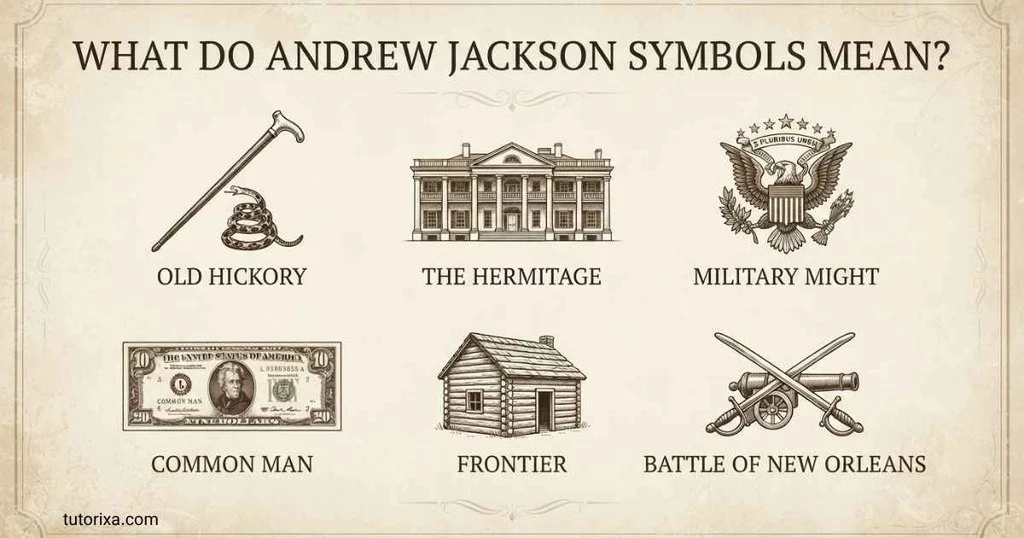
Andrew Jackson symbols primarily represent strength, military success, popular political appeal, presidential authority, and controversy. No single symbol captures Jackson completely because different communities portrayed him in very different ways.
The most famous positive symbol is the hickory tree. Jackson received the nickname “Old Hickory” because soldiers associated his toughness and endurance with the durable hickory tree. The nickname became a powerful political image during his campaigns. The Library of Congress preserves an 1828 Jackson election ticket featuring a hickory tree and the phrase “rallying round our Hickory tree.”
Other symbols communicate different ideas. Jackson’s portrait on U.S. currency connects him to the history of the American presidency, while political cartoons from his lifetime used exaggerated images to criticize his policies.
This distinction matters. A symbol showing Jackson as a strong leader may reflect the perspective of his supporters, whereas an image depicting him as “King Andrew” reflects opposition to what critics considered excessive presidential power. The same historical figure could therefore be represented through completely different visual languages.
History and Origin of Andrew Jackson Symbols
The Rise of “Old Hickory”
The roots of Jackson’s most recognizable symbol come from his military career.
During the War of 1812 era, Jackson became known for his toughness and determination. His troops compared him to hickory, a tree known for its hard wood, and the nickname “Old Hickory” became attached to him. Andrew Jackson’s Hermitage identifies the comparison with his military reputation and describes how his troops associated his toughness with a hickory tree.
The nickname eventually moved beyond military life. During Jackson’s presidential campaigns, hickory became a political emblem.
The Library of Congress records an 1828 election ticket featuring a hickory tree. Other Jackson-related materials include campaign songs and political prints centered on the same imagery.
Hickory Poles and Political Campaigning
The hickory symbol became especially important during the highly competitive presidential campaigns of the 1820s.
Jackson supporters used hickory poles, trees, songs, banners, and printed materials to create a recognizable political identity. The Library of Congress notes that the hickory pole became a dominant symbol of the grassroots campaign of 1827–1828.
This was significant because political campaigning was becoming more accessible to ordinary voters. Symbols helped people recognize candidates even when campaign information was distributed through small printed tickets, parades, public gatherings, and songs.
Military Imagery
Jackson’s reputation was also tied to the Battle of New Orleans, fought in January 1815 during the War of 1812.
His victory helped transform him into a national military hero. Later campaign materials used portraits and references to New Orleans to strengthen this public image. One 1828 campaign print held by the Library of Congress places Jackson’s portrait within an oval and describes him in connection with his victory at New Orleans.
Military imagery therefore became another symbolic shorthand for Jackson: a determined commander who had become a national political figure.
Symbolism and Interpretation
The Hickory Tree: Strength and Endurance
The hickory tree is the clearest symbol associated with Jackson.
Its meaning developed from his military nickname rather than from an ancient religious or mythological tradition. In Jackson’s political culture, the hickory represented toughness, resilience, firmness, and loyalty.
Supporters could use the tree as a positive metaphor for a leader who would stand firm under pressure. Opponents could also reuse the same symbol in satire, demonstrating how political symbols can change meaning depending on context.
“Old Hickory”: A Personal Symbol
“Old Hickory” functioned almost like a brand for Jackson during his political career.
It connected the private individual to a larger public character: tough, persistent, and difficult to intimidate. The phrase appeared in campaign songs, printed materials, political cartoons, and later historical writing.
The $20 Bill: Historical Recognition
Jackson’s portrait has appeared on U.S. paper currency for generations, and he remains the portrait on the $20 Federal Reserve Note listed by the Bureau of Engraving and Printing. The current $20 note has been issued in its present denomination design since 2003, and the U.S. Currency Education Program identifies Andrew Jackson as the portrait on the front.
This makes the portrait one of the most familiar modern visual representations of Jackson.
However, it is important not to confuse being depicted on currency with approval of every part of a historical figure’s record. Currency portraits are historical representations, not necessarily statements endorsing a person’s entire legacy.
Political Satire and “King Andrew”
Jackson’s opponents created symbols intended to criticize him.
One famous theme portrayed him as “King Andrew,” suggesting that his use of presidential authority had become excessive. Political cartoonists used crowns, royal imagery, and other visual devices to attack his approach to presidential power.
This is an important lesson in interpreting Andrew Jackson symbols: a symbol’s meaning depends on its creator and audience.
Cultural Significance of Andrew Jackson Symbols
Andrew Jackson symbols have significance in several areas of American culture.
American Political Culture
Jackson’s campaigns helped change American political communication. Political tickets, slogans, songs, public gatherings, and visual symbols became increasingly important.
The Library of Congress collection of 1828 election materials includes campaign tickets containing portraits, hickory imagery, agricultural themes, and other political messages.
Military Culture
The “Old Hickory” image grew from Jackson’s relationship with soldiers and his military reputation.
His leadership during the War of 1812, particularly at New Orleans, became central to his public identity. His military symbolism later supported his presidential image.
Popular Political Identity
Jackson’s political movement helped establish a new style of mass political participation among white male voters.
The Jacksonian political coalition eventually developed into the Democratic Party. The Library of Congress notes that the Jackson party emerged in the 1820s and became known as Democrats.
At the same time, the expansion of political participation was highly limited by modern standards. Jacksonian democracy did not extend equal political rights to everyone, and slavery and the displacement of Native Americans remained central realities of the period.
Religious or Spiritual Meaning
Andrew Jackson symbols do not have a recognized religious or sacred meaning comparable to established religious symbols such as the cross, Star of David, dharma wheel, or crescent.
The hickory tree was primarily a political and military metaphor. Its importance came from Jackson’s nickname and political campaigns rather than from Christian, Indigenous, or other religious traditions.
It is therefore misleading to describe the hickory tree associated with Jackson as an ancient spiritual symbol created specifically for him. Its Jacksonian meaning developed in nineteenth-century American political culture.
Where Andrew Jackson Symbols Are Used
Andrew Jackson symbols can appear in several historical and educational contexts.
Currency
Jackson’s portrait appears on the U.S. $20 note. The note also includes modern anti-counterfeiting features such as a security thread, watermark, and color-shifting ink.
Museums and Historic Sites
The Hermitage in Tennessee is closely associated with Jackson and his family history. Objects, documents, portraits, and historical interpretation at the site help explain how Jackson was represented during his lifetime and afterward.
Books and Literature
Historical biographies and textbooks frequently use Jackson’s portrait, “Old Hickory” nickname, and references to the Battle of New Orleans as recognizable identifiers.
Political Cartoons
Nineteenth-century political cartoons provide some of the richest evidence for how Jackson symbols worked.
Cartoonists could transform Jackson into different visual characters depending on their political purpose. The Library of Congress collection includes cartoons depicting him in relation to the Bank War, treasury policy, elections, and other controversies.
Campaign Material
Jackson campaign tickets used hickory trees, portraits, slogans, flags, and other imagery. These artifacts demonstrate that political symbolism surrounding Jackson was already sophisticated during his own lifetime.
Important Historical Context: Removal and Native American Symbolism
Any serious discussion of Andrew Jackson symbols must include the Indian Removal Act of 1830 and its consequences.
Jackson signed the Indian Removal Act on May 28, 1830. The law authorized the federal government to negotiate removal treaties with Native nations and exchange lands east of the Mississippi for territory farther west.
The policy contributed to the forced removal of the Cherokee, Choctaw, Chickasaw, Muscogee (Creek), and Seminole peoples from their southeastern homelands. The National Park Service describes the Trail of Tears as the forced westward migration associated with these policies, with the Cherokee removal taking place particularly in 1838–1839.
This history changes how Jackson’s symbols can be interpreted today.
For some historical accounts, the hickory represents strength and political determination. But Jackson’s policies toward Native nations are also part of the historical record and are remembered through the suffering, displacement, and resilience of Indigenous communities.
The symbolic meaning of Jackson therefore cannot be reduced to heroic imagery alone. His legacy contains both celebrated achievements and deeply damaging policies.
Common Variations of Andrew Jackson Symbols
Hickory Tree
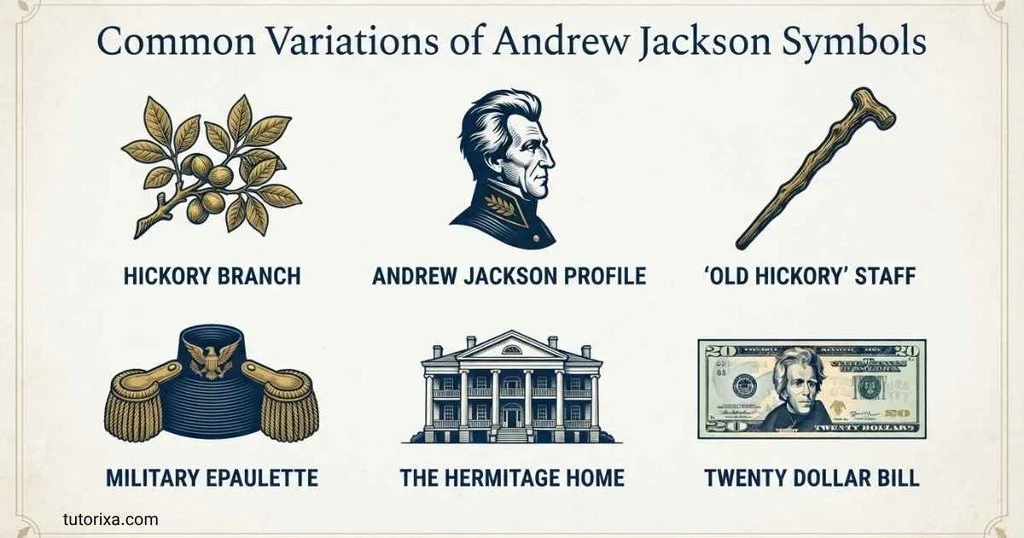
A hickory symbol may appear as:
- A complete tree
- A single hickory branch
- A hickory leaf
- A hickory pole
- A tree with political slogans
- A stylized campaign emblem
The meaning usually depends on whether the image represents Jackson himself, his supporters, or later historical interpretation.
Portraits
Jackson has been represented in:
- Formal presidential portraits
- Military portraits
- Campaign prints
- Currency engravings
- Political cartoons
- Sculptures
- Historical illustrations
Each format can emphasize a different part of his identity.
Satirical Symbols
Political opponents sometimes transformed Jackson into exaggerated characters or placed him alongside animals, crowns, banks, trees, and other objects.
For example, a Library of Congress political cartoon depicts Jackson as a jackass while criticizing his treasury policy. This is political satire, not evidence that the donkey was an official personal symbol adopted by Jackson.
That distinction is especially important because modern readers sometimes incorrectly assume that every recurring image in a political cartoon was an official emblem.
Common Misconceptions About Andrew Jackson Symbols
1. The hickory tree was an ancient Jackson family symbol
There is no need to invoke ancient symbolism to explain it. Its Jacksonian significance came primarily from the nickname “Old Hickory” and its use in nineteenth-century political campaigning.
2. The donkey was Andrew Jackson’s official symbol
This is misleading.
Jackson was sometimes portrayed as a jackass by political opponents. The Library of Congress documents such imagery in a political cartoon attacking Jackson’s financial policies. The donkey later became strongly associated with the Democratic Party, but that broader development should not be retroactively treated as Jackson’s official personal emblem.
3. “Old Hickory” was simply a nickname with no political meaning
The nickname became much more than a personal label. Campaigners turned it into a political symbol through hickory poles, trees, songs, tickets, and slogans.
4. The $20 portrait means Jackson endorsed paper currency
This is historically problematic. Jackson strongly distrusted paper money and opposed the Second Bank of the United States. His later appearance on currency creates an often-noted historical irony.
5. Andrew Jackson symbols have only positive meanings
They do not.
Some symbols celebrate his military reputation and political popularity, while others criticize his policies, presidential authority, economic decisions, or treatment of Native peoples.
10 Interesting Facts About Andrew Jackson Symbols
1. The hickory tree became a campaign image
An 1828 Jackson election ticket actually features a hickory tree, showing that the metaphor had moved directly into campaign material.
2. “Old Hickory” began as a military comparison
Jackson’s troops associated his toughness with hickory, helping establish the nickname that later became politically powerful.
3. Jackson’s campaign used physical hickory poles
The hickory pole became a recognizable feature of Jackson’s grassroots political campaign during the 1820s.
4. Jackson’s portrait has a long currency history
The $20 denomination is not the only historical currency connection. Jackson appeared on earlier forms of U.S. paper currency as well.
5. His currency portrait creates a historical irony
Jackson opposed paper money and attacked the national bank, yet his face appears on one of America’s most familiar paper notes.
6. Political opponents reused his symbols
The hickory tree could appear in critical cartoons as well as supportive campaign material, demonstrating that symbols can be politically contested.
7. Jackson’s political image extended beyond portraits
Songs, election tickets, banners, trees, poles, cartoons, and slogans all helped create a recognizable Jacksonian political identity.
8. His military victory shaped his political symbolism
The Battle of New Orleans became a central element of Jackson’s national reputation and appeared in campaign imagery.
9. “King Andrew” was an anti-Jackson symbol
Opponents used royal imagery to criticize what they saw as excessive presidential power.
10. Jackson’s symbolic legacy is deeply contested
His image cannot be separated from Indian Removal and the displacement of Native nations. The National Park Service identifies Jackson’s administration as an important part of the historical context of the Trail of Tears.
Related Symbols
Several symbols and concepts are closely connected to Andrew Jackson.
Old Hickory
“Old Hickory” is the verbal counterpart to the hickory tree. Both refer to Jackson’s reputation for toughness.
Hickory Pole
The hickory pole was a campaign object and public political symbol during the Jackson era.
Battle of New Orleans
Although not technically a symbol, New Orleans became a powerful shorthand for Jackson’s military fame and national reputation.
The $20 Bill
Jackson’s portrait on U.S. currency is his most recognizable modern government-issued image.
The Hermitage
The Hermitage in Tennessee is a physical place strongly connected with Jackson’s life, family, plantation, and historical memory.
Political Cartoonry
Political cartoons provide another symbolic language through which nineteenth-century Americans debated Jackson’s presidency.
The Democratic Party
Jackson’s political movement became closely associated with the development of the modern Democratic Party, although the party has changed substantially over nearly two centuries.
Frequently Asked Questions
What is the main symbol of Andrew Jackson?
The hickory tree is the strongest traditional symbol associated with Andrew Jackson. It developed from his nickname, “Old Hickory,” which reflected the toughness attributed to him by his soldiers. During his presidential campaigns, supporters turned hickory trees and poles into recognizable political symbols. The Library of Congress preserves Jackson campaign material featuring a hickory tree.
Why is Andrew Jackson associated with a hickory tree?
Andrew Jackson became known as “Old Hickory” because soldiers compared his toughness to hickory wood. The nickname eventually became a political identity. Jackson supporters used hickory poles, trees, campaign tickets, songs, and slogans during the presidential campaigns of the 1820s. The tree therefore symbolizes the public image of Jackson as resilient and determined.
What does the $20 bill symbolize in relation to Andrew Jackson?
The $20 bill represents Jackson’s continuing place in American historical memory and currency design. The Bureau of Engraving and Printing identifies Andrew Jackson as the portrait on the $20 note. His appearance on paper currency is historically ironic because Jackson strongly opposed paper money and fought the Second Bank of the United States.
Was the donkey an Andrew Jackson symbol?
The donkey appeared in political satire directed at Jackson, but it was not simply an official Andrew Jackson emblem. A Library of Congress cartoon, for example, portrays Jackson as a jackass while attacking his treasury policies. The broader donkey association with the Democratic Party developed over time and should not be treated as identical to Jackson’s personal symbolism.
What does “Old Hickory” mean?
“Old Hickory” was Andrew Jackson’s famous nickname. It referred to his reputation for toughness and endurance, especially among soldiers who served with him. The nickname later became an important political symbol and was incorporated into campaign songs, election tickets, and hickory imagery supporting Jackson’s presidential campaigns.
Why is Andrew Jackson represented as “King Andrew”?
“King Andrew” was an expression used by political opponents who criticized Jackson’s exercise of presidential power. Political cartoonists used royal imagery to suggest that Jackson was acting too much like a monarch. The symbol therefore represents criticism of executive authority rather than a title Jackson officially adopted.
What symbol represents Andrew Jackson’s military career?
Military portraits, references to the Battle of New Orleans, and the “Old Hickory” nickname are among the strongest symbols of Jackson’s military career. His victory at New Orleans became a major part of his national reputation and was incorporated into campaign imagery during his presidential rise.
Are Andrew Jackson symbols still used today?
Yes. Jackson’s portrait remains on the U.S. $20 note, while the hickory tree and “Old Hickory” continue to appear in historical writing, museum exhibits, educational material, and discussions of nineteenth-century American politics. His symbols are also used when discussing the Bank War, presidential power, and Native American removal.
Why are Andrew Jackson symbols controversial?
They are controversial because Jackson’s public legacy contains sharply contrasting historical dimensions. He was celebrated by supporters for military achievements and political leadership, while his policies toward Native nations contributed to forced removal and displacement. His presidency also generated intense arguments over banking and executive authority.
Is the hickory tree a religious symbol of Andrew Jackson?
No. The hickory tree’s connection to Jackson is primarily political and military. It grew from his “Old Hickory” nickname and became campaign imagery in the 1820s. There is no established religious tradition in which the Jackson-associated hickory tree functions as a sacred symbol.
Key Takeaways
- The hickory tree is the best-known traditional Andrew Jackson symbol.
- “Old Hickory” refers to Jackson’s reputation for toughness and endurance.
- Hickory imagery became especially important during Jackson’s political campaigns.
- The $20 bill portrait is Jackson’s most familiar modern official image.
- Military imagery reflects Jackson’s fame after the Battle of New Orleans.
- Political cartoons used symbols to both praise and attack Jackson.
- “King Andrew” represented criticism of Jackson’s presidential power.
- The donkey appeared in anti-Jackson satire but was not simply his official symbol.
- The Bank War generated a large body of Jackson-related political imagery.
- Indian Removal is essential to understanding the full historical context of Jackson’s legacy.
- Symbols associated with Jackson can have very different meanings depending on their creator, audience, and historical period.
Conclusion
Andrew Jackson symbols tell the story of how a nineteenth-century American military hero became a powerful and controversial political figure. The hickory tree remains the clearest symbol of his “Old Hickory” identity, while the $20 bill portrait connects Jackson to modern American currency. Campaign tickets, military imagery, political cartoons, and “King Andrew” representations reveal how supporters and opponents constructed competing versions of his public image.
The most useful way to understand these symbols is to place them in their historical context. Jackson’s political movement expanded participation for many white male voters while excluding others, and his administration pursued policies that resulted in the forced removal of Native peoples. The symbolism surrounding him therefore reflects both the political achievements celebrated by his supporters and the serious consequences emphasized by later historical interpretation.
Ultimately, Andrew Jackson symbols are not simply decorative images. They are pieces of historical evidence showing how Americans represented leadership, military power, democracy, economic conflict, presidential authority, and national identity during and after the Jacksonian era.

I’m Rowan Whitaker, a British writer fascinated by the symbols surrounding us every day. I explore their meanings, origins, cultural significance, and changing interpretations. From ancient marks to modern signs, I enjoy making symbolism easier to understand. My writing helps curious readers discover the hidden messages behind familiar shapes, images, and signs.
Books:
- The Meaning Behind Symbols
- A Modern Guide to Symbolism
 Ellis Montgomery