
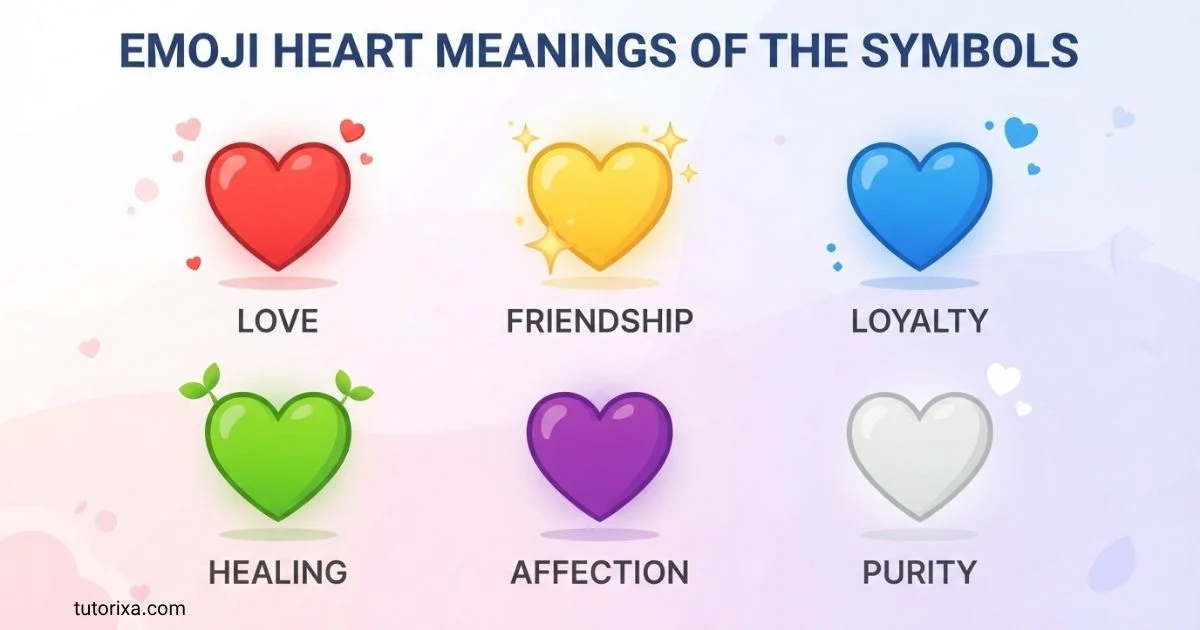
Heart emojis are among the most recognizable symbols in digital communication, but their meanings go far beyond love and romance. The emoji heart meanings of the symbols can express friendship, affection, gratitude, passion, sadness, support, humor, and emotional connection. Each color and design adds a different tone to a message, depending on the conversation and relationship.
From the classic red heart ❤️ to the peaceful white heart 🤍, the playful pink heart 🩷, and the mysterious black heart 🖤, these symbols help people communicate feelings that words sometimes struggle to express. You can find them in text messages, social media comments, dating conversations, birthday wishes, online communities, and everyday chats.
Understanding what each heart emoji commonly represents can help you choose the right symbol, interpret messages more thoughtfully, and avoid misunderstandings. However, context matters: the same heart can communicate different things depending on who sends it and why.
Quick Meaning of Heart Emojis
Heart emojis represent emotions and relationships, including romantic love, friendship, kindness, appreciation, loyalty, and emotional support. Different colors often suggest different feelings: red commonly expresses love, yellow represents friendship and happiness, blue can suggest trust, and black may convey dark humor or grief. Their precise meaning depends on context, culture, and personal communication style.
Heart Emoji Symbols: Overview Table
Heart emojis belong to the Unicode emoji collection, which allows people to use standardized characters across digital platforms. Their appearance can vary slightly between Apple, Google, Microsoft, Samsung, and other systems.
| Heart Symbol | Common Meaning | Typical Category | Unicode Code Point |
| ❤️ Red Heart | Love, romance, affection | Romantic and general love | U+2764 U+FE0F |
| 🩷 Pink Heart | Tenderness, affection, sweetness | Warm emotional connection | U+1FA77 |
| 🧡 Orange Heart | Care, encouragement, warmth | Friendship and support | U+1F9E1 |
| 💛 Yellow Heart | Happiness, friendship, positivity | Platonic affection | U+1F49B |
| 💚 Green Heart | Nature, growth, health, support | Environmental and personal symbolism | U+1F49A |
| 💙 Blue Heart | Trust, loyalty, calmness | Friendship and solidarity | U+1F499 |
| 🩵 Light Blue Heart | Gentleness, peace, tenderness | Calm emotional expression | U+1FA75 |
| 💜 Purple Heart | Compassion, admiration, creativity | Affection and appreciation | U+1F49C |
| 🤎 Brown Heart | Earthiness, warmth, solidarity | Nature and cultural expression | U+1F90E |
| 🖤 Black Heart | Dark humor, grief, edgy affection | Complex or ironic emotions | U+1F5A4 |
| 🩶 Grey Heart | Neutrality, subtle affection, balance | Understated emotion | U+1FA76 |
| 🤍 White Heart | Purity, peace, remembrance | Gentle affection and sympathy | U+1F90D |
| 💔 Broken Heart | Heartbreak, loss, disappointment | Emotional pain | U+1F494 |
| ❤️🔥 Heart on Fire | Intense passion, excitement | Strong emotional intensity | U+2764 U+FE0F U+200D U+1F525 |
| ❤️🩹 Mending Heart | Healing, recovery, reconciliation | Emotional support | U+2764 U+FE0F U+200D U+1FA79 |
| 💕 Two Hearts | Mutual affection, closeness | Love and friendship | U+1F495 |
| 💞 Revolving Hearts | Shared affection, emotional exchange | Mutual connection | U+1F49E |
| 💓 Beating Heart | Excitement, affection, emotional intensity | Strong feelings | U+1F493 |
| 💗 Growing Heart | Increasing affection, developing love | Growing connection | U+1F497 |
| 💖 Sparkling Heart | Joyful love, admiration, excitement | Celebration and affection | U+1F496 |
| 💘 Heart with Arrow | Falling in love, romantic attraction | Romance | U+1F498 |
| 💝 Heart with Ribbon | A gift of love, appreciation | Gifts and special occasions | U+1F49D |
| ❣️ Heart Exclamation | Emphasis, enthusiasm, affection | Expressive communication | U+2763 U+FE0F |
| 💟 Heart Decoration | Decorative affection, warmth | Visual expression | U+1F49F |
| 💌 Love Letter | Romantic communication, affectionate messages | Written expressions of love | U+1F48C |
| 💑 Couple with Heart | Partnership, romantic connection | Relationships | U+1F491 |
| 💏 Kiss | Affection, kissing, romantic intimacy | Romantic relationships | U+1F48F |
These meanings are common interpretations rather than fixed definitions. A person might use a blue heart to represent a favorite sports team, a green heart to celebrate an environmental cause, or a black heart simply because they like its appearance.
What Do Heart Emoji Symbols Mean?
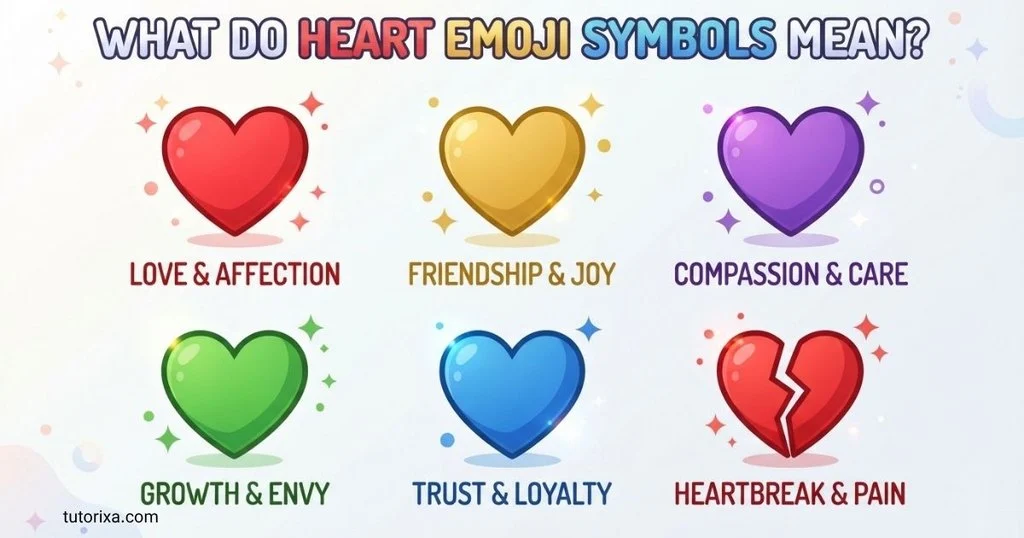
Heart emojis communicate feelings through color, shape, movement, and accompanying imagery. Although the traditional heart shape is associated with love, digital communication has expanded its meaning to include friendship, identity, emotional healing, humor, and community support.
1. Red Heart ❤️: Love and Deep Affection
The red heart is the most widely recognized digital symbol of love. It commonly expresses romantic affection, strong appreciation, emotional closeness, and sincere care.
Examples include:
- “I love you ❤️”
- “Thank you for always being there ❤️”
- “Happy anniversary to my favorite person ❤️”
A red heart can be romantic between partners, affectionate between family members, or friendly between close friends. It does not automatically indicate romantic interest.
2. Pink Heart 🩷: Sweetness and Tender Affection
The pink heart often communicates gentle love, kindness, tenderness, and playful affection. Its softer appearance can make it feel less intense than a red heart in some conversations.
People may use it when congratulating friends, expressing appreciation, celebrating relationships, or sending a warm message.
For example, “You made my day 🩷” communicates appreciation in a friendly, affectionate tone.
3. Orange Heart 🧡: Warmth and Encouragement
The orange heart frequently represents care, positivity, encouragement, and friendly affection. Some people use it when they want to express warmth without suggesting a romantic relationship.
It can also represent the color orange itself, autumn, sports teams, creative projects, or awareness campaigns.
For example, “You’ve got this! 🧡” combines encouragement with a supportive emotional tone.
4. Yellow Heart 💛: Friendship and Happiness
The yellow heart is often associated with cheerful friendship, optimism, happiness, and positive energy. It can communicate affection without the romantic associations that a red heart sometimes carries.
Friends might use it in birthday messages, group chats, celebratory posts, and expressions of gratitude.
For example, “So lucky to have you as a friend 💛” emphasizes appreciation and companionship.
5. Green Heart 💚: Nature, Growth, and Support
The green heart has several common interpretations, including nature, environmental awareness, renewal, balance, and personal growth.
It may appear in messages about plants, gardening, sustainability, healthy habits, or environmental causes. Some communities also use it to show solidarity or support.
In certain contexts, green can suggest envy or jealousy, but a green heart does not automatically communicate those feelings.
6. Blue Heart 💙: Trust and Loyalty
The blue heart often represents trust, stability, loyalty, calmness, and dependable friendship. People also use it to show support for a sports team, organization, cause, or community associated with blue.
For example, “Always here for you 💙” can express steady emotional support.
Its meaning depends on the relationship and conversation. It is not necessarily less affectionate than a red heart.
7. Light Blue Heart 🩵: Peace and Gentle Care
The light blue heart can communicate calmness, softness, serenity, and gentle affection. Its lighter shade gives it a different visual tone from the deeper blue heart.
People may use it in peaceful greetings, supportive messages, aesthetic posts, and conversations about the sky, water, or favorite colors.
The distinction between blue and light blue is subjective rather than an official emotional classification.
8. Purple Heart 💜: Admiration and Compassion
The purple heart commonly expresses affection, admiration, compassion, and appreciation. It may also reflect creativity, individuality, spirituality, or a favorite color.
In some online communities, purple hearts have specific associations with entertainers, fandoms, or group identities.
The symbol can be romantic, friendly, or supportive depending on the message surrounding it.
9. Brown Heart 🤎: Warmth and Earthiness
The brown heart is often associated with nature, warmth, stability, and earthy aesthetics. It appears in messages about coffee, chocolate, autumn, natural materials, and outdoor activities.
It can also be used in conversations about racial identity, cultural representation, and solidarity. These interpretations depend on the context and the people involved.
10. Black Heart 🖤: Dark Humor and Complex Emotions
The black heart may communicate dark humor, irony, grief, sadness, emotional complexity, or unconventional affection.
For example, “That joke was terrible 🖤” might communicate playful sarcasm, while a black heart accompanying a memorial message may express mourning.
Some people choose it simply because they like monochrome designs, gothic fashion, or a minimalist aesthetic.
11. White Heart 🤍: Peace and Sincere Affection
The white heart commonly represents purity, peace, kindness, gentle affection, and remembrance. It may appear in wedding messages, sympathy notes, spiritual discussions, or minimalist social media captions.
For example, “Sending you peace and strength 🤍” expresses support in a calm, understated way.
Its meaning can vary considerably across cultural, religious, and personal settings.
12. Grey Heart 🩶: Neutrality and Understated Emotion
The grey heart can suggest neutrality, subtle affection, balance, or a restrained emotional tone. It may also be used for monochrome aesthetics or to match a particular color scheme.
Unlike the red heart’s strong conventional association with love, the grey heart has a less established emotional meaning. Its interpretation often comes from the surrounding message.
History and Origin of Heart Symbols
The heart symbol developed over centuries through art, literature, religious imagery, decorative design, and changing ideas about human emotion. Although modern heart emojis are digital characters, the familiar heart shape existed long before smartphones, messaging apps, and social media.
The Ancient History of the Heart Shape
Ancient civilizations understood the physical heart as an important organ, but they did not all use the modern heart outline to represent romantic love. In ancient Egyptian traditions, the heart held an important place in ideas about thought, character, morality, and the afterlife.
Ancient Greek and Roman writers also connected the heart with emotion, courage, and human experience. Over time, artistic traditions helped establish visual associations between the heart and personal feelings.
The precise origin of the familiar heart-shaped icon remains uncertain. Several historical theories connect its outline to stylized leaves, plant seeds, anatomical interpretations, or decorative motifs, but no single explanation accounts for every stage of its development.
Medieval Art and Romantic Love
During the European Middle Ages, heart imagery became increasingly visible in manuscripts, religious art, and representations of courtly love. Artists used heart-shaped forms to symbolize devotion, affection, and spiritual commitment.
By the late medieval period, recognizable heart-shaped designs appeared in visual representations of love and emotional exchange. The symbol gradually became more closely associated with romantic relationships, particularly as love poetry and courtship traditions developed.
The Development of Modern Heart Imagery
Printing, greeting cards, Valentine’s Day traditions, commercial illustrations, and popular culture helped spread the heart symbol widely. Its simple outline made it easy to reproduce on cards, jewelry, clothing, decorations, and advertising.
Digital communication introduced another important change: the heart became something people could send instantly in a conversation. Instead of writing a long expression of affection, users could select a small symbol that communicated warmth or appreciation.
How Heart Emojis Became Digital Symbols
Emoji systems developed from earlier digital emoticons and pictographic communication. The red heart was included in Unicode’s emoji repertoire, helping standardize its use across different computer systems and mobile devices.
The Unicode Standard now includes numerous heart-related characters, including colored hearts, broken hearts, decorative hearts, and hearts combined with other symbols. The Unicode Consortium standardizes character encoding and names; it does not establish one universal emotional interpretation for each heart color.
Symbolism and Interpretation of Heart Emojis
Heart emojis represent a broad range of emotions, and their interpretations depend on color, design, context, and personal experience. Their symbolism is flexible rather than universal.
Traditional Meanings
The traditional heart shape is strongly associated with love, affection, emotional attachment, compassion, and devotion. In religious and artistic contexts, it can also symbolize sacrifice, spiritual commitment, kindness, and the inner life.
Red became especially associated with romantic love and passion, while white often appears in contexts involving peace, sincerity, or purity. These associations come from overlapping cultural traditions rather than a single official system.
Positive Symbolism
Heart emojis can communicate positive feelings quickly and naturally. Common positive interpretations include:
- Love: Romantic attachment or deep affection.
- Friendship: Appreciation, companionship, and trust.
- Kindness: Warmth, generosity, and compassion.
- Encouragement: Emotional support during a difficult time.
- Gratitude: Appreciation for a thoughtful action.
- Celebration: Happiness about an achievement or special event.
- Connection: A sense of belonging to a family, friendship group, or community.
Negative or Complex Symbolism
Not every heart emoji expresses happiness. A broken heart can represent disappointment, grief, separation, or emotional pain. A black heart may convey dark humor, irony, or mourning. A grey heart can communicate emotional distance or a deliberately neutral tone.
These meanings are not fixed. A person may use a black heart affectionately, while another may use the same symbol to express sadness. The surrounding words and relationship usually provide more information than the color alone.
Psychological Interpretation of Heart Emojis
Heart emojis can make written messages feel warmer because they add an emotional cue to text that otherwise lacks facial expressions, vocal tone, and body language.
For example, “Thanks” can sound neutral, while “Thanks ❤️” may feel more affectionate. However, that difference depends on the sender’s habits and the recipient’s expectations.
It is important not to treat emoji use as a reliable psychological test. Sending a particular color does not reveal someone’s personality, romantic intentions, emotional health, or level of commitment. Emojis provide clues about communication, not definitive evidence about a person’s feelings.
Cultural Significance of Heart Emojis
Heart emojis appear across countries and languages, but their meanings can vary according to local customs, online communities, relationships, and social expectations.
Western Cultural Contexts
In many English-speaking communities, the red heart is strongly associated with romance, affection, and Valentine’s Day. Yellow hearts often appear in friendly conversations, while pink hearts may communicate sweetness or gentle affection.
These conventions are common, but individual preferences can differ substantially. Some people use red hearts with nearly everyone, while others reserve them for close relationships.
South Asian Cultural Contexts
In South Asian digital communication, heart emojis commonly appear in family chats, friendships, romantic messages, celebrations, and expressions of gratitude. People may combine hearts with Urdu, Hindi, Punjabi, Bengali, and English phrases.
The intended meaning depends on the relationship, age, community, and conversational setting. A heart sent by a family member may communicate care, while the same symbol in a romantic conversation may carry a different implication.
East Asian Digital Communication
In East Asian online communities, emoji meanings can be influenced by local messaging conventions, fan culture, internet humor, and platform-specific habits. Color combinations may be used to support entertainers, celebrate events, or identify particular communities.
There is no single interpretation shared by every country or online group. Users should consider the local context rather than assuming that a color carries an identical meaning everywhere.
Social Media and Online Communities
On platforms such as messaging services, social networks, and video-sharing sites, heart emojis can function as reactions, decorative elements, expressions of support, or recognizable community markers.
A colored heart might refer to a favorite team, a creator’s visual identity, an awareness campaign, or a particular fandom. In these cases, the heart’s meaning may have little connection to romance.
Religious or Spiritual Meaning of Heart Symbols
Heart symbols can have spiritual meanings, although a colored heart emoji is not automatically a religious symbol.
In Christianity, heart imagery has long been associated with love, compassion, devotion, and the relationship between humanity and God. The Sacred Heart of Jesus, for example, is a specific devotional image representing divine love and sacrifice. Its religious meaning comes from Christian tradition and imagery, not simply from the use of a red heart emoji.
In other religious and philosophical traditions, the heart can represent sincerity, moral character, wisdom, inner awareness, or spiritual life. These associations differ between traditions and should not be treated as interchangeable.
White hearts may be used in messages about peace, prayer, remembrance, or sympathy. Purple hearts may accompany spiritual or reflective content, while other colors may appear in religious community posts.
However, no heart emoji has one universal spiritual meaning across all religions. When interpreting a heart used in a religious message, consider the accompanying words, the tradition involved, and the sender’s stated intention.
Scientific and Technical Meaning of Heart Emojis
Heart emojis are digital characters rather than scientific measurements or medical symbols. Their emotional meanings should be distinguished from the biological meaning of the human heart.
Unicode and Character Encoding
Unicode assigns standardized code points to heart characters so that compatible digital systems can recognize them. For example, the red heart uses U+2764 with an optional variation selector to request emoji presentation, while the pink heart uses U+1FA77.
Some heart emojis contain multiple code points. The heart on fire ❤️🔥 and mending heart ❤️🩹 combine characters using a zero-width joiner sequence. This allows compatible software to display them as single emoji designs.
Platform Appearance
The same Unicode character may look slightly different on different devices. Differences can include shading, outline thickness, shape, size, and visual detail.
The underlying character remains standardized, but its artwork depends on the platform’s emoji font and rendering system. Therefore, a heart may look slightly different on an iPhone, Android phone, computer, or website.
Heart Emojis and Medical Symbols
The red heart emoji ❤️ is commonly used to express affection, but it is not a medical diagram of the human heart. Medical communication may use specialized anatomical illustrations, cardiovascular terminology, or other standardized symbols depending on the situation.
A heart emoji can accompany health awareness posts or messages of support, but it should not be confused with a technical medical notation.
Where Heart Emoji Symbols Are Used
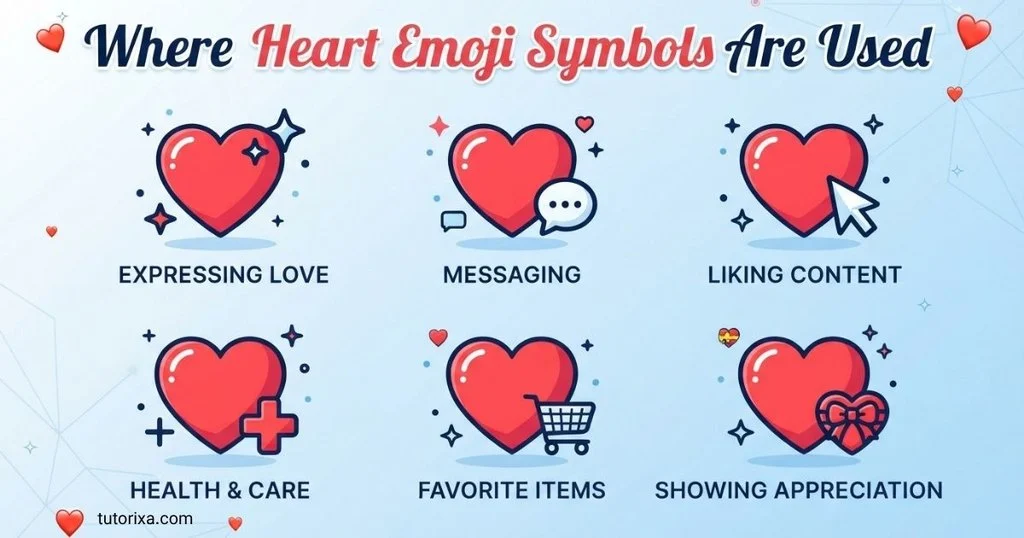
Heart emojis appear in personal communication, creative work, online communities, and commercial design. Their function changes according to the platform and the message.
Text Messages and Private Chats
In private conversations, hearts can soften a message, communicate affection, or acknowledge something meaningful. People use them in greetings, congratulations, thank-you messages, family conversations, and supportive replies.
The most appropriate heart depends on the relationship and communication style. A simple yellow heart may suit a friendly message, while a red heart may communicate stronger affection.
Social Media Posts and Comments
Heart emojis are common in captions, comments, profile descriptions, and reactions. They help users express appreciation without writing a detailed response.
For example, a pink heart might accompany a birthday photograph, a green heart might appear in an environmental post, and a white heart might accompany a peaceful landscape.
Relationships and Romantic Communication
In romantic conversations, hearts can communicate affection, attraction, excitement, and commitment. Decorative variations such as the heart with arrow 💘 or the heart on fire ❤️🔥 may add a playful or passionate tone.
However, the meaning of a heart should not be interpreted in isolation. Someone’s usual communication habits, the conversation itself, and the nature of the relationship provide important context.
Art, Jewelry, and Fashion
Heart imagery appears in necklaces, rings, clothing, greeting cards, tattoos, illustrations, and decorative patterns. Different colors may match a personal style or communicate a specific idea.
A black heart might suit a gothic design, a white heart might complement a minimalist aesthetic, and a red heart might emphasize traditional romance.
Business, Branding, and Awareness Campaigns
Businesses and organizations sometimes use heart shapes to communicate care, community, appreciation, or support. Heart colors may also connect to an organization’s visual identity or a particular campaign.
However, a heart color alone does not establish an official affiliation. When a symbol is used in an awareness campaign or community initiative, its intended meaning should be checked against the organization’s own information.
Common Variations of Heart Emojis
Heart emojis differ not only in color but also in shape, movement, decoration, and the other symbols surrounding them.
Broken Heart 💔
The broken heart commonly represents heartbreak, sadness, grief, disappointment, or the end of a meaningful relationship. It can also be used humorously when something relatively minor goes wrong.
For example, “My favorite show just ended 💔” expresses disappointment rather than romantic heartbreak.
Two Hearts 💕
Two hearts often suggest affection, closeness, mutual appreciation, or a warm relationship. Friends, partners, and family members may use this emoji.
Its meaning is not limited to romantic relationships, and it does not necessarily indicate that two people share identical feelings.
Revolving Hearts 💞
The revolving hearts emoji features two hearts moving around one another. It can suggest shared affection, emotional exchange, or a lively connection.
Some people use it to communicate mutual love, while others choose it because of its animated-looking design.
Beating Heart 💓
The beating heart commonly represents excitement, strong affection, emotional intensity, or a racing-heart feeling.
It may appear in romantic messages, enthusiastic reactions, and conversations about something emotionally meaningful. Its pulsing design adds a sense of movement that a standard heart does not have.
Growing Heart 💗
The growing heart features a central heart surrounded by expanding heart shapes. It often conveys affection that is increasing, developing, or becoming more expressive.
People may use it when describing a growing friendship, a developing relationship, or appreciation that becomes stronger over time.
Sparkling Heart 💖
The sparkling heart adds decorative sparkles to the traditional heart design. It often communicates excitement, admiration, joy, or an especially enthusiastic expression of affection.
It is also popular in celebratory messages and decorative social media captions.
Heart with Arrow 💘
The heart with arrow is associated with falling in love, romantic attraction, and Cupid-inspired imagery. Its design connects it to longstanding artistic traditions in which an arrow represents the beginning of romantic love.
The emoji may be used playfully rather than as a serious declaration of romantic interest.
Heart on Fire ❤️🔥
The heart on fire combines a heart with flames to express intense passion, excitement, enthusiasm, or powerful attraction. It may also describe something impressive, exciting, or exceptionally appealing.
Its meaning depends on the subject being discussed. For example, it can refer to a song, performance, creative achievement, or romantic feeling.
Mending Heart ❤️🩹
The mending heart shows a heart associated with a bandage. It often represents recovery, healing, comfort, reconciliation, or emotional support.
People may use it when encouraging someone after a difficult experience or acknowledging gradual progress toward feeling better.
Heart with Ribbon 💝
The heart with ribbon resembles a heart-shaped gift. It commonly symbolizes giving affection, expressing appreciation, celebrating a relationship, or marking a special occasion.
It can accompany birthday messages, Valentine’s Day greetings, anniversaries, and other expressions of gratitude.
Heart Exclamation ❣️
The heart exclamation combines heart imagery with punctuation. It can emphasize affection, enthusiasm, gratitude, or an excited reaction.
It often works as a decorative alternative to a traditional heart when someone wants to make a message feel especially expressive.
Common Misconceptions About Heart Emoji Meanings
Several misunderstandings arise when people assume that heart emojis have fixed emotional definitions.
Misconception 1: Every red heart means romantic love.
A red heart can express family affection, friendship, appreciation, or general support. Romantic meaning depends on context.
Misconception 2: A yellow heart means a relationship is only platonic.
Yellow hearts often communicate friendship, but they do not establish relationship boundaries. People may choose them for aesthetic reasons or personal preference.
Misconception 3: A black heart always represents sadness or negativity.
Black hearts can communicate grief, irony, humor, affection, or a preference for dark aesthetics. The symbol does not automatically indicate a negative emotion.
Misconception 4: Each heart color has an official emotional definition.
Unicode provides standardized character names and code points, not universally binding emotional meanings. Common interpretations develop through culture, online habits, and individual use.
Misconception 5: A particular heart proves someone is romantically interested.
An emoji alone cannot reliably establish romantic attraction. The surrounding conversation, relationship, and direct communication matter much more.
Misconception 6: Every device displays heart emojis identically.
Different platforms can render the same character with slightly different designs. These differences may influence how a heart appears without changing its underlying Unicode identity.
Interesting Facts About Heart Emojis
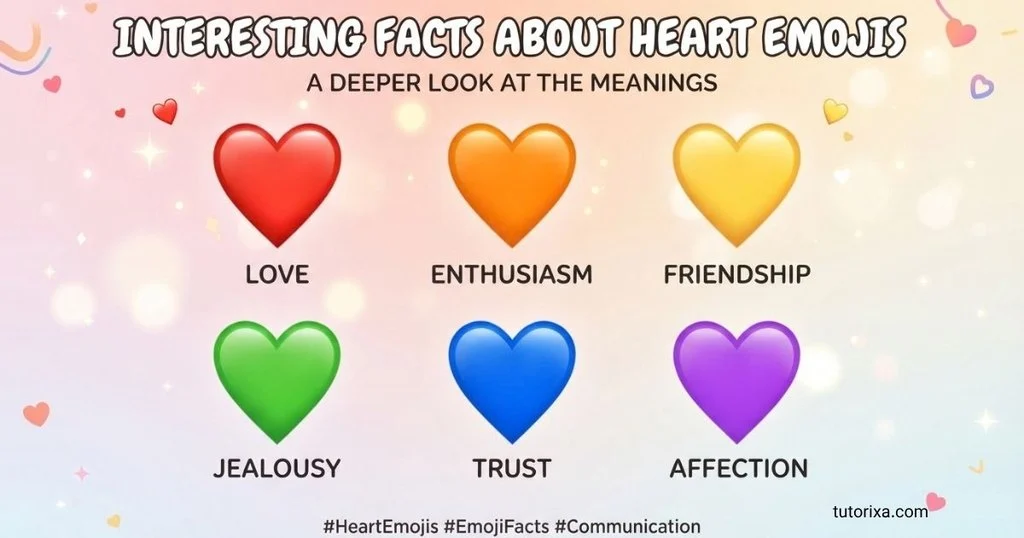
The history and use of heart emojis reveal how small digital symbols can communicate complex ideas.
1. The familiar heart outline predates digital communication. Heart-shaped imagery appeared in art and decorative traditions long before computers and smartphones existed.
2. Unicode distinguishes character identity from artwork. The standard identifies the character, while platform developers determine much of its visual presentation.
3. Heart emojis do not require a shared spoken language. Their widespread recognition allows people to express affection and support across language barriers, although interpretations still vary.
4. A heart can communicate more than one emotion. The same symbol may represent romance, gratitude, friendship, sympathy, or enthusiasm in different conversations.
5. New heart colors have expanded the available choices. Pink, light blue, and grey hearts provide additional visual options beyond the earlier set of widely used colored hearts.
6. Some heart emojis are combinations of multiple characters. The heart on fire and mending heart use sequences that compatible software can display as single emoji designs.
7. Heart colors can serve as community markers. Online groups may use a particular color to represent a shared interest, favorite team, creator, or cause.
8. The broken heart communicates more than romantic loss. It can also express disappointment about everyday experiences, fictional stories, cancelled events, or unexpected changes.
9. A decorative heart can be chosen for its appearance alone. Color preferences, matching designs, and visual themes sometimes matter more than emotional symbolism.
10. Context often carries more meaning than color. The words accompanying an emoji, the relationship between the participants, and their established communication habits help clarify its intended meaning.
Related Symbols and Their Meanings
Heart emojis belong to a broader family of symbols associated with emotion, affection, relationships, and care.
| Related Symbol | Common Meaning | Difference From Heart Emojis |
| 💋 Kiss Mark | Affection, kissing, or a playful goodbye | Focuses on a kiss rather than love in general |
| 🥰 Smiling Face with Hearts | Warm affection, happiness, or feeling loved | Combines facial expression with heart imagery |
| 😍 Smiling Face with Heart-Eyes | Admiration, excitement, or attraction | Emphasizes an enthusiastic emotional reaction |
| 💌 Love Letter | Written affection or a romantic message | Represents communication rather than just a feeling |
| 🫶 Heart Hands | Love, support, gratitude, or solidarity | Uses a hand gesture to form a heart |
| ❤️🔥 Heart on Fire | Intense passion or enthusiasm | Adds a flame to suggest intensity |
| ❤️🩹 Mending Heart | Healing, recovery, or comfort | Emphasizes repair and emotional recovery |
| 💐 Bouquet | Celebration, appreciation, or a gift | Uses flowers rather than a heart to communicate sentiment |
| ✨ Sparkles | Magic, excitement, emphasis, or beauty | Adds visual emphasis without directly representing love |
These symbols can complement one another. A heart combined with a smiling face might communicate happiness and affection, while a love letter with a red heart may emphasize a written expression of love.
Frequently Asked Questions About Emoji Heart Meanings
1. What Do the Different Heart Emoji Colors Mean?
Heart emoji colors commonly express different shades of affection. Red often represents love, pink suggests tenderness, yellow communicates friendship, blue can suggest trust, and green is associated with nature or growth. Purple, black, white, brown, orange, light blue, and grey have additional interpretations. These meanings are informal and can vary by person and situation.
2. What Does ❤️ Mean From Someone?
The red heart usually communicates love, affection, appreciation, or emotional closeness. From a romantic partner, it may express romantic love, while a friend or family member may use it to show care. The emoji alone cannot confirm romantic interest. Consider the conversation, the relationship, and how the person normally communicates.
3. What Is the Difference Between ❤️ and 🩷?
The red heart is strongly associated with love, deep affection, and emotional closeness. The pink heart often suggests gentleness, sweetness, tenderness, or playful affection. However, these are common conventions rather than strict rules. People may use either symbol for romance, friendship, family affection, or simply because they prefer its appearance.
4. What Does a Yellow Heart 💛 Mean?
The yellow heart commonly represents friendship, happiness, warmth, optimism, and appreciation. It is frequently used in cheerful conversations, birthday greetings, and supportive messages between friends. However, it does not automatically mean that a relationship is strictly platonic. Its intended meaning depends on the sender, the recipient, and the surrounding conversation.
5. What Does a Black Heart 🖤 Mean in Texting?
A black heart can express dark humor, irony, unconventional affection, grief, sadness, or an interest in gothic and monochrome aesthetics. Its meaning changes with context. For example, it might accompany a sarcastic joke in one message and a memorial tribute in another. It should not automatically be interpreted as negativity.
6. What Does a White Heart 🤍 Symbolize?
The white heart often symbolizes peace, purity, sincerity, gentle affection, and remembrance. People may use it in supportive messages, wedding greetings, spiritual posts, or expressions of sympathy. However, it has no single universal meaning. Its interpretation depends on personal preferences, cultural context, and the purpose of the message.
7. Which Heart Emoji Is Best for Friendship?
Yellow 💛, orange 🧡, pink 🩷, and blue 💙 hearts are commonly used in friendly conversations. Yellow often suggests happiness and companionship, orange communicates warmth, pink expresses tenderness, and blue can suggest trust or loyalty. No color is exclusively reserved for friendship, so choose the symbol that feels natural for your message.
8. Do Heart Emojis Have Official Meanings?
Unicode assigns standardized names and character codes to heart emojis, but it does not establish a single official emotional definition for every color. Interpretations develop through social conventions, online communities, cultural traditions, and individual preferences. Consequently, two people may understand the same heart differently without either interpretation being universally correct.
9. Why Do Heart Emojis Look Different on Different Devices?
Heart emojis can have different colors, shading, outlines, and proportions depending on the device, operating system, application, and emoji font. Unicode standardizes the underlying character rather than requiring every platform to use identical artwork. As a result, the same heart emoji may appear slightly different when sent between phones or computers.
10. Can Heart Emojis Have Different Meanings in Different Cultures?
Yes. Although many heart emojis have widely recognized associations with love and affection, their use can vary across cultures, languages, communities, and generations. Online fandoms and social groups may also assign additional meanings to particular colors. When interpreting a heart, consider the cultural setting and the sender’s communication habits rather than relying on color alone.
Key Takeaways
- Heart emojis communicate emotions: They can express love, friendship, gratitude, compassion, excitement, sadness, and support.
- Red ❤️ commonly represents love: It can express romantic affection, family love, friendship, or appreciation.
- Each color offers a different association: Yellow often suggests friendship, pink tenderness, blue trust, green nature, and white peace.
- Black hearts have multiple interpretations: They may communicate dark humor, grief, irony, or unconventional affection.
- Decorative hearts add emotional detail: Broken, sparkling, growing, revolving, and mending hearts provide additional ways to express feelings.
- Context matters more than color alone: The relationship, conversation, and sender’s habits help clarify an emoji’s meaning.
- Unicode standardizes digital characters: Platform designs may vary even when the underlying character is the same.
- Heart meanings are not universal rules: Cultural differences, personal preferences, and online communities influence interpretation.
- Emojis cannot reliably prove romantic interest: A single heart is not definitive evidence of someone’s intentions.
- Choose hearts naturally: The most suitable symbol is the one that communicates your intended message in the situation.
Conclusion
Understanding the emoji heart meanings of the symbols makes digital communication easier, clearer, and more expressive. From the classic red heart ❤️ to the gentle pink heart 🩷, cheerful yellow heart 💛, supportive blue heart 💙, and mysterious black heart 🖤, each symbol offers a different way to communicate feelings.
Heart emojis can express romantic love, friendship, kindness, gratitude, encouragement, remembrance, and countless other emotions. Decorative designs, such as the broken heart 💔, sparkling heart 💖, heart on fire ❤️🔥, and mending heart ❤️🩹, provide even more ways to communicate complex feelings through a simple image.
However, no color has one meaning in every situation. Culture, personal preferences, relationships, and conversational context all influence how a heart is understood.
The best approach is to consider both the symbol and the message surrounding it. When you understand these differences, you can choose heart emojis more thoughtfully, interpret digital conversations more accurately, and express yourself with greater confidence.

I’m Rowan Whitaker, a British writer fascinated by the symbols surrounding us every day. I explore their meanings, origins, cultural significance, and changing interpretations. From ancient marks to modern signs, I enjoy making symbolism easier to understand. My writing helps curious readers discover the hidden messages behind familiar shapes, images, and signs.
Books:
- The Meaning Behind Symbols
- A Modern Guide to Symbolism
 Ellis Montgomery