
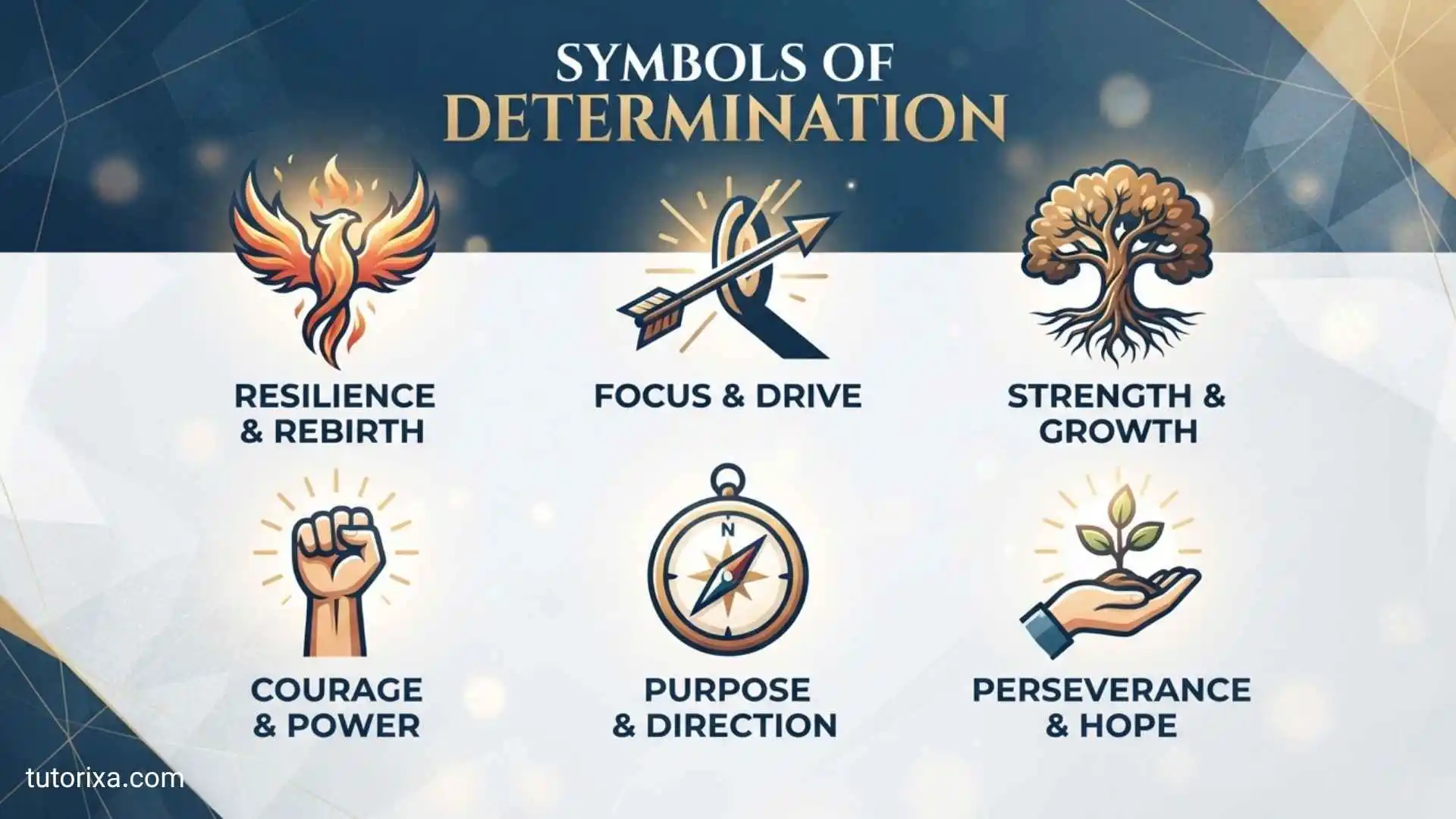
Determination Symbols can remind you of the strength you carry when life gets difficult. I believe a simple symbol can hold a powerful message, especially when you need a little courage to keep moving forward.
When you see a symbol of persistence, you may feel connected to your own goals and struggles. You can use these meaningful signs as inspiration, personal reminders, artwork ideas, or ways to express your inner strength.
I’ll explore the most powerful Determination Symbols, their meanings, and the stories behind them. You’ll discover how each symbol represents qualities like courage, resilience, focus, patience, and the will to never give up.
Quick Meaning
Determination symbols are visual representations of persistence, resilience, courage, ambition, discipline, and commitment to a goal. Common symbols include mountains, arrows, anchors, oak trees, lions, compasses, and phoenixes. Their meanings are interpretive rather than universal, so cultural background and context can influence what a particular symbol communicates.
Symbol Overview Table
| Symbol Name | Primary Meaning | Category | Cultural or Historical Association | Common Modern Meaning |
| Mountain | Perseverance, challenge, achievement | Nature | Widely used in mountain cultures and spiritual traditions | Overcoming obstacles |
| Arrow | Direction, progress, purpose | Object | Ancient hunting and warfare traditions | Moving toward a goal |
| Anchor | Stability, endurance, hope | Maritime | Ancient Mediterranean maritime culture and Christianity | Staying grounded |
| Oak Tree | Strength, endurance, longevity | Nature | Greek, Roman, Celtic, and Germanic traditions | Resilience and strength |
| Lion | Courage, bravery, leadership | Animal | Ancient Egypt, Greece, Rome, and medieval heraldry | Fearlessness |
| Compass | Direction, guidance, purpose | Navigation | Maritime and exploration history | Staying focused |
| Phoenix | Renewal, perseverance, rebirth | Mythological | Ancient Egyptian and later Greek literary traditions | Rising after hardship |
| Clenched Fist | Resolve, resistance, solidarity | Gesture | Modern political and social movements | Determination and collective strength |
There is no single universally recognized “determination symbol.” These are symbols commonly interpreted as expressing determination or related qualities.
What Do Determination Symbols Mean?
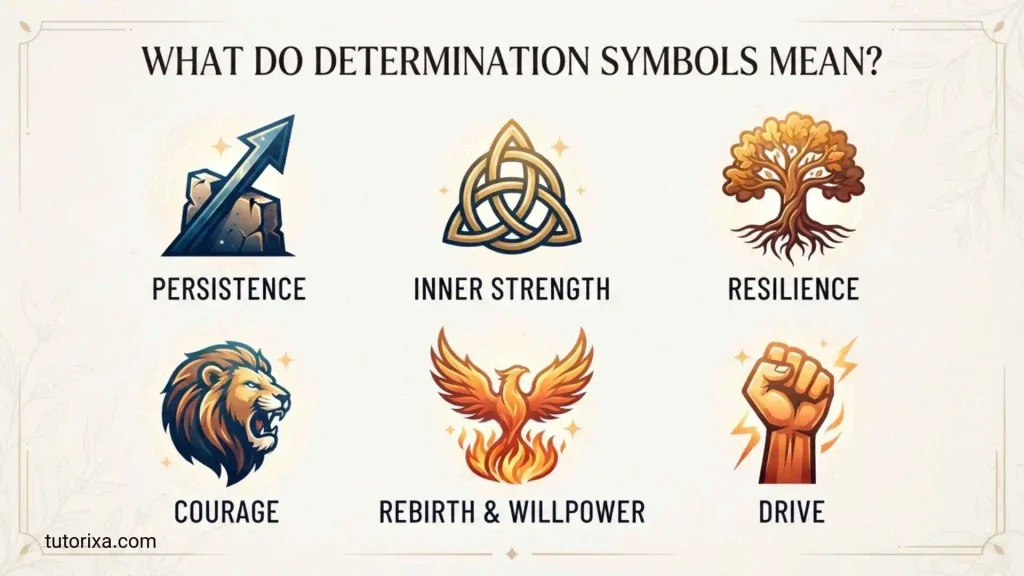
Determination symbols communicate the idea of continuing toward an objective despite difficulty, uncertainty, or setbacks. They often combine several related qualities, including persistence, courage, discipline, resilience, confidence, and hope.
The mountain is one of the clearest examples. A mountain creates a visual relationship between difficulty and achievement. Its height suggests a demanding goal, while reaching the summit represents progress or accomplishment. This interpretation is especially common in motivational art and modern personal-development language.
The arrow emphasizes movement. Unlike a mountain, it does not necessarily suggest a difficult obstacle. Instead, it points toward a destination. For this reason, arrows frequently symbolize focus, direction, ambition, and forward progress.
The anchor communicates a different form of determination. It stays in place against forces that might move a vessel. Symbolically, this can represent emotional stability, commitment, loyalty, and the ability to remain steady during difficult circumstances.
The oak tree represents strength through endurance. Trees take years to grow, making the oak a useful metaphor for patience and lasting resilience. Historical cultures also attached religious, political, or sacred meanings to oak trees, giving the symbol additional layers beyond modern motivational symbolism.
The phoenix represents transformation after destruction or hardship. Because the phoenix belongs to mythology rather than zoology, its meaning is primarily literary and cultural. Today, it is frequently used to symbolize renewal, recovery, and beginning again.
These examples show why “determination” is not a single symbolic concept. It can mean moving forward, standing firm, overcoming an obstacle, developing strength, or starting again.
History and Origin of Determination Symbols
Determination symbolism developed across many societies rather than originating from one ancient civilization or language. People have long used natural objects, animals, tools, and gestures to express qualities that are difficult to represent directly.
Ancient civilizations often connected strength and endurance with the natural world. The oak, for example, became important in several European and Mediterranean cultural traditions. In ancient Greece, oak trees were associated with Zeus, particularly at the sanctuary of Dodona, where the sacred oak played an important role in religious practice.
The lion also acquired strong symbolic importance in ancient societies. In ancient Egypt, lions appeared in religious and royal imagery. Lion symbolism later became prominent in Greek, Roman, and European heraldic traditions, where the animal could represent courage, authority, nobility, and strength.
The anchor has a long maritime history because anchors were practical objects essential to keeping vessels in position. It also gained religious significance in early Christianity. The anchor could symbolize hope and steadfastness, partly because of its association with security and stability.
The arrow is even older as a human-made object. Archaeological evidence shows that humans have used bows and arrows for thousands of years. Because an arrow travels toward a chosen target, later symbolic interpretations naturally connected it with aim, direction, purpose, and determination.
The compass became particularly meaningful as navigation developed. A compass does not itself represent determination in a traditional universal sense, but its relationship with direction makes it a powerful modern metaphor for having a clear purpose and staying on course.
The mountain has both practical and spiritual histories. Mountains served as geographic landmarks and difficult barriers, while many religions and cultures associated particular mountains with sacred places, revelation, pilgrimage, or divine presence.
Over time, these practical and religious associations became part of modern visual language. Contemporary motivational culture often combines them into simplified messages about goals, resilience, achievement, and personal growth.
Symbolism and Interpretation
Determination symbolism usually falls into four broad ideas: moving forward, overcoming obstacles, remaining stable, and becoming stronger.
Positive Symbolism
Determination symbols commonly communicate:
- Persistence
- Courage
- Resilience
- Self-discipline
- Patience
- Focus
- Ambition
- Confidence
- Hope
- Strength
- Commitment
- Achievement
A mountain, for example, can suggest the willingness to climb despite difficulty. An arrow can suggest purposeful movement. An anchor can emphasize commitment and stability.
Negative or More Complex Meanings
Symbols do not always have positive meanings.
A clenched fist may represent determination and solidarity, but depending on context it can also communicate confrontation, resistance, anger, or political struggle.
A lion may represent courage and leadership, but it can also symbolize domination or aggression.
A mountain can represent achievement, but it may also symbolize an overwhelming challenge.
This distinction matters because symbolism is contextual. The same visual form can communicate different ideas depending on its surrounding words, colors, cultural setting, and intended audience.
Psychological Interpretation
From a psychological perspective, determination is an internal quality rather than an object with a fixed visual form. People may choose symbols that act as personal reminders of a goal or value.
For example, someone might associate an anchor with staying steady during stressful periods, while another person may choose a mountain because it represents a difficult goal they want to accomplish.
This is a personal interpretation, not evidence that a particular symbol has a universal psychological effect.
Cultural Significance
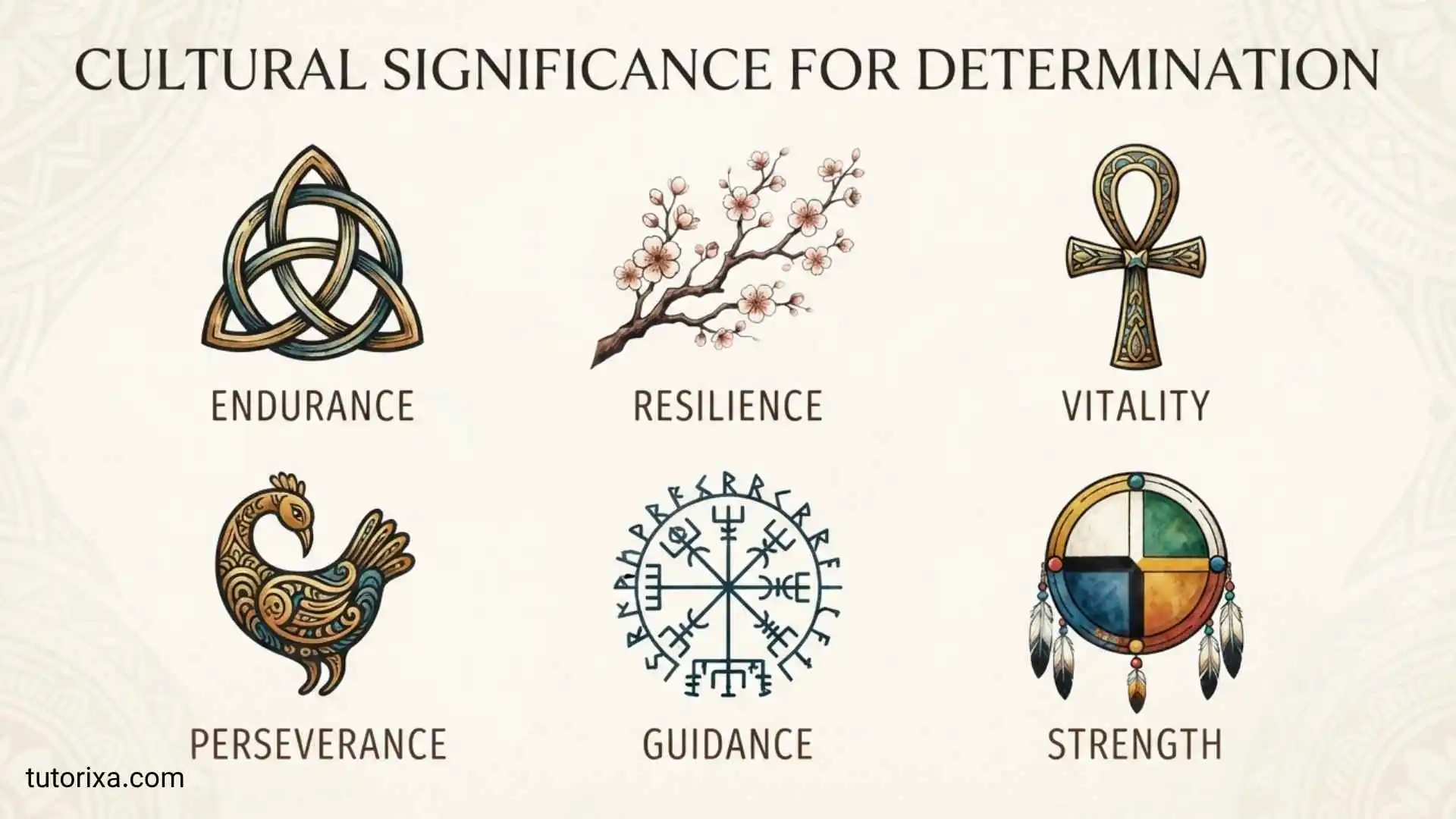
Different cultures interpret determination-related symbols according to their own histories, religions, environments, and traditions.
The oak tree illustrates this particularly well. In ancient Greek tradition, the oak was associated with Zeus and the sanctuary of Dodona. In other European traditions, oak trees also developed associations with strength, sacred places, kingship, or endurance.
The lion has similarly broad cultural significance. Ancient Egyptian art used lions in religious and royal contexts, while later European heraldry frequently used lions to communicate courage, authority, or nobility.
The mountain has different meanings depending on geography and religion. In cultures surrounded by mountains, the landscape can become part of identity and mythology. In religious traditions, particular mountains may be associated with sacred events or divine encounters.
The anchor has especially strong maritime associations. Coastal societies naturally encountered anchors as practical tools, while Christian symbolism gave the anchor another layer through its association with hope.
The arrow can symbolize direction in many modern cultures, but historical meanings have also included hunting, warfare, protection, and communication.
These examples demonstrate an important principle: a symbol should be interpreted within its cultural context rather than treated as having one meaning everywhere.
Religious or Spiritual Meaning
Several determination-related symbols have religious or spiritual associations, but “determination” itself is usually a modern interpretive description rather than the original meaning of every symbol.
The anchor has an important Christian symbolic history. Early Christian communities used anchor imagery, and the Letter to the Hebrews contains an image of hope as an anchor for the soul. This helped establish the anchor as a Christian symbol of hope and steadfastness.
The oak tree was associated with Zeus at Dodona in ancient Greece. The sacred oak was connected with the religious life of the sanctuary, making its symbolism more specific than simply “strength.”
The mountain has spiritual importance in numerous religious traditions. Mountains can represent sacred space, divine revelation, pilgrimage, or closeness to the heavens. Examples include Mount Sinai in Judaism and Christianity and Mount Olympus in ancient Greek religious tradition.
The phoenix is often described as a symbol of rebirth, but its history is more complicated than the simple modern phrase “rising from the ashes.” Ancient accounts of the phoenix developed through Egyptian associations and Greek and Roman literary traditions. Modern interpretations emphasize renewal, transformation, and resilience.
These meanings should not be treated as interchangeable. A symbol may have a specific sacred meaning in one tradition while having a secular motivational meaning today.
Scientific or Technical Meaning
Most determination symbols do not have a standardized scientific meaning. Their modern use is primarily cultural, artistic, or communicative.
Some related symbols do have technical functions. An arrow, for instance, is widely used in mathematics, physics, engineering, diagrams, maps, interfaces, and technical illustrations. Its meaning depends on the field and notation system.
A compass also has a practical technical meaning in navigation and geometry. A magnetic compass uses Earth’s magnetic field to indicate direction, while a drawing compass is a geometric instrument used to construct circles and arcs.
A mountain-like shape may appear in geographic maps to represent terrain, but that cartographic function is different from the motivational meaning of a mountain as an obstacle or achievement.
Therefore, a determination symbol should not automatically be described as a scientific symbol. Symbolic interpretation and technical notation are different systems.
Where Are Determination Symbols Used?
Determination symbols appear in personal, artistic, cultural, commercial, and motivational contexts.
Jewelry
Mountain pendants, anchor necklaces, arrow bracelets, and compass designs can serve as personal reminders of resilience, direction, or commitment.
Tattoos
Determination-themed tattoos commonly use mountains, arrows, anchors, lions, trees, and phoenixes. The meaning is usually personal rather than universally defined.
Logos and Branding
Organizations may use mountains to suggest ambition, arrows to suggest progress, or lions to suggest confidence and leadership. Businesses often simplify these forms for easy recognition.
Literature
Writers use symbolic objects and natural imagery to communicate character development. A journey toward a mountain, for example, can function as a metaphor for overcoming difficulty.
Art
Artists use symbols of endurance to explore themes such as struggle, survival, courage, identity, and transformation.
Architecture
Mountains, trees, columns, and other forms can appear in buildings and monuments as visual expressions of permanence or strength, although their meaning depends on the specific architectural tradition.
Maps and Navigation
Arrows and compass symbols have practical functions in cartography and navigation. In these settings, they should be understood primarily as directional tools rather than motivational symbols.
Flags and Emblems
Animals, weapons, plants, and geometric forms on flags or coats of arms may represent courage, independence, heritage, or strength. Their exact meanings depend on the history of the specific emblem.
Common Variations
Determination symbols vary greatly in design because artists adapt the same basic concept to different cultures and personal meanings.
A mountain may appear as a simple triangular outline, a realistic landscape, or a mountain combined with a rising sun. The basic idea can shift from endurance to adventure or achievement.
Arrows may point upward, forward, backward, or in multiple directions. A broken arrow can communicate a very different idea from a straight arrow, while multiple arrows may represent cooperation or collective strength.
Anchor designs range from realistic maritime anchors to minimalist geometric icons. Adding a rope, compass, coordinates, or words can create a more personalized meaning.
Phoenix imagery may depict a bird rising, spreading its wings, or surrounded by flames. Because the phoenix is mythological, artistic traditions differ considerably.
Related symbols such as the infinity symbol, knot, spiral, and staircase can also communicate continuity, persistence, or progress, although none is universally defined as a symbol of determination.
Common Misconceptions
The biggest misconception is that one universal symbol officially represents determination. No single international authority assigns a universal visual symbol to this concept.
Another misconception is that every mountain represents determination. Mountains have many meanings, including geography, spirituality, danger, isolation, travel, nature, and permanence.
It is also inaccurate to claim that a particular symbol has exactly the same meaning in every culture. Symbolism changes across historical periods and regions.
The phoenix is sometimes presented as an ancient universal symbol of personal resilience. Its historical development is more specific, involving ancient Mediterranean literary traditions and connections with earlier Egyptian religious imagery.
Likewise, an anchor should not automatically be labeled a “determination symbol.” Its historical meanings include maritime security and, in Christian contexts, hope. Determination is a modern interpretation that can reasonably be derived from its broader association with steadfastness.
Interesting Facts About Determination
- There is no official universal determination symbol.
Determination is an abstract human quality, so different cultures use different images to represent it. - The anchor has both practical and religious symbolism.
It began as a maritime tool but later acquired important symbolic associations, including Christian associations with hope. - Mountains can represent both obstacles and achievements.
Their symbolic power comes from the same physical feature: they are difficult to climb but can be reached through sustained effort. - The oak has ancient sacred associations.
The sacred oak at Dodona was connected with Zeus, demonstrating that the tree’s symbolism goes beyond modern ideas of physical strength. - Arrows have a very old practical history.
Their association with direction and aim developed from an object that literally travels toward a selected target. - The phoenix is a mythological creature.
Its symbolic meaning comes from stories and literature rather than observations of a real animal. - The lion is older than modern motivational symbolism.
Lions appeared in royal, religious, artistic, and heraldic traditions long before modern concepts of motivational branding. - Compasses symbolize direction more directly than determination.
Their connection with determination comes from the idea of knowing where you are going and remaining on course. - A symbol’s context can change its meaning.
A clenched fist can suggest resolve, solidarity, protest, or confrontation depending on how and where it is used. - Personal symbolism can differ from historical symbolism.
Someone may choose a mountain to represent a personal achievement even though mountains have very different meanings in religious or cultural traditions.
Related Symbols
Several symbols are closely connected to determination but emphasize different qualities.
- Infinity symbol (∞): Often represents endlessness, continuity, or an enduring connection rather than determination specifically.
- Knot: Can symbolize strength, connection, commitment, and an enduring bond.
- Spiral: Often associated with growth, development, cycles, or transformation.
- Staircase: Commonly represents gradual progress and movement toward a higher goal.
- Rising sun: Can symbolize hope, renewal, opportunity, or a new beginning.
- Crown: More strongly associated with authority, achievement, leadership, or status.
- Sword: Can symbolize courage, justice, protection, conflict, or strength depending on context.
- Lotus: Frequently represents purity, spiritual growth, and transformation, particularly in South and East Asian religious traditions.
- Wolf: May symbolize independence, loyalty, instinct, or strength, although interpretations vary considerably.
- Star: Often represents guidance, hope, achievement, or aspiration.
These symbols overlap with determination because determination itself is connected to several broader concepts: purpose, endurance, courage, progress, and resilience.
Frequently Asked Questions
What is the most common symbol of determination?
There is no universally accepted symbol of determination. However, the mountain is one of the clearest modern representations because it combines challenge, effort, progress, and achievement. Arrows, anchors, oak trees, lions, and phoenixes are also frequently interpreted as symbols of persistence, courage, stability, or overcoming adversity.
What animal symbolizes determination?
The lion is commonly associated with courage, strength, and leadership, qualities that can support an interpretation of determination. Other animals, such as wolves, elephants, and eagles, may also represent endurance or strength in particular cultural contexts. None is universally designated as the animal symbol of determination.
What flower represents determination?
There is no universally recognized flower specifically representing determination. Flowers such as the lotus can symbolize resilience and transformation because of their religious and cultural associations, while other flowers may represent perseverance in particular traditions or modern floral symbolism. The meaning depends heavily on cultural and historical context.
What symbol represents never giving up?
The mountain is a strong modern symbol for never giving up because climbing it represents continuing despite difficulty. The phoenix can communicate a related idea through renewal after hardship. An anchor represents a different form of persistence: remaining steady and committed rather than constantly moving forward.
What symbol represents strength and determination?
The oak tree is a strong example because it can represent endurance, longevity, and strength. The lion is another common choice for courage and power, while the mountain combines strength with the idea of overcoming a difficult challenge. Their exact meanings depend on cultural and artistic context.
Is an arrow a symbol of determination?
An arrow can symbolize determination in modern visual language because it has a clear direction and target. It may represent focus, ambition, progress, or moving forward. Historically, however, arrows were practical tools used for hunting, warfare, and other purposes, so “determination” is a later interpretive association rather than their only meaning.
What does a mountain symbolize spiritually?
Mountains have many spiritual meanings, including sacred space, divine encounters, revelation, pilgrimage, transcendence, and spiritual elevation. Their significance varies among religions and cultures. For this reason, it is better to identify the specific tradition before assigning one universal spiritual meaning to a mountain.
What does an anchor symbolize?
An anchor primarily represents stability, security, and staying in place. It also has important Christian symbolism connected with hope. In modern personal symbolism, an anchor may represent commitment, emotional steadiness, loyalty, or remaining grounded during difficult circumstances.
Does the phoenix symbolize determination?
The phoenix can symbolize determination in modern interpretations because its story is commonly connected with renewal and beginning again after destruction. Historically, however, the phoenix has a more complex development through ancient Egyptian associations and Greek and Roman literary accounts. Its modern resilience symbolism should therefore be distinguished from its ancient cultural history.
What symbol represents staying strong during hard times?
An anchor strongly communicates the idea of remaining steady during difficult circumstances, while a mountain emphasizes overcoming a challenge. An oak tree can represent long-term strength and endurance. The best choice depends on the particular message: stability, overcoming obstacles, or developing strength over time.
Key Takeaways
- Determination symbols represent abstract qualities such as persistence, courage, focus, resilience, and endurance.
- There is no single universal symbol officially assigned to determination.
- Mountains commonly represent challenges, perseverance, and achievement.
- Arrows emphasize direction, purpose, and forward movement.
- Anchors symbolize stability, security, hope, and steadfastness.
- Oak trees can represent strength, endurance, longevity, and sacred traditions.
- Lions are widely associated with courage, strength, leadership, and authority.
- Compasses primarily symbolize direction and guidance, with determination as a modern interpretation.
- Phoenixes commonly represent renewal and transformation.
- Religious meanings should be separated from modern motivational interpretations.
- Symbolic meanings can change according to culture, history, geography, religion, and context.
- A symbol’s personal meaning does not necessarily represent its historical meaning.
Conclusion
Determination symbols give visual form to qualities that are otherwise difficult to see: persistence, courage, purpose, endurance, and the decision to keep moving forward. Mountains express the challenge of reaching a difficult goal, arrows communicate direction, anchors suggest stability, and oak trees evoke lasting strength. The phoenix adds another dimension by representing renewal and transformation.
Their meanings are not fixed formulas. A symbol gains significance from the culture that uses it, the history behind it, and the personal or artistic context in which it appears. Understanding those differences makes symbolism more meaningful and prevents modern interpretations from being mistaken for ancient facts.
If you are choosing a determination symbol for art, jewelry, a tattoo, a personal emblem, writing, or a logo, the strongest choice is the one whose established symbolism matches the specific quality you want to express—steadfastness, courage, progress, resilience, or overcoming obstacles.

I’m Rowan Whitaker, a British writer fascinated by the symbols surrounding us every day. I explore their meanings, origins, cultural significance, and changing interpretations. From ancient marks to modern signs, I enjoy making symbolism easier to understand. My writing helps curious readers discover the hidden messages behind familiar shapes, images, and signs.
Books:
- The Meaning Behind Symbols
- A Modern Guide to Symbolism
 Ellis Montgomery
 Freddie Beaumont