
Mental Symbols can reveal how the mind turns thoughts, feelings, and ideas into meaningful images or concepts. I find them fascinating because a simple symbol can carry a much deeper message than it first appears to.
You may notice mental symbols in dreams, art, stories, memories, or everyday thinking. I’ll help you explore these symbols in a simple way so you can understand why they matter and how people interpret them.
If you want to discover the meanings behind mental symbols, you’re in the right place. You’ll find practical explanations, common examples, and useful insights that make this fascinating subject easier to understand.
Quick Meaning
A mental symbol is an internal representation that stands for something else, such as an object, concept, event, word, action, or relationship. Mental symbols can support thinking, remembering, reasoning, planning, and communication. In cognitive science, the exact nature of these representations remains debated: some theories emphasize symbolic structures, while others emphasize distributed patterns of neural activity.
Mental Symbols Overview
| Field | Information |
| Symbol Name | Mental symbol |
| Primary Meaning | An internal representation of something |
| Category | Cognitive representation |
| Main Field | Cognitive science and philosophy of mind |
| Historical Development | Roots in philosophy; major modern development in 20th-century cognitive science |
| Important Concept | Language of Thought / Mentalese |
| Common Forms | Concepts, words, propositions, images, rules, patterns |
| Modern Usage | Psychology, cognitive science, neuroscience, linguistics, philosophy, AI |
| Physical Unicode | None; a mental symbol is not a specific written character |
| Emoji Equivalent | None |
| Related Concepts | Mental representation, mental imagery, concepts, schemas, propositions, language of thought |
What Does a Mental Symbol Mean?
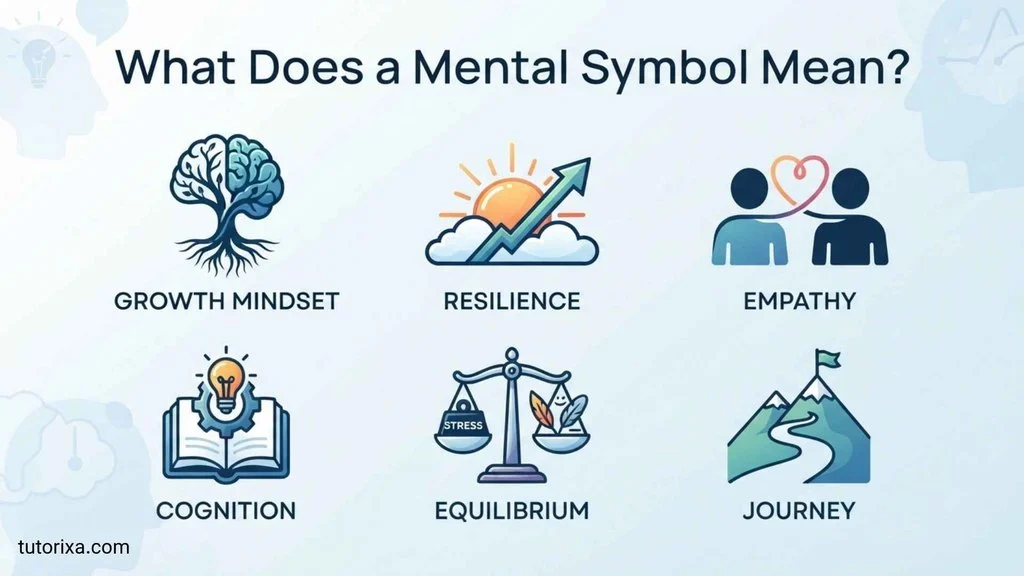
A mental symbol represents something within a person’s cognitive system. The thing represented could be physical, abstract, remembered, imagined, or hypothetical.
For example, consider the concept “tree.” You can think about a tree while sitting inside a building. You do not need an actual tree in front of you. Your mind can use stored knowledge, concepts, imagery, language, or other representations associated with trees.
The representation does not have to look like the thing it represents. A person’s internal representation of a dog might involve the concept “dog,” a visual image, memories of dogs, sounds, language, or several of these at once.
This distinction is important because mental symbol does not simply mean a picture inside the brain. Cognitive theories recognize many possible forms of mental representation. Philosophical and scientific discussions have included mental models, images, symbolic structures, and distributed or sub-symbolic patterns.
Mental symbols can therefore help with several cognitive activities:
- Recognition: identifying something as familiar.
- Memory: retaining information about past events.
- Reasoning: combining information to reach conclusions.
- Planning: imagining possible future actions.
- Language: representing meanings and relationships.
- Problem-solving: manipulating information internally.
- Imagination: considering things that are not currently present.
- Decision-making: comparing possible outcomes.
A key point is that researchers do not all agree that every cognitive process operates through discrete symbols. This remains an important theoretical issue in cognitive science.
History and Origin of Mental Symbols
The idea that human thought involves internal representations has a long philosophical history, although the modern term mental symbols belongs largely to contemporary discussions of mind and cognition.
Ancient and medieval philosophers examined how the mind represents objects and concepts. Philosophers such as Aristotle discussed mental concepts and their relationship to perception, language, and external things. Medieval thinkers also developed theories of mental concepts and signs.
The modern scientific discussion became especially influential during the development of cognitive science in the 20th century. Researchers increasingly challenged explanations that treated behavior only as a direct response to environmental stimuli. Instead, they investigated internal processes involving memory, representation, reasoning, language, and problem-solving.
Computational approaches became particularly influential. Thinkers such as Alan Turing, Noam Chomsky, Herbert Simon, Allen Newell, and Jerry Fodor contributed to different aspects of the idea that cognitive processes could be understood through information processing and representation.
Fodor’s Language of Thought Hypothesis, developed prominently in The Language of Thought in 1975, proposed that thought involves a structured internal representational system. In this view, mental representations can combine according to rules, somewhat like expressions in a language.
This proposal helped explain why humans can produce and understand an enormous number of thoughts from a limited set of concepts and rules. However, it is a theory rather than an established fact about the brain.
Symbolism and Interpretation
Mental symbols are interpreted through their relationship to what they represent and through the role they play in cognition.
Traditional Interpretation
In classical symbolic theories, a mental symbol is treated as an internal structure that carries information. A thought can involve several symbols arranged in a meaningful relationship.
For example:
DOG + CHASES + BALL
could represent a simple relationship between an animal, an action, and an object.
The important idea is not the literal appearance of those hypothetical symbols. Instead, it is their structure and relationships.
Classical theories argue that this structure helps explain why people can understand complex ideas by combining simpler elements. The Language of Thought Hypothesis calls attention to the compositional structure of mental representations.
Positive Cognitive Role
Mental representations can support:
- learning,
- memory,
- reasoning,
- creativity,
- planning,
- communication,
- categorization,
- decision-making.
They allow people to consider absent objects and possible situations rather than responding only to what is immediately visible.
Potential Limitations
Mental symbols can also be incomplete or inaccurate. A person’s representation of a place, person, event, or concept may differ from reality.
For example, someone may remember a location as larger than it actually is. The representation remains useful, but it is not necessarily a perfect copy of the world.
This is one reason researchers distinguish between representation and reality.
Psychological Interpretation
Psychology uses several concepts that overlap with mental symbols, including mental representations, concepts, schemas, mental imagery, prototypes, and propositions.
A mental representation can help organize knowledge. A schema, for example, is a structured framework associated with a category or situation. A person may have a schema for “restaurant” that includes ideas about menus, ordering, tables, meals, and payment.
Mental imagery is another related form of representation. People can sometimes imagine visual, auditory, spatial, or other sensory information without the corresponding external stimulus.
However, mental imagery should not automatically be treated as identical to symbolic thought. Research and philosophical discussion have considered whether images, language-like structures, or multiple representational formats are involved in different cognitive tasks.
Cultural Significance
Mental symbols do not have one universal cultural vocabulary. People learn many concepts and symbolic associations through language, education, family, social interaction, art, religion, and cultural traditions.
For example, a physical symbol such as a heart may evoke ideas of love or affection in many modern societies. But the mental representation associated with that symbol depends partly on personal experience and cultural learning.
This creates an important distinction:
A physical symbol can be culturally shared, while the mental representation connected with it can vary from person to person.
A person raised in one cultural environment may associate a particular object with celebration, while another person may associate the same object with mourning or tradition.
Language also shapes mental categorization. Different languages may divide experiences and concepts in different ways, although claims that language completely determines thought are much stronger than the evidence supports.
Therefore, mental symbols are influenced by both individual experience and cultural learning.
Religious or Spiritual Meaning
Mental symbols are relevant to religious studies because religious traditions frequently use symbols to communicate complex ideas such as creation, sacrifice, purity, wisdom, death, renewal, divine authority, or transcendence.
However, a mental symbol should not be confused with a religious symbol itself.
A cross, crescent, lotus, wheel, or other sacred sign is a public or physical symbol. The ideas a believer associates with that sign are part of their mental representation.
The same physical religious symbol may therefore evoke different thoughts depending on a person’s tradition, education, personal experiences, and historical context.
Religious symbolism is also highly context-dependent. Meaning can change according to scripture, ritual, artistic tradition, geography, and historical period. For that reason, it is inaccurate to claim that every symbol has one universal spiritual meaning.
Scientific and Technical Meaning
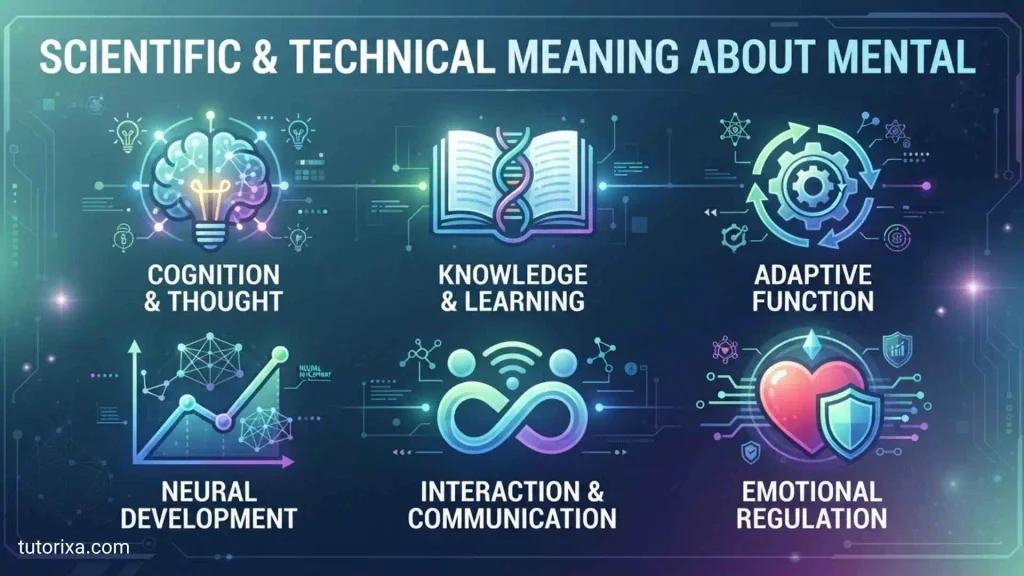
Mental symbols have an important role in cognitive science, especially theories that explain thinking through representation and computation.
The traditional computational view treats cognition as involving representational structures and processes that operate on those structures. Cognitive theories have proposed representations resembling logical propositions, rules, concepts, images, analogies, and other information structures.
Computational Theory of Mind
The Computational Theory of Mind proposes that aspects of thinking can be understood in computational terms. One influential version combines mental representation with computational operations.
Fodor’s representational theory, for example, describes mental states as related to mental representations and proposes that cognitive processes can involve operations over structured representations.
Connectionist Approaches
Not every theory treats cognition as manipulation of discrete symbols.
Connectionist approaches model cognitive activity using patterns of activation across networks of simple processing units. In such approaches, information may be represented through distributed patterns rather than individual symbolic tokens.
This creates a major theoretical contrast:
Symbolic approaches emphasize structured representations; connectionist approaches often emphasize patterns of activity distributed across networks.
Some modern approaches combine insights from both traditions rather than treating them as completely incompatible.
Symbol Grounding
Another major issue is the symbol grounding problem: how does an internal representation acquire meaning rather than merely being a formal mark manipulated according to rules?
This question matters because a computer or cognitive system could theoretically manipulate symbols according to formal rules without those symbols necessarily having the same kind of meaning humans experience.
The issue remains central to debates about representation, cognition, and intelligent behavior.
Where Mental Symbols Are Used
Mental symbols and related representations are involved in many areas of human activity.
Language
When people understand a sentence, they do more than recognize its sounds or letters. They construct representations of its meaning, relationships, and context.
Memory
Remembering a person, place, event, or fact involves accessing stored information and representations.
Problem-Solving
People can mentally manipulate concepts before taking physical action. A person assembling furniture, for example, may mentally represent the order of several steps.
Maps and Navigation
Spatial representations allow people to imagine routes, locations, distances, and relationships between places.
Mathematics
Mathematical thinking uses symbolic notation externally, but people can also maintain internal representations of numbers, quantities, operations, and relationships.
Literature and Art
Readers build mental representations of characters, locations, events, and fictional worlds. Artists may mentally plan forms, compositions, or visual relationships before producing a physical work.
Technology
Computers use formal symbols and representations, while researchers in artificial intelligence and cognitive science investigate how computational systems represent information.
It is important not to assume that computer symbols and human mental symbols are identical. They can be compared functionally, but their underlying mechanisms may differ.
Common Variations of Mental Symbols
Mental symbols can differ according to the type of information they represent.
Conceptual Representations
These represent categories or ideas, such as “animal,” “justice,” or “school.”
Linguistic Representations
These involve language-like information, including words, sentences, or propositions.
Visual Representations
These involve imagined shapes, objects, colors, layouts, or scenes.
Spatial Representations
These represent locations, distances, directions, and relationships between objects.
Propositional Representations
These represent information that can be expressed as a claim or relationship, such as the idea that one object is larger than another.
Distributed Representations
In some cognitive theories, information is represented through patterns across many processing units rather than one isolated symbolic unit. Connectionist theories are strongly associated with this approach.
Common Misconceptions About Mental Symbols
Misconception 1: Mental symbols are tiny pictures inside the brain
Not necessarily. Mental representation can involve concepts, structured information, imagery, or distributed patterns. Researchers disagree about the exact form of many mental representations.
Misconception 2: Mental symbols are proven to be like a hidden language
The Language of Thought Hypothesis is an influential philosophical and cognitive theory, not a universally established description of the brain.
Misconception 3: Everyone has exactly the same mental symbol for an object
People can share basic concepts while having different memories, associations, imagery, and experiences.
Misconception 4: Mental symbols must be conscious
Some theories discuss representations involved in cognitive processes that are not consciously accessible. A mental representation should therefore not automatically be equated with a consciously experienced thought.
Misconception 5: Symbols always have fixed meanings
Meaning depends on context, relationships, experience, and interpretation. This applies to both external symbols and internal representations.
Interesting Facts About Mental Symbols
- Mental symbols do not need to resemble what they represent.
The concept of a tree does not need to physically resemble an actual tree. Representation can depend on learned associations and cognitive structure. - Mental representation is broader than mental imagery.
Imagining a picture is only one possible form of representation. Cognitive theories also discuss concepts, propositions, rules, models, and other structures. - Mental symbols are closely connected to language research.
The Language of Thought Hypothesis uses a language-like structure to explain aspects of thinking. - The mind-computer comparison influenced cognitive science.
Cognitive scientists have often compared mental representations with information structures in computers, while recognizing that brains and computers are not literally the same. - A representation can be useful without being perfectly accurate.
A simplified mental map can help someone navigate even if it does not reproduce every physical detail. - Mental representations can combine into complex structures.
Classical symbolic theories emphasize how simpler representational elements can form more complex thoughts. - Mental symbols are part of an ongoing scientific debate.
Symbolic, connectionist, embodied, and other approaches offer different explanations of cognition. - Culture can influence what symbols evoke.
The same external sign may activate different associations in people with different cultural backgrounds. - Mental images can be ambiguous.
A mental picture may not uniquely determine what it represents. Philosophical discussions of imagery have highlighted this problem. - There is no Unicode character for a mental symbol.
Unicode encodes written characters and other digital symbols. A mental symbol is a theoretical cognitive representation, not a specific character.
Related Symbols and Concepts
Because “mental symbol” describes a category of internal representation rather than one specific visual sign, several related concepts are useful:
- Mental representation: The broader concept of information being represented within cognition.
- Mental imagery: Sensory-like internal experiences, such as imagining a face or location.
- Concept: A mental category or idea used to organize knowledge.
- Schema: An organized framework for understanding objects, situations, or events.
- Proposition: A structured claim or content that can be evaluated as true or false.
- Mental model: An internal model used to understand or reason about a system or situation.
- Language of Thought: The theory that some thought operates through a structured internal symbolic system.
- Connectionist representation: Information represented through patterns of activity across networks.
- Physical symbol: An externally observable sign, such as a written character, logo, or road sign.
- Semantic representation: A representation considered in relation to meaning.
These concepts overlap, but they should not be treated as exact synonyms.
Frequently Asked Questions
What are mental symbols?
Mental symbols are internal representations used by cognitive systems to stand for objects, concepts, events, relationships, or information. They may involve language-like structures, concepts, imagery, models, or other forms of representation. Cognitive science does not have one universally accepted theory describing exactly how every mental representation is physically realized in the brain.
Are mental symbols the same as thoughts?
Not exactly. A mental symbol can be considered a component or vehicle of thought in some theories, but “thought” is a broader term. Some theories describe thinking as processes involving structured representations, while other approaches emphasize distributed neural activity, embodied processes, or other mechanisms.
What is the Language of Thought?
The Language of Thought Hypothesis proposes that thinking involves a structured internal representational system sometimes called Mentalese. Jerry Fodor developed one influential version of this theory. It argues that complex thoughts can be constructed from simpler representational elements according to systematic rules.
Are mental symbols visible in the brain?
Mental symbols are not normally visible as individual objects during ordinary brain observation. Researchers use behavioral experiments, computational models, neuroscience methods, and other evidence to investigate how information may be represented in the brain. The precise relationship between theoretical symbols and neural activity remains an area of research.
Are mental symbols always visual?
No. Mental representation can involve verbal, conceptual, spatial, auditory, visual, and other forms. Cognitive science recognizes multiple kinds of representation rather than reducing all thought to pictures. Some theories also argue that representations may be distributed patterns rather than discrete symbols.
Why are mental symbols important?
Mental symbols are important because internal representation helps explain how people can remember absent objects, imagine possibilities, understand language, solve problems, make plans, and reason about abstract ideas. The concept provides one way to investigate how information becomes part of cognition.
Do cultures create different mental symbols?
Culture can influence the concepts, associations, categories, and meanings people learn. However, it would be too simple to say that every culture creates completely separate mental symbol systems. Humans also share many cognitive abilities and experiences, while individual learning creates additional differences.
What is the difference between a symbol and a mental symbol?
A physical symbol is an observable sign, such as a letter, logo, diagram, or road sign. A mental symbol refers to an internal representation used by cognition. A physical symbol may trigger or communicate a mental representation, but the two are not the same thing.
Are mental symbols scientifically proven?
Mental representation is a major concept in cognitive science, but there is no single scientific agreement that all cognition consists of discrete mental symbols. Symbolic theories provide influential explanations, while connectionist, embodied, and other approaches propose different mechanisms.
Do mental symbols have universal meanings?
No. A mental representation is shaped by its cognitive role, context, knowledge, learning, and experience. Even if people share a concept, their personal associations may differ. External symbols can also acquire different meanings across cultures, historical periods, and social contexts.
Key Takeaways
- Mental symbols are internal representations used to stand for objects, concepts, events, relationships, or information.
- They can support memory, language, reasoning, planning, learning, and imagination.
- A mental symbol does not have to resemble the thing it represents.
- Mental imagery is related to mental representation but is not identical to every form of mental symbol.
- The Language of Thought Hypothesis proposes that some thinking involves structured, language-like mental representations.
- Cognitive science also includes connectionist and other approaches that do not treat cognition as simple manipulation of discrete symbols.
- Cultural experience can influence the associations and concepts connected with symbols.
- Mental symbols should not be confused with physical symbols such as logos, letters, signs, or religious icons.
- There is no single Unicode character or visual glyph representing the concept of a mental symbol.
- The exact nature of mental representation remains an important question in cognitive science and philosophy of mind.
Conclusion
Mental symbols are best understood as internal representations that help the mind organize and work with information. They provide a useful framework for explaining how people can think about things that are absent, remember experiences, understand language, imagine possibilities, and reason about abstract concepts.
The concept has deep roots in philosophical theories of mind and became especially important with the rise of modern cognitive science. The Language of Thought Hypothesis gave one influential account of structured mental symbols, while connectionist and embodied approaches have offered different explanations of how cognition works.
The most important point is that a mental symbol is not necessarily a picture, word, or visible mark. It is better understood as a representation involved in cognition. Its form, meaning, and role can depend on the type of information, the cognitive task, the individual’s experience, and the theoretical framework used to explain the mind.
Understanding mental symbols therefore opens a wider question: how does the human mind turn experience and information into meaningful representations that can be remembered, combined, interpreted, and used for thought? That question continues to connect psychology, linguistics, neuroscience, philosophy, computer science, and the study of human culture.

I’m Freddie Beaumont, a British author with a passion for discovering what symbols communicate without words. I write about their history, meanings, and everyday uses in an accessible way. I believe symbols tell fascinating stories about people, cultures, and ideas, and my work helps readers recognise and understand those stories more clearly.
Books:
- Symbols and Their Hidden Meanings
- Understanding Signs and Symbols
 Ellis Montgomery
 Rowan Whitaker