
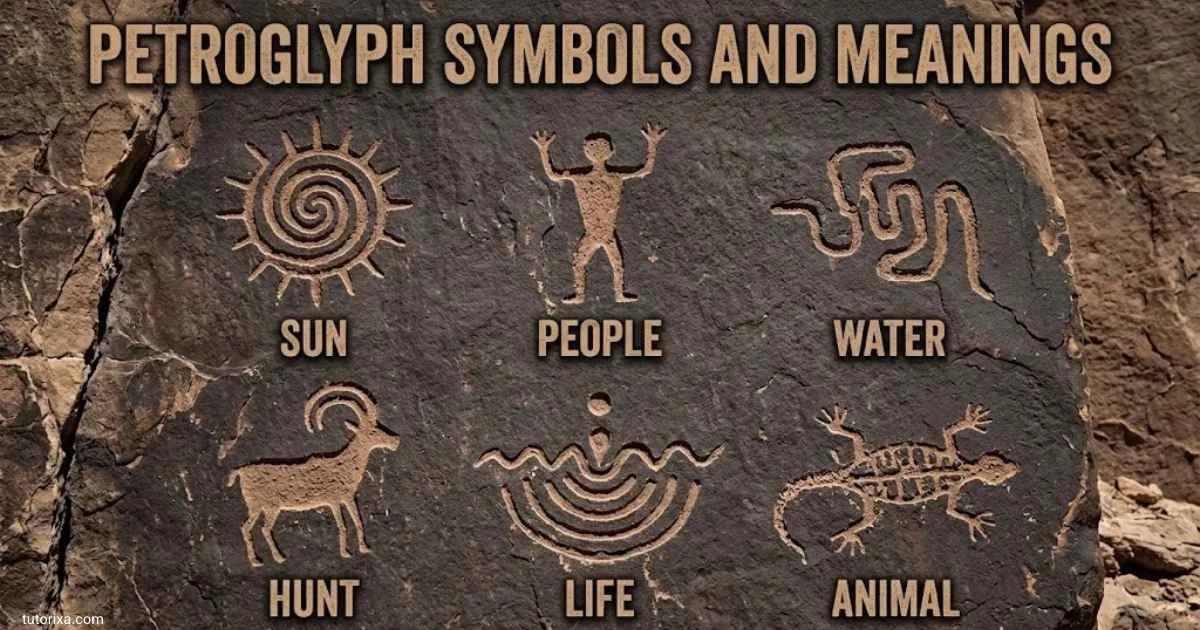
Petroglyphs are ancient designs carved, scratched, or pecked into natural rock surfaces. These markings offer clues about how people lived, what they believed, and how they understood the world around them. From spirals and circles to human figures and animal shapes, petroglyphs appear in many cultures and regions.
The meanings of petroglyphs symbols vary depending on the people who created them, the time period, and the place where they were found. Some may represent animals, water, travel, spiritual beliefs, or important events. Others remain difficult to interpret because their original creators left no written explanations.
In this guide, you will explore ancient petroglyphs symbols and meanings, recognizable examples, famous rock art sites, and designs associated with Native American, Anasazi, Navajo, Hawaiian, and Taíno cultures. You will also learn how petroglyphs differ from pictographs and why their meanings should be understood within their cultural and historical context.
Meaning Of Petroglyphs Symbols
Petroglyphs are images made by removing or disturbing the surface of rock. Ancient artists created them by pecking, scraping, incising, or grinding stone. Unlike paintings, which add pigment to a surface, petroglyphs change the rock itself.
The word petroglyph comes from Greek roots associated with stone and carving. These markings can be found on cliff faces, boulders, canyon walls, and exposed rock surfaces around the world.
A petroglyph does not always have one definite meaning. Researchers study its shape, location, age, surrounding images, and cultural connections to understand what it might represent.
Common Petroglyph Symbols And Their Possible Meanings
Spiral
A spiral may represent movement, cycles, growth, or a relationship with the natural world. Its meaning depends on the culture and the setting in which it appears.
Rings within rings may have been used in symbolic designs, maps, or ceremonial imagery. Some interpretations connect them with places or natural patterns, but no single meaning applies everywhere.
Animal figures
Animals such as sheep, deer, birds, and other local wildlife may reflect hunting, observation of nature, spiritual relationships, or cultural stories.
Human figures
Human-like forms may depict people, ancestors, ceremonial participants, or supernatural beings. Their posture and accompanying symbols can help researchers interpret them.
Radiating lines and circular patterns are sometimes interpreted as solar imagery. However, a circular carving with rays should not automatically be identified as a sun symbol.
Other recurring designs include zigzags, footprints, handprints, lines, grids, and abstract patterns. Some may relate to movement, landscape features, ceremonial practices, or ways of recording information.
The key point: a symbol’s appearance alone cannot prove its meaning. Archaeologists compare rock art with archaeological evidence, environmental conditions, and knowledge shared by descendant communities before proposing an interpretation.
Ancient Petroglyphs Symbols And Meanings
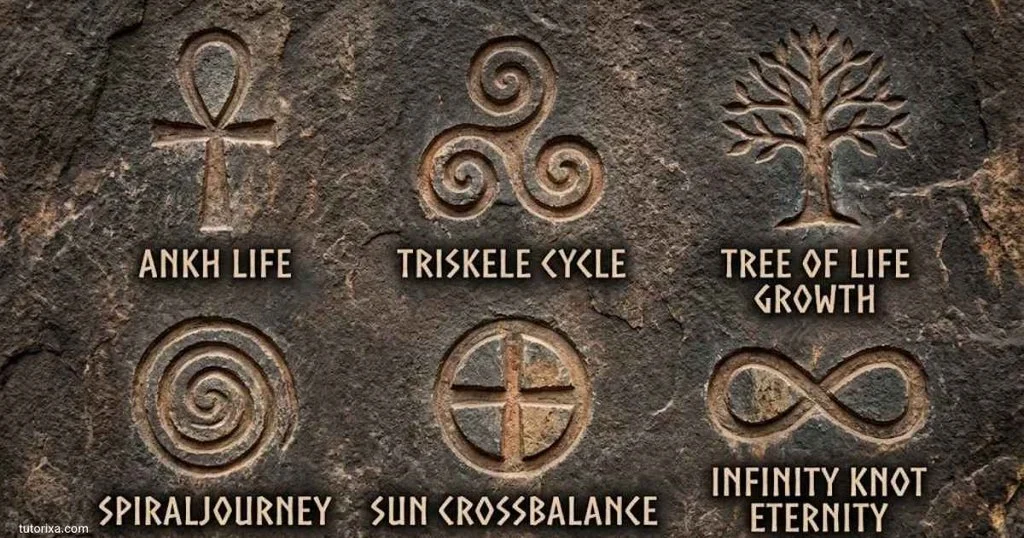
Ancient petroglyphs developed in different parts of the world over thousands of years. People carved images into rock long before modern writing systems became widespread. These markings could preserve memories, communicate important ideas, or connect people with places and traditions.
The age of a petroglyph varies by location. Some carvings are thousands of years old, while others were made during more recent historical periods. Archaeologists estimate their ages by studying the rock surface, overlapping carvings, nearby artifacts, and other evidence.
Common Ancient Petroglyph Designs
Hand images may record human presence, carry ceremonial significance, or form part of a cultural tradition. Some hand images are painted rather than carved, so the technique matters.
Footprints may represent people or animals, indicate movement, or carry symbolic meaning. Their purpose depends on the surrounding images and local traditions.
These patterns may resemble water, lightning, snakes, or other natural forms. Their appearance alone is not enough to establish what the original makers intended.
Multiple figures may record an activity, depict a story, or communicate a relationship between humans and animals. Some panels may have been created over long periods rather than during a single event.
Why Did Ancient People Make Petroglyphs?
There was no single reason for creating petroglyphs. Depending on the society, they may have served several purposes:
- Communication: Sharing messages or culturally important information.
- Ceremonies: Marking locations associated with spiritual practices.
- Travel and place marking: Recording routes, important locations, or visits.
- Cultural memory: Preserving stories, traditions, and significant events.
- Observations of nature: Depicting animals, landscapes, or celestial patterns.
These are possible purposes, not universal definitions. Some meanings remain known through living Indigenous traditions, while others cannot be established with confidence.
Petroglyphs Examples
Petroglyphs include recognizable figures, geometric patterns, and designs that are difficult to identify. Examining actual examples makes it easier to understand their variety without assuming every carving has a fixed meaning.
Sheep with curved horns appear in rock imagery across parts of the American Southwest. They may relate to wildlife, hunting, cultural stories, or other local traditions.
Human-shaped carvings are especially recognizable in Hawaiian rock imagery. Some Hawaiian petroglyphs are thought to have recorded births or other important events, although their precise meanings are not always known.
Spirals can be found in rock markings across many regions. Their interpretation may involve cultural beliefs, movement, or other ideas, but the same pattern can have different meanings in different places.
Canoe-shaped figures occur in Hawaiian petroglyph collections. They connect visually with the importance of ocean travel in Hawaiian life, although the purpose of any individual carving requires further evidence.
Rings, lines, and repeated shapes appear in many rock-art traditions. They may carry cultural significance even when their original meaning cannot be recovered.
When studying a petroglyph example, look at more than its outline. Notice nearby images, the natural landscape, signs of later carving, and any reliable interpretation from the people connected to the site.
Petroglyphs And Pictographs
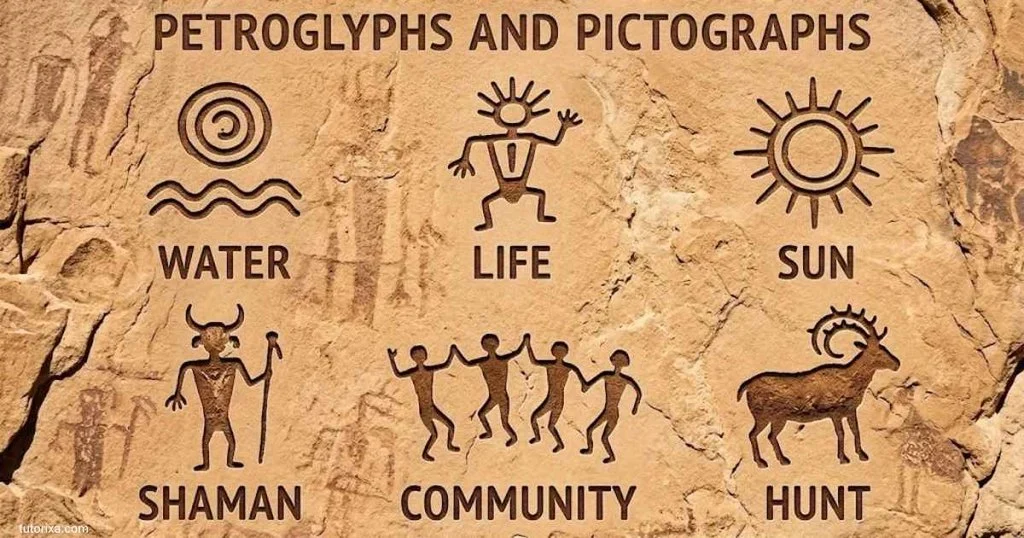
Petroglyphs and pictographs are both forms of rock imagery, but they are made differently. The simplest way to tell them apart is to ask whether the image was carved into the rock or applied to its surface.
Images created by pecking, cutting, scraping, or grinding a rock surface. Removing a darker outer coating can expose lighter stone beneath it.
Images painted or otherwise applied to rock. Traditional pigments may include mineral-based colors, such as red ochre, depending on the site and culture.
Petroglyphs Vs. Pictographs
| Feature | Petroglyphs | Pictographs |
| Main technique | Carving or pecking | Painting or applying pigment |
| Surface | Rock is physically altered | Color is added to the surface |
| Appearance | Grooves, pits, or exposed lighter rock | Colored lines, shapes, or figures |
| Preservation | Can weather and erode | Pigments can fade or flake |
| Meaning | Depends on cultural context | Also depends on cultural context |
Both forms can include animals, human figures, geometric designs, and abstract patterns. A single location may contain both, sometimes created by different people in different periods.
Neither form is automatically a written language. Some images may communicate information, but petroglyphs and pictographs should not all be treated as a universal code in which every shape translates into a particular word.
Famous Petroglyphs
Several well-known petroglyph sites preserve thousands of carvings and offer opportunities to study the relationship between people, landscapes, and cultural traditions.
This monument contains extensive carvings across volcanic rock. Many were created by ancestors of today’s Pueblo people, with other markings from different periods. Animal figures and abstract designs appear throughout the area.
This extensive Hawaiian site contains thousands of images carved into lava rock. Dots, human figures, and other designs are part of the cultural record known as kiʻi pōhaku.
Parowan Gap contains many carved rock panels. Its markings are associated with Indigenous cultural history, and the area remains important to modern Native communities.
Taíno carvings occur near caves and pools of water in this landscape. Their location offers clues to how the places may have been used for gatherings and communication with ancestors.
Famous sites should be approached as cultural places, not just collections of unusual symbols. Their setting, history, and continuing significance are essential parts of understanding them.
Native American Petroglyphs Symbols And Meanings
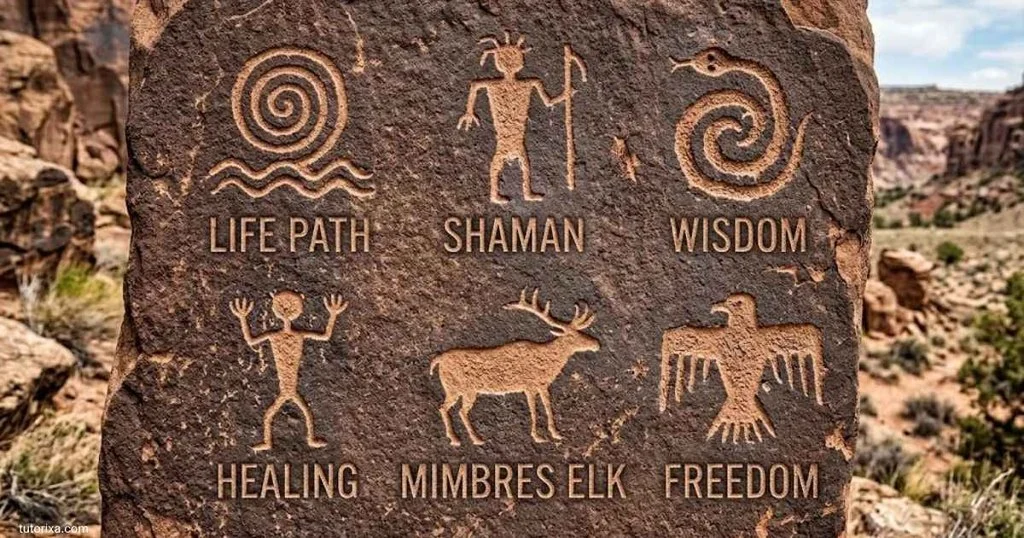
Native American petroglyphs come from many distinct Indigenous nations and communities across North America. There is no single set of Native American symbols with meanings that apply to every such as group.
Some carvings depict animals, human figures, hand-like forms, spirals, footprints, and abstract designs. Depending on their cultural setting, such markings may relate to ceremonies, travel, clan identity, sacred places, hunting, or important events.
Common Types Of Native American Petroglyphs
- Animal figures: May reflect relationships with local wildlife, hunting practices, stories, or spiritual traditions.
- Human-like figures: May represent people, ancestors, ceremonial figures, or other beings.
- Spirals and circles: May carry meanings tied to particular places, beliefs, or traditions.
- Footprints and tracks: May relate to movement, presence, or culturally significant journeys.
- Abstract patterns: May communicate ideas that are not obvious to an outside observer.
These descriptions are possibilities rather than a universal dictionary. For example, a spiral carved by one community cannot automatically be assigned the same interpretation as a similar spiral elsewhere.
How Native Communities Help Interpret Petroglyphs
Archaeologists study the location of carvings, associated objects, and the physical evidence left at a site. Knowledge holders and descendant communities may also preserve oral histories and cultural interpretations that help explain the images.
Some meanings are known only within particular communities or ceremonial contexts. Respecting that knowledge means recognizing that not every symbol needs to be publicly decoded or reduced to a simple definition. The National Park Service emphasizes that many rock markings remain part of living Indigenous traditions.
North American Petroglyphs Symbols And Meanings
North American petroglyphs appear across deserts, mountains, forests, coastal areas, and river valleys. Their styles reflect the different environments, histories, and cultural practices of the people who made them.
Some sites feature naturalistic animals, while others contain abstract patterns or combinations of human and animal forms. The range is too broad to explain through one universal symbol chart.
Regional Differences In North American Rock Markings
| Region | Commonly encountered imagery | Important consideration |
| Southwestern United States | Human figures, animals, spirals, geometric designs | Many sites are associated with ancestral and modern Pueblo communities |
| Great Basin | Animal forms, abstract patterns, and human-like figures | Interpretations vary by site and Indigenous tradition |
| Pacific Islands and coastal regions | Human figures, animals, and designs connected with local life | Regional cultural knowledge is essential |
| Caribbean | Anthropomorphic, zoomorphic, and symbolic carvings | Water, caves, and gathering places may be significant to site interpretation |
The categories in this table are broad examples, not strict regional boundaries. Similar-looking motifs can occur in distant areas without sharing the same meaning.
How To Interpret North American Petroglyphs
Start with the location and the evidence surrounding the carving. Ask who lived in the region, what archaeological remains have been found nearby, and whether the site has a known cultural connection.
Do not assume that all Indigenous carvings are ancient, either. Some were created in historical periods, and rock markings can represent multiple generations of activity. Studying their layers and context helps researchers distinguish different periods.
Southwest Petroglyphs Symbols
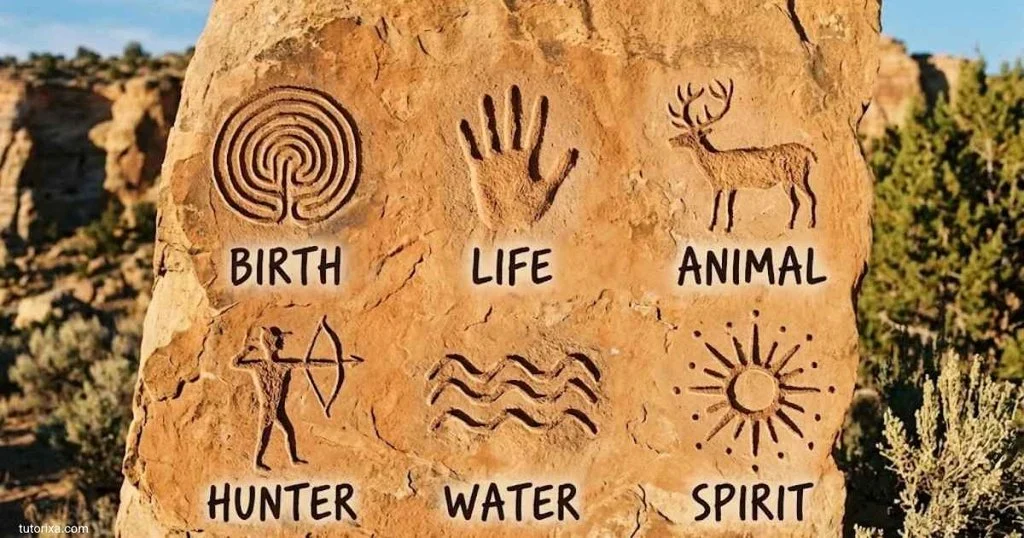
The American Southwest contains some of the best-known petroglyph sites in the United States. Rock carvings appear on sandstone cliffs, basalt boulders, canyon walls, and other natural surfaces across Arizona, New Mexico, Utah, and neighboring areas.
Many designs are associated with ancestral Pueblo communities, while other images belong to different Indigenous peoples or later historical periods.
Common Southwestern Petroglyph Motifs
Recognizable animal figures may reflect wildlife, hunting, stories, or other cultural relationships.
Spirals appear at numerous Southwestern sites. Their specific meaning must be established through local evidence rather than assumed from shape alone.
These can have cultural, ceremonial, or narrative significance. The figure’s features and nearby carvings may provide useful clues.
These markings may communicate ideas or form part of a larger visual tradition. Their meaning is not necessarily obvious from the image itself.
Why Location Matters In Southwestern Petroglyphs
The placement of a carving can be as important as the design. Its direction, relationship to nearby images, visibility from a trail, and position within the landscape may help explain why a particular place was chosen.
Petroglyph National Monument, for example, contains carvings connected with Pueblo cultural landscapes. Some meanings remain unknown to outside observers, while others retain significance for living communities.
If you encounter these markings in person, stay on designated paths and never scratch, trace, wet, or apply substances to the rock. Even small changes can damage fragile archaeological evidence.
Anasazi Petroglyphs Symbols And Meanings
The term Anasazi is a historical name often used for the people now more commonly called the Ancestral Puebloans. Many descendants prefer terms such as Ancestral Pueblo people or the names of specific Pueblo communities. Their ancestors created and used rock imagery across parts of the American Southwest.
Ancestral Pueblo petroglyphs include human-like figures, animals, spirals, geometric patterns, and other designs. These images are found near settlements, travel routes, and other culturally significant places.
Common Ancestral Pueblo Petroglyph Designs
- Human figures: May represent people, ceremonial participants, or other culturally significant beings.
- Animal carvings: May depict wildlife or reflect relationships between people and animals.
- Spirals and circles: May have specific cultural meanings connected with a site or tradition.
- Geometric designs: May communicate information or ideas that are difficult to interpret without further evidence.
- Groups of figures: May form part of a larger scene, story, or visual composition.
Some rock imagery in the Southwest is associated with Pueblo traditions that continue today. However, it would be inaccurate to assign one meaning to every ancestral symbol simply because it appears at a Pueblo-related archaeological site.
How Old Are Ancestral Pueblo Petroglyphs?
The age varies considerably by location. At Petroglyph National Monument, many carvings are believed to have been created between approximately 1300 and the late 1600s, although some images may be older and others belong to later historical periods.
Researchers use archaeological evidence, the relationship between overlapping markings, and comparisons with dated objects to estimate when carvings were made. The date of one image should not be applied automatically to every marking on the same rock.
Navajo Petroglyphs Meanings
Navajo, or Diné, cultural traditions are an important part of the history of the American Southwest. Petroglyphs found in areas associated with Diné communities can be understood through their local history, landscape, and cultural context.
It is important to distinguish Diné rock imagery from the work of neighboring Indigenous peoples. A carving’s location alone does not prove that Navajo people created it, because many sites were visited or used by different communities over time.
Possible Subjects In Rock Carvings
- Animals: May relate to local wildlife, stories, or culturally significant relationships.
- Human-like forms: May depict people or figures whose significance depends on the tradition.
- Geometric patterns: May communicate ideas or have meanings that are not obvious to outsiders.
- Landscape-related markings: May relate to important places, routes, or other features of the environment.
These are general categories, not a definitive guide to Navajo symbols.
Understanding Diné Cultural Context
Diné traditions include complex relationships among people, the natural world, spiritual beliefs, and culturally significant stories. Interpreting a particular petroglyph responsibly requires reliable information about the specific site and its connection to the people who created or maintained it.
Some Indigenous rock markings have meanings known through oral traditions, while others remain uncertain. The National Park Service explains that a symbol’s placement and relationship to surrounding carvings can be essential to its interpretation.
Avoid treating every spiral, animal, or human figure as an established Navajo symbol. When a reliable community source does not confirm a meaning, it is better to acknowledge the uncertainty than invent an explanation.
Hawaiian Petroglyphs Symbols And Meanings
Hawaiian petroglyphs are known as kiʻi pōhaku, a Hawaiian term for images carved into stone. Many are found on the Island of Hawaiʻi, where people created markings on hardened lava surfaces.
These carvings include human figures, dots, canoes, turtles, and other designs. Their meanings are not always known, although some have been interpreted as records of births or other significant events in people’s lives.
Common Hawaiian Petroglyph Symbols
Human-shaped carvings may be connected with individuals, family histories, or significant life events. The meaning of each image depends on its context.
Small depressions and dot patterns are prominent at some Hawaiian sites. Their purpose can vary, and not every dot pattern has a known explanation.
Canoe-shaped carvings connect visually with the importance of seafaring in Hawaiian history. The intended meaning of an individual image may remain uncertain.
Turtle-like figures appear among the designs recorded at Hawaiian petroglyph sites. Their presence does not establish a universal symbolic meaning.
Famous Hawaiian Petroglyph Locations
- Puʻuloa Petroglyph Field: Located within Hawaiʻi Volcanoes National Park, this extensive field contains thousands of carvings.
- Puakō Petroglyph Archaeological Preserve: Located along the Kohala Coast on Hawaiʻi Island, it preserves a large collection of carvings.
- Kaloko-Honokōhau National Historical Park: This park contains Hawaiian petroglyphs alongside other significant cultural and archaeological features.
These places offer insight into Hawaiian history, but their carvings should be interpreted with care and respect for Native Hawaiian cultural knowledge.
If you visit a petroglyph field, follow the site’s instructions and remain on designated walkways. Lava rock carvings can be damaged by direct contact, and many sites hold continuing cultural significance.
Taino Petroglyphs Symbols And Meanings
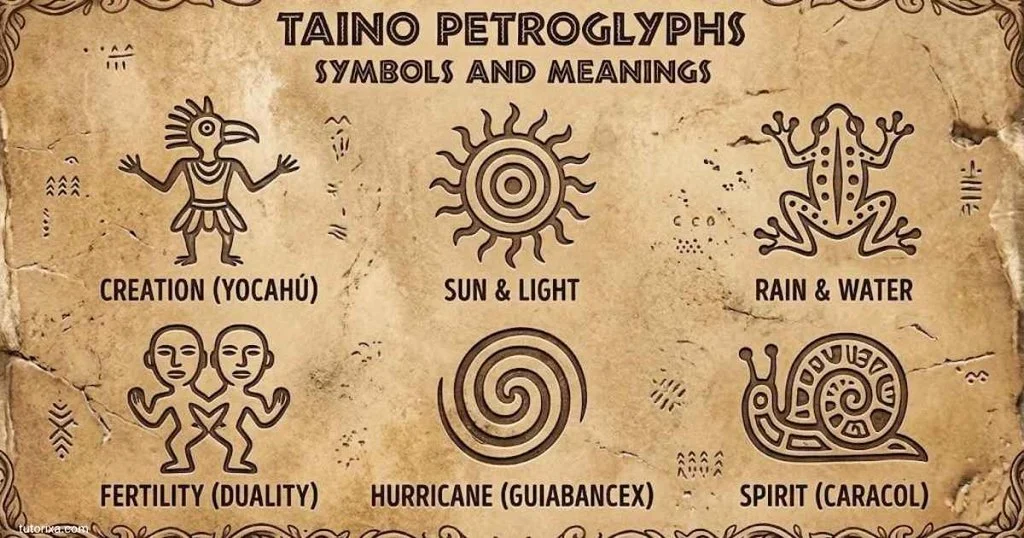
The Taíno were Indigenous peoples of the Caribbean, including communities across islands such as Hispaniola, Puerto Rico, Cuba, and Jamaica. Taíno petroglyphs provide evidence of cultural expression and the significance of particular landscapes.
Many Taíno carvings depict human-like faces, full human figures, animal-like forms, and abstract designs. They are found in places such as caves and near pools of water. Archaeological research suggests that some locations were associated with gatherings and communication with ancestors.
Common Types Of Taíno Petroglyphs
Face-like carvings are among the recognizable forms in Taíno rock imagery. They may relate to people, spiritual concepts, or other cultural ideas, depending on the evidence.
These are images with human features or human-like forms. Their exact identities and meanings cannot always be determined.
These carvings have recognizable or suggested animal features. Researchers consider their shape and setting when exploring possible interpretations.
Lines and other nonrepresentational forms may carry cultural meaning that cannot be identified from their appearance alone.
Why Caves And Water Matter
The placement of Taíno petroglyphs near caves and pools of water is an important clue in interpreting their use. According to the National Park Service, these accessible locations may have provided places where people gathered and communicated with ancestors.
This evidence helps explain why the location of a carving matters as much as its design. However, it does not mean every Taíno petroglyph found near water has the same purpose.
Taíno cultural heritage also continues through descendant communities. Their perspectives should be considered alongside archaeological research when discussing the meanings of these ancient carvings.
Frequently Asked Questions
What Do Petroglyphs Symbols Mean?
Petroglyphs can represent animals, people, cultural beliefs, important events, or abstract ideas. Their meanings depend on the people who created them and the setting in which they appear. Some interpretations are supported by cultural knowledge and archaeological evidence, while others remain uncertain.
How Old Are Petroglyphs?
Petroglyphs range from thousands of years old to markings created in more recent historical periods. Their age depends on the location and the people who made them. Researchers use archaeological evidence, geological clues, and comparisons with other dated materials to estimate when they were created.
What Is The Difference Between Petroglyphs And Pictographs?
Petroglyphs are carved, pecked, or scratched into rock, while pictographs are painted or applied to the surface. Both can depict people, animals, geometric patterns, and culturally significant ideas. A site may contain both types of markings.
Are All Native American Petroglyphs Symbols Of Spiritual Beliefs?
No. Some markings have spiritual or ceremonial significance, while others may relate to communication, travel, cultural identity, stories, or significant events. Their purposes vary among Indigenous communities, so it is inaccurate to assign every carving a religious meaning.
Where Can You See Famous Petroglyphs?
Well-known sites include Petroglyph National Monument in New Mexico, Parowan Gap in Utah, Puʻuloa Petroglyph Field in Hawaiʻi Volcanoes National Park, and Reef Bay in Virgin Islands National Park. Check official visitor guidance before traveling, and respect any access restrictions at these culturally significant places.
Conclusion
Petroglyphs symbols and meanings offer a fascinating way to explore the histories, beliefs, and experiences of people who lived long before modern written records. From spirals and animal figures to human shapes and geometric designs, these carvings preserve visual traces of different cultures and traditions.
The examples from Native American, Ancestral Pueblo, Navajo-associated, Hawaiian, and Taíno contexts show why location and cultural knowledge matter. Similar-looking symbols can have different meanings, and some carvings cannot be interpreted with certainty. Understanding these differences helps prevent misleading assumptions about ancient rock imagery.
When exploring petroglyphs, look beyond the shape of each carving. Consider its age, surroundings, cultural connections, and the evidence supporting its interpretation. Above all, treat these markings with respect, since many remain important parts of Indigenous heritage and living traditions.

I’m Freddie Beaumont, a British author with a passion for discovering what symbols communicate without words. I write about their history, meanings, and everyday uses in an accessible way. I believe symbols tell fascinating stories about people, cultures, and ideas, and my work helps readers recognise and understand those stories more clearly.
Books:
- Symbols and Their Hidden Meanings
- Understanding Signs and Symbols
 Ellis Montgomery
 Rowan Whitaker