
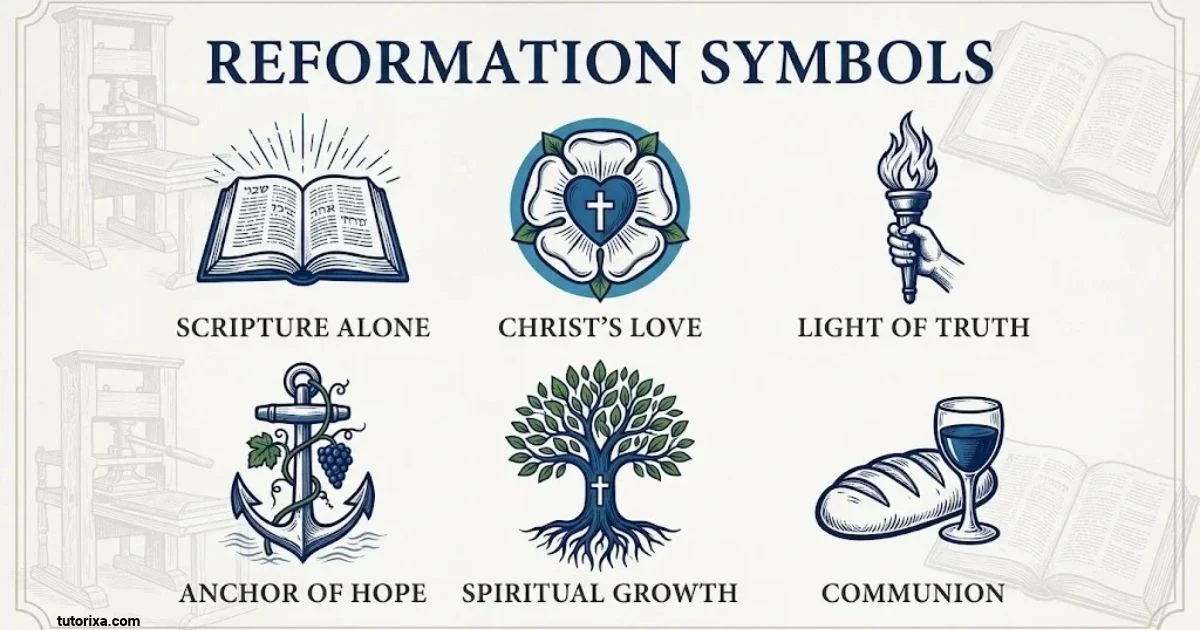
Reformation symbols carry powerful stories of faith, change, and religious identity. From the famous Protestant rose to the Luther seal, these symbols represent ideas that shaped Christianity and transformed religious history. Each emblem has a deeper meaning that connects people to the beliefs and events of the Protestant Reformation.
But what do these symbols actually represent, and why have they remained important for centuries? If you want to understand the stories behind these historic signs, you’re about to discover a fascinating part of religious history.
In this guide, you’ll explore important Reformation symbols, their meanings, origins, and historical significance. I’ll help you understand how these emblems reflect Protestant beliefs, spiritual values, and the movement that changed the course of Christianity.
What Are Reformation Symbols?
Reformation symbols are religious signs, images, and visual designs associated with the Protestant Reformation and the wider religious changes that took place in Europe during the 16th century.
The Protestant Reformation began in 1517, when Martin Luther challenged certain practices and teachings of the Catholic Church. His ideas helped inspire new Christian movements, including Lutheran and Reformed traditions.
Symbols played an important role in expressing these changing beliefs. They helped churches communicate religious ideas, identify their traditions, and explain important teachings to their communities.
Some symbols were created specifically during the Reformation, while others existed in Christianity long before it began.
Popular Reformation Symbols And Their Meanings
Here are some recognizable symbols connected to the Reformation and the Christian traditions that developed around it.
| Symbol | Name | Meaning |
| 🌹 | Luther Rose | Faith, salvation, and joy in Christ |
| ✝ | Christian Cross | The crucifixion and resurrection of Jesus |
| 📖 | Open Bible | Scripture and the authority of God’s Word |
| 🕊 | Dove | Holy Spirit and peace |
| 🍷 | Communion Cup | The Lord’s Supper and Christ’s sacrifice |
| 🍞 | Bread | Communion and the body of Christ |
| 🔥 | Flame | Faith, spiritual renewal, and the Holy Spirit |
| ⚓ | Anchor | Christian hope and steadfast faith |
| 🐟 | Ichthys (Fish) | Christian identity and belief in Jesus |
| ☀ | Sun | Light, truth, and divine guidance |
These are illustrative representations, not a single official collection of Reformation symbols. Their meanings can also differ between Christian denominations.
Why Were Symbols Important During The Reformation?
Symbols helped people understand and communicate religious beliefs at a time of major disagreement and change.
Their importance included:
- Religious identity: Churches used distinctive designs to represent their traditions.
- Teaching: Images helped communicate biblical stories and Christian beliefs.
- Faith: Religious symbols reminded believers of important spiritual teachings.
- Communication: Printed illustrations and religious emblems helped spread ideas.
- Historical recognition: Certain designs became lasting signs of particular denominations.
The Luther Rose is one of the clearest examples of a symbol directly associated with a major Reformation leader.
Protestant Reformation Symbols
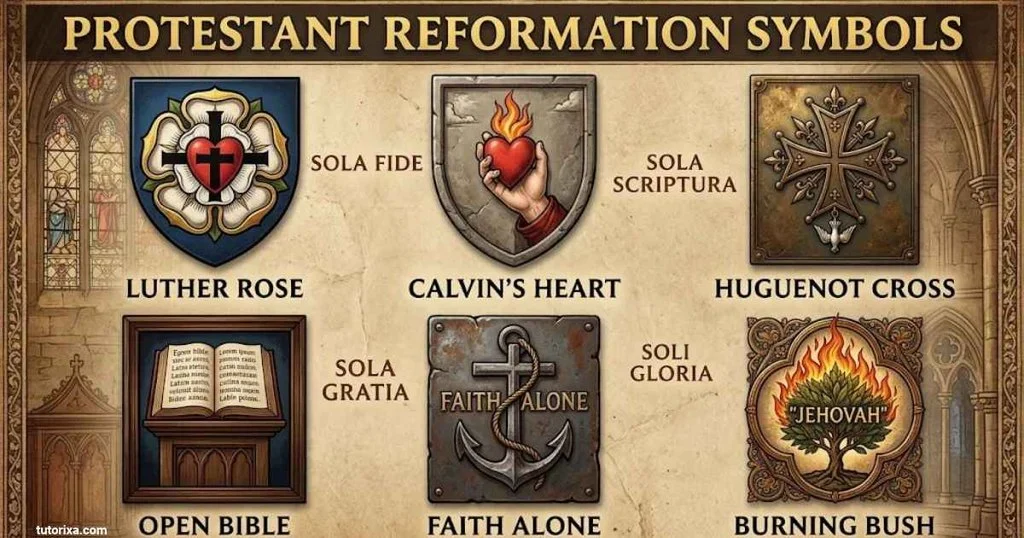
Protestant Reformation symbols represent the religious ideas, teachings, and movements that emerged during the 16th-century Reformation.
Many Protestant reformers emphasized the importance of Scripture, faith in Jesus Christ, and salvation through God’s grace. Their religious artwork and visual designs often reflected these beliefs.
Luther Rose 🌹
The Luther Rose is one of the most recognizable symbols of the Protestant Reformation.
Its design contains several elements:
- Black cross: Represents faith in Jesus Christ and His crucifixion.
- Red heart: Represents the human heart and faith.
- White rose: Represents the joy, peace, and comfort that faith brings.
- Blue background: Represents heavenly joy and hope.
- Golden ring: Represents eternal heavenly blessings.
Martin Luther explained the meaning of this seal in a letter to Lazarus Spengler dated July 8, 1530. The design became an important symbol of Lutheran Christianity.
Christian Cross ✝
The cross represents the crucifixion of Jesus Christ and His sacrifice for humanity.
For Protestant Christians, it is a central reminder of salvation through Christ.
Open Bible 📖
The open Bible represents the importance of Scripture in Protestant Christianity.
Many Reformers emphasized that Christians should have access to biblical teachings and understand God’s Word.
Dove 🕊
The dove represents the Holy Spirit, peace, and spiritual guidance.
It is a familiar Christian symbol used in different Protestant traditions.
Communion Cup
The communion cup represents the Lord’s Supper, an important Christian practice that remembers the Last Supper of Jesus.
Different Protestant denominations understand the meaning of Communion in different ways.
Flame 🔥
The flame can represent the Holy Spirit, spiritual renewal, and the strength of faith.
It is also used in some modern Protestant church logos and religious designs.
These symbols help explain the religious ideas behind the Reformation, although not all of them originated during that period.
Protestant Symbols
Protestant symbols are visual representations of Christian faith used by Protestant churches and denominations. Some are shared across Christianity, while others have particular connections to Lutheran, Reformed, Anglican, and other Protestant traditions.
Here are some popular Protestant symbols and their meanings.
| Symbol | Name | Meaning |
| ✝ | Cross | Jesus Christ’s sacrifice and resurrection |
| 🌹 | Luther Rose | Lutheran faith and salvation |
| 📖 | Bible | Authority of Scripture |
| 🕊 | Dove | Holy Spirit and peace |
| 🐟 | Ichthys | Christian faith and identity |
| 🍞 | Communion Bread | The Lord’s Supper |
| 🍷 | Communion Cup | Christ’s sacrifice and Communion |
| 🔥 | Flame | Spiritual renewal |
| ⚓ | Anchor | Hope and steadfast faith |
| Α Ω | Alpha And Omega | God as the beginning and the end |
Common Protestant Denominational Symbols
Different Protestant denominations have their own recognizable religious emblems.
Lutheran symbol: The Luther Rose is closely associated with Lutheran churches and institutions.
Reformed symbol: The burning bush is used by some Reformed and Presbyterian churches. It represents the biblical account of Moses and the burning bush that was not consumed.
Anglican symbol: The compass rose is associated with the worldwide Anglican Communion. It represents the Anglican tradition and its international identity.
Methodist symbol: The cross and flame represents the United Methodist Church. The cross recalls Christ, while the flame represents the Holy Spirit and Pentecost.
Baptist symbol: The open Bible and cross are commonly used in Baptist church logos to represent Scripture and faith in Christ.
These symbols are useful for recognizing different Protestant traditions, but their designs and uses can vary between churches.
Lutheran Reformation Symbols
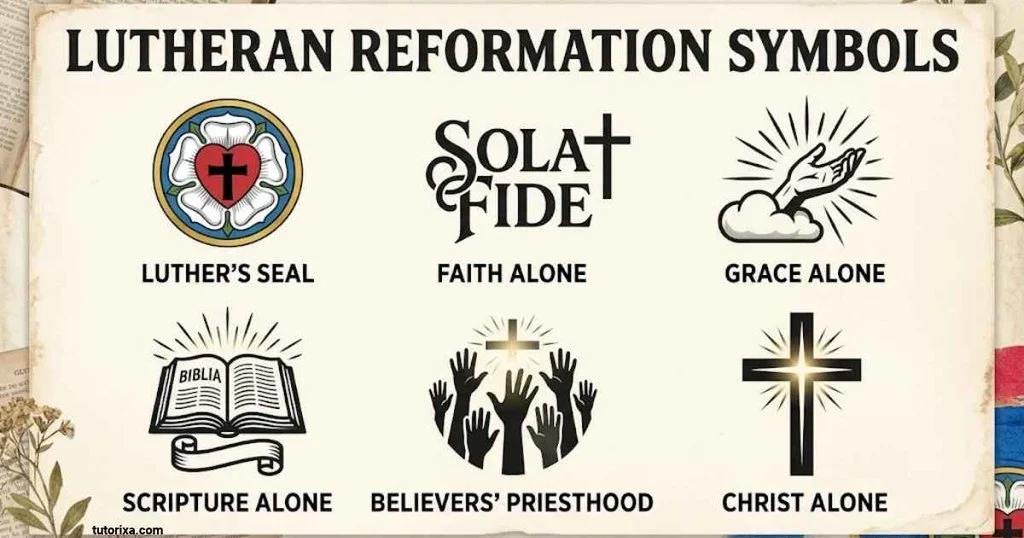
Lutheran Reformation symbols are closely connected to the teachings of Martin Luther and the development of Lutheran Christianity.
Lutheran churches use several religious designs to represent their beliefs, history, and identity. The Luther Rose is the most famous example.
Luther Rose
The Luther Rose is the central symbol of Lutheran Christianity.
Its black cross, red heart, white rose, blue background, and golden ring communicate important ideas about faith, salvation, joy, and eternal life.
It is commonly displayed on Lutheran church buildings, publications, educational materials, and religious items.
The Christian Cross
The cross represents Jesus Christ’s sacrifice and the Christian belief in salvation.
Lutheran churches use different cross designs, including simple crosses and crucifix designs.
The Open Bible
The Bible represents the importance of Scripture in Lutheran teaching.
Luther’s translation of the Bible into German also helped make biblical texts more accessible to ordinary readers.
The Chalice
The chalice represents Holy Communion, one of the central practices of Lutheran worship.
It reminds believers of the Last Supper and the promises associated with Christ’s body and blood.
The Reformation Anniversary Seal
Modern Lutheran organizations sometimes use anniversary emblems inspired by the Luther Rose.
These designs celebrate the history of the Reformation and its continuing influence on Lutheran churches.
Protestant Symbol vs Catholic Symbol
Protestant and Catholic symbols share many Christian themes, including the cross, Jesus Christ, the Bible, and the Holy Spirit. However, their religious artwork and traditional imagery can differ.
The main differences are connected to their traditions, worship practices, and views about religious images.
Protestant And Catholic Symbols Compared
| Feature | Protestant Symbols | Catholic Symbols |
| Cross | Often a simple empty cross | Crucifix with Jesus’ body is widely used |
| Bible | Strong emphasis on Scripture | Used alongside Sacred Tradition |
| Mary | Respected in many traditions, with varying devotional practices | Important figure in Catholic devotion |
| Saints | Practices vary; generally no Catholic-style veneration | Saints are honored and venerated |
| Religious Images | Use varies by denomination | Images of Jesus, Mary, and saints are widely used |
| Communion | Beliefs about Christ’s presence vary | Eucharist is central to Catholic worship |
| Rosary | Not generally a central Protestant practice | Important Catholic devotional prayer |
Important Differences Between The Symbols
1. The Cross And Crucifix
✝ — The cross is commonly used in Protestant churches to represent the death and resurrection of Jesus.
A crucifix is a cross displaying the body of Jesus. It is particularly associated with Catholic religious traditions.
2. The Bible
📖 — Protestant traditions generally emphasize Scripture as the highest authority for Christian doctrine.
Catholic Christianity recognizes the authority of Scripture and Sacred Tradition, interpreted within the teaching authority of the Church.
3. Mary And The Saints
Catholic churches frequently use images of Mary and the saints as part of religious devotion.
Protestant traditions differ in their treatment of these images. Some use religious artwork extensively, while others prefer simpler church interiors.
4. The Eucharist And Communion
🍞 🍷 — Both Catholics and Protestants celebrate Communion, but they understand its meaning differently.
Catholics teach the doctrine of transubstantiation, while Protestant denominations have different teachings about Christ’s presence in Communion.
Neither tradition has just one universal visual style. These differences describe broad religious traditions rather than every individual church.
Catholic Reformation Symbols
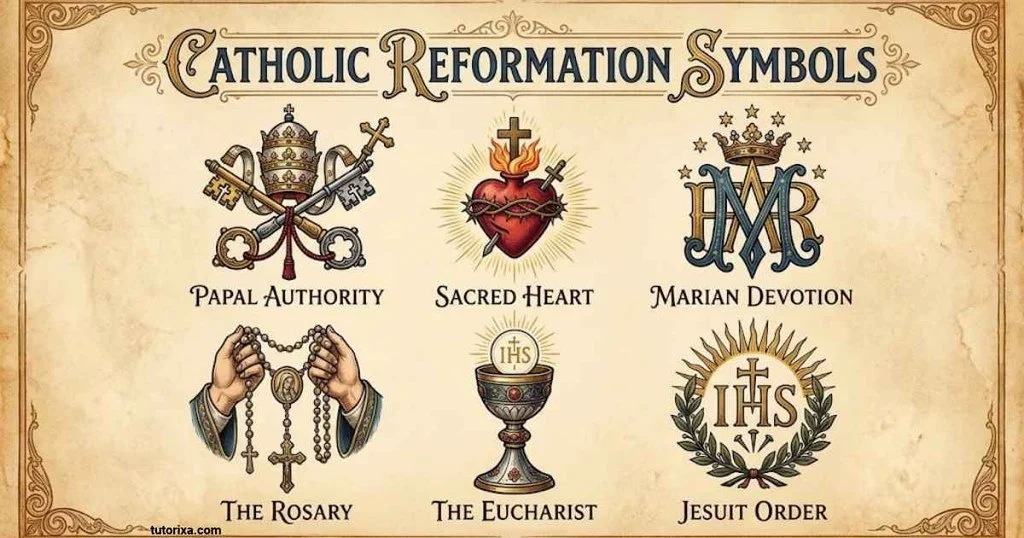
Catholic Reformation symbols are religious images and objects associated with Catholic renewal during the 16th and 17th centuries.
The Catholic Reformation, also known as the Counter-Reformation in many historical discussions, sought to strengthen Catholic teaching, renew religious life, and respond to Protestant challenges.
Catholic religious artwork became an important way to communicate Christian beliefs and encourage devotion.
Sacred Heart Of Jesus ❤️
The Sacred Heart represents the love, mercy, and sacrifice of Jesus Christ.
It is often shown as a heart surrounded by flames, with a crown of thorns and sometimes a cross.
The image expresses Christ’s love for humanity and became especially important in Catholic devotion.
The Marian Lily ⚜
The lily is associated with purity and is frequently used in Christian artwork connected with the Virgin Mary.
It also appears in images of saints, especially Saint Joseph and Saint Gabriel, depending on the artistic context.
The Rosary
The rosary is a Catholic prayer devotion using a string of beads.
Its beads help worshippers keep track of prayers while meditating on important events in the lives of Jesus and Mary.
The Eucharist
The Eucharist represents the body and blood of Christ under the forms of bread and wine.
A common Catholic symbol is a golden monstrance displaying the consecrated host.
The Crucifix
The crucifix shows Jesus on the cross and reminds believers of His suffering and sacrifice.
It is widely used in Catholic churches, homes, and devotional objects.
The Keys Of Saint Peter 🔑
The crossed keys represent Saint Peter and his traditional role in Catholic teaching.
They are connected to the biblical passage in Matthew 16:19 and are also used in the coat of arms of the papacy.
These symbols illustrate important aspects of Catholic religious identity and devotional practice.
Counter Reformation Symbols
Counter-Reformation symbols are religious images, objects, and artistic themes associated with the Catholic Church’s response to the Protestant Reformation.
The Counter-Reformation was a major period of Catholic renewal. The Council of Trent, held between 1545 and 1563, played a significant role in clarifying Catholic teachings and addressing religious practices.
The council also reaffirmed the appropriate use of sacred images. Religious artwork was intended to teach biblical stories, encourage devotion, and help believers understand Christian teachings.
Popular Counter-Reformation Symbols And Their Meanings
| Symbol | Name | Meaning |
| ❤️ | Sacred Heart | Christ’s love and mercy |
| ✝ | Crucifix | Jesus’ sacrifice |
| ⚜ | Fleur-de-lis | Often associated with Mary and purity in Christian art |
| 🔑 | Crossed Keys | Authority associated with Saint Peter |
| 🕊 | Holy Spirit Dove | Divine guidance and spiritual presence |
| 🍷 | Eucharistic Chalice | The Eucharist |
| 🌹 | Marian Rose | Love and devotion associated with Mary |
| 👑 | Crown Of Mary | Mary’s queenship in Catholic tradition |
| ☀ | Eucharistic Sunburst | Glory and divine presence associated with the Eucharist |
The Sacred Heart
The Sacred Heart became a recognizable expression of devotion to Jesus.
Its imagery focuses on Christ’s compassion, suffering, and love for humanity.
The Immaculate Conception
Images of the Immaculate Conception became an important part of Catholic religious art.
Mary is often shown standing on a crescent moon, surrounded by rays of light or stars. The imagery represents the Catholic belief that Mary was preserved from original sin from the first moment of her conception.
The Eucharistic Monstrance
The monstrance is a sacred vessel used to display the consecrated host during Catholic worship.
Its sunburst design symbolizes the glory and holiness associated with the Eucharist.
Saints And Angels
Paintings and sculptures of saints and angels became important features of Catholic devotional art.
They helped communicate religious stories, highlight examples of Christian virtue, and encourage spiritual reflection.
Baroque Religious Artwork
Dramatic lighting, expressive figures, rich colors, and detailed compositions became recognizable features of much Counter-Reformation-era Baroque art.
These artistic techniques helped create powerful religious experiences for viewers.
The Counter-Reformation did not introduce an entirely new set of Christian symbols. Instead, it reinforced and developed existing Catholic imagery while emphasizing its proper religious use.
Renaissance And Reformation Symbols
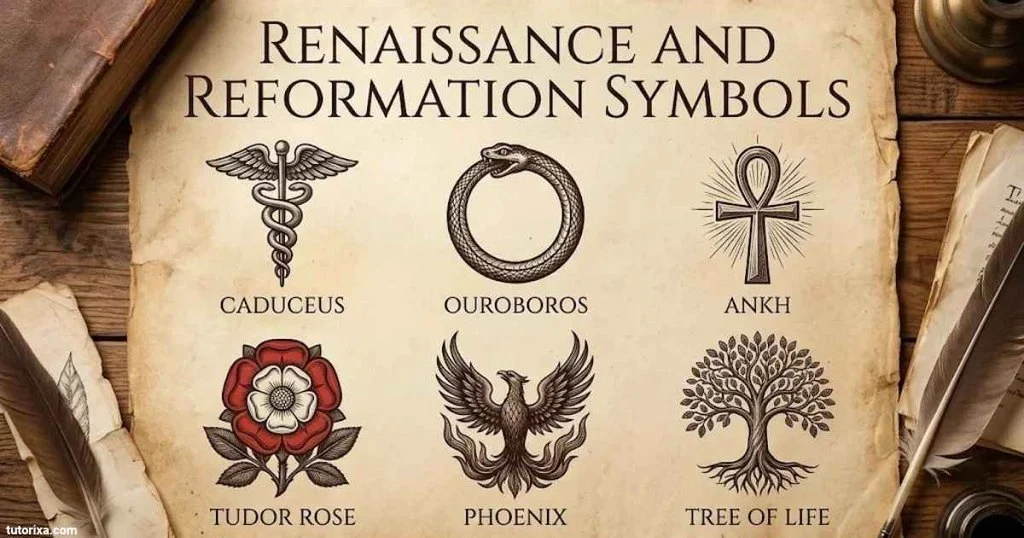
The Renaissance and Reformation were two important movements that transformed European culture, religion, education, and art.
The Renaissance began before the Protestant Reformation and encouraged renewed interest in classical learning, humanism, science, and artistic expression.
The Reformation brought major changes to Christian religious beliefs and practices.
Although these movements had different goals, they overlapped in time and influenced each other.
Common Renaissance Symbols
| Symbol | Name | Meaning |
| ☀ | Sun | Light, knowledge, and divine power |
| 🌿 | Laurel Wreath | Victory, honor, and achievement |
| ⚜ | Fleur-de-lis | Purity and royal identity in different traditions |
| 🕊 | Dove | Peace and the Holy Spirit |
| 🪽 | Angel Wings | Spiritual presence and divine messages |
| 📖 | Book | Learning, knowledge, and religious teachings |
| 🏛 | Classical Architecture | Ancient Greek and Roman influence |
These symbols appeared in different forms of Renaissance art and culture. Their meanings depended on the artwork and historical setting.
Common Reformation Symbols
| Symbol | Name | Meaning |
| 🌹 | Luther Rose | Lutheran faith |
| ✝ | Cross | Christian salvation |
| 📖 | Open Bible | Scripture and religious teaching |
| 🕊 | Dove | Holy Spirit |
| 🔥 | Flame | Faith and spiritual renewal |
| 🍷 | Communion Cup | The Lord’s Supper |
How Were The Two Movements Connected?
The Renaissance helped create an environment in which education, printing, and the study of ancient texts became increasingly important.
The Reformation benefited from these developments.
For example:
- Printing press: Helped distribute Reformation writings and translated Bibles.
- Humanism: Encouraged the study of original biblical and classical texts.
- Religious artwork: Continued to communicate Christian ideas across different traditions.
- Education: Increased interest in reading, learning, and religious instruction.
- Books and illustrations: Made religious arguments accessible to wider audiences.
One important difference is that Renaissance symbols often reflected broader cultural and artistic interests, while Reformation symbols were more directly connected to religious debates and Christian beliefs.
Reformation Drawing Easy
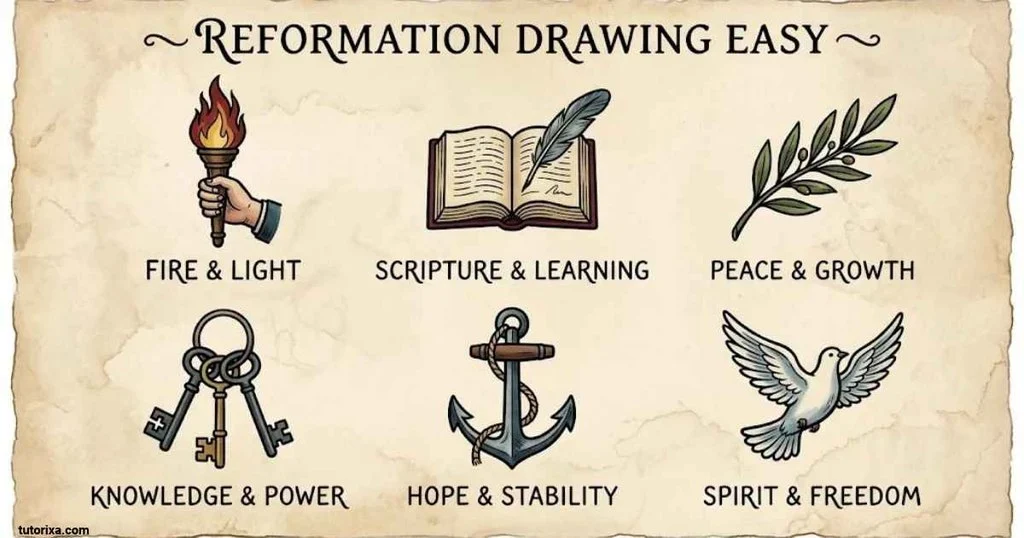
Drawing Reformation symbols is a simple way to understand the history and religious ideas associated with the movement.
You do not need advanced artistic skills. Start with basic shapes and choose recognizable designs such as the Luther Rose, a Christian cross, or an open Bible.
Easy Luther Rose Drawing
The Luther Rose is a good choice for a Reformation-themed drawing because its design contains several meaningful elements.
Steps to draw it:
- Draw a small circle in the center.
- Add a heart shape inside the circle.
- Draw a simple black cross inside the heart.
- Create five rounded petals around the heart.
- Draw a larger circle around the rose.
- Add a blue background and golden outer ring.
Color the heart red, the rose white, and the cross black to represent the traditional design.
Easy Christian Cross Drawing
The Christian cross is one of the simplest Reformation-related symbols to draw.
Steps:
- Draw one long vertical line.
- Add a shorter horizontal line across its upper section.
- Make both lines thicker.
- Add simple decorative details if desired.
You can draw an empty cross or a traditional crucifix depending on the religious tradition you want to represent.
Easy Open Bible Drawing
An open Bible is another suitable drawing for a school project.
Steps:
- Draw two slightly curved rectangular shapes.
- Connect them in the middle to create the book’s spine.
- Add several short lines to represent written text.
- Draw a small cross on the front or above the pages.
- Add color to make the design attractive.
Easy Reformation Poster Idea
You can combine several symbols into one simple poster.
Include these elements:
- Luther Rose in the center.
- Open Bible underneath.
- Christian cross at the top.
- Martin Luther’s name on one side.
- The year 1517 on the other side.
- A short title such as “The Protestant Reformation.”
This layout works well for classroom assignments, history projects, and religious education activities.
Frequently Asked Questions About Reformation Symbols
What Is The Main Symbol Of The Protestant Reformation?
The Luther Rose is one of the most recognizable symbols associated with the Protestant Reformation. It represents faith in Jesus Christ, salvation, spiritual joy, and eternal hope.
What Does The Luther Rose Symbolize?
The Luther Rose represents important Christian beliefs. Its black cross represents Christ’s sacrifice, the red heart represents faith, the white rose represents joy and peace, the blue background represents heavenly hope, and the golden ring represents eternity.
What Is The Difference Between Protestant And Catholic Symbols?
Protestant symbols often emphasize the cross, Bible, and teachings of Scripture. Catholic symbols frequently include the crucifix, rosary, Sacred Heart, images of Mary, and saints. Both traditions share many Christian symbols.
What Symbols Represent The Counter-Reformation?
Common Catholic imagery associated with the Counter-Reformation includes the Sacred Heart, crucifix, Eucharistic monstrance, Virgin Mary, saints, and angels. These images helped communicate Catholic teachings and encourage religious devotion.
Can I Use Reformation Symbols In School Projects?
Yes. You can use symbols such as the Luther Rose, Christian cross, open Bible, and dove in history assignments, educational posters, and religious presentations. Include their names and meanings to make your project more informative.
Conclusion
Reformation symbols provide a visual connection to one of the most important periods in Christian history. From the Luther Rose to the Christian cross and open Bible, these designs communicate beliefs about faith, salvation, Scripture, and religious identity.
Protestant and Catholic traditions share many symbols, but they also have distinctive images that reflect their teachings and practices. The Renaissance and Counter-Reformation further influenced how religious ideas were represented through paintings, sculptures, books, and church decorations.
Understanding these symbols makes it easier to recognize their historical and religious importance. You can also use simple designs such as the Luther Rose, cross, and open Bible for educational drawings, classroom posters, and history projects.

I’m Ellis Montgomery, a British writer interested in the powerful language of symbols. I explore everything from traditional emblems and cultural signs to contemporary symbols found in modern life. My aim is to explain their meanings clearly while revealing the stories and ideas behind them, making symbolism fascinating and accessible to everyone.
Books:
- The Complete Book of Symbols
- Hidden Messages in Everyday Symbols
 Rowan Whitaker
 Freddie Beaumont