
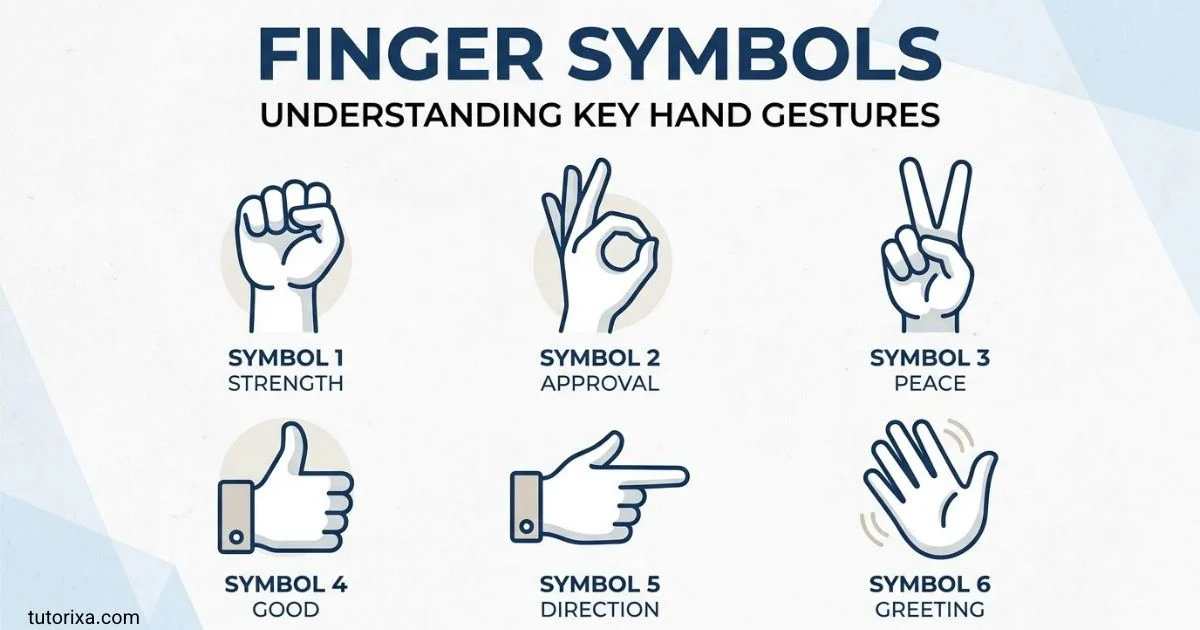
Have you ever seen someone make a hand gesture and wondered what it really means? Finger symbols can communicate peace, friendship, confidence, love, or even disrespect without saying a single word. However, the meaning isn’t always as obvious as it seems.
I find the world of finger symbols fascinating because a simple gesture can carry different meanings depending on the culture, situation, and person using it. You might recognize a thumbs-up or a peace sign, but other hand gestures have surprising histories and interpretations that are worth discovering.
In this guide, you’ll explore popular finger symbols, their meanings, cultural significance, and everyday uses. Whether you’re curious about hand gestures, learning about symbolism, or trying to understand nonverbal communication, you’ll find helpful explanations to make sense of these familiar signs.
Quick Meaning of Finger Symbols
Finger symbols are hand gestures or stylized finger images that represent emotions, ideas, beliefs, or instructions. Common examples include the thumbs-up for approval, crossed fingers for hope or luck, the peace sign for peace or victory, and the index finger pointing toward something. Their meanings vary by culture, context, and how the gesture is performed.
Finger Symbols Overview Table
The following table explains common finger gestures, their typical meanings, and important cultural considerations.
| Finger Symbol or Gesture | Primary Meaning | Category | Common Context | Modern Interpretation |
| Thumbs-up 👍 | Approval or agreement | Social gesture | Conversation and messaging | Good, accepted, or positive |
| Thumbs-down 👎 | Disapproval | Social gesture | Reviews and reactions | Negative or rejected |
| Index finger pointing ☝️ | Attention or direction | Communication | Teaching and instructions | Look here or one important point |
| Index finger pointing down 👇 | Direction toward something below | Digital communication | Social media captions | See below or follow this link |
| Crossed fingers 🤞 | Hope or good luck | Cultural gesture | Personal wishes | Hoping for a positive outcome |
| Peace sign ✌️ | Peace or victory | Social and political gesture | Photos and demonstrations | Peace, friendliness, or celebration |
| Raised index and middle fingers | Two or a V-shaped gesture | Social gesture | Informal conversation | Meaning depends on orientation and context |
| Middle finger 🖕 | Insult or defiance | Social gesture | Informal communication | Strong offense in many settings |
| OK hand 👌 | Agreement or approval in some contexts | Social gesture | Conversation and messaging | OK, correct, or satisfactory |
| Pinched fingers 🤌 | Emphasis or expressive questioning | Cultural gesture | Conversation and online messages | Varies considerably by context |
| Shaka hand 🤙 | Friendly greeting or relaxed attitude | Regional gesture | Surf culture and informal settings | Hang loose or friendly connection |
| Rock-on hand 🤘 | Rock music or enthusiasm | Music-related gesture | Concerts and entertainment | Music, excitement, or identity |
| Love-you hand 🤟 | I love you in American Sign Language | Signed communication | Deaf culture and messaging | A sign combining the handshapes for I, L, and Y |
| Raised index finger | One, attention, or emphasis | Communication | Teaching and discussion | One moment, one point, or listen |
| Finger heart 🫰 | Affection or love | Popular culture | Korean popular culture and social media | Small, playful expression of love |
| Interlocked or clasped fingers | Connection or cooperation | Body language | Personal interaction | Meaning depends on the action and situation |
Important: A hand gesture does not always have one universal meaning. The same finger position can represent different ideas in different countries, communities, and communication systems.
What Do Finger Symbols Mean?
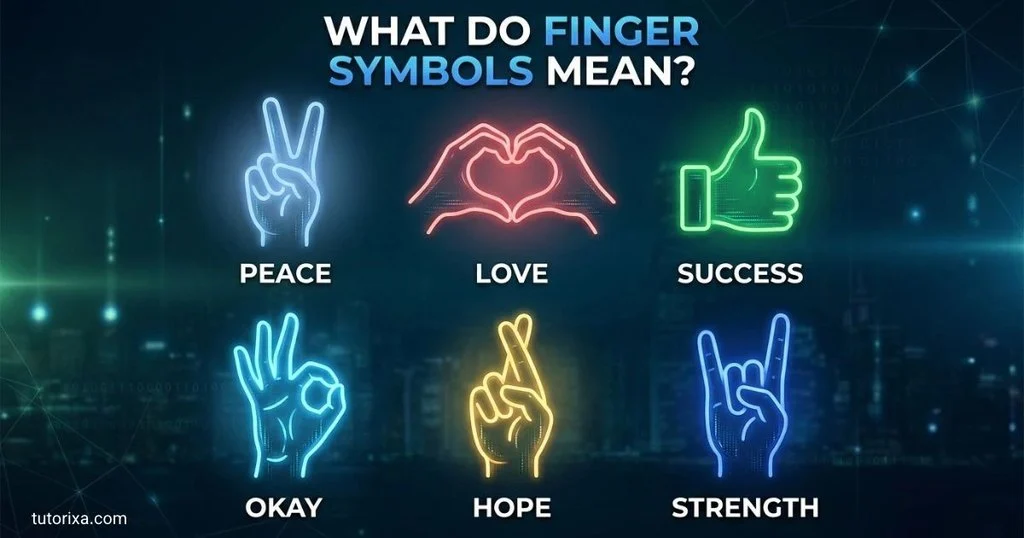
Finger symbols represent a wide range of messages, from simple approval to complex cultural or linguistic meanings. Their interpretation depends on which fingers are extended, how the palm faces, whether the hand moves, and what is happening around the gesture.
1. Thumbs-Up: Approval and Agreement
The thumbs-up gesture usually communicates approval, acceptance, encouragement, or a positive response in many contemporary settings.
You might use it to tell someone that a plan sounds good, acknowledge a message, or show that you agree without speaking. In digital communication, the thumbs-up emoji serves a similar purpose.
However, its meaning is not identical everywhere. In some cultural contexts, a thumbs-up has been considered rude or overly informal. Its interpretation also depends on the relationship between the people communicating.
2. Crossed Fingers: Hope and Good Luck
Crossing the index and middle fingers commonly represents hope, luck, or a wish for a favorable result.
Someone might cross their fingers before an exam, during a job application process, or while waiting for important news. The gesture can communicate optimism without a spoken explanation.
In some English-speaking contexts, crossed fingers have also been associated with wishing that an untrue statement will escape consequences. This less straightforward interpretation shows why the surrounding situation matters.
3. Peace Sign: Peace, Victory, and Friendship
The V-shaped gesture, made by extending the index and middle fingers, has several widely recognized meanings.
It became strongly associated with peace activism during the twentieth century, while the same shape has also been used to represent victory. In casual photographs, it can simply communicate friendliness or playfulness.
Palm orientation can affect interpretation in some countries. A V sign with the palm facing inward may be offensive in certain British and other cultural contexts, even though the outward-facing version is commonly used for peace or victory.
4. Pointing Fingers: Direction and Attention
Pointing gestures direct another person’s attention toward an object, location, person, or idea.
An extended index finger can indicate a direction, emphasize a statement, or introduce an important point. On websites and social media, pointing-finger emojis often direct readers toward a link, caption, comment, or item below an image.
Pointing directly at a person can seem confrontational or impolite in some situations. The gesture’s meaning depends on the setting and the relationship between the people involved.
5. Middle Finger: Defiance and Insult
The raised middle finger is a widely recognized obscene gesture in many parts of the world. It can express anger, contempt, hostility, or defiance.
Its use in memes and online conversations may sometimes be intended as humor among friends, but that does not make it universally harmless. In workplaces, schools, formal events, and unfamiliar social settings, the gesture can cause offense.
6. OK Hand: Agreement and Approval
The OK hand gesture is commonly formed by touching the thumb and index finger to make a circle while extending the other fingers.
In many contexts, it means “OK,” “correct,” or “everything is fine.” It may also be used to indicate precision or satisfaction.
However, the gesture has acquired other meanings in different settings, including political associations. It should not be assigned a single universal interpretation without considering who is using it and why.
7. Finger Heart: Affection and Appreciation
The finger heart is a small gesture formed by crossing the thumb and index finger to create a heart-like shape.
It became particularly recognizable through Korean popular culture, including K-pop performances, celebrity photographs, and fan interactions. People now use it in social media posts and everyday photographs to express affection, appreciation, or playful friendliness.
Unlike a full hand-shaped heart, the finger heart can be made quickly with one hand. Its small size has helped it become a recognizable symbol in digital culture.
History and Origin of Finger Symbols
Finger symbols developed through many different traditions rather than from one single source. Ancient gestures, religious hand positions, military signals, political movements, and modern digital communication all contribute to the meanings people recognize today.
Ancient Civilizations and Hand Gestures
Human beings have used gestures for communication long before the development of modern messaging platforms.
Ancient Greek and Roman art depicts hand positions used in public speaking, religious ceremonies, social interaction, and political life. Writers and artists sometimes represented gestures as part of a person’s character or role.
The historical meaning of an individual gesture can be difficult to establish because a hand position in an ancient artwork does not necessarily have the same meaning it has today. Researchers must consider the artwork’s date, cultural setting, and intended subject.
Roman History and the Middle Finger
The middle finger has a long history as an obscene gesture. Ancient Greek and Roman sources describe gestures involving the finger in insulting or sexually suggestive contexts.
This historical evidence shows that some finger gestures have been used for insult for many centuries. However, it does not prove that every modern gesture has remained unchanged since antiquity.
The Peace Sign in the Twentieth Century
The V sign gained prominent political and public associations during the twentieth century. It was used as a victory gesture during World War II and later became strongly associated with peace movements, particularly during the Vietnam War era.
Its meaning expanded through photographs, public demonstrations, popular music, and television. Today, people may use the same gesture to communicate peace, victory, or simple friendliness.
The Growth of Digital Finger Symbols
Smartphones and social media transformed familiar gestures into standardized digital characters.
The Unicode Standard includes emoji characters for common hand gestures, allowing supported devices and applications to exchange them as text. Their appearance varies by platform, but their encoded identity helps maintain compatibility across systems.
Digital culture has also created new conventions. The finger heart, for example, became more widely recognizable through entertainment, celebrity culture, and online fan communities.
Symbolism and Interpretation of Finger Gestures
Finger gestures often communicate emotion quickly, but their meanings are influenced by social expectations and personal relationships.
Positive Symbolism
Some finger gestures are commonly associated with encouragement, connection, or goodwill.
- Thumbs-up: Approval and support.
- Crossed fingers: Hope and good luck.
- Peace sign: Peace, friendliness, or victory.
- Finger heart: Affection and appreciation.
- Love-you hand: A specific expression associated with American Sign Language and commonly adapted into popular culture.
These meanings are common rather than universal. Even a positive gesture can feel inappropriate if it conflicts with the situation.
Negative Symbolism
Other gestures communicate anger, disapproval, or disrespect.
- Thumbs-down: Rejection or a negative judgment.
- Middle finger: Insult or defiance.
- Aggressive pointing: Accusation or confrontation in some situations.
The emotion behind a gesture may also be ambiguous. A person might use a thumbs-down as a joke rather than a serious rejection, particularly among friends.
Psychological Interpretation
Gestures can help people communicate when speech is difficult, unnecessary, or less effective than a visual signal.
A familiar hand movement may also reinforce a spoken message. For example, someone can point toward a doorway while giving directions or raise one finger to emphasize a single important instruction.
However, a gesture alone cannot reliably reveal a person’s thoughts, personality, honesty, or emotional state. Body language is influenced by culture, individual habits, disability, and context. It is more accurate to interpret gestures alongside words and other observable information than to treat them as psychological proof.
Cultural Significance of Finger Symbols
Finger symbols have different meanings across cultures because gestures develop within particular social traditions. A movement that seems friendly in one country may be offensive, confusing, or unfamiliar in another.
The Thumbs-Up Across Cultures
The thumbs-up is widely used for approval in the United States and many other places. It appears in workplace messages, product reviews, informal conversations, and social media reactions.
However, the gesture has been regarded as insulting or vulgar in some cultural settings. Its interpretation has also changed over time, so broad claims that it always means the same thing in a particular country can be misleading.
When traveling, pay attention to local customs rather than assuming that familiar gestures are universally understood.
The V Sign in Britain and Other Countries
The V sign illustrates how palm orientation can change a gesture’s interpretation.
With the palm facing outward, the gesture commonly communicates peace or victory. In some British and related cultural contexts, turning the palm inward can make the gesture offensive.
This distinction is useful because two people may make nearly identical hand shapes while communicating very different messages.
The OK Gesture Around the World
The circle formed by the thumb and index finger commonly means “OK” in the United States and many other settings.
In other cultural contexts, similar hand shapes may have different meanings or be considered impolite. The gesture has also been used in political debates, demonstrating that contemporary events can add new associations to an existing sign.
A person’s intention, the surrounding conversation, and the relevant cultural context all matter.
The Shaka Gesture in Hawaiian and Surf Culture
The shaka is commonly formed by extending the thumb and little finger while curling the middle three fingers.
It is strongly associated with Hawaii, where it can communicate friendliness, gratitude, greeting, or a relaxed sense of connection. The gesture also spread through surf culture and is now recognized in many places outside Hawaii.
Although people sometimes describe it as meaning “hang loose,” its use can communicate more than relaxation. In Hawaii, it can be an everyday expression of goodwill and social connection.
Finger Gestures in South Asian Cultures
In South Asia, hand movements are part of everyday conversation, religious practice, dance, and traditional arts. Their meaning depends on the specific gesture and the setting.
For example, mudras are meaningful hand positions used in Hindu and Buddhist religious traditions, as well as in classical Indian dance. A mudra may represent a concept, convey a narrative, or serve a ritual purpose.
These formal gestures should not be confused with ordinary finger signs such as thumbs-up or pointing. Their meanings are often shaped by specific artistic, religious, or textual traditions.
Religious and Spiritual Meaning of Finger Symbols
Finger symbols can carry religious and spiritual significance, particularly in traditions that use prescribed hand positions during prayer, meditation, ritual, or sacred art.
Mudras in Hinduism and Buddhism
Mudras are symbolic hand gestures used in several Indian religious and artistic traditions. They appear in sculptures, paintings, ritual practices, and meditation contexts.
Different mudras can communicate ideas such as teaching, reassurance, meditation, generosity, or the transmission of knowledge. Their interpretations depend on the specific hand position, religious tradition, and visual context.
For example, Buddhist images may depict the Buddha with a hand raised in a gesture commonly interpreted as reassurance or protection. Other hand positions can represent teaching or meditation.
A mudra’s meaning should be identified from its recognized form and religious context rather than guessed from a photograph.
Hand Gestures in Christian Art
Christian art sometimes depicts religious figures with specific hand positions. These may communicate blessing, teaching, or other aspects of a sacred scene.
The exact meaning depends on the artistic tradition and the figure being represented. A raised hand in a painting, for example, may be part of a blessing gesture rather than a general sign of approval.
Not every hand gesture appearing in religious art has a formal religious meaning. Some simply help illustrate an action or convey an emotion.
Finger Gestures in Prayer and Meditation
People may bring their fingertips together, fold their hands, or adopt prescribed hand positions during prayer or meditation.
These practices can encourage concentration or express reverence, depending on the tradition. However, touching the fingers together does not automatically constitute a religious mudra, and similar movements can have entirely ordinary meanings.
The most reliable interpretation comes from the practice in which the gesture appears.
Scientific and Technical Meaning of Finger Symbols
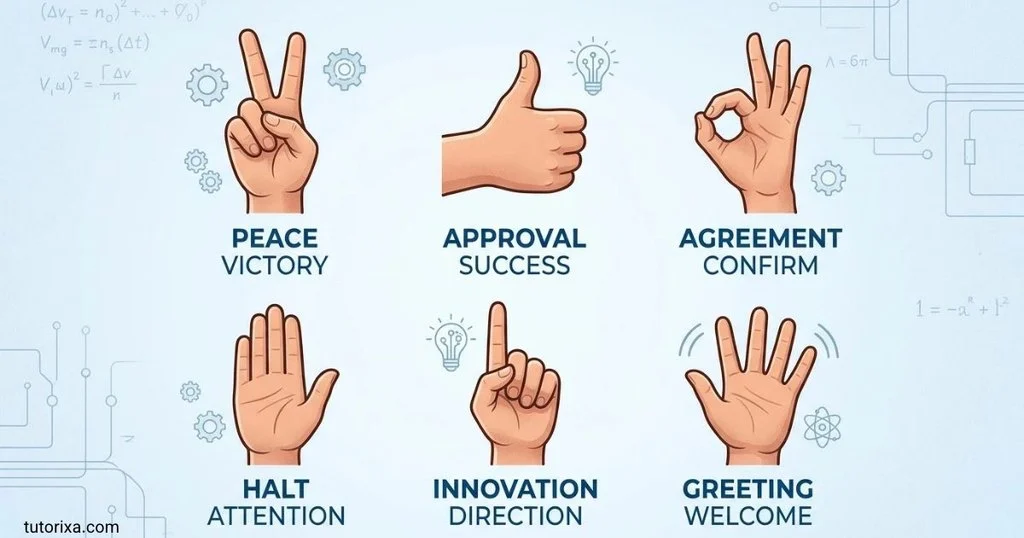
Finger symbols have practical uses in communication systems, medicine, accessibility, and digital technology. In these settings, the hand position may represent a defined instruction or linguistic unit rather than an informal emotion.
Finger Symbols in Sign Languages
Sign languages are complete natural languages with their own grammars, vocabulary, and regional variations. They use handshapes, movement, location, orientation, and facial expressions to convey meaning.
For example, American Sign Language (ASL) includes a handshape commonly used for the letters I, L, and Y in the manual alphabet. The familiar “I love you” handshape combines these three letter handshapes by extending the thumb, index finger, and little finger.
This sign is not simply an improvised symbol for love. It is associated with ASL and has spread into popular culture.
Important: ASL is not a universal sign language. British Sign Language, Pakistan Sign Language, and other sign languages have their own linguistic systems. A gesture recognized in one sign language may have a different meaning or no established meaning in another.
Finger Counting and Mathematics
Finger counting is one of the most familiar uses of hand gestures. People use their fingers to represent quantities, track steps, teach arithmetic, and communicate numbers.
However, finger-counting systems vary. Some people begin counting with the thumb, while others begin with the index finger. Different communities may use different hand positions to represent the same number.
This variation matters in international communication because a numerical hand sign should not automatically be assumed to have a universal meaning.
Finger Symbols in Medicine
Healthcare professionals may use hand movements to give instructions, demonstrate exercises, or assess specific physical functions. A clinician might ask someone to move a finger, touch the thumb to each fingertip, or follow a moving object with their eyes.
These actions are practical examination or communication tasks rather than symbolic gestures with fixed cultural meanings.
The interpretation depends on the clinical purpose. A finger movement used in a neurological examination, for example, should not be treated as equivalent to an informal hand sign.
Finger Symbols in Digital Communication
Unicode supports many emoji representing hands and fingers. These characters allow users to send standardized text-based symbols through compatible devices and applications.
Examples include:
- 👍 Thumbs-up
- 👎 Thumbs-down
- 🤞 Crossed fingers
- ✌️ Victory hand
- 👌 OK hand
- 🤟 Love-you gesture
- 🤘 Sign of the horns
- 🤌 Pinched fingers
- 🫰 Hand with index finger and thumb crossed
The emoji’s appearance may differ between Apple, Google, Microsoft, and other platforms. The underlying character is standardized, but its visual design and perceived tone may vary.
Where Finger Symbols Are Used
Finger symbols appear in many areas of everyday life, from casual conversation to formal systems of communication.
Everyday Conversation
People use gestures to agree, disagree, point toward objects, count, greet friends, or emphasize a statement.
In many situations, a gesture can replace a short spoken response. A thumbs-up may communicate agreement, for example, while pointing can make directions easier to follow.
Social Media and Messaging
Finger emojis are common in text messages, comments, captions, and online reactions.
The pointing-down emoji may direct readers toward a link or explanation. Crossed fingers can express hope about an upcoming event, while a finger heart can convey affection.
However, an emoji can appear more casual, sarcastic, or dismissive than its sender intended. Consider the recipient and conversation before choosing a gesture.
Photography and Entertainment
People frequently use peace signs, finger hearts, and rock-on gestures in photographs, music videos, and performances.
These gestures can communicate a mood or help establish a recognizable style. Their meaning may also depend on the artist, fandom, or cultural community using them.
Education and Public Speaking
Teachers, presenters, and speakers use their fingers to count points, direct attention, or emphasize an idea.
Raising one finger may mean “one moment” or “I have one point to make.” Pointing toward a chart can help an audience connect spoken information with a visual reference.
The gesture’s usefulness comes from its relationship to the message, not from a universal symbolic meaning.
Religion, Art, and Architecture
Finger gestures appear in religious sculptures, paintings, murals, and traditional dance.
In these settings, hand positions can communicate narratives, sacred concepts, blessings, or formal teachings. Interpreting them correctly may require knowledge of the relevant artistic or religious tradition.
Accessibility and Communication
Hand gestures can support communication when speech is impractical. They may also form part of established communication systems used by Deaf communities.
However, informal gestures are not substitutes for learning a sign language when effective communication with a sign-language user is important.
Common Variations of Finger Symbols
Finger symbols can vary in hand shape, orientation, movement, and cultural interpretation.
Palm Orientation
The direction of the palm can change the meaning of a gesture. The V sign is a clear example because outward-facing and inward-facing versions may carry different associations.
When identifying a gesture from a photograph, examine the palm as well as the extended fingers.
Finger Position and Movement
Small changes in finger position can distinguish one sign from another. The thumb may touch the index finger, the fingers may cross, or the hand may move repeatedly.
In sign languages, these details can be essential to meaning. A handshape that looks similar to another sign may communicate a different word or grammatical function.
One-Handed and Two-Handed Gestures
Some gestures can be made with one hand, while others require both hands or involve coordinated movement.
The finger heart usually uses one hand, whereas a full hand-shaped heart generally uses both hands. Both can express affection, but their visual forms differ.
Traditional and Modern Variations
Traditional gestures may gain new meanings through music, sports, politics, or online culture.
The peace sign, for example, is now used in casual photographs as well as in political contexts. Similarly, the finger heart spread from popular culture into everyday messaging.
A gesture’s modern popularity does not erase its earlier associations. It adds another layer of meaning.
Common Misconceptions About Finger Symbols
Misconception 1: Every finger gesture has one universal meaning.
Finger gestures depend on culture, context, and performance. The same handshape can communicate different things in different settings.
Misconception 2: Sign language is just a collection of gestures.
Sign languages are complete natural languages with grammar and vocabulary. They are not simply informal hand signals or direct visual versions of spoken languages.
Misconception 3: Crossed fingers always mean good luck.
Crossed fingers commonly express hope or luck, but the gesture can also carry other meanings in particular situations. The context determines the likely interpretation.
Misconception 4: The OK hand always means everything is fine.
Although the gesture commonly communicates approval, it has different associations in some cultures and political contexts. It should not automatically be interpreted as a friendly sign in every setting.
Misconception 5: A finger gesture reveals someone’s true feelings.
A gesture alone cannot reliably establish a person’s emotions or intentions. Someone might use a gesture jokingly, habitually, or for a practical reason.
Misconception 6: Emoji look identical on every device.
Unicode standardizes emoji characters, but companies create their own designs. A hand’s shape, skin tone, and overall appearance may differ between platforms.
Misconception 7: Every religious hand position is a mudra.
Mudra is a term associated with specific symbolic hand gestures in particular traditions. An ordinary hand position in a religious painting or personal prayer is not automatically a formally recognized mudra.
10 Interesting Facts About Finger Symbols
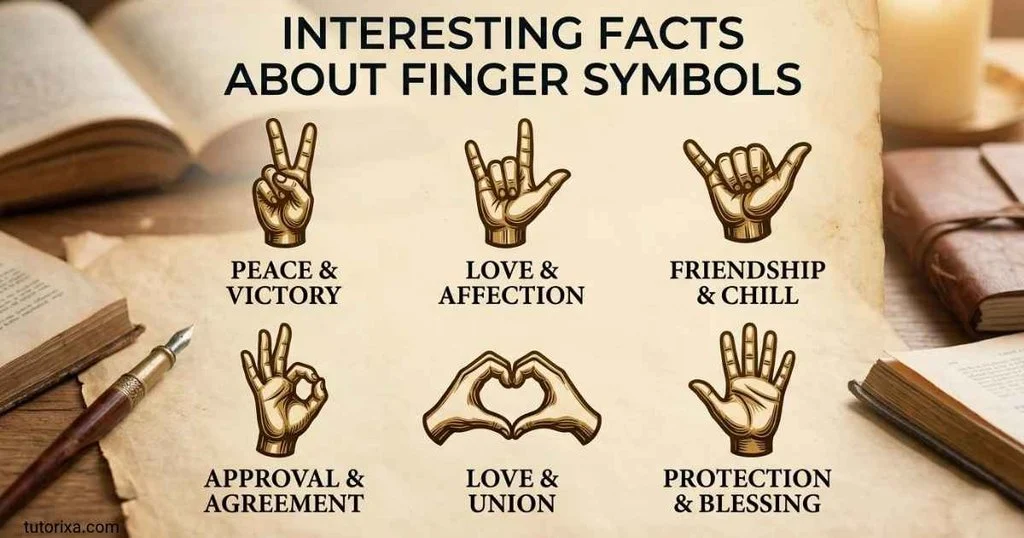
1. Gestures can communicate without speech. A familiar hand sign can convey approval, direction, or a greeting when speaking is difficult or unnecessary.
2. Palm orientation can matter as much as finger position. Two V signs may look similar but carry different associations because the palm faces a different direction.
3. Finger gestures have long histories. Ancient Greek and Roman sources document insulting gestures, showing that some forms of nonverbal communication have persisted for centuries.
4. The peace sign has several modern meanings. It can represent peace activism, victory, or a casual pose in a photograph.
5. The finger heart became widely recognized through popular culture. Korean entertainment and celebrity interactions helped spread this gesture internationally.
6. Sign languages use precise handshapes. In a natural sign language, a small difference in hand position or movement can change the meaning of a sign.
7. Finger counting varies between communities. Different people begin counting with different fingers, and the same number may be represented by different hand configurations.
8. Emoji have standardized character identities. Unicode allows supported systems to exchange the same emoji character, even though the artwork may look different.
9. A gesture can change meaning over time. Popular culture, politics, and social media can add new associations to familiar hand movements.
10. Context is essential to interpretation. A raised finger may mean “one,” “wait,” or “listen,” depending on the conversation and how the gesture is performed.
Related Symbols and Their Meanings
Finger symbols are connected to other forms of nonverbal communication, including hand gestures, facial expressions, and written emoji. Understanding these related symbols helps explain how people communicate visually.
| Related Symbol | Meaning | How It Differs |
| Hand symbols | General gestures made with the hand | Include palm positions and movements beyond individual fingers |
| Heart symbol ❤️ | Love, affection, or care | Represents an idea through a stylized heart rather than a finger gesture |
| Peace symbol ☮️ | Peace and antiwar movements | A graphic emblem rather than the two-finger V gesture |
| Handshake 🤝 | Agreement, cooperation, or partnership | Represents interaction between people |
| Wave 👋 | Greeting or farewell | Usually involves movement of the hand |
| OK symbol 👌 | Agreement or approval in many settings | Uses a circle formed by the thumb and index finger |
| Rock-on sign 🤘 | Rock music, enthusiasm, or group identity | Often associated with music culture |
| Shaka 🤙 | Friendly greeting or relaxed attitude | Extends the thumb and little finger |
| Love-you hand 🤟 | A sign associated with ASL | Combines specific letter handshapes |
| Raised fist ✊ | Solidarity, resistance, or determination | Uses a closed fist rather than extended fingers |
These symbols can overlap in meaning, but they are not interchangeable. For example, the peace symbol is a distinct graphic emblem, while the V-shaped peace sign is a hand gesture. Both may communicate peace, yet their histories and uses differ.
Frequently Asked Questions About Finger Symbols
1. What are finger symbols?
Finger symbols are gestures or visual representations made with one or more fingers to communicate ideas, emotions, instructions, or cultural messages. Examples include the thumbs-up, peace sign, crossed fingers, and finger heart. Their meanings depend on cultural background, hand orientation, movement, and the situation in which someone uses them.
2. What does the two-finger sign mean?
The two-finger V sign commonly represents peace, victory, or friendliness. Its meaning can change depending on the direction of the palm and the cultural setting. In some British contexts, the inward-facing version can be offensive. In photographs, however, the outward-facing version is often used as a casual, cheerful pose.
3. What does crossing your fingers symbolize?
Crossing the index and middle fingers commonly expresses hope or a wish for good luck. Someone might make this gesture before an important exam, a competition, or a job interview. In some English-speaking contexts, crossed fingers can also be associated with insincerity or hoping to escape the consequences of an untrue statement.
4. What does the finger heart symbol mean?
The finger heart is formed by crossing the thumb and index finger to create a small heart-like shape. It commonly expresses affection, appreciation, or playful friendliness. The gesture became especially recognizable through Korean popular culture and K-pop fan interactions before spreading more widely through social media and everyday photographs.
5. What is the difference between 🤟 and 🤘?
The 🤟 emoji represents the love-you handshape associated with American Sign Language, combining the handshapes for I, L, and Y. The 🤘 emoji represents the sign of the horns, often associated with rock music and enthusiasm. Although their shapes look similar, their conventional meanings and cultural associations differ.
6. Are finger symbols universal across cultures?
No. Some gestures are widely recognized internationally, but their meanings can vary significantly. A thumbs-up may express approval in one setting but cause offense in another. Palm orientation, social relationships, and regional customs can all affect interpretation. When traveling, it is best to learn local conventions rather than assume a gesture means the same thing everywhere.
7. What do finger symbols mean in sign language?
In sign languages, handshapes and finger positions form part of a structured linguistic system. Their meaning depends on hand orientation, movement, location, facial expressions, and grammar. American Sign Language and British Sign Language, for example, are distinct languages. Informal gestures should not be assumed to have the same meaning in every sign language.
8. What does the middle finger symbol mean?
The raised middle finger is a widely recognized obscene gesture that commonly expresses contempt, anger, or defiance. Its historical roots extend to ancient Greek and Roman sources. Although people sometimes use it jokingly among friends or in online memes, it can still be highly offensive in formal, professional, or unfamiliar social situations.
9. What does the OK finger symbol mean?
The OK gesture is usually made by touching the thumb and index finger together to form a circle. It commonly means approval, agreement, or that something is satisfactory. However, its interpretation can differ across cultures and political contexts. Consider the setting and the person’s intended message before assuming it always communicates approval.
10. Why do finger symbols look different on different phones?
Finger emojis can look different because Apple, Google, Microsoft, and other platforms create their own artwork for Unicode characters. The underlying character may be the same even when its shape, shading, proportions, or visual style differs. These design differences can affect how a gesture appears, although they do not necessarily change its intended meaning.
Key Takeaways
- Finger symbols communicate emotions, ideas, instructions, and cultural messages through hand gestures.
- Common examples include the thumbs-up, peace sign, crossed fingers, finger heart, and middle finger.
- Gesture meanings depend on culture, palm orientation, movement, and context.
- The same gesture may express friendliness in one setting and offense in another.
- Mudras carry specific symbolic meanings in several Hindu and Buddhist traditions.
- Sign languages use structured handshapes and movements as part of complete natural languages.
- Finger-counting systems differ across communities and cultures.
- Unicode supports standardized emoji characters, but their visual designs vary by platform.
- A finger gesture alone cannot reliably establish someone’s feelings or intentions.
- Learning local customs helps prevent misunderstandings when communicating across cultures.
Conclusion
Finger symbols are a fascinating part of human communication because a small movement can express approval, hope, affection, defiance, or an entire linguistic message. From the thumbs-up used in everyday conversations to the mudras found in religious art and the handshapes used in sign languages, these gestures connect communication with culture, history, and technology.
Their meanings are not always straightforward. The direction of the palm, the position of the fingers, and the surrounding situation can change how a gesture is understood. A sign that feels familiar may carry a different meaning in another country or community.
By understanding the history, cultural significance, and practical uses of finger symbols, you can interpret hand gestures more accurately and communicate with greater awareness. The most reliable approach is to consider the complete gesture, the person using it, and the context in which it appears.

I’m Ellis Montgomery, a British writer interested in the powerful language of symbols. I explore everything from traditional emblems and cultural signs to contemporary symbols found in modern life. My aim is to explain their meanings clearly while revealing the stories and ideas behind them, making symbolism fascinating and accessible to everyone.
Books:
- The Complete Book of Symbols
- Hidden Messages in Everyday Symbols
 Rowan Whitaker
 Freddie Beaumont