
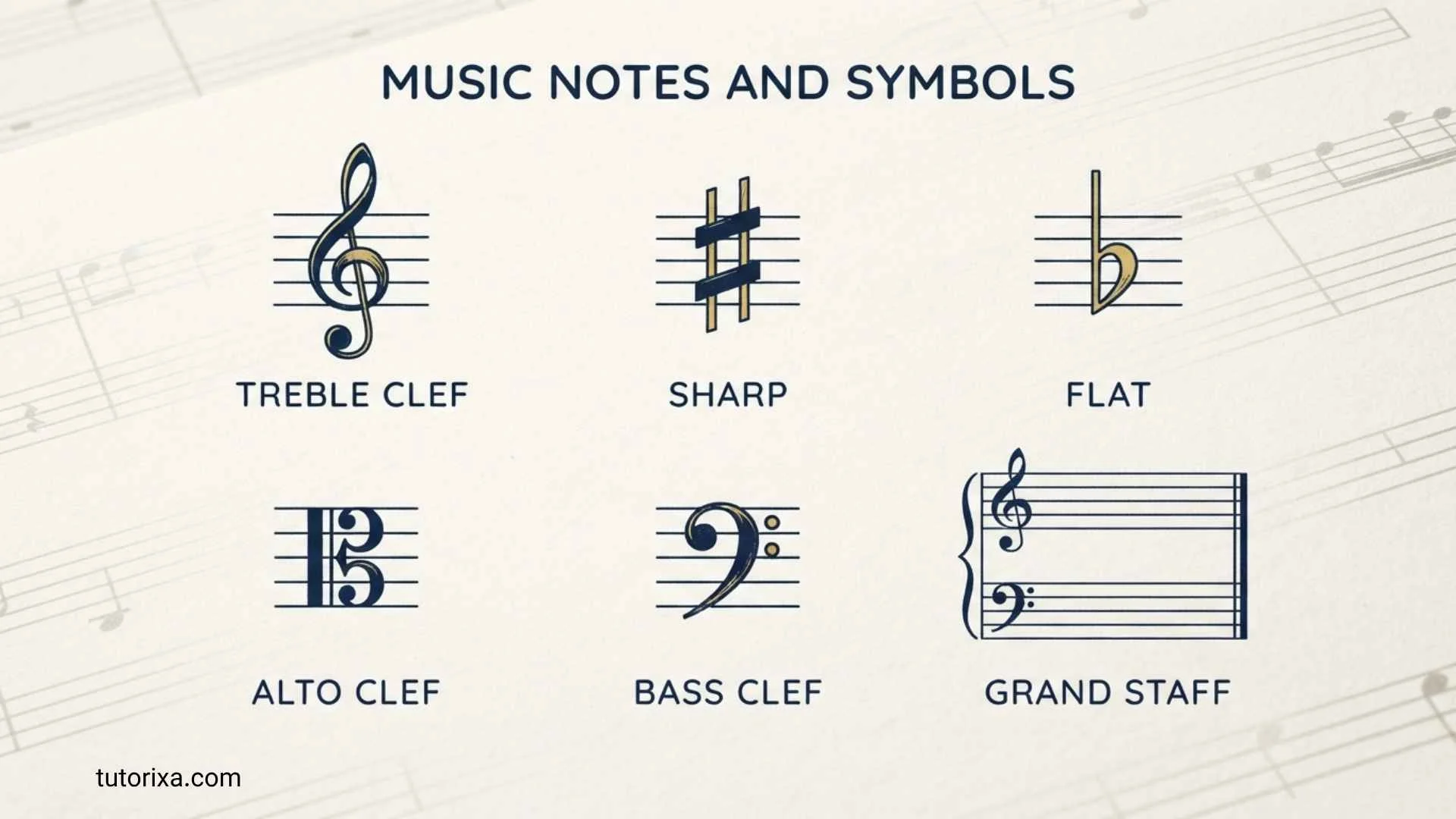
Music can look confusing when you first see unfamiliar notes and symbols on a page. I know how difficult it can feel, but you can learn what each mark means with a simple approach.
Whether you are a beginner, student, musician, or simply curious, understanding music notes and symbols can make reading music much easier. You will discover how these signs communicate pitch, rhythm, timing, expression, and more.
I created this guide to make musical notation easier to understand without overwhelming you. As you explore each symbol, you can build confidence and start recognizing the language of music more naturally.
Quick Meaning
Music notes and symbols are written marks used to represent musical information. Notes indicate pitch and duration, while symbols such as clefs, rests, accidentals, dynamics, articulations, and time signatures provide instructions about how music should be performed. Modern Western notation developed gradually from earlier systems used in medieval Europe and remains widely used today.
Music Notes and Symbols Overview Table
| Symbol or Term | Primary Meaning | Category | Common Usage |
| ♩ | Quarter note | Rhythm | Usually receives one beat in common time |
| ♪ | Eighth note | Rhythm | Shorter rhythmic value |
| ♫ | Two eighth notes | Rhythm | Two connected eighth-note values |
| 𝅝 | Whole note | Rhythm | Sustained note |
| 𝅗𝅥 | Half note | Rhythm | Two quarter-note values |
| 𝄽 | Quarter rest | Silence | One quarter-note duration of silence |
| 𝄼 | Eighth rest | Silence | Eighth-note duration of silence |
| 𝄞 | Treble clef | Clef | Higher musical register |
| 𝄢 | Bass clef | Clef | Lower musical register |
| ♯ | Sharp | Pitch | Raises a note by a semitone |
| ♭ | Flat | Pitch | Lowers a note by a semitone |
| ♮ | Natural | Pitch | Cancels a previous sharp or flat |
| 𝄪 | Double sharp | Pitch | Raises a note by two semitones |
| 𝄫 | Double flat | Pitch | Lowers a note by two semitones |
| ♩ = 60 | Tempo marking | Tempo | Indicates approximate beats per minute |
| p | Piano | Dynamics | Play softly |
| f | Forte | Dynamics | Play loudly |
| < | Crescendo | Dynamics | Gradually become louder |
| > | Decrescendo | Dynamics | Gradually become softer |
| 𝄐 | Fermata | Expression | Hold a note or rest longer than its written value |
| | | Barline | Structure | Separates measures |
| 4/4 | Time signature | Meter | Four quarter-note beats per measure |
| 𝄆 𝄇 | Repeat signs | Structure | Repeat a section of music |
What Do Music Notes and Symbols Mean?
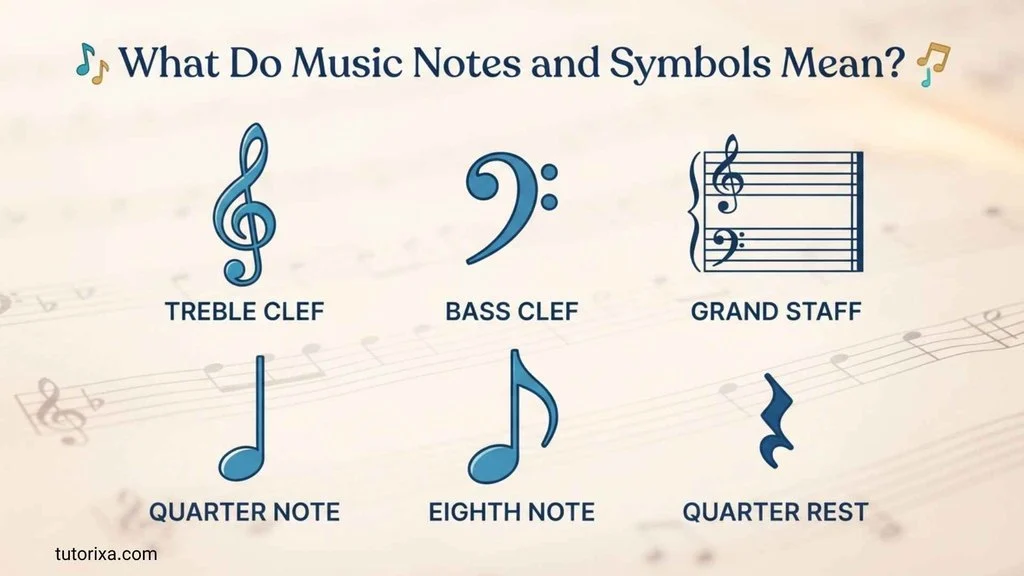
Music notes and symbols communicate different parts of a musical performance. Notes primarily identify pitch and duration, while other symbols explain rhythm, silence, tempo, dynamics, articulation, structure, and expression.
A note’s vertical position on a staff helps identify its pitch. Its shape and additional markings help indicate how long it should sound. For example, a filled notehead with a stem can represent a quarter note, while an open notehead with a stem can represent a half note.
A musical staff normally contains five horizontal lines and four spaces. The clef placed at the beginning tells the reader how those lines and spaces correspond to pitches.
Music notation therefore works as a system rather than as a collection of isolated symbols. A musician reads several elements together to understand what should happen during a particular passage.
Common Musical Notes
Some of the most frequently encountered note values include:
- Whole note: A sustained note whose duration depends on the meter.
- Half note: Traditionally half the duration of a whole note.
- Quarter note: Commonly used as a basic beat unit in simple meters.
- Eighth note: Half the duration of a quarter note.
- Sixteenth note: Half the duration of an eighth note.
- Thirty-second note: Half the duration of a sixteenth note.
These values can be modified by dots, ties, tuplets, and other rhythmic devices.
Common Rests
A rest represents silence rather than a sounded pitch.
Common rests include the whole rest, half rest, quarter rest, eighth rest, and sixteenth rest. Their durations correspond to related note values, although the exact interpretation depends on the musical meter and notation context.
Rests are important because silence is part of musical structure. A rest can separate phrases, create anticipation, support rhythm, or give performers a moment before the next musical event.
History and Origin of Music Notes and Symbols
Modern Western music notation developed over many centuries rather than being invented as one complete system.
Ancient civilizations, including cultures in Mesopotamia, Greece, China, India, and elsewhere, developed ways of recording or describing musical ideas. These systems were different from modern staff notation and cannot simply be treated as earlier versions of today’s notation.
Ancient Greek music theory used letters and other signs to communicate aspects of musical pitch. Medieval European musicians later developed increasingly systematic forms of notation for preserving melodies and teaching singers.
One major development was the use of neumes, early signs that helped singers remember the general movement of melodies. Neumatic notation initially did not provide the precise pitch information found in modern staff notation.
Guido of Arezzo and the Staff
The Italian Benedictine monk and music theorist Guido of Arezzo, active during the 11th century, is strongly associated with important developments in Western musical notation and music education.
Guido promoted the use of lines to establish definite pitch relationships. The staff eventually developed into the five-line system widely used today.
The familiar solmization syllables ut, re, mi, fa, sol, la were also associated with Guido’s teaching system. The syllable “ut” later became “do” in many traditions.
Evolution Into Modern Notation
Over time, note shapes became more standardized. Mensural notation of the late medieval and Renaissance periods helped musicians represent increasingly complex rhythms.
During the Baroque, Classical, Romantic, and modern periods, notation expanded to accommodate changing musical practices. New markings were introduced or standardized for dynamics, articulation, tempo, expression, instruments, and increasingly complex rhythms.
Today, notation exists both on paper and digitally. Software can display, edit, print, transpose, and play back music represented through digital notation systems.
Symbolism and Interpretation in Music
Music notation has a practical meaning rather than one universal symbolic interpretation. A sharp, for example, has a technical pitch function rather than automatically representing a particular emotion.
However, musical symbols can influence how performers interpret a composition.
A fermata may encourage a performer to linger on a note or rest. A crescendo can create a sense of increasing intensity. Staccato articulation can make notes sound detached, while a legato marking encourages smooth connection.
This distinction is important: the symbol itself provides an instruction, while the emotional effect may depend on the surrounding music, composer, performer, culture, and listening context.
Positive and Expressive Associations
Some musical symbols have acquired familiar associations outside formal notation.
The eighth note ♪, paired notes ♫, and other note characters often represent music generally in logos, websites, messages, posters, and decorative designs.
In this broader cultural use, musical notes may symbolize:
- Creativity
- Joy
- Performance
- Rhythm
- Celebration
- Artistic expression
- Singing
- Instrumental music
- Entertainment
- Emotional expression
These associations are cultural and visual rather than strict rules of musical notation.
Cultural Significance of Music Notes and Symbols
Music is universal as a human activity, but Western staff notation is not universal as a musical writing system.
Different cultures have developed different ways to describe and preserve music. Indian classical music, for example, has traditions of notation associated with systems such as sargam. Chinese music can be represented through jianpu, a numbered notation system. Japan has used several notation traditions, including systems associated with particular instruments.
Western staff notation became particularly influential through European art music and later spread internationally through education, publishing, churches, conservatories, popular music, and global media.
This does not mean staff notation is inherently superior to other systems. Each notation tradition reflects the musical structures, instruments, performance practices, and educational needs of the communities that use it.
Scientific and Technical Meaning
Music notation has a strong technical function because it represents measurable relationships involving pitch, time, frequency, rhythm, and musical structure.
Pitch
Pitch refers to how high or low a sound is perceived. In Western music, pitch is associated with frequencies measured in hertz, although musical pitch also depends on tuning systems and context.
A note such as A4 is commonly associated with 440 Hz in the widely used A440 tuning standard, but historical and contemporary ensembles may use different tuning references.
Rhythm and Time
Written rhythm represents relationships between durations. A quarter note does not inherently equal a fixed number of seconds. Its duration depends on the tempo.
For example, if the tempo is 60 beats per minute and the quarter note receives one beat, a quarter note lasts approximately one second.
Digital Music Notation
Modern computers can encode musical information digitally. Formats such as MusicXML allow musical notation data to be exchanged between compatible programs.
Digital systems can represent pitches, durations, measures, articulations, dynamics, lyrics, instruments, and other information. This has made it easier to edit, transpose, publish, and share written music.
Where Are Music Notes and Symbols Used?
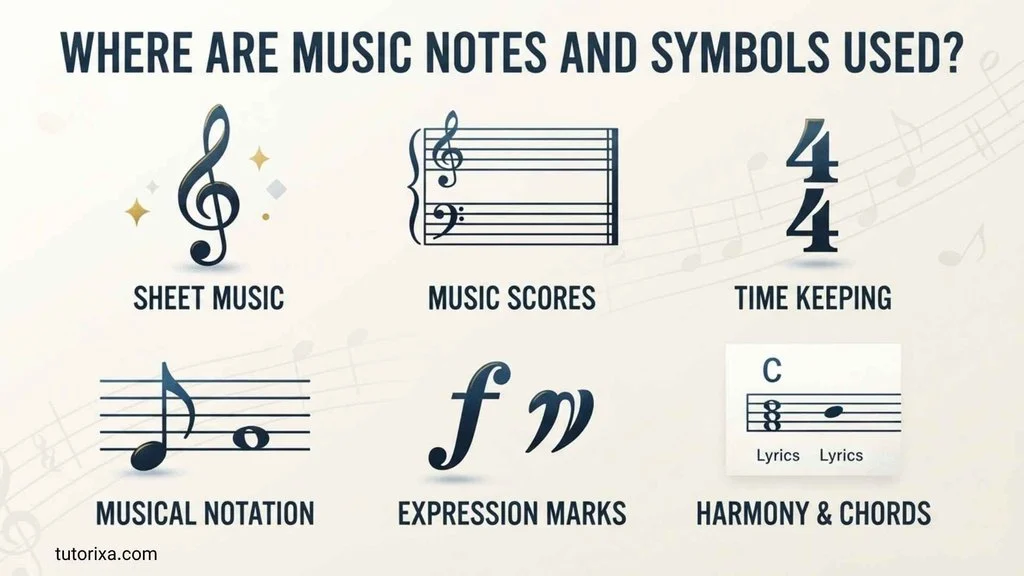
Music notes and symbols appear in many environments, including:
Sheet Music
Printed scores use notation to communicate melodies, harmonies, rhythms, dynamics, articulations, and structure to performers.
Music Education
Teachers use notation when teaching students to recognize pitches, rhythms, scales, intervals, rests, key signatures, and musical forms.
Composition
Composers use notation to preserve musical ideas and communicate performance instructions to other musicians.
Digital Music Software
Notation programs allow users to enter notes and symbols digitally and often provide playback.
Popular Culture
Musical-note characters appear in posters, websites, logos, social media posts, invitations, educational materials, and decorative designs.
Instrumental Performance
Different instruments may require different clefs, ranges, transpositions, and specialized markings. A violinist, pianist, trumpet player, and bassoonist may therefore encounter different notation requirements.
Common Variations of Music Notes and Symbols
Musical notation contains many variations because the same basic concept may need to communicate different rhythmic or expressive information.
Dotted Notes
A dot placed after a note increases its duration by half of its original value. A dotted quarter note, for example, lasts one and a half times the duration of a quarter note.
Ties
A tie connects two notes of the same pitch and combines their durations into one sustained sound.
Beams
Beams connect the stems of certain shorter notes, such as eighth and sixteenth notes. They make rhythmic groupings easier to read.
Clef Variations
The treble and bass clefs are widely recognized, but other clefs also exist.
The alto clef and tenor clef are forms of the C clef and are especially associated with instruments and vocal ranges where they can reduce the need for excessive ledger lines.
Accidentals
Sharp, flat, natural, double-sharp, and double-flat signs modify written pitch according to the notation system and musical context.
Common Misconceptions About Music Notes and Symbols
A Musical Note Always Has the Same Duration
It does not. Duration depends on the note’s written value, meter, tempo, and other rhythmic markings.
A Sharp Always Means a Black Piano Key
Not necessarily. A sharp raises a pitch by a semitone in the relevant musical context. On a piano, some sharped notes correspond to white keys, such as E♯ corresponding enharmonically to F.
A Flat Always Means a Black Key
Again, not always. B♭ commonly corresponds to a black key, but C♭ corresponds enharmonically to B.
Treble Clef Means “High-Pitched Instrument”
Not exactly. A clef establishes the pitch identity of lines and spaces. Treble clef is commonly used for higher ranges, but the clef itself does not define an instrument’s complete range.
♫ Is a Complete Musical Sentence
No. The character ♫ is a typographic representation of two beamed eighth notes. Outside formal notation, it is often used simply as a decorative symbol meaning “music.”
Interesting Facts About Music Notes and Symbols
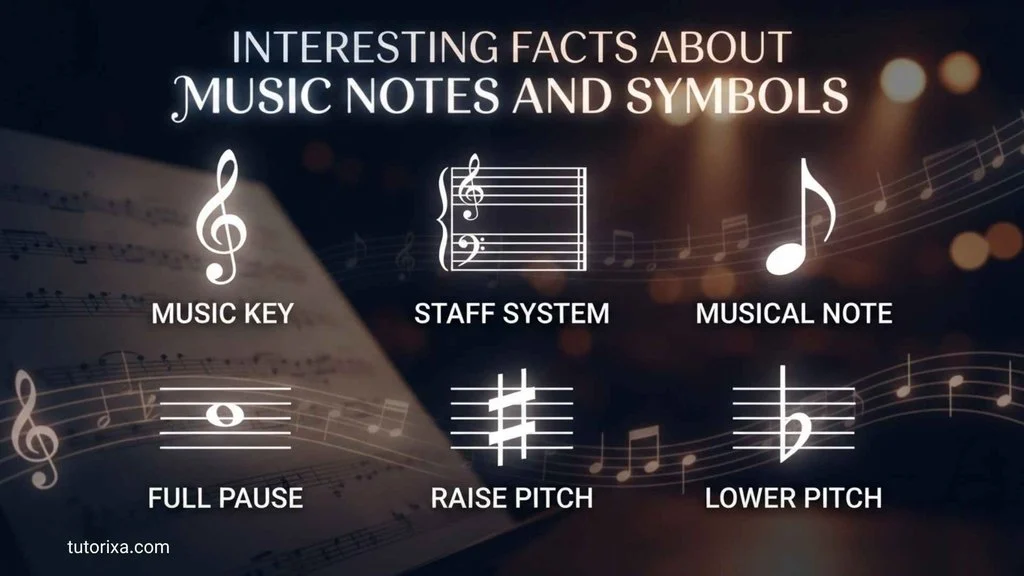
- The five-line staff is not ancient.
Earlier notation systems used different arrangements, including single lines and various forms of neumes. The five-line staff developed gradually. - Clefs are not decorative symbols.
Their main purpose is to establish the pitch reference for the staff. - A rest is part of the music.
Silence has a written duration and can be just as structurally important as a sounded note. - Note names differ between languages.
Many countries use letter names such as A, B, C, D, E, F, and G, while other traditions use systems such as solfège. - “Do” was not always “do.”
Early Western solmization systems used “ut.” “Do” became widely established later. - A note’s appearance carries multiple kinds of information.
The notehead, stem, flag, beam, dot, and position can collectively communicate pitch and duration. - Time signatures do more than show a fraction.
They describe the organization of beats into measures and help establish meter. - Music symbols can have different meanings outside notation.
A note character used in a text message may simply mean “music,” while the same visual idea inside a score has a precise notational role. - Western notation can represent extremely complex rhythms.
Tuplets, nested rhythms, ties, dots, beams, changing meters, and other devices allow composers to communicate sophisticated timing. - Not every musical tradition uses staff notation.
Global musical cultures have developed their own systems, oral traditions, diagrams, tablatures, and other ways of preserving musical knowledge.
Related Music Symbols
Music notes are connected to many other signs and concepts used in written music.
- Treble clef: Establishes the pitch positions commonly used for higher registers.
- Bass clef: Establishes pitch positions commonly used for lower registers.
- Alto clef: Places middle C on the middle line of the staff.
- Tenor clef: Another C-clef position used for certain higher-register passages.
- Sharp: Raises a written pitch by a semitone.
- Flat: Lowers a written pitch by a semitone.
- Natural: Cancels a sharp or flat under the applicable notation rules.
- Rest: Represents a period of silence.
- Fermata: Indicates that a note or rest should be prolonged beyond its normal written duration.
- Staccato: Indicates a detached style of articulation.
- Legato: Indicates smoothly connected performance.
- Crescendo: Indicates gradually increasing loudness.
- Decrescendo: Indicates gradually decreasing loudness.
- Repeat sign: Tells the performer to repeat a designated passage.
- Segno: A navigation symbol used with instructions such as “dal segno.”
- Coda: Identifies a passage used as a concluding section or navigation point.
Frequently Asked Questions
What are music notes and symbols?
Music notes and symbols are visual signs used to record and communicate musical information. Notes primarily show pitch and duration, while symbols such as clefs, rests, accidentals, dynamics, articulations, tempo markings, and time signatures explain how the music should be organized and performed.
What are the basic music notes?
The basic note values commonly taught in Western music include whole notes, half notes, quarter notes, eighth notes, and sixteenth notes. Each represents a different relative duration. Their actual length depends on the tempo and meter of the piece rather than on a fixed number of seconds.
What does ♪ mean?
The character ♪ is a typographic representation of a musical eighth note. In everyday writing, it is commonly used as a general symbol for music, singing, melody, or a musical mood. In formal notation, an eighth note has a specific rhythmic value determined by the surrounding meter and tempo.
What does ♫ mean?
The symbol ♫ represents two musical eighth notes connected visually by a beam. In ordinary text and graphic design, it is often used as a decorative music symbol. Its informal meaning may simply be “music,” but in a musical score, the underlying notation has a specific rhythmic function.
What does a sharp symbol mean in music?
A sharp, written as ♯, generally raises the pitch of the affected note by one semitone. Its effect depends on the musical context and notation rules. A sharp should not automatically be understood as meaning a black piano key because some sharped notes correspond enharmonically to white keys.
What does a flat symbol mean in music?
A flat, written as ♭, generally lowers a note by one semitone. Like a sharp, it changes pitch rather than referring specifically to a particular piano key. Some flat notes correspond enharmonically to white keys, such as C♭ and F♭.
What is the purpose of a musical rest?
A rest tells a performer not to produce a musical sound for a specified rhythmic duration. Rests help organize phrases, rhythms, and silence. They are not empty spaces in music; they are deliberate parts of the composition and can contribute strongly to timing and musical expression.
Why are there different clefs in music?
Different clefs make it easier to represent different pitch ranges on the staff. Instead of placing large numbers of ledger lines above or below a staff, composers can use a clef appropriate to the register. Treble, bass, alto, and tenor clefs are common examples.
Are music symbols the same in every culture?
No. Western staff notation is widely used internationally, but it is not the only musical notation system. Cultures have developed systems such as Indian sargam traditions and Chinese numbered notation, along with instrument-specific notation and strong oral traditions. Musical notation reflects the needs and practices of the community using it.
Can music symbols be copied and used digitally?
Many common musical symbols are available as Unicode characters, including characters such as ♩, ♪, ♫, ♯, ♭, and ♮. However, a Unicode character is not necessarily equivalent to complete professional music notation. Detailed scores normally require dedicated notation software or specialized digital formats.
Key Takeaways
- Music notes and symbols form a visual system for communicating musical information.
- Notes primarily communicate pitch and duration.
- Rests represent silence with rhythmic value.
- Clefs establish how pitches are interpreted on the staff.
- Sharps, flats, and naturals modify written pitches.
- Time signatures organize beats into measures and establish meter.
- Dynamics communicate changes in loudness.
- Articulations describe how notes should be performed.
- Western notation developed gradually through centuries of musical practice.
- Different cultures use different musical notation traditions.
- Decorative symbols such as ♪ and ♫ can have broader meanings outside formal sheet music.
- Digital notation has expanded how musicians create, edit, share, and preserve music.
Conclusion
Music notes and symbols turn sound into a readable visual language. A simple note can communicate pitch and duration, while clefs, rests, accidentals, dynamics, articulations, and rhythmic markings add the information a performer needs to understand a composition.
Their history also shows that musical notation is constantly evolving. Western staff notation grew from earlier European systems, while cultures around the world developed their own methods for preserving musical knowledge. Today, traditional sheet music and digital notation work together across classrooms, orchestras, studios, churches, concerts, and online platforms.
Whether you are learning your first quarter note, studying the treble clef, interpreting a complex score, or simply wondering what ♪ and ♫ mean, understanding music notes and symbols gives you a clearer view of how musicians communicate ideas through written music.

I’m Freddie Beaumont, a British author with a passion for discovering what symbols communicate without words. I write about their history, meanings, and everyday uses in an accessible way. I believe symbols tell fascinating stories about people, cultures, and ideas, and my work helps readers recognise and understand those stories more clearly.
Books:
- Symbols and Their Hidden Meanings
- Understanding Signs and Symbols
 Ellis Montgomery
 Rowan Whitaker