
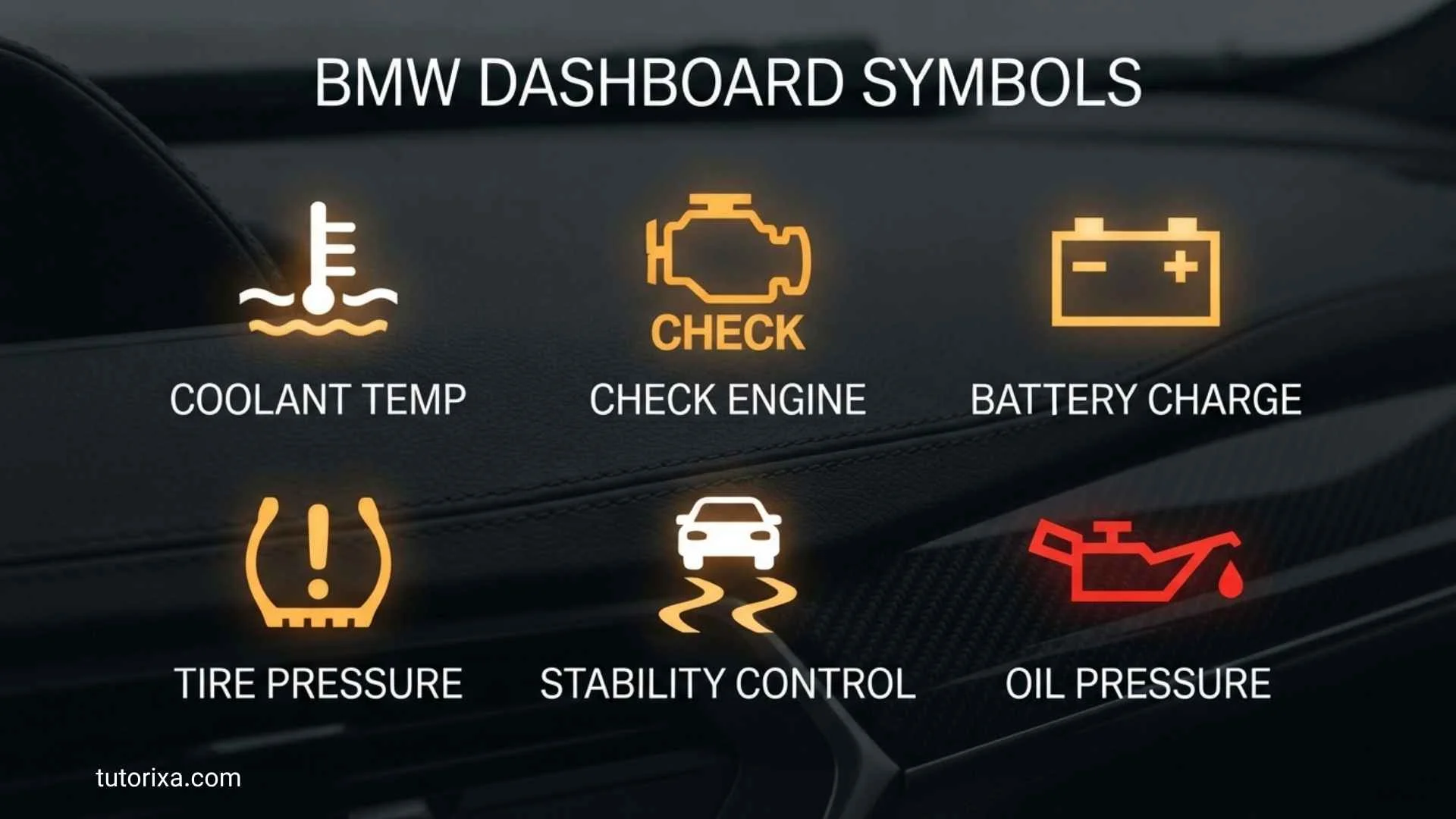
When a BMW dashboard light appears, I know how quickly you can start wondering what it means. You want a clear answer before deciding whether you can keep driving or need help.
In this guide, I’ll explain BMW dashboard symbols in simple language so you can understand what your vehicle is telling you. You’ll learn the meaning of common warning, indicator, and information lights.
Whether you drive an older BMW or a modern model, I’ll help you recognize important symbols and understand which ones deserve immediate attention. The goal is to make your BMW dashboard easier for you to understand.
Quick Meaning
BMW dashboard symbols communicate information about systems such as the engine, brakes, tires, battery, airbags, stability control, and driver assistance. Red symbols generally indicate an urgent warning, yellow or amber symbols indicate a fault or condition requiring attention, and green or blue symbols usually show that a system is active. The exact icon can vary by BMW model and year.
BMW Dashboard Symbols Overview Table
| Symbol / Warning | Primary Meaning | Category | Typical Color | What It Usually Means |
| Brake warning | Brake system or parking brake warning | Safety | Red/Yellow | Check the brake system or parking brake |
| Engine warning | Engine/emissions fault | Powertrain | Yellow | Diagnostic inspection may be needed |
| Oil pressure | Low engine oil pressure | Engine | Red | Stop safely and check immediately |
| Engine temperature | Engine overheating | Cooling | Red | Stop and allow the engine to cool |
| Battery | Charging-system problem | Electrical | Red | Charging system may require attention |
| Tire pressure | Low tire pressure or TPMS issue | Tires | Yellow | Check tire pressures |
| ABS | ABS malfunction | Brakes | Yellow | ABS may be unavailable |
| Airbag | Airbag/restraint-system fault | Safety | Red/Yellow | Restraint system requires inspection |
| DSC | Dynamic Stability Control status/fault | Stability | Yellow/Green | Stability system may be active or unavailable |
| Seat belt | Seat belt reminder | Safety | Red | Buckle the indicated seat belt |
| Steering | Steering-system warning | Steering | Red/Yellow | Steering assistance may be limited |
| Fuel reserve | Low fuel | Fuel | Yellow | Refuel soon |
| High beams | High-beam headlights active | Lighting | Blue | High beams are switched on |
| Turn signal | Direction indicator active | Lighting | Green | Turn signal is operating |
| Cruise control | Cruise-control system active | Driver assistance | Green | System is operating |
| Parking brake | Parking brake engaged | Braking | Red | Release when appropriate |
Important: BMW uses different instrument clusters, displays, and warning strategies across generations. Always compare an unfamiliar warning with the owner’s manual for your exact model and production year.
What Do BMW Dashboard Symbols Mean?
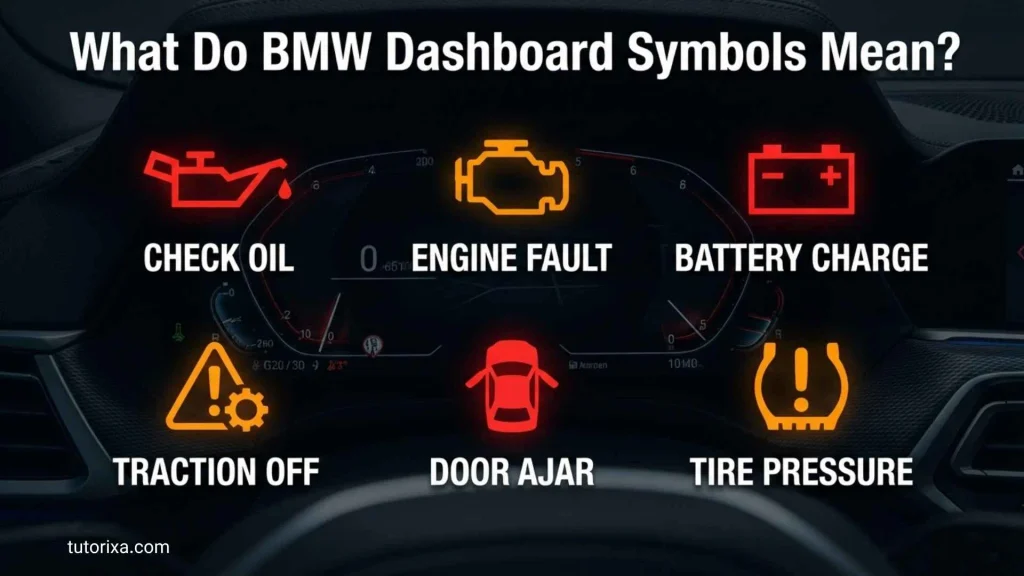
BMW dashboard symbols are designed to communicate vehicle information quickly without requiring a written message. The icon, color, and accompanying message work together to tell you what is happening.
A useful first step is to consider the color:
- Red: Usually indicates a serious warning or condition requiring immediate attention.
- Yellow/amber: Usually means a malfunction, limitation, or condition that should be checked.
- Green: Usually confirms that a system is switched on or operating.
- Blue: Commonly indicates high-beam headlights or another active lighting function.
- White: Often provides information or indicates a selected function.
Color alone is not enough to diagnose a problem. For example, a yellow engine-shaped icon does not tell you which specific engine or emissions component has failed. The vehicle may need diagnostic testing to identify the cause.
BMW also uses text messages alongside many warning symbols. If an icon appears with a message such as a request to drive carefully, stop the vehicle, or contact a service center, the written message should not be ignored.
History and Origin of BMW Dashboard Warning Symbols
Modern BMW dashboard symbols developed from the broader automotive tradition of standardized warning indicators. Early vehicles relied heavily on mechanical gauges and simple indicator lamps. As cars gained electronic control units and increasingly complex safety systems, manufacturers needed a compact way to communicate faults and system status.
BMW gradually incorporated more electronic warning and information systems as vehicle technology advanced. Modern BMW vehicles can monitor numerous components through interconnected control modules, including engine management, braking, tire-pressure monitoring, airbags, stability control, and driver-assistance systems.
The symbols themselves are not generally ancient cultural symbols. They belong primarily to the history of automotive human-machine communication. Many use familiar visual conventions developed across the automobile industry, while BMW’s software, graphics, colors, and warning hierarchy can vary by model generation.
The evolution is particularly noticeable when comparing older analog BMW instrument clusters with newer digital displays. Current systems can combine an icon with a text explanation, graphical vehicle representation, or head-up-display notification.
BMW Warning Light Symbolism and Interpretation
The most important distinction is between warning symbols and status symbols.
A warning symbol tells you that a condition may require action. A status symbol usually confirms that a feature is operating.
For example, a green turn-signal indicator does not mean there is a problem. It simply confirms that the direction indicator is active. By contrast, a red brake warning can indicate a condition requiring immediate attention.
Positive and Neutral Meanings
Green and blue BMW indicators are generally informational. They commonly confirm:
- Turn signals are active.
- Exterior lighting is operating in a selected mode.
- Cruise control or another assistance feature is active.
- High-beam headlights are switched on.
Warning Meanings
Yellow or amber indicators commonly represent:
- A detected malfunction.
- Reduced functionality.
- A maintenance-related condition.
- Low tire pressure.
- A driver-assistance limitation.
Red indicators generally deserve greater urgency because they can relate to systems affecting immediate vehicle operation or safety.
The psychological purpose of this color hierarchy is straightforward: drivers need to recognize urgency quickly, especially while driving.
Major BMW Dashboard Symbols and Their Meanings
BMW Brake Warning Symbol
The brake warning symbol can indicate an engaged parking brake, low brake fluid, or another braking-system condition depending on the vehicle and display message.
If the warning remains illuminated after releasing the parking brake, consult the vehicle’s instructions and have the braking system checked. A braking warning accompanied by unusual brake-pedal behavior or reduced braking performance should be treated as urgent.
BMW Check Engine Symbol
The check-engine light indicates that the vehicle’s onboard diagnostic system has detected a problem involving engine management, emissions, or a related component.
A steady yellow light generally calls for diagnosis rather than immediate panic. A flashing warning, however, can indicate a more serious engine-related condition. Follow the vehicle’s specific instructions and seek professional assistance when required.
BMW Oil Pressure Symbol
The oil-pressure warning is one of the symbols that should receive immediate attention.
If the red oil-pressure warning appears while the engine is running, safely stop the vehicle as soon as possible and follow the instructions in the owner’s manual. Low oil pressure can prevent adequate lubrication of engine components.
This warning is different from a simple oil-level reminder. Oil level and oil pressure are related but are not the same measurement.
BMW Engine Temperature Symbol
An engine-temperature warning can indicate overheating or a problem with the cooling system.
If a red temperature warning appears, continuing to drive can cause serious engine damage. Safely stop the vehicle and follow BMW’s instructions rather than opening a hot cooling system.
BMW Battery Symbol
The battery-shaped warning symbol generally relates to the vehicle’s charging system rather than simply indicating that the battery is old.
Possible causes can involve the alternator, charging circuit, battery, wiring, or related electrical components. If the warning appears while driving, electrical functions may eventually become unavailable if the charging problem is not addressed.
BMW Tire Pressure Symbol
The tire-pressure warning indicates that the vehicle has detected low pressure or a problem with the tire-pressure monitoring system.
Check the tires and adjust pressures according to the vehicle’s recommended specifications. After correcting pressure, the system may require a reset or initialization depending on the BMW model.
Do not assume that a tire-pressure warning always means there is a puncture. Temperature changes, slow leaks, or sensor/system issues can also trigger warnings.
BMW ABS Symbol
The ABS warning indicates a problem with the anti-lock braking system.
Normal braking may still be available depending on the fault, but ABS functionality can be reduced or unavailable. Because ABS contributes to controlled braking during emergency situations, a persistent warning deserves prompt inspection.
BMW Airbag Symbol
The airbag or restraint-system warning indicates that the vehicle has detected a problem in the restraint system.
Because airbags and seat-belt pretensioners are important safety components, this warning should not be treated as a routine dashboard notification. Have the system diagnosed by a qualified technician.
BMW DSC Symbol
Dynamic Stability Control (DSC) helps BMW vehicles maintain stability when traction is limited.
A DSC indicator may appear temporarily when the system intervenes. A persistent warning may indicate that the system has been switched off or has detected a malfunction, depending on the icon and message.
BMW Steering Warning Symbol
A steering warning can indicate a problem with the steering system or steering assistance.
The seriousness depends on the specific warning and vehicle behavior. If steering becomes unusually heavy, difficult, or unpredictable, stop safely and seek professional assistance.
BMW Seat Belt Symbol
The seat-belt warning reminds occupants to fasten their belts. Some BMW models use seat-specific indicators to show which occupied seat requires attention.
This is a safety reminder rather than an indication of mechanical failure.
Cultural Significance
BMW dashboard symbols do not generally have different traditional meanings across civilizations in the way religious, national, or historical symbols do. Their significance comes from modern automotive design and international communication.
The steering wheel, tire, engine, battery, and brake-related pictograms use recognizable objects or concepts so drivers can understand them without depending entirely on language.
Regional differences can still occur because BMW vehicles are sold in many countries and regulatory requirements vary. The exact warning presentation, wording, equipment, and icon set can therefore differ between markets and model generations.
The underlying principle remains consistent: important vehicle information should be understandable quickly.
Scientific and Technical Meaning
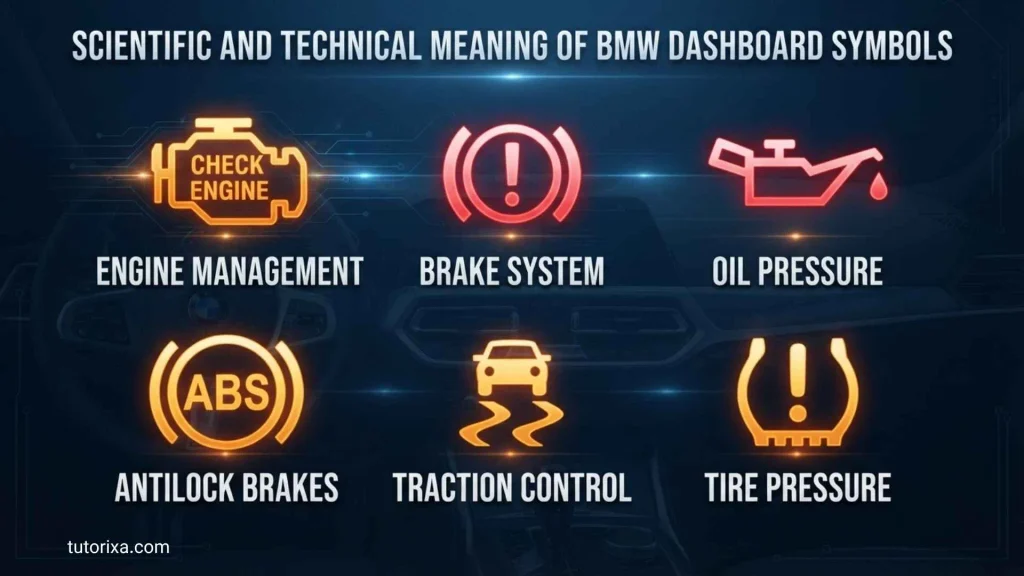
BMW dashboard symbols are closely connected to automotive engineering and electronics.
Modern BMW vehicles use sensors and electronic control modules to monitor systems continuously. Depending on the model, information can come from:
- Wheel-speed sensors
- Engine sensors
- Brake-system sensors
- Tire-pressure monitoring components
- Battery and charging-system monitoring
- Temperature sensors
- Airbag and restraint-system controllers
- Steering sensors
- Stability-control sensors
- Driver-assistance cameras and radar
The dashboard acts as the communication layer between these systems and the driver.
For example, a tire-pressure warning is not simply a decorative icon. It is the visible result of information collected by the vehicle’s monitoring system.
Where BMW Dashboard Symbols Are Used
BMW warning and status symbols may appear in several locations:
Instrument Cluster
The instrument cluster is the traditional location for warning lamps and vehicle information. Older BMWs commonly use physical indicator lamps, while newer vehicles may use digital displays.
Central Information Display
Some warnings appear alongside detailed text or vehicle information on the central screen.
Head-Up Display
Equipped BMW models can present selected driving information and warnings in the driver’s field of view through the head-up display.
iDrive System
BMW’s iDrive interface can provide additional explanations, vehicle-status information, and instructions related to warnings.
Vehicle Settings and Status Menus
Some conditions can be investigated through vehicle-status screens that provide additional information beyond the initial dashboard icon.
Common Variations in BMW Dashboard Symbols
BMW dashboard graphics vary according to model, generation, equipment, and display technology.
A warning may appear as:
- A traditional illuminated lamp
- A digital icon
- An icon accompanied by text
- A vehicle graphic highlighting a specific area
- A temporary notification
- A persistent warning in the instrument cluster
- A head-up-display alert
The same underlying system can therefore look slightly different between a BMW 3 Series from one generation and a newer BMW 5 Series.
Similar symbols can also have different meanings depending on whether they are illuminated steadily, flashing, or accompanied by another indicator.
Common Misconceptions About BMW Dashboard Symbols
“Every Yellow Light Means I Can Ignore It”
Not necessarily. Yellow generally indicates a lower level of urgency than red, but it can still represent a malfunction that affects safety, emissions, performance, or another important system.
“The Battery Symbol Means I Only Need a New Battery”
Not necessarily. The symbol commonly relates to the charging system. The alternator or charging circuit can be involved.
“The Tire Symbol Always Means a Flat Tire”
No. It can indicate low pressure, a pressure change, or a monitoring-system issue.
“Green Means the Car Is Fully Safe”
Green generally indicates an active or available function. It does not provide a complete assessment of vehicle safety.
“All BMWs Use Exactly the Same Symbols”
No. BMW warning displays have changed substantially across model years and generations.
“Turning the Car Off Removes the Problem”
A temporary warning may disappear after a restart, but that does not automatically prove the underlying condition has been fixed.
Interesting Facts About BMW Dashboard Symbols
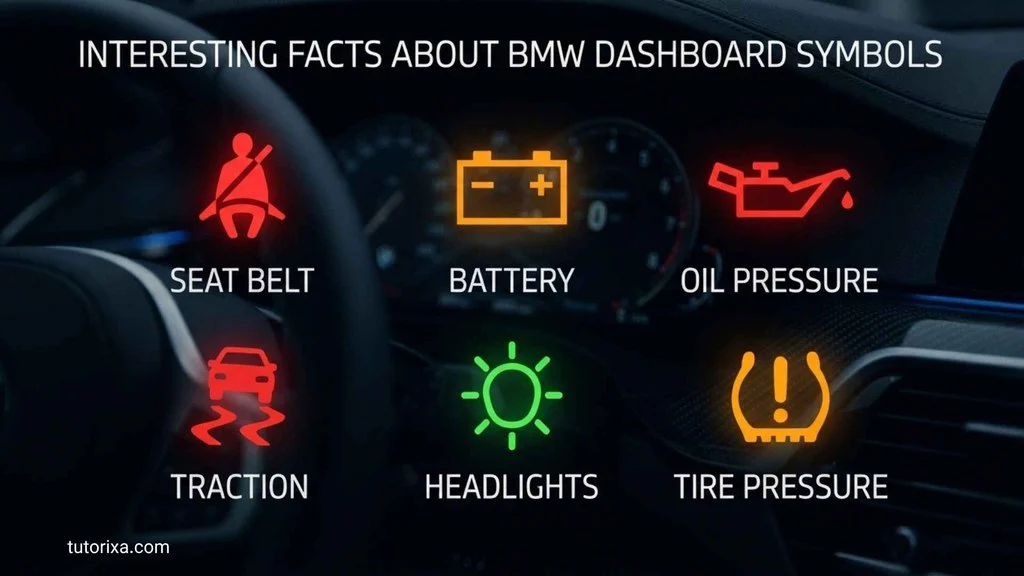
- Colors communicate urgency. BMW’s use of red, yellow, green, and blue lets drivers interpret many alerts without reading a long message.
- A symbol can represent an entire electronic system. The small icon shown to the driver may be the visible endpoint of information collected by multiple sensors and control modules.
- Not every illuminated symbol is a fault. Some simply confirm that a feature, such as high beams or a turn signal, is active.
- BMW warning displays have evolved with digital dashboards. Modern displays can provide substantially more context than traditional indicator lamps.
- The same warning can look different across generations. Instrument-cluster design has changed from analog gauges to highly configurable digital displays.
- The brake symbol can have multiple causes. Its exact meaning depends on the icon, color, vehicle state, and accompanying message.
- Tire-pressure monitoring has reduced reliance on visual tire checks alone. Electronic monitoring can alert drivers to pressure changes that may not be obvious from the driver’s seat.
- DSC is more than a single dashboard light. The system involves electronic monitoring and intervention designed to help maintain vehicle stability.
- Dashboard symbols are a form of visual language. Familiar pictograms help communicate important information despite differences in spoken language.
- The owner’s manual remains the definitive reference for a specific BMW. Model-specific equipment and warning systems mean that a generic symbol chart cannot replace the vehicle’s own documentation.
Related Symbols
Several automotive symbols are closely connected to BMW dashboard indicators:
- Engine symbol: Relates to engine management or emissions-related faults.
- Oil-can symbol: Commonly associated with engine oil status or pressure.
- Battery symbol: Relates to the charging system.
- Brake symbol: Indicates a braking or parking-brake condition.
- ABS symbol: Specifically relates to anti-lock braking.
- Tire-pressure symbol: Indicates tire pressure or monitoring-system information.
- Airbag symbol: Relates to supplemental restraint systems.
- Steering-wheel symbol: Relates to steering or steering assistance.
- Traction-control symbol: Indicates traction or stability-control activity.
- High-beam symbol: Confirms high-beam headlights are active.
- Seat-belt symbol: Indicates that a seat belt needs attention.
These symbols are related because they form part of the broader visual language used by modern vehicles to communicate mechanical, electrical, and safety information.
Frequently Asked Questions
What are the most important BMW dashboard symbols?
Red warning symbols generally deserve the greatest immediate attention, particularly those associated with brakes, oil pressure, engine temperature, steering, or other critical systems. Yellow symbols usually indicate a fault or condition requiring attention. Green and blue indicators are commonly informational. Always read the accompanying message and consult the manual for your exact BMW model.
What does a yellow triangle mean on a BMW dashboard?
A yellow triangle can serve as a general warning indicator, but its precise meaning depends on the BMW model and the accompanying message. It may direct your attention to another vehicle warning or information message. Check the instrument-cluster display or vehicle-status menu rather than interpreting the triangle alone.
What does the red BMW warning light mean?
A red BMW warning light generally indicates a condition requiring prompt attention. The exact meaning depends on the symbol. Some red indicators relate to braking, oil pressure, engine temperature, steering, or other important systems. Safely stop when the vehicle instructs you to do so and follow the model-specific guidance.
What does the BMW engine symbol mean?
The engine-shaped warning light, commonly called the check-engine light, indicates that the vehicle’s diagnostic system has detected a problem involving engine management, emissions, or a related component. A steady warning generally requires diagnosis, while a flashing warning can indicate a more serious condition. The vehicle’s accompanying message should always be considered.
What does the BMW tire symbol mean?
The tire-shaped symbol generally indicates low tire pressure or a problem with the tire-pressure monitoring system. Check all tires using an appropriate pressure gauge and compare the readings with BMW’s recommended specifications. If pressure is correct but the warning remains, the monitoring system may need initialization or diagnosis.
Why is my BMW dashboard showing a red oil symbol?
A red oil-pressure warning can indicate insufficient engine oil pressure, which can threaten engine lubrication. If it appears while the engine is running, safely stop and follow your BMW’s instructions. Do not assume that adding oil alone will solve an oil-pressure problem; the underlying cause may require professional diagnosis.
What does the BMW DSC warning light mean?
The DSC indicator relates to Dynamic Stability Control. Depending on its appearance and accompanying message, it can indicate that the system is actively intervening, has been switched off, or has detected a malfunction. Consult the display message to determine which situation applies to your vehicle.
Can BMW dashboard warning lights disappear by themselves?
Some temporary indicators can disappear when the underlying condition is no longer detected. However, a warning disappearing after restarting does not necessarily mean the cause has been repaired. If a warning repeatedly returns, appears with unusual vehicle behavior, or is associated with a serious system, have the vehicle inspected.
Where can I find the exact meaning of a BMW dashboard symbol?
The most reliable source is the owner’s manual or official vehicle documentation for your specific BMW model and model year. BMW’s digital vehicle documentation may also provide model-specific explanations. This is important because dashboard symbols, equipment, and warning messages can vary between generations and markets.
Are BMW dashboard symbols the same on every model?
No. BMW dashboard symbols share many common conventions, but the exact graphics, colors, wording, and available warnings vary by model, production year, equipment level, and instrument-cluster technology. A symbol chart for one BMW should therefore not be treated as a complete reference for every BMW vehicle.
Key Takeaways
- BMW dashboard symbols communicate vehicle status, faults, and safety information.
- Red warnings generally indicate greater urgency than yellow warnings.
- Green and blue indicators commonly show that a feature is active.
- A yellow check-engine light means the diagnostic system has detected a fault, not necessarily a specific engine failure.
- A red oil-pressure or overheating warning can require immediate action.
- Tire-pressure warnings should be investigated rather than ignored.
- ABS, airbag, steering, and stability-system warnings deserve appropriate attention.
- The exact meaning of a symbol depends on its color, appearance, accompanying message, and vehicle model.
- BMW dashboard displays have evolved from simple indicator lamps to sophisticated digital information systems.
- The owner’s manual for the exact BMW model remains the best authority for interpreting an unfamiliar warning.
Conclusion
BMW dashboard symbols are a compact visual language connecting the driver with the vehicle’s mechanical, electrical, and safety systems. Learning the difference between warning, status, and information indicators makes it easier to respond appropriately instead of treating every illuminated icon as the same type of problem.
The most important rule is simple: look at the symbol, note its color, read the accompanying message, and consider your BMW’s exact model and year. Red warnings deserve particular caution, while yellow warnings should generally be investigated rather than ignored. When a warning concerns brakes, oil pressure, overheating, steering, airbags, or another critical system, follow the vehicle’s instructions and seek qualified assistance when necessary.
Understanding BMW dashboard symbols does not replace professional diagnosis, but it gives drivers the knowledge to recognize what their vehicle is communicating and make safer, better-informed decisions.

I’m Freddie Beaumont, a British author with a passion for discovering what symbols communicate without words. I write about their history, meanings, and everyday uses in an accessible way. I believe symbols tell fascinating stories about people, cultures, and ideas, and my work helps readers recognise and understand those stories more clearly.
Books:
- Symbols and Their Hidden Meanings
- Understanding Signs and Symbols
 Ellis Montgomery
 Rowan Whitaker