
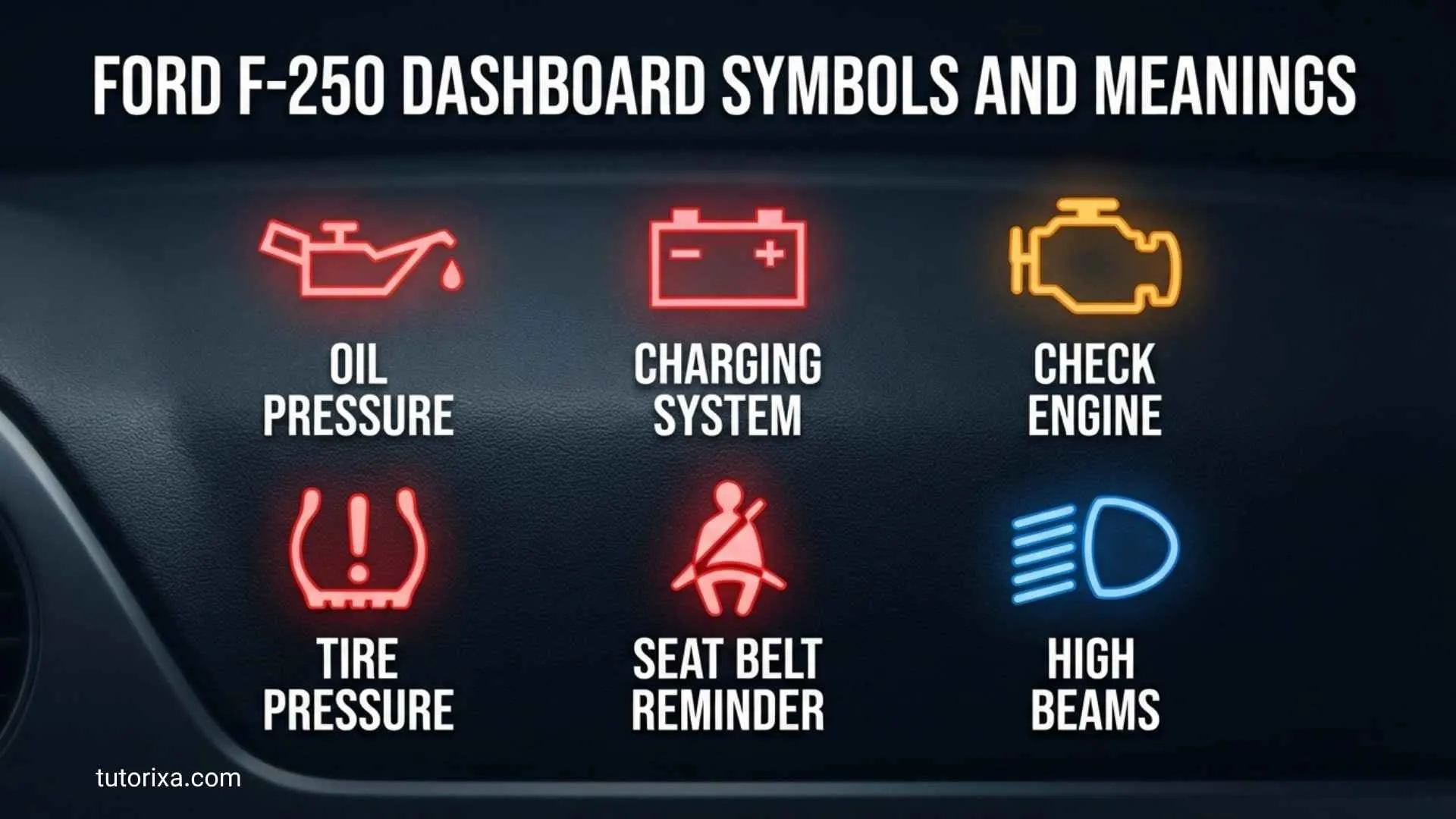
When a warning light suddenly appears on your Ford F-250 dashboard, I know it can make you wonder whether you should keep driving or stop right away. You want a clear answer without confusing technical terms.
In this guide, I’ll help you understand Ford F-250 dashboard symbols and meanings in simple language. You’ll learn what common warning lights, indicators, and alerts are telling you.
Whether you’re a new truck owner or simply want to be prepared, you can use this guide as a practical reference. I’ll show you what each symbol means and why it matters.
Quick Meaning
Ford F-250 dashboard symbols are visual indicators for systems such as the engine, brakes, oil pressure, tire pressure, airbags, four-wheel drive, transmission, diesel emissions equipment, lighting, and driver-assistance features. Green or blue indicators generally show that a feature is operating, while amber symbols usually indicate a condition requiring attention. Red warning lamps generally signal a more serious condition. Exact symbols vary by model year and equipment.
Ford F-250 Dashboard Symbols Overview
| Symbol or Indicator | Primary Meaning | Category | Typical Color | What It Tells You |
| Brake warning | Brake system or parking brake warning | Brakes | Red | Check the brake system or parking brake |
| ABS | Anti-lock brake system fault | Brakes | Amber | ABS may not operate correctly |
| Oil can | Low engine oil pressure | Engine | Red | Stop safely and investigate immediately |
| Thermometer | High engine coolant temperature | Engine | Red | Engine may be overheating |
| Engine outline | Malfunction Indicator Lamp | Engine/emissions | Amber | Engine or emissions fault detected |
| Battery | Charging system problem | Electrical | Red | Charging system may require service |
| Tire with exclamation mark | Low tire pressure | Tires | Amber | One or more tires may be underinflated |
| Airbag | Airbag system fault | Safety | Red/Amber | Airbag system requires attention |
| Seat belt | Seat belt reminder | Safety | Red | A seat belt needs to be fastened |
| Fuel pump | Low fuel | Fuel | Amber | Fuel level is low |
| 4×4 symbol | Four-wheel-drive system status/fault | Drivetrain | Various | 4WD system is active or requires attention |
| Transmission temperature | Transmission overheating | Transmission | Red/Amber | Transmission temperature is too high |
| Water in fuel | Water detected in diesel fuel system | Diesel | Amber/Red | Fuel-water separator requires attention |
| Glow plug | Diesel preheating | Diesel | Amber | Wait for the indicator to go out before starting |
| DEF | Diesel exhaust fluid system | Diesel emissions | Various | DEF level/system condition |
| High beam | High-beam headlights active | Lighting | Blue | High beams are switched on |
| Turn signal | Turn indicator active | Lighting | Green | Left or right signal is operating |
| Cruise control | Cruise control active | Driver assistance | Green/Amber | Cruise system is switched on or engaged |
| Door ajar | Door or applicable opening is not fully closed | Vehicle status | Red/Amber | Close the indicated opening |
The exact set of symbols depends on the F-250’s equipment and instrument cluster. Ford’s current Super Duty documentation specifically states that not all listed symbols are available on every vehicle.
What Do Ford F-250 Dashboard Symbols Mean?
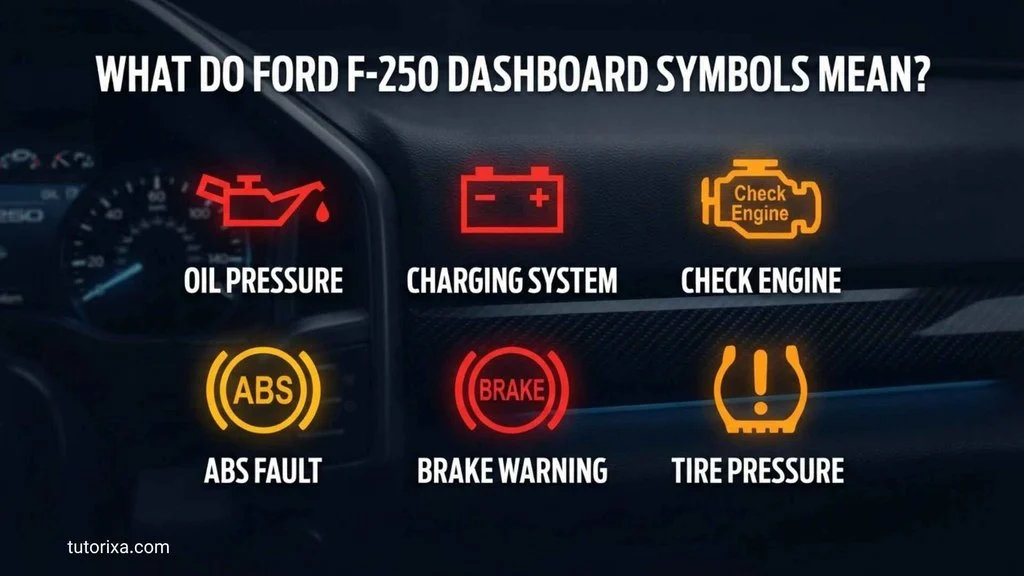
Ford F-250 dashboard symbols communicate the status of major vehicle systems. Some are simply informational, while others warn you about conditions that can affect safety or vehicle operation.
Red Dashboard Symbols
A red warning generally deserves immediate attention. Examples include the oil-pressure warning, brake warning, coolant-temperature warning, and certain electrical or safety-system warnings.
For example, Ford states that a low oil-pressure warning while driving means the vehicle should be stopped as soon as it is safe, with the engine switched off. Continuing to drive despite a genuine low-oil-pressure condition can cause serious engine damage.
A red symbol does not automatically mean the truck has suffered catastrophic damage, but it should not be ignored.
Amber or Yellow Symbols
Amber indicators commonly mean that a system has detected a fault, a maintenance-related condition, or a situation that needs attention.
The check-engine or Malfunction Indicator Lamp is a major example. Ford explains that it can illuminate with the ignition on and engine off as a normal system check. If it remains illuminated while the engine is running, the vehicle may have an emissions-control or engine-related fault. A flashing indicator requires more immediate attention.
Green and Blue Symbols
Green and blue indicators usually tell you that a feature is operating rather than warning you of a failure.
A blue high-beam indicator, for example, means the high beams are switched on. Green turn-signal indicators show that the corresponding signal is operating.
Ford F-250 Brake Warning Symbols
Brake-related symbols are among the most important dashboard indicators on an F-250.
Brake Warning Light
The red brake warning symbol can indicate that the parking brake is applied or that the braking system has detected a problem, depending on the vehicle and circumstances.
Ford warns that driving with a brake warning lamp illuminated when the parking brake is not engaged can indicate a malfunction and may involve reduced braking performance.
ABS Warning Light
The ABS symbol indicates a problem with the anti-lock braking system when it remains illuminated during driving.
The truck can generally retain conventional braking capability when ABS is unavailable, but the anti-lock function may not operate. Ford recommends having the system checked.
ABS is particularly important during hard braking or when traction is limited because the system is designed to help prevent wheel lockup.
Ford F-250 Engine Warning Symbols
Check Engine Light
The engine-shaped check-engine symbol is the Malfunction Indicator Lamp (MIL).
It can appear during the normal ignition sequence before the engine starts. If it stays illuminated while the engine is running, it indicates that the vehicle has detected a fault that may involve the emissions or engine-management system. A flashing light is more urgent and should be addressed promptly.
A check-engine light does not identify one specific failed part. Diagnostic testing is normally required to determine the cause.
Oil Pressure Warning
The oil-can symbol represents engine oil pressure.
If it illuminates while the engine is running, Ford instructs the driver to stop safely, switch the engine off, and check the engine oil level. If the oil level is adequate, the warning can indicate a system malfunction requiring immediate attention.
This symbol is about oil pressure, not simply the age of the oil.
Engine Coolant Temperature Warning
The thermometer-style coolant symbol indicates an engine-temperature problem.
If the warning indicates overheating, the safest response is to stop when conditions allow and switch the engine off. Ford specifically warns against continuing a journey when the warning remains present despite an apparently correct coolant level.
Ford F-250 Tire Pressure Symbol
The tire-pressure monitoring symbol looks like a tire cross-section with an exclamation mark.
It indicates that one or more tires may have pressure below the vehicle’s recommended level. Ford identifies this as the low-tire-pressure indicator.
A tire-pressure warning should not be interpreted simply as a reminder to replace a tire. Temperature changes can affect tire pressure, and a puncture or slow leak can also trigger the warning.
Use the tire-pressure specification for your particular F-250 rather than relying on a generic pressure number.
Ford F-250 Airbag and Seat Belt Symbols
Airbag Warning Light
The airbag symbol relates to the supplemental restraint system.
If the lamp fails to illuminate during the normal startup check, remains illuminated, or behaves abnormally, Ford identifies this as a possible malfunction requiring inspection.
Because airbags are part of the truck’s occupant-protection system, this warning should not be treated as an ordinary convenience indicator.
Seat Belt Warning
The seat-belt symbol reminds occupants to use their seat belts. Ford documentation describes the warning lamp together with an audible reminder.
The exact behavior can depend on seating position and vehicle configuration.
Ford F-250 Diesel Dashboard Symbols
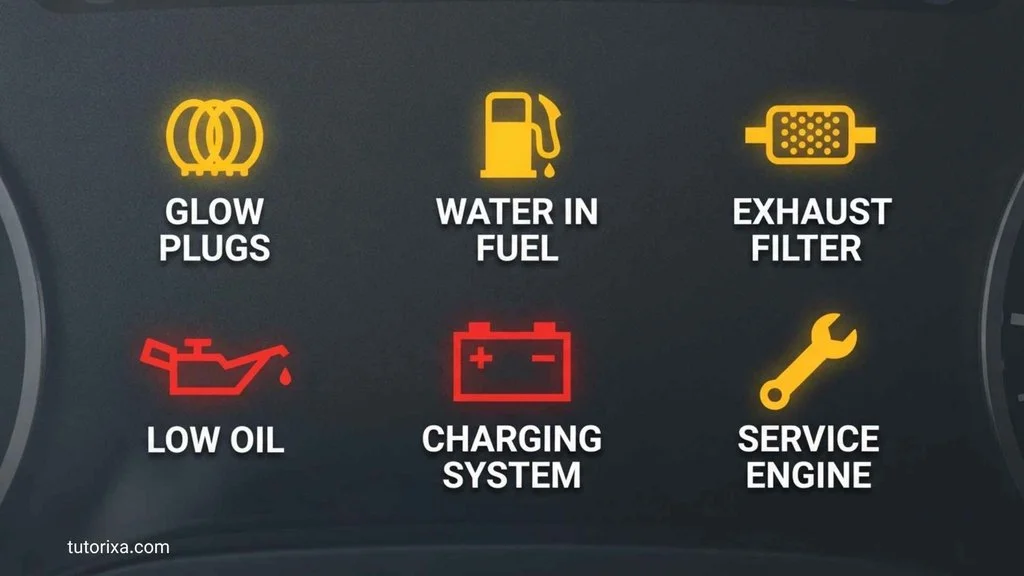
Diesel-powered F-250 models have additional indicators that gasoline-powered configurations may not use.
Glow Plug Indicator
The glow-plug symbol is associated with diesel engine preheating.
During a cold start, the indicator can illuminate while the system prepares the engine for starting. Ford describes the diesel preheat indicator as a unique diesel warning/indicator.
Water in Fuel Symbol
The water-in-fuel indicator warns that the fuel system’s water separator has detected a significant quantity of water.
Ford’s instrument-cluster documentation describes this as a diesel-specific condition requiring immediate draining or service.
Diesel Exhaust Fluid Symbol
Modern diesel Super Duty trucks can also display indicators associated with Diesel Exhaust Fluid (DEF) and the emissions system.
DEF is used by the selective catalytic reduction system to help reduce nitrogen-oxide emissions from diesel exhaust. The exact messages and warning stages vary with the model year and system configuration.
Ford F-250 4×4 and Drivetrain Symbols
Four-wheel-drive indicators can show that a selected 4WD mode is active or that the system has detected a problem.
F-250 Super Duty trucks can have different drivetrain configurations, so the exact 4×4 symbol and message depend on equipment.
A powertrain malfunction, reduced-power, electronic-throttle-control, or Check 4X4 warning can indicate that the powertrain or four-wheel-drive system requires service. Ford’s instrument-cluster documentation identifies these as potential system faults.
Do not assume that every illuminated 4×4 symbol means the same thing. The accompanying information-display message can provide important additional context.
Ford F-250 Transmission Temperature Symbol
A transmission-temperature warning indicates that transmission temperature has exceeded the normal operating range.
Ford specifically lists transmission temperature among F-250/Super Duty instrument-cluster warning conditions.
This can be particularly important in a heavy-duty truck because towing, hauling, steep grades, high ambient temperatures, and demanding driving conditions can place additional thermal load on the drivetrain.
If a temperature warning appears, follow the message displayed by the truck and the instructions in the owner’s manual for that model year.
Ford F-250 Fuel and Electrical Symbols
Low Fuel Symbol
The fuel-pump warning indicates that fuel is running low. Ford advises refueling as soon as possible when the low-fuel warning illuminates.
The remaining driving range depends on fuel level, load, terrain, driving conditions, and fuel economy, so the warning should not be treated as a precise distance guarantee.
Battery or Charging System Warning
A battery-shaped warning generally relates to the vehicle’s charging system rather than simply telling you that the battery is old.
A charging-system problem can affect the vehicle’s ability to maintain electrical power. If the warning remains illuminated while driving, the vehicle should be inspected according to the instructions for that model year.
Ford F-250 Lighting Symbols
Lighting indicators are generally straightforward.
- High-beam symbol: High beams are active.
- Turn-signal arrows: Left or right turn signal is operating.
- Headlamp indicator: Exterior lighting is switched on.
- Fog-lamp indicator: Applicable fog lamps are active.
- Auto high-beam indicator: Automatic high-beam functionality is active when equipped.
Ford’s Super Duty symbol glossary includes high beams, automatic high beams, front fog lamps, and turn-signal indicators among the instrument-cluster symbols.
These indicators are usually informational rather than signs of a fault.
Ford F-250 Driver Assistance and Information Symbols
Modern F-250 trucks can display indicators for systems such as cruise control, lane-related assistance, collision-related functions, parking aids, and other driver-assistance technologies when equipped.
These symbols are often different from traditional warning lamps because they may show whether a feature is available, activated, unavailable, or temporarily limited.
The information display is therefore an important part of interpreting a dashboard symbol. Two similar-looking icons can have different meanings depending on the accompanying message.
Why Do Ford F-250 Dashboard Symbols Appear When Starting?
Many dashboard lamps illuminate briefly when the ignition is switched on.
This is normally part of the vehicle’s self-check procedure. Ford explains that some warning lamps illuminate during startup to confirm that the systems and indicators are functioning. If a warning remains illuminated after startup, the relevant system should be checked.
Therefore, seeing several symbols for a few seconds does not automatically mean the F-250 has multiple problems.
The important distinction is whether a symbol goes out after the startup check or remains illuminated.
History and Origin of Dashboard Symbols
Automotive dashboard symbols developed from the broader tradition of using standardized visual signs to communicate information quickly.
Early vehicle dashboards relied heavily on gauges, mechanical indicators, switches, and warning lamps. As vehicles became more complex, manufacturers needed compact ways to communicate information about braking, engine temperature, lubrication, electrical systems, lighting, and safety equipment.
Modern Ford dashboards combine internationally recognizable pictograms with Ford-specific system indicators and text messages.
The symbols are not primarily cultural or religious symbols. Their development is closely connected with automotive engineering, human-machine interaction, road safety, and visual communication.
Modern F-250 dashboards therefore represent an evolution from simple mechanical gauges toward integrated digital information systems.
Symbolism and Interpretation
Unlike traditional cultural symbols, F-250 dashboard icons have functional meanings defined by vehicle systems.
Their interpretation is largely based on three elements:
- Shape — the pictogram identifies the relevant system.
- Color — color helps communicate urgency or operating status.
- Behavior — whether the light is steady, flashing, or appears with a message can change its significance.
For example, an oil-can pictogram represents lubrication pressure, while a tire-shaped pictogram identifies tire-pressure monitoring.
This makes dashboard symbols a practical visual language rather than a symbolic tradition with different meanings across ancient civilizations.
Cultural Significance
Ford F-250 dashboard symbols have relatively consistent technical meanings across regions, but their availability can differ according to market, vehicle specification, and regulations.
The underlying pictograms are designed to be understood without relying entirely on written language. This is especially useful in vehicles because drivers need to recognize important information quickly.
Regional differences may involve:
- Instrument-cluster layouts
- Warning-message wording
- Available equipment
- Lighting regulations
- Driver-assistance features
- Engine and emissions configurations
Ford explicitly notes that symbols can vary according to vehicle options, market, and instrument-cluster type.
Where Ford F-250 Symbols Are Used
These symbols can appear in several places:
- Instrument cluster
- Digital information display
- Center display
- Headlamp controls
- Four-wheel-drive controls
- Climate controls
- Trailer-related displays
- Driver-assistance menus
- Vehicle settings
- Warning messages
Some indicators are permanent physical icons, while others are generated digitally by the vehicle’s display system.
Common Variations
Ford F-250 dashboard designs have changed considerably across generations.
Older trucks may use primarily physical gauges and conventional warning lamps, while newer Super Duty models can use more advanced digital displays.
The same vehicle family can also have different symbols because of:
- Gasoline versus diesel engines
- Two-wheel drive versus four-wheel drive
- Different trim levels
- Towing equipment
- Driver-assistance packages
- Different model years
- Different instrument clusters
- Regional specifications
This is why a symbol found in a 2012 F-250 owner’s guide should not automatically be assumed to operate exactly the same way in a newer model.
Ford’s 2025 Super Duty owner’s manual, for example, contains a dedicated symbols glossary and states that not all listed symbols are available on every vehicle.
Common Misconceptions About F-250 Dashboard Symbols
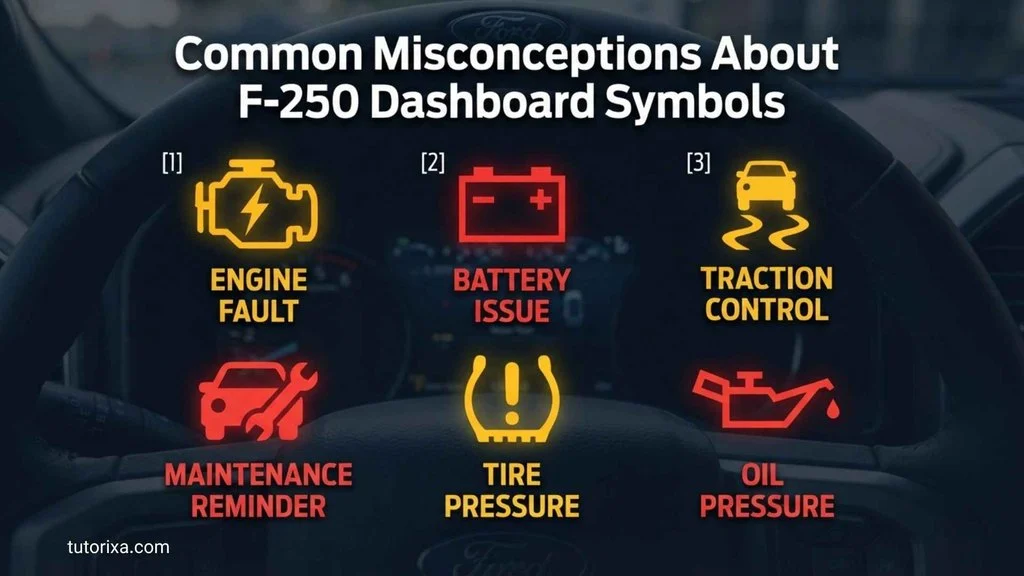
A Check-Engine Light Always Means an Engine Is Failing
Not necessarily. The Malfunction Indicator Lamp can be triggered by different engine or emissions-system conditions. Diagnostic information is needed to identify the cause.
Every Red Light Means the Engine Is About to Fail
No. Red generally indicates a serious condition or one requiring immediate attention, but the affected system could be the brakes, oil pressure, charging system, or another vehicle function.
A Tire-Pressure Light Means the Tire Is Damaged
Not necessarily. Low pressure can have several causes, including temperature-related pressure changes or an air leak.
Every Symbol Means the Same Thing on Every F-250
No. Ford states that available symbols depend on options, market, and instrument-cluster type.
A Light That Appears During Startup Is Always a Fault
No. Many lamps illuminate temporarily as part of the normal startup check. The concern is usually a warning that remains illuminated or behaves abnormally after startup.
10 Interesting Facts About Ford F-250 Dashboard Symbols
- Not every F-250 has the same symbols. Equipment and instrument-cluster configuration determine which indicators are available.
- Diesel F-250s have specialized indicators. Glow plugs, water-in-fuel detection, and diesel emissions systems create warning symbols that may not appear on gasoline versions.
- A flashing warning can be more significant than a steady warning. Ford specifically identifies flashing engine-related indicators as requiring prompt attention.
- Dashboard colors form a visual language. Color helps drivers distinguish operating indicators from conditions requiring attention.
- The information display matters. A dashboard icon may be accompanied by a written message that gives more specific information.
- ABS and conventional brakes are different systems. An ABS warning does not necessarily mean all braking has disappeared; it can mean the anti-lock function has malfunctioned.
- The oil-pressure symbol is not simply an oil-change reminder. Its primary concern is oil pressure while the engine is operating.
- High-beam indicators are intentionally blue. This provides an easily recognizable visual distinction from many red and amber warnings.
- Dashboard symbols are designed for rapid recognition. A pictogram can communicate a system category faster than a long written message.
- Ford’s official manuals are model-specific. Because equipment changes over time, the owner’s manual supplied for the particular truck remains the most reliable reference for that vehicle. Ford itself advises treating the vehicle’s owner’s manual as the primary source when information differs.
Related Symbols
Several dashboard symbols are closely connected:
- Brake symbol and ABS symbol: Both concern braking, but the ABS indicator specifically relates to the anti-lock system.
- Oil-pressure and coolant-temperature symbols: Both concern critical engine operating conditions but monitor different systems.
- Check-engine and powertrain warnings: Both can indicate drivetrain-related faults, but their exact diagnostic meanings differ.
- Tire-pressure and traction-control symbols: Tire condition can affect vehicle handling and traction systems, although the indicators represent different functions.
- 4×4 and powertrain symbols: Both may relate to drivetrain operation, but one specifically identifies four-wheel-drive status or faults.
- Glow-plug and water-in-fuel symbols: Both are associated particularly with diesel operation but represent completely different conditions.
Frequently Asked Questions
What does the wrench symbol mean on a Ford F-250?
A wrench or service-related symbol generally indicates that the vehicle has detected a powertrain or service condition, but the exact meaning depends on the model year and accompanying message. Because Ford has used different instrument clusters and warning strategies over time, check the owner’s manual and information display for the specific F-250 configuration.
What does the red exclamation mark mean on a Ford F-250?
A red exclamation-mark symbol can be associated with the brake system or another serious vehicle warning, depending on its exact shape and accompanying message. If it is the brake warning lamp and the parking brake is not engaged, Ford advises having the braking system checked because braking performance may be affected.
What does the yellow engine symbol mean on an F-250?
The yellow engine-shaped symbol is generally the Malfunction Indicator Lamp. It can indicate an engine or emissions-system fault. If it remains illuminated after the engine starts, diagnostic attention may be needed. If it flashes while driving, Ford recommends reducing vehicle speed and avoiding heavy acceleration or deceleration while seeking service.
What does the snowflake symbol mean on a Ford F-250?
A snowflake or cold-weather-related indicator can provide information about low outside temperatures or weather-related conditions on applicable configurations. It should not automatically be interpreted as proof that the road is icy. Temperature warnings are informational and should be considered together with actual road conditions.
What does the tire symbol with an exclamation mark mean?
The tire-shaped symbol with an exclamation mark is the low-tire-pressure indicator. It means the vehicle’s tire-pressure monitoring system has detected low pressure in one or more tires. Check the pressures against the specifications for your particular F-250 rather than guessing from the appearance of the tire.
What does the water-in-fuel symbol mean on a diesel F-250?
The water-in-fuel indicator means the fuel-water separator has detected a significant quantity of water. Ford identifies this as a diesel-specific condition requiring attention and draining of the separator. Because fuel-system contamination can affect diesel operation, the warning should not be ignored.
What does the 4×4 light mean on an F-250?
The 4×4 indicator can show that a four-wheel-drive mode is selected or active. However, a separate 4×4 or powertrain fault message can indicate that the system needs service. The exact meaning depends on the drivetrain configuration and the message shown in the information display.
Why do all the warning lights come on when I start my F-250?
Many dashboard lamps illuminate briefly during startup as part of the vehicle’s system check. Ford states that some lamps are designed to illuminate when the vehicle starts to verify their operation. If a warning remains illuminated after startup, consult the relevant system information.
Are Ford F-250 dashboard symbols the same for every model year?
No. Symbols and available indicators can change according to model year, engine, trim, market, options, and instrument-cluster type. Ford specifically states that not all symbols shown in its instrument-cluster glossary are available on every vehicle. The owner’s manual for the specific F-250 is therefore the best reference.
Which F-250 dashboard lights should never be ignored?
Red warnings involving oil pressure, engine overheating, or braking deserve immediate attention. A flashing check-engine or engine-related warning can also require prompt action. The safest approach is to follow the specific message in the information display and the instructions in the owner’s manual rather than judging a warning solely by its color.
Key Takeaways
- Ford F-250 dashboard symbols communicate vehicle status, system operation, and potential faults.
- Red warnings generally indicate conditions requiring immediate attention.
- Amber warnings commonly indicate faults or conditions that need investigation.
- Green and blue indicators generally identify operating features.
- The oil-pressure warning is particularly important and should not be ignored.
- The coolant-temperature warning can indicate overheating.
- The ABS symbol relates specifically to the anti-lock braking system.
- The check-engine symbol can represent different engine or emissions faults.
- Diesel F-250 models can display glow-plug, water-in-fuel, DEF, and exhaust-related indicators.
- Four-wheel-drive and drivetrain symbols vary with vehicle configuration.
- Not every F-250 has every dashboard symbol.
- Model year and equipment can significantly change the instrument cluster.
- A symbol that appears briefly during startup may simply be part of the normal system check.
- The owner’s manual for the specific F-250 should take priority when a symbol’s meaning is uncertain.
Conclusion
Understanding Ford F-250 dashboard symbols and meanings makes it easier to recognize the difference between a normal operating indicator and a warning that deserves attention. Symbols for brakes, oil pressure, coolant temperature, tire pressure, airbags, engine faults, diesel systems, four-wheel drive, and transmission temperature can provide important information before a small issue becomes a larger problem.
The most reliable interpretation depends on the exact F-250 model year, engine, equipment, and instrument cluster. Ford’s documentation confirms that symbol availability varies between vehicles, so the owner’s manual and accompanying information-display message should always be used to verify a warning.
A dashboard symbol is more than a picture: it is a compact communication system between the truck and its driver. Learning what each indicator represents helps you respond appropriately, understand your F-250’s systems, and recognize when professional inspection may be necessary.

I’m Ellis Montgomery, a British writer interested in the powerful language of symbols. I explore everything from traditional emblems and cultural signs to contemporary symbols found in modern life. My aim is to explain their meanings clearly while revealing the stories and ideas behind them, making symbolism fascinating and accessible to everyone.
Books:
- The Complete Book of Symbols
- Hidden Messages in Everyday Symbols
 Rowan Whitaker
 Freddie Beaumont