
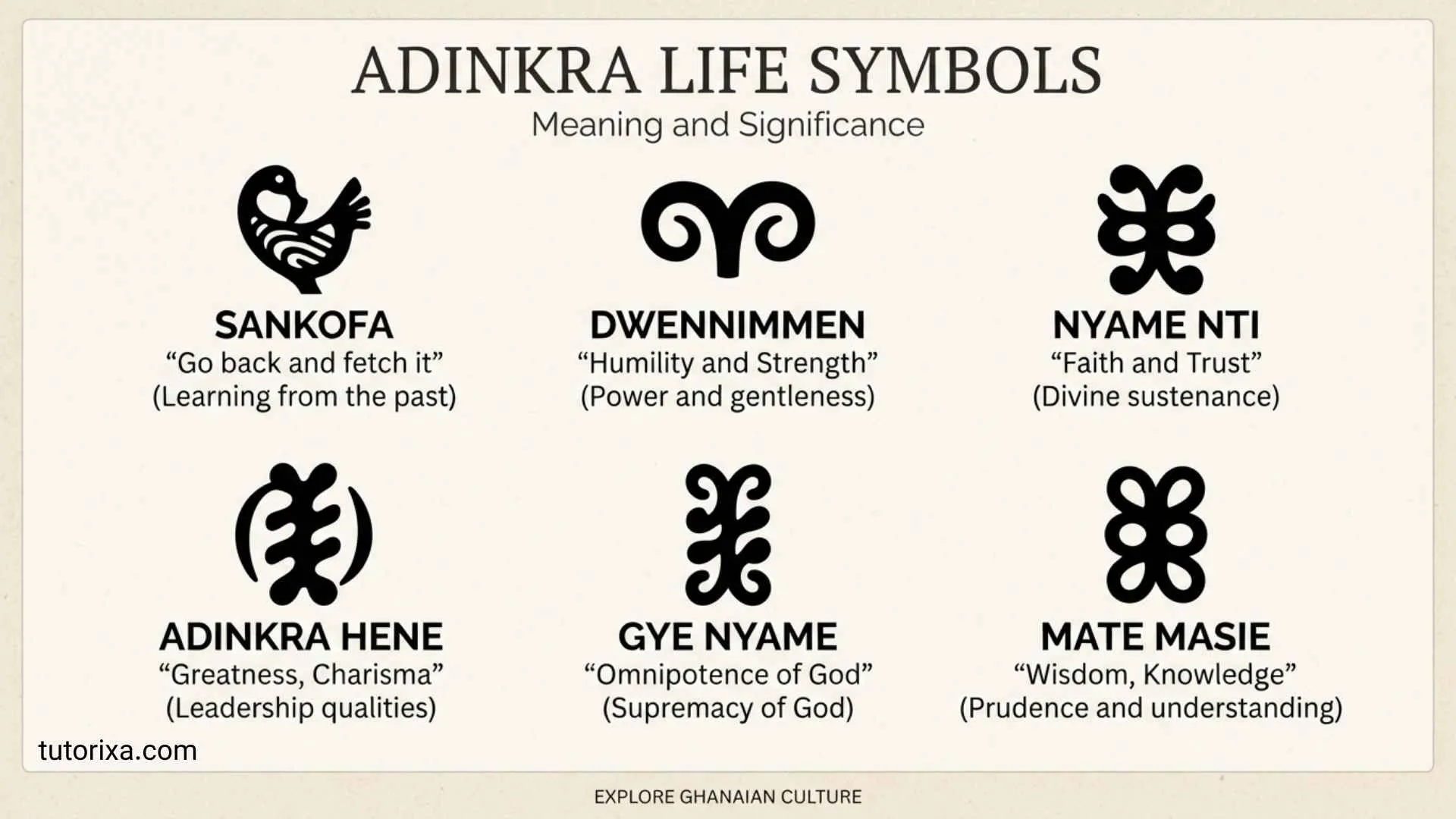
All Adinkra Symbols and Meanings: opens a fascinating window into Ghanaian culture, wisdom, history, and identity. I find these symbols especially powerful because each design can carry a deeper message, making even a simple shape feel meaningful.
If you are curious about what Adinkra symbols really mean, you are in the right place. You can explore their names, meanings, cultural significance, and the ideas they represent in a simple and easy-to-follow way.
I’ll help you discover the stories and values behind these remarkable symbols, from wisdom and courage to unity, strength, and peace. As you explore this guide, you’ll see why Adinkra symbols remain meaningful and inspiring today.
Quick Meaning
Adinkra symbols are Akan visual symbols associated especially with the Asante tradition of Ghana. Each design represents an idea, proverb, moral principle, or aspect of life. Common examples include Gye Nyame for the supremacy of God, Sankofa for learning from the past, Adinkrahene for leadership, and Dwennimmen for strength combined with humility.
Adinkra Symbol Overview Table
| Symbol Name | Primary Meaning | Category | Akan/Asante Context | Common Modern Use |
| Gye Nyame | Supremacy of God | Spiritual | Akan | Jewelry, art, textiles |
| Sankofa | Learn from the past | Wisdom | Akan | Education, heritage, art |
| Adinkrahene | Leadership, greatness | Leadership | Asante | Textiles, logos, art |
| Dwennimmen | Strength with humility | Character | Akan | Clothing, design |
| Nyame Dua | Divine protection/presence | Spiritual | Akan | Architecture, textiles |
| Nyame Nti | Faith and trust in God | Spiritual | Akan | Art, jewelry |
| Mpatapo | Reconciliation and peacemaking | Social values | Akan | Art, mediation themes |
| Fawohodie | Freedom and independence | Liberty | Akan | Political and cultural art |
| Nkyim | Initiative and adaptability | Character | Akan | Textiles, visual art |
| Akoben | Vigilance and readiness | Conduct | Akan | Art, symbolic design |
| Akofena | Courage and authority | Leadership | Akan | Regalia, modern art |
| Aya | Endurance and resourcefulness | Character | Akan | Jewelry, tattoos, textiles |
| Eban | Security and protection | Community | Akan | Architecture, design |
| Wawa Aba | Hardiness and perseverance | Character | Akan | Clothing, artwork |
| Bese Saka | Abundance, unity, prosperity | Prosperity | Akan | Textiles, cultural art |
| Nea Onnim No Sua A, Ohu | Learning and education | Knowledge | Akan | Educational contexts |
| Odo Nnyew Fie Kwan | Love brings harmony | Relationships | Akan | Decorative art |
| Boa Me Na Me Boa Wo | Mutual help | Community | Akan | Social and educational art |
| Osram Ne Nsoromma | Love, harmony, faithfulness | Relationships | Akan | Jewelry, artwork |
| Kuntinkantan | Humility/modesty | Character | Akan | Textiles, design |
Interpretations are presented as commonly documented meanings; individual sources may translate Akan names and concepts differently.
What Do Adinkra Symbols Mean?
Adinkra symbols communicate concepts rather than simply representing physical objects. Their meanings are often connected to Akan proverbs, moral lessons, spirituality, leadership, nature, and social relationships.
For example, Sankofa is commonly represented by a bird looking backward while moving forward, or by a stylized heart-like form. Its central lesson is that people should look to the past for useful knowledge rather than abandoning history.
Gye Nyame expresses the supremacy or uniqueness of God. It is among the best-known Adinkra motifs and is frequently encountered outside Ghana in contemporary African-inspired art and design.
Dwennimmen, commonly translated in relation to ram’s horns, connects strength with humility. The concept reflects the Akan idea that genuine power does not require arrogance.
This relationship between image, proverb, and spoken language is particularly important. Akan visual culture often works alongside oral tradition rather than separately from it. Historical Akan objects demonstrate how imagery could reinforce spoken messages and social values.
History and Origin of Adinkra Symbols
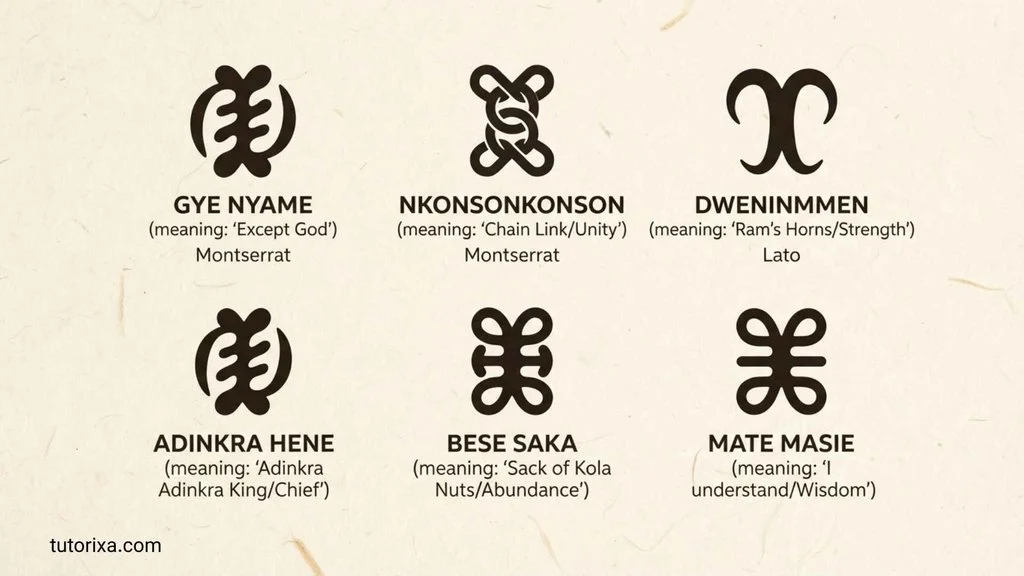
Adinkra developed among the Akan peoples of West Africa, with the Asante tradition of present-day Ghana playing a particularly important role in its history.
The exact origin date of individual Adinkra designs is difficult to establish. It is therefore safer to discuss the development of the Adinkra visual tradition rather than assign a precise ancient date to every symbol.
Historical Adinkra cloth was used for significant occasions. The cloth could contain repeated stamped motifs arranged into an intentional visual composition. The Metropolitan Museum of Art notes that an early twentieth-century Adinkra ceremonial wrapper from Ghana contains numerous named symbols, including Adinkrahene, Aban, Nwimu, Dwennimmen, and Ananse Ntontan.
Captain R. S. Rattray, a colonial-era ethnographer who studied Asante culture, recorded 53 Adinkra signs in his work. This documentation is historically valuable, but it should not be treated as proof that only 53 symbols have ever existed. Contemporary collections, scholarship, artists, and cultural organizations document additional motifs and variations.
Adinkra also belongs to a much larger Akan tradition in which visual symbols appear on objects such as goldweights, royal regalia, buildings, staffs, stools, and textiles. Some geometric designs used on Akan objects are associated with proverbs, although the meanings of many historical geometric motifs remain uncertain.
Symbolism and Interpretation
Gye Nyame
Gye Nyame is generally understood as expressing the supremacy, uniqueness, or omnipotence of God. Its religious interpretation makes it one of the most recognizable Adinkra symbols.
The phrase is associated with the Akan concept of God, commonly called Nyame. Modern users often select the symbol to express faith, divine authority, humility before God, or spiritual dependence.
Sankofa
Sankofa expresses the importance of returning to the past to retrieve valuable knowledge.
Its message is not simply “look backward.” Instead, it encourages people to learn from history while continuing forward. That makes it especially relevant to education, genealogy, cultural preservation, historical research, and personal development.
Adinkrahene
Adinkrahene, often translated as “Adinkra king,” is associated with leadership, authority, greatness, and influence.
Historical documentation describes the motif as paramount among Adinkra designs. Its importance also illustrates how Akan symbolism can connect visual hierarchy with social ideas about leadership.
Dwennimmen
Dwennimmen is associated with the horns of a ram and commonly symbolizes strength combined with humility.
The symbol offers an important distinction between physical or political power and good character. Its traditional lesson suggests that someone can possess great strength without becoming proud or aggressive.
Mpatapo
Mpatapo represents reconciliation, peace-making, and the resolution of conflict. Its interlocking form is commonly interpreted as representing the bonds that bring people together after disagreement.
Fawohodie
Fawohodie is associated with freedom, independence, and emancipation. Its meaning connects freedom with responsibility rather than treating liberty as simply the absence of restrictions.
Aya
Aya, often represented by a fern-like form, is associated with endurance, resourcefulness, and the ability to survive difficult circumstances. The fern’s ability to grow in challenging environments provides the visual foundation for this interpretation.
Eban
Eban is commonly associated with a fence or enclosure and therefore represents security, safety, protection, and the importance of a protected home.
Akoben
Akoben represents vigilance, preparedness, or readiness. The symbol is traditionally connected with the idea of a war horn or call to alertness.
Nyame Dua
Nyame Dua, commonly associated with a sacred or divine tree, represents God’s presence, protection, and a place of spiritual significance.
Ananse Ntontan
Ananse Ntontan, associated with the spider’s web, represents wisdom, creativity, cleverness, and the ability to solve problems. The symbolism connects with Ananse, the well-known Akan trickster figure whose stories frequently explore intelligence, deception, consequences, and human behavior.
Cultural Significance
Adinkra symbolism is primarily connected with Akan cultural traditions, particularly those of Ghana and the Asante. It should not be described as a universal symbol system shared identically by every African culture.
Akan culture includes several related communities, and symbolic meanings can shift according to language, local tradition, historical context, and the proverb associated with a motif.
The importance of symbols becomes especially clear in traditional Akan art. Asante buildings, for example, feature decorative reliefs containing geometric patterns, animal imagery, and Adinkra motifs. These buildings were connected with community and spiritual life, and surviving examples are recognized as important cultural heritage.
Adinkra also belongs to a broader Akan “verbal-visual” tradition. Royal staffs, for example, could contain imagery that complemented the words of an official spokesperson. Visual imagery therefore did not merely decorate an object; it could reinforce a message, proverb, political position, or social relationship.
Religious or Spiritual Meaning
Adinkra has important spiritual associations, but it should not be treated as a single religious code.
Akan religious thought includes a supreme creator commonly referred to as Nyame, along with other spiritual beings and traditions. Symbols such as Gye Nyame and Nyame Dua can therefore have explicitly spiritual associations.
Traditional Adinkra cloth also carried ideas relating the living, ancestors, present life, future generations, and the afterlife. The Metropolitan Museum describes Adinkra textiles as engaging with relationships between the living and ancestors and with concerns extending beyond ordinary daily life.
At the same time, not every Adinkra symbol is religious. Many communicate practical virtues such as perseverance, cooperation, courage, leadership, wisdom, or peace.
Where Adinkra Symbols Are Used
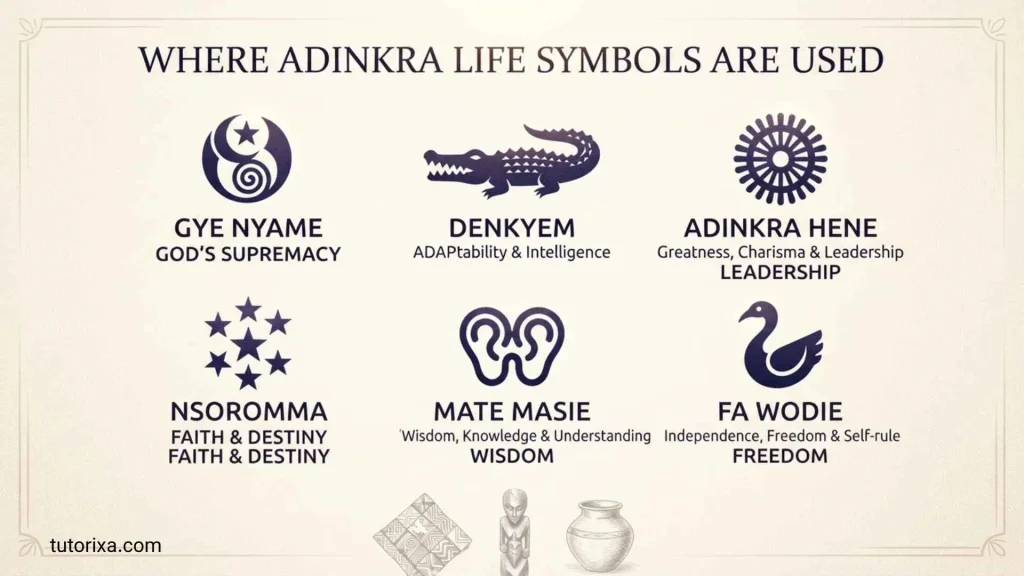
Adinkra symbols have appeared in many forms of Akan visual culture and continue to inspire modern design.
Textiles
Traditional Adinkra cloth is one of the most important contexts. Symbols can be stamped repeatedly across fabric to create visual messages.
Architecture
Adinkra motifs appear in decorative elements of traditional Asante buildings. These motifs can accompany geometric and figurative designs.
Jewelry
Modern jewelry frequently incorporates recognizable motifs such as Gye Nyame, Sankofa, Aya, and Adinkrahene.
Art
Artists use Adinkra designs to explore African identity, history, spirituality, ancestry, and cultural continuity.
Education
Sankofa is particularly suitable for educational contexts because its central idea emphasizes learning from history.
Logos and Graphic Design
Modern organizations sometimes use Adinkra-inspired imagery to communicate concepts such as unity, leadership, heritage, wisdom, or independence.
Clothing
Adinkra-inspired designs are common in contemporary fashion, including garments, accessories, and cultural clothing.
Tattoos
Some people choose Adinkra motifs because they want a visual reminder of a particular value. However, a tattoo can remove a symbol from its original cultural context, so learning the authentic meaning and history is important before using one.
Common Variations
Adinkra designs are not always reproduced identically. Hand-carved stamps, textile printing, modern graphic design, digital illustrations, jewelry, and architectural decoration can produce noticeable differences in shape.
Some motifs also have alternative spellings because Akan words can be transliterated differently into English. For example, a symbol may appear with slightly different spacing, punctuation, or spelling in different sources.
Modern designers may simplify a traditional form while preserving its basic identity. This creates an important distinction between a traditional motif and a modern adaptation inspired by that motif.
The same principle applies to meanings. A contemporary designer may use a symbol to express an idea that overlaps with its traditional meaning without reproducing every historical cultural association.
Common Misconceptions
“There is one official list containing every Adinkra symbol.”
There is no universally authoritative master list that settles every symbol, spelling, design variation, and interpretation. Historical documentation recorded particular collections of signs, while later sources document additional motifs.
“Every Adinkra symbol has exactly one meaning.”
Meanings can depend on proverbs, context, language, and interpretation. A short English translation often captures only part of the concept.
“Adinkra is the same thing as all African symbolism.”
It is not. Adinkra is strongly associated with Akan cultural traditions, especially those of Ghana and the Asante.
“Every geometric design in Akan art is an Adinkra symbol.”
Not necessarily. Akan art contains many geometric motifs, including designs found on goldweights and architecture whose exact historical meanings may be uncertain.
“Adinkra symbols are only decorative.”
Historically, many motifs functioned as visual expressions of proverbs, values, concepts, and social ideas. Their decorative beauty and communicative function can exist at the same time.
10 Interesting Facts About Adinkra Symbols
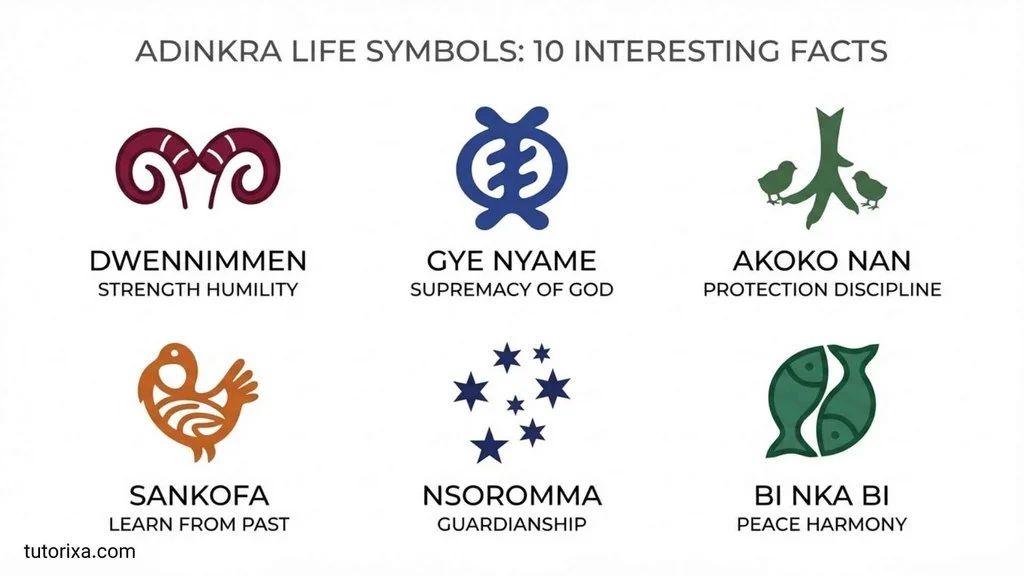
- Adinkra can function like visual language.
Symbols can communicate ideas without requiring a long written explanation. - Proverbs are central to many interpretations.
Akan proverbs provide an important bridge between visual imagery and moral or practical wisdom. - The tradition is closely associated with Ghana.
Particularly important historical connections exist with Akan and Asante culture. - Historical sources recorded dozens of symbols.
Rattray documented 53 named signs, demonstrating that the tradition already contained a substantial symbolic vocabulary in the period he studied. - Adinkra appears beyond textiles.
Related motifs can be found in architecture and other forms of Akan art. - Sankofa has become internationally recognizable.
Its message about learning from history has made it especially meaningful in education, heritage, and cultural identity. - Symbols can connect visual and spoken communication.
Akan royal spokespersons historically used symbolic staffs whose imagery could reinforce speeches and proverbs. - Not every historical meaning is certain.
Museum collections show that some Akan geometric designs have uncertain interpretations. This is why responsible sources should distinguish documented meanings from modern guesses. - Adinkra developed within a larger Akan artistic system.
Akan symbolism also appears in goldwork, royal regalia, architecture, stools, staffs, and other objects. - The tradition continues to evolve.
Contemporary artists and designers continue using Adinkra forms while adapting them to new materials, audiences, and cultural settings.
Related Symbols About Adinkra Symbols
Several concepts and visual traditions are closely connected with Adinkra.
- Akan goldweights: Small brass objects often feature geometric or figurative designs connected with Akan proverbs and cultural knowledge.
- Kente patterns: Kente is a distinct Akan textile tradition, although both kente and Adinkra are important parts of Ghanaian visual culture.
- Akan royal regalia: Stools, staffs, gold ornaments, swords, and other objects use imagery to communicate authority and social status.
- Sankofa imagery: Often discussed alongside Adinkra because its message of recovering useful knowledge from the past has broad cultural significance.
- Akan proverbs: These are particularly important because many visual motifs express ideas that are also communicated verbally.
Frequently Asked Questions
1. What are Adinkra symbols?
Adinkra symbols are visual motifs associated with Akan peoples, especially the Asante tradition of Ghana. They represent ideas, values, proverbs, moral lessons, spiritual concepts, and observations about human life. They have traditionally appeared on textiles and in other forms of Akan art, architecture, and ceremonial culture.
2. What is the most famous Adinkra symbol?
Gye Nyame is one of the most widely recognized Adinkra symbols. It expresses the supremacy or uniqueness of God and is frequently used in contemporary African-inspired jewelry, artwork, clothing, and cultural designs. Its popularity today extends well beyond traditional textile contexts.
3. What does Sankofa mean?
Sankofa expresses the idea that people should look to the past and recover useful knowledge before moving forward. It is commonly associated with learning from history, cultural heritage, reflection, education, and intergenerational knowledge. The concept emphasizes that understanding the past can help guide better decisions in the present.
4. Are Adinkra symbols religious?
Some Adinkra symbols have clear spiritual associations, especially motifs connected with Nyame, the Akan concept of the supreme creator. However, Adinkra is not exclusively religious. Many symbols communicate secular values such as wisdom, cooperation, leadership, courage, perseverance, freedom, and reconciliation.
5. Where did Adinkra symbols originate?
Adinkra symbols originated within Akan cultural traditions of West Africa and are particularly associated with the Asante of present-day Ghana. Their precise origins are difficult to assign to a single date or historical event. The tradition developed alongside broader Akan systems of textile production, proverbs, art, architecture, and royal symbolism.
6. How many Adinkra symbols are there?
There is no universally accepted number of Adinkra symbols. A historical source associated with R. S. Rattray recorded 53 signs, while later scholarship, museum collections, artists, and cultural resources identify additional motifs and variations. Therefore, claims that there is one definitive number should be treated cautiously.
7. What does Gye Nyame mean?
Gye Nyame is commonly interpreted as expressing God’s supremacy, uniqueness, or omnipotence. The phrase is associated with the Akan concept of Nyame. Modern users often choose the symbol as an expression of faith, spirituality, humility, or belief in divine authority.
8. What does Adinkrahene symbolize?
Adinkrahene, commonly translated as “Adinkra king,” is associated with leadership, authority, greatness, and influence. Historical documentation identifies it as a particularly important Adinkra design. Its name and position within Adinkra traditions help explain its association with leadership and prominence.
9. Can Adinkra symbols be used in modern designs?
Yes. Adinkra-inspired designs are widely used in contemporary art, fashion, jewelry, education, branding, and cultural projects. Responsible use requires understanding the original cultural meaning rather than treating the motif as a meaningless decorative icon. Designers should also avoid presenting uncertain interpretations as established historical facts.
10. Are all Adinkra meanings historically proven?
No. Some meanings are strongly documented through historical sources, museum collections, linguistic evidence, and Akan cultural traditions, while others are simplified or modern interpretations. The safest approach is to distinguish established cultural interpretations from speculative claims, especially when discussing ancient origins or exact symbolism.
Key Takeaways
- Adinkra symbols are part of Akan visual culture, especially the Asante tradition of Ghana.
- They communicate proverbs, values, ideas, spiritual concepts, and social principles.
- Gye Nyame is associated with the supremacy of God.
- Sankofa emphasizes learning from the past.
- Adinkrahene represents leadership and greatness.
- Dwennimmen connects strength with humility.
- Mpatapo represents reconciliation and peacemaking.
- Fawohodie represents freedom and independence.
- Aya is associated with endurance and resourcefulness.
- Adinkra is used on textiles, architecture, jewelry, art, clothing, and ceremonial objects.
- There is no universally fixed list of every Adinkra symbol.
- Meanings can vary with Akan language, proverb, context, historical period, and modern interpretation.
- Adinkra should be understood as part of a broader Akan verbal and visual cultural tradition.
Conclusion
All Adinkra symbols and meanings cannot be reduced to a simple dictionary because Adinkra is a living cultural tradition shaped by language, proverbs, history, spirituality, art, and social experience. Symbols such as Gye Nyame, Sankofa, Adinkrahene, Dwennimmen, Aya, and Mpatapo remain powerful because they transform complex ideas into memorable visual forms.
The deeper significance of Adinkra lies in the relationship between image and meaning. A small motif can point toward a proverb, a moral lesson, a spiritual belief, a political value, or an observation about human behavior. Understanding that context makes the symbols far more meaningful than simply memorizing their English translations.
Today, Adinkra continues to connect Ghanaian and Akan heritage with contemporary art, education, fashion, architecture, and cultural expression. Studying the symbols carefully also reveals an important principle: visual design can preserve knowledge, communicate values, and connect generations without relying entirely on written language.

I’m Rowan Whitaker, a British writer fascinated by the symbols surrounding us every day. I explore their meanings, origins, cultural significance, and changing interpretations. From ancient marks to modern signs, I enjoy making symbolism easier to understand. My writing helps curious readers discover the hidden messages behind familiar shapes, images, and signs.
Books:
- The Meaning Behind Symbols
- A Modern Guide to Symbolism
 Ellis Montgomery
 Freddie Beaumont