
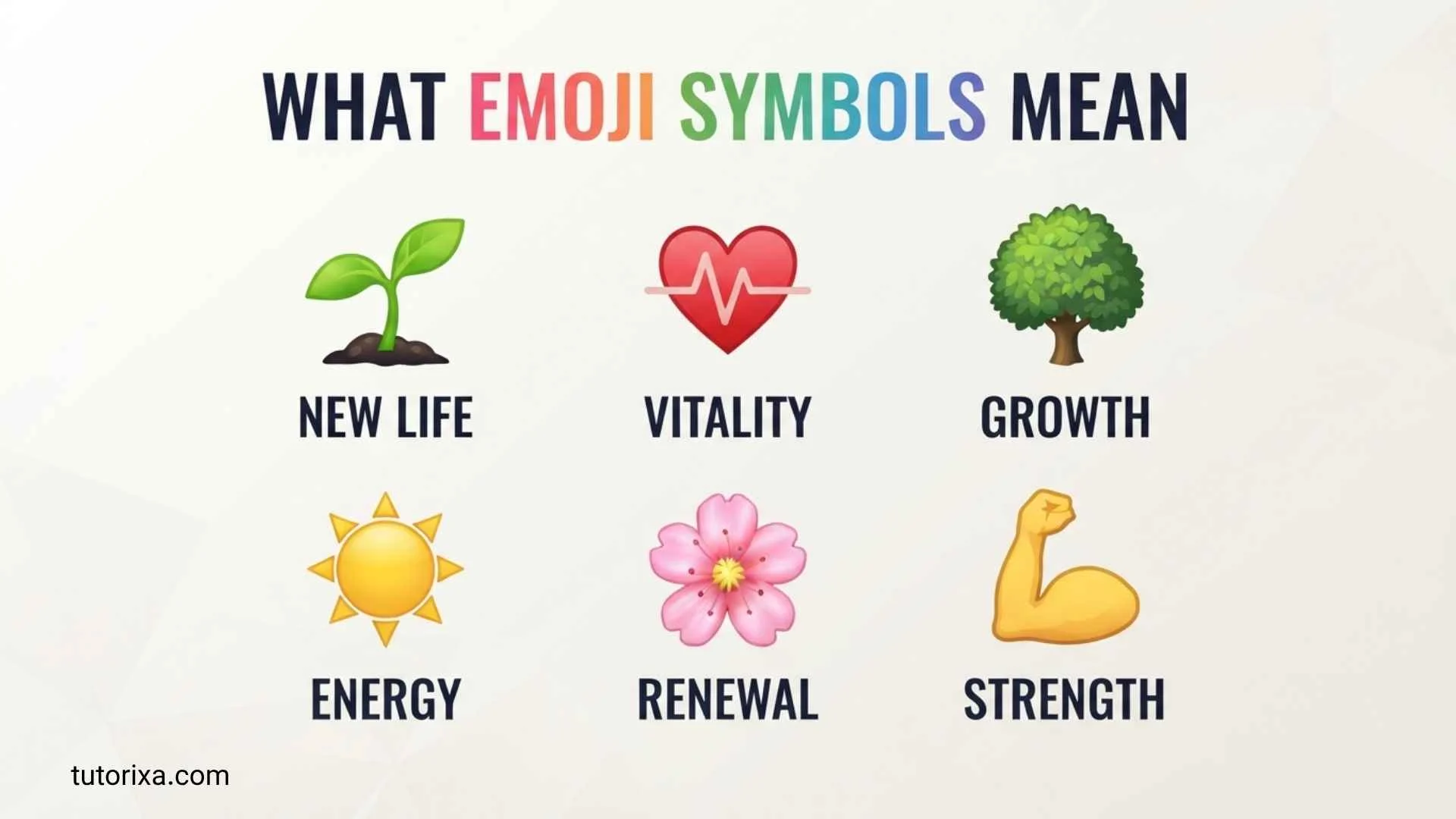
What Emoji Symbols Mean can be surprisingly hard to figure out, especially when one tiny symbol can change the feeling of an entire message. I use emojis to add emotion, humor, or meaning, and you probably do too—but do you always know what each one really means?
You may have sent an emoji thinking it meant one thing, only to discover that someone understood it differently. You want your messages to feel clear and natural, so I’ll help you understand the meanings behind common emoji symbols in a simple, practical way.
From hearts and faces to hands, objects, and popular symbols, you’ll discover what these emojis commonly represent and how people use them today. I’ll also show you the meanings that can change depending on context, so you can choose the right emoji with confidence.
Quick Meaning
Emoji symbols are pictographic characters used in digital communication to express emotions, objects, actions, ideas, reactions, and cultural concepts. Their meaning usually comes from their visual appearance and common usage, but context can change the intended message. For example, 👍 can mean approval, agreement, or acknowledgment, while 🙏 may express thanks, prayer, hope, or a respectful request.
Symbol Overview Table
| Field | Details |
| Symbol Name | Emoji |
| Basic Meaning | Pictographic symbol used in digital communication |
| Category | Digital symbols and pictographs |
| Word Origin | Japanese emoji, meaning pictograph |
| Main Development | Japan, especially mobile communication |
| Important Early Set | NTT DoCoMo’s 176-emoji set launched with i-mode in 1999 |
| Earlier Development | SoftBank had an emoji implementation in 1997 |
| Standardization | Unicode Standard |
| Modern Use | Messaging, social media, websites, email, digital communication |
| Technical Form | Unicode characters or sequences |
| Visual Form | Usually colorful graphical representations |
| Related Concepts | Emoticons, pictograms, symbols, stickers, GIFs |
| Current Standard | Unicode Emoji 18.0 documentation |
The history of emoji is more complicated than the common claim that one person simply “invented emoji.” SoftBank had an emoji implementation in 1997, while Shigetaka Kurita designed a well-known set of 176 emoji for NTT DoCoMo’s i-mode service in 1999.
What Does the Symbol Mean?
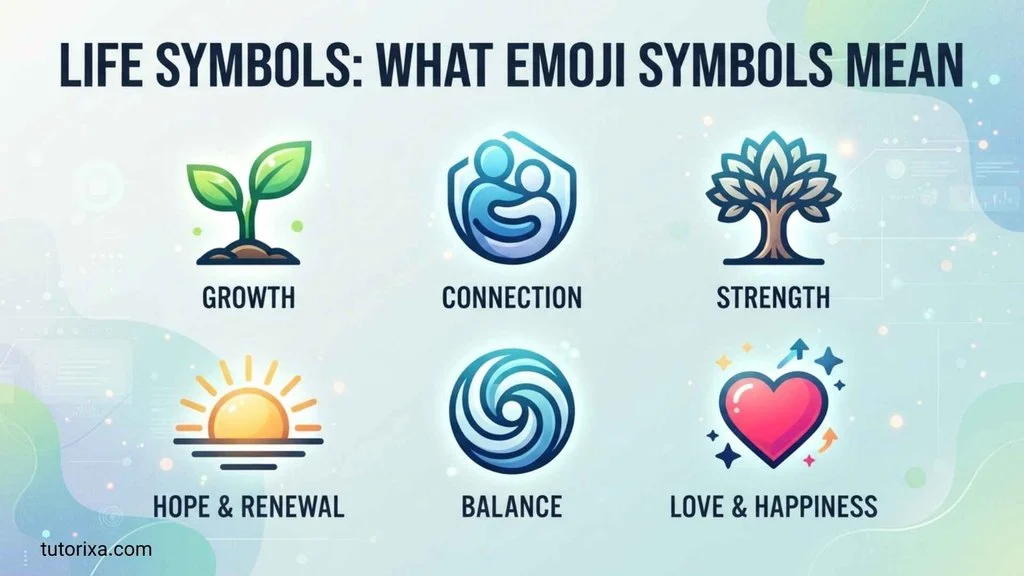
Emoji symbols generally mean visual ideas, emotions, reactions, objects, or concepts that supplement written language. Their meaning is not fixed in exactly the same way as a dictionary word.
Consider these common examples:
- 😀 — happiness, friendliness, positive mood
- 😂 — strong laughter or amusement
- 😊 — warmth, happiness, appreciation, or gentle friendliness
- 😢 — sadness or disappointment
- 😍 — admiration, delight, or strong enthusiasm
- 😎 — confidence, coolness, or relaxed attitude
- 😮 — surprise or amazement
- 🤔 — thinking, uncertainty, or questioning
- 😴 — sleepiness, tiredness, or going to bed
- 😡 — anger or frustration
- ❤️ — love, affection, care, or support
- 👍 — approval, agreement, or acknowledgment
- 👎 — disagreement or disapproval
- 🎉 — celebration
- 🔥 — something exciting, impressive, popular, or “hot”
- 💯 — complete agreement, excellence, or strong approval
- 🙏 — thanks, prayer, hope, respect, or a request
- 🚀 — launch, progress, ambition, or rapid growth
- ✅ — confirmation, correctness, or completion
- ❌ — rejection, incorrectness, or cancellation
These are common interpretations rather than universal rules.
Unicode itself warns that a character name does not necessarily define every meaning of an emoji. Its official documentation uses names, annotations, and keywords to help describe intended uses, but actual interpretation can be broader.
Why Context Matters
The sentence around an emoji can completely change its interpretation.
For example:
“Great job 👍”
The thumbs-up most likely expresses approval.
But:
“Okay, fine 👍”
The same emoji may sound impatient, dismissive, or sarcastic depending on the relationship between the speakers.
This is why understanding an emoji requires looking at the symbol + surrounding words + conversation + relationship + culture rather than treating the picture as a single fixed definition.
History and Origin
Modern emoji developed from Japanese mobile communication and later became standardized through Unicode.
The word emoji comes from Japanese and refers to a pictograph. Unicode defines emoji as pictographic and related symbols that commonly receive colorful or playful presentation on digital devices.
Early emoji-like systems appeared in Japan before emoji became globally standardized. SoftBank introduced an emoji implementation in 1997. In 1999, NTT DoCoMo launched an influential set of 176 small pictographs designed by Japanese interface designer Shigetaka Kurita for its i-mode mobile internet service.
These early symbols were designed for a practical communication problem: tiny screens provided limited space, so a small image could communicate an idea quickly.
The concept spread as Japanese mobile carriers developed their own symbol sets. The designs were eventually incorporated into broader digital standards.
Unicode became especially important because different companies once used incompatible character systems. Standardization allowed the underlying characters and sequences to be exchanged between systems, although their visual designs can still differ.
In 2010, 608 additional emoji characters were added to Unicode 6.0, followed by further additions in later releases.
Today, Unicode Technical Standard #51 defines the structure and behavior of emoji characters and sequences. Unicode Emoji 18.0 is the current version of that technical specification as of August 2026.
Symbolism and Interpretation
Emoji symbolism comes from visual resemblance, established conventions, emotional associations, and repeated patterns of use.
Positive Meanings
Many emoji communicate positive emotions:
- ❤️ represents love, affection, care, or support.
- 💛 can suggest warmth, friendship, happiness, or affection.
- 😊 often creates a gentle and friendly tone.
- 🎉 represents celebration and excitement.
- ✨ can suggest beauty, emphasis, excitement, or something special.
- 🌟 often suggests excellence, success, or something noteworthy.
- 🙌 can express celebration, excitement, or praise.
- 💪 can represent strength, determination, or encouragement.
Negative Meanings
Other emoji commonly communicate difficult or negative emotions:
- 😢 — sadness
- 😭 — intense sadness or emotional reaction
- 😡 — anger
- 😞 — disappointment
- 😔 — sadness or reflection
- 😰 — anxiety, worry, or nervousness
- 💔 — heartbreak or emotional pain
- 😩 — exhaustion, frustration, or distress
Neutral or Context-Dependent Meanings
Some emoji are especially dependent on context:
- 🤔 — thinking or questioning
- 👀 — watching, noticing, or showing interest
- 🤷 — uncertainty or lack of knowledge
- 🤝 — agreement, cooperation, or partnership
- 📌 — something important or worth remembering
- 💡 — an idea or solution
- 🔍 — searching or examining something
Psychological Interpretation
Emoji can provide emotional cues that plain text sometimes lacks. A short sentence can appear cold, playful, serious, friendly, or sarcastic depending on the symbols surrounding it.
However, emoji should not be treated as precise psychological measurements. An emoji does not prove what someone feels. It only provides an additional communication cue.
Cultural Significance
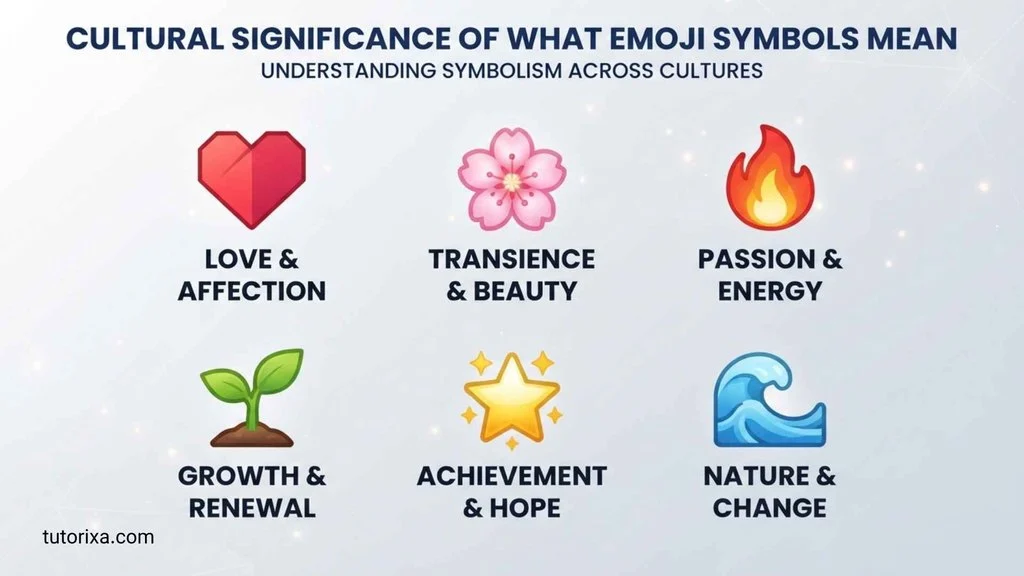
Emoji meanings can vary across cultures because symbols are interpreted through local customs, language, religion, gestures, and social conventions.
A classic example is the 🙏 emoji. In different contexts, people may interpret it as prayer, gratitude, respect, pleading, greeting, or appreciation. Its meaning depends heavily on the surrounding message and cultural background.
Hand gestures can be particularly sensitive to cultural differences. A gesture that looks positive in one society may have a different association elsewhere.
Food, clothing, celebrations, animals, buildings, and national symbols can also carry cultural associations.
Emoji therefore function as a kind of global visual vocabulary, but they are not a perfectly universal language.
Regional Differences
An emoji may also receive different popular interpretations in different online communities.
For example, 🙂 may literally represent a slightly smiling face, but some internet users use it in situations involving awkwardness, restraint, passive frustration, or irony.
Similarly, 💀 can literally represent a skull but is frequently used informally to mean something like “that was extremely funny” or “I am overwhelmed by how funny this is.”
These meanings develop through community usage rather than through the literal picture alone.
Where Emoji Symbols Are Used
Emoji are used across almost every major form of digital communication.
Text Messaging
People use emoji to communicate emotions, reactions, greetings, and short responses.
Example:
“See you tomorrow! 😊”
The emoji adds warmth to the sentence.
Social Media
Emoji are common in captions, comments, reactions, profiles, and posts.
Examples include:
- ❤️ for appreciation
- 🔥 for excitement or praise
- 👏 for recognition
- 😂 for humor
- ✨ for emphasis
Emoji may appear in informal or friendly email communication, although professional environments often call for moderation.
Digital Marketing
Businesses use emoji to add visual emphasis to social posts, notifications, promotional messages, and informal campaigns.
Online Communities
Different communities develop their own emoji conventions. A symbol can become an inside joke or shorthand within a particular group.
Education
Teachers and students sometimes use emoji for quick reactions, feedback, encouragement, and informal communication.
Art and Creative Expression
Emoji can be arranged together to create visual messages, jokes, narratives, or decorative patterns.
Common Variations
Emoji can vary visually across platforms even when they represent the same Unicode character.
Apple, Google, Microsoft, Samsung, and other platforms can design their own emoji artwork. Unicode standardizes the underlying character or sequence, not one universal colored picture. Unicode explicitly notes that the images shown in its technical documentation are illustrative rather than the actual images contained in the Unicode Standard.
This explains why the same emoji can look slightly different on different phones.
Skin-Tone Variations
Some human emoji support skin-tone modifiers. Unicode defines mechanisms for emoji that can be displayed with different skin tones.
Gender Variations
Some emoji concepts have gender-specific or gender-inclusive sequences.
Family and Relationship Sequences
Several emoji are created from multiple Unicode characters joined together. This allows more complex representations than a single character.
Flag Emoji
Many flag emoji use regional indicator sequences rather than one simple character. Unicode notes that regional indicators are commonly used in pairs to represent flags.
Common Misconceptions
Misconception 1: Every emoji has one official meaning
Not true. Unicode defines characters and provides names, annotations, and keywords, but everyday meaning can extend beyond those descriptions.
Misconception 2: Unicode designs the emoji pictures
Unicode standardizes characters and sequences, but companies and platforms create their own graphical presentations.
Misconception 3: Emoji and emoticons are identical
They are different.
An emoticon is traditionally created from keyboard characters, such as 🙂 or :-(.
An emoji is a pictographic character or sequence represented digitally. Unicode distinguishes these concepts in its glossary.
Misconception 4: Emoji are only for expressing emotions
Emoji can represent emotions, but they also represent objects, animals, food, locations, activities, weather, symbols, people, and abstract ideas.
Misconception 5: The first emoji appeared in 1999
1999 is an important milestone because of NTT DoCoMo’s influential set, but SoftBank had an emoji implementation in 1997. Earlier emoji-like pictographs also existed in Japanese digital systems.
Interesting Facts About What Emoji Symbols Mean
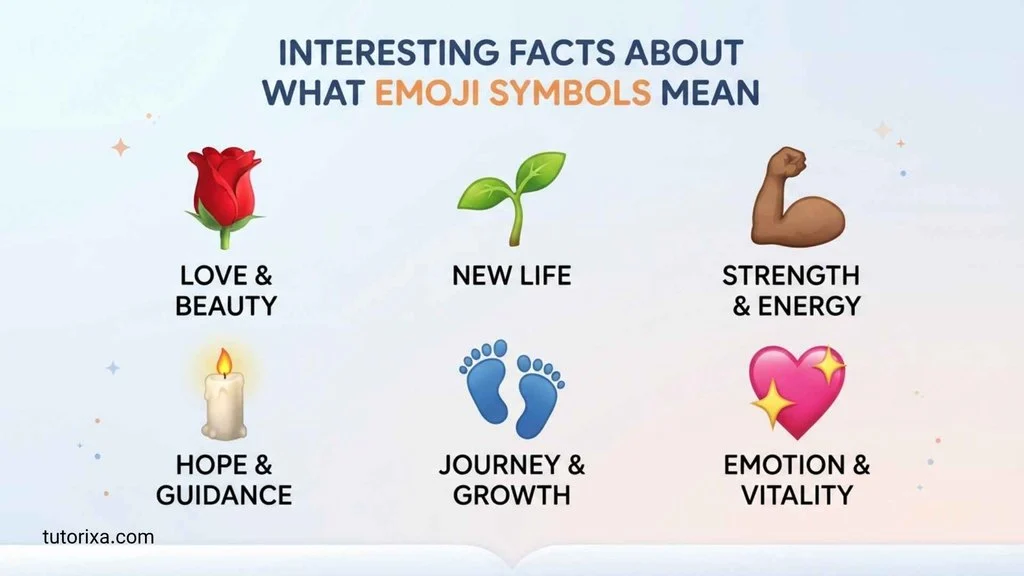
- The word emoji is Japanese.
It refers to a pictograph, which fits the basic function of these symbols: communicating ideas visually. - Emoji existed before modern smartphone keyboards.
Their development is closely connected with Japanese mobile phone communication in the 1990s. - Shigetaka Kurita designed the famous 176-symbol DoCoMo set.
His work became an important milestone in the development of modern emoji. - Emoji are standardized as characters or sequences.
What appears as one picture to a user may technically consist of multiple Unicode characters. - Unicode does not dictate one visual design.
Different platforms can display the same underlying emoji differently. - Emoji can have more than one meaning.
A single symbol may have a literal meaning, an emotional meaning, and an internet-culture meaning. - Emoji are not limited to facial expressions.
The Unicode emoji repertoire includes categories covering people, animals, food, transportation, places, activities, objects, and symbols. - Emoji selection is deliberate.
Unicode evaluates proposed emoji using factors such as expected usage, distinctiveness, and breadth of potential use. - Emoji can represent entire ideas.
A combination such as 💡✨ can communicate “great idea” without using words. - Emoji continue to evolve.
New characters and sequences are periodically added as communication needs and cultural representation change.
Related Symbols
Emoji belong to a wider family of visual communication systems.
Emoticons
Emoticons use punctuation and keyboard characters to represent facial expressions, such as 🙂 or :-(. They became popular before modern emoji.
Pictograms
Pictograms are simplified images that communicate information visually. Public restroom signs, transportation icons, and warning symbols are common examples.
Dingbats
Dingbats are decorative or symbolic characters that have appeared in typefaces and character sets. Some older symbols later became part of the digital emoji ecosystem. Unicode identifies sources such as Zapf Dingbats, ARIB, Japanese carrier sets, and Wingdings/Webdings in its emoji documentation.
Stickers
Stickers are graphical images used in messaging apps. Unlike standardized Unicode emoji, stickers generally depend on the particular application or platform.
GIFs
GIFs can communicate reactions and emotions through short animations, but they are media files rather than Unicode characters.
Frequently Asked Questions
1. What do emoji symbols mean?
Emoji symbols are visual characters used to express emotions, objects, actions, reactions, and ideas in digital communication. Their meanings are often based on common usage, but context matters. A heart can represent romantic love, friendship, appreciation, support, or affection depending on the message and relationship between the people communicating.
2. Where did emoji originate?
Modern emoji developed primarily through Japanese mobile communication in the 1990s. SoftBank had an emoji implementation in 1997, while NTT DoCoMo launched a widely influential set of 176 emoji in 1999. Shigetaka Kurita designed the DoCoMo set for the company’s i-mode service.
3. What is the most common meaning of ❤️?
The red heart emoji commonly expresses love, affection, care, appreciation, or emotional support. Its meaning does not have to be romantic. Friends, family members, organizations, and online communities can all use ❤️ to communicate warmth or support.
4. Why does the same emoji look different on different phones?
Unicode standardizes the underlying character or sequence, while individual platforms can create their own visual designs. As a result, an emoji may look different on Apple, Google, Microsoft, Samsung, or another platform while still representing the same standardized character.
5. Can emoji have different meanings?
Yes. Emoji meanings are strongly influenced by context and culture. For example, 😂 generally indicates laughter, but a particular community may use it in a more exaggerated or ironic way. Unicode also states that the formal character name does not define every possible meaning of an emoji.
6. What is the difference between an emoji and an emoticon?
An emoji is a pictographic character or sequence used in digital text. An emoticon traditionally uses ordinary keyboard characters to create an expression, such as 🙂 or :-(. Unicode treats emoji and emoticons as related but distinct concepts.
7. Are emoji a universal language?
Emoji are not a completely universal language. Their visual forms are widely recognizable, but interpretations can differ by culture, generation, community, and context. Some symbols have particularly strong cultural or religious associations, so a literal interpretation may not always match the sender’s intended meaning.
8. Why are new emoji added?
New emoji can be added when they satisfy Unicode’s selection requirements. Factors include expected frequency of use, distinctiveness, compatibility with existing emoji, and the ability to represent a broad concept. The selection process is designed to evaluate proposals systematically.
9. Do Unicode names tell you exactly what an emoji means?
No. A Unicode character name is primarily an identifier and does not necessarily describe every interpretation or use. Unicode’s emoji charts and CLDR annotations provide additional keywords and information about intended uses.
10. How should I interpret an emoji in a message?
Start with its common meaning, then examine the surrounding words, tone, relationship, and conversation history. If the emoji seems ambiguous, avoid assuming that one interpretation is automatically correct. Digital communication often depends on context more than the symbol itself.
Key Takeaways
- Emoji symbols are visual characters used in digital communication.
- Their meanings can express emotions, actions, objects, reactions, and ideas.
- Context is essential because one emoji can have several interpretations.
- Modern emoji developed significantly through Japanese mobile communication.
- SoftBank had an emoji implementation in 1997.
- NTT DoCoMo’s influential 176-emoji set appeared in 1999.
- Shigetaka Kurita designed the DoCoMo set.
- Unicode standardizes emoji characters and sequences.
- Different platforms can display the same emoji differently.
- Emoji are different from traditional emoticons.
- Cultural background can influence how a symbol is understood.
- Emoji meanings continue to evolve through everyday usage.
- Unicode character names do not necessarily define every possible meaning.
- Emoji can function as emotional cues, visual shorthand, or complete ideas.
- The safest interpretation comes from considering the emoji together with its context.
Conclusion
What emoji symbols mean cannot always be reduced to a single dictionary-style definition. Emoji combine visual representation with language, emotion, culture, technology, and social context. A heart can show love or support, a thumbs-up can signal agreement, and a laughing face can turn a plain sentence into an obvious joke.
Their history also shows why emoji became so useful. They grew from compact pictographs designed for digital communication and developed into a standardized system used around the world. Unicode provides the technical framework that lets these symbols function across modern digital systems, while everyday users continue to give them new shades of meaning.
The best way to understand an emoji is therefore to consider three things together: what the symbol visually represents, how people commonly use it, and what the surrounding conversation means. That combination reveals the real message behind the symbol.

I’m Ellis Montgomery, a British writer interested in the powerful language of symbols. I explore everything from traditional emblems and cultural signs to contemporary symbols found in modern life. My aim is to explain their meanings clearly while revealing the stories and ideas behind them, making symbolism fascinating and accessible to everyone.
Books:
- The Complete Book of Symbols
- Hidden Messages in Everyday Symbols
 Rowan Whitaker
 Freddie Beaumont