
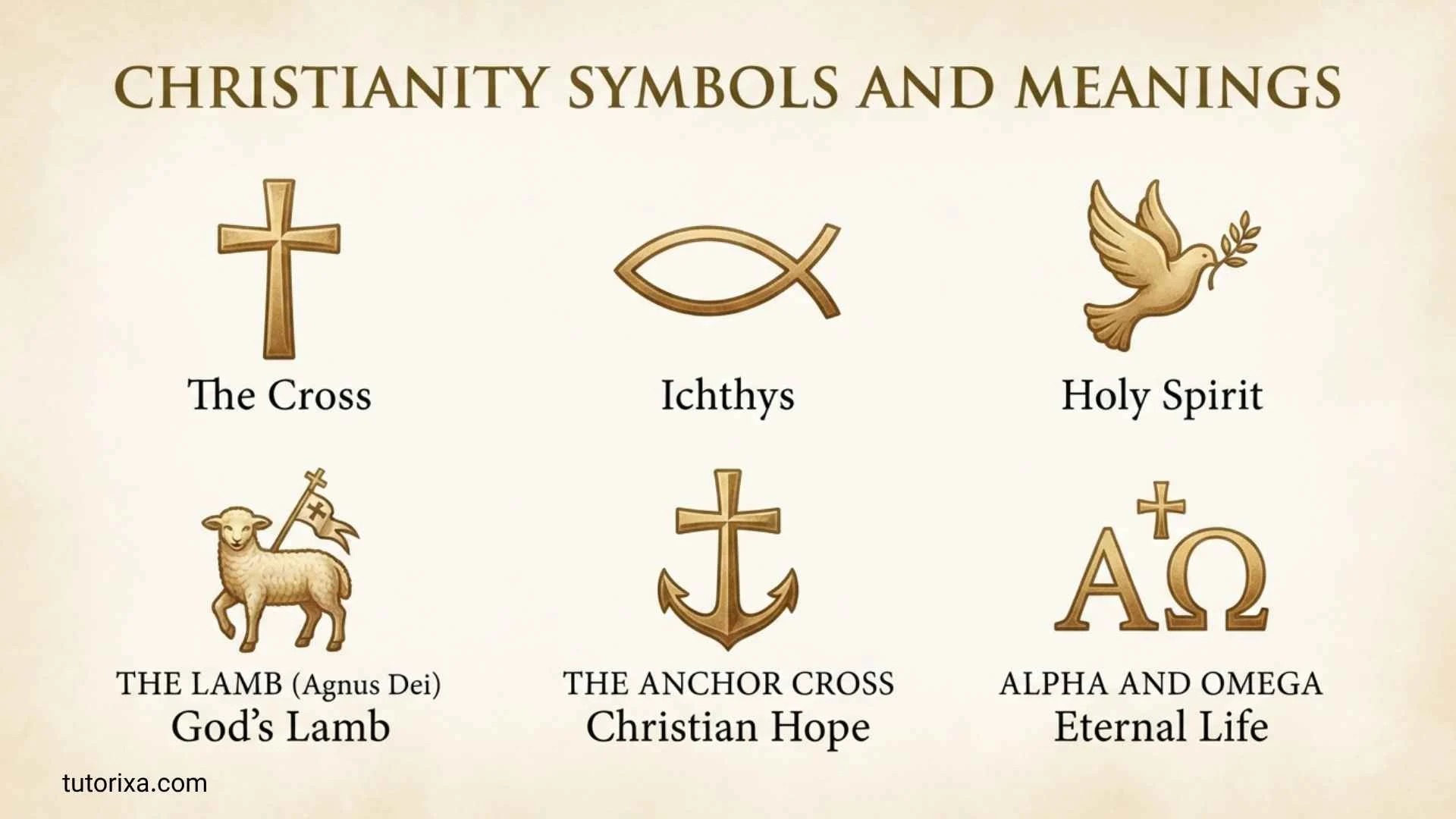
Christianity Symbols and Meanings can reveal deep ideas about faith, hope, sacrifice, love, and spiritual life. I find these symbols fascinating because a simple image can carry centuries of meaning, and you may recognize many of them without knowing their full story.
From the cross and the fish to the dove, lamb, and anchor, Christian symbols appear in churches, artwork, jewelry, books, and everyday life. You can learn what these powerful symbols mean and why they remain important to Christians today.
In this guide, I’ll walk you through the most important Christianity Symbols and Meanings in a simple, clear way. You’ll discover their origins, biblical connections, spiritual meanings, and how these symbols continue to shape Christian culture and worship.
Quick Meaning
Christian symbols are visual signs that communicate central Christian beliefs, especially the identity of Jesus Christ, his crucifixion and resurrection, salvation, hope, faith, eternal life, and God’s presence. The cross is the best-known Christian symbol, while the fish, Chi-Rho, dove, lamb, anchor, and Alpha and Omega are important related symbols.
Symbol Overview Table
| Symbol Name | Primary Meaning | Category | Historical Background | Common Usage Today |
| Cross | Christ’s crucifixion, sacrifice, and salvation | Christian | Became especially prominent in late antiquity | Churches, jewelry, art, worship |
| Crucifix | Christ on the cross | Christian | Developed as a major devotional image later than the earliest Christian symbols | Catholic, Anglican, Orthodox and other traditions |
| Ichthys/Fish | Christ and Christian faith | Christian | Found in early Christian art | Jewelry, logos, artwork |
| Chi-Rho | Christ | Christogram | Used by Christians in late Roman antiquity | Church art, manuscripts, decorations |
| Alpha & Omega | Beginning and end; God’s eternity | Biblical/Christian | Associated with Revelation | Crosses, church art, manuscripts |
| Dove | Holy Spirit, peace, purity | Biblical/Christian | Draws on biblical imagery | Baptismal art, stained glass, church decoration |
| Anchor | Hope, salvation, steadfastness | Christian | Appears in early Christian funerary art | Jewelry, monuments, artwork |
| Lamb | Christ as sacrificial Lamb | Biblical/Christian | Rooted in biblical sacrificial imagery | Art, church decoration |
| Good Shepherd | Christ’s care for believers | Biblical/Christian | Prominent in early Christian art | Paintings, sculpture, church art |
| Peacock | Eternal life | Early Christian art | Used in early Christian funerary imagery | Historic Christian art |
Unicode does not provide a single universal “Christian symbol” character. Some individual symbols have Unicode representations—for example, ✝ is commonly displayed as a Latin cross and ☦ as an Orthodox cross—but Unicode characters are digital encodings, not definitions of Christian theology.
What Do Christian Symbols Mean?
Christian symbols generally communicate ideas that are central to Christian belief. Their meanings come from several sources: the Bible, Christian tradition, early Christian art, liturgy, theology, and the historical circumstances in which believers used them.
The cross is the central Christian symbol for many denominations. It recalls the crucifixion of Jesus and, within Christian theology, points beyond death toward resurrection and salvation. Its meaning therefore combines suffering, sacrifice, redemption, hope, and victory over death.
The fish, or ichthys, is another ancient Christian sign. The Greek word ichthys means “fish,” and the fish became associated with Christ in early Christian communities. Archaeological evidence shows fish imagery among early Christian symbols, particularly in Roman catacombs.
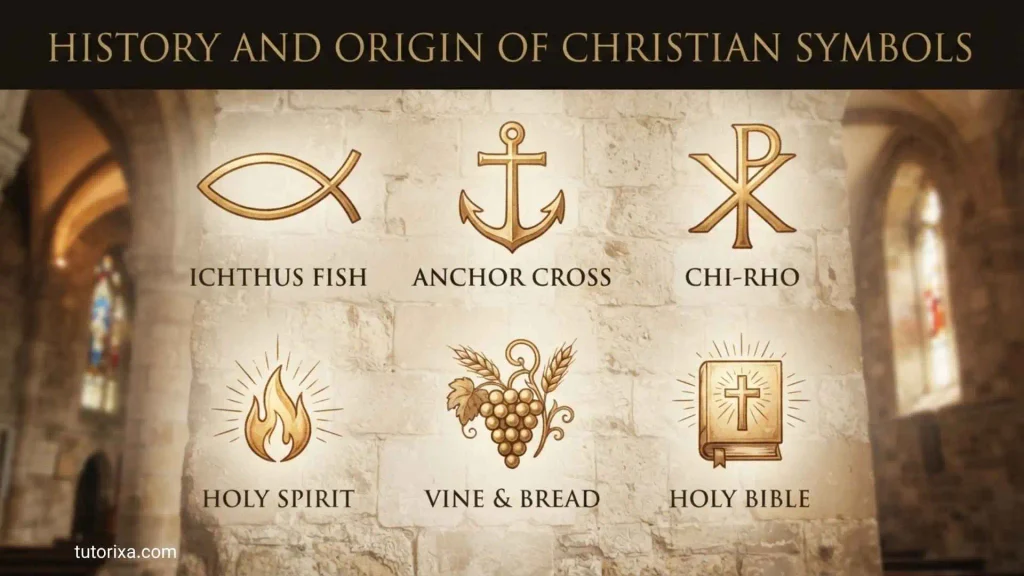
The Chi-Rho combines the Greek letters chi (Χ) and rho (Ρ), the first two letters of Christos, the Greek word for Christ. It became an important Christogram and was used prominently in late Roman Christian art.
The Alpha and Omega symbols are the first and last letters of the Greek alphabet. In Christian interpretation, they express God’s eternity and completeness. Their use is connected especially with the Book of Revelation.
These symbols should not be treated as secret codes with only one fixed interpretation. Context matters. The same image may have different meanings in different periods, regions, denominations, or artworks.
History and Origin of Christian Symbols
Christian symbolism developed gradually rather than appearing as a complete system at the beginning of Christianity.
The earliest identifiable Christian art can be traced to roughly the late second and early third centuries. Much of this early evidence comes from places such as the Roman catacombs, where Christians decorated burial spaces with images and inscriptions.
Early Christian artists frequently used familiar visual forms to communicate biblical ideas. Some images were adapted from wider Greco-Roman artistic traditions. The Good Shepherd, for example, resembles pre-Christian shepherd imagery while being given a Christian interpretation connected with Jesus’ teaching about the good shepherd.
Early Christians also used symbols connected with hope and salvation. In the Catacomb of Priscilla, scholars identify an anchor as a reference to safe harbor and salvation, while fish imagery refers to Christ. Doves, peacocks, shepherds, and biblical scenes also appear in early Christian decoration.
The visual language of Christianity changed significantly during the fourth century. Emperor Constantine’s conversion and the changing legal status of Christianity helped create conditions for Christian art to become much more public and monumental. The Chi-Rho became especially important in connection with Constantine and the Christian Roman Empire.
As Christianity expanded, symbols appeared in churches, mosaics, sarcophagi, manuscripts, jewelry, architecture, liturgical objects, and public monuments. Over centuries, regional traditions produced different forms of crosses, icons, monograms, saints’ attributes, and decorative motifs.
Symbolism and Interpretation
Christian symbols can have several layers of meaning.
Traditional Meaning
Traditional Christian symbolism usually connects an image to biblical events, Christian doctrine, or the life of Jesus. The lamb, for example, can represent Christ through the biblical image of the Lamb of God. The dove may represent the Holy Spirit, especially in connection with the baptism of Jesus.
Modern Meaning
Today, the same symbols can communicate both religious identity and broader cultural ideas. A cross may express personal faith, remembrance, family tradition, or Christian heritage. A dove may communicate peace even outside a specifically Christian setting.
Positive Symbolism
Common positive themes include:
- Faith
- Hope
- Salvation
- Resurrection
- Love
- Peace
- Sacrifice
- Forgiveness
- Eternal life
- Spiritual guidance
Negative or Complex Associations
Christian symbols do not normally represent evil, but some have complex historical associations. The cross, for instance, represents a form of execution in its historical context while simultaneously representing salvation in Christian theology. The meaning depends on the religious and historical context.
Likewise, a symbol such as the fish may appear in non-Christian contexts because fish are widespread artistic motifs. An image cannot automatically be identified as Christian solely because it resembles a known Christian symbol.
Cultural Significance
Christian symbolism varies across cultures and denominations.
In Western Christianity, Latin and Celtic cross forms became particularly common. In Eastern Christianity, the Byzantine tradition developed distinctive iconography, including the Orthodox cross and richly symbolic images of Christ, Mary, angels, and saints.
African, Asian, Middle Eastern, European, and Latin American Christian communities have also incorporated local artistic traditions into Christian visual culture. This means that Christianity does not have one universal artistic style.
Historical Christian art also demonstrates cultural exchange. Early Christian artists borrowed visual conventions from the surrounding Roman world while assigning them new theological meanings. Scholars therefore caution against assuming that every image had a uniquely Christian origin.
This is an important distinction: a symbol can have a Christian meaning without having originated exclusively within Christianity.
Religious or Spiritual Meaning
Christian symbols are deeply connected with worship, Scripture, prayer, baptism, funerals, Easter, Christmas, and other religious practices.
The cross reminds Christians of Jesus’ death and, in Christian belief, his resurrection.
The dove can represent the Holy Spirit and is particularly associated with biblical accounts of Jesus’ baptism.
The lamb represents Christ through the biblical theme of sacrificial redemption.
The Alpha and Omega emphasize God’s eternal nature.
The anchor expresses steadfast hope. Its appearance in early Christian funerary settings makes its association with salvation especially significant.
The Good Shepherd represents Christ’s care and guidance. Early Christian artists used the shepherd image as a visual way to express protection, care, and salvation.
These symbols are not magical objects. Their religious significance comes from the beliefs, stories, practices, and traditions attached to them.
Where Christian Symbols Are Used
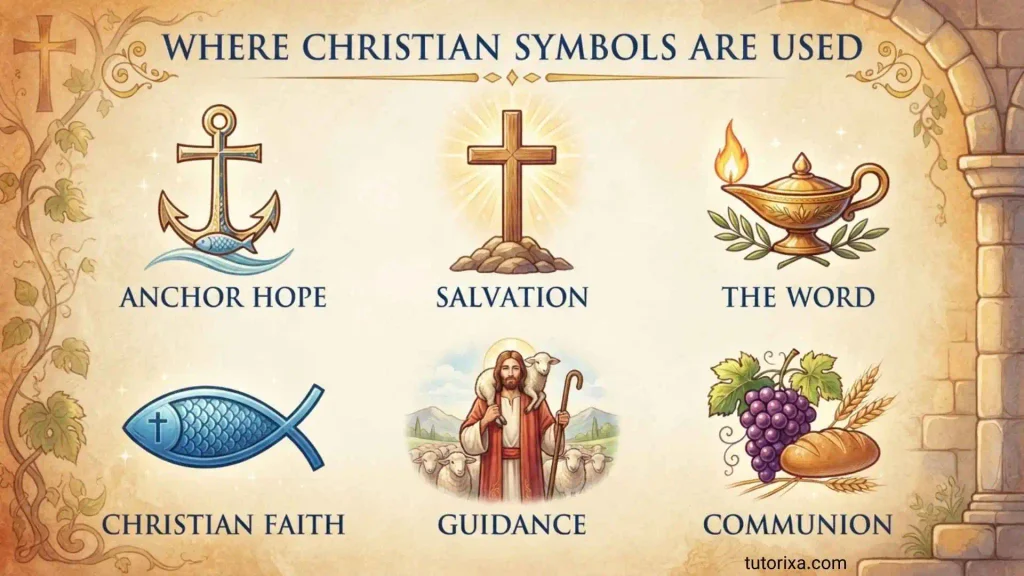
Christian symbols appear in many forms of religious and cultural expression.
Churches
Crosses, crucifixes, Chi-Rho monograms, doves, lambs, and biblical imagery can appear on altars, walls, doors, windows, ceilings, and furnishings.
Stained Glass
Church windows frequently use crosses, biblical scenes, saints, doves, crowns, lambs, and other Christian imagery to teach or reinforce religious themes.
Jewelry
Cross necklaces, rings, pendants, fish symbols, and other Christian designs are commonly worn as expressions of faith, identity, remembrance, or tradition.
Architecture
Crosses and Christograms may appear on church facades, towers, domes, doors, monuments, and interior decoration.
Manuscripts and Books
Medieval Christian manuscripts often contain elaborate crosses, Christograms, Alpha and Omega letters, evangelist symbols, and biblical imagery.
Art and Sculpture
Christian artists have used symbols to communicate stories and doctrines visually. Early Christian sarcophagi and catacomb paintings are important examples.
Funerary Art
Christian symbols frequently appear on tombs and memorials because themes such as resurrection, eternal life, salvation, and hope are closely connected with Christian understandings of death.
Common Variations
Christian symbols have changed considerably over time.
Cross Variations
Common forms include:
- Latin cross
- Greek cross
- Orthodox cross
- Celtic cross
- Jerusalem cross
- Maltese cross
- Crucifix
- Tau cross
These forms should not automatically be treated as interchangeable. Their histories and denominational associations can differ.
Fish Variations
The ichthys may appear as a simple fish outline, two curved shapes forming a fish, or a fish combined with Greek lettering.
Chi-Rho Variations
The Chi-Rho can appear inside a circle, surrounded by a wreath, combined with Alpha and Omega, or integrated into a cross. Late Roman and Byzantine examples show how the symbol could become part of elaborate decorative designs.
Alpha and Omega
These letters may appear on either side of a cross, around a Christogram, or as independent Christian decorative elements.
Common Misconceptions
1. The cross has always been Christianity’s only symbol
It has not. Early Christian communities used several images, including fish, anchors, shepherds, doves, and biblical scenes.
2. Every fish image is automatically Christian
A fish can have many meanings. Its Christian interpretation depends on context and historical evidence.
3. The Chi-Rho is an abbreviation invented in modern Christianity
The Chi-Rho is an ancient Christian Christogram using Greek letters and became prominent in late antiquity.
4. All Christian denominations use exactly the same symbols
Christian traditions share many symbols but differ in how prominently they use them and how they interpret particular images.
5. Every ancient symbol has a secret meaning
Historical symbolism is usually more complicated. Scholars often distinguish between documented meanings and later interpretations. An image’s meaning should be established from its archaeological, textual, artistic, and cultural context.
Interesting Facts About Christianity Symbols and Meanings
- The fish is among the earliest recognizable Christian images. Fish imagery appears in early Christian archaeological contexts, including Roman catacombs.
- The Chi-Rho is made from Greek letters. Chi and rho are the first two letters of Christos, meaning Christ.
- Alpha and Omega are not random decorative letters. Their Christian use refers to biblical language about God as the beginning and the end.
- The anchor had a Christian meaning in early funerary art. It could express the idea of safe harbor and salvation.
- The peacock could symbolize eternal life. Early Christian art sometimes used the bird in connection with immortality and eternal existence.
- Early Christian art borrowed from surrounding cultures. Christian artists used familiar Greco-Roman artistic forms and gave some of them new religious meanings.
- The Good Shepherd image predates many familiar Christian paintings of Jesus. It became an important early representation of Christ’s care for believers.
- The cross became increasingly prominent after Christianity gained public status. The fourth century marked a major transformation in Christian art and architecture.
- Christian symbols can appear alongside non-Christian imagery. Historical artifacts sometimes combine Christian symbols with older Greco-Roman artistic traditions.
- A symbol’s meaning depends on context. The same visual form can communicate different ideas in different historical or cultural settings.
Related Symbols
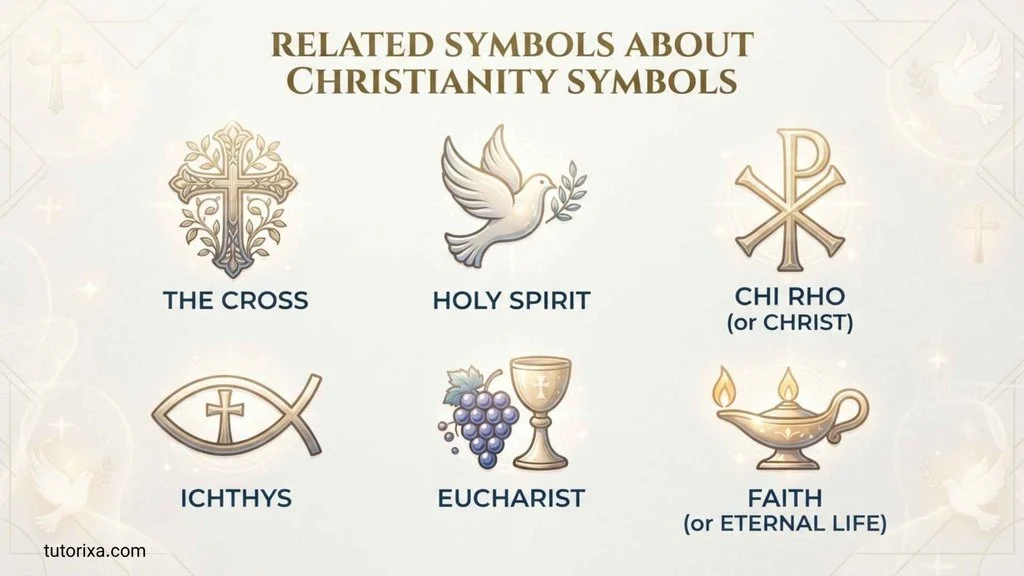
Cross and Crucifix
A cross emphasizes the cross itself, while a crucifix normally includes a representation of Jesus’ body. The distinction is particularly noticeable in Western Christian traditions.
Chi-Rho and Cross
Both identify Christ, but the Chi-Rho does so through Greek letters, while the cross communicates primarily through the image of the cross associated with Jesus’ crucifixion.
Fish and Dove
The fish is strongly associated with Christ and early Christian identity. The dove is more closely associated with the Holy Spirit, peace, and biblical imagery.
Anchor and Cross
Both can communicate Christian hope and salvation, but the anchor emphasizes steadfastness and hope, while the cross focuses more directly on Christ’s crucifixion and redemption.
Lamb and Good Shepherd
Both relate to Christ, but they emphasize different biblical images. The lamb highlights sacrifice and Christ as the Lamb of God, while the Good Shepherd emphasizes care, guidance, and protection.
Frequently Asked Questions
What is the most important symbol in Christianity?
The cross is generally regarded as the most widely recognized Christian symbol. It represents the crucifixion of Jesus and, within Christian theology, is closely connected with salvation and resurrection. Different Christian traditions use different forms of the cross, and some also emphasize other symbols such as the fish, Chi-Rho, or dove.
What does the Christian cross symbolize?
The Christian cross primarily recalls the crucifixion of Jesus Christ. For Christians, however, its meaning extends beyond suffering or death to include sacrifice, redemption, salvation, resurrection, and hope. Its importance comes from the central role of Jesus’ crucifixion and resurrection in Christian belief.
What does the fish symbol mean in Christianity?
The fish is an ancient Christian symbol associated with Christ. The Greek word ichthys means “fish,” and fish imagery appears in early Christian art. The symbol became a recognizable way of expressing Christian identity and connection with Jesus, although not every historical fish image should automatically be interpreted as Christian.
What does Chi-Rho mean?
Chi-Rho is a Christian Christogram made from the Greek letters Chi (Χ) and Rho (Ρ), the first two letters of Christos, meaning Christ. It became particularly important in late Roman Christianity. Archaeological and artistic examples show the Chi-Rho combined with crosses, wreaths, and Alpha and Omega.
What do Alpha and Omega mean in Christianity?
Alpha and Omega are the first and last letters of the Greek alphabet. In Christian symbolism, they represent God’s eternal and all-encompassing nature and are particularly associated with the Book of Revelation. They are frequently placed on either side of a cross or Christogram.
What does the dove symbolize in Christianity?
The dove commonly represents the Holy Spirit and can also communicate peace, purity, and divine presence. Its Christian meaning is especially connected with biblical accounts involving the Spirit and the baptism of Jesus. Early Christian artwork also used doves in symbolic compositions.
What does the anchor symbolize in Christianity?
The anchor can symbolize hope, steadfastness, safety, and salvation. In early Christian catacomb art, the anchor has been interpreted as an image of safe harbor and salvation. Its meaning makes it particularly suitable for funerary contexts, where Christian hope beyond death is an important theme.
Why did early Christians use symbols?
Early Christians used images and symbols as part of a developing visual culture that communicated biblical stories, beliefs, and ideas about salvation. Christian art emerged within the wider Greco-Roman artistic world, so familiar visual forms could be adapted to express Christian teachings.
Are Christian symbols the same in every country?
No. Christian symbolism varies by region, denomination, artistic tradition, and historical period. European, Middle Eastern, African, Asian, and Latin American Christianity have developed distinctive artistic expressions. Shared symbols such as the cross can therefore look and function differently in different communities.
Can a Christian symbol have more than one meaning?
Yes. A single symbol can carry several related meanings. The cross, for example, can represent Christ’s crucifixion, sacrifice, salvation, resurrection, hope, and Christian identity. Its specific meaning can also depend on the setting, artwork, denomination, and historical period.
Key Takeaways
- The cross is the most widely recognized Christian symbol.
- Christian symbolism communicates ideas about Christ, salvation, faith, hope, resurrection, and eternal life.
- The fish or ichthys is an important early Christian symbol associated with Christ.
- The Chi-Rho is a Greek Christogram representing Christ.
- Alpha and Omega symbolize God’s eternal nature.
- The dove is strongly associated with the Holy Spirit and peace.
- The anchor can represent hope, steadfastness, and salvation.
- The lamb is associated with Christ and sacrificial imagery.
- The Good Shepherd represents Christ’s care and guidance.
- Early Christian symbolism developed within the wider artistic world of the Roman Empire.
- Symbolic meanings can change across cultures, denominations, historical periods, and artistic contexts.
- A symbol should not be assigned a historical meaning without considering its context.
Conclusion
Christianity symbols and meanings provide a visual language for expressing some of the most important ideas in Christian tradition. The cross points to Christ’s crucifixion and salvation; the fish recalls Christ and early Christian identity; the Chi-Rho identifies Christ through Greek letters; Alpha and Omega express eternity; the dove represents the Holy Spirit; and the anchor communicates hope and steadfastness.
The history of these symbols also shows that Christian visual culture developed over time. Early believers used imagery in catacombs, tombs, and other settings, drawing from biblical themes as well as the wider artistic traditions of the ancient Mediterranean world.
The most useful way to understand a Christian symbol is therefore to look beyond its shape. Ask where it appears, which biblical or theological idea it references, when it was created, and how a particular Christian community understands it. That approach turns familiar images into a richer story of faith, history, culture, art, and religious identity.

I’m Freddie Beaumont, a British author with a passion for discovering what symbols communicate without words. I write about their history, meanings, and everyday uses in an accessible way. I believe symbols tell fascinating stories about people, cultures, and ideas, and my work helps readers recognise and understand those stories more clearly.
Books:
- Symbols and Their Hidden Meanings
- Understanding Signs and Symbols
 Ellis Montgomery
 Rowan Whitaker