
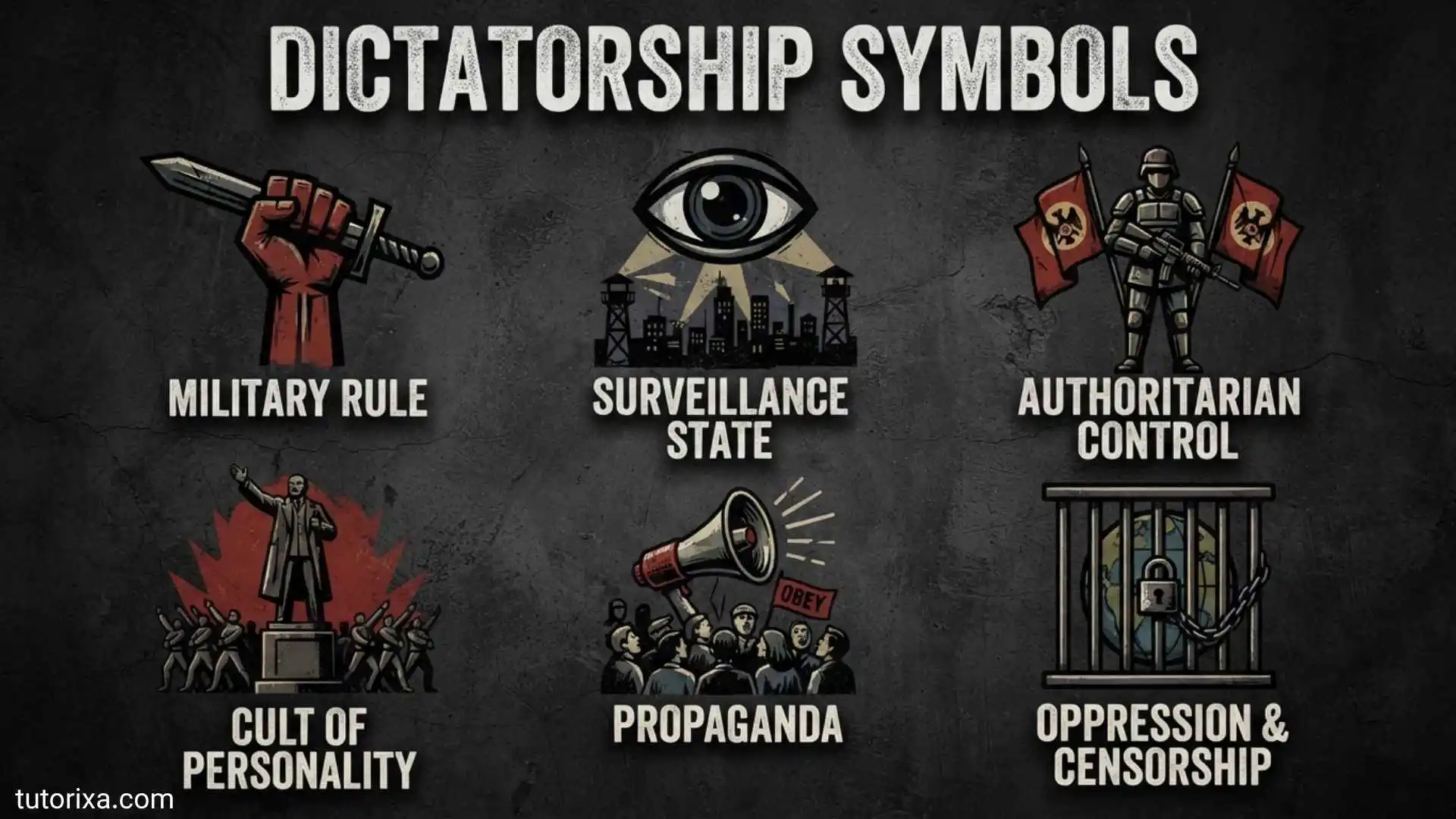
Dictatorship Symbols can reveal a lot about power, control, and political history. When I look at these symbols, I see more than simple images or signs—they often carry messages about authority, loyalty, fear, or national identity.
You may have seen some of these symbols in history books, museums, films, or political discussions without knowing what they meant. I want to make those meanings easier for you to understand by looking at their history, purpose, and cultural context.
As you explore these symbols, you’ll discover how simple visual designs can become powerful tools for communicating political ideas. I’ll help you understand their meanings clearly so you can recognize and interpret them with greater confidence.
Quick Meaning
Dictatorship symbols are visual or symbolic representations associated with authoritarian rule, concentrated political power, forced loyalty, propaganda, nationalism, censorship, or a ruler’s cult of personality. Their meanings depend heavily on historical context. A symbol itself is not automatically dictatorial; its connection to a regime, movement, or political system determines how it is interpreted.
Symbol Overview Table
| Symbol or Symbol Type | Primary Meaning | Category | Historical Context | Common Modern Meaning |
| Dictator portrait | Loyalty, authority, ruler worship | Political imagery | Cults of personality | Authoritarian leadership |
| Leader statue | Permanence and power | Monument | Ancient and modern states | State propaganda or historical memory |
| Military uniform and insignia | Discipline, authority, force | Military symbolism | Used by authoritarian and democratic states | State power or militarism |
| State emblem | Government authority and national identity | Heraldry | Ancient through modern states | National or governmental identity |
| Propaganda poster | Political persuasion and loyalty | Political art | Especially prominent in the 20th century | Political messaging |
| Raised-arm salute | Political allegiance in specific historical contexts | Gesture | Associated with several authoritarian movements | Historical fascist symbolism in particular contexts |
| Red star | Revolution, socialism, or communist movements | Political emblem | Associated with communist states and movements | Communism or revolutionary politics |
| Swastika in Nazi context | Nazi ideology and racial dictatorship | Political emblem | Adopted by Nazi Germany | Nazi Germany and neo-Nazism |
| Eagle emblems | Sovereignty, power, empire, or nationalism | Heraldry | Used by many civilizations and states | Depends on national context |
| Political slogan | Ideological loyalty | Language | Common in authoritarian propaganda | Political messaging |
What Do Dictatorship Symbols Mean?
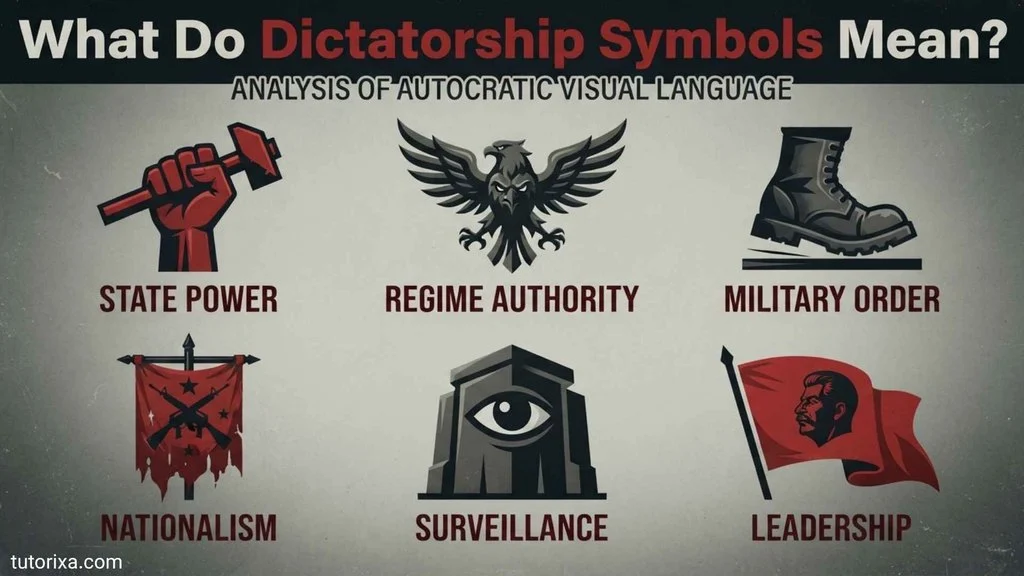
Dictatorship symbols generally communicate authority, political ideology, loyalty, unity, national identity, or the power of the state. They are particularly important because authoritarian governments often rely heavily on controlled public imagery.
A dictatorship may place the ruler’s portrait in schools, offices, public buildings, newspapers, or official publications. The repeated image can make the leader appear inseparable from the state itself. This is commonly described as a cult of personality.
Symbols can also simplify complicated political ideas. A flag, emblem, color, uniform, salute, or monument can communicate an entire political message without requiring a long explanation.
For example, a government might use a national emblem to suggest stability and legitimacy. A military symbol may emphasize strength and discipline. A leader’s portrait can imply loyalty to a single individual. Propaganda imagery may present the government as the defender of the nation.
However, symbolism does not automatically prove that a government is a dictatorship. Democracies also use flags, official seals, military uniforms, monuments, portraits, and national slogans. The political system and historical context determine the meaning.
History and Origin of Dictatorship Symbols
Dictatorship symbols do not have a single origin because authoritarian rulers have used symbolic communication for thousands of years. The practice developed from older traditions of kingship, imperial authority, military power, religion, and national identity.
Ancient Civilizations
Ancient rulers in Mesopotamia, Egypt, Persia, Greece, Rome, China, and other civilizations used visual symbols to establish authority.
Egyptian pharaohs, for example, were represented through crowns, royal regalia, monuments, and divine imagery. Roman emperors appeared on coins and monuments, allowing their authority to be recognized across a vast empire.
These examples should not simply be labeled “dictatorship symbols.” Ancient political systems were different from modern authoritarian states. Instead, they demonstrate an older principle: political power becomes stronger when it is made visible through recognizable symbols.
Medieval and Imperial Traditions
Kings, emperors, and dynasties continued using coats of arms, crowns, seals, banners, palaces, statues, and ceremonial clothing to communicate legitimacy.
Royal symbols often connected rulers with ancestry, territory, military victories, or religious authority. The use of symbolic power later influenced modern governments, even though modern dictatorships developed within very different political and technological environments.
The 20th Century
The 20th century saw a major expansion of political symbolism because of mass newspapers, radio, photography, cinema, public rallies, posters, and later television.
Authoritarian governments could reproduce the same portrait, emblem, slogan, or visual style across millions of copies.
The regimes of Benito Mussolini in Fascist Italy, Adolf Hitler in Nazi Germany, Joseph Stalin in the Soviet Union, and Mao Zedong in the People’s Republic of China provide important historical examples of extensive political symbolism.
Their systems were different from one another, so their symbols should not be treated as interchangeable. Fascist, Nazi, and communist symbolism developed from different ideologies and historical circumstances.
The Digital Era
Modern authoritarian governments can also use television, websites, social media, state-controlled media, digital graphics, and carefully staged photographs.
This changes the speed and scale of symbolic communication. A political image that once required printing and distribution can now reach millions of people almost instantly.
Symbolism and Interpretation
The meaning of dictatorship symbols usually depends on the relationship between the symbol, the government using it, and the audience interpreting it.
Traditional Meanings
Many political symbols began with meanings unrelated to dictatorship.
The eagle, for instance, has represented strength, sovereignty, and imperial authority in many cultures. It appears in the symbols of different countries with very different political systems.
Similarly, red has long been associated with revolution, sacrifice, power, and political movements. Its meaning changes according to context.
Authoritarian Meanings
Under authoritarian governments, familiar symbols can become connected to:
- Centralized political authority
- Obedience to the state
- Nationalism
- Military strength
- Political ideology
- Loyalty to a leader
- Revolutionary identity
- State propaganda
- Fear or repression
Positive and Negative Interpretations
Supporters of an authoritarian movement may view its symbols as representing order, national unity, strength, stability, or independence.
Opponents may interpret the same symbols as representing censorship, repression, forced conformity, militarism, or political violence.
This difference matters when studying historical symbols. A symbol’s meaning cannot always be determined simply by its appearance.
Psychological Interpretation
Repeated political imagery can create familiarity and emotional association. A leader’s face displayed everywhere can make the individual seem constantly present in public life.
Large monuments, synchronized ceremonies, flags, uniforms, and mass gatherings can also create a sense of collective identity. Political communication researchers often examine these techniques as forms of propaganda and political persuasion.
Cultural Significance
Dictatorship symbols can become deeply embedded in cultural memory long after the regime disappears.
In Germany, Nazi symbols carry an exceptionally serious historical association because of the Nazi dictatorship, the Holocaust, and the Second World War. Modern German law also places restrictions on the public use of certain Nazi symbols, subject to legal exceptions such as education, research, journalism, and artistic contexts.
In countries formerly governed by communist regimes, symbols such as the hammer and sickle can have different meanings. Some people associate them with Soviet power and repression, while others interpret them through labor movements, socialism, revolution, or family history.
The meaning can also differ across generations. Older people may have personal memories of a political regime, while younger people may encounter its symbols mainly through textbooks, museums, films, or online discussions.
This is why historical context is essential when interpreting authoritarian symbolism.
Where Dictatorship Symbols Are Used
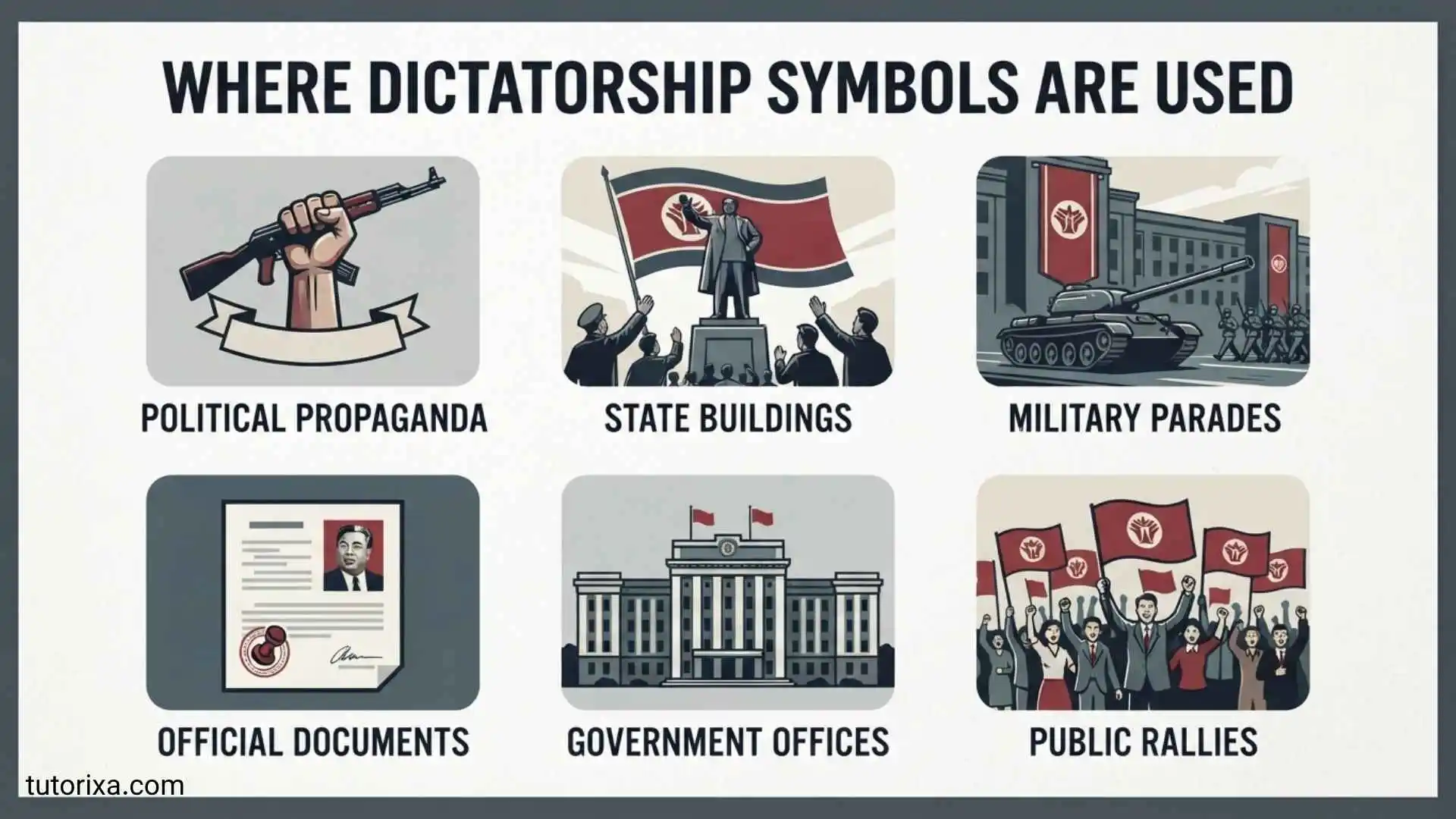
Dictatorship-related symbols have appeared in many forms of public communication, political culture, and historical representation.
Flags and State Emblems
Flags provide a highly visible way for governments to communicate national identity. Authoritarian regimes may redesign flags or introduce new emblems after taking power.
A state emblem can include animals, stars, weapons, agricultural imagery, geometric designs, or historical references.
Portraits and Posters
Leader portraits are among the clearest examples of authoritarian political imagery. They can appear in public offices, classrooms, factories, newspapers, and propaganda materials.
Propaganda posters often combine portraits with idealized workers, soldiers, children, national landscapes, or symbols of progress.
Monuments and Architecture
Dictatorial governments may build enormous statues, ceremonial avenues, government buildings, memorials, and plazas.
Architecture can communicate political ideas through scale, symmetry, permanence, and controlled public space. Monumental design can make government power feel physically overwhelming.
Military Uniforms and Insignia
Uniforms communicate hierarchy, discipline, and institutional authority. Some authoritarian movements deliberately adopted distinctive clothing or insignia to create a recognizable political identity.
However, military symbols are not inherently dictatorial. Armed forces in democratic countries also use uniforms, medals, flags, ranks, and insignia.
Literature and Art
Writers, painters, filmmakers, and political cartoonists have used dictatorship symbols both to support governments and to criticize them.
After a dictatorship ends, artists may reuse former state symbols ironically to examine memory, propaganda, censorship, or political trauma.
Tattoos and Personal Expression
Historical political symbols sometimes appear in tattoos as expressions of ideology, rebellion, remembrance, or historical interest. Because some symbols have strong extremist associations, their use can be misunderstood when removed from context.
Common Variations
Dictatorship symbolism varies according to ideology, country, historical period, and method of political communication.
Common variations include:
- Leader-centered imagery — portraits, statues, signatures, or slogans connected to one ruler.
- Military imagery — uniforms, weapons, medals, ranks, and martial poses.
- National imagery — flags, eagles, national colors, maps, and historical heroes.
- Revolutionary imagery — stars, workers, agricultural symbols, fists, and revolutionary slogans.
- Architectural symbolism — monumental government buildings and ceremonial spaces.
- Mass-rally symbolism — banners, coordinated clothing, flags, and choreographed gestures.
- Modern digital adaptations — edited photographs, graphic designs, videos, hashtags, and online political imagery.
A particularly important distinction is between historical symbols and modern extremist adaptations. An ancient or culturally significant symbol may later be appropriated by a political movement without losing all of its earlier meanings.
Common Misconceptions
Misconception 1: Every powerful symbol represents dictatorship
False. Flags, military insignia, monuments, national emblems, and leader portraits can exist in democratic societies too.
Misconception 2: A symbol has only one meaning
False. Symbols are interpreted through cultural and historical context. The same design can have completely different meanings in different societies.
Misconception 3: The swastika always means Nazism
False. The swastika is an ancient symbol with religious and cultural importance in traditions including Hinduism, Buddhism, and Jainism. Nazi Germany appropriated a version of the symbol and transformed its meaning in the context of Nazi racial ideology and genocide. Context is therefore essential.
Misconception 4: The hammer and sickle represents all dictatorships
False. It is specifically associated with communism, socialism, the Soviet Union, and related political movements, although its interpretation varies across societies.
Misconception 5: A dictator’s portrait is merely decoration
Often it has a political purpose. Repeated portraits can reinforce the idea that the leader embodies the nation, government, or political movement.
Misconception 6: All authoritarian symbols were invented by dictators
Not necessarily. Governments frequently borrow older national, religious, military, classical, or cultural imagery and give it new political associations.
Interesting Facts About Dictatorship Symbols
1. Symbols can outlive governments
A dictatorship may disappear, but its symbols can remain in museums, monuments, photographs, textbooks, and public debates.
2. Leader portraits can function as political messaging
A portrait does more than identify a person when displayed throughout public institutions. Its repetition can communicate authority and loyalty.
3. Architecture can become propaganda
Buildings and public spaces can express political power through size, symmetry, ceremonial entrances, and monumental design.
4. Ancient symbols can acquire modern political meanings
Political movements frequently borrow symbols from older civilizations and reinterpret them for modern ideological purposes.
5. Color can carry political meaning
Colors such as red, black, white, and gold have been used by many political movements. Their meaning depends on the specific movement and historical context.
6. Propaganda works through repetition
Repeating the same visual elements can make political messages easier to recognize and remember.
7. Political symbols can change meaning after regime change
A former state emblem may later become a symbol of oppression, nostalgia, historical identity, or resistance.
8. Symbols can unite supporters
Shared flags, clothing, gestures, and emblems can create a visible sense of group membership.
9. Symbols can also become tools of resistance
Artists and activists sometimes transform official imagery into satire, criticism, or protest art.
10. Context can completely change interpretation
The same eagle, star, color, or gesture may have different meanings depending on the country, historical period, and political movement.
Related Symbols About Dictatorship Symbols
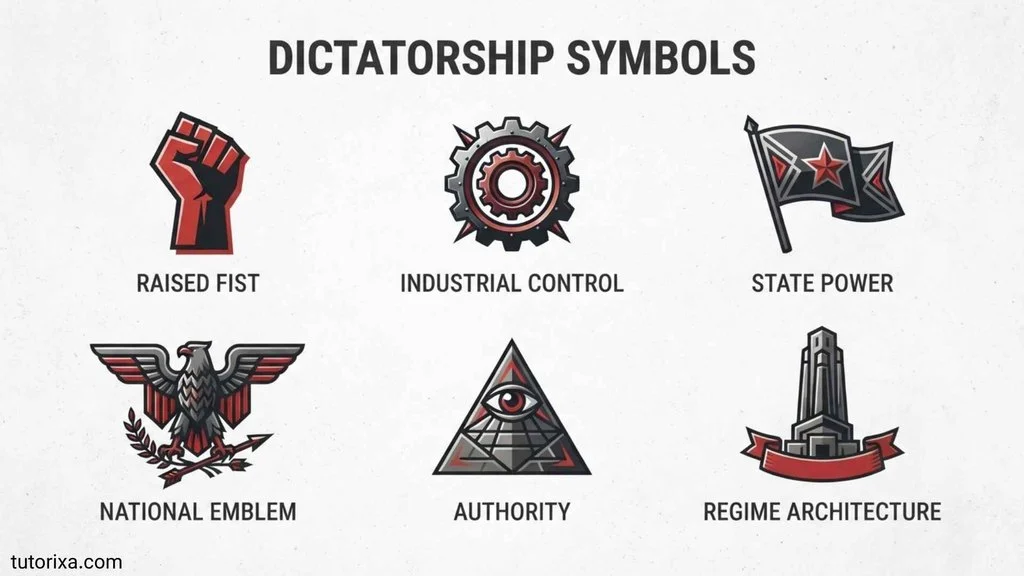
Related symbols help explain the wider visual language of political authority and authoritarianism.
- Cult of personality: Centers political loyalty around an individual leader rather than an institution.
- Propaganda poster: Uses visual communication to persuade audiences and promote political ideas.
- National flag: Represents a country or political community and is not inherently authoritarian.
- Military insignia: Represents rank, organization, or service and can exist under many forms of government.
- Hammer and sickle: Strongly associated with communist movements and the Soviet political tradition.
- Nazi swastika: A specific political appropriation of an ancient symbol, strongly associated with Nazi Germany and its ideology.
- Fascist fasces: An ancient Roman symbol later adopted by Italian Fascism.
- Red star: Commonly associated with communist and revolutionary movements, particularly in connection with the Soviet tradition.
- Political salute: A gesture whose meaning depends on the specific movement and historical setting.
- Monumental statue: Can commemorate historical figures, celebrate political leaders, or become an object of later controversy.
Frequently Asked Questions
What are dictatorship symbols?
Dictatorship symbols are images, objects, gestures, colors, monuments, slogans, or emblems associated with authoritarian governments or movements. They can communicate political authority, nationalism, ideology, loyalty, military power, or the importance of a ruler. Their meaning depends on historical context rather than simply on their visual appearance.
What is the most recognizable dictatorship symbol?
There is no single universal dictatorship symbol. Some symbols are strongly associated with particular regimes, such as the Nazi swastika with Nazi Germany. Other symbols, including leader portraits, military imagery, monumental statues, and political emblems, have been used by many different governments throughout history.
Why do dictators use symbols?
Dictators and authoritarian governments use symbols because they communicate political messages quickly and repeatedly. A flag, portrait, emblem, uniform, or monument can make authority visible throughout society. Symbols can also encourage loyalty, strengthen group identity, promote ideology, and associate the government with national history or political legitimacy.
Are national flags dictatorship symbols?
National flags are not inherently dictatorship symbols. Democracies, monarchies, republics, and authoritarian states all use flags. A particular flag may become associated with a dictatorship when a specific regime adopts it, changes it, or uses it extensively for political propaganda.
Is the swastika a dictatorship symbol?
The swastika has ancient religious and cultural meanings in several Asian traditions, including Hinduism, Buddhism, and Jainism. A specific form was adopted by Nazi Germany and became associated with Nazi ideology, racial persecution, and genocide. Therefore, its meaning must be interpreted according to cultural and historical context.
What is a cult of personality?
A cult of personality is a political system of imagery, propaganda, ceremony, and messaging that presents a leader as exceptionally important, heroic, or inseparable from the nation or state. Portraits, statues, slogans, speeches, school materials, and mass events can all contribute to such a political image.
Can a symbol change its meaning?
Yes. Symbols can change meaning over time because political movements may appropriate older imagery or societies may reinterpret symbols after major historical events. A symbol that once represented one idea can later become associated with a government, conflict, resistance movement, or historical tragedy.
Are dictatorship symbols still used today?
Authoritarian political symbolism continues to appear in contemporary politics, propaganda, historical remembrance, extremist movements, and popular culture. Modern communication has expanded the range of symbolic tools to include digital graphics, videos, social media imagery, edited photographs, and online political branding.
Why is historical context important when identifying a symbol?
Historical context identifies who used a symbol, when they used it, what they intended it to communicate, and how audiences understood it. Without context, it is easy to mistake an ancient cultural symbol, national emblem, or ordinary military design for a specifically authoritarian symbol.
Can dictatorship symbols be used for education?
Yes. Historical symbols can be studied in classrooms, museums, documentaries, academic research, journalism, and art. Educational use can help people understand propaganda, political history, authoritarianism, and the experiences of societies affected by dictatorships.
Key Takeaways
- Dictatorship symbols represent political power, ideology, authority, loyalty, nationalism, or the image of a ruler.
- There is no single symbol that represents every dictatorship.
- Portraits, monuments, flags, military imagery, propaganda posters, gestures, and state emblems can all serve political purposes.
- Many authoritarian symbols have older cultural, religious, military, or national origins.
- The same symbol can have different meanings in different cultures and historical periods.
- A symbol is not automatically authoritarian simply because a dictatorship used it.
- The cult of personality often relies heavily on portraits, statues, slogans, and public ceremonies.
- Propaganda became especially powerful during the 20th century because of mass media.
- Digital technology has created new ways for governments and political movements to distribute symbolic imagery.
- Historical context is essential for interpreting controversial symbols accurately.
Conclusion
Dictatorship symbols are best understood as part of a larger language of political power. They can turn abstract ideas such as authority, nationalism, ideology, loyalty, and state control into recognizable visual forms.
Their history reaches from ancient traditions of kingship and empire to modern propaganda, monuments, political posters, mass media, and digital communication. Yet no symbol has a universal meaning. An eagle may represent national sovereignty, a star may represent revolution, and an ancient religious design may later be appropriated for an entirely different political purpose.
The most accurate way to understand dictatorship symbols is therefore to examine their origin, historical setting, political users, intended message, cultural interpretation, and modern context. Studying these connections helps distinguish genuine historical symbolism from assumptions based only on appearance.

I’m Ellis Montgomery, a British writer interested in the powerful language of symbols. I explore everything from traditional emblems and cultural signs to contemporary symbols found in modern life. My aim is to explain their meanings clearly while revealing the stories and ideas behind them, making symbolism fascinating and accessible to everyone.
Books:
- The Complete Book of Symbols
- Hidden Messages in Everyday Symbols
 Rowan Whitaker
 Freddie Beaumont