
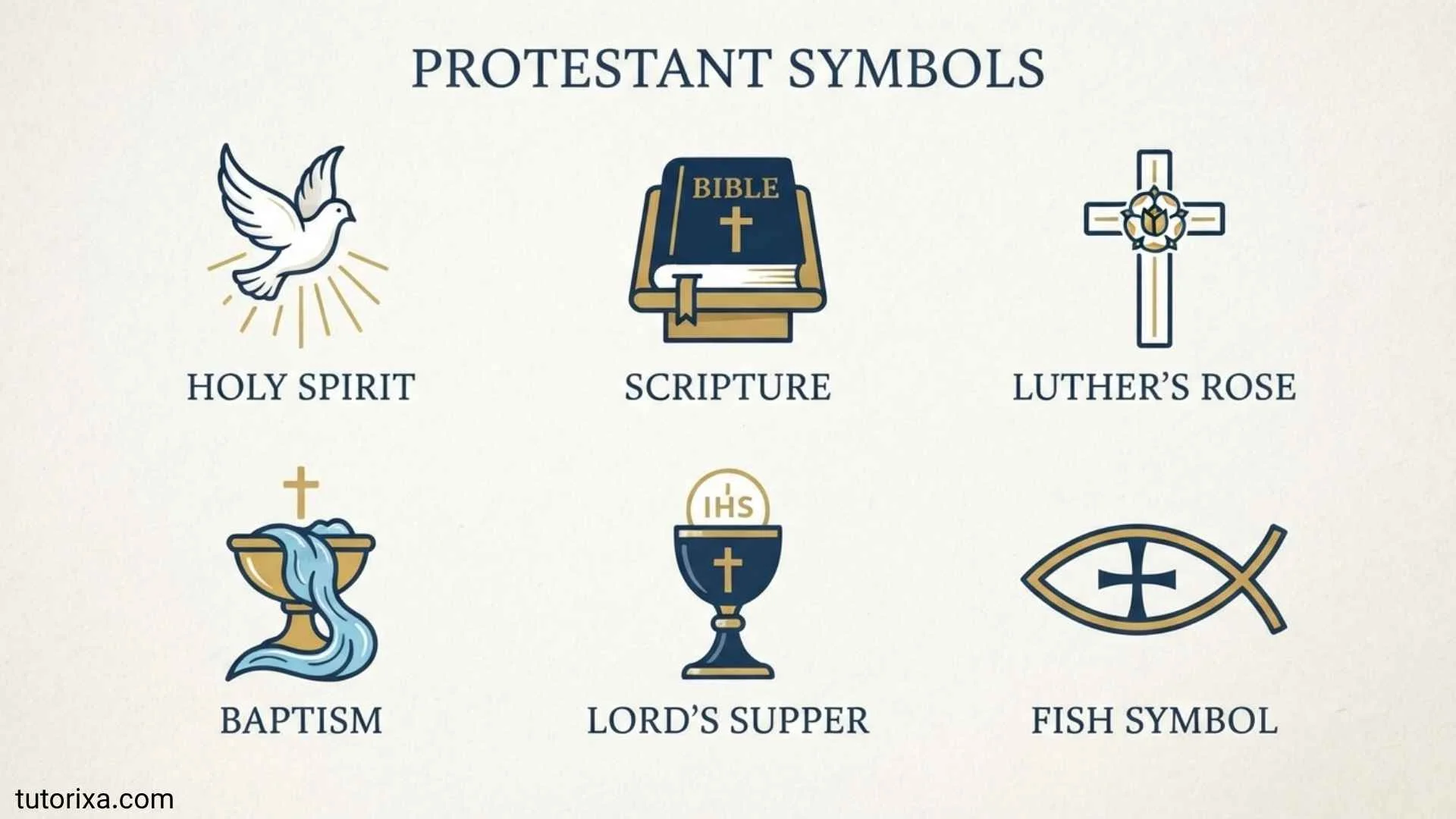
Protestant Symbols can tell powerful stories about faith, history, and Christian beliefs. I find these symbols fascinating because a simple sign can carry a deep meaning, and you may be surprised by how much history is behind them.
If you are new to Christian symbolism, you do not need to feel confused by unfamiliar signs. I’ll help you understand the most important Protestant Symbols in a simple way, so you can quickly see what each one represents.
You’ll discover the meanings, history, and significance behind these symbols while learning how they are used today. By the end, you’ll have a clearer understanding of the visual language that has shaped Protestant Christian tradition.
Quick Meaning
Protestant symbols are visual representations of Christian faith and Protestant history. The cross is the central symbol, representing Christ’s crucifixion and salvation. Other symbols, such as the Luther Rose, Huguenot Cross, dove, fish, and denominational emblems, communicate specific theological ideas, historical identities, or traditions.
Symbol Overview Table
| Symbol Name | Primary Meaning | Category | Origin | Common Usage |
| Cross | Christ’s crucifixion and salvation | Christian/Protestant | Early Christianity | Churches, jewelry, art |
| Empty Cross | Christ’s death and, in some Protestant traditions, emphasis on the risen Christ | Protestant/Christian | Christian tradition | Churches, logos, artwork |
| Luther Rose | Faith in Christ, joy, peace, and eternal hope | Lutheran | 16th-century Reformation | Lutheran churches and institutions |
| Huguenot Cross | Reformed faith, French Protestant identity, remembrance | Reformed/Huguenot | French Protestant tradition | Jewelry, heritage groups |
| Huguenot Maltese-style Cross | Faith and historical identity | Reformed | Huguenot tradition | Pendants and commemorative items |
| Dove | Holy Spirit | Christian | Biblical/early Christian tradition | Church art, Pentecost |
| Ichthys/Fish | Jesus Christ and Christian faith | Early Christian | Ancient Christian tradition | Art, jewelry, church materials |
| Chi-Rho | Christ | Early Christian | Greek Christian tradition | Religious art and historical churches |
| Cross and Flame | Spirit, mission, and Christian witness | Methodist | Modern Methodist tradition | Methodist churches and publications |
| Anchor Cross | Hope and steadfast faith | Christian | Early Christian tradition | Art and church decoration |
What Do Protestant Symbols Mean?
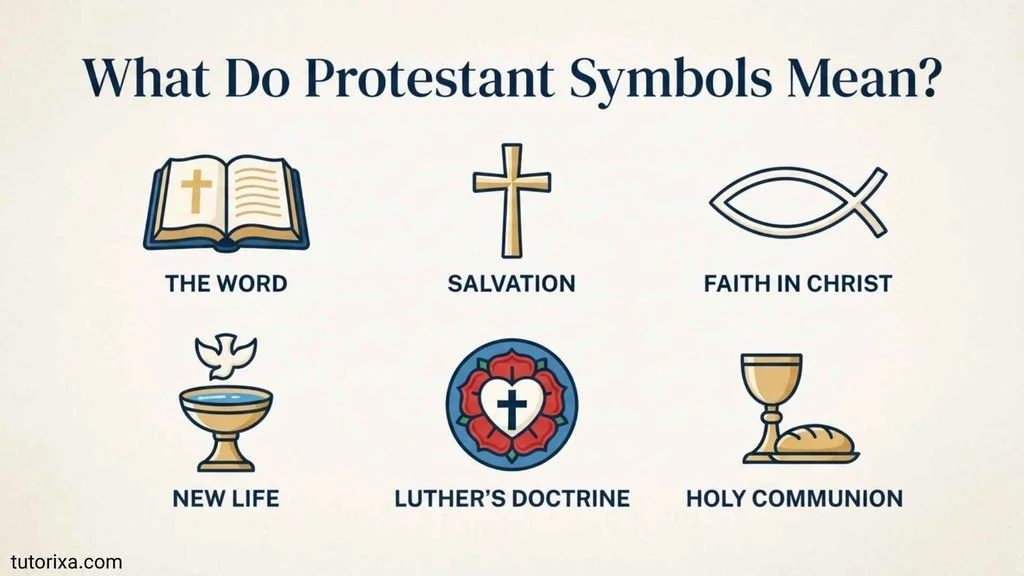
Protestant symbols communicate Christian beliefs, historical identity, and denominational traditions through visual forms. There is no single symbol that represents every Protestant church.
The cross has the broadest significance. It recalls the crucifixion of Jesus and is central to Christian teaching about Christ’s death and salvation. Protestants generally regard the cross as a reminder of the Gospel rather than as an object possessing supernatural power in itself.
The empty cross is particularly common in many Protestant settings. Some Christians associate its empty form with Christ’s resurrection, although this interpretation should be treated carefully. The cross was physically empty regardless of the resurrection. Some Lutheran sources specifically explain that both an empty cross and a crucifix point to Christ’s death for salvation.
The meaning of a symbol can also depend on denomination. A Lutheran may immediately recognize the Luther Rose, while a French Protestant family may recognize the Huguenot Cross as an important heritage symbol.
This makes Protestant symbolism less like a single visual language and more like a collection of related traditions.
History and Origin of Protestant Symbols
Early Christian Roots
Many Protestant symbols are much older than Protestantism itself.
The first Protestant movements emerged in the 16th-century Reformation, but Christians had already used crosses, fish, anchors, doves, monograms, and other visual forms for centuries.
Early Christians used the fish, or ichthys, as a Christian symbol. The Greek word for fish, ichthys, became associated with a phrase identifying Jesus as Christ and Savior. Christian art also used the anchor as an image of steadfast hope.
The Chi-Rho, formed from Greek letters associated with Christos (Christ), is another ancient Christian symbol. It predates the Protestant Reformation by many centuries and therefore should not be described as an exclusively Protestant symbol.
The Protestant Reformation
The Protestant Reformation transformed Western European Christianity during the 16th century. Martin Luther, John Calvin, Huldrych Zwingli, and other reformers challenged aspects of late medieval church practice and developed distinct theological movements.
The term Protestant itself became associated with events surrounding the Diet of Speyer in 1529. Lutheran princes and representatives protested measures directed against the Reformation, contributing to the historical use of the term.
The Reformation did not create a completely new set of Christian symbols. Instead, Protestant communities inherited older Christian imagery while also developing new symbols that expressed their theological and historical identities.
Development of the Luther Rose
One of the clearest examples is the Luther Rose, also called the Luther Seal.
The design appeared in Luther’s writings during the 1520s. It contains several elements: a black cross within a heart, a white rose, a blue field, and a gold ring. Martin Luther explained these elements as representing faith in Christ, joy and peace, heavenly hope, and eternal blessedness.
Unlike the cross, which belongs to Christianity broadly, the Luther Rose has a much more specific historical connection to Lutheranism.
Symbolism and Interpretation
The Cross
The cross represents the death of Jesus Christ and stands at the center of Christian symbolism.
For Protestants, it can also point toward themes such as:
- Salvation through Christ
- Sacrifice
- Grace
- Faith
- Repentance
- Christian discipleship
- Hope
Different Protestant communities may emphasize different aspects.
The Empty Cross
An empty cross is widely associated with Protestant Christianity, especially in traditions that favor it over a crucifix.
However, the distinction should not be exaggerated. The presence or absence of Christ’s figure on a cross does not automatically determine whether a church is Protestant.
Lutheran history demonstrates this particularly well. Historic Lutheran churches have used crucifixes, and Lutheran sources reject the idea that the crucifix is exclusively Roman Catholic.
The Luther Rose
The Luther Rose has a layered meaning.
Its central black cross represents Christ’s saving work. The heart emphasizes faith, while the white rose represents joy, peace, and comfort. The blue background points toward heavenly hope, and the gold ring represents eternal blessedness.
The important point is that the Luther Rose is not simply decorative. Its components were deliberately arranged to summarize theological ideas associated with Martin Luther.
The Dove
The dove commonly represents the Holy Spirit because the New Testament describes the Spirit descending like a dove at Jesus’ baptism.
Christian artists have used the dove in different forms. It may appear descending, ascending, or surrounded by rays. In some Christian artwork, the dove is connected specifically with Pentecost and the work of the Holy Spirit.
The Fish
The fish is an ancient Christian symbol rather than a uniquely Protestant one.
Its connection with Jesus comes partly from the Greek word ichthys and its Christian interpretation. Fish imagery also connects with several Gospel stories involving Jesus and his disciples.
Because the symbol existed long before the Reformation, calling it a “Protestant symbol” is technically too narrow.
Cultural Significance
Protestant symbols vary considerably by region because Protestantism developed into many traditions across Europe, North America, Africa, Asia, and other parts of the world.
In Germany, the Luther Rose has strong historical associations with Lutheran identity.
In France and among descendants of French Protestants, the Huguenot Cross can represent Protestant heritage and remembrance.
In Scotland and parts of the English-speaking Protestant world, different forms of crosses and church emblems developed alongside Presbyterian and Reformed traditions.
In England, Anglican churches use crosses, crests, shields, and other forms of Christian symbolism. Anglican symbolism can also reflect the historical identity of individual churches, dioceses, and institutions.
In the United States, Protestant churches often use relatively simple crosses in architecture and branding. Some denominations have recognizable modern emblems, such as the Cross and Flame associated with Methodism.
These differences demonstrate an important principle: a symbol’s meaning depends on both its visual form and the community using it.
Religious or Spiritual Meaning
Protestant symbolism is fundamentally religious because its imagery points toward Christian beliefs.
The cross can direct attention toward Jesus Christ. The dove can represent the Holy Spirit. The fish can recall Christ and early Christian faith. The Luther Rose can summarize Lutheran theology.
Protestant traditions have historically differed over how much religious imagery should appear in worship.
Some Reformed communities have favored simpler church interiors because they worry that elaborate imagery can distract from Scripture and worship. Reformed Christianity has generally emphasized the Bible’s authority and has been cautious about giving religious objects an importance that belongs to God alone.
Other Protestant traditions, particularly Lutheran and Anglican communities, have retained substantial visual art, stained glass, crosses, and other traditional Christian imagery.
Therefore, Protestantism should not be treated as uniformly “against religious symbols.” Its denominations have different approaches to visual worship.
Scientific or Technical Meaning
Protestant symbols generally have no scientific or mathematical meaning.
Some symbols can, however, have technical meanings in unrelated contexts. A cross, for example, can represent mathematical addition, coordinate intersections, medical concepts, or other technical ideas depending on its design and context.
The important distinction is that these technical meanings should not be confused with Protestant religious symbolism.
A cross displayed on a church steeple has a different communicative purpose from a plus sign in mathematics.
Where Are Protestant Symbols Used?
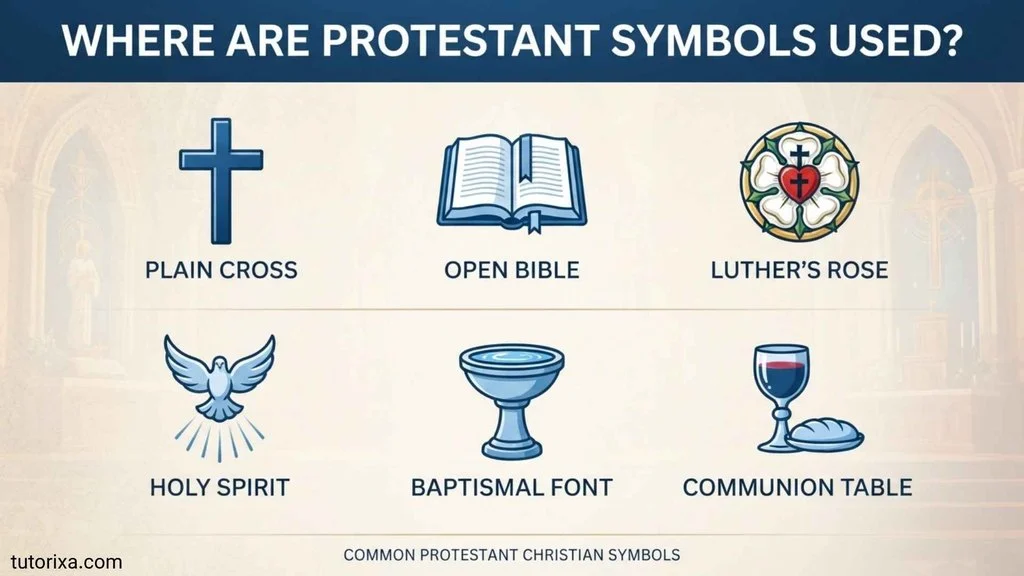
Protestant symbols appear in many settings, including:
Churches and Architecture
Crosses are frequently placed on church walls, towers, altars, pulpits, windows, and exterior signs.
Stained Glass
Colored glass may depict crosses, biblical scenes, doves, fish, crowns, biblical figures, or denominational symbols.
Books and Religious Publications
Bibles, hymnals, theological books, church bulletins, and historical publications may use Christian or denominational symbols on their covers.
Jewelry
Cross necklaces, rings, pendants, and commemorative pieces are common ways people display Christian identity.
Art
Painters, sculptors, calligraphers, and designers use Protestant and broader Christian symbols to communicate religious ideas.
Church Logos
Modern denominations and individual congregations often combine crosses with words, flames, shields, circles, or other graphic elements.
Educational Materials
Sunday school resources, Reformation history materials, confirmation resources, and denominational publications may use recognizable symbols to identify their religious tradition.
Historical Documents
Reformation-era publications, seals, coats of arms, and church records can contain symbolic imagery connected to Protestant movements.
Common Variations
Cross vs. Crucifix
A cross is usually a simple cross shape. A crucifix includes a representation of Jesus on the cross.
Both are Christian symbols, and neither design alone provides a perfect test for identifying someone’s denomination.
Latin Cross
The familiar Latin cross has a longer vertical section below the shorter horizontal beam. It is probably the most recognizable Christian cross design in the modern world.
Celtic Cross
The Celtic cross combines a cross with a circle and has strong historical and artistic associations with Celtic Christianity and the British Isles. It is used by people and churches from multiple Christian traditions and is not exclusively Protestant.
Luther Rose
The Luther Rose is more denomination-specific because of its direct connection to Martin Luther and Lutheran history.
Huguenot Cross
The Huguenot Cross is strongly connected with French Protestant heritage and is frequently worn as jewelry or displayed by organizations preserving Huguenot history.
Cross and Flame
The Cross and Flame is associated with Methodist identity and combines a cross with stylized flames, communicating Christian faith and the work of the Holy Spirit.
Common Misconceptions
Misconception 1: There Is One Official Protestant Symbol
There is no single universal symbol controlled by all Protestant denominations.
Protestantism includes many traditions, so symbolism differs between Lutherans, Anglicans, Baptists, Methodists, Presbyterians, Reformed churches, Pentecostals, and others.
Misconception 2: The Empty Cross Is Exclusively Protestant
The empty cross is strongly associated with many Protestant churches, but it is not exclusively Protestant.
Christians from different traditions may use an empty cross for different theological or artistic reasons.
Misconception 3: Protestants Do Not Use Religious Art
This is too broad.
Some Protestant traditions historically reduced religious imagery, while others retained extensive Christian art. Lutheranism, Anglicanism, and some other Protestant traditions have rich artistic traditions.
Misconception 4: The Fish Is a Protestant Symbol
The fish is a Christian symbol with roots centuries before Protestantism. It can certainly be used by Protestants today, but its origin is not Protestant.
Misconception 5: Every Symbol Has One Fixed Meaning
Symbols gain meaning from context.
A dove may represent the Holy Spirit in Christian art, but a dove can represent peace in secular imagery. A cross can represent Christianity, a particular denomination, historical heritage, or simply personal faith.
Interesting Facts About Protestant Symbols
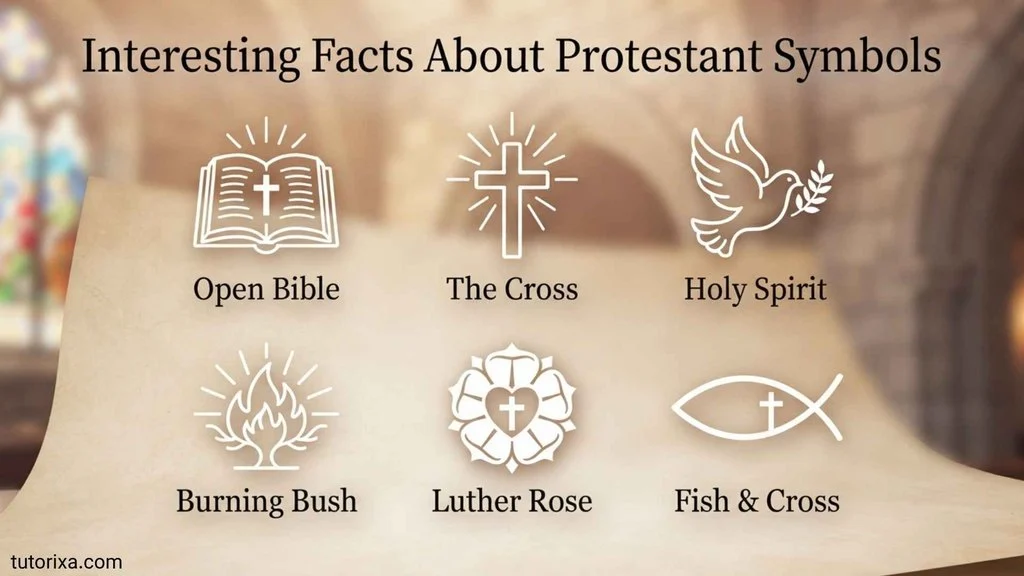
- The Luther Rose is essentially a visual theological summary.
Its individual colors and shapes were given meanings connected with faith, joy, hope, and eternal life. - The Protestant movement inherited many older Christian symbols.
The cross, fish, dove, anchor, and Chi-Rho were already part of Christian visual culture before the Reformation. - The word Protestant has a historical political context.
The term became associated with the protest made at the Diet of Speyer in 1529. - Lutherans have historically used crucifixes.
The idea that crucifixes are automatically “Roman Catholic” does not accurately describe historic Lutheran practice. - The fish symbol has a linguistic history.
Its significance is connected with the Greek word ichthys and early Christian interpretation. - The dove has several visual forms.
Christian artists may show the dove descending, ascending, or surrounded by rays depending on the theological context. - Reformed churches have often approached imagery cautiously.
This reflects concern that religious symbols should point toward God rather than become objects of worship themselves. - Not every Protestant symbol is ancient.
Some recognizable denominational logos were created in modern times to communicate church identity in a visually simple way. - A symbol can identify both faith and heritage.
The Huguenot Cross, for example, can carry historical significance for families and communities connected with French Protestant history. - Symbolism differs within Protestantism itself.
Two Protestant churches may share the cross while using completely different secondary symbols, colors, artwork, and architectural styles.
Related Symbols
- Crucifix: A cross depicting Jesus; especially associated with Catholic, Orthodox, Anglican, and Lutheran contexts, though usage varies.
- Luther Rose: A distinctive Lutheran symbol connected with Martin Luther.
- Huguenot Cross: A symbol of French Protestant identity and heritage.
- Ichthys: Ancient Christian fish symbol associated with Jesus Christ.
- Dove: Common Christian representation of the Holy Spirit.
- Chi-Rho: Ancient Christogram formed from Greek letters associated with Christ.
- Anchor: Christian symbol associated with hope and steadfastness.
- Crown: Can represent Christ’s kingship, victory, or eternal life depending on context.
- Crown and Cross: Used in several Christian traditions to express Christ’s kingship and victory.
- Cross and Flame: A recognizable Methodist emblem representing Christian faith and the Spirit’s work.
Frequently Asked Questions
What is the main symbol of Protestantism?
The cross is the most widely recognized symbol associated with Protestant Christianity. It represents Jesus Christ’s crucifixion and is displayed by many Protestant denominations. However, Protestantism has no single universal emblem. Different denominations and historical movements use additional symbols, including the Luther Rose, Huguenot Cross, dove, fish, and denominational logos.
What does the Protestant cross symbolize?
The Protestant cross primarily points to the crucifixion of Jesus Christ and Christian beliefs about salvation. Many Protestant churches use an empty cross, while others use a crucifix. The specific theological emphasis can vary, but the cross remains fundamentally connected with Christ’s death and the Christian Gospel.
What is the Luther Rose?
The Luther Rose is a historic symbol associated with Martin Luther and Lutheran Christianity. It contains a black cross inside a heart, surrounded by a white rose, blue background, and gold ring. Luther explained the elements as representing faith, joy, peace, heavenly hope, and eternal blessedness.
Is the fish a Protestant symbol?
The fish can be used by Protestants, but it is more accurate to call it an ancient Christian symbol. Its Christian significance developed centuries before the Protestant Reformation. The Greek word ichthys became associated with a Christian confession about Jesus Christ and salvation.
What does the Huguenot Cross mean?
The Huguenot Cross is associated with French Protestant history and Huguenot identity. It is often worn as jewelry or displayed as a reminder of Protestant heritage. Its meaning can include faith, remembrance, family history, and connection with communities affected by the history of the French Reformation.
Why do some Protestant churches use an empty cross?
Many Protestant churches use an empty cross because it provides a simple visual reminder of Christ’s saving work. Some traditions also associate its empty form with the resurrection. However, the theological distinction should not be overstated because both crosses and crucifixes are used within different Protestant traditions.
Do all Protestant denominations use the same symbols?
No. Protestantism includes many denominations and theological traditions. Lutherans may prominently use the Luther Rose, Methodists may use the Cross and Flame, and Huguenot communities may use the Huguenot Cross. Many other churches simply emphasize the cross or use locally developed symbols.
Are Protestant symbols allowed in churches?
Yes, although individual Protestant traditions differ greatly in their approach to religious imagery. Some churches prefer simple interiors with minimal visual symbolism, while others use crosses, stained glass, statues, banners, and other Christian art. The difference reflects theological and historical traditions rather than one universal Protestant rule.
Is the crucifix only a Catholic symbol?
No. The crucifix is strongly associated with Roman Catholic and Orthodox Christianity, but it is not exclusively Catholic. Historic Lutheranism, for example, has used crucifixes in worship and devotional settings.
What is the difference between a Christian symbol and a Protestant symbol?
A Christian symbol is used broadly across Christianity, while a Protestant symbol may have a particular connection to Protestant history or a specific denomination. The cross is broadly Christian; the Luther Rose is specifically connected with Lutheran history. Some symbols can belong to both categories depending on how they are used.
Key Takeaways
- The cross is the central and most widely recognized Protestant symbol.
- Protestantism does not have one universal official symbol.
- The cross represents Christ’s crucifixion and Christian salvation.
- The empty cross is common in many Protestant communities but is not exclusively Protestant.
- The Luther Rose is closely associated with Martin Luther and Lutheranism.
- The Huguenot Cross represents French Protestant history and heritage.
- The dove commonly symbolizes the Holy Spirit.
- The fish and Chi-Rho are ancient Christian symbols that predate Protestantism.
- Protestant churches differ significantly in their use of religious artwork and imagery.
- A symbol’s meaning depends on its historical, theological, cultural, and denominational context.
- Protestant symbols can communicate both religious beliefs and historical identity.
- No single symbol can fully represent the diversity of global Protestant Christianity.
Conclusion
Protestant symbols tell a story that reaches far beyond simple shapes and decorative designs. The cross points to the central Christian message of Christ’s death and salvation, while symbols such as the Luther Rose and Huguenot Cross preserve the identities of particular Protestant traditions and historical communities.
Their history also shows why religious symbolism cannot always be divided into simple categories. Many symbols used by Protestants existed centuries before the Reformation, while others developed specifically within Protestant movements. Their meanings have continued to evolve as churches, cultures, and communities have carried them into modern life.
The best way to understand a Protestant symbol is therefore to consider what it depicts, where it originated, which Christian tradition uses it, and what that community intends it to communicate. Seen in that context, Protestant symbols become valuable visual records of Christian belief, Reformation history, cultural heritage, and religious identity.

I’m Freddie Beaumont, a British author with a passion for discovering what symbols communicate without words. I write about their history, meanings, and everyday uses in an accessible way. I believe symbols tell fascinating stories about people, cultures, and ideas, and my work helps readers recognise and understand those stories more clearly.
Books:
- Symbols and Their Hidden Meanings
- Understanding Signs and Symbols
 Ellis Montgomery
 Rowan Whitaker