
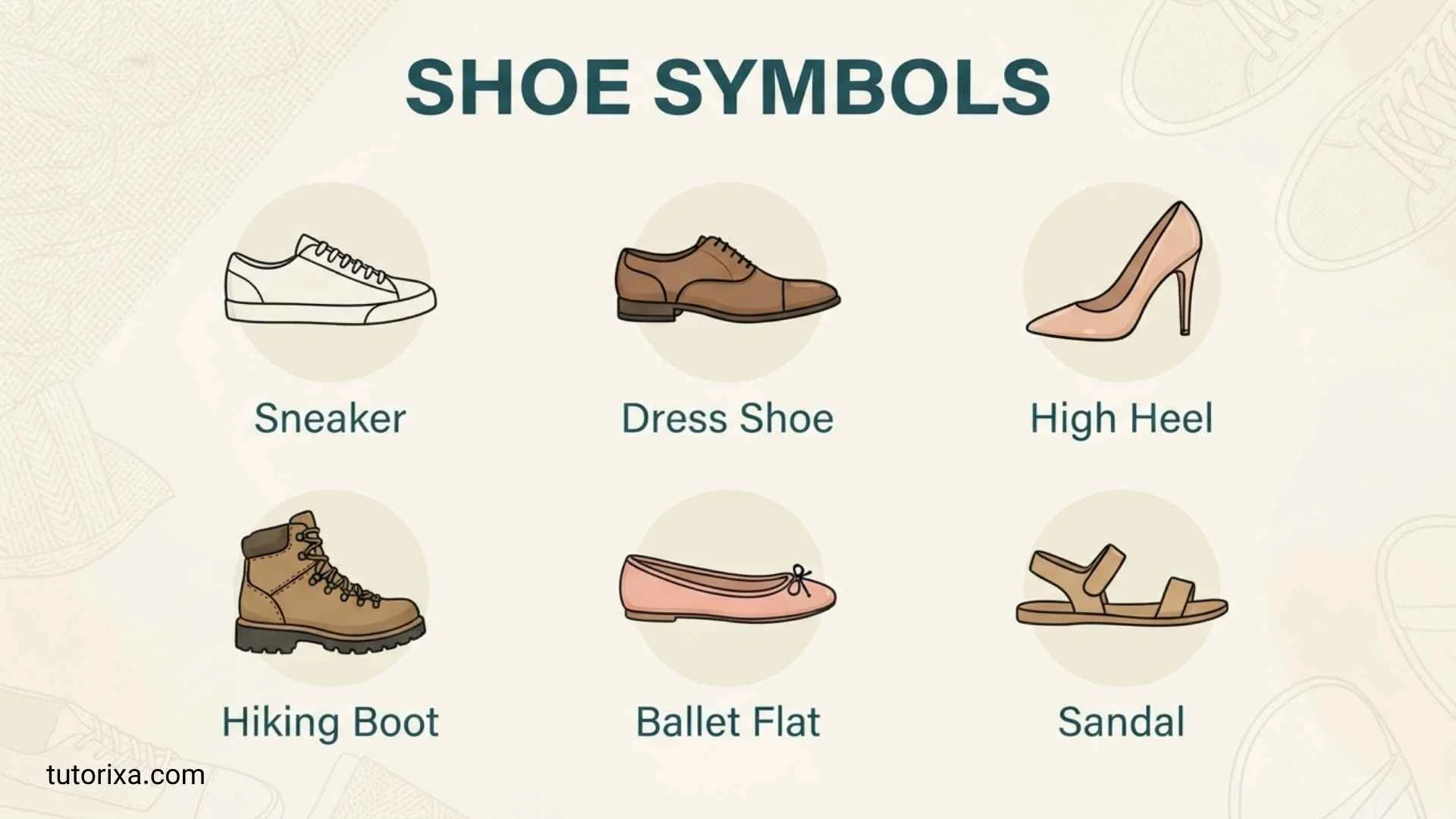
Shoe Symbols can look like simple marks, but I find they often tell you more than you expect. From care instructions to material signs, these small symbols can help you understand your shoes and keep them in better condition.
You may have noticed unfamiliar icons inside your shoes or on their labels and wondered what they mean. I’m here to make those confusing signs easy to understand, so you can quickly recognize what each symbol is telling you.
When you know what Shoe Symbols mean, you can make smarter choices about cleaning, caring for, and using your footwear. You don’t need to be an expert—I’ll break down the most important symbols in a simple and practical way.
Quick Meaning
Shoe symbols are visual signs used to communicate information about footwear. They commonly identify materials such as leather or textiles, indicate parts such as the upper, lining, and outer sole, provide care instructions, or communicate safety and product information. Their exact meaning depends on the symbol system, country, manufacturer, and context.
Symbol Overview Table
| Symbol Information | Meaning |
| Symbol Name | Shoe or footwear symbol |
| Primary Meaning | Communicates information about footwear |
| Category | Product labeling, material identification, care, safety, or branding |
| Origin | Modern footwear manufacturing and labeling systems |
| Major Standardized System | European footwear material/part pictograms |
| Main Shoe Parts Identified | Upper, lining and sock/insole, outer sole |
| Common Materials Identified | Leather, coated leather, textile, other materials |
| Common Usage | Shoe labels, boxes, tags, product descriptions |
| Modern Meaning | Material, care, safety, sizing, environmental, or brand information |
| Unicode | No single universal “shoe symbols” character set |
| Emoji Examples | 👞 👟 🥿 🩴 |
| Related Symbols | Textile-care symbols, recycling marks, safety footwear markings, size marks |
European footwear labeling provides a particularly useful example of how pictograms can communicate material information. Its system distinguishes the upper, lining and sock, and outer sole, and pairs these shoe-part indications with material symbols such as leather, coated leather, textile, and other materials.
What Do Shoe Symbols Mean?
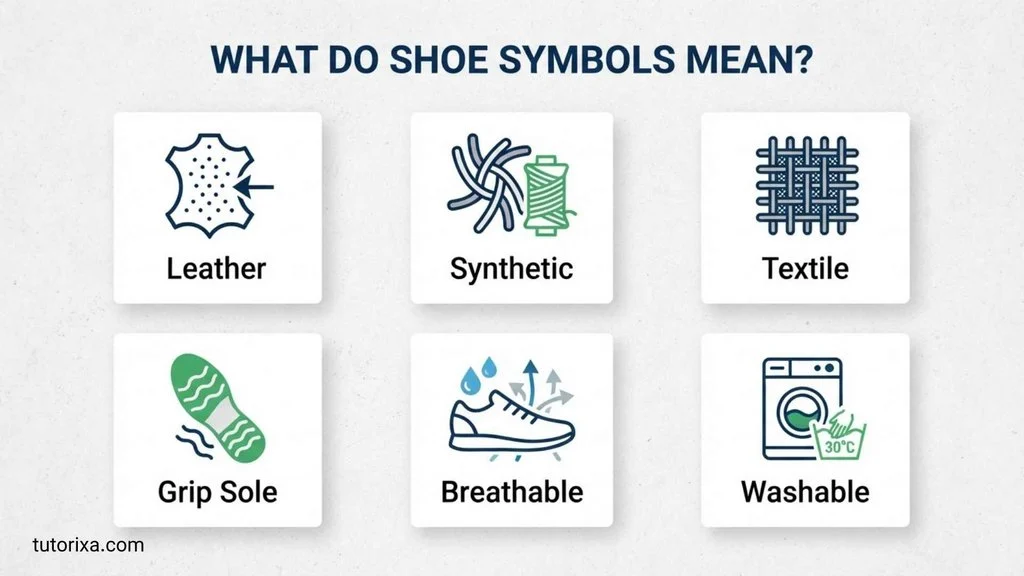
Shoe symbols usually tell you something about the construction, material, care, function, or identification of a shoe. They are designed to communicate information quickly without requiring a long explanation.
A shoe label can contain several different types of information. For example, one group of pictograms may identify the part of the shoe, while another identifies the material used for that part.
The three important footwear parts
In the European footwear labeling system, three major parts are identified:
- Upper — the part that forms the outside of the shoe above the sole.
- Lining and sock — the inside materials, including the lining and insole area.
- Outer sole — the bottom portion that contacts the ground and experiences wear.
These distinctions matter because a shoe can use different materials in each area. A pair of shoes may have a leather upper, a textile lining, and a synthetic outer sole.
The symbol therefore does not necessarily mean that the entire shoe is made from that material.
That is one of the most important details to understand when reading shoe symbols.
Material symbols
Common footwear material categories include:
- Leather
- Coated leather
- Textile
- Other materials
The European system defines corresponding pictograms for these categories.
The distinction between leather and coated leather is especially useful because the two terms describe different material categories. A consumer should not automatically interpret every leather-looking surface as genuine leather.
In the United States, the Federal Trade Commission’s leather guidance also addresses misleading claims about leather and imitation leather products, including footwear.
History and Origin of Shoe Symbols
Modern shoe symbols developed from the need to communicate product information clearly across languages and markets.
Shoemaking itself is thousands of years old, but the standardized pictograms used on modern footwear labels are much more recent. Manufacturers and retailers increasingly needed simple visual methods to describe materials and construction without relying entirely on written language.
European footwear labeling
A major development came through European Directive 94/11/EC, which established rules for labeling footwear materials. The system includes definitions and pictograms for the principal footwear parts and material categories.
The system was important because footwear can contain several materials, and written descriptions can vary between languages. A standardized pictogram makes information easier to recognize.
The European Commission later explained that the footwear definition and Annex I were adopted across European Union member states, with the annex covering the upper, lining and sock, outer sole, and related material symbols.
From labels to global product communication
Modern footwear labeling has expanded beyond material identification. Shoes now commonly carry information about:
- Size
- Manufacturing details
- Care
- Safety properties
- Recycling
- Country of origin
- Brand technologies
- Product codes
- Environmental claims
Not all of these symbols are governed by one worldwide standard. Some are regulated, some follow voluntary standards, and others are created by individual brands.
Symbolism and Interpretation
Shoe symbols usually have a practical rather than symbolic or spiritual meaning. They are primarily designed to communicate information efficiently.
However, footwear itself can carry cultural symbolism. Shoes may represent movement, travel, work, status, identity, or a particular social role. A shoe symbol on a sign or in an illustration can therefore have a meaning beyond product labeling.
Traditional interpretations of footwear
Historically, shoes have been associated with:
- Journeys and travel
- Work and occupation
- Social status
- Protection
- Movement
- Independence
- Practicality
These associations come from the importance of footwear in everyday life rather than from a universal symbolic code.
Modern interpretations
Today, a shoe icon may simply mean:
- Footwear
- Walking
- Running
- A shoe store
- Fashion
- Sports
- Foot protection
- A product category
Context determines the meaning.
A shoe icon on a retail website may indicate the footwear category, while a shoe-part pictogram on a product label provides technical material information.
Positive and negative symbolism
A shoe itself can have positive associations such as progress, travel, freedom, and preparation.
Negative interpretations can also occur in specific cultural or artistic contexts, but these are not universal meanings of shoe symbols. It is therefore inaccurate to claim that one shoe icon always represents a particular emotion or spiritual idea.
Cultural Significance
Footwear has cultural significance in many societies, but shoe symbols themselves do not have one universal cultural interpretation.
Shoes can reflect climate, geography, occupation, religion, social customs, fashion, and economic conditions.
For example, footwear designed for cold climates differs greatly from footwear developed for hot environments. Traditional sandals, boots, slippers, and ceremonial footwear can each carry distinct cultural associations.
Regional differences
A shoe icon can also be interpreted differently depending on where it appears.
In a shopping environment, it usually means footwear. On a workplace sign, it may identify required protective footwear. On a care label, a pictogram may provide treatment instructions.
This makes context more important than the shape of the icon alone.
Scientific or Technical Meaning
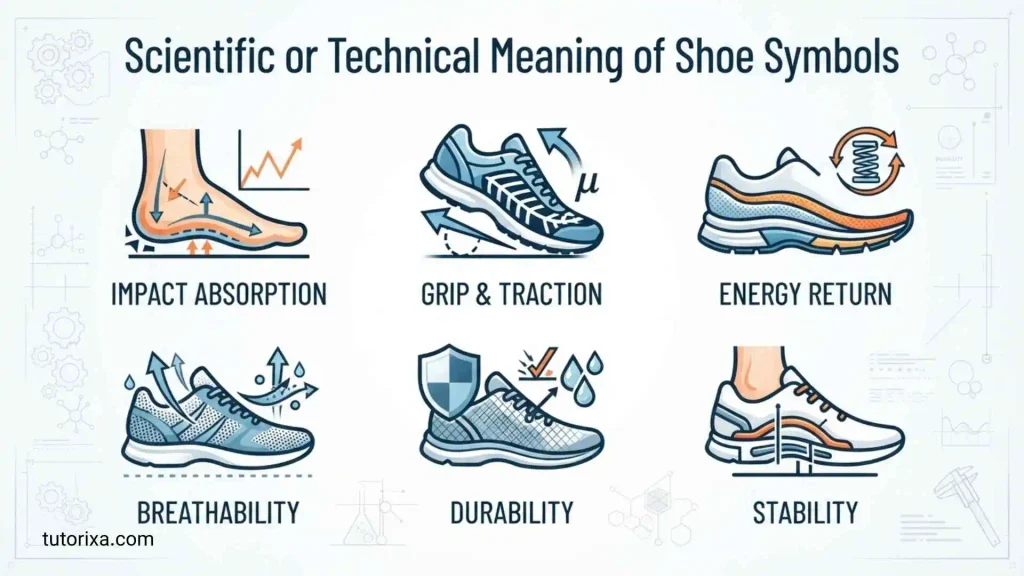
Technical shoe symbols are used to communicate material, performance, safety, or care information.
Footwear engineering involves several components, including:
- Upper
- Lining
- Insole or sock
- Midsole
- Outsole
- Heel
- Fastening system
- Protective toe area in safety footwear
International standards also address specialized footwear. For example, ISO 20345:2021 specifies requirements for safety footwear, including areas such as mechanical risks, slip resistance, thermal risks, and ergonomic behavior.
This illustrates why a symbol found on protective footwear should not automatically be interpreted as a fashion or material symbol.
Care symbols
Care symbols provide another technical category. ISO 3758:2023 establishes a graphical system for textile care labeling covering treatments such as washing, bleaching, drying, ironing, and professional textile care.
A shoe containing textile components may therefore carry care information related to those materials, although footwear manufacturers can also provide specific written care instructions.
Why technical symbols matter
Using the wrong cleaning method can damage certain materials. A care symbol is therefore not decoration. It communicates a recommended or restricted treatment.
Where Are Shoe Symbols Used?
Shoe symbols appear wherever manufacturers, retailers, or organizations need to communicate footwear information quickly.
1. Shoe labels
Labels may show material symbols identifying the upper, lining, and outer sole.
2. Shoe boxes
Boxes often contain symbols alongside written product information, size details, product codes, or care instructions.
3. Online stores
Retail websites frequently use shoe icons to organize categories such as running shoes, boots, sandals, or formal shoes.
4. Safety footwear
Work shoes can contain markings connected with protective properties and applicable standards.
5. Care instructions
Some footwear includes washing, drying, cleaning, or treatment information.
6. Recycling and environmental information
Packaging may contain recycling symbols or other environmental marks. These should not automatically be interpreted as proof that the shoe itself is recyclable.
7. Logos and branding
Manufacturers may use stylized shoe images or proprietary symbols as part of their branding.
8. Maps and public signs
A shoe or walking-footwear icon can sometimes represent walking routes, pedestrian areas, or footwear-related locations. The exact meaning depends on the sign system.
Common Variations of Shoe Symbols
Shoe symbols vary because different information systems have different purposes.
Material variations
Material pictograms can distinguish categories such as:
- Leather
- Coated leather
- Textile
- Other materials
Part variations
The same material can be associated with different shoe components, including:
- Upper
- Lining and sock
- Outer sole
Care variations
Care symbols may use familiar visual conventions involving:
- Washing
- Bleaching
- Drying
- Ironing
- Professional cleaning
ISO 3758:2023 specifically defines a graphical care-labeling system for textile articles.
Brand variations
Brands may also create their own icons for features such as cushioning, waterproof membranes, stability systems, recycled materials, or performance technologies.
These proprietary icons should not be confused with standardized symbols.
Common Misconceptions About Shoe Symbols
Misconception 1: One shoe symbol has one universal meaning
Not necessarily. A shoe icon can mean footwear in one context and communicate a specific technical property in another.
Misconception 2: A leather symbol means the whole shoe is leather
Not necessarily. Material symbols can refer to specific footwear components. The upper, lining, and outer sole may use different materials.
Misconception 3: Every shoe symbol is internationally standardized
False. Some symbols are standardized or regulated, while others are manufacturer-specific.
Misconception 4: A recycling symbol proves the entire shoe is recyclable
False. Recycling marks generally communicate information about a material, packaging, or disposal system. They do not automatically establish that an entire multi-material shoe can be recycled through ordinary household recycling.
Misconception 5: A shoe emoji is the same as a technical shoe symbol
False. Emojis such as 👟 and 👞 are communication characters, not universal technical footwear-labeling symbols.
Misconception 6: A symbol always tells you shoe quality
False. A material symbol identifies a material category; it does not by itself establish craftsmanship, durability, comfort, or overall quality.
Interesting Facts About Shoe Symbols
1. Shoe labels can describe different parts separately
A single shoe may contain several material categories. This is why material identification can be connected to specific shoe parts rather than the entire product.
2. The upper is not the same as the outsole
The upper covers much of the shoe’s exterior, while the outer sole is the bottom section exposed to ground contact and abrasion.
3. Leather and coated leather are distinct categories
The European footwear labeling framework distinguishes leather from coated leather instead of treating every leather-like surface as identical.
4. Shoe symbols reduce language barriers
A pictogram can communicate a category visually, making product information easier to recognize across multilingual markets.
5. Footwear standards go beyond materials
Safety footwear standards can address properties such as slip resistance, thermal risks, and mechanical hazards.
6. Textile care symbols have their own international standard
ISO 3758:2023 establishes a care-labeling system using graphical symbols for textile articles.
7. A brand icon may not be a standard symbol
A manufacturer can create proprietary graphics for its own technologies. Their meanings normally need to be confirmed through the manufacturer’s documentation.
8. Symbols can communicate restrictions
A care symbol may indicate that a particular treatment should not be used. This makes the symbol a practical instruction rather than simply an identification mark.
9. Safety footwear uses specialized information
Protective footwear can require markings and documentation that differ substantially from ordinary fashion shoes. ISO 20345:2021 is one example of a technical standard for safety footwear.
10. Shoe symbols are part of a larger visual language
The same design principle appears across clothing, packaging, industrial products, transportation, and consumer goods: a simple graphic can communicate information quickly without a long sentence.
Related Symbols
Several symbol systems are closely connected to footwear.
Textile-care symbols
These explain suitable care treatments for textile materials. ISO 3758:2023 covers washing, bleaching, drying, ironing, and professional textile care symbols.
Recycling symbols
These communicate information about recycling or material recovery systems. Their exact meaning depends on the mark and jurisdiction.
Safety footwear markings
These communicate information associated with protective footwear and relevant requirements. ISO 20345:2021 covers safety footwear for general-purpose applications.
Size symbols
Shoe sizing may use different systems, such as US, UK, European, and Japanese sizing conventions. A size mark should therefore always be interpreted according to the system specified.
Brand symbols
A company logo or technology icon identifies a manufacturer, product line, or proprietary feature rather than serving as a universal footwear symbol.
Frequently Asked Questions
What are shoe symbols?
Shoe symbols are pictograms, icons, and markings used to communicate information about footwear. They can identify shoe materials, specific components, care instructions, safety characteristics, sizing information, or brand features. Their meaning depends on the symbol system and context, so a shoe icon used for branding should not be confused with a standardized material or care pictogram.
What do the symbols on shoe labels mean?
Symbols on shoe labels commonly identify the materials used in the upper, lining and sock, or outer sole. In European footwear labeling, recognized pictograms distinguish materials such as leather, coated leather, textile, and other materials. The symbols help consumers understand the construction of the footwear without relying entirely on written descriptions.
What does the leather symbol on a shoe mean?
A leather symbol generally indicates that the relevant footwear component belongs to the leather material category. It does not necessarily mean every part of the shoe is leather. The component being identified matters, because the upper, lining, and outer sole can be made from different materials.
What do three shoe symbols on a label mean?
Three groups of shoe-related pictograms commonly correspond to the upper, lining and sock, and outer sole in the European footwear labeling system. A material symbol may appear alongside each part to indicate its material category. This allows a label to show that different parts of the same shoe have different materials.
Are shoe symbols universal?
No. Some footwear symbols are standardized or regulated within particular systems, while other icons are created by manufacturers, retailers, or organizations. A shoe icon on a website might simply represent footwear, while a pictogram on a material label can have a precise technical meaning.
What is the difference between shoe symbols and shoe emojis?
Shoe emojis such as 👟, 👞, 🥿, and 🩴 are Unicode characters used in digital communication. Shoe-label symbols serve practical purposes such as identifying materials, components, care instructions, or safety information. An emoji should therefore not be treated as a technical labeling standard.
Do shoe symbols tell you if shoes are good quality?
Not by themselves. A material symbol can tell you what material category is used in a particular shoe component, but it does not automatically measure durability, comfort, craftsmanship, fit, or performance. Quality requires consideration of construction, materials, manufacturing, intended use, and other product information.
What do care symbols on shoes mean?
Care symbols provide information about suitable treatment, particularly for textile components. International textile-care labeling uses graphical symbols for processes such as washing, bleaching, drying, ironing, and professional cleaning. Footwear manufacturers may also provide additional shoe-specific instructions because shoes can combine leather, textiles, rubber, plastics, adhesives, and other materials.
Why are shoe symbols useful?
Shoe symbols make product information faster and easier to understand. They can reduce language barriers, identify materials, distinguish shoe components, communicate care requirements, and provide technical information. For consumers, they are especially useful when comparing products or trying to understand how a particular shoe should be maintained.
Key Takeaways
- Shoe symbols are visual marks used to communicate footwear information.
- They can describe materials, shoe parts, care, safety, sizing, recycling, or branding.
- European footwear labeling uses pictograms for the upper, lining and sock, and outer sole.
- Common material categories include leather, coated leather, textile, and other materials.
- A material symbol may apply to one part of a shoe, not the entire product.
- Shoe emojis such as 👟 and 👞 are different from technical labeling symbols.
- Care symbols belong to a separate visual system and may apply particularly to textile components.
- Safety footwear can use specialized standards and markings.
- Brand-created icons should not automatically be treated as universal symbols.
- The context surrounding a symbol is essential for interpreting it correctly.
- A symbol can communicate material information without proving overall product quality.
Conclusion
Shoe symbols are a practical visual language that helps people understand footwear without relying entirely on written descriptions. From material pictograms identifying leather or textiles to care marks and safety information, these small graphics can reveal important details about how a shoe is constructed and used.
The most useful approach is to look at the symbol together with its location and surrounding information. A pictogram identifying the upper has a different purpose from a care symbol or a brand logo. Understanding that distinction prevents common mistakes, especially the assumption that one symbol automatically describes the entire shoe.
Modern footwear combines many materials and technologies, making clear labeling increasingly valuable. Once you understand the major categories—shoe parts, materials, care, safety, sizing, and branding—the symbols on a shoe label become much easier to read and interpret.

I’m Rowan Whitaker, a British writer fascinated by the symbols surrounding us every day. I explore their meanings, origins, cultural significance, and changing interpretations. From ancient marks to modern signs, I enjoy making symbolism easier to understand. My writing helps curious readers discover the hidden messages behind familiar shapes, images, and signs.
Books:
- The Meaning Behind Symbols
- A Modern Guide to Symbolism
 Ellis Montgomery
 Freddie Beaumont