
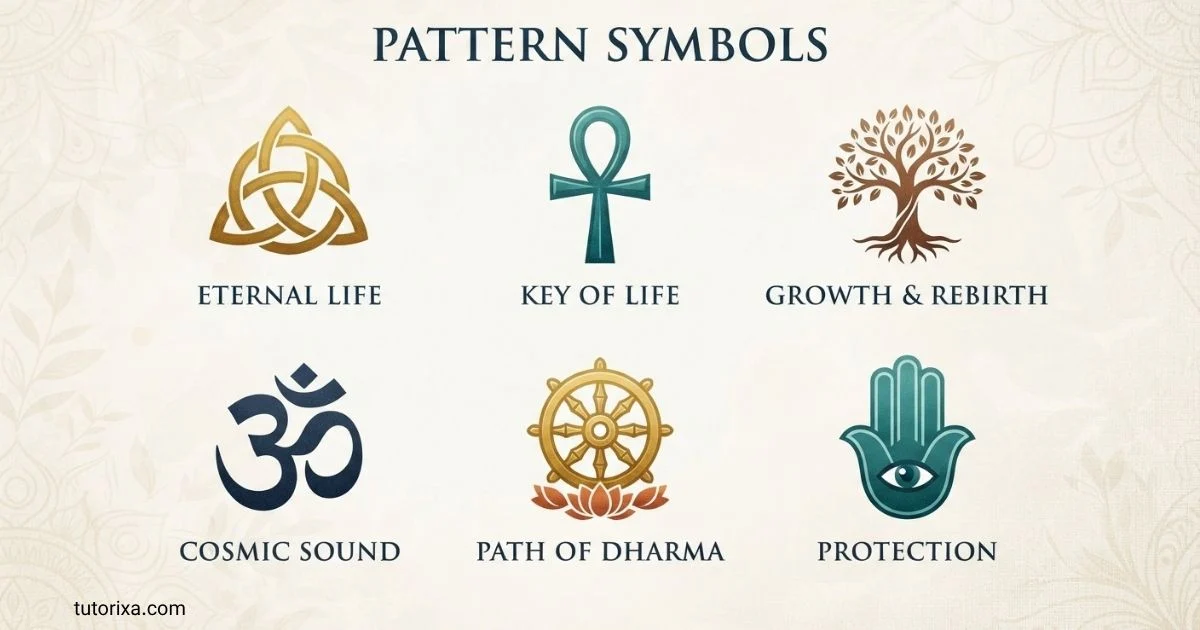
I’ve always found patterns fascinating because a simple shape can communicate an idea, feeling, or tradition without using words. Pattern symbols can turn ordinary designs into something meaningful, memorable, and visually powerful.
You may have seen these symbols in art, clothing, architecture, digital designs, or cultural traditions without knowing what they represent. I’ll help you explore their meanings, common types, and practical uses in a simple way.
Whether you’re a beginner, designer, student, or simply curious, you can discover how pattern symbols work and why certain shapes and repeated designs have remained meaningful across different cultures and creative fields..
Quick Meaning of Pattern Symbols
Pattern symbols are recognizable shapes, lines, motifs, or arrangements that repeat or combine to create visual meaning. They can communicate cultural identity, religious beliefs, natural processes, mathematical relationships, or decorative ideas. Their meanings depend on context: some have established historical significance, while others function mainly as artistic elements without a universal symbolic interpretation.
Pattern Symbols Overview Table
| Feature | Description |
| Symbol Name | Pattern symbols |
| Primary Meaning | Repetition, organization, visual communication, and representation |
| Category | Geometric, natural, cultural, decorative, mathematical, and symbolic designs |
| Origin | Prehistoric art and independently developed traditions worldwide |
| Cultures | Ancient Egyptian, Greek, Chinese, Islamic, Indigenous, African, European, and many others |
| First Known Use | Repeated patterns appear in prehistoric artifacts; individual motifs have different timelines |
| Common Usage | Textiles, architecture, ceramics, jewelry, art, writing, and digital design |
| Modern Meaning | Creativity, identity, structure, rhythm, continuity, and visual expression |
| Unicode | Depends on the individual character or symbol |
| Emoji Equivalent | No single emoji represents all pattern symbols |
| Related Symbols | Spiral, circle, triangle, mandala, knotwork, tessellation, and interlocking geometry |
What Do Pattern Symbols Mean?
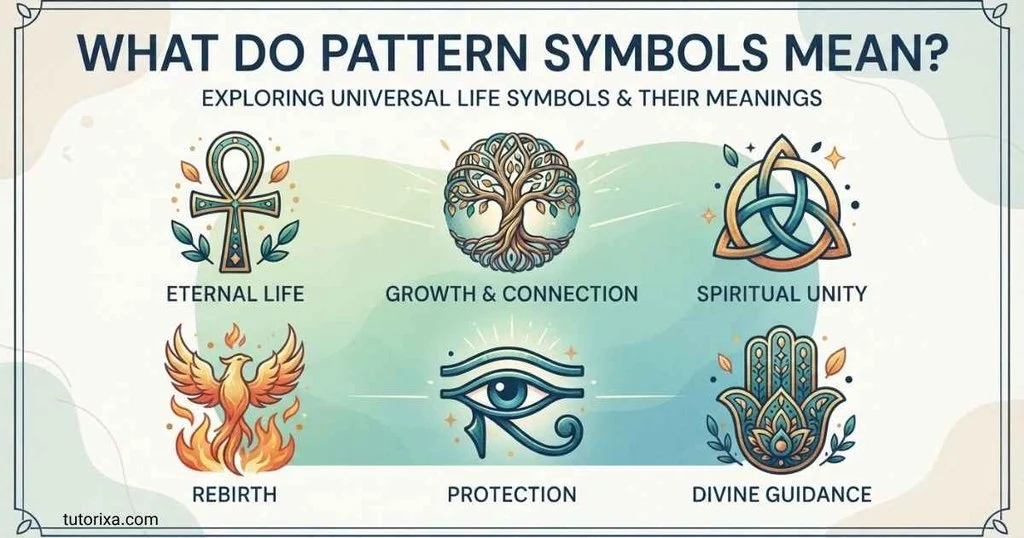
Pattern symbols communicate meaning through the relationship between individual shapes and the larger design. A single circle, for instance, is a basic geometric figure. Repeated circles may form a chain, a flower-like motif, or a decorative border, with each arrangement creating a different visual effect.
There is no universal dictionary of pattern symbols. Their interpretation depends on several factors, including cultural background, historical period, visual structure, materials, and intended use.
Repetition and Continuity
Repeating a shape creates rhythm and a sense of continuity. Rows of connected circles, repeating waves, or interlocking lines can suggest an ongoing process or an unbroken sequence.
In decorative design, repetition also helps connect separate areas into a unified composition. However, continuity is an interpretation rather than a fixed meaning shared by every culture.
Balance and Harmony
Symmetrical patterns often create a sense of order and stability. A design with identical elements arranged around a central point may feel balanced because its parts relate to one another in a predictable way.
This principle appears in architecture, ornamental art, textile design, and graphic composition. Some traditions also associate symmetry with harmony or cosmic order, although those associations vary.
Growth and Transformation
Spirals, branching lines, and expanding geometric arrangements can suggest growth, movement, or transformation. These shapes sometimes resemble natural processes, including plant growth, shells, and branching structures.
Artists may use these visual similarities to communicate change or development. Nevertheless, a spiral does not automatically represent spiritual growth, life, or rebirth in every setting.
Identity and Belonging
Patterns can identify a community, family, region, or artistic tradition. Particular weaving techniques, motifs, color combinations, and arrangements may be connected to local histories and shared knowledge.
When a pattern belongs to a living cultural tradition, its significance may extend beyond decoration. It can communicate relationships, status, heritage, or community identity, depending on the tradition.
Order and Complexity
Geometric patterns organize individual elements into larger systems. Repeating squares, triangles, polygons, or lines can produce complex designs from simple rules.
This relationship between simplicity and complexity explains why patterns appear in both art and mathematics. A repeating design may be visually intricate even when it follows a straightforward geometric process.
History and Origin of Pattern Symbols
Pattern symbols developed across many societies as people decorated tools, clothing, pottery, buildings, and ceremonial objects. Repetition is a basic visual technique, so similar pattern-making methods emerged independently in different parts of the world rather than originating from one single civilization.
Prehistoric Patterns and Early Human Art
Prehistoric people created repeated marks, lines, and geometric arrangements on objects, cave surfaces, and pottery. Archaeological finds demonstrate that pattern-making has a long history, although the precise meaning of many early designs remains uncertain.
Some patterns may have served decorative purposes, while others could have communicated identity, practical information, or beliefs. Without written records or reliable cultural continuity, researchers cannot confidently assign a specific meaning to every ancient motif.
As communities developed new tools and materials, pattern-making expanded into weaving, carving, painting, beadwork, and architecture.
Ancient Egyptian and Greek Patterns
Ancient Egyptian art used repeated floral motifs, geometric borders, and stylized natural forms in architecture, jewelry, tomb decoration, and everyday objects. Lotus and papyrus motifs, for example, were associated with recognizable plants and carried cultural significance in Egyptian visual traditions.
Ancient Greek decorative art featured patterns such as the meander, often called the Greek key. Its repeated, turning lines create a continuous geometric border. The motif appeared on pottery, buildings, mosaics, and other objects.
These examples show how a pattern can function as both decoration and a recognizable marker of a particular artistic tradition.
Chinese and East Asian Pattern Traditions
Chinese decorative arts developed rich traditions of repeating cloud forms, floral motifs, dragons, waves, and geometric designs. Particular motifs could communicate prosperity, longevity, good fortune, authority, or other culturally established associations.
Their meanings often depended on the depicted subject, color, historical period, and setting. For example, a decorative cloud motif should not automatically be interpreted as a religious symbol simply because it resembles a natural form.
Pattern traditions in Japan, Korea, and other East Asian societies also developed distinctive visual languages, including repeating waves, interlocking shapes, and textile motifs.
Islamic Geometric Patterns
Geometric patterns became prominent in many Islamic artistic traditions, appearing in architecture, manuscripts, ceramics, woodwork, and textiles. Artists used circles, polygons, stars, and intersecting lines to create highly organized compositions.
These patterns often demonstrate mathematical relationships, symmetry, and repeated geometric construction. In some religious and architectural contexts, their ordered designs have been interpreted in relation to unity, infinity, and the organization of creation.
However, not every Islamic geometric pattern has one fixed theological meaning. Artistic choices also reflect regional traditions, available materials, workshop practices, and the requirements of a particular building or object.
Patterns in African and Indigenous Artistic Traditions
Across African societies, repeating designs appear in textiles, beadwork, pottery, architecture, body art, and carved objects. Certain patterns may communicate proverbs, social identity, historical events, or community values.
Adinkra symbols associated with Akan traditions in Ghana and Côte d’Ivoire, for example, include recognizable visual motifs connected to concepts and sayings. They are more specific than generic geometric patterns because individual designs have established cultural associations.
Indigenous communities in the Americas and elsewhere have also developed distinctive pattern traditions. Their designs may relate to land, ancestry, animals, spiritual beliefs, or community identity. These meanings should be understood within their specific cultural contexts rather than treated as interchangeable across Indigenous peoples.
The Development of Modern Pattern Design
Industrial printing, textile manufacturing, photography, and digital tools expanded the possibilities for creating and reproducing patterns. Artists and designers began combining traditional motifs with modern geometric systems, abstract shapes, and experimental arrangements.
Today, pattern symbols appear in website interfaces, brand identities, product packaging, architectural surfaces, video games, and digital illustrations. Some preserve historical associations, while others are created primarily to communicate a contemporary visual style.
Symbolism and Interpretation of Pattern Designs
Pattern symbols can communicate ideas through their shapes, repetition, arrangement, and cultural associations. Their meaning is not determined by appearance alone; the same design can serve different purposes in different settings.
Traditional Meanings
Traditional interpretations usually develop through repeated use within a particular community. A motif may become associated with a ceremony, a historical event, a family, a religious practice, or a regional art form.
For example, a pattern woven into ceremonial clothing may have a significance that differs from an identical-looking pattern printed on commercial fabric. The materials, maker, intended wearer, and occasion can all affect its interpretation.
Modern Meanings
Modern designers frequently use repeating patterns to communicate visual qualities rather than specific historical messages.
Common design associations include:
- Circles: unity, wholeness, cycles, or connection.
- Triangles: direction, stability, movement, or tension.
- Squares: structure, organization, and regularity.
- Spirals: movement, development, or change.
- Waves: motion, water, rhythm, or fluidity.
- Interlocking lines: connection, complexity, or continuity.
- Repeating flowers: nature, beauty, seasonal change, or decoration.
These are common artistic associations, not universal definitions. A triangle, for example, can represent a mountain in one design and simply provide a structural shape in another.
Positive and Negative Interpretations
Pattern symbolism can communicate favorable, unfavorable, or mixed ideas. A repeating knot may suggest connection in one context but complexity or entanglement in another. A dense pattern can create a sense of richness and intricacy, while another viewer may experience it as visually overwhelming.
Interpretation also depends on the subject. A pattern featuring protective figures may have a specific traditional purpose, whereas an abstract arrangement of the same shapes may have no protective meaning.
Psychological Interpretation
People often respond to patterns through visual perception. Symmetry may feel orderly, repetition may establish rhythm, and irregular arrangements may create tension or visual excitement.
These reactions are influenced by experience, familiarity, context, and individual preference. Although pattern perception is studied in psychology and visual science, it is not possible to determine someone’s personality, beliefs, or emotional state reliably from a pattern they prefer.
Cultural Significance of Pattern Symbols
Pattern symbols become culturally significant when communities use them to preserve traditions, express identity, or communicate shared ideas. Their meaning may be connected to religion, geography, craftsmanship, social relationships, or historical experience.
South Asian Patterns
South Asian decorative traditions include intricate floral designs, paisleys, repeating geometric borders, latticework, and elaborate textile patterns.
Paisley, a curved, teardrop-like motif, appears in textiles and decorative arts across several regions. Its history involves cross-cultural exchange, and its interpretation varies according to the object and tradition in which it appears.
Patterns in South Asian architecture, embroidery, carpets, and block printing also reflect regional materials, craftsmanship, and artistic influences. A decorative motif should not be assumed to have the same religious meaning in every South Asian community.
Middle Eastern Patterns
Geometric borders, floral arabesques, calligraphic designs, and interlocking forms appear in many Middle Eastern artistic traditions. Their visual arrangements may emphasize symmetry, repetition, and continuity.
Some patterns are used in religious architecture, while others appear on domestic objects, textiles, ceramics, and secular buildings. Their presence alone does not establish a religious purpose.
European Patterns
European pattern traditions include Celtic knotwork, classical meanders, heraldic designs, floral wallpaper, and repeating textile motifs.
Celtic knotwork is often associated in modern popular culture with eternity or interconnectedness. However, interpretations differ by design and historical context, and not every knot has a documented ancient symbolic meaning.
European decorative patterns also developed through trade and cultural exchange, incorporating influences from Asia, North Africa, and the Middle East.
Indigenous and Community-Specific Patterns
For many Indigenous communities, designs are connected to specific cultural knowledge, family histories, ceremonial practices, or relationships with the natural world.
Some motifs are intended for particular people or occasions, and some designs may have restrictions on their use. When researching or reproducing a community-specific pattern, it is important to consult reliable sources and respect the community’s own explanations rather than relying exclusively on commercial descriptions.
Religious or Spiritual Meaning of Pattern Symbols
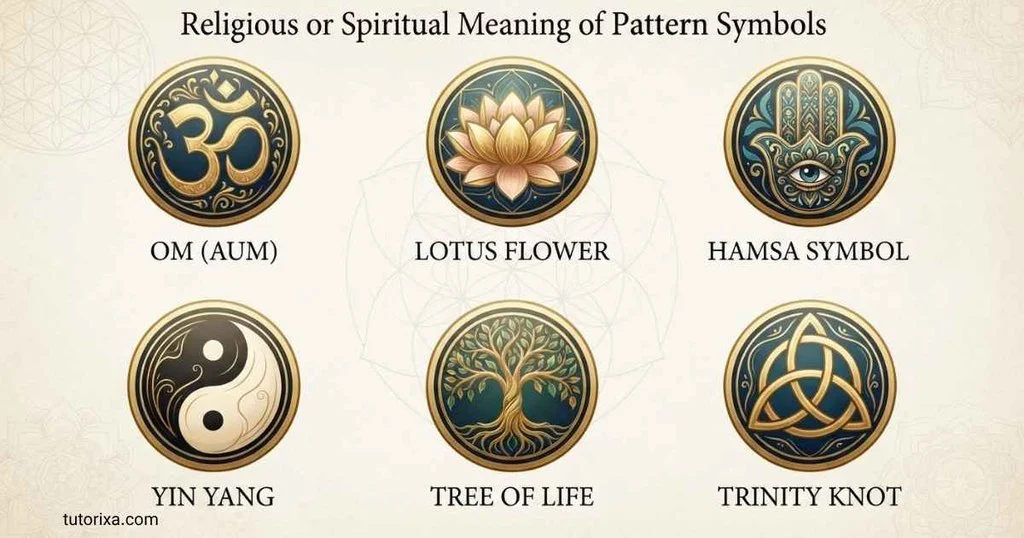
Pattern symbols can have religious or spiritual significance when they are used in sacred spaces, rituals, devotional objects, or systems of belief. Their meanings vary, and a geometric design is not automatically religious simply because it appears in a temple, mosque, church, or other sacred building.
Mandalas in Hindu and Buddhist Traditions
A mandala is a structured design, often organized around a central point and surrounded by geometric shapes, figures, or repeating motifs. Mandalas have important roles in particular Hindu and Buddhist traditions.
Depending on the tradition, a mandala may represent a sacred arrangement of the universe, serve as a focus for meditation, or provide a visual framework for ritual practice. Not all mandalas have the same structure or purpose.
Modern decorative mandalas often borrow the circular arrangement and symmetry without retaining the religious context of traditional examples.
Sacred Geometry
Sacred geometry refers to approaches that connect geometric forms and mathematical relationships with spiritual, philosophical, or religious ideas.
Circles, squares, triangles, and complex proportional arrangements appear in different sacred buildings and artworks. Their use can express ideas about order, balance, or the relationship between physical space and a larger cosmic framework.
However, claims that a particular ratio or shape has one universal spiritual meaning should be treated cautiously. Historical evidence and interpretations vary by tradition.
Knots, Spirals, and Repeated Motifs
Some knotwork and spiral designs have religious, ceremonial, or spiritual associations in particular cultural settings. Others are primarily decorative.
A spiral may be interpreted as a cycle, journey, or transformation in contemporary spiritual art, but its presence in an ancient artifact does not establish that the original maker intended any of these meanings.
Understanding spiritual pattern symbols therefore requires attention to historical evidence, cultural context, and the explanations provided by the people who use them.
Scientific and Technical Meaning of Pattern Symbols
In science and technology, patterns are recurring arrangements that can be observed, measured, described, or reproduced. A pattern may be visually symbolic, but it can also represent a mathematical relationship or a physical process.
Mathematical Patterns
Mathematical patterns follow rules that help explain how numbers, shapes, or arrangements develop.
Examples include:
- Tessellations: shapes that cover a surface without gaps or overlaps.
- Symmetry: a design that remains unchanged under particular transformations.
- Fractals: structures that display recurring patterns across different scales.
- Sequences: ordered lists of numbers or objects that follow a rule.
- Geometric progressions: arrangements or sequences connected by consistent mathematical relationships.
These concepts help connect decorative patterns with mathematics. However, a design that looks mathematically complex is not necessarily a fractal or a tessellation; those terms have specific definitions.
Patterns in Nature
Nature contains repeating structures, including honeycomb cells, branching plants, animal markings, mineral formations, and spiral arrangements.
Scientists study these patterns to investigate growth, material efficiency, physical forces, biological development, and environmental processes. Similar visual arrangements may arise from different mechanisms, so appearance alone does not prove that two patterns share the same cause.
Digital and Computing Patterns
Digital systems use patterns to represent, organize, and process information. Repeating characters, icons, interface motifs, and graphical textures help users recognize categories and navigate software.
Pattern recognition also describes computational methods that identify recurring features in images, sound, text, or data. In this technical context, the term refers to detecting regularities rather than interpreting cultural symbolism.
Where Are Pattern Symbols Used?
Pattern symbols appear in nearly every area of visual communication. Their function may be decorative, practical, cultural, informational, or a combination of these purposes.
1. Textiles and Clothing
Repeating motifs appear in woven fabric, embroidery, printed clothing, carpets, scarves, and traditional dress. Patterns may communicate regional identity, artistic style, or ceremonial significance, depending on their origin.
2. Architecture and Interior Design
Geometric tiles, carved borders, decorative ceilings, floor patterns, and wall coverings use repetition to establish visual rhythm and connect architectural elements.
3. Pottery and Ceramics
Repeated lines, dots, spirals, and geometric arrangements decorate vessels and other objects. Historical examples can provide evidence of craftsmanship, artistic exchange, and cultural practices.
4. Graphic Design and Branding
Businesses and designers use patterns in logos, packaging, websites, advertisements, and backgrounds. Repetition can establish a recognizable visual identity without requiring every motif to carry a symbolic message.
5. Jewelry and Personal Accessories
Patterned pendants, rings, bracelets, and ornaments may express personal taste, cultural belonging, or spiritual affiliation. Their significance depends on the design and the person wearing the object.
6. Digital Art and Games
Repeated textures, geometric backgrounds, decorative borders, and visual motifs help create environments, organize interfaces, and establish a consistent artistic style.
Pattern symbols also appear in books, maps, scientific illustrations, public art, mosaics, furniture, stationery, tattoos, and decorative household products. Their meaning depends on whether they function as cultural symbols, practical diagrams, or visual ornament.
Common Variations of Pattern Symbols
Pattern symbols can be classified by the shapes they use, the way those shapes repeat, and the visual rules that organize them.
| Pattern Type | Main Characteristics | Common Examples |
| Geometric | Uses regular shapes and structured arrangements | Squares, triangles, polygons |
| Floral | Features stylized flowers, leaves, and plants | Rose motifs, vines, petals |
| Spiral | Curves inward or outward around a center | Coiled spirals, expanding curves |
| Symmetrical | Balances elements around an axis or center | Radial designs, mirrored motifs |
| Repeating | Reuses a motif in a regular sequence | Textile prints, wallpaper |
| Interlocking | Connects shapes or lines into a continuous design | Knotwork, linked polygons |
| Tessellated | Covers a surface without gaps or overlaps | Repeating tiles, polygon grids |
| Organic | Uses irregular, flowing, nature-inspired forms | Waves, branching lines |
| Abstract | Uses shapes without necessarily depicting recognizable objects | Modern decorative compositions |
Geometric Patterns
Geometric patterns rely on circles, squares, triangles, polygons, straight lines, and repeated measurements. They may be simple or extremely complex, depending on the rules used to arrange their elements.
Floral and Organic Patterns
Floral patterns draw on recognizable plants and natural forms. Organic patterns use irregular curves, flowing lines, or asymmetrical arrangements that resemble natural processes without necessarily depicting a specific object.
Interlocking and Knotwork Patterns
Interlocking patterns connect lines or shapes so that the overall design appears continuous. Some traditions have distinctive knotwork systems, while modern graphic designers also create new interlocking motifs for decorative purposes.
Digital Pattern Symbols and Unicode Characters
Some individual shapes can be represented by Unicode characters, allowing them to appear in text, messages, and digital documents. Examples include circles, triangles, squares, and geometric marks.
However, pattern symbols as a broad category do not have one Unicode character or standard emoji. A repeating pattern is often created by combining characters, using a decorative font, or inserting a graphic image. The appearance of a character can also vary between fonts and platforms.
Common Misconceptions About Pattern Symbols
Pattern symbols are often misunderstood when people assume that every design has a fixed, ancient, or universal meaning. Several distinctions help prevent inaccurate interpretations.
Misconception 1: Every Pattern Has a Hidden Meaning
Not every repeating shape represents a belief, message, or spiritual idea. Many patterns are created to decorate a surface, make an object visually appealing, or solve a practical design problem.
What to know: A symbolic interpretation should be supported by historical evidence, cultural explanations, or a clearly identified modern use.
Misconception 2: The Same Pattern Means the Same Thing Everywhere
A spiral, circle, or triangle may carry different associations across cultures. Even within a single society, meanings can change across historical periods and social settings.
What to know: Identify the pattern’s origin, purpose, and cultural context before assigning a specific meaning.
Misconception 3: All Ancient Patterns Have Known Origins
Archaeologists sometimes discover patterns on artifacts without enough evidence to determine their exact purpose. Similar shapes may have developed independently in different communities.
What to know: An artifact’s age, location, material, and archaeological context can provide clues, but they do not always reveal the original maker’s intentions.
Misconception 4: Geometric Patterns Are Always Religious
Geometric designs occur in religious buildings, but they also appear in ordinary household objects, clothing, tools, and secular architecture.
What to know: The location of a pattern can provide context, but it does not prove a specific religious interpretation.
Misconception 5: Modern Interpretations Are Ancient Facts
Contemporary books, websites, and commercial products sometimes assign universal meanings to popular motifs without reliable historical support.
What to know: Distinguish documented traditional meanings from modern artistic associations, personal interpretations, and marketing descriptions.
10 Interesting Facts About Pattern Symbols
1. Patterns can be created from very simple rules. A small collection of lines or shapes can produce an intricate design through repetition, rotation, reflection, or translation.
2. Similar patterns can develop independently. Different societies may use circles, grids, spirals, and repeating borders without sharing a direct historical origin.
3. A meander pattern can extend across a surface. Its repeated turning lines make it suitable for decorative borders on pottery, architecture, and other objects.
4. Some patterns are also mathematical structures. Tessellations and symmetrical arrangements can be analyzed using geometry rather than symbolism alone.
5. Textiles preserve historical information. Weaving structures, dye choices, motifs, and production techniques can help researchers investigate trade, craftsmanship, and cultural exchange.
6. Pattern meaning can change over time. A motif once used in a particular regional tradition may later become a widely marketed decorative design with a different meaning.
7. Nature provides many pattern examples. Honeycombs, branching plants, animal markings, and mineral formations display recurring arrangements that scientists investigate for different reasons.
8. Not every spiral is a Fibonacci spiral. Some spirals resemble mathematical curves, but a visual resemblance alone does not establish a specific mathematical relationship.
9. Digital patterns depend on display technology. Repeated characters and geometric marks can look different across fonts, screen sizes, and rendering systems.
10. The same design can serve multiple purposes. A patterned surface may provide decoration, communicate identity, mark a ceremonial object, and organize visual information at the same time.
These facts demonstrate that pattern symbols connect art, culture, mathematics, technology, and the natural world without requiring every pattern to have a single symbolic interpretation.
Related Symbols and Their Meanings
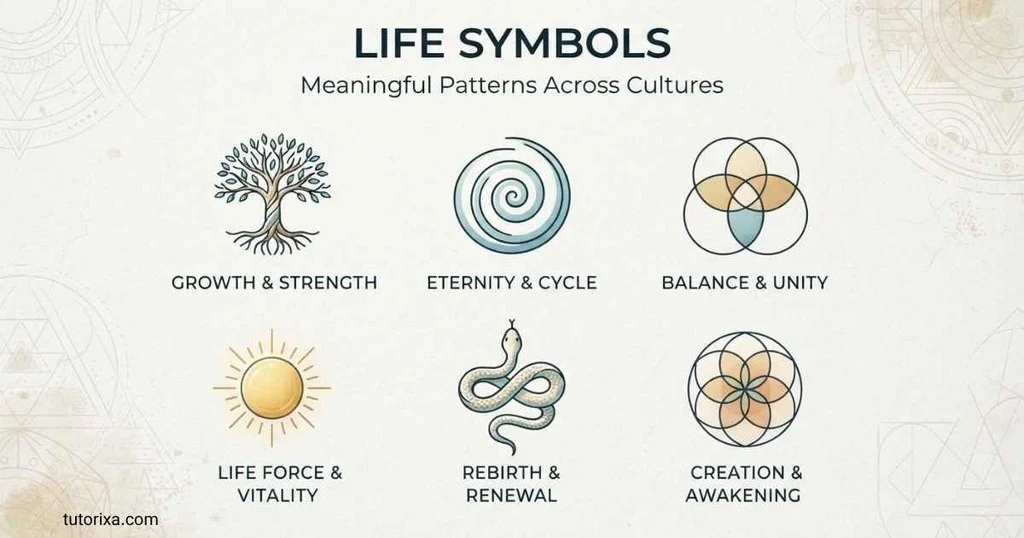
Several symbols are closely related to pattern design because they often appear as repeated motifs or serve as the basic building blocks of larger compositions.
1. Spiral Symbol
A spiral is a curved line that winds around a central point. Depending on its cultural or artistic context, it may suggest movement, cycles, growth, or transformation.
2. Circle Symbol
A circle may represent unity, completeness, cycles, or wholeness in particular traditions. Repeated circles can form chains, floral arrangements, and symmetrical patterns.
3. Triangle Symbol
Triangles can suggest stability, direction, hierarchy, or movement in visual design. Their meaning depends on orientation, surrounding shapes, and cultural context.
4. Celtic Knot Symbol
Celtic knotwork uses interlacing lines and loops. Modern interpretations frequently associate it with continuity or interconnectedness, although the meanings of specific historical examples are not always documented.
5. Mandala Symbol
Mandalas organize shapes around a central point. In particular Hindu and Buddhist traditions, they can serve religious, ritual, or contemplative purposes; decorative mandalas may have no such function.
6. Tessellation Pattern
A tessellation covers a surface using shapes without gaps or overlaps. Unlike a purely symbolic motif, a tessellation has a precise geometric definition.
These related designs illustrate how a simple shape can become part of a larger visual system. To understand any particular symbol, examine both the individual motif and the pattern formed by its repetition.
Frequently Asked Questions About Pattern Symbols
1. What Are Pattern Symbols?
Pattern symbols are shapes, marks, lines, or motifs arranged in recognizable ways, often through repetition. They appear in decorative art, architecture, clothing, mathematics, and digital design. Some communicate established cultural or religious meanings, while others are used mainly to create rhythm, structure, and visual interest.
2. What Do Pattern Symbols Represent?
Pattern symbols can represent continuity, balance, growth, identity, nature, or cultural traditions. Their interpretation depends on the particular design and its context. A spiral may suggest movement or development in modern artwork, while the same shape in another setting may simply be a decorative element.
3. What Are the Most Common Types of Pattern Symbols?
Common types include geometric patterns, floral motifs, spirals, repeating lines, symmetrical arrangements, interlocking knotwork, tessellations, and abstract designs. Each type uses different visual elements and construction methods. Some have documented cultural significance, whereas others are created for practical, mathematical, or decorative purposes.
4. Are Pattern Symbols the Same Across All Cultures?
No. Similar shapes may appear in different societies, but their meanings, uses, and historical associations can differ. A geometric motif may identify a regional craft tradition in one community and serve as decoration elsewhere. Cultural context is essential when interpreting a particular pattern accurately.
5. What Is the Historical Origin of Pattern Symbols?
Pattern-making dates back to prehistoric human art and developed independently across many regions. Archaeological objects show repeated marks and geometric arrangements in early artistic traditions. Individual motifs have different histories, so there is no single origin date or civilization responsible for all pattern symbols.
6. What Is the Difference Between a Pattern and a Symbol?
A pattern is an arrangement of visual elements, often repeated according to a rule. A symbol is a mark, image, or object that represents an idea, identity, or concept. A pattern can contain symbols, but a repeated decorative arrangement does not automatically carry symbolic meaning.
7. Do Pattern Symbols Have Spiritual Meanings?
Some do. Mandalas, certain knotwork designs, and geometric arrangements have spiritual or religious significance in particular traditions. Other patterns are entirely decorative or practical. It is important to distinguish documented religious uses from modern spiritual interpretations that may not reflect the beliefs of the original community.
8. What Do Geometric Patterns Symbolize?
Geometric patterns are often associated with order, symmetry, structure, and balance in visual design. Some traditions also connect them with spiritual or philosophical ideas. However, geometric shapes have no single universal symbolic meaning, and their significance depends on the cultural setting and intended use.
9. Where Can I Find Pattern Symbols for Art and Design?
Pattern symbols appear in textiles, architecture, pottery, decorative objects, graphic design resources, and digital illustration libraries. When using culturally specific motifs, research their origins and any restrictions on reproduction. For technical projects, also check file formats, character support, and licensing requirements.
10. How Can I Identify the Meaning of a Pattern Symbol?
Start by identifying the motif, the object on which it appears, its geographic origin, and its approximate age. Consult museum collections, archaeological publications, cultural institutions, and sources from the relevant community. Compare documented explanations with modern interpretations, and avoid assigning a definitive meaning when reliable evidence is unavailable.
Key Takeaways
- Pattern symbols are repeated shapes, lines, motifs, and arrangements that can communicate ideas or create visual structure.
- Their meanings depend on cultural background, historical period, artistic purpose, and surrounding context.
- Ancient civilizations and communities worldwide developed distinctive pattern-making traditions independently.
- Geometric, floral, spiral, symmetrical, interlocking, and tessellated designs are common pattern types.
- Some patterns have documented religious, spiritual, or cultural significance, while others are primarily decorative.
- Mathematical patterns connect visual design with geometry, symmetry, sequences, and natural structures.
- Pattern symbols appear in textiles, architecture, jewelry, pottery, graphic design, digital media, and everyday objects.
- Similar-looking motifs do not necessarily share the same origin or meaning.
- Modern interpretations should be distinguished from documented historical traditions.
- Reliable interpretation begins with research into the pattern’s origin, purpose, and cultural context.
Conclusion
Pattern symbols reveal how people organize shapes, communicate ideas, preserve traditions, and create visual beauty. From prehistoric markings and ancient geometric borders to modern digital designs, patterns have played an important role in art, architecture, mathematics, and cultural expression.
Their significance extends beyond appearance, but not every design contains a hidden message. Some patterns represent established beliefs or community identities, while others exist to create rhythm, balance, or decoration. Understanding this distinction helps us appreciate both the artistic value and the cultural history of individual motifs.
When exploring pattern symbols and their meanings, consider the shape, repetition, origin, and setting together. This approach provides a clearer understanding of how simple visual elements can develop into distinctive designs that connect history, creativity, and human experience.

I’m Freddie Beaumont, a British author with a passion for discovering what symbols communicate without words. I write about their history, meanings, and everyday uses in an accessible way. I believe symbols tell fascinating stories about people, cultures, and ideas, and my work helps readers recognise and understand those stories more clearly.
Books:
- Symbols and Their Hidden Meanings
- Understanding Signs and Symbols
 Rowan Whitaker
 Ellis Montgomery