
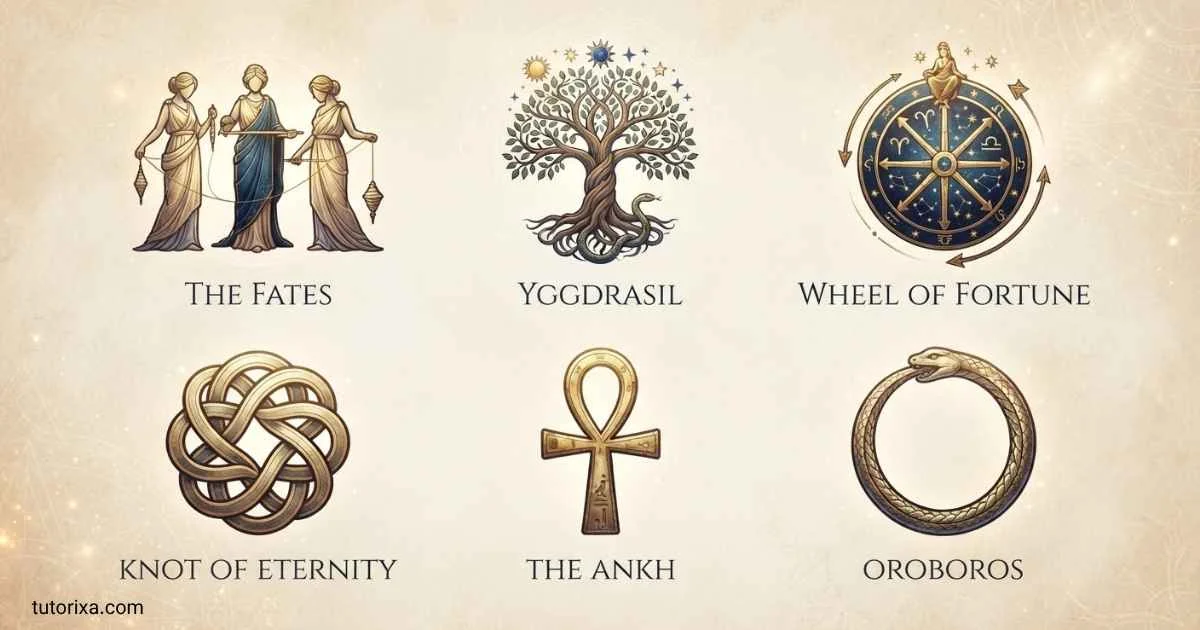
Have you ever wondered whether certain symbols represent destiny, life changes, or the mysterious forces that shape our lives? Throughout history, people have used meaningful signs to express their beliefs about fate, fortune, and the unknown.
When I explore the symbols of fate, I discover fascinating stories from ancient mythology, spiritual traditions, and different cultures. From the Wheel of Fortune to the threads of destiny, these symbols reveal how people have tried to understand life’s unpredictable journey.
In this guide, you will discover the meanings, origins, and cultural significance of powerful fate symbols from around the world. Whether you are curious about ancient beliefs or searching for a symbol that reflects your personal journey, you will find meaningful insights to explore.
Quick Meaning of Symbols of Fate
Symbols of fate represent destiny, predetermined events, life’s interconnected paths, and the forces believed to influence human experiences. Examples include the thread of life, the wheel of fortune, the three Fates of Greek mythology, the Norns of Norse mythology, and the crossroads. Their meanings vary according to cultural traditions, religious beliefs, and personal interpretations.
Symbol Overview Table
| Symbol Name | Primary Meaning | Origin or Association | Common Modern Meaning |
| The Three Fates | Human lifespan and destiny | Ancient Greek mythology | Life’s predetermined course |
| The Norns | Destiny and the passage of time | Norse mythology | Past, present, and future |
| Thread of Life | The continuity of existence | Greek and Roman traditions | Connection and life’s journey |
| Wheel of Fortune | Changing circumstances | Ancient Mediterranean traditions | Luck, cycles, and change |
| Ouroboros | Cycles and renewal | Ancient Egyptian and Greek traditions | Eternal return and transformation |
| Celtic Knot | Interconnection and continuity | Celtic art traditions | Connected lives and enduring bonds |
| Crossroads | Choice and destiny | Multiple cultural traditions | Decisions and new directions |
| Labyrinth | A journey toward understanding | Ancient Greek and other traditions | Life’s complicated path |
| Zodiac Wheel | Cosmic order and cycles | Ancient Babylonian and later traditions | Astrological interpretations of destiny |
| The Eye of Providence | Divine oversight | European Christian artistic tradition | Guidance and watchfulness |
| Ananke | Necessity and inevitability | Ancient Greek mythology | Forces beyond personal control |
| Tyche’s Wheel | Fortune and uncertainty | Greek mythology | Unpredictable life events |
| Fate Runes | Destiny and interpretation | Modern adaptations of historical runic traditions | Reflection and spiritual guidance |
| Knot of Eternity | Continuity and interdependence | Various artistic and religious traditions | Lasting connections |
| Phoenix | Renewal after destruction | Ancient Egyptian and Greek traditions | Rebirth and transformation |
| Hourglass | Time and mortality | Historical timekeeping traditions | The passage of time |
| River | The flow of life | Widespread literary and spiritual imagery | Change and life’s journey |
These symbols do not all have the same historical status. Some belong to documented mythological traditions, while others are visual metaphors associated with fate. Their inclusion reflects the different ways people have expressed ideas about destiny.
What Do Symbols of Fate Mean?
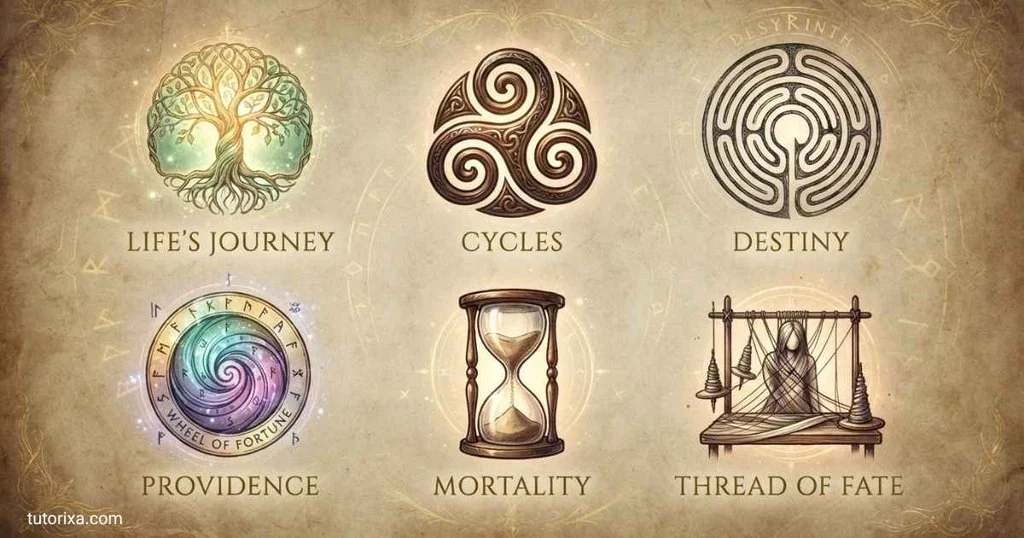
Symbols of fate represent the relationship between human life, time, choices, uncertainty, and forces that people believe shape their future. They help make an abstract idea visible through recognizable images such as threads, wheels, knots, paths, and celestial patterns.
The central meaning depends on the symbol. A thread may represent the length of a life, while a wheel suggests changing circumstances. A crossroads highlights the role of decisions, and an hourglass reminds people that time continues to pass regardless of personal wishes.
1. The Three Fates: Destiny and the Human Lifespan
Mythological association: Ancient Greece
The Three Fates, known as the Moirai, are among the most recognizable representations of destiny in Western mythology. They personify the idea that every human life has a course and limits that cannot always be controlled.
The three figures are Clotho, Lachesis, and Atropos. Clotho spins the thread of life, Lachesis measures or assigns its portion, and Atropos determines its end. Their roles transform the abstract idea of fate into a visual story about birth, experience, and mortality.
The Fates are often represented with spinning tools, measuring rods, thread, or shears. In modern artwork, these objects can symbolize life’s beginning, the decisions and experiences that shape it, and the uncertainty surrounding its conclusion.
2. The Norns: Destiny and the Passage of Time
Mythological association: Norse tradition
The Norns are supernatural figures associated with destiny in Norse mythology. They are traditionally identified as Urðr, Verðandi, and Skuld, names commonly interpreted in relation to what has happened, what is happening, and what is yet to come.
Norse sources connect the Norns with the well of Urðr beneath Yggdrasil, the world tree. Their association with the tree links individual destiny to the wider structure of the cosmos.
The Norns are sometimes compared with the Greek Fates because both traditions connect supernatural female figures with human destiny. However, their stories belong to different mythological systems and should not be treated as identical.
Today, the Norns can symbolize the relationship between past experiences, present circumstances, and future possibilities.
3. The Thread of Life: Connection and Continuity
Mythological association: Greek and Roman traditions
The thread of life represents the course of an individual’s existence. Its imagery comes from the idea that a person’s life can be spun, measured, and eventually brought to an end.
A thread is particularly meaningful because it can be continuous yet fragile. It connects one moment to another while remaining vulnerable to interruption. In this way, the symbol expresses both life’s continuity and its uncertainty.
In contemporary art, a thread can also represent family connections, relationships, personal history, or the unseen links between events. A tangled thread may suggest confusion, while a long, unbroken thread can suggest persistence and continuity.
The thread of life is especially suitable for literature and artwork exploring mortality, memory, and the relationship between individual choices and circumstances beyond personal control.
4. The Wheel of Fortune: Changing Circumstances
Historical association: Classical philosophy and medieval European art
The Wheel of Fortune represents the changing nature of worldly circumstances. It is commonly depicted as a wheel carrying people upward and downward, illustrating how status, prosperity, and influence can change.
The image became especially prominent in medieval European literature and art through the influence of Boethius’s Consolation of Philosophy. Medieval illustrations frequently portrayed Fortue’s wheel as a reminder that earthly success and power are temporary.
Unlike symbols that suggest a fixed destiny, the wheel emphasizes change. A person at the top may descend, while someone at the bottom may rise.
In modern interpretations, the Wheel of Fortune can symbolize unexpected opportunities, changing conditions, luck, and the importance of remaining adaptable when life takes an unexpected direction.
5. The Ouroboros: Eternal Cycles and Renewal
Historical association: Ancient Egyptian and Greek symbolism
The ouroboros is a serpent or dragon depicted eating its own tail, forming a circle. Its circular shape makes it a powerful image of continuity, recurring patterns, and renewal.
The symbol has ancient roots in Egyptian imagery and later appears in Greek-associated alchemical traditions. Its meanings developed across different historical settings rather than remaining fixed to one interpretation.
In relation to fate, the ouroboros can represent recurring experiences, the relationship between endings and beginnings, and the possibility that life follows cycles rather than a straight line.
Modern artwork often uses it to express personal transformation, repeating family patterns, or the sense that one stage of life prepares the way for another. It does not necessarily mean that every event is predetermined; it may simply represent the recurring nature of experience.
6. The Celtic Knot: Interconnected Lives
Historical association: Celtic and Insular art
Celtic knotwork uses interlacing lines to create intricate patterns. Some designs form continuous loops without an obvious beginning or end, making them natural visual expressions of continuity and connection.
Interlaced patterns appear in early medieval manuscripts, metalwork, stone crosses, and other forms of Insular art. However, not every Celtic knot has a documented ancient meaning related specifically to fate.
Modern interpretations often associate these patterns with eternity, relationships, family bonds, and the interconnectedness of life. A knot may suggest that one experience influences another, even when the relationship is not immediately apparent.
When used as a symbol of fate, Celtic knotwork generally represents the connections between people and events rather than a specific prediction about the future.
7. The Crossroads: Choice and Destiny
Cultural association: Greek mythology and numerous literary traditions
A crossroads represents a point where different paths meet and a decision becomes necessary. It is a widely understood metaphor for the moments when a person’s choices may influence the direction of their life.
In ancient Greek religion, Hecate was associated with crossroads, boundaries, and certain forms of ritual practice. The significance of crossroads also appears in other cultural traditions, although the associated beliefs differ.
In modern symbolism, a crossroads may represent a career decision, a relationship change, a move to another place, or a transition between stages of life.
The image offers an important distinction between fate and free will. It can suggest that circumstances create a particular situation while the individual still has decisions to make within it.
8. The Labyrinth: A Complicated Journey
Mythological association: Ancient Greek tradition
The labyrinth represents a difficult journey through uncertainty toward an important destination. Its winding paths make progress appear indirect, suggesting that understanding often develops through experience rather than through a simple, predictable route.
The best-known classical association is the labyrinth of Greek mythology connected with King Minos, the Minotaur, and the hero Theseus.
As a symbol of fate, a labyrinth may represent the twists and turns of life. A person might understand the meaning of a decision only after experiencing its consequences.
Unlike a straight road, a labyrinth does not provide an immediately obvious route forward. It can therefore symbolize patience, self-discovery, perseverance, and the challenge of navigating circumstances that cannot be fully understood in advance.
9. The Zodiac Wheel: Cosmic Cycles and Destiny
Historical association: Babylonian astronomy and later astrology
The zodiac wheel divides the ecliptic, the apparent annual path of the Sun across the sky, into twelve signs in the familiar Western astrological system. Its circular arrangement connects celestial movement with recurring patterns of time.
Babylonian astronomical traditions contributed to the development of the zodiac, while Greek and later cultures developed different astrological systems and interpretations.
In astrology, some people interpret planetary positions and zodiac signs as meaningful in relation to personality, timing, and life experiences. These interpretations are cultural or spiritual beliefs, not scientifically established methods for predicting an individual’s destiny.
As a symbol of fate, the zodiac wheel can represent the desire to understand life’s events through a larger cosmic pattern. It may also serve as a personal reminder of cycles, seasons, and the passage of time.
10. The Eye of Providence: Divine Oversight
Historical association: European Christian art
The Eye of Providence is an eye, often enclosed within a triangle and sometimes surrounded by rays of light. In European Christian artistic traditions, it has been used to represent God’s watchfulness and divine providence.
Providence refers to the belief that divine wisdom or care guides or oversees events. This idea differs from fate understood as an impersonal, unchangeable force.
The eye is familiar from religious artwork and from the reverse of the Great Seal of the United States, where it appears above a pyramid. Its appearance in that setting has a documented historical and civic context, separate from many later popular interpretations.
As a symbol connected to destiny, the Eye of Providence may express faith that events occur within a larger divine order. Its exact meaning depends on the religious, historical, or artistic context.
11. Ananke: Necessity and Inevitability
Mythological association: Ancient Greece
Ananke personifies necessity in Greek mythology and philosophical thought. Her symbolism concerns the limits imposed by conditions that cannot easily be changed, including the fundamental order of existence.
Ananke is sometimes connected with the cosmic order and with ideas about fate, time, and the structure of the universe. Particular accounts vary, so there is no single universally accepted image that serves as her symbol.
In modern interpretations, Ananke can represent unavoidable circumstances, natural limitations, and the difference between what people wish to happen and what circumstances permit.
Her association with fate encourages reflection on the boundaries of personal control. It does not mean that every aspect of life is necessarily fixed or that individual actions have no consequences.
12. Tyche’s Wheel: Fortune and Uncertainty
Mythological association: Ancient Greece
Tyche was a Greek personification or goddess associated with fortune and the fortunes of cities and individuals. She was often represented with attributes such as a rudder, a cornucopia, or a mural crown, depending on the artistic tradition.
The wheel associated with fortune is a related image, but it is important not to assume that every historical Wheel of Fortune depiction specifically represents Tyche.
Together, these images express the uncertainty of prosperity, opportunity, and changing circumstances. A person’s situation may improve or deteriorate through a combination of decisions, external events, and conditions beyond their control.
Today, Tyche-related imagery may symbolize luck, unpredictability, and the recognition that success is not always entirely within an individual’s control.
13. Fate Runes: Reflection and Interpretation
Historical association: Germanic writing systems and modern spiritual practices
Runes were characters used in historical Germanic writing systems. Archaeological inscriptions show that they served practical purposes, including recording names, messages, and commemorative statements.
Modern rune readings sometimes use rune symbols for divination, personal reflection, or spiritual guidance. These contemporary practices should be distinguished from what historical evidence establishes about the original uses of runic writing.
When associated with fate today, runes may represent the search for meaning, the interpretation of uncertainty, or the desire to reflect on possible choices.
There is no single ancient runic symbol universally accepted as the symbol of fate. Meanings assigned to individual runes can vary across modern systems, and predictive interpretations are matters of belief rather than verified knowledge about the future.
14. The Knot of Eternity: Enduring Connections
Religious and artistic association: Several Asian and other traditions
The term knot of eternity is sometimes used broadly for intricate patterns that have no obvious beginning or end. However, particular knot designs have distinct histories and should not automatically be treated as the same symbol.
The Buddhist Endless Knot, for example, is one of the Eight Auspicious Symbols in Tibetan Buddhist traditions. It is commonly associated with interdependence, continuity, and the interconnected nature of phenomena.
When connected with fate, a continuous knot may suggest that actions and circumstances influence one another in ways that are not always immediately visible.
This symbolism can encourage reflection on relationships and consequences. It does not necessarily communicate that every event has been predetermined; in Buddhist contexts, interconnectedness is a more precise concept than a fixed personal destiny.
15. The Phoenix: Renewal and Transformation
Mythological association: Ancient Egyptian and Greek traditions
The phoenix is a legendary bird associated in later traditions with renewal, death, and rebirth. Accounts of the bird vary, and its history includes connections with ancient Egyptian and Greek ideas about sacred birds and recurring life.
In modern symbolism, the phoenix commonly represents recovery, transformation, and the beginning of a new chapter after a difficult period.
Although the phoenix is not primarily a symbol of predetermined fate, it can be used to express the belief that life’s direction may change through experience. Its symbolism emphasizes renewal rather than inevitability.
The phoenix is especially common in literature, jewelry, tattoos, and visual art depicting personal growth or the ability to begin again after major change.
16. The Hourglass: Time and Mortality
Historical association: Timekeeping and European symbolic art
The hourglass represents the passage of time through sand moving from one chamber to another. Because the amount of sand is limited, the object also serves as a reminder that a particular interval will eventually end.
Hourglasses became familiar tools for measuring periods of time, although their exact origins and early history are not fully established.
In art and literature, the hourglass can represent mortality, urgency, aging, and the temporary nature of worldly circumstances. When combined with wings or a skull in historical art, it may reinforce themes about the passage of life.
As a symbol of fate, the hourglass emphasizes that time continues to move forward. It can encourage people to consider how they use their time without claiming to reveal how long any individual will live.
17. The River: The Flow of Life
Symbolic association: Literature, philosophy, and spiritual traditions
A river is a widespread metaphor for life’s movement, change, and uncertainty. Its water continues to flow while its surroundings, depth, and direction may vary.
Rivers have practical and spiritual significance in many civilizations. They have supported agriculture, settlements, trade, travel, and religious rituals. Their changing waters have also made them useful metaphors for time and the human experience.
As a symbol of fate, a river can represent the circumstances into which a person is born, the experiences that shape a life, and the movement toward an unknown future.
Unlike a rigid path, a river may branch, change course, or encounter obstacles. This makes it a flexible symbol for the relationship between external conditions and the ways people respond to them.
History and Origin of Fate Symbols
Symbols of fate developed in different societies as people tried to understand birth, death, time, fortune, and the apparent order of events. Rather than emerging from one common source, these symbols reflect distinct mythologies, religious beliefs, philosophical systems, and artistic traditions.
Ancient Greek Civilization
Ancient Greek mythology developed a particularly detailed representation of fate through the Moirai. Their story transformed destiny into a process that could be pictured through spinning, measuring, and cutting a thread.
Greek literature also explored whether gods and humans could escape destiny. Different authors presented different relationships between divine authority, necessity, personal decisions, and unavoidable outcomes.
The Greek concepts of Tyche and Ananke added other dimensions to these ideas. Tyche represented fortune and changing circumstances, while Ananke represented necessity. Together, they illustrate that ancient discussions of fate included both unpredictability and constraint.
Ancient Rome
Roman culture developed its own traditions associated with destiny. The Parcae were linked to the Greek Moirai, and Roman writers used ideas about fortune, necessity, and the limits of human control in poetry and philosophical writing.
Fortuna, the Roman goddess of fortune, became especially important in the visual language of luck and changing circumstances. Her wheel later became a widely recognized image of the rise and fall of human fortunes in European literature and art.
Norse Civilization
Norse mythology presented destiny through the Norns and their association with Yggdrasil, the world tree. Their presence connected individual lives with a much larger cosmic structure.
The Norns’ stories appear in Old Norse literary sources, including accounts of the world’s origins and eventual destruction. Their mythology emphasizes that even powerful gods exist within a world shaped by destiny and the passage of time.
Medieval Europe
During the Middle Ages, the Wheel of Fortune became a familiar image in manuscripts, literature, and religious instruction. Writers used it to illustrate how worldly power and wealth could change unexpectedly.
The image often showed people rising toward power before descending again. Its lesson was not simply that fate exists, but that status and prosperity are temporary and should not be mistaken for permanent security.
Themes & Motifs
+1
Modern Interpretations
Today, fate symbols appear in tattoos, fantasy literature, films, jewelry, personal artwork, and spiritual practices. Their meanings frequently combine historical traditions with modern ideas about identity, resilience, self-discovery, and personal choice.
This evolution explains why the same image can carry different meanings for different people. A thread may evoke ancient mythology for one person and family connections for another.
Symbolism and Interpretation of Fate
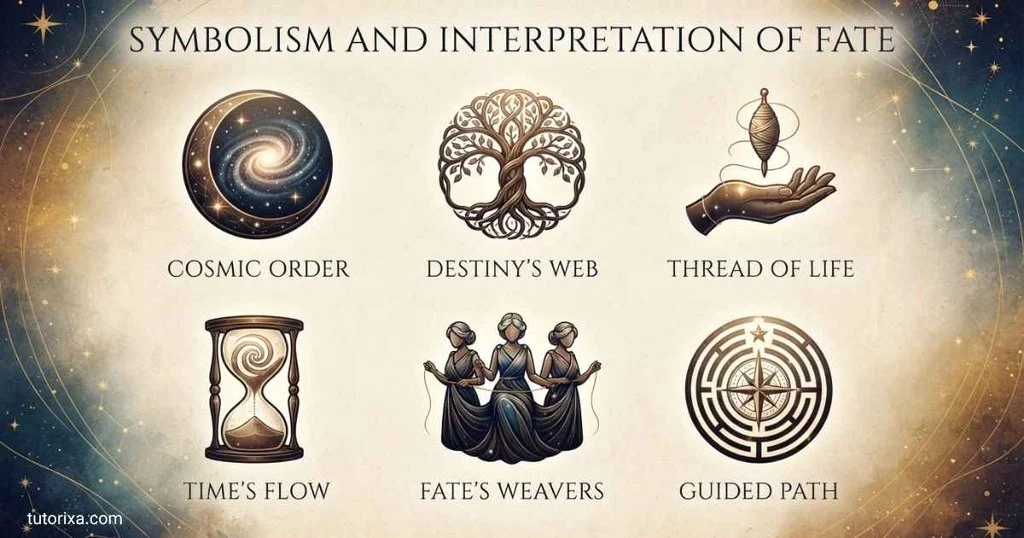
Symbols of fate communicate several related ideas, but their interpretations are not interchangeable.
Destiny and Predetermination
Some symbols suggest that events follow a course established beyond an individual’s control. The Three Fates and the Norns are clear mythological examples because their stories directly concern destiny.
Change and Uncertainty
The Wheel of Fortune expresses how circumstances can shift. Its circular movement illustrates the possibility of rising and falling rather than following a predictable, straight line.
The hourglass offers a related but different message: time passes continuously, and opportunities may be limited by its passage.
Connection and Interdependence
Threads, knots, and rivers can represent relationships between events, people, and experiences. These images suggest that life is made up of connections rather than isolated moments.
Interconnection, however, does not necessarily mean predestination. A relationship between events does not prove that one predetermined future must occur.
Positive Interpretations
Depending on the context, fate symbols may express:
- Trust in a larger order or purpose.
- Acceptance of circumstances that cannot be changed.
- Hope for renewal and transformation.
- Recognition that difficult periods may eventually pass.
- Appreciation for relationships and meaningful experiences.
- Awareness of how choices influence future possibilities.
Negative Interpretations
Some symbols can also suggest powerlessness, uncertainty, mortality, or fear of the unknown. The cut thread, descending wheel, and nearly empty hourglass may evoke the limits of human control.
These interpretations are not universal. An image associated with inevitability in one setting might represent peace, acceptance, or freedom from uncertainty in another.
Psychological Interpretation
From a psychological perspective, fate symbols can help people organize their thoughts about uncertain events. A labyrinth may provide a metaphor for navigating a difficult decision, while a crossroads can represent competing options.
Using a symbol to reflect on life does not establish that the symbol predicts the future. Its value may lie in the questions it encourages people to consider about their experiences, priorities, and decisions.
Cultural Significance of Fate Symbols
Different cultures have developed distinctive ways to express destiny. Comparing these traditions helps explain why no single symbol represents fate universally.
Greek and Roman Traditions
Greek and Roman mythology personified destiny and fortune through divine figures. The Moirai, Parcae, Tyche, and Fortuna helped explain the limits of human control and the instability of worldly circumstances.
The thread and wheel remain influential images in Western art and storytelling because they offer clear visual explanations of complex ideas.
Norse Traditions
Norse mythology connects the Norns with the world tree and the structure of the cosmos. Their stories explore the relationship between individual destiny, time, and the eventual fate of gods and the world.
The emphasis is not identical to the Greek thread-of-life imagery, even though both traditions contain figures associated with destiny.
Celtic Artistic Traditions
Interlacing patterns in Celtic and Insular art have become associated in modern culture with eternity, continuity, and interconnectedness. Their historical uses are varied, however, and a particular knot should not automatically be described as an ancient Celtic symbol of fate.
South and East Asian Traditions
In Hindu philosophical and religious traditions, karma concerns the relationship between actions and their consequences. The concept is complex and differs among Hindu schools and other South Asian religious traditions.
Buddhist traditions also discuss karma, dependent origination, and the conditions that shape experience. These ideas should not be reduced to a simple belief that everything is predetermined.
The Buddhist Endless Knot, particularly in Tibetan Buddhist contexts, expresses interconnectedness and continuity. It can relate to reflection on the consequences of actions without serving as a universal emblem of fixed destiny.
Middle Eastern Traditions
Ideas about divine decree, human responsibility, and destiny appear in several Middle Eastern religious and philosophical traditions. Their interpretations differ across communities, schools of thought, and historical periods.
The Arabic term qadar, for example, is associated with divine decree or determination in Islamic theology. However, there is no single visual symbol that universally represents this concept throughout Islam.
This distinction matters because a religious belief about destiny should not automatically be assigned an unrelated decorative symbol.
Modern Western Culture
In contemporary Western culture, fate symbols frequently appear in fantasy stories, films, games, jewelry, and tattoos. The Three Fates, zodiac wheel, hourglass, and ouroboros are especially adaptable because their imagery is visually recognizable.
Modern interpretations often emphasize personal transformation and the search for meaning, even when the original historical source focused on divine authority or unavoidable destiny.
Religious and Spiritual Meaning of Fate Symbols
Fate symbols can represent divine guidance, cosmic order, moral responsibility, or the uncertainty of human life. Their significance depends on the particular religion or spiritual tradition.
In Greek mythology, the Moirai personify the allocation and limits of human life. In Norse mythology, the Norns connect destiny with the world tree and the wider cosmic order.
In Buddhist traditions, the Endless Knot is associated with interconnectedness, continuity, and the relationship between causes and conditions. It should not be interpreted as proof that every event in an individual’s life is predetermined.
In Christianity, the Eye of Providence can represent God’s watchfulness and providential care. Christian theological traditions differ in how they understand divine foreknowledge, human freedom, and predestination.
Islamic discussions of qadar similarly involve questions about divine knowledge, decree, and human responsibility. The subject has been interpreted in different ways within Islamic theology.
These examples show that spiritual beliefs about destiny cannot be reduced to one universal meaning. A symbol’s significance depends on the teachings, practices, and history of the tradition in which it appears.
Where Are Symbols of Fate Used Today?
Symbols of fate appear in everyday objects, creative works, spiritual settings, and personal expressions. Their modern uses often emphasize identity and reflection rather than literal predictions about future events.
Tattoos and Jewelry
Fate symbols are popular in tattoos and jewelry because they can communicate complex ideas through simple visual designs.
- Thread of life: Represents continuity, relationships, or the fragility of life.
- Ouroboros: Suggests cycles, renewal, or recurring experiences.
- Celtic knot: Expresses enduring connections and continuity.
- Hourglass: Reminds the wearer of time and mortality.
- Crossroads: Represents a turning point or important life decision.
- Phoenix: Symbolizes renewal and personal transformation.
The meaning of a tattoo or piece of jewelry is ultimately personal. A design’s historical meaning may differ from the meaning its wearer intends.
Literature and Poetry
Writers use fate symbols to explore questions about free will, responsibility, uncertainty, and mortality.
The Three Fates are useful in stories where characters confront unavoidable outcomes. The labyrinth can represent a complicated personal journey, while the Wheel of Fortune can illustrate a sudden change in circumstances.
These symbols help writers express abstract ideas without explaining every detail directly.
Art and Illustration
Artists use threads, wheels, hourglasses, and celestial patterns to create visual representations of destiny. A broken thread might communicate interruption, while a winding path may suggest uncertainty.
The surrounding details influence the interpretation. For example, an hourglass paired with flowers may suggest the relationship between beauty and the passage of time, while the same hourglass in a dark setting may emphasize mortality.
Spiritual Reflection
Some people use symbolic images as prompts for meditation, journaling, or personal reflection. A crossroads may encourage consideration of available choices, while a river can serve as a reminder that circumstances change.
These practices can provide a framework for thinking about experiences, but symbols themselves do not establish what will happen in the future.
Films, Games, and Digital Media
Fantasy films, role-playing games, and digital artwork frequently use runes, spinning wheels, labyrinths, and mythological figures to suggest hidden knowledge or supernatural forces.
Creators may adapt older symbols or invent new ones. Consequently, a symbol’s meaning in a modern fictional universe may differ significantly from its historical or religious meaning.
Common Variations of Fate Symbols
Fate symbols vary in appearance, cultural association, and intended meaning. Understanding these differences helps prevent confusion.
| Symbol Variation | Common Interpretation | Important Distinction |
| Single thread | Life’s continuity | Often more personal than mythological |
| Three women with thread | Destiny and the human lifespan | May refer specifically to the Greek Fates |
| Spinning wheel | Creation or continuation of life | Context determines its exact meaning |
| Circular serpent | Renewal and recurring cycles | Commonly associated with the ouroboros |
| Interwoven knot | Connection and continuity | Not every knot has a documented fate meaning |
| Turning wheel | Changing fortune | May relate to Fortuna or broader ideas of luck |
| Crossroads | Choice and uncertainty | Emphasizes decisions more than predetermination |
| Celestial wheel | Cosmic order or astrological interpretation | Beliefs about destiny vary |
| Hourglass | Time and mortality | Does not indicate a person’s actual lifespan |
| Winding path | Life’s journey | A general metaphor rather than a specific religious symbol |
Ancient Versus Modern Designs
Historical depictions often followed recognizable artistic conventions. The Three Fates, for example, were identified through their mythological roles and associated objects.
Modern designs may combine different traditions, such as placing an ouroboros around a zodiac wheel or incorporating a Celtic-style knot into a thread-of-life illustration.
Such combinations can be meaningful artistic creations, but they should not automatically be presented as ancient symbols with established historical origins.
Common Misconceptions About Symbols of Fate
Several misunderstandings arise when modern interpretations are confused with historical evidence.
Misconception 1: Every Fate Symbol Predicts the Future
A symbol associated with destiny does not necessarily function as a prediction. The Norns and the Greek Fates belong to mythological narratives, while the hourglass and crossroads are often used as metaphors.
Their meaning depends on context rather than an ability to reveal future events.
Misconception 2: Fate and Luck Mean the Same Thing
Fate generally concerns destiny or the course of events, while luck usually refers to favorable or unfavorable circumstances that may appear unpredictable.
The Wheel of Fortune connects these ideas, but it can communicate changing circumstances without suggesting that every outcome is predetermined.
Misconception 3: All Celtic Knots Are Ancient Symbols of Destiny
Celtic knotwork is a broad category of interlaced artistic patterns. Although modern interpretations frequently associate these patterns with eternity and interconnectedness, a universal ancient meaning specifically connected to fate cannot be assumed.
Misconception 4: All Cultures Share One Belief About Destiny
Different philosophical and religious traditions understand fate, divine decree, karma, fortune, and free will in different ways.
The Greek Fates, Norse Norns, Buddhist Endless Knot, and Christian Eye of Providence belong to distinct contexts. Treating them as interchangeable removes important historical and religious differences.
Misconception 5: A Symbol’s Modern Meaning Must Be Its Original Meaning
A symbol can acquire new interpretations as it moves between cultures and historical periods. The modern association of an image with personal growth or destiny may not match its earliest documented use.
For accurate interpretation, consider the source, historical period, cultural setting, and intended use.
10 Interesting Facts About Symbols of Fate
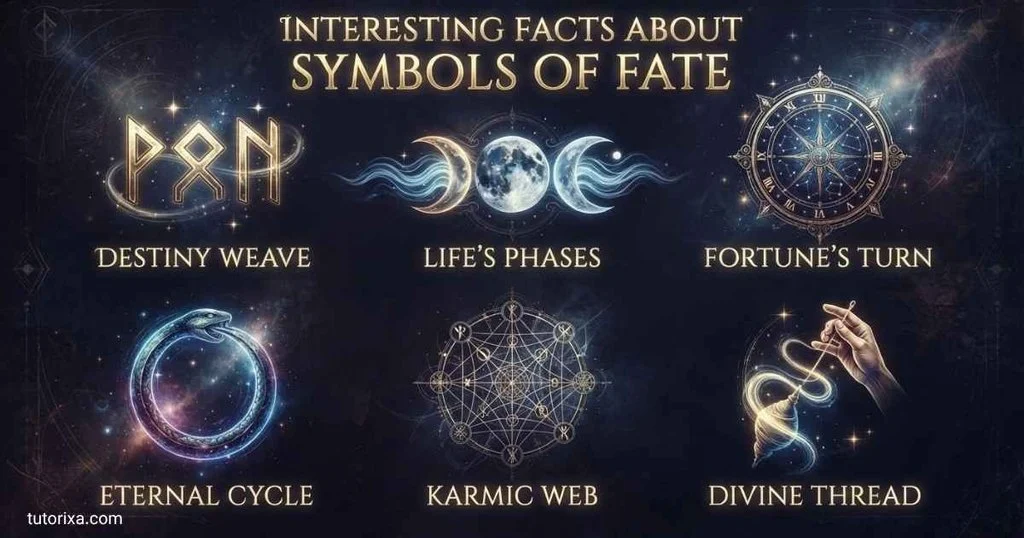
1. The Greek Fates had different responsibilities. Clotho spun the thread of life, Lachesis measured or allotted it, and Atropos determined its end. Their individual roles make the thread a structured metaphor for human existence.
2. The Norns were associated with a world tree. Their connection with Yggdrasil placed human destiny within a much larger mythological universe, linking individual lives to cosmic order.
3. Fortune’s wheel became an important medieval image. Medieval writers and artists used the wheel to show how worldly power could rise and fall, making it a lesson about the temporary nature of success.
4. Fate and free will have long been debated together. Philosophers and religious thinkers have asked whether human choices can coexist with predetermined events or divine knowledge. The debate is much older than modern discussions of personal agency.
5. A thread can communicate both continuity and fragility. Its connected length suggests an ongoing life, but its vulnerability to breaking makes it an effective image for mortality and uncertainty.
6. The ouroboros has more than one historical association. Its appearance in ancient Egyptian imagery and later alchemical traditions shows how a symbol can travel between cultures and acquire additional meanings.
7. The Endless Knot has a specific Buddhist context. In Tibetan Buddhist traditions, it is one of the Eight Auspicious Symbols and is associated with interconnectedness and continuity rather than a universal prediction of destiny.
8. Runes originally served as writing characters. Their use in modern divination is distinct from their historical role in Germanic writing systems. This distinction helps separate archaeological evidence from contemporary spiritual interpretation.
9. The hourglass is both practical and symbolic. It measures time through a physical process, while its limited quantity of sand has made it a useful image for mortality and the temporary nature of life.
10. Not every symbol of fate is ancient. Some modern designs combine older motifs or create new visual representations of destiny. Their contemporary meaning can be valid as personal expression without being an established historical tradition.
Related Symbols and Their Meanings
Symbols of fate overlap with other symbols associated with time, transformation, spirituality, and human experience. These related images can help clarify what makes each symbol distinctive.
| Related Symbol | Primary Meaning | Relationship to Fate |
| Infinity Symbol | Endless continuation | Suggests continuity without necessarily implying destiny |
| Yin-Yang | Complementary forces and balance | Expresses relationships between opposing but connected aspects |
| Tree of Life | Growth, connection, and existence | Connects individual life with a larger structure |
| Compass | Direction and navigation | Represents guidance when choosing a path |
| Star | Guidance, hope, or aspiration | May symbolize direction or a sense of purpose |
| Butterfly | Change and transformation | Represents transitions and personal development |
| Spiral | Growth and recurring movement | Suggests development through cycles |
| Sun and Moon | Cycles, contrast, and time | Reflects recurring natural patterns |
| Lotus | Purity, growth, and spiritual development | Represents transformation in several Asian traditions |
| Hourglass | Time and mortality | Emphasizes the passage and limits of time |
The main difference is that a symbol of fate directly addresses destiny, inevitability, or the direction of events, whereas related symbols may focus on guidance, renewal, balance, or continuity.
For example, the compass represents finding direction rather than determining a person’s future. The infinity symbol suggests endless continuation, while the thread of life more directly represents the course and limits of an individual existence.
Frequently Asked Questions About Symbols of Fate
1. What Is the Most Recognized Symbol of Fate?
The Three Fates from Greek mythology are among the most recognizable representations of fate in Western cultural traditions. Clotho, Lachesis, and Atropos represent different stages in the course of human life through the imagery of spinning, measuring, and cutting a thread. Their story makes destiny visible through a simple, memorable metaphor.
2. What Symbol Represents Destiny and Fate?
The thread of life is a widely recognized symbol of destiny because it represents the course of a person’s existence. Other symbols include the Greek Fates, Norse Norns, and Wheel of Fortune. Each expresses a different aspect of destiny, from the limits of human life to changing circumstances and uncertainty.
3. What Is the Norse Symbol of Fate?
In Norse mythology, the Norns are figures associated with destiny and the passage of time. They are connected with Yggdrasil, the world tree, and are traditionally identified as Urðr, Verðandi, and Skuld. Their significance comes from Norse mythological narratives rather than from one universally established graphic symbol.
4. What Does the Thread of Life Symbolize?
The thread of life symbolizes the continuity, course, and limits of human existence. In Greek mythology, the Three Fates use thread to represent the beginning, allotted course, and end of a person’s life. Modern interpretations may also associate thread imagery with family connections, relationships, memory, and the consequences of personal experiences.
5. What Does the Wheel of Fortune Mean as a Fate Symbol?
The Wheel of Fortune represents the changing nature of circumstances, particularly the rise and fall of prosperity, status, and influence. Its circular movement illustrates that situations can change unexpectedly. In medieval European art, the wheel often reminded viewers that worldly success is temporary and should not be mistaken for permanent security.
6. What Symbol Represents Free Will and Fate Together?
The crossroads is a useful symbol for exploring the relationship between fate and free will. It represents a situation in which circumstances bring someone to a decision point, while the available paths suggest different possibilities. The image does not prove that choices determine every outcome, but it clearly expresses the tension between circumstances and personal agency.
7. Is the Ouroboros a Symbol of Fate?
The ouroboros, a serpent or dragon eating its own tail, is primarily associated with cycles, continuity, and renewal. It can be interpreted as a symbol of fate when its circular form represents recurring experiences or the relationship between beginnings and endings. However, its historical meanings vary, and it is not exclusively a symbol of destiny.
8. What Symbol Represents the Passage of Time and Destiny?
The hourglass is commonly associated with the passage of time, mortality, and the temporary nature of human circumstances. When interpreted in relation to destiny, it emphasizes that life unfolds within the limits of time. Unlike the Greek Fates, however, the hourglass does not directly represent a supernatural power determining an individual’s future.
9. Are Symbols of Fate the Same Across All Cultures?
No. Symbols of fate vary across cultures because societies have developed different mythologies, religious teachings, and philosophical ideas about destiny. The Greek Fates, Norse Norns, Buddhist Endless Knot, and Christian Eye of Providence have distinct histories and meanings. Some share broad themes, but they should not be treated as interchangeable symbols.
10. Can Symbols of Fate Predict the Future?
Symbols of fate do not provide scientifically established predictions about future events. Some spiritual traditions use symbols in divination or personal reflection, while literature and artwork use them as metaphors for uncertainty, destiny, and change. Their meanings can help people explore beliefs and experiences, but they should not be confused with verified forecasts.
Key Takeaways
- Symbols of fate represent destiny, uncertainty, time, inevitability, and the relationship between choices and circumstances.
- The Greek Three Fates symbolize the course and limits of human life through the thread of life.
- The Norse Norns connect destiny with the passage of time and the cosmic structure represented by Yggdrasil.
- The Wheel of Fortune represents changing circumstances and the temporary nature of worldly success.
- The ouroboros, Celtic knot, and Endless Knot can express continuity, renewal, and interconnectedness, although their histories and meanings differ.
- The crossroads represents important decisions and the relationship between external circumstances and personal agency.
- The hourglass symbolizes time, mortality, and the limited duration of human experiences.
- Religious traditions have different understandings of destiny, divine providence, karma, and human responsibility.
- Modern tattoos, jewelry, literature, and artwork frequently adapt traditional fate imagery to express personal meaning.
- Symbolic interpretations are not universal facts or scientifically established predictions of future events.
Conclusion
Symbols of fate offer different ways to understand destiny, life’s uncertainty, the passage of time, and the relationship between circumstances and personal choices. From the thread of life in Greek mythology to the Norns of Norse tradition, these images show how societies have explored questions about existence, mortality, and the future.
The Wheel of Fortune reminds us that circumstances can change, while the crossroads represents moments when decisions matter. The ouroboros expresses recurring cycles, and the hourglass highlights the importance of time. Each symbol provides a different perspective on the human experience.
Understanding the history and cultural context behind these images makes their meanings more valuable. Whether encountered in mythology, religious art, literature, jewelry, or tattoos, symbols of fate can encourage thoughtful reflection on life’s uncertainties without suggesting that every event is predetermined.
Ultimately, their enduring appeal comes from a shared human interest in understanding where life leads, how experiences connect, and what remains beyond our control.

I’m Ellis Montgomery, a British writer interested in the powerful language of symbols. I explore everything from traditional emblems and cultural signs to contemporary symbols found in modern life. My aim is to explain their meanings clearly while revealing the stories and ideas behind them, making symbolism fascinating and accessible to everyone.
Books:
- The Complete Book of Symbols
- Hidden Messages in Everyday Symbols
 Rowan Whitaker