
When you see brackets in writing, math, or coding, I know they can sometimes look confusing. You may recognize the symbols but still wonder what each type means and when you should use it.
I created this guide to make bracket symbols simple and practical. You’ll discover the different types, their names, meanings, and common uses with easy examples you can understand quickly.
Whether you’re a student, writer, designer, or beginner learning symbols, I’ll help you understand brackets with confidence. You’ll also learn how these small symbols can make information clearer, more organized, and easier to read.
Quick Meaning of Bracket Symbols
Bracket symbols are paired punctuation or delimiter marks that enclose information and show its relationship to surrounding content. Common types include parentheses ( ), square brackets [ ], curly braces { }, and angle brackets < >. Their exact function varies by discipline, with uses ranging from editorial comments and mathematical grouping to sets, programming blocks, and markup languages.
Bracket Symbols Overview
| Field | Details |
| Symbol Name | Bracket symbols |
| Primary Meaning | Enclosure, grouping, separation, or delimitation |
| Main Categories | Parentheses, square brackets, curly braces, angle brackets |
| Category | Punctuation, delimiters, mathematical notation, technical symbols |
| Origin | Developed through the historical evolution of written punctuation and typography |
| Common Usage | Writing, mathematics, linguistics, programming, publishing |
| Modern Meaning | Organizing or enclosing information according to context |
| ASCII Characters | ( ), [ ], { }, < > |
| Unicode Examples | U+005B [, U+005D ], U+007B {, U+007D } |
| Related Symbols | Parentheses, braces, chevrons, quotation marks, delimiters |
| Emoji Equivalent | No universal emoji equivalent |
Unicode identifies square brackets as U+005B LEFT SQUARE BRACKET and U+005D RIGHT SQUARE BRACKET, while curly brackets are U+007B LEFT CURLY BRACKET and U+007D RIGHT CURLY BRACKET. Unicode also includes many specialized bracket characters beyond the familiar keyboard forms.
What Do Bracket Symbols Mean?
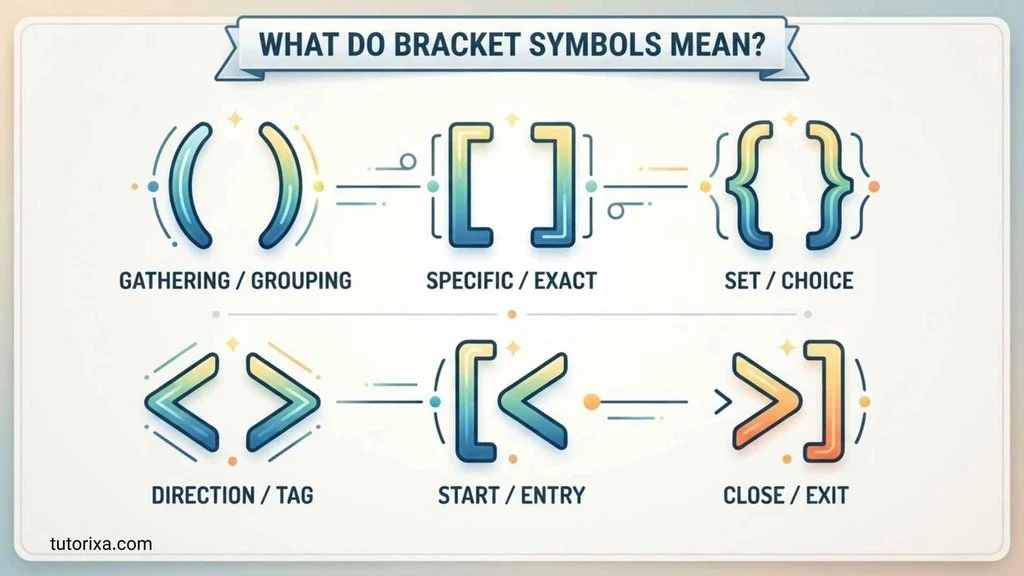
Bracket symbols generally mean “the material inside these marks should be treated as a related or separate unit.” However, the precise meaning changes according to the type of bracket and the field in which it appears.
Parentheses: ( )
Parentheses are also called round brackets in some varieties of English. They commonly add supplementary information without making it part of the main grammatical structure.
Example:
The meeting begins at 9:00 a.m. (local time).
In mathematics, parentheses can group operations:
5 × (2 + 3)
They can also represent function arguments:
f(x)
In this sense, parentheses often signal grouping, qualification, or additional information.
Square Brackets: [ ]
Square brackets frequently indicate material inserted into an existing quotation or text.
Example:
“She [the researcher] published the results.”
They are also common in mathematics, where they can group expressions, represent closed interval endpoints, or appear in specialized notation.
In editing, square brackets can therefore distinguish an editor’s addition from the original wording.
Curly Braces: { }
Curly braces are often called braces or curly brackets. Their strongest association is with mathematics and programming.
In set notation:
{1, 2, 3, 4}
The braces show that the listed elements belong to one set. In programming, braces commonly mark a block of statements.
For example, many programming languages use a structure conceptually similar to:
{ statements }
Braces can also organize cases in mathematical expressions.
Angle Brackets: < >
Angle brackets have several specialized functions. In mathematics, they can represent concepts such as inner products or other paired relationships. In computing, < and > are important comparison operators and are also associated with markup languages.
For example:
x < y
means that x is less than y.
In HTML, angle brackets surround element names:
<p>
Special Unicode angle brackets, such as 〈 〉, are distinct characters from the ordinary keyboard symbols < and >.
History and Origin of Bracket Symbols
Bracket symbols did not appear as one unified system at a single moment. Their history is connected to the broader development of punctuation, manuscript culture, printing, mathematics, and typography.
Early writing systems often relied much less on punctuation than modern readers expect. Ancient Greek writing, for example, originally used limited visual punctuation, while later developments introduced marks that helped readers understand pauses and structure. The history of punctuation therefore reflects a continuing effort to make written language easier to interpret.
As manuscript and printing practices developed, paired marks became increasingly useful for separating material from the main text. Printers needed consistent characters that could be reproduced alongside letters and other punctuation.
The English word bracket has its own history. Merriam-Webster records its first known English use as a noun in 1574, although the marks themselves and related forms have older histories in writing and typography.
Over subsequent centuries, different bracket forms became associated with different functions. Parentheses became common for supplementary material and grouping. Square brackets became useful for editorial interventions and nested material. Braces developed important mathematical and typographic functions. Angle brackets eventually gained major importance in mathematics, linguistics, and computing.
The modern keyboard brought these forms into everyday digital communication. ASCII standardized basic characters such as [ ], { }, and < >, while Unicode expanded support for a much larger family of bracket characters. Unicode’s character catalog includes numerous specialized brackets, including square, curly, angle, corner, and other forms.
Symbolism and Interpretation of Bracket Symbols
Bracket symbols have little fixed symbolic meaning in the same way that a heart or religious emblem might. Their significance is primarily structural and contextual.
Traditional Meaning
Traditionally, brackets help readers recognize that something has been enclosed, separated, added, grouped, or treated as a unit.
The visual principle is simple:
outside information → bracket → enclosed information → bracket
This creates a boundary that helps readers understand relationships within a sentence, formula, or system.
Modern Meaning
In modern digital culture, bracket symbols can indicate organization, hierarchy, programming structure, data relationships, or specialized notation.
For example:
- ( ) often suggests grouping or supplementary information.
- [ ] often indicates an editorial insertion, list, array, or mathematical interval.
- { } often indicates a set or programming block.
- < > often indicates comparison, markup, or a specialized mathematical relationship.
Positive Symbolism
When considered symbolically rather than technically, brackets can suggest:
- containment
- organization
- boundaries
- structure
- classification
- connection
- separation
- order
These are interpretive associations rather than universal cultural meanings.
Negative or Ambiguous Interpretations
Brackets can sometimes create ambiguity when readers do not know the convention being used. For example, a square bracket in a quotation has a different function from a square bracket in mathematics.
Therefore, the most important principle is:
A bracket does not have one universal meaning; its meaning comes from context.
Cultural and Linguistic Significance
Bracket conventions differ across languages, publishing traditions, and regions.
English-language writing commonly distinguishes parentheses, square brackets, and braces by function. In other writing traditions, different bracket forms may be preferred for particular situations.
Unicode’s localization data demonstrates that terminology and preferred characters can vary across locales. For example, square brackets may be described with different regional names, while angle and other bracket forms have specialized local conventions.
East Asian typography provides especially rich examples. Japanese and Chinese writing systems use several forms of brackets, including corner and double-angle brackets. Unicode includes characters such as:
- 〈 〉 — angle brackets
- 《 》 — double angle brackets
- 「 」 — corner brackets
- 『 』 — white corner brackets
These forms are not simply decorative alternatives. They can have established roles within particular writing systems and publishing conventions.
This illustrates an important point about symbols: the visual shape may be shared internationally while the conventions surrounding it can differ by language and culture.
Religious or Spiritual Meaning
Bracket symbols do not have one broadly recognized religious or spiritual meaning.
Unlike symbols such as the cross, crescent, dharma wheel, or Om, ordinary brackets are primarily functional marks. They can appear inside religious texts, translations, commentaries, academic studies, and inscriptions, but their presence does not automatically give them religious significance.
In a religious quotation, for example, square brackets may identify words supplied by a translator or editor. In that situation, the brackets communicate editorial information rather than spiritual symbolism.
Any claimed mystical meaning for ordinary brackets should therefore be treated as an interpretation rather than an established religious definition.
Scientific, Mathematical, and Technical Meaning
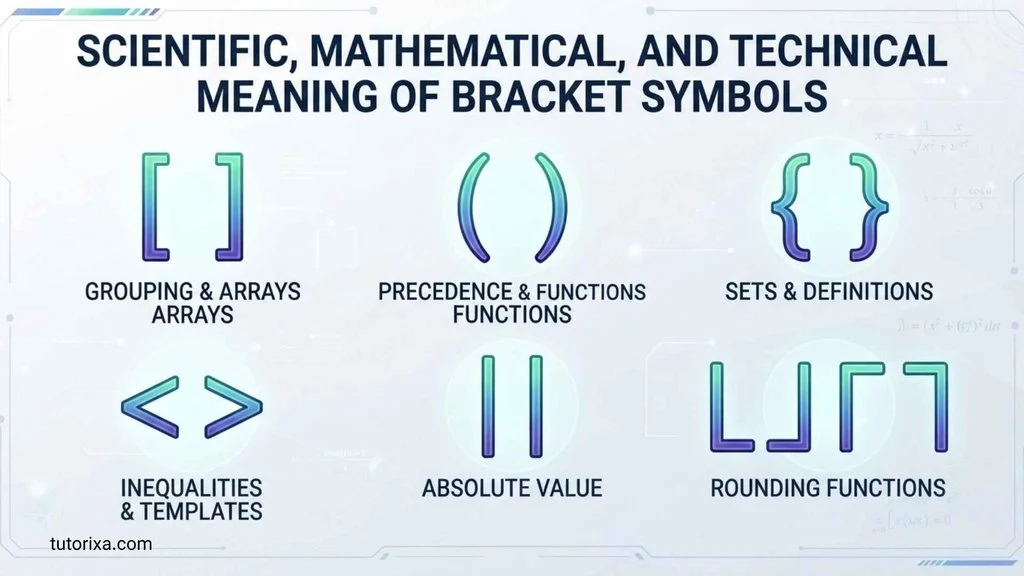
Bracket symbols become especially important in technical fields because they provide a compact visual language for relationships.
Mathematics
Mathematics uses several bracket forms for grouping and notation.
Parentheses can group operations:
(a + b) × c
Square brackets can provide an additional level of grouping:
[a + (b × c)]
Curly braces can define sets:
{2, 4, 6, 8}
Angle brackets can have specialized meanings, including inner products and tuple-related notation.
Square brackets can also indicate that an endpoint belongs to a mathematical interval. For example:
[2, 5]
normally represents the numbers from 2 through 5, including both endpoints. By contrast:
(2, 5)
normally excludes both endpoints.
Programming
Brackets are fundamental in many programming languages.
Parentheses often appear in:
- function calls
- conditions
- expressions
- parameters
Square brackets often represent:
- arrays
- lists
- indexing
- collections
Curly braces often define:
- code blocks
- objects
- scopes
- sets or dictionaries, depending on the language
Angle brackets also appear in generic type notation and markup systems.
The same visual symbol can therefore perform completely different technical jobs.
Digital Markup
HTML uses angle brackets to distinguish tags from ordinary text.
For example:
<h1>Title</h1>
Here, the angle brackets are structural delimiters. They tell the browser that the enclosed names represent markup elements.
Where Bracket Symbols Are Used
Bracket symbols appear in an unusually wide range of environments.
Books and Academic Writing
Parentheses provide additional information, while square brackets can identify editorial additions, corrections, or explanatory insertions.
Dictionaries and Linguistics
Linguists use different brackets to distinguish types of linguistic information. Depending on the system, square brackets can represent phonetic transcription, while slashes and other delimiters distinguish phonological notation.
Mathematics
All four major bracket families can organize expressions, define sets, indicate intervals, or represent specialized relationships.
Computer Programming
Brackets organize functions, arrays, blocks, objects, parameters, and expressions.
Websites
Angle brackets are fundamental to HTML and other markup languages.
Literature
Editors may use square brackets to distinguish additions from an author’s original words, particularly when quoting historical or literary material.
Art and Design
Bracket forms may appear as graphic elements because their geometric shapes naturally communicate containment, framing, or structure.
Data and File Formats
Square brackets and braces are widely encountered in structured data. Their exact meaning depends on the syntax of the particular format.
Social Media and Digital Communication
Users sometimes use brackets decoratively, for emphasis, categorization, or stylistic effect. These informal uses do not necessarily follow formal punctuation rules.
Common Variations of Bracket Symbols
Bracket symbols exist in many shapes and typographic forms.
Round Brackets
( )
Also called parentheses.
Square Brackets
[ ]
Also called square brackets or, in some English varieties, crotchets.
Curly Brackets
{ }
Usually called braces or curly braces.
Angle Brackets
< >
Often called angle brackets, although the keyboard characters also serve as mathematical comparison operators.
Double Angle Brackets
《 》
These are used in several East Asian writing contexts.
Corner Brackets
「 」
These are important punctuation marks in Japanese and related East Asian typography.
Unicode contains many additional bracket characters, including specialized mathematical and typographic delimiters.
Common Misconceptions About Bracket Symbols
Misconception 1: All brackets mean the same thing
They do not. Parentheses, square brackets, braces, and angle brackets can have different functions.
Misconception 2: Brackets are only punctuation
Not always. They are also important mathematical delimiters, programming characters, linguistic notation, and markup syntax.
Misconception 3: Curly brackets and square brackets are interchangeable
Their roles depend on the convention being used. In mathematics and programming, changing one for another can change the meaning or make an expression invalid.
Misconception 4: < and > are always brackets
Not necessarily. In mathematics, they commonly function as less-than and greater-than operators. In HTML, they delimit tags.
Misconception 5: Every bracket has a symbolic or spiritual meaning
Ordinary bracket symbols are primarily functional. Claims about hidden or universal spiritual meanings are not established simply because a bracket has a particular shape.
Misconception 6: Unicode has only four kinds of brackets
Unicode contains many bracket characters beyond the four common keyboard families. Its character repertoire includes specialized mathematical, typographic, and writing-system-specific forms.
Interesting Facts About Bracket Symbols
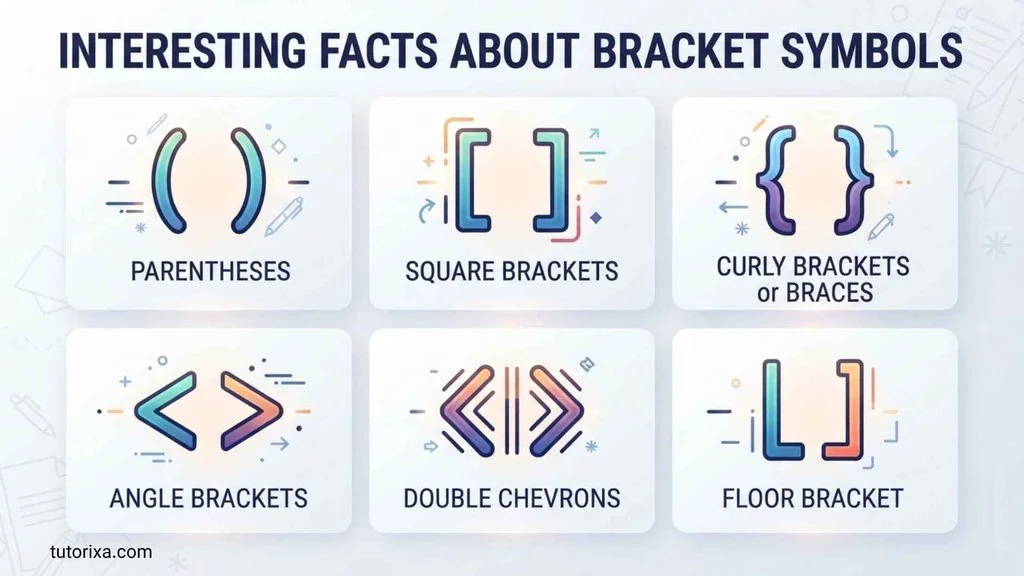
- The word “bracket” has multiple meanings. It can describe punctuation, a structural support, a classification range, or even a tournament pairing. Merriam-Webster records the punctuation-related noun among its meanings and dates the English noun to 1574.
- Brackets are essentially boundary markers. Their most basic visual function is to tell readers where a particular unit begins and ends.
- Mathematics gives brackets highly specialized jobs. The same pair can represent grouping, sets, intervals, matrices, or other structures depending on context.
- Square brackets can change mathematical meaning. In interval notation, a square bracket normally indicates inclusion of an endpoint, whereas a parenthesis normally indicates exclusion.
- Braces are central to set notation. Writing {a, b, c} identifies a collection as a set in standard mathematical notation.
- Unicode recognizes many specialized brackets. The basic keyboard characters represent only a small part of the larger international collection of bracket-like characters.
- Some bracket forms are culturally specific. Japanese typography, for example, uses corner and double-angle brackets with established functions.
- The same character can have unrelated meanings. The > character can mean “greater than” in mathematics but participate in markup syntax in HTML.
- Brackets help create nested structures. A sentence, mathematical expression, or computer program can contain several layers of enclosure.
- Brackets support information hierarchy. Different shapes allow writers and programmers to distinguish one structural level from another.
- There are horizontal bracket characters. Unicode includes top and bottom forms of square, parenthetical, curly, and tortoise-shell delimiters for specialized mathematical display.
- Bracket terminology varies by region. Terms such as “parentheses,” “round brackets,” “braces,” and “crotchets” may be preferred differently depending on English variety and local convention.
Related Symbols
Parentheses ( )
Parentheses are closely related to other brackets but usually have a softer grouping or supplementary-information role in ordinary prose.
Square Brackets [ ]
Square brackets are strongly associated with editorial insertions, mathematical notation, arrays, and technical syntax.
Curly Braces { }
Braces are particularly important for sets, grouping, and programming structures.
Angle Brackets < >
Angle brackets have major roles in mathematics, linguistics, markup, and technical notation.
Quotation Marks “ ”
Quotation marks also enclose material, but their primary function is normally to identify quoted speech, titles, or special wording rather than general structural grouping.
Vertical Bars | |
Vertical bars can act as delimiters in mathematics, logic, programming, and linguistics. Their meanings are highly context-dependent.
Slash /
The slash is not normally a bracket, but it can separate alternatives, paths, fractions, and other related information.
Frequently Asked Questions About Bracket Symbols
What are the four main bracket symbols?
The four commonly recognized families are parentheses ( ), square brackets [ ], curly braces { }, and angle brackets < >. Their functions differ by context. Parentheses often group or add information, square brackets mark editorial or technical material, braces commonly represent sets or code blocks, and angle brackets serve mathematical and computing purposes.
What is the difference between brackets and parentheses?
In American English, “brackets” often specifically means square brackets [ ], while “parentheses” means round marks ( ). In broader usage, however, “bracket” can be a general term for paired enclosing marks. British English commonly uses “round brackets” for parentheses and “square brackets” for [ ].
What do square brackets mean?
Square brackets [ ] can indicate editorial additions within quotations, grouping in mathematics, arrays in programming, and closed endpoints in interval notation. Their exact meaning depends on context. Unicode officially identifies [ and ] as LEFT SQUARE BRACKET and RIGHT SQUARE BRACKET.
What do curly brackets mean?
Curly brackets { }, also called braces, commonly represent sets in mathematics and blocks of code in many programming languages. A single brace can also organize cases in mathematical expressions. Their meaning is therefore strongly connected with structure and grouping.
What do angle brackets mean?
Angle brackets < > can represent mathematical relationships, specialized linguistic notation, or markup syntax. In ordinary mathematics, < and > are commonly comparison operators meaning “less than” and “greater than.” In HTML, angle brackets help identify tags.
Are brackets punctuation marks?
Many bracket forms function as punctuation or delimiters, but their use extends beyond ordinary prose. Brackets are important in mathematics, programming, linguistics, markup, and data structures. Unicode treats many of these characters as distinct symbols with specific names and properties.
Do brackets have a universal symbolic meaning?
No. Bracket symbols do not have one universal symbolic interpretation. Their meaning depends on language, culture, discipline, and context. A square bracket in a historical quotation may indicate an editorial addition, while the same symbol in mathematics may represent grouping or an included interval endpoint.
Why are different types of brackets used together?
Different bracket shapes help readers recognize different levels of structure. For example, a complicated mathematical expression might use parentheses inside square brackets and braces outside them. This visual hierarchy makes nested information easier to distinguish.
How are brackets used in programming?
Programming languages use brackets as syntax. Parentheses commonly handle functions and conditions, square brackets frequently represent lists or indexing, and braces often define blocks or objects. The exact rules vary by programming language, so a bracket that is valid in one language may have a different role elsewhere.
How many bracket symbols exist?
There is no simple universal number because “bracket” can refer to a broad family of paired delimiters. Unicode contains many specialized bracket characters beyond the common keyboard forms, including mathematical, East Asian, ornamental, and other writing-system-specific brackets.
Key Takeaways
- Bracket symbols are paired marks that enclose, separate, or organize information.
- The main familiar forms are ( ), [ ], { }, and < >.
- Parentheses commonly provide grouping or supplementary information.
- Square brackets have important editorial and mathematical functions.
- Curly braces are strongly associated with sets and programming.
- Angle brackets are used in mathematics, linguistics, and computing.
- Bracket meanings are determined by context rather than shape alone.
- Unicode contains many specialized bracket characters.
- Different cultures and writing systems use different bracket conventions.
- Mathematics uses brackets for grouping, sets, intervals, matrices, and specialized notation.
- Programming uses brackets as part of formal syntax.
- Bracket symbols are primarily functional rather than universally spiritual or symbolic.
Conclusion
Bracket symbols may look like simple marks, but they form an important visual system for organizing written and technical information. From the parentheses in an everyday sentence to the braces defining a mathematical set and the angle brackets surrounding an HTML tag, each form helps readers understand relationships that would otherwise be harder to see.
Their history reflects the broader development of punctuation, printing, mathematics, and digital communication. Their modern importance comes from their flexibility: the same basic idea of enclosing and organizing information works across literature, language, science, mathematics, and computing.
Understanding bracket symbols therefore means more than learning what each shape is called. It means recognizing how context determines meaning—and why these small marks remain essential to clear communication in both traditional writing and modern technology.

I’m Rowan Whitaker, a British writer fascinated by the symbols surrounding us every day. I explore their meanings, origins, cultural significance, and changing interpretations. From ancient marks to modern signs, I enjoy making symbolism easier to understand. My writing helps curious readers discover the hidden messages behind familiar shapes, images, and signs.
Books:
- The Meaning Behind Symbols
- A Modern Guide to Symbolism
 Ellis Montgomery
 Freddie Beaumont