
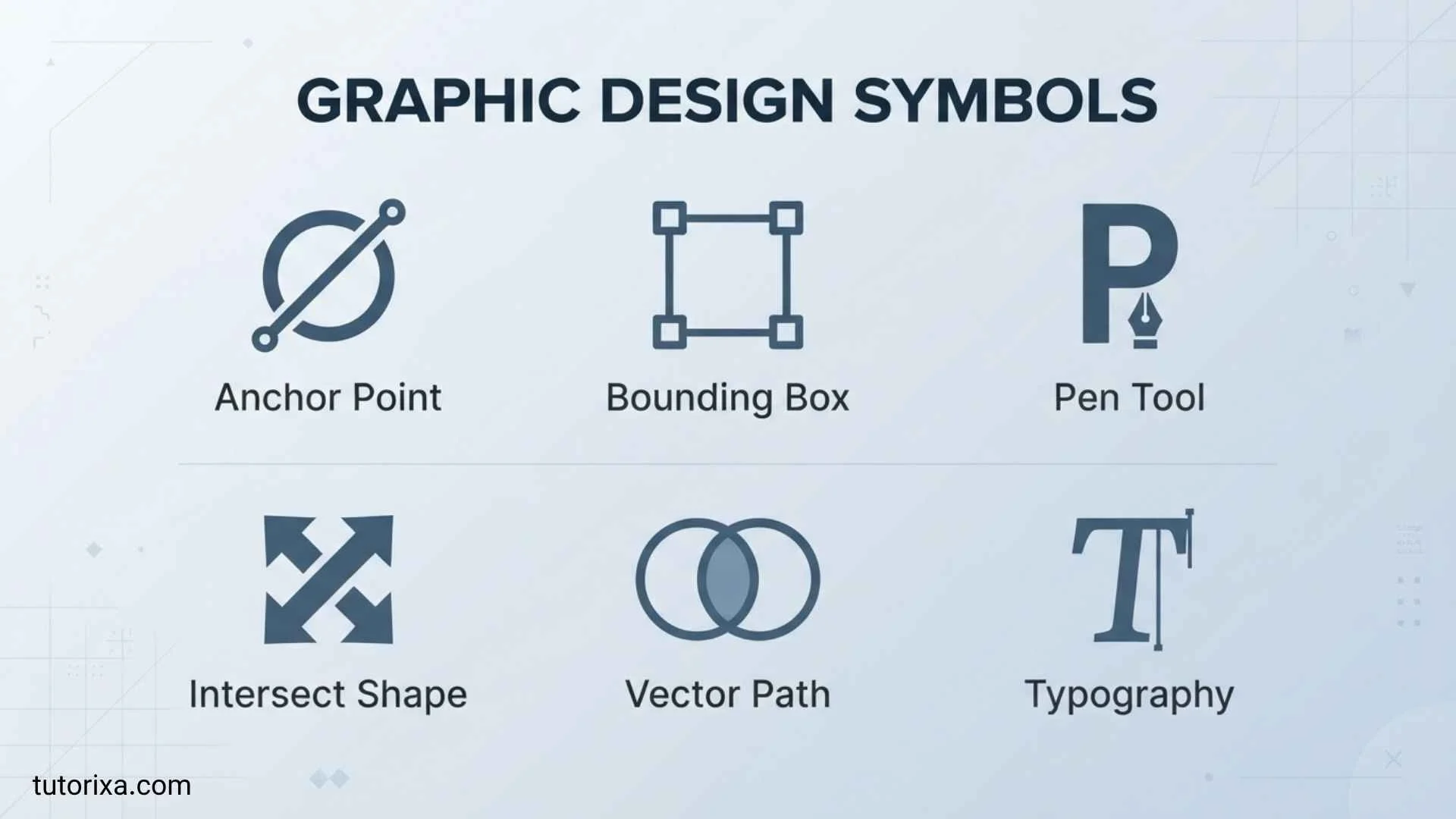
Graphic Design Symbols can turn a simple design into something clear, meaningful, and memorable. I know how confusing it can feel when you see countless icons, shapes, and visual marks and wonder what each one really means.
You want your designs to communicate quickly, and the right symbol can help you do exactly that. I’ll show you how these symbols work, where they are used, and why small visual details can make a big difference.
From basic icons to powerful visual signs, you’ll discover practical ideas you can use in your own projects. By the end, I want you to feel more confident choosing and using Graphic Design Symbols in a smart and effective way.
Quick Meaning
Graphic design symbols are visual elements that represent concepts, actions, objects, emotions, or information. They include icons, geometric shapes, punctuation marks, arrows, pictograms, logos, and culturally recognized signs. Their purpose is to communicate quickly and clearly, often allowing people to understand an idea without reading a long explanation.
Symbol Overview Table
| Field | Details |
| Symbol Name | Graphic Design Symbols |
| Primary Meaning | Visual communication of ideas and information |
| Category | Visual communication, symbols, icons, signs, design |
| Origin | Developed across many ancient and modern cultures |
| Historical Roots | Writing systems, pictograms, religious signs, maps, heraldry, and visual art |
| Common Usage | Logos, interfaces, advertisements, packaging, publications, signage |
| Modern Meaning | Fast, recognizable, scalable visual communication |
| Unicode | Many individual symbols have Unicode characters; graphic icons do not have one universal Unicode |
| Emoji Equivalent | Some symbols have related emoji, such as ❤️, ✔️, ⭐, 🔍, and ➡️ |
| Related Concepts | Icons, pictograms, ideograms, logos, signs, visual metaphors, typography |
What Do Graphic Design Symbols Mean?
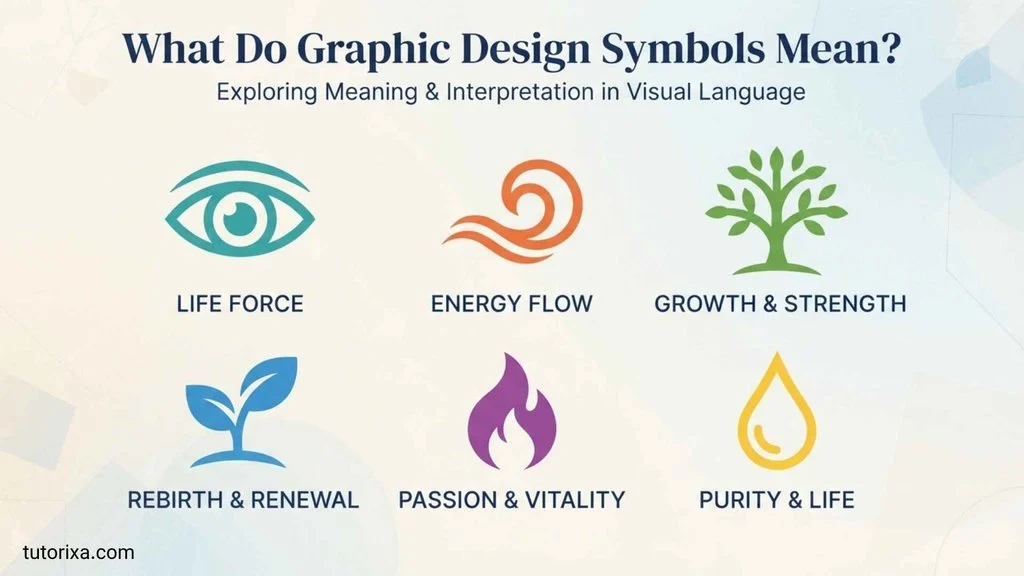
Graphic design symbols mean different things depending on their visual form, context, culture, and intended audience. They function as a visual language that can make information easier to recognize and remember.
A symbol generally represents something beyond its physical appearance. For example:
- Arrow → direction, movement, continuation, or navigation
- Check mark ✓ approval, completion, correctness, or selection
- X ✕ cancellation, incorrectness, closure, or prohibition
- Heart ♥ love, affection, care, or emotional connection
- Star ★ excellence, importance, quality, or recognition
- Plus + addition, healthcare, expansion, or a positive action
- Minus − subtraction, reduction, removal, or minimizing
- Magnifying glass 🔍 search, investigation, or discovery
- Lock 🔒 security, privacy, or restricted access
- House ⌂ home, residence, or homepage
- Globe 🌐 international connection, Earth, or the internet
- Person silhouette user, profile, customer, or human presence
The meaning is rarely determined by shape alone. A red cross, for instance, can have a very specific humanitarian meaning in an appropriate context, while a similar cross-shaped graphic might simply be a decorative or interface element.
This distinction matters because symbols can communicate more quickly than paragraphs, but they can also be misunderstood when designers assume that everyone interprets an image in the same way.
History and Origin of Graphic Design Symbols
Graphic design symbols do not have a single inventor or birthplace. Their history developed through thousands of years of human attempts to communicate visually.
Ancient Pictorial Communication
Long before modern graphic design, humans used pictures and marks to represent objects, events, and ideas. Cave paintings and early visual records demonstrate the importance of images in human communication.
Ancient writing systems also provide important foundations for symbolic communication. Egyptian hieroglyphs, for example, used visual signs as part of a sophisticated writing system. Mesopotamian cuneiform developed from earlier pictorial marks into a more abstract system.
These systems were not simply collections of decorative pictures. They could represent objects, sounds, words, and concepts.
Religious and Cultural Symbols
Symbols also developed through religious traditions. The cross, crescent, Dharma wheel, Star of David, lotus, and other culturally significant signs acquired meanings through particular historical and religious contexts.
Their meanings cannot always be separated from the communities that used them. A designer working with a religious symbol therefore needs to understand its history instead of treating it as a generic decorative shape.
Heraldry and Emblems
Medieval heraldry introduced another important tradition of visual identification. Shields, animals, crowns, colors, geometric forms, and other devices helped identify families, rulers, institutions, and military groups.
This tradition influenced the development of modern emblems and identity design.
Maps and Public Signage
As cities, transportation networks, and public institutions became more complex, standardized visual signs became increasingly useful.
Maps use symbols for roads, railways, boundaries, buildings, parks, and geographic features. Modern public signage similarly uses pictograms to communicate information to people who may speak different languages.
Modern Graphic Design
The 19th and 20th centuries brought major developments in typography, advertising, corporate identity, information design, and modernist graphic design.
Designers increasingly emphasized simplicity, geometry, readability, and functional communication. The development of international transportation systems and public information systems further increased the need for recognizable visual symbols.
Today, digital interfaces have expanded this visual vocabulary even further.
Symbolism and Interpretation
Traditional Meanings
Traditional symbolic meanings often come from long-standing cultural practices.
For example, circles have frequently been associated with ideas such as unity, continuity, wholeness, or eternity because they have no obvious beginning or end. However, this is an interpretation rather than a universal rule.
Similarly, birds can represent freedom in some artistic contexts, but their meaning can change according to species, culture, mythology, and composition.
Modern Meanings
Modern graphic design often assigns practical meanings to familiar symbols.
A hamburger menu icon usually indicates hidden navigation. A bell often represents notifications. A gear commonly represents settings. A play triangle indicates media playback.
These meanings developed through repeated exposure rather than ancient symbolism.
Positive Symbolism
Many symbols are used to communicate positive concepts:
- Stars → achievement
- Hearts → affection
- Sun shapes → energy or optimism
- Leaves → nature or sustainability
- Circles → unity
- Upward arrows → progress
- Open hands → welcome or support
The surrounding design determines how strongly these associations apply.
Negative Symbolism
Other symbols may communicate warning, danger, rejection, or restriction:
- Exclamation mark → warning or attention
- Skull → danger or mortality
- X → rejection or cancellation
- Slash → prohibition or exclusion
- Triangle with warning elements → caution
- Broken chain → separation or freedom, depending on context
Psychological Interpretation
Visual psychology can help explain why certain symbols feel intuitive. Familiar forms reduce the mental effort required to understand a message.
However, designers should avoid claiming that every shape has a fixed psychological meaning. Human interpretation is influenced by learning, culture, experience, context, and design conventions.
Cultural Significance
Graphic symbols can have very different meanings across cultures.
Color is one of the clearest examples. White can be associated with purity, peace, or cleanliness in some contexts, while it has associations with mourning in certain East Asian cultural traditions. Red can communicate love, danger, celebration, power, or political significance depending on the setting.
Gestures and hand symbols also require cultural awareness. A gesture that appears positive in one country may be inappropriate or misunderstood somewhere else.
Animals provide another example. Owls may symbolize wisdom in many Western contexts because of their association with Athena in ancient Greek tradition, while animals have different symbolic roles in other cultures.
For global graphic design, a symbol should therefore be tested within its intended cultural environment rather than assumed to have one universal interpretation.
Scientific or Technical Meaning
Graphic design symbols overlap heavily with technical and scientific notation.
Mathematics
Common mathematical symbols include:
- + addition
- − subtraction
- = equality
- ≠ inequality
- < and > comparison
- % percentage
- ∞ infinity
- √ square root
- π pi
- ∑ summation
These symbols have precise technical meanings that should not be confused with decorative symbolism.
Technology
Digital design relies on familiar symbols to represent functions.
Examples include:
- Power symbol → device power
- Wi-Fi symbol → wireless connectivity
- Bluetooth logo → Bluetooth technology
- Search icon → search
- Download arrow → downloading
- Share icon → sharing content
- Trash can → delete
- Pencil → edit
Digital symbols are effective because users learn recurring interface conventions.
Maps and Information Graphics
Cartographers use symbols to represent physical and human features. A small tree, road line, railway mark, or building icon can convey information without occupying much space.
The key principle is consistency: users must be able to understand what a visual mark represents.
Where Graphic Design Symbols Are Used
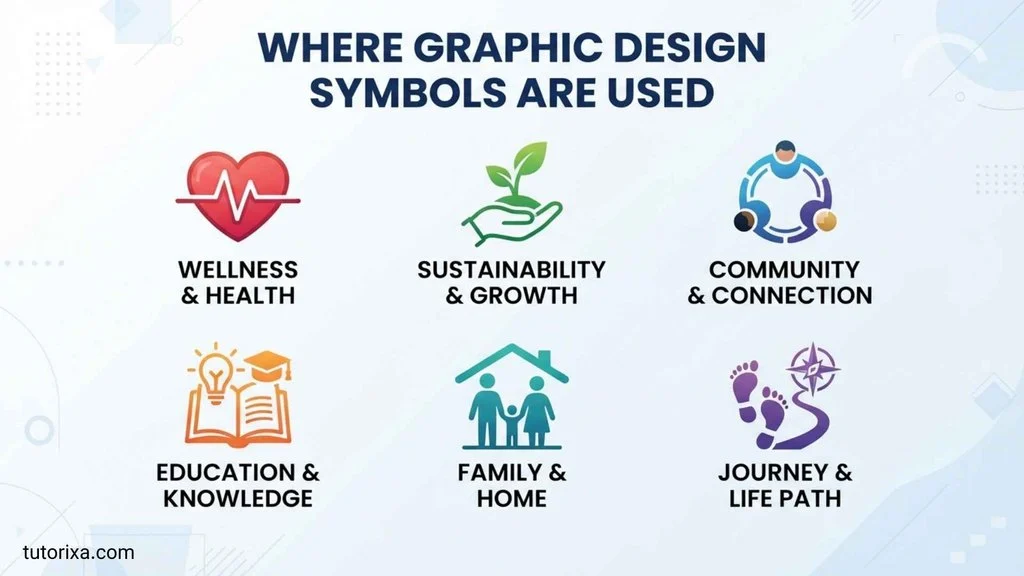
Graphic design symbols appear across almost every area of visual communication.
Logos and Branding
Brands use symbols to create recognizable identities. A logo symbol can represent an organization’s name, values, product, or broader idea.
Effective identity symbols are generally designed to remain recognizable at different sizes and across different media.
Websites and Apps
Interface icons help users navigate digital products. Common examples include home, search, menu, settings, profile, notification, share, and shopping-cart icons.
Books and Publications
Editorial designs use symbols for footnotes, sections, navigation, warnings, references, and decorative emphasis.
Maps
Symbols make complex geographic information easier to understand. They can identify transportation, landmarks, boundaries, services, and natural features.
Road and Public Signs
Road signs depend heavily on standardized shapes, colors, and pictograms. Their purpose is rapid communication, especially when drivers have only a short time to process information.
Packaging
Packaging symbols can communicate handling instructions, recycling information, warnings, storage requirements, or product characteristics.
Architecture and Interior Design
Architectural drawings use standardized graphic conventions to represent walls, doors, windows, electrical components, dimensions, and other features.
Art and Illustration
Artists use symbols to create metaphor, cultural references, emotional meaning, or narrative depth.
Common Variations
Graphic symbols can change considerably while retaining their basic concept.
Outline vs. Filled Symbols
An icon may use a thin outline or a solid shape. Both can represent the same object, but the visual weight differs.
Geometric vs. Organic Designs
Geometric icons use circles, squares, triangles, and straight lines. Organic symbols use curves and irregular forms that can feel more natural or expressive.
Minimalist Symbols
Modern interfaces often simplify symbols to improve recognition at small sizes.
Cultural Variations
A symbol may be redesigned for a particular language or region while preserving its basic function.
Similar Symbols
Some symbols look alike but have different meanings. The plus sign, cross, and medical cross-related imagery can overlap visually while carrying different meanings depending on context.
This is why appearance alone should not determine interpretation.
Common Misconceptions
Myth 1: Every Shape Has One Universal Meaning
A circle does not automatically mean eternity, and a triangle does not always mean danger. Shape meanings depend on context and cultural convention.
Myth 2: Symbols Mean the Same Thing Everywhere
They do not. Cultural traditions can dramatically affect interpretation.
Myth 3: An Icon and a Symbol Are Exactly the Same
The terms overlap, but they are not identical. An icon often resembles the thing it represents, while a symbol may have a more abstract relationship with its meaning.
Myth 4: Ancient Meanings Always Apply to Modern Icons
A modern search icon is not meaningful because of ancient symbolism. Its meaning comes largely from established interface conventions.
Myth 5: A Symbol Is Automatically Self-Explanatory
Familiar symbols can still be ambiguous. Good design considers the audience, environment, accessibility, and surrounding text.
Myth 6: Unicode Contains Every Graphic Symbol
Unicode contains many standardized characters and symbols, but it is not a complete catalog of every graphic icon or logo used in design.
Interesting Facts About Graphic Design Symbols
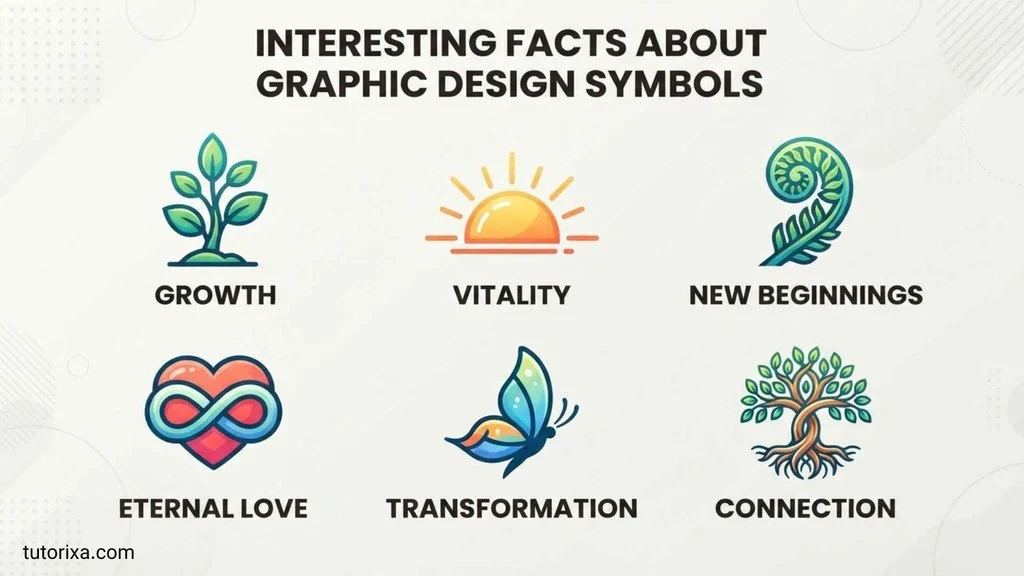
- Symbols can communicate without a shared spoken language.
A recognizable pictogram can sometimes convey an action or object even when the viewer cannot read the surrounding text. - Context can completely change meaning.
A heart on a medical interface, jewelry advertisement, or social media post may communicate very different ideas. - Digital icons are learned conventions.
Many users understand a floppy-disk-shaped save icon even if they have never personally used a floppy disk. - Simple designs are often easier to recognize at small sizes.
Removing unnecessary details can preserve the essential visual structure. - Symbols can become part of brand identity.
A distinctive graphic mark may become strongly associated with an organization over time. - Ancient visual communication influenced modern design.
Pictorial representation has a much longer history than the modern profession of graphic design. - Symbols can carry political or social meanings.
Their significance may develop through historical events, movements, communities, or public use. - Some symbols have highly precise technical meanings.
Mathematical notation demonstrates that a symbol can represent a specific rule rather than a broad emotional idea. - Accessibility changes how symbols should be designed.
Designers need to consider contrast, size, recognition, and alternative text when symbols appear in digital products. - A symbol’s meaning can evolve.
New technologies and social habits continually create new visual conventions.
Related Symbols
Graphic design symbols connect to several important categories of visual communication.
- Icons: Usually simplified visual representations of objects, functions, or concepts.
- Pictograms: Simplified pictures designed to communicate information efficiently.
- Ideograms: Graphic signs that represent ideas or concepts rather than simply depicting physical objects.
- Logos: Visual identities used to represent organizations, products, or brands.
- Emblems: Distinctive symbolic designs associated with an institution, group, or identity.
- Arrows: Common directional symbols used for movement, navigation, and sequence.
- Geometric symbols: Circles, squares, triangles, crosses, lines, and other basic forms used in visual communication.
- Mathematical symbols: Formal signs used to represent quantities, operations, relationships, and concepts.
- Religious symbols: Signs connected with particular religious traditions and communities.
- Emoji: Digital pictorial characters used in electronic communication, many of which overlap visually with traditional symbols.
The major difference is purpose. A logo primarily identifies, an icon often indicates a function, a pictogram communicates information, and a mathematical symbol represents a defined relationship or operation.
Frequently Asked Questions
What are graphic design symbols?
Graphic design symbols are visual signs used to communicate ideas, objects, actions, emotions, or information. They can include icons, pictograms, arrows, geometric forms, logos, mathematical marks, and culturally significant signs. Their meanings come from visual resemblance, established conventions, cultural traditions, or the context in which designers use them.
Why are symbols important in graphic design?
Symbols make visual communication faster and often reduce the amount of text needed. A familiar search icon, for example, can communicate the purpose of a button immediately. Symbols also help organize information, establish visual identity, guide users through interfaces, and make designs easier to scan.
What is the most common symbol in graphic design?
There is no single universally accepted “most common” graphic design symbol. Arrows, check marks, crosses, circles, plus signs, menu icons, search icons, and user symbols are extremely common across digital and printed communication. Their frequency varies according to the design field and the audience.
What is the difference between a symbol and an icon?
An icon often has a visual resemblance to what it represents, such as a trash-can image representing deletion. A symbol can be more abstract and may acquire meaning through convention or cultural learning. In everyday design language, the two terms frequently overlap, especially when discussing interface graphics.
Do graphic design symbols have universal meanings?
No. Some symbols have widely recognized meanings because international standards or repeated design conventions have established them. Others depend strongly on culture and context. Designers working for international audiences should research local interpretations instead of assuming that a symbol will communicate the same message everywhere.
How are symbols used in logos?
Symbols in logos provide a visual identity that can represent a company, organization, product, or concept. A successful logo symbol is usually distinctive, recognizable, adaptable, and appropriate for the brand. Its meaning may become stronger over time as audiences repeatedly associate the mark with the organization.
Why are simple symbols effective?
Simple symbols are often easier to recognize, reproduce, scale, and remember. They can work on everything from a small mobile screen to a large sign. Simplicity does not automatically make a symbol effective, however. It still needs appropriate contrast, recognizable structure, suitable context, and consideration for the intended audience.
Can colors change the meaning of a symbol?
Yes. Color can significantly influence interpretation. Red may suggest danger, urgency, love, celebration, or importance depending on context. Green can be associated with nature or permission in some settings. Cultural differences also matter, so color should be considered alongside shape, typography, imagery, and surrounding information.
What symbols are commonly used in digital interfaces?
Common interface symbols include the magnifying glass for search, house for home, gear for settings, bell for notifications, person silhouette for profiles, trash can for deletion, pencil for editing, arrows for navigation, and three horizontal lines for menus. Their effectiveness comes largely from widespread exposure and consistent use.
How can designers avoid confusing symbols?
Designers can reduce confusion by using familiar conventions, testing symbols with representative users, providing labels when necessary, maintaining visual consistency, and considering cultural differences. Accessibility is also important. A symbol should not be the only way essential information is communicated when users may have difficulty recognizing it.
Key Takeaways
- Graphic design symbols communicate ideas through visual signs.
- Symbols can represent objects, actions, emotions, concepts, and information.
- Their meanings come from culture, history, resemblance, convention, and context.
- Ancient pictorial communication helped establish long traditions of visual symbolism.
- Modern interfaces have created widely recognized digital symbols.
- Shapes and colors can influence interpretation but do not have completely universal meanings.
- Religious and cultural symbols require historical and cultural sensitivity.
- Mathematical and technical symbols can have precise meanings that differ from artistic symbolism.
- Icons, pictograms, ideograms, logos, and symbols overlap but serve different purposes.
- Simple symbols are useful because they can communicate quickly and work across many sizes and formats.
- Global design requires attention to cultural and regional differences.
- Good symbols are understandable, appropriate, accessible, and consistent with their context.
Conclusion
Graphic design symbols form a powerful visual language that connects ancient communication traditions with modern digital experiences. From arrows and check marks to logos, pictograms, mathematical signs, and cultural emblems, symbols allow people to recognize information quickly and attach meaning to visual forms.
Their power comes from more than appearance. History, culture, technology, language, psychology, and repeated social use all influence what a symbol communicates. A design that seems obvious in one environment may have a completely different interpretation in another.
For designers, understanding these layers is essential. The best symbol is not simply attractive; it communicates the intended message clearly, respects its cultural context, works for its audience, and remains useful across the environment where it appears. By studying the origins, meanings, variations, and applications of graphic design symbols, we can better understand how visual communication shapes the way people navigate information, technology, brands, art, and everyday life.

I’m Freddie Beaumont, a British author with a passion for discovering what symbols communicate without words. I write about their history, meanings, and everyday uses in an accessible way. I believe symbols tell fascinating stories about people, cultures, and ideas, and my work helps readers recognise and understand those stories more clearly.
Books:
- Symbols and Their Hidden Meanings
- Understanding Signs and Symbols
 Ellis Montgomery
 Rowan Whitaker