
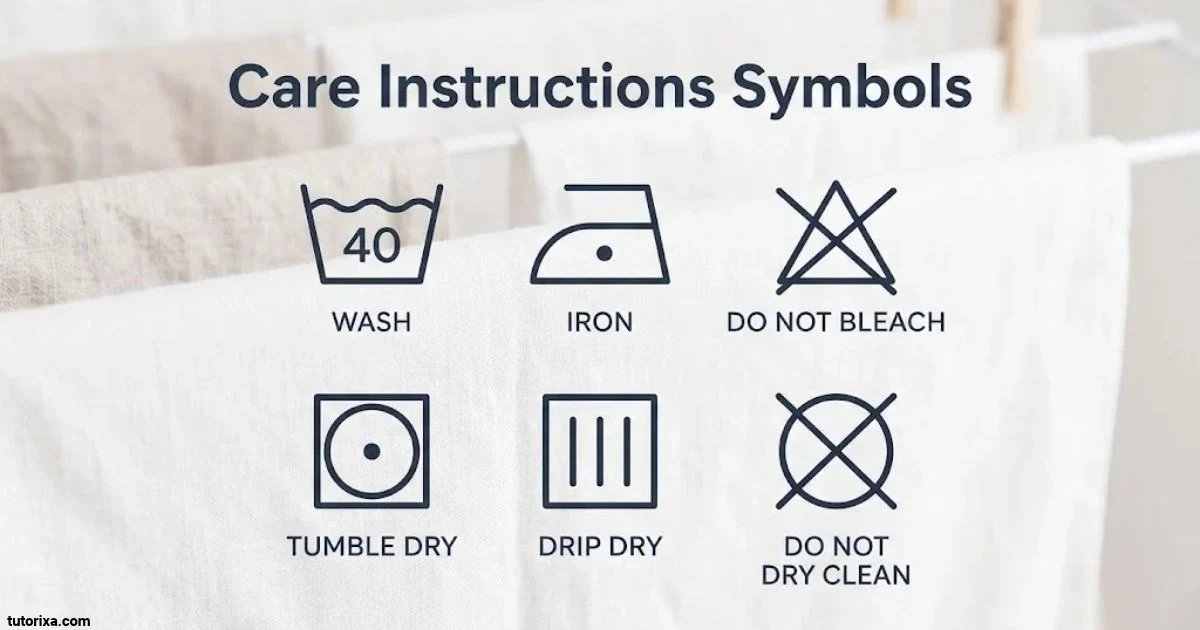
Care instructions symbols help you understand how to wash, dry, iron, and clean your clothes without damaging them. You can find these small symbols on the care labels attached to shirts, jeans, dresses, jackets, towels, and other fabric items. Each symbol gives you a specific instruction about the safest way to care for a garment.
Understanding laundry symbols can save your favorite clothes from shrinking, fading, stretching, or losing their shape. A washing tub, triangle, square, iron, or circle may look simple, but each one communicates a different care instruction. Extra marks, such as dots, numbers, lines, and crosses, provide more details about the treatment a fabric can handle.
In this guide, you’ll find care instructions symbols and their meanings, including washing, drying, bleaching, ironing, and professional cleaning symbols. You’ll also learn how to read clothing labels, understand symbols used by washing machines, and follow care recommendations for popular brands such as Zara and Lululemon.
Care Instructions Symbols And Meanings
Care instructions symbols are small pictures printed on clothing labels to explain how a textile should be cleaned and maintained. They provide a simple way to understand garment care without relying on written instructions in a particular language.
Most standardized textile care labels use five main categories:
Washing symbol
Shows whether a garment can be machine-washed or hand-washed and the maximum water temperature.
Bleaching symbol
Explains whether bleach is allowed and which type can be used.
Drying symbol
Tells you whether to tumble-dry, hang, drip-dry, or lay a garment flat.
Ironing symbol
Indicates the maximum recommended ironing temperature.
Professional cleaning symbol
Shows whether professional dry cleaning or wet cleaning is suitable.
These symbols follow the international textile care labelling system described in ISO 3758. Their standard order is washing, bleaching, drying, ironing, and professional textile care.
You should also pay attention to the small details inside or around each symbol:
- Numbers: Show the maximum washing temperature in degrees Celsius.
- Dots: Indicate temperature settings for tumble drying or ironing.
- Single line underneath: Means a mild process with reduced mechanical action.
- Double line underneath: Indicates a very mild process for delicate fabrics.
- Cross (X): Means the treatment shown by that symbol is not permitted.
For example, a crossed-out washing tub means you should not wash the item at home. A washing tub marked 30°C means the garment should not be washed above that temperature.
Universal Care Instructions Symbols
Universal care instructions symbols are standardized pictures designed to make clothing care easier across different languages. They communicate the same basic cleaning instructions on garments sold in many countries.
Here are the five main symbols and their general meanings:
| Symbol | Name | Meaning |
| 🛁 | Washing tub | Washing instructions |
| △ | Triangle | Bleaching instructions |
| □ | Square | Drying instructions |
| ♨️ | Iron | Ironing instructions |
| ○ | Circle | Professional textile care |
The emoji and geometric characters in this table are visual substitutes, not exact reproductions of the official garment-care pictograms. Always use the actual printed label when deciding how to treat clothing.
Some additional marks help you understand the instructions:
| Mark | Meaning |
| 30, 40, 60 | Maximum washing temperature in °C |
| • | Low temperature |
| •• | Medium temperature |
| ••• | High temperature |
| X over a symbol | Do not perform that treatment |
| One underline | Mild treatment |
| Two underlines | Very mild treatment |
For example, an iron with one dot means low-temperature ironing, while an iron with three dots permits a higher temperature.
Remember that these symbols describe the recommended care treatment for the complete garment. A delicate lining, print, or decorative feature can affect how an item should be cleaned, so follow any additional written instructions on its label.
List Of Laundry Symbols And Meanings
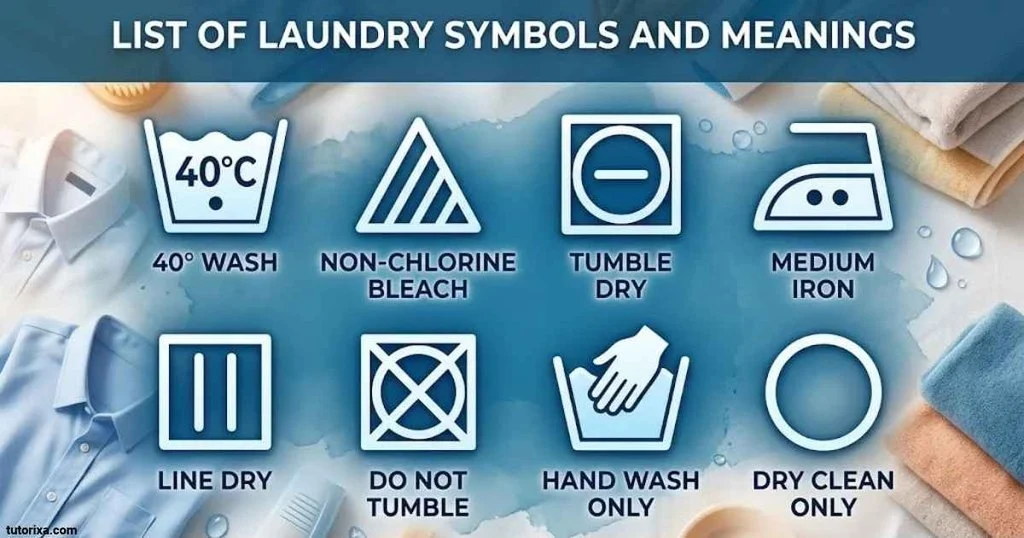
This section provides a practical list of common laundry symbols and their meanings. Use it as a quick reference when checking the care label on your clothes.
Washing symbols
The washing tub indicates the recommended washing method and maximum temperature.
| Symbol appearance | Meaning |
| Tub with 30 | Machine wash at maximum 30°C |
| Tub with 40 | Machine wash at maximum 40°C |
| Tub with 60 | Machine wash at maximum 60°C |
| Tub with one underline | Use a mild washing cycle |
| Tub with two underlines | Use a very mild washing cycle |
| Tub with a hand | Hand wash only |
| Crossed-out tub | Do not wash |
Bleaching symbols
The triangle tells you whether a bleaching product is safe for the fabric.
| Symbol appearance | Meaning |
| Empty triangle | Bleaching is permitted |
| Triangle with two diagonal lines | Use oxygen or non-chlorine bleach only |
| Crossed-out triangle | Do not bleach |
Drying symbols
Drying symbols appear inside a square. A circle inside the square indicates tumble drying.
| Symbol appearance | Meaning |
| Square with circle and one dot | Tumble-dry at low temperature |
| Square with circle and two dots | Tumble-dry at normal temperature |
| Crossed-out square with circle | Do not tumble-dry |
| Square with vertical line | Line dry |
| Square with horizontal line | Dry flat |
| Square with two vertical lines | Drip dry |
| Square with diagonal corner line | Dry in the shade |
Ironing symbols
The iron symbol shows how much heat a garment can tolerate.
| Symbol appearance | Meaning |
| Iron with one dot | Low temperature |
| Iron with two dots | Medium temperature |
| Iron with three dots | High temperature |
| Crossed-out iron | Do not iron |
Professional cleaning symbols
A circle represents professional textile cleaning.
| Symbol appearance | Meaning |
| Circle with P | Professional dry cleaning using specified solvents |
| Circle with F | Professional dry cleaning using hydrocarbon solvents |
| Circle with W | Professional wet cleaning |
| Crossed-out circle | Do not dry-clean |
The letters inside professional cleaning symbols are instructions for cleaners, not washing-machine settings. The underline beneath a circle indicates that a gentler professional cleaning process is required.
Wash Care Instructions Symbols
Wash care symbols are among the most frequently used marks on clothing labels. They tell you whether an item can go into a washing machine, needs hand washing, or should not be washed with water.
The basic washing symbol looks like a small tub filled with water. The number inside it indicates the highest permitted washing temperature.
| Wash care symbol | Instruction |
| Tub with 30°C | Wash at a maximum of 30°C |
| Tub with 40°C | Wash at a maximum of 40°C |
| Tub with 60°C | Wash at a maximum of 60°C |
| Tub with 95°C | Wash at a maximum of 95°C |
| Tub with hand | Hand wash only |
| Crossed-out tub | Do not wash |
| Tub with one underline | Use a gentle washing cycle |
| Tub with two underlines | Use a very gentle washing cycle |
What Do Washing Temperature Symbols Mean?
The temperature number is a maximum, not a required setting. For example, if a shirt has a 40°C washing symbol, you can generally wash it at 30°C, but you should not exceed 40°C.
Here are some practical examples:
- 30°C: Suitable for many delicate clothes, dark garments, and lightly soiled everyday items.
- 40°C: Commonly used for washable everyday clothing, depending on the fabric.
- 60°C: Suitable for certain durable fabrics that can tolerate hotter washing.
- 95°C: Reserved for textiles specifically designed to withstand very hot washing.
Always consider the fabric and the complete care label before selecting a temperature.
How To Hand Wash Clothes
A hand inside a washing tub means the garment should be washed by hand rather than using a regular machine cycle.
Follow these steps:
- Fill a clean basin with water at the temperature shown on the label.
- Add a small amount of suitable detergent.
- Gently move the garment through the water.
- Rinse carefully without twisting or pulling the fabric.
- Press out excess water and dry according to the drying instructions.
This method is useful for delicate garments that can be damaged by strong machine agitation.
Laundry Care Instructions Symbols
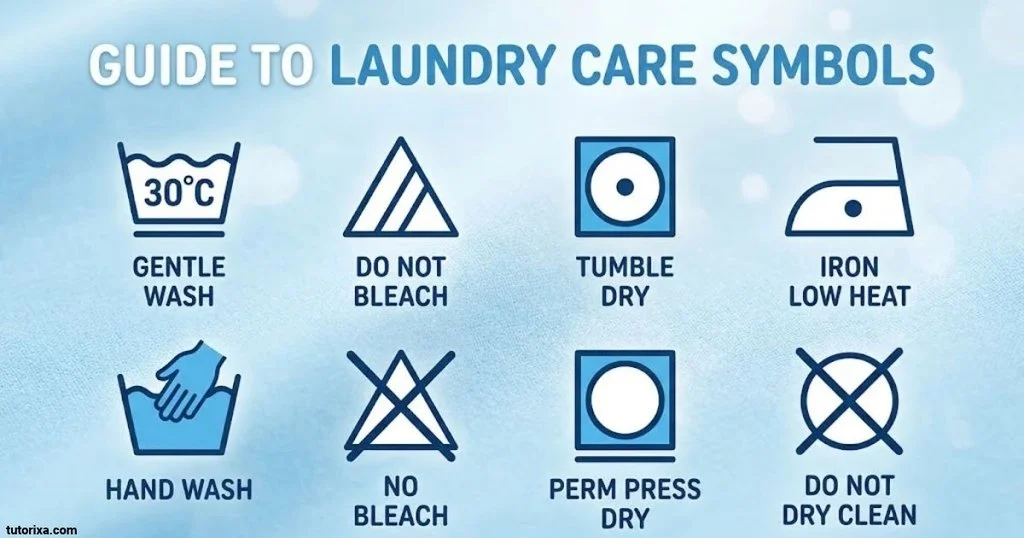
Laundry care instructions symbols cover the complete process of looking after clothes, from washing them to drying, ironing, and professional cleaning.
Understanding the entire sequence helps you avoid mistakes that might damage your garments.
The five main laundry care categories are:
| Category | Main symbol | What It Tells You |
| Washing | Water tub | How to wash clothing |
| Bleaching | Triangle | Whether bleach is allowed |
| Drying | Square | How to dry clothing |
| Ironing | Iron | How much heat to use |
| Professional cleaning | Circle | Whether specialist cleaning is required |
Bleaching Symbols And Their Meanings
Bleaching symbols are represented by triangles. They explain which bleaching treatments are suitable for a garment.
| Symbol | Meaning |
| △ | Any type of bleach is permitted |
| △ with two diagonal lines | Oxygen-based, non-chlorine bleach only |
| Crossed-out △ | Do not bleach |
Do not assume that white clothing can always be bleached. Some white fabrics have delicate finishes, prints, or fibres that can be damaged by bleaching products.
Drying Symbols And Their Meanings
Drying symbols appear inside squares. The additional marks indicate the recommended drying method.
| Symbol | Meaning |
| Square with circle | Tumble drying permitted |
| Square with circle and one dot | Low-temperature tumble drying |
| Square with circle and two dots | Normal-temperature tumble drying |
| Crossed-out tumble dryer symbol | Do not tumble dry |
| Square with one vertical line | Line dry |
| Square with two vertical lines | Drip dry |
| Square with one horizontal line | Dry flat |
| Square with two horizontal lines | Drip flat |
| Square with diagonal lines | Dry in the shade |
Ironing Symbols And Their Meanings
The ironing symbol looks like a traditional clothes iron. The number of dots indicates the maximum heat setting.
| Symbol | Meaning |
| Iron with one dot | Maximum 110°C |
| Iron with two dots | Maximum 150°C |
| Iron with three dots | Maximum 200°C |
| Crossed-out iron | Do not iron |
These temperature limits refer to the maximum soleplate temperature. Some fabrics also require special handling, such as ironing inside out or avoiding steam.
Dry Cleaning Symbols And Their Meanings
Professional cleaning symbols appear as circles, sometimes containing letters.
| Symbol | Meaning |
| Circle with P | Professional dry cleaning with specified solvents |
| Circle with F | Professional dry cleaning using hydrocarbon solvents |
| Circle with W | Professional wet cleaning |
| Crossed-out circle | Do not dry-clean |
The exact letters and variations matter. If you are unsure about a professional cleaning symbol, show the label to a qualified cleaner rather than guessing.
Fabric Care Instructions Symbols
Different fabrics respond differently to water, heat, detergents, and mechanical movement. This is why fabric care instructions are especially useful when washing delicate or expensive materials.
The care label provides the treatment limits for the finished garment, taking its material, construction, dyes, and other features into account.
Here are some common fabric types and their care considerations.
| Fabric | Common care considerations |
| Cotton | Often machine-washable; check temperature and shrinkage instructions |
| Polyester | Usually washable; avoid excessive heat |
| Wool | May require hand washing or a wool-specific cycle |
| Silk | Often needs delicate washing or professional cleaning |
| Linen | Follow washing and ironing limits to manage creasing |
| Nylon | Use the temperature and drying method specified on the label |
| Viscose | Can be sensitive to water and mechanical movement |
| Cashmere | Usually requires particularly gentle handling |
Cotton Care Instructions
Cotton is commonly used in T-shirts, shirts, jeans, towels, and everyday clothing. Many cotton garments can be machine-washed, but the correct temperature depends on the fabric and its construction.
Check the washing tub for the maximum temperature. Also look at the drying symbol because some cotton items can shrink when exposed to excessive heat.
Wool And Cashmere Care Instructions
Wool and cashmere are sensitive to heat and rough handling. Some garments have a hand-wash symbol, while others require a very mild wool cycle or professional cleaning.
Use a suitable detergent and avoid twisting the fabric. If the label shows a flat-drying symbol, place the garment on a clean, flat surface to help it maintain its shape.
Silk Care Instructions
Silk is a delicate material that may lose its appearance if washed incorrectly. Some silk garments can be hand-washed, while others require professional cleaning.
Follow the temperature, washing, and ironing instructions carefully. Avoid rubbing the material aggressively or exposing it to unnecessary heat.
Polyester And Synthetic Fabric Care
Polyester, nylon, and other synthetic fabrics are common in sportswear, jackets, dresses, and everyday clothing.
Many of these items can be machine-washed, but their labels may recommend lower temperatures and reduced drying heat. Avoid assuming that all synthetic fabrics have identical care requirements.
Clothing Care Instructions Symbols
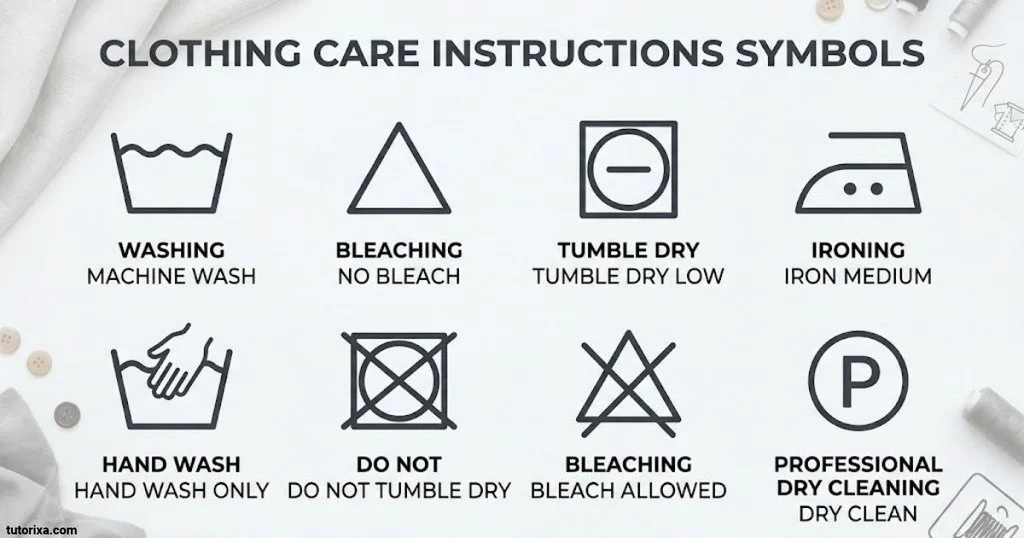
Clothing care instructions symbols appear on the small labels attached to garments. These labels are usually located inside the neck, along a side seam, or near the waistband.
You can find them on almost every type of clothing, including T-shirts, jeans, trousers, dresses, jackets, underwear, and sportswear.
Here are some practical examples of clothing care symbols.
| Clothing label instruction | What You Should Do |
| Machine wash 30°C | Use a wash cycle no hotter than 30°C |
| Machine wash 40°C | Keep the washing temperature at or below 40°C |
| Hand wash | Clean gently by hand |
| Do not wash | Avoid washing with water |
| Do not bleach | Use bleach-free cleaning products |
| Tumble dry low | Use a low-heat dryer setting |
| Do not tumble dry | Choose an alternative drying method |
| Iron low | Use a low-temperature setting |
| Do not iron | Avoid direct ironing |
| Dry clean | Take the item to a professional cleaner |
How To Read Clothing Care Labels
Most garment labels display several symbols in a standard sequence. Reading them from left to right makes the instructions easier to understand.
For example, imagine a clothing label showing:
Washing tub 30°C → Crossed triangle → Square with circle and one dot → Iron with one dot → Circle with P
This combination means:
- Wash at a maximum of 30°C.
- Do not bleach.
- Tumble-dry at low temperature.
- Iron at low temperature.
- Professional dry cleaning is permitted under the specified P process.
The example shows why you should read all the symbols rather than focusing only on the washing instruction.
Where To Find Care Labels On Clothes
- T-shirts: Usually inside the side seam or near the bottom.
- Shirts: Often inside a side seam or near the lower hem.
- Jeans: Commonly inside the waistband or a side seam.
- Dresses: Usually attached to an inside seam.
- Jackets: Often found inside the lining or along a side seam.
- Underwear: Usually printed or attached inside the garment.
If a label becomes difficult to read, check the product’s official website for its care information.
Garment Care Instructions Symbols
Garment care instructions symbols provide guidance for maintaining the appearance, fit, and quality of different clothing items. They are particularly useful for garments with special construction, decorations, or multiple fabric layers.
A jacket, for example, may contain a delicate lining even if its outer material is durable. Similarly, a dress may have embroidery, beads, or printed designs that require extra care.
Here are some garment-specific recommendations.
| Garment | What To Check |
| T-shirts | Washing temperature and tumble-drying instructions |
| Jeans | Washing temperature, bleaching, and drying |
| Sweaters | Wool or delicate washing and flat drying |
| Dresses | Fabric care and professional cleaning |
| Jackets | Lining, drying, and ironing instructions |
| Suits | Professional cleaning instructions |
| Sportswear | Washing temperature and fabric softener recommendations |
| Leather clothing | Special leather cleaning instructions |
Care Instructions For Delicate Garments
Delicate garments should be handled carefully to prevent stretching, shrinking, and damage.
Before cleaning them:
- Check whether hand washing is required.
- Use a suitable detergent.
- Avoid excessive rubbing.
- Do not twist delicate fabrics to remove water.
- Follow the drying instructions carefully.
- Use a professional cleaner if the label requires it.
Care Instructions For Printed And Decorated Clothing
Clothing with printed designs, embroidery, sequins, or decorative details may need additional attention.
Turning a garment inside out before washing can help reduce friction against its outer surface. However, this does not replace the official care instructions.
Avoid ironing directly over printed graphics or decorative attachments unless the manufacturer specifically allows it.
Care Instructions Symbols In Washing Machine
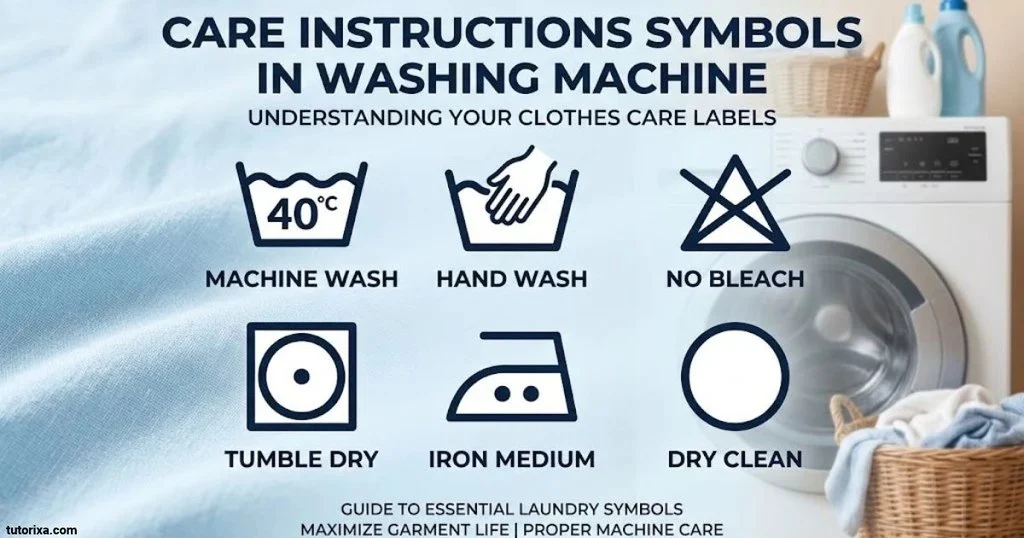
Washing machine symbols are different from the care symbols printed on clothing labels. They appear on the control panel of a washing machine and help you select the correct cleaning programme.
Most washing machines use a combination of pictures, numbers, and written labels.
Here are some common washing machine symbols and their meanings.
| Washing machine symbol | Meaning |
| Cotton flower | Cotton washing programme |
| Wool ball | Wool or wool-care programme |
| Feather | Delicate fabric programme |
| Hand in tub | Hand-wash programme |
| Spiral | Spin cycle |
| Water tub | Rinse or washing-related programme, depending on the machine |
| Clock | Time or delay setting |
| T-shirt | Clothing or mixed-fabric programmed |
| Leaf | Eco or energy-saving programme |
| Shower or water drops | Rinse-related function |
The exact design and meaning can differ between washing machine manufacturers. Always check your appliance manual before selecting an unfamiliar programme.
Common Washing Machine Programmes
Cotton programme: Designed for cotton clothing and other suitable durable fabrics.
Synthetic programme: Intended for many synthetic or blended fabrics.
Delicate programme: Uses gentler movement for suitable delicate clothing.
Wool programme: Designed for washable wool items.
Quick wash: A shorter programme for lightly soiled laundry when appropriate.
Eco programme: Designed to reduce energy consumption, often by using longer washing times and lower temperatures.
Washing Machine Temperature Symbols
Some machines display temperatures such as 20°C, 30°C, 40°C, 60°C, and 90°C.
These settings control the water temperature during washing. Select a temperature that does not exceed the maximum shown on your garment’s care label.
For example, if your shirt has a 30°C washing instruction, avoid selecting a 40°C or 60°C programme.
Important Difference Between Machine And Clothing Symbols
A washing machine programme tells you what the appliance can do. A garment care symbol tells you what the clothing can safely tolerate.
Always follow the garment label when choosing a machine setting. A programme named Delicate does not automatically make every garment suitable for machine washing.
Wash And Care Instructions Symbols
Wash and care instructions symbols provide a complete set of recommendations for cleaning, drying, ironing, and maintaining clothing.
The easiest way to understand them is to separate each symbol into its own category.
Quick wash and care reference
Water temperature and washing method.
Permitted bleaching treatments.
Tumble drying or natural drying.
Maximum ironing temperature.
Professional cleaning
Professional dry or wet cleaning.
Practical Example Of A Complete Care Label
Suppose your clothing label contains the following instructions:
- Washing tub with 40°C.
- Crossed-out triangle.
- Square with a horizontal line.
- Iron with two dots.
- Crossed-out circle.
You should:
- Wash the garment at a maximum of 40°C.
- Avoid bleach.
- Dry the garment flat.
- Iron at a maximum of 150°C.
- Avoid professional dry cleaning.
This combination gives you a complete cleaning routine without needing a long written explanation.
The most useful habit is to check the label before the first wash. It takes only a few seconds and can help prevent avoidable damage.
Zara Care Instructions Symbols
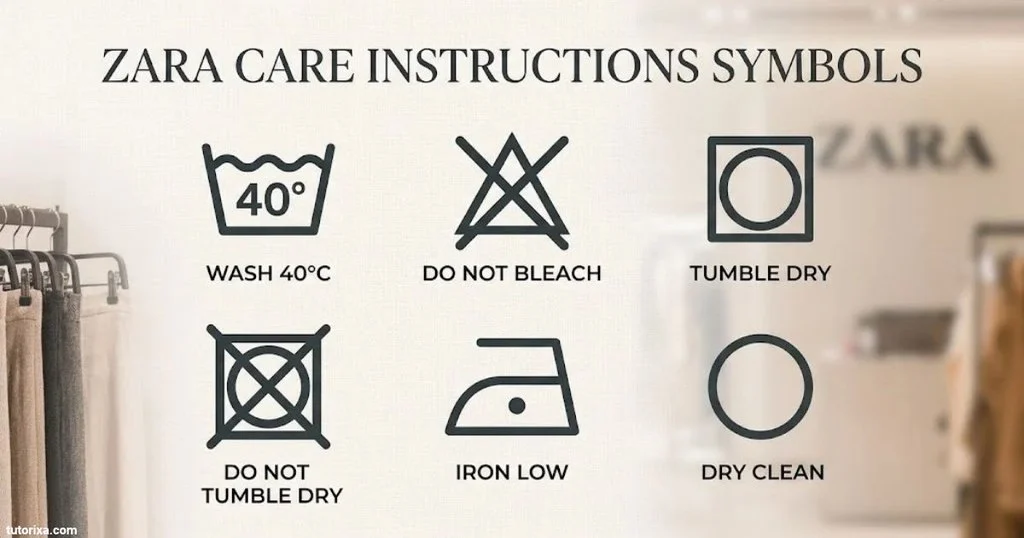
Zara uses garment care labels to provide washing, drying, ironing, and professional cleaning instructions for its clothing.
Zara sells clothing made from different materials, including cotton, wool, polyester, viscose, linen, and leather. Because these materials have different care requirements, the correct instructions depend on the individual product.
Zara’s official clothing care guide includes the following instructions:
| Zara care instruction | Meaning |
| Machine wash max. 30°C | Wash at or below 30°C |
| Machine wash max. 40°C | Wash at or below 40°C |
| Machine wash max. 60°C | Wash at or below 60°C |
| Hand wash max. 30°C | Gently wash by hand |
| Do not wash | Avoid water washing |
| Do not use bleach | Keep bleach away from the garment |
| Dry on a flat surface | Place flat to dry |
| Normal drum drying | Use the permitted normal dryer setting |
| Tumble dry low | Use low dryer heat |
| Do not tumble dry | Avoid machine drying |
| Iron max. 110°C | Use low heat |
| Iron max. 150°C | Use medium heat |
| Iron max. 200°C | Use higher permitted heat |
| Do not iron | Avoid ironing |
| Dry clean | Use the specified professional cleaning method |
| Do not dry clean | Avoid professional dry cleaning |
How To Find Zara Care Instructions
You can find the recommended care information in two places:
- Inside the garment: Check the attached care label for washing and cleaning symbols.
- Zara website: Open the relevant product page and look for its composition and care information.
Zara also recommends using lower-temperature washing programmes when suitable, avoiding overloaded washing machines, and air-drying clothes whenever possible.
Tips For Washing Zara Clothes
- Check the label before washing a new garment.
- Separate clothes according to colour and fabric.
- Use a suitable washing programme.
- Avoid excessive spin cycles for delicate items.
- Air-dry clothing when the label permits.
- Dry knitwear flat when instructed.
- Use suitable cleaning methods for leather and suede items.
You can also visit Zara’s official Clothing Care Guide for its detailed garment-care recommendations.
Lululemon Care Instructions Symbols
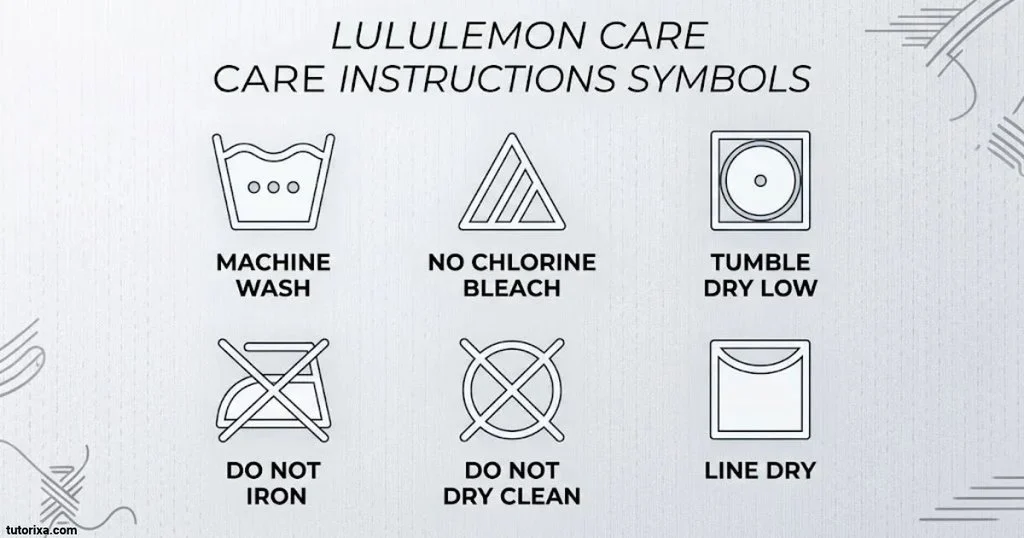
Lululemon
Lululemon makes activewear, leggings, sports bras, tops, jackets, and other performance clothing.
Lululemon clothing often uses technical fabrics designed for stretching, movement, comfort, and athletic performance. Proper washing and drying can help maintain the appearance and performance of these materials.
The company provides general washing recommendations, but individual products may have different requirements depending on their fabric and construction.
Common Lululemon Care Recommendations
| Care instruction | What It Means |
| Wash in cold water | Use cold water for washing |
| Wash with similar fabrics | Separate suitable fabric types and colours |
| Avoid cotton fabrics and towels | Reduce lint transfer and unnecessary friction |
| Avoid fabric softeners | Prevent interference with technical fabric properties |
| Hang to dry | Allow clothing to air-dry |
These are general recommendations published by Lululemon. The specific care label and product information should take priority for each item.
lululemon+1
How To Wash Lululemon Leggings
Lululemon leggings are commonly made from technical stretch fabrics. Follow these general steps:
- Turn the leggings inside out before washing.
- Wash them in cold water with similar fabrics and colours.
- Avoid washing them with cotton towels.
- Do not use fabric softener.
- Hang them to dry.
Always check the individual care label because not every Lululemon product has identical washing requirements.
How To Care For Lululemon Sports Bras And Tops
Sports bras and workout tops can collect sweat, oils, and deodorant residue during exercise.
To maintain them:
- Check the washing instructions before cleaning.
- Use cold water when recommended.
- Wash similar colours together.
- Avoid fabric softeners when following Lululemon’s general care advice.
- Hang the garments to dry.
Where To Find Lululemon Product Care Information
You can find product-specific care details by visiting the Lululemon website, opening the product page, and checking its Fit and Feel or Materials and Care section.
For additional guidance, visit the official Lululemon Product Wash and Care Guide.
Frequently Asked Questions
What Are The Five Basic Laundry Care Symbols?
The five basic laundry care symbols represent washing, bleaching, drying, ironing, and professional textile cleaning. Each symbol provides a different instruction for looking after clothing.
What Does A Crossed-Out Washing Symbol Mean?
A washing tub with a cross means the garment should not be washed with water. Check the remaining care instructions to determine whether professional cleaning or another treatment is recommended.
What Does 30°C Mean On A Clothing Label?
A washing tub containing 30°C means the garment should be washed at a maximum temperature of 30 degrees Celsius. You can use a lower temperature if appropriate, but should not exceed the stated limit.
How Do I Know If Clothes Are Safe For A Washing Machine?
Look for a washing tub symbol on the garment label. If it contains a temperature number, follow that maximum temperature. A hand inside the tub indicates hand washing, while a crossed-out tub means do not wash.
Are Zara And Lululemon Care Instructions The Same?
No. Both brands use care instructions based on the materials and construction of their products. Zara provides care recommendations for its different clothing materials, while Lululemon offers additional guidance for its technical activewear fabrics. Always follow the individual garment label.
Conclusion
Care instructions symbols make it easier to understand how to look after different types of clothing. From washing temperatures and bleaching restrictions to drying methods and ironing limits, each symbol provides useful information that helps protect your garments.
Learning these symbols can help you avoid common laundry mistakes, especially when handling delicate fabrics, expensive clothing, and sportswear. You can also use the instructions to understand the specific care recommendations provided by brands such as Zara and Lululemon.
Before washing any garment, take a moment to check its care label. Understanding a few simple symbols can help your clothes maintain their colour, shape, comfort, and quality for longer.

I’m Freddie Beaumont, a British author with a passion for discovering what symbols communicate without words. I write about their history, meanings, and everyday uses in an accessible way. I believe symbols tell fascinating stories about people, cultures, and ideas, and my work helps readers recognise and understand those stories more clearly.
Books:
- Symbols and Their Hidden Meanings
- Understanding Signs and Symbols
 Rowan Whitaker
 Ellis Montgomery