
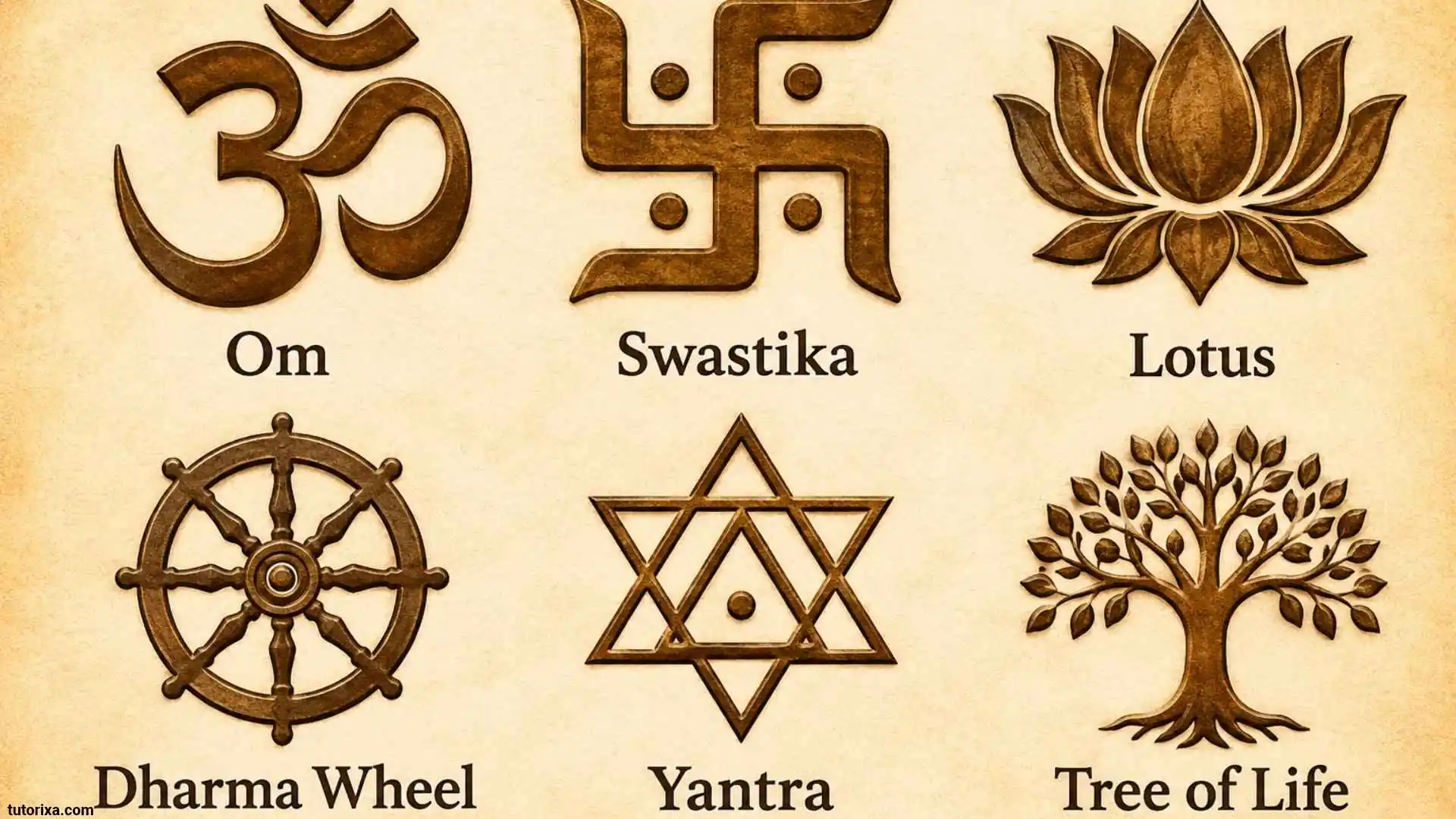
Ancient Indian symbols carry deep meanings connected to spirituality, religion, nature, and everyday life. Many have been used for thousands of years in Hindu traditions, while others are shared across Buddhism, Jainism, and different Indian cultural practices. Each symbol tells a story through its shape, history, and spiritual meaning.
If you are looking for ancient Indian symbols and their meanings, you will find familiar signs such as Om (ॐ), the Swastika (卐), the Lotus (🪷), and the Trishula (🔱). Some represent peace and wisdom, while others are associated with strength, protection, devotion, and spiritual growth.
In this guide, I will explain popular Indian religious symbols, their traditional meanings, and their cultural significance. You will also find symbols you can copy and paste, tattoo inspiration, and examples of Hindu symbols used in spiritual and decorative designs.
Hindu Symbols And Meanings
Hinduism has a rich collection of symbols that express ideas about the universe, divine energy, knowledge, and the human journey toward spiritual freedom. These symbols appear in temples, religious artwork, sacred texts, festivals, jewelry, and daily worship.
Some Hindu symbols represent specific deities, while others communicate broader spiritual ideas. Their meanings can also change depending on the tradition, region, and context in which they are used.
Here are some widely recognized Hindu symbols and their meanings:
| Symbol | Name | Traditional meaning |
| ॐ | Om | Universal sound and ultimate reality |
| 卐 | Swastika | Good fortune, well-being, and auspiciousness |
| 🪷 | Lotus | Purity, spiritual growth, and enlightenment |
| 🔱 | Trishula | Shiva’s power and divine authority |
| डमरू | Damru | Creation, rhythm, and cosmic sound |
| कलश | Kalash | Abundance, prosperity, and auspicious beginnings |
| तिलक | Tilak | Devotion and religious identity |
| नंदी | Nandi | Devotion and service to Shiva |
| शंख | Shankha | Sacred sound, purity, and victory |
| चक्र | Chakra | Divine power, protection, and cosmic order |
These symbols are more than decorative images. They help communicate religious beliefs and cultural values that have been passed down through generations.
Ancient Indian Symbols And Their Meanings

Ancient Indian symbols developed through different religious, philosophical, and cultural traditions. Some are associated with Hinduism, while others are important in Buddhism, Jainism, and older Indian civilizations.
Understanding their meanings helps you recognize the ideas behind traditional Indian artwork, architecture, spiritual objects, and religious practices.
Here are some important ancient Indian symbols:
1. Om (ॐ) – Spiritual Connection
Symbol: ॐ
Om is one of the most sacred symbols in Hinduism. It represents the ultimate reality, often called Brahman, and is associated with the origin and unity of existence. It is also used during meditation, prayer, and spiritual recitation.
2. Swastika (卐) – Good Fortune
Symbol: 卐
The Swastika is an ancient symbol associated with auspiciousness, prosperity, well-being, and good fortune in Hindu traditions. It is commonly drawn during festivals, weddings, housewarming ceremonies, and religious celebrations.
Its traditional Indian religious meaning should be distinguished from the Nazi appropriation of a similar-looking symbol in the twentieth century.
3. Lotus (🪷) – Purity And Spiritual Growth
Symbol: 🪷
The lotus represents purity, beauty, spiritual development, and freedom from worldly attachments. It grows in muddy water but produces a clean flower, making it a powerful image of spiritual growth.
The lotus is associated with several Hindu deities, including Lakshmi and Saraswati.
4. Trishula (🔱) – Divine Power
Symbol: 🔱
The Trishula is the three-pronged weapon of Lord Shiva. It represents divine authority, strength, and the ability to overcome destructive forces. Its three points are also interpreted in different traditions as representing the three gunas or the three aspects of time.
5. Dharma Chakra (☸) – Righteous Living
Symbol: ☸
The Dharma Chakra, or Wheel of Dharma, is especially important in Buddhism. It represents the Buddha’s teachings and the path toward liberation. The wheel also appears in broader Indian religious and philosophical contexts.
6. Shankha (🐚) – Purity And Victory
Symbol: Conch shell
The Shankha is a sacred conch shell used in Hindu worship. Blowing it produces a powerful sound associated with auspicious beginnings, the removal of negativity, and the announcement of divine victory.
7. Kalash – Abundance And Prosperity
Traditional form: कलश
The Kalash is a decorated pot filled with water and often topped with mango leaves and a coconut. It represents abundance, fertility, prosperity, and auspiciousness. It is frequently placed during Hindu ceremonies and religious rituals.
8. Nandi – Devotion And Loyalty
Symbol: Sacred bull
Nandi is the sacred bull and devoted vehicle of Lord Shiva. He represents loyalty, patience, strength, and devotion. Statues of Nandi are commonly placed facing Shiva’s shrine in Hindu temples.
9. Sri Yantra – Cosmic Harmony
Symbol: श्री यन्त्र
The Sri Yantra is a sacred geometric design made from interlocking triangles arranged around a central point called the bindu. It is associated with Goddess Tripura Sundari and represents the union of cosmic principles, divine energy, and spiritual harmony.
10. Matsya – Preservation And Protection
Symbol: Fish
Matsya is the fish incarnation of Lord Vishnu. In Hindu tradition, Vishnu takes this form to protect life and preserve sacred knowledge during a great flood. The symbol is therefore associated with preservation, guidance, and protection.
These examples show how ancient Indian symbols express different aspects of spiritual life, from purity and devotion to cosmic order and divine protection.
Om Hindu Symbol
The Om symbol (ॐ) is one of the most recognizable sacred symbols in Hinduism. It represents the universal sound and the ultimate reality that connects all existence. Many Hindus believe that Om expresses the essence of the universe and the connection between the physical and spiritual worlds.
Om is made up of three main sounds: A, U, and M. These sounds are traditionally connected with different states of consciousness.
Meaning Of The Three Sounds Of Om
| Sound | Traditional association |
| A | Waking state |
| U | Dreaming state |
| M | Deep sleep |
| Silence after the sound | Pure consciousness or transcendental awareness |
Common Uses Of The Om Symbol
- Meditation: Used as a focus during meditation and breathing exercises.
- Prayer: Chanted at the beginning or end of many Hindu prayers.
- Religious artwork: Displayed in temples, homes, and sacred paintings.
- Jewelry: Used in pendants, rings, and bracelets as a spiritual reminder.
- Decorations: Appears on religious posters, wall art, and festival decorations.
Copy and paste Om symbols:
ॐ
Popular
Om symbol: ॐ
Copy
Unicode name: OM. Code point: U+0950.
The Om symbol is also popular in meditation spaces, spiritual tattoos, and social media profiles. However, because it is sacred to many Hindus, it is best used respectfully rather than as an ordinary decorative character.
Indian Religion Symbols With Names
India is home to several major religious traditions, each with its own symbols, stories, and spiritual teachings. Hinduism, Buddhism, Jainism, and Sikhism all have recognizable symbols that represent their beliefs and values.
Some symbols are shared across traditions, but their meanings may differ. Here are important Indian religious symbols with their names and meanings.
| Symbol | Name | Religion or tradition | Meaning |
| ॐ | Om | Hinduism | Ultimate reality and sacred sound |
| 卐 | Swastika | Hinduism, Jainism, Buddhism | Auspiciousness and well-being |
| 🔱 | Trishula | Hinduism | Shiva’s divine power |
| 🪷 | Lotus | Hinduism and Buddhism | Purity and spiritual development |
| ☸ | Dharma Chakra | Buddhism | Buddha’s teachings |
| 卍 | Jain Swastika | Jainism | Four possible states of existence |
| 🖐️ | Ahimsa Hand | Jainism | Nonviolence and compassion |
| ੴ | Ik Onkar | Sikhism | One universal God |
| ਖੰਡਾ | Khanda | Sikhism | Divine truth and spiritual strength |
| Vajra | Vajra | Buddhism and Hindu traditions | Indestructibility and spiritual power |
Hindu Religious Symbols
Hindu symbols are closely connected to deities, sacred teachings, and religious ceremonies. Om represents ultimate reality, the Trishula is associated with Lord Shiva, and the Shankha is connected with Lord Vishnu.
Buddhist Religious Symbols
Buddhist symbols often represent enlightenment, wisdom, and the path to liberation. The Dharma Chakra represents the Buddha’s teachings, while the lotus represents spiritual purity and awakening.
Jain Religious Symbols
Jainism emphasizes nonviolence, truth, and spiritual liberation. The Ahimsa Hand represents the principle of nonviolence, while the Jain Swastika is associated with the four states of existence.
Sikh Religious Symbols
The Ik Onkar symbol expresses the belief in one universal God. The Khanda represents important Sikh principles, including spiritual authority, justice, and the unity of spiritual and worldly responsibilities.
These symbols help explain the diversity of India’s religious heritage. It is useful to identify the tradition behind a symbol rather than treating every Indian religious sign as exclusively Hindu.
Ancient Indian Symbols Of Peace
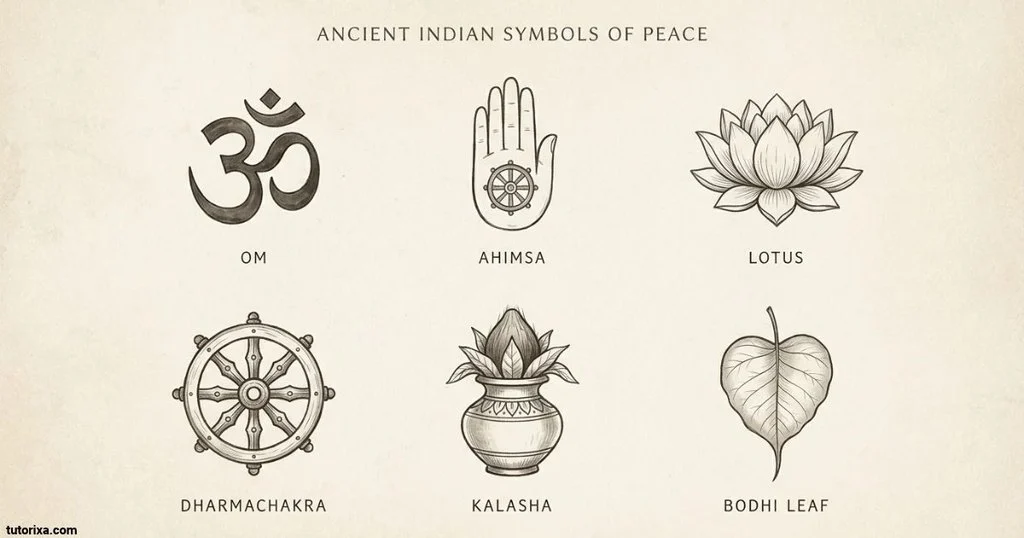
Peace is an important idea in Indian spiritual traditions. It is often connected with nonviolence, inner balance, compassion, meditation, and freedom from negative thoughts.
Several ancient Indian symbols represent these values. Some are connected with Hinduism, while others come from Buddhist and Jain traditions.
Here are some meaningful ancient Indian symbols associated with peace:
1. Lotus Flower (🪷)
The lotus represents purity, spiritual awakening, and peace. Its ability to grow in muddy water while producing a beautiful flower makes it a symbol of remaining calm and pure despite life’s difficulties.
2. Om (ॐ)
Om is associated with meditation, spiritual awareness, and the harmony of existence. Chanting Om is a common practice for people seeking calmness and concentration.
3. Dharma Chakra (☸)
The Dharma Chakra represents the teachings of Buddha and the path toward enlightenment. Its association with wisdom and right living makes it an important symbol of spiritual peace.
4. Ahimsa Hand
Symbol: 🖐️ (visual approximation)
The Ahimsa Hand is an important Jain symbol. It represents nonviolence, compassion, and respect for all living beings. The traditional emblem includes a hand with a wheel in its palm and the word Ahimsa.
5. Bodhi Tree
The Bodhi Tree represents enlightenment and wisdom because Buddha is traditionally believed to have attained enlightenment while meditating beneath a sacred fig tree.
6. Hamsa (Sacred Swan)
In Hindu traditions, the Hamsa, or sacred swan, is associated with wisdom, discernment, and spiritual knowledge. It is connected with Goddess Saraswati and is sometimes used as a symbol of purity and higher understanding.
7. Shanti Symbolism (शान्ति)
Shanti is the Sanskrit word for peace. It is frequently recited in Hindu prayers and spiritual practices. The word itself is a meaningful way to express a wish for peace and harmony.
Quick guide to peace symbols:
| Symbol | Main association |
| 🪷 | Purity and calmness |
| ॐ | Inner harmony |
| ☸ | Wisdom and spiritual peace |
| Ahimsa Hand | Nonviolence |
| 🌳 Bodhi Tree | Enlightenment |
| हंस | Wisdom and purity |
| शान्ति | Peace and tranquility |
These symbols can be used in meditation spaces, spiritual artwork, meaningful gifts, and personal designs. Their traditional religious meanings make them more meaningful than simple decorative images.
Ancient Indian Symbols Of Power
Ancient Indian symbols of power represent strength, courage, divine authority, protection, and the ability to overcome challenges. Many are connected with Hindu gods and goddesses, while others come from India’s wider spiritual traditions.
These symbols appear in temple carvings, religious paintings, traditional weapons, sculptures, and sacred artwork.
Here are some well-known Indian symbols associated with power:
1. Trishula (🔱) – Divine Strength
The Trishula is the sacred trident associated with Lord Shiva. It represents divine authority, destruction of evil, and the power to overcome negative forces.
2. Sudarshana Chakra (☸) – Divine Protection
The Sudarshana Chakra is the spinning discus weapon of Lord Vishnu. It represents divine power, protection, righteousness, and the restoration of cosmic order. The Dharma Chakra character is visually similar to a wheel but is not an exact representation of the Sudarshana Chakra.
3. Vajra – Indestructible Strength
The Vajra is a thunderbolt-like ritual object associated with Indra in Hindu traditions and with spiritual power in Buddhism. It symbolizes indestructibility, firmness, and powerful spiritual energy.
4. Gada (Mace) – Courage And Strength
The Gada is a traditional mace associated with powerful Hindu figures, including Lord Hanuman and Lord Vishnu. It represents physical strength, courage, discipline, and the ability to defeat evil.
5. Lion – Courage And Authority
The lion is associated with Goddess Durga, who is traditionally depicted riding a lion or tiger. It represents bravery, confidence, and the strength to face difficult situations.
6. Garuda – Freedom And Divine Power
Garuda is the mighty eagle-like divine being and vehicle of Lord Vishnu. It represents courage, speed, freedom, and the ability to overcome obstacles.
7. Nandi – Strength And Loyalty
Nandi represents patience, devotion, and disciplined strength. As the vehicle of Lord Shiva, he is a reminder that true power can exist alongside humility and dedication.
8. Tiger – Fearlessness
The tiger is associated with Goddess Durga and represents courage, energy, and the ability to face powerful challenges without fear.
Ancient Indian power symbols at a glance:
| Symbol | Represents |
| 🔱 Trishula | Divine strength |
| Sudarshana Chakra | Protection and righteousness |
| Vajra | Indestructible power |
| Gada | Courage and physical strength |
| Lion | Authority and bravery |
| Garuda | Freedom and divine power |
| Nandi | Loyalty and patience |
| Tiger | Fearlessness |
These symbols are meaningful choices for artwork, jewelry, and personal designs inspired by Indian mythology. Their traditional meanings can also provide inspiration for courage, confidence, and determination.
Hindu Symbols Of Protection
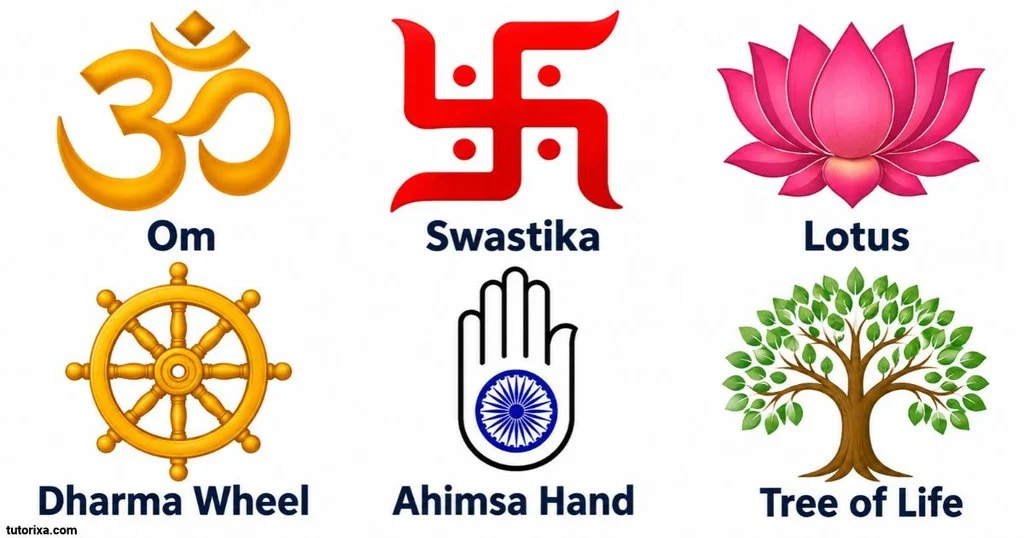
Hindu religious traditions include many symbols believed to represent divine protection, the removal of obstacles, and safety from negative influences. They are commonly found at temple entrances, on religious objects, in homes, and during auspicious ceremonies.
Some are connected with specific deities, while others are used as sacred signs of good fortune.
1. Swastika (卐) – Auspicious Protection
The Swastika is traditionally associated with good fortune, prosperity, and well-being. Hindu families often draw it near entrances, on religious objects, and during festivals to mark auspicious occasions.
2. Trishula (🔱) – Protection From Evil
The Trishula represents Lord Shiva’s divine power. It is commonly associated with the destruction of negative forces and the protection of righteousness.
3. Hanuman Symbol – Courage And Devotion
Lord Hanuman is widely worshipped as a symbol of strength, courage, loyalty, and devotion. His image and traditional gada are commonly used in religious artwork and devotional objects.
4. Garuda – Protection And Freedom
Garuda is associated with Lord Vishnu and is traditionally viewed as a powerful enemy of serpents. His image represents divine protection, courage, and freedom from harmful forces.
5. Shankha – Sacred Protection
The Shankha is used during Hindu worship to produce an auspicious sound. It is associated with purity, divine presence, and the removal of negativity.
6. Kalash – Blessings And Prosperity
The Kalash is used in religious ceremonies to represent abundance, fertility, and auspicious blessings. It is commonly placed during weddings, housewarming ceremonies, and other important events.
7. Nazar Battu – Protection From The Evil Eye
Nazar Battu is a popular protective charm in Indian folk traditions. It is believed by some people to protect against the evil eye or unwanted attention. It is a folk-cultural practice rather than a universal Hindu religious symbol.
8. Durga Symbol – Divine Protection
Goddess Durga represents the power of divine feminine energy. Her image, often shown with several arms and weapons, symbolizes the destruction of evil and protection of good.
Popular Hindu protection symbols:
| Symbol | Protective association |
| 卐 | Good fortune and well-being |
| 🔱 | Shiva’s divine power |
| Hanuman | Courage and devotion |
| Garuda | Divine protection |
| Shankha | Purity and auspiciousness |
| Kalash | Blessings and prosperity |
| Nazar Battu | Protection from the evil eye |
| Durga | Victory over evil |
Remember that these meanings belong to religious beliefs and cultural traditions. A symbol may be meaningful as a spiritual reminder, but it should not be treated as a guaranteed form of physical protection.
Hindu Symbols Tattoos
Hindu symbols tattoos are popular among people who want body art connected with spirituality, devotion, strength, peace, and personal beliefs. Many traditional designs have deep religious meanings, so understanding a symbol before choosing it is essential.
Some people choose a small Om tattoo, while others prefer detailed designs featuring the Trishula, lotus, or sacred geometric patterns.
Popular Ancient Indian Tattoo Symbols
Here are some tattoo ideas inspired by Indian spiritual and religious traditions.
| Tattoo symbol | Meaning | Design idea |
| ॐ | Spiritual connection | Small wrist or forearm tattoo |
| 🔱 Trishula | Strength and divine power | Arm or shoulder design |
| 🪷 Lotus | Purity and growth | Minimalist wrist or back tattoo |
| ☸ Dharma Chakra | Wisdom and spiritual direction | Circular geometric design |
| Sri Yantra | Cosmic harmony | Detailed geometric tattoo |
| स्वस्तिक | Auspiciousness | Traditional religious artwork |
| हंस | Wisdom and purity | Swan-inspired design |
| शान्ति | Peace | Sanskrit lettering |
1. Om Tattoo
An Om tattoo represents spiritual awareness, universal consciousness, and devotion. It is a popular choice for people who practice meditation or feel connected to Hindu philosophy.
2. Trishula Tattoo
A Trishula tattoo is associated with Lord Shiva and represents courage, strength, and the ability to overcome difficulties. Some designs combine it with a crescent moon or other Shiva-related imagery.
3. Lotus Tattoo
A lotus tattoo represents personal growth, purity, and spiritual development. It can be designed as a small flower or a detailed mandala-style pattern.
4. Sri Yantra Tattoo
The Sri Yantra is a detailed geometric design that represents cosmic harmony and divine energy. Because of its sacred significance and complex structure, accuracy matters when using it as a tattoo.
5. Sanskrit Tattoo
Sanskrit words such as शान्ति (peace), धर्म (dharma), and सत्यम् (truth) can be used for meaningful tattoo designs. Always verify the spelling, grammar, and intended meaning with someone knowledgeable in Sanskrit before making it permanent.
Things To Consider Before Getting A Hindu Tattoo
- Understand the meaning: Choose a symbol because you understand and respect its traditional significance.
- Check the design: Make sure the artist reproduces the symbol correctly.
- Consider placement: Some Hindus consider placing sacred symbols below the waist or on the feet disrespectful.
- Verify Sanskrit spelling: A small writing mistake can change the meaning.
- Respect religious traditions: Sacred symbols should not be treated as meaningless fashion decorations.
A meaningful tattoo should reflect your personal intention while respecting the religious and cultural background of the design.
Hindu Symbols Text
If you want to use Hindu symbols in messages, social media bios, captions, or decorative designs, copy-and-paste characters are a convenient option.
The following collection includes sacred symbols, religious characters, and traditional Sanskrit words that you can copy directly.
Hindu Symbols For Copy And Paste
Popular Hindu Symbols

ॐ
Om
Copy
卐
Swastika
Copy
卍
Swastika variant
Copy
☸
Dharma Wheel
Copy
🕉️
Om emoji
Copy
🔱
Trishula
Copy
🪷
Lotus
Copy
☯
Yin Yang
Copy
✺
Decorative star
Copy
Hindu Sanskrit Symbols And Words
Sanskrit is an ancient language with an important place in Hindu religious and philosophical traditions. Many Sanskrit words are used as spiritual expressions and decorative text.
| Sanskrit text | Meaning |
| ॐ | Om, sacred sound |
| शान्ति | Peace |
| धर्म | Dharma or righteous duty |
| कर्म | Karma or action |
| सत्य | Truth |
| प्रेम | Love |
| शक्ति | Power or divine energy |
| ज्ञान | Knowledge |
| भक्ति | Devotion |
| मोक्ष | Liberation |
Hindu Symbols For Instagram And WhatsApp
You can use these combinations in social media bios, captions, and messages.
- ॐ नमः शिवाय
- हर हर महादेव 🔱
- जय श्री राम 🚩
- राधे राधे 🪷
- ॐ शान्तिः शान्तिः शान्तिः
- जय माता दी 🙏
- सत्यमेव जयते
- ॐ नमो भगवते वासुदेवाय
Decorative Hindu Symbol Combinations
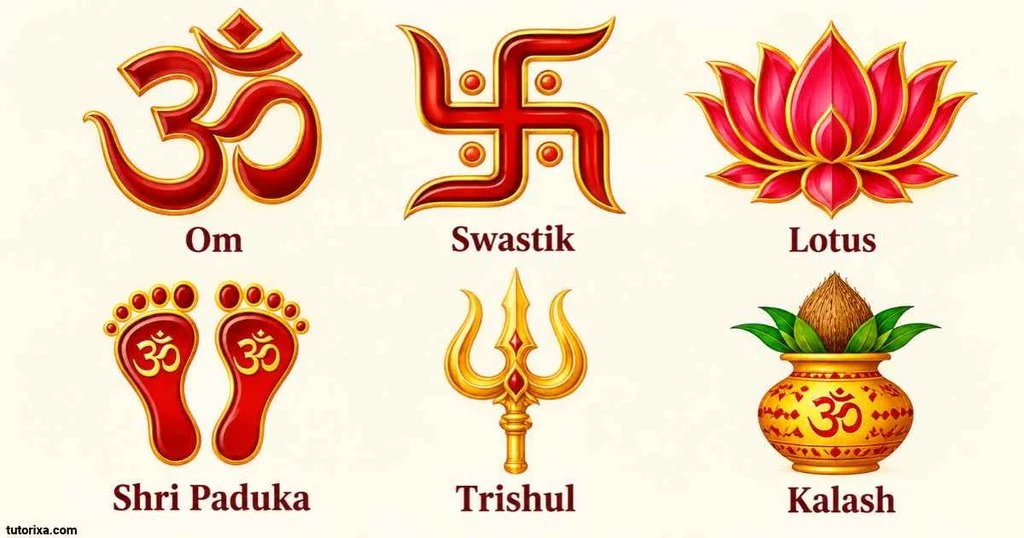
Here are some simple combinations for captions and spiritual designs:
꧁ॐ꧂
Copy
✧ ॐ ✧
Copy
༺🔱༻
Copy
☸ ॐ ☸
Copy
🪷 शान्ति 🪷
Copy
॥ हर हर महादेव ॥
Copy
ॐ नमः शिवाय ॐ
Copy
A small compatibility tip: Text characters and emoji may look different across phones, browsers, and applications. Some decorative combinations may not display correctly on every device. If a symbol appears as an empty square, try another font or application.
Frequently Asked Questions
What Is The Most Powerful Ancient Indian Symbol?
The Om symbol (ॐ) is among the most sacred symbols in Hinduism. The Trishula, Sudarshana Chakra, and Vajra are also associated with divine power and spiritual strength. Their meanings depend on their religious traditions.
What Is The Oldest Symbol In Indian Culture?
The Swastika is among the oldest widely recognized symbols found in the Indian subcontinent. Swastika motifs appear in ancient archaeological contexts, including the Indus Valley Civilization, although the exact meanings of particular ancient examples are not always known.
Which Indian Symbol Represents Peace And Harmony?
The lotus, Om, and Dharma Chakra are commonly associated with spiritual peace and harmony. The Sanskrit word शान्ति (Shanti) directly means peace.
Which Hindu Symbol Represents Protection From Evil?
The Trishula, Swastika, and images of Lord Hanuman and Goddess Durga are traditionally associated with protection and overcoming negative forces.
Can I Use Ancient Indian Symbols In My Tattoo Or Social Media Bio?
Yes, you can use many ancient Indian symbols in tattoos, social media bios, and decorative designs. However, sacred symbols such as Om and religious images should be used with an understanding of their cultural and spiritual significance.
Conclusion
Ancient Indian symbols offer a fascinating look into India’s religious, spiritual, and cultural heritage. From Om and the Swastika to the Lotus, Trishula, and Dharma Chakra, each symbol represents ideas that have been meaningful across generations.
Some symbols express peace, wisdom, and spiritual growth, while others represent courage, divine power, protection, and devotion. Their meanings become easier to understand when you learn about the religious traditions and stories connected with them.
If you want to use these symbols in artwork, tattoos, messages, or social media designs, take time to understand their meanings first. Choosing a symbol with the right cultural and spiritual context makes it more meaningful and respectful.

I’m Ellis Montgomery, a British writer interested in the powerful language of symbols. I explore everything from traditional emblems and cultural signs to contemporary symbols found in modern life. My aim is to explain their meanings clearly while revealing the stories and ideas behind them, making symbolism fascinating and accessible to everyone.
Books:
- The Complete Book of Symbols
- Hidden Messages in Everyday Symbols
 Rowan Whitaker
 Freddie Beaumont