
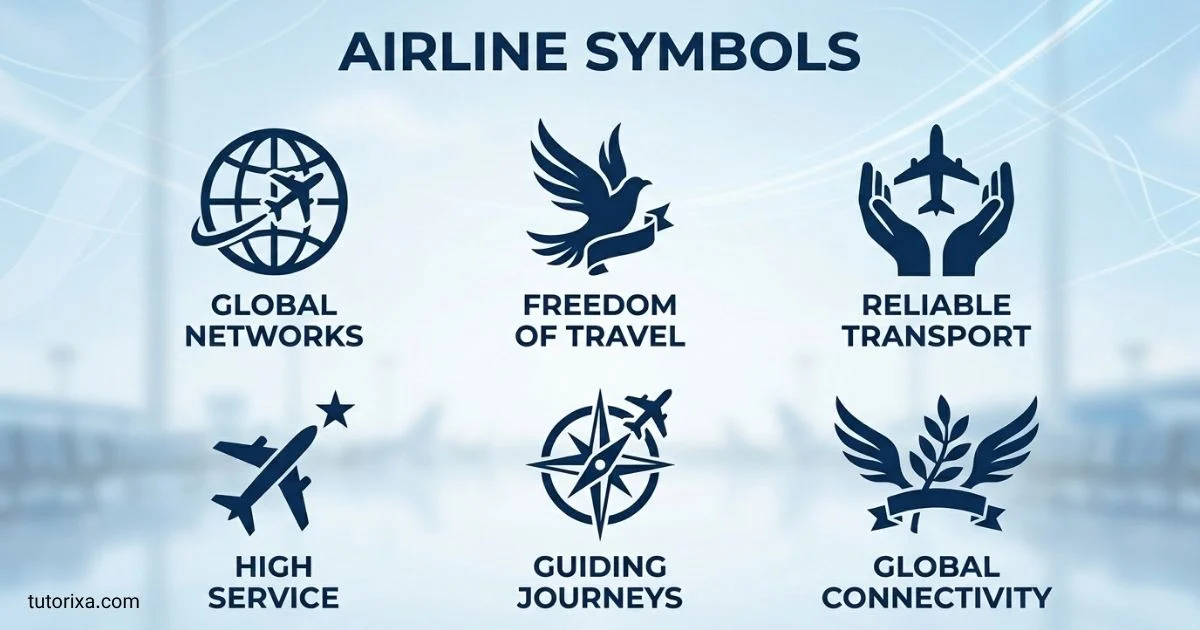
Have you ever looked at an airline logo or aviation icon and wondered what it really means? From familiar airline logos to important airport and travel symbols, these small designs can tell you a lot about the world of air travel.
I created this guide to help you understand airline symbols without confusion. Whether you love aviation, travel frequently, or simply want to learn what different airline icons represent, you’ll find clear and useful explanations here.
Discover the meanings behind popular airline symbols and the stories their designs tell. Explore recognizable logos, common aviation icons, and helpful details that make every symbol easier to understand.
Quick Meaning of Airline Symbols
Airline symbols are visual representations used to identify airlines, communicate aviation information, and guide passengers through airports. They include airline logos, aircraft markings, airport pictograms, baggage icons, and flight-status indicators. Their meanings depend on context: a logo identifies a company, while a standardized airport sign communicates directions, facilities, safety information, or passenger services.
Airline Symbols Overview Table
The following table summarizes common airline-related symbols and their primary meanings.
| Symbol or Sign | Primary Meaning | Category | Common Location | Modern Use |
| Airline tail logo | Identifies an airline | Branding | Aircraft tail | Airline recognition |
| Stylized bird | Often suggests flight or freedom | Branding | Airline logos | Brand identity |
| Globe | May represent international travel | Branding | Logos and websites | Global connectivity |
| Wings | Suggest flight, movement, or aviation | Branding | Logos and uniforms | Aviation identity |
| Airplane pictogram | Represents air travel or aircraft | Transportation | Airport signs and maps | Directions and information |
| Departures sign | Directs passengers to departing flights | Airport wayfinding | Terminals | Passenger navigation |
| Arrivals sign | Directs passengers to arriving flights | Airport wayfinding | Terminals | Passenger navigation |
| Baggage claim sign | Directs passengers to checked luggage | Airport wayfinding | Arrival areas | Luggage collection |
| Baggage allowance icon | Indicates baggage-related information | Passenger services | Tickets and websites | Luggage policies |
| Check-in symbol | Identifies passenger check-in services | Passenger services | Terminals and apps | Flight preparation |
| Security screening symbol | Indicates a security checkpoint | Airport operations | Terminal entrances | Passenger screening |
| Accessible travel symbol | Indicates accessibility facilities or services | Accessibility | Airports and aircraft facilities | Inclusive travel |
| No-smoking symbol | Prohibits smoking in a designated area | Safety | Airports and aircraft | Safety compliance |
| Flight-status indicator | Communicates flight information | Digital interface | Screens and apps | Travel updates |
| IATA airline code | Identifies an airline using a two-character code | Aviation identification | Tickets and reservations | Booking and operations |
| ICAO airline designator | Identifies an airline using a three-letter designator | Aviation identification | Flight plans and operations | Aviation communication |
Important distinction: Airline logos are brand-specific and may have trademark protection. Airport signs are often designed around common pictograms and recognized wayfinding conventions. Airline codes are identification systems, not decorative symbols.
What Do Airline Symbols Mean?
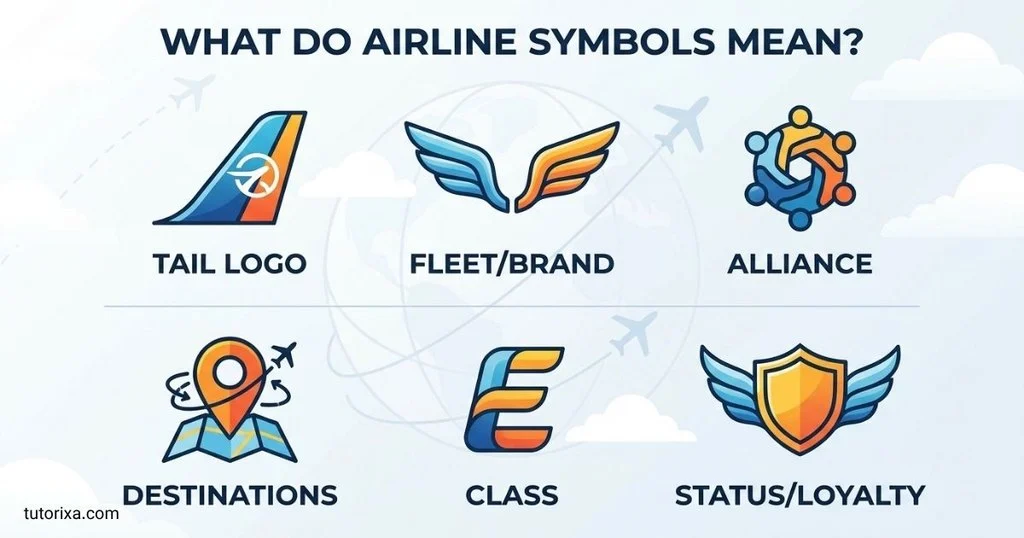
Airline symbols communicate three main types of information: identity, navigation, and operational status. Understanding which category a symbol belongs to helps you interpret it correctly.
1. Airline Logos and Brand Symbols
An airline logo identifies a company and distinguishes it from other carriers. Airlines use logos on aircraft, uniforms, boarding passes, websites, airport counters, and promotional materials.
The design may include a bird, globe, wing, star, flag-inspired pattern, geometric shape, or stylized letter. These elements can communicate ideas such as speed, reliability, national identity, exploration, or international service.
For example, an airline may use a bird to suggest freedom and movement. However, the bird’s precise meaning depends on the airline’s own branding. It would be inaccurate to assume that every bird-shaped airline logo represents the same idea.
2. Airport Wayfinding Symbols
Airport wayfinding symbols help passengers find essential locations without needing to read lengthy instructions.
Common examples include:
- Departures: Directs travelers toward departure areas and flight information.
- Arrivals: Identifies areas associated with arriving passengers.
- Baggage claim: Points toward the location where checked luggage is collected.
- Restroom: Identifies toilet facilities.
- Information desk: Marks a location where passengers can ask for assistance.
- Security screening: Indicates an area where passengers and belongings undergo screening.
- Ground transportation: Helps travelers find services such as taxis, buses, or other transport options.
These symbols are particularly valuable in international airports, where passengers may speak many different languages.
3. Aviation Identification Codes
Airlines also use standardized codes to identify companies in reservations, flight schedules, and operational communication.
The International Air Transport Association (IATA) assigns airline designator codes commonly used in commercial reservations and ticketing. The International Civil Aviation Organization (ICAO) assigns three-letter airline designators used in aviation operations.
For example, American Airlines uses the IATA code AA and the ICAO designator AAL. These codes identify the carrier rather than representing a visual logo.
4. Digital Airline Icons
Flight-booking websites and travel applications use icons to make information easier to scan.
A suitcase may indicate baggage details, a clock may represent departure time or duration, and an airplane may indicate a flight segment. A warning symbol may flag a schedule change or important restriction.
The same icon can have slightly different meanings across applications, so nearby labels and explanatory text remain important.
History and Origin of Airline Symbols
Airline symbols developed from the growth of commercial aviation, corporate identity, international travel, and standardized transportation signage.
Early Aviation and Aircraft Identification
During the early development of aviation, aircraft markings helped identify operators, military units, manufacturers, and national affiliations. As commercial passenger services expanded during the early twentieth century, airlines increasingly used distinctive names and visual identities.
Aircraft were highly visible public symbols of technological progress. Painting a recognizable logo or color scheme on an aircraft helped a company stand out and made its planes easier for passengers to identify.
The Growth of Commercial Airline Branding
As passenger aviation expanded after World War II, airlines invested more heavily in consistent branding. Logos, typography, cabin uniforms, airport counters, advertisements, and aircraft liveries became parts of a coordinated visual identity.
Airlines often selected designs intended to communicate professionalism, comfort, speed, modernity, or a connection to their home country.
Some companies used national colors or recognizable geographic features. Others preferred abstract shapes that could be reproduced clearly on aircraft tails and printed materials.
Standardized Airport Signage
Airport signs serve a different purpose from airline branding. Their main goal is to help passengers find places and understand instructions.
As airports became larger and international travel increased, clear pictograms and consistent sign layouts became increasingly important. Transportation authorities and airport operators adopted wayfinding systems designed to remain understandable across language barriers.
International guidance, including materials published by ICAO, addresses aspects of aviation safety signs and airport-related operations. Individual airports may also apply national requirements and local design standards.
The Digital Era
Today, airline symbols appear on mobile boarding passes, electronic departure boards, booking applications, digital maps, and flight-tracking services.
Small icons must remain recognizable on different screen sizes. As a result, modern digital interfaces often use simplified versions of familiar shapes, accompanied by text where additional clarity is necessary.
The purpose of airline symbols has therefore expanded from identifying aircraft and companies to helping passengers navigate a connected travel system.
Symbolism and Interpretation of Airline Logos
Airline logos often use recognizable shapes to communicate brand values, but their meanings should be interpreted carefully.
Birds: Freedom and Flight
Birds are common motifs in aviation branding because they naturally suggest flight, movement, and freedom.
An eagle may communicate strength or confidence, while a more abstract bird may suggest elegance or agility. These are common design associations, not universal meanings that apply to every airline.
Wings: Movement and Aviation
Wings directly connect a brand with flight. They can also suggest speed, progress, protection, or the ability to travel beyond geographical boundaries.
Wings are used in many aviation contexts, including pilot insignia, military aviation badges, and airline branding. Their precise significance depends on the design and institution using them.
Globes: International Connectivity
A globe can communicate international routes, worldwide service, and connections between countries.
Airlines that operate across multiple continents may use globe-inspired graphics to emphasize their international reach. However, a globe in a logo does not prove that an airline serves every region of the world.
Stars: Excellence and Direction
Stars can suggest quality, aspiration, navigation, or prestige. Some airlines use stars as central branding elements, while others include them as smaller decorative details.
A star’s meaning depends on the brand’s official explanation and visual context. It should not automatically be interpreted as a religious or political symbol.
Flags and National Colors
Some airlines use national flags, flag-inspired shapes, or familiar national colors to communicate a connection with a country.
This association can be especially important for national or flag carriers. However, an airline’s ownership, nationality, and operating rights cannot always be determined from its logo alone.
Positive and Negative Interpretations
Airline logos generally aim to create positive associations, such as trust, comfort, movement, and connection.
A symbol may nevertheless have different associations for different audiences. A color or shape that appears modern in one cultural setting may carry historical or political significance in another.
For this reason, airline symbolism should be interpreted through the company’s branding history, cultural context, and intended audience rather than through assumptions about individual shapes.
Cultural Significance of Airline Symbols
Airline symbols connect transportation with national identity, cultural heritage, and international communication.
National Identity and Flag Carriers
Some airlines reflect their home countries through colors, flags, animals, landscapes, or geometric designs associated with national imagery.
These visual choices can help passengers recognize a carrier’s national connection. They may also communicate cultural heritage to travelers who are familiar with the imagery.
However, an airline’s visual identity does not necessarily indicate that it is government-owned. A company can use national imagery while operating under a different ownership structure.
Regional Design Traditions
Airline branding sometimes incorporates regional patterns, calligraphy, indigenous motifs, or local artistic traditions.
Such elements can make a brand distinctive and communicate a connection with a particular place. Their meaning depends on the specific design and the culture from which it comes.
It is important not to treat all designs from a geographic region as interchangeable. Patterns that look similar to an unfamiliar observer may have different histories or meanings.
International Airport Pictograms
Airport signs are designed for passengers from many backgrounds. A suitcase, airplane, or restroom pictogram can communicate a practical message without requiring fluency in the local language.
Even so, pictograms are not perfectly universal. Passengers may misunderstand unfamiliar signs, particularly when a symbol is abstract or when local conventions differ.
Text labels, arrows, multilingual instructions, and staff assistance help reduce these problems.
Religious or Spiritual Meaning of Airline Symbols
Airline symbols do not have a universal religious meaning, although some logos may incorporate imagery that has religious, cultural, or historical associations.
An airline might use a star, crescent-like shape, bird, or other recognizable form as part of its branding. The presence of that form does not automatically establish a religious purpose.
Some visual elements have several meanings across different traditions. A star, for instance, can be used in navigation, decoration, national symbolism, religious art, or corporate identity.
The most reliable interpretation comes from the airline’s official explanation and the symbol’s documented context. Unless an airline explicitly identifies a religious meaning, it is better to describe the design neutrally rather than assign it a spiritual significance without evidence.
Scientific and Technical Meaning of Airline Symbols
Airline symbols are closely connected with technical identification, flight operations, passenger information, and aviation safety.
IATA and ICAO Codes
The two main airline identification systems serve related but different purposes.
| Feature | IATA Airline Designator | ICAO Airline Designator |
| Organization | International Air Transport Association | International Civil Aviation Organization |
| Typical format | Two characters | Three letters |
| Common uses | Reservations, tickets, schedules | Flight plans and operational communications |
| Example | AA for American Airlines | AAL for American Airlines |
| Main purpose | Commercial airline identification | Aviation operational identification |
The codes should not be confused with airport codes. For example, the three-letter code used to identify an airport is a different type of identifier from an ICAO airline designator.
Aircraft Registration and Nationality Marks
Aircraft also carry registration markings that identify individual aircraft in the applicable civil aviation registration system.
These markings are different from airline logos. One airline may operate many aircraft, each with its own registration. An aircraft may also change operators while retaining a registration, subject to the relevant rules.
Registration marks support identification and regulatory oversight; they are not simply decorative branding.
Flight Status Icons
Airline websites and airport screens use status labels and icons to describe a flight’s progress.
Common terms include:
- Scheduled: The flight is planned for the listed time.
- Boarding: Passengers are being invited to board or the boarding process is underway.
- Delayed: The flight is expected to depart or arrive later than scheduled.
- Cancelled: The flight will not operate as planned.
- Departed: The aircraft has left the departure airport.
- Landed: The aircraft has arrived at its destination airport.
A symbol may accompany one of these labels, but the written status is usually more informative than the icon alone.
Safety and Accessibility Signs
Aviation environments use signs to identify restricted areas, emergency equipment, escape routes, and other safety-related information.
Accessibility symbols can identify facilities or services intended to help passengers with disabilities. Their exact application depends on the facility, local requirements, and available services.
Passengers should always follow official instructions and posted signs rather than relying on a general interpretation of a pictogram.
Where Airline Symbols Are Used
Airline symbols appear throughout the passenger journey, from booking a flight to collecting luggage after landing.
Aircraft and Airport Terminals
Airline logos appear on aircraft tails, fuselages, check-in counters, uniforms, and boarding gates. They help passengers identify their carrier and locate the appropriate services.
Airport pictograms appear on directional signs, information boards, elevators, restrooms, and transport connections.
Boarding Passes and Tickets
Boarding passes may display airline logos, carrier codes, seat information, baggage details, boarding groups, and flight numbers.
The airline logo helps identify the carrier, while the flight number and other information identify the particular service. The logo alone does not establish the passenger’s departure time, gate, or seat.
Baggage Tags and Luggage Areas
Baggage tags use printed identifiers and barcodes to help route luggage through airport systems.
Airline names and codes may appear alongside airport codes and routing information. Passengers should use the claim tag and official baggage instructions rather than trying to interpret every printed code independently.
Websites and Mobile Applications
Travel websites use symbols to communicate baggage allowances, meal availability, flight duration, aircraft information, and service options.
Because each booking platform can design its own interface, an icon may not have exactly the same meaning everywhere. Labels and policy details should be checked before making travel decisions.
Aviation Publications and Educational Materials
Airline logos, aircraft markings, and airport pictograms also appear in aviation books, maps, educational resources, and historical collections.
These materials help explain the development of commercial aviation, airline branding, and the systems used to manage international travel.
Common Variations in Airline Symbols
Airline symbols vary according to branding decisions, operational requirements, and the medium in which they appear.
Airline Logo Variations
An airline may use a full logo with its name, a simplified symbol, a monochrome version, or a compact design for small digital screens.
The aircraft livery may feature a different arrangement of the same visual identity. This does not necessarily mean the airline has changed ownership or adopted an entirely new brand.
Airport Sign Variations
Airports may use different colors, fonts, arrows, and layouts according to local design systems and applicable standards.
A pictogram for baggage claim may be accompanied by text in one airport and appear with a directional arrow in another. The main purpose remains navigation, but the presentation can differ.
Airline Codes and Airport Codes
Codes are easy to confuse because they appear together on tickets and flight boards.
Airline codes identify carriers, while airport codes identify locations. Flight numbers combine an airline designator with a numerical identifier, although formatting varies by system.
Understanding this distinction helps passengers read travel documents more accurately.
Similar-Looking Aviation Symbols
A bird, wing, arrow, or star can appear in many unrelated airline logos. Visual similarity does not prove that two airlines are connected.
To establish a genuine relationship, consult official company information, corporate histories, or documented branding changes.
Common Misconceptions About Airline Symbols
Misconception 1: Every airline logo has a hidden meaning.
Many logos are designed to suggest broad ideas, but some are primarily distinctive visual marks. A symbol’s meaning should not be invented when the airline has not documented it.
Misconception 2: A bird always represents freedom.
Birds commonly suggest flight or freedom, but the intended meaning varies. The bird may instead represent a national animal, regional identity, or a specific corporate concept.
Misconception 3: Every airplane icon represents a specific airline.
A generic airplane pictogram usually represents air travel or aircraft, not an individual company. Airline logos are generally more distinctive.
Misconception 4: Airline codes and airport codes are interchangeable.
They are separate identification systems. Confusing them can lead to errors when reading tickets, flight schedules, or operational information.
Misconception 5: National colors prove government ownership.
Colors and flag-inspired designs can communicate national identity without establishing the ownership structure of the airline.
Misconception 6: Similar logos mean airlines are affiliated.
Two carriers may independently use stars, birds, wings, or globes. Similar visual elements do not prove a corporate relationship.
Misconception 7: Airport pictograms have exactly the same design everywhere.
International conventions encourage clarity, but airports may differ in layout, labels, colors, and local requirements.
10 Interesting Facts About Airline Symbols

1. Aircraft tails provide a highly visible branding surface. Their height and distinctive shape make them useful for displaying airline identities that passengers can recognize from a distance.
2. Airline logos and aircraft registrations serve different purposes. A logo identifies a brand, while registration markings identify an individual aircraft within the applicable registration system.
3. IATA and ICAO codes are not the same. They were developed for different identification needs, which is why a carrier can have both a two-character IATA code and a three-letter ICAO designator.
4. Airport pictograms reduce dependence on language. A recognizable suitcase or airplane can help travelers understand a sign even if they do not read the local language.
5. Airline branding can communicate national identity. Some carriers use flag-inspired colors or cultural motifs to reinforce their connection with a country or region.
6. A logo can change without changing the airline’s core identity. Companies sometimes modernize typography, simplify shapes, or update aircraft paint schemes while retaining recognizable elements.
7. Digital icons must work at small sizes. A symbol displayed on a mobile boarding pass needs to remain legible on a screen much smaller than an airport information board.
8. Flight numbers are not complete airline logos. A flight number helps identify a particular scheduled service, while the associated airline code identifies the carrier.
9. Accessibility symbols have practical consequences. These signs can direct passengers toward relevant facilities and services, making them an important part of inclusive airport design.
10. A familiar shape can communicate different messages. A star may represent a brand, a destination, a decorative feature, or a navigation concept. Context is essential to interpreting it accurately.
Related Symbols in Aviation
Several related symbols help explain the wider visual language of air travel.
| Related Symbol | Meaning | Difference From Airline Symbols |
| Airport codes | Identify airports and locations | Refer to places rather than airline brands |
| Aircraft registration marks | Identify an individual aircraft | Serve identification and regulatory purposes |
| Aviation warning signs | Communicate hazards or restrictions | Focus on safety rather than branding |
| Runway markings | Provide visual guidance to pilots | Support aircraft movement and operations |
| Air traffic control symbols | Represent aircraft or operational information in specific systems | Support aviation monitoring and coordination |
| Luggage pictograms | Identify baggage-related services | Help passengers navigate luggage processes |
| Navigation arrows | Indicate direction | Guide movement rather than identify a company |
| Emergency exit signs | Identify escape routes or exits | Communicate safety instructions |
These categories work together to make air travel more understandable. Airline logos help passengers identify companies, airport signs guide them through buildings, and technical markings support safe and orderly aviation operations.
Frequently Asked Questions About Airline Symbols
1. What are airline symbols?
Airline symbols are visual marks used to identify airlines, communicate travel information, and guide passengers through airports. They include corporate logos, aircraft markings, airport pictograms, and digital flight indicators. Some are unique to individual companies, while others follow widely recognized transportation or safety conventions.
2. What does a bird mean in an airline logo?
A bird in an airline logo often suggests flight, freedom, speed, or movement. Some designs may also represent a national animal, a regional identity, or a particular corporate idea. The exact meaning depends on the airline’s documented branding rather than on a universal rule about bird symbolism.
3. What is the difference between an airline symbol and an airport symbol?
An airline symbol usually identifies a carrier or its brand, while an airport symbol typically provides directions or practical information. For example, an airline logo identifies a company, whereas a baggage-claim pictogram directs passengers toward luggage collection. Both are important, but they serve different purposes.
4. What do airline codes such as AA and AAL mean?
Airline codes identify carriers in different aviation systems. IATA airline designators commonly use two characters and appear in commercial reservations and ticketing. ICAO airline designators use three letters and support operational aviation communication. American Airlines, for example, uses AA as its IATA code and AAL as its ICAO designator.
5. Why do airlines use stars, wings, and globes in their logos?
Stars, wings, and globes can communicate broad ideas such as excellence, flight, direction, and international connectivity. These visual associations help companies establish a recognizable identity. However, their specific meanings vary between brands, and a shape should not be assigned a precise historical, religious, or cultural meaning without supporting evidence.
6. Are airline symbols standardized worldwide?
Not all airline symbols are standardized. Airline logos are individual brand identities, while certain airport signs, safety markings, and operational identifiers are influenced by international guidance or national regulations. The precise design of a sign may still vary by airport, country, and application.
7. What do baggage symbols mean at an airport?
Baggage symbols generally identify services or areas associated with luggage. A suitcase pictogram may direct passengers toward baggage claim, while an icon on a booking website may explain checked-baggage or carry-on allowances. Always read the accompanying label or airline policy because baggage rules can vary by fare, route, and carrier.
8. How can I identify an unfamiliar airline logo?
Start by checking the logo on the aircraft, ticket, boarding pass, or airline website. Look for the company’s written name or airline code, then compare it with official carrier information. Avoid identifying an airline from a generic bird, star, or wing alone because many unrelated companies use similar design elements.
9. Do airline logos have religious meanings?
Most airline logos are corporate identity marks, and they do not necessarily have religious significance. Some may incorporate shapes that also appear in religious or cultural traditions, but that resemblance alone does not establish an intended religious meaning. The airline’s official branding explanation and historical context provide the most reliable evidence.
10. Why are symbols important in airports?
Symbols help passengers navigate large terminals, find services, understand instructions, and identify relevant facilities. They are particularly valuable when travelers speak different languages or need to make quick decisions. Clear pictograms, directional arrows, text labels, and staff assistance work together to make airports easier to navigate.
Key Takeaways
- Airline symbols include logos, airport pictograms, aircraft markings, airline codes, and digital travel icons.
- Airline logos primarily identify companies and communicate brand identity.
- Birds, wings, stars, and globes often suggest flight, movement, quality, or international connectivity, but meanings vary.
- Airport pictograms help passengers find departures, arrivals, baggage claim, restrooms, and other services.
- IATA airline designators and ICAO airline designators serve different identification purposes.
- Aircraft registration marks identify individual aircraft rather than airline brands.
- Airport signs and safety symbols may follow international guidance and national regulations, but their appearance can vary.
- Similar logos do not necessarily indicate that airlines are affiliated.
- Cultural, historical, or religious interpretations should be based on evidence rather than assumptions.
- The context in which a symbol appears is the best starting point for understanding its meaning.
Conclusion
Airline symbols are an essential part of the visual language of modern aviation. They help passengers recognize airlines, read travel documents, navigate airports, understand baggage services, and interpret important flight information. From a distinctive aircraft-tail logo to a simple baggage-claim pictogram, each symbol serves a particular purpose within the broader travel experience.
Although birds, wings, stars, and globes often communicate ideas such as flight, progress, and international connection, their meanings are not universal. The airline’s identity, cultural background, and documented design choices determine how a logo should be understood.
By learning the difference between airline branding, airport signage, airline codes, and technical aircraft markings, you can interpret airline symbols and their meanings more accurately. These visual elements do more than decorate aircraft and terminals: they help connect passengers with the information and services they need throughout their journey.

I’m Freddie Beaumont, a British author with a passion for discovering what symbols communicate without words. I write about their history, meanings, and everyday uses in an accessible way. I believe symbols tell fascinating stories about people, cultures, and ideas, and my work helps readers recognise and understand those stories more clearly.
Books:
- Symbols and Their Hidden Meanings
- Understanding Signs and Symbols
 Rowan Whitaker
 Ellis Montgomery