
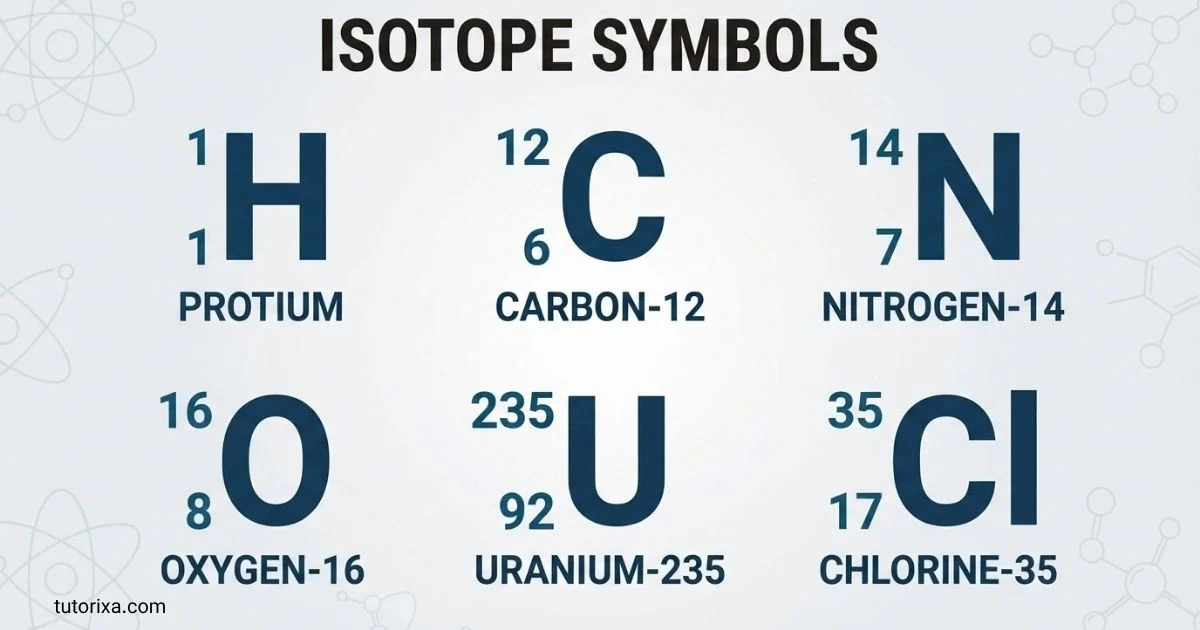
When I first learned about isotope symbols, the notation looked more complicated than it really was. You may feel the same way, especially when numbers, elements, protons, and neutrons all appear together.
I’ll break isotope symbols down into simple, clear steps so you can understand what every number means. You don’t need to memorize confusing rules when you understand the basic pattern.
By the end, I want you to feel confident reading and writing isotope symbols on your own. Whether you’re studying chemistry or simply reviewing the basics, this guide will make the topic much easier to understand.
Quick Meaning
An isotope symbol identifies a particular isotope of an element. In standard nuclide notation, the mass number is written at the upper left of the element symbol, while the atomic number appears at the lower left: ᴬZX. The mass number equals protons plus neutrons, while the atomic number identifies the element by its number of protons.
Isotope Symbols Overview
| Field | Explanation |
| Symbol Name | Isotope or nuclide notation |
| Primary Meaning | Identifies a specific isotope of an element |
| Category | Chemistry, atomic physics, nuclear science |
| Standard Form | ᴬZX |
| Mass Number | Written as a superscript on the left |
| Atomic Number | Written as a subscript on the left |
| Element Symbol | Chemical symbol such as H, C, O, or U |
| Neutron Number | Calculated as mass number − atomic number |
| Common Alternative | Element name or symbol followed by mass number, such as carbon-14 |
| Common Usage | Chemistry, nuclear physics, medicine, geology, archaeology |
| Radioactive Isotopes | Often identified by their mass number, such as carbon-14 |
| Stable Isotopes | Examples include carbon-12 and carbon-13 |
| Related Concepts | Atomic number, mass number, nuclide, radioactive decay, half-life |
What Do Isotope Symbols Mean?
An isotope symbol tells you exactly which isotope of an element is being discussed. The standard notation is:
ᴬZX
Here:
- A = mass number
- Z = atomic number
- X = chemical symbol of the element
For example:
¹⁴₆C
This represents carbon-14.
The C tells you that the element is carbon. The subscript 6 tells you that carbon has six protons. The superscript 14 tells you that the nucleus contains 14 total nucleons, meaning protons and neutrons combined.
You can determine the number of neutrons with a simple calculation:
Neutrons = Mass number − Atomic number
For carbon-14:
14 − 6 = 8 neutrons
Therefore, a carbon-14 nucleus contains 6 protons and 8 neutrons.
Carbon-12, written as ¹²₆C, also has six protons, but it has six neutrons. Both are carbon because they have the same atomic number, but they are different isotopes because their neutron counts differ.
Why Is the Atomic Number Important?
The atomic number defines the element. Every carbon atom has six protons, every oxygen atom has eight protons, and every uranium atom has 92 protons.
Changing the number of protons changes the element itself.
Changing the number of neutrons does not change the element; it creates a different isotope of that element.
This distinction is the key to understanding isotope symbols.
Why Is the Mass Number Important?
The mass number tells you the total number of protons and neutrons in the nucleus.
For example:
²³₁₁Na
represents sodium-23.
It contains:
- 11 protons
- 12 neutrons
- 23 total nucleons
The mass number is therefore not the same thing as an element’s average atomic mass shown on the periodic table. The periodic table usually gives a weighted average of naturally occurring isotopes, whereas an isotope symbol identifies one particular nuclide.
History and Origin of Isotope Notation
The scientific idea behind isotope symbols developed from discoveries about atomic structure, radioactivity, and isotopes during the late 19th and early 20th centuries.
The word isotope was introduced by British chemist Frederick Soddy in 1913. The term comes from Greek roots meaning “same place,” referring to isotopes occupying the same position in the periodic table because they have the same atomic number.
Scientists had already discovered that atoms of the same chemical element could have different atomic masses. Research involving radioactive substances and mass spectrometry provided increasingly strong evidence that elements could exist as multiple atomic varieties.
The discovery of the atomic nucleus by Ernest Rutherford and subsequent work on atomic number helped establish the relationship between nuclear charge and an element’s identity. In 1913, Henry Moseley demonstrated that atomic number provided a more fundamental basis for arranging the elements than atomic mass.
The discovery of the neutron by James Chadwick in 1932 provided a clear physical explanation for isotopes. Scientists could now understand that atoms of the same element have the same number of protons but can contain different numbers of neutrons.
Modern isotope notation developed into the compact nuclear notation used today, including the familiar form ᴬZX.
Isotope Symbolism and Interpretation
Unlike many symbols discussed in cultural or religious studies, isotope symbols do not primarily carry metaphorical or spiritual meanings. Their significance is scientific and highly precise.
The notation communicates information about an atomic nucleus in a very small space.
Traditional Scientific Meaning
The standard isotope symbol identifies:
- The element.
- The number of protons.
- The combined number of protons and neutrons.
- The number of neutrons when the first two values are known.
For example:
²³⁵₉₂U
means uranium-235.
The element is uranium, the atomic number is 92, and the mass number is 235. The nucleus therefore contains:
235 − 92 = 143 neutrons
Modern Scientific Meaning
Today, isotope notation is used to distinguish nuclides in nuclear chemistry, nuclear physics, medicine, environmental science, geology, archaeology, and many other fields.
A symbol such as ¹⁴C can immediately identify carbon-14, a radioactive isotope widely known for its role in radiocarbon dating.
Similarly, ³H identifies hydrogen-3, commonly called tritium, while ²H identifies hydrogen-2, commonly called deuterium.
Positive and Negative Interpretations
Isotope symbols themselves do not have positive or negative symbolic meanings. Their significance depends on the isotope and its application.
Some isotopes are important for medical diagnosis or treatment. Others are useful for dating ancient materials, studying chemical reactions, tracing biological processes, or generating energy. Radioactive isotopes can also present hazards when improperly handled.
The notation simply identifies the nuclide; it does not indicate whether that nuclide is safe, dangerous, useful, stable, or radioactive.
Cultural Significance
Isotope symbols do not have established cultural meanings in the same way that religious, national, or traditional symbols do. Their interpretation is largely universal because the notation describes measurable properties of atomic nuclei.
Different countries may use different educational conventions or typography, but the scientific information remains the same.
For example, carbon-14 is identified as carbon-14 in English and may be translated into other languages, but its atomic number, mass number, and nuclear composition remain unchanged.
The international nature of chemical symbols is especially important in science. Symbols such as C, O, H, and U allow scientists from different linguistic backgrounds to communicate about the same elements.
Scientific or Technical Meaning
Isotope symbols have their most important role in science and technology.
Atomic Number, Mass Number, and Neutron Number
Three numbers are especially important when studying isotopes:
- Atomic number (Z): number of protons
- Mass number (A): protons + neutrons
- Neutron number (N): mass number − atomic number
The relationship can be written as:
A = Z + N
Therefore:
N = A − Z
Consider oxygen-18:
¹⁸₈O
It contains eight protons and:
18 − 8 = 10 neutrons
Isotope Symbols and Ions
An isotope can also be an ion. When an atom gains or loses electrons, its charge changes, but the nucleus does not change simply because of ionization.
For example:
²³₁₁Na⁺
represents a sodium-23 ion with a +1 charge.
The 11 protons identify sodium, and the 23 mass number identifies the isotope. The positive charge indicates that the atom has lost one electron.
Isotope Symbols and Radioactivity
Some isotopes are stable, while others are radioactive.
A radioactive isotope has an unstable nucleus that can undergo radioactive decay. The decay may transform the nucleus into another nuclide and can release particles or electromagnetic radiation.
For example, carbon-14 undergoes radioactive decay and is useful in radiocarbon dating because its radioactive behavior can provide information about the age of certain once-living materials.
Isotope Symbols in Medicine
Radioisotopes are used in nuclear medicine for diagnosis and treatment.
For example, technetium-99m is widely associated with diagnostic nuclear medicine. The “m” indicates a metastable nuclear state rather than forming part of the basic mass-number notation.
Other radionuclides have specialized medical applications. Their use requires carefully controlled procedures because radioactive materials interact with living tissue and require appropriate safety measures.
Isotope Symbols in Geology and Archaeology
Isotopes can provide information about geological processes, environmental changes, and the age or origin of materials.
Radiocarbon dating uses carbon-14 to estimate the age of suitable organic materials. Other isotope systems, including uranium-lead methods, are important in geochronology.
The isotope symbol tells scientists exactly which nuclide is being measured or discussed.
Where Are Isotope Symbols Used?

Isotope symbols appear in many scientific and practical settings.
Chemistry Textbooks
Students encounter isotope symbols when learning about atomic structure, average atomic mass, isotopic abundance, and nuclear chemistry.
Nuclear Physics
Physicists use isotope notation when describing nuclear reactions, decay processes, nuclear structure, and transformations between nuclides.
Medical Science
Nuclear medicine uses radioactive isotopes for certain diagnostic and therapeutic procedures. Isotope notation helps distinguish one radionuclide from another.
Geology
Geologists use isotopes to investigate the history of rocks, minerals, groundwater, and geological processes.
Archaeology
Certain isotope-based dating methods help researchers investigate the age of archaeological materials.
Environmental Science
Isotopes can act as tracers. Scientists may use them to study water movement, nutrient cycles, pollution pathways, and ecological processes.
Scientific Literature
Research papers, laboratory reports, equations, diagrams, and databases frequently use isotope symbols because the notation is compact and unambiguous.
Common Variations of Isotope Symbols
Isotopes can be represented in several closely related ways.
Full Nuclear Notation
The most informative form is:
ᴬZX
For example:
¹⁴₆C
This shows both mass number and atomic number.
Hyphen Notation
A shorter form is:
carbon-14
This format gives the element name followed by the mass number.
It is extremely common in textbooks, news articles, medical writing, and general scientific communication.
Chemical Symbol With Mass Number
Scientists may also write:
¹⁴C
This retains the isotope’s mass number while omitting the atomic number because the element symbol already identifies the element.
Isotope Labels in Chemistry
Isotopes may be used as labels in chemical and biological research. Stable isotopes such as carbon-13 or nitrogen-15 can help researchers follow atoms through chemical or biological processes.
Related Nuclide Notation
The term nuclide refers to a species of atom defined by a specific number of protons and neutrons. Every isotope is therefore a nuclide, although “nuclide” is the broader nuclear-science term.
Common Misconceptions About Isotope Symbols
An Isotope Is a Different Element
False. Isotopes are different forms of the same element. They have the same number of protons but different numbers of neutrons.
The Mass Number Is the Decimal Number on the Periodic Table
Usually false. The decimal atomic mass listed on a periodic table generally represents a weighted average of naturally occurring isotopes. The mass number in isotope notation is always a whole number.
Isotopes Have Different Atomic Numbers
False. Isotopes of the same element have the same atomic number.
Every Isotope Is Radioactive
False. Many isotopes are stable. For example, carbon-12 and carbon-13 are stable isotopes of carbon, while carbon-14 is radioactive.
The Superscript Means the Atomic Number
False. In standard nuclear notation, the superscript on the left is the mass number, while the subscript on the left is the atomic number.
Isotopes Differ Because They Have Different Electrons
Not normally. Isotopes are defined by differences in neutron number. Differences in electron number create ions.
Isotope Symbols Have a Hidden Spiritual Meaning
There is no established scientific basis for assigning spiritual or mystical meanings to standard isotope notation. Any such interpretation is a personal or fictional association rather than part of nuclear science.
Interesting Facts About Isotope Symbols
- The word isotope means “same place.”
Frederick Soddy introduced the term because isotopes of an element occupy the same position in the periodic table. - The element symbol alone cannot identify an isotope.
Writing C identifies carbon, but adding the mass number distinguishes carbon-12, carbon-13, carbon-14, and other carbon isotopes. - Atomic number determines elemental identity.
If the number of protons changes, the atom becomes a different element rather than a different isotope. - Mass number is always a whole number.
It counts protons and neutrons, so it cannot be a decimal average. - The periodic table usually does not list every isotope.
A typical periodic table provides an element’s atomic number and standard atomic weight or another representative atomic-mass value rather than displaying every known nuclide. - Some elements have many known isotopes.
Isotopic diversity varies considerably among elements, and not all known isotopes are stable. - Isotope notation can reveal neutron count immediately.
Once you know A and Z, subtracting them gives the number of neutrons. - The same isotope can have different charge states.
Ionization changes electron number, not the isotope’s proton and neutron counts. - Radioactive decay can change the nuclide.
When a radioactive nucleus decays, it may become a different isotope or even a different element, depending on the decay process. - Isotope symbols are useful across scientific languages.
Chemical symbols provide a compact international notation that reduces ambiguity in scientific communication.
Related Symbols and Concepts
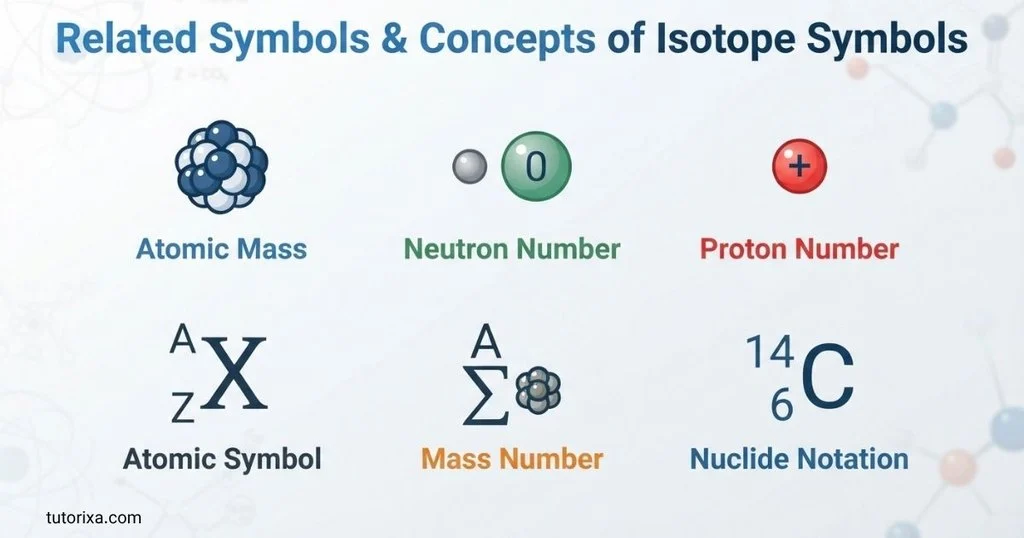
Several concepts are closely connected to isotope symbols:
- Element symbols: C, H, O, U, and other abbreviations identify chemical elements.
- Atomic number (Z): identifies an element by its number of protons.
- Mass number (A): gives the total number of protons and neutrons.
- Nuclide notation: the broader nuclear notation used to identify a specific nuclear species.
- Carbon-12: a stable carbon isotope with six protons and six neutrons.
- Carbon-13: a stable carbon isotope with six protons and seven neutrons.
- Carbon-14: a radioactive carbon isotope with six protons and eight neutrons.
- Deuterium: hydrogen-2, containing one proton and one neutron.
- Tritium: hydrogen-3, containing one proton and two neutrons.
- Radioisotope: an unstable radioactive isotope.
- Isotone: nuclides with the same number of neutrons but different numbers of protons.
- Isobar: nuclides with the same mass number but different atomic numbers.
- Isotope abundance: the proportion of a particular isotope within a naturally occurring element sample.
Understanding these relationships prevents confusion between terms that sound similar but describe different nuclear properties.
Frequently Asked Questions
What is an isotope symbol?
An isotope symbol identifies a specific isotope using an element symbol together with its mass number and, in full nuclear notation, its atomic number. The standard format is ᴬZX. The mass number appears at the upper left, while the atomic number appears at the lower left. This notation tells you the isotope’s proton and neutron composition.
How do you read an isotope symbol?
Start with the chemical symbol to identify the element. Then read the upper-left number as the mass number and the lower-left number as the atomic number. Subtract the atomic number from the mass number to determine the number of neutrons. For example, ¹⁸₈O is oxygen-18 with eight protons and ten neutrons.
What does the top number mean in isotope notation?
The top-left number is the mass number, represented by A. It equals the total number of protons and neutrons in the nucleus. For example, in ²³₁₁Na, the mass number is 23. Because sodium has 11 protons, the isotope contains 12 neutrons.
What does the bottom number mean in an isotope symbol?
The bottom-left number is the atomic number, represented by Z. It tells you how many protons are in the nucleus and therefore identifies the element. For example, the atomic number of oxygen is 8, so every isotope of oxygen has eight protons.
How do you find neutrons from an isotope symbol?
Subtract the atomic number from the mass number. The formula is neutrons = mass number − atomic number. For example, uranium-235 has an atomic number of 92. Therefore, its neutron count is 235 − 92 = 143 neutrons.
Are isotope symbols and element symbols the same?
No. An element symbol identifies an element, while an isotope symbol identifies a particular isotope of that element. For example, C identifies carbon generally, whereas ¹⁴C specifically identifies carbon-14. Full notation such as ¹⁴₆C provides both the mass number and atomic number.
What is the difference between isotope notation and hyphen notation?
Full isotope notation uses the nuclear format ᴬZX, showing mass number and atomic number around the element symbol. Hyphen notation writes the element name followed by the mass number, such as carbon-14. Both identify the same isotope, but full notation provides more explicit nuclear information.
Do isotopes have the same chemical properties?
Isotopes of the same element generally have very similar chemical behavior because they have the same number of protons and, when neutral, the same electron arrangement. However, their different masses can produce measurable isotope effects, and radioactive isotopes have distinctive nuclear behavior.
Are all isotopes radioactive?
No. Isotopes can be stable or radioactive. Stable isotopes do not spontaneously undergo radioactive decay, while radioactive isotopes have unstable nuclei and decay over time. Carbon-12 and carbon-13 are examples of stable carbon isotopes, whereas carbon-14 is radioactive.
Why are isotope symbols important?
Isotope symbols provide a concise and standardized way to identify individual nuclides. They are important in chemistry, nuclear physics, medicine, geology, archaeology, environmental science, and laboratory research because different isotopes can have different masses, nuclear stability, decay properties, and scientific applications.
Key Takeaways
- Isotope symbols identify specific forms of an element.
- The standard nuclear notation is ᴬZX.
- A, the mass number, equals protons plus neutrons.
- Z, the atomic number, equals the number of protons.
- The number of neutrons is found by A − Z.
- Isotopes have the same number of protons but different numbers of neutrons.
- Isotopes may be stable or radioactive.
- Carbon-12, carbon-13, and carbon-14 are different isotopes of carbon.
- Hyphen notation, such as carbon-14, is another common way to identify an isotope.
- Isotope symbols are used in chemistry, nuclear science, medicine, geology, archaeology, and environmental research.
- An isotope symbol does not inherently have a religious, mystical, or cultural meaning.
- Understanding atomic number and mass number is the easiest way to read isotope notation correctly.
Conclusion
Isotope symbols provide one of the clearest ways to describe the identity and nuclear composition of an atom. By combining an element symbol with its mass number and, when needed, atomic number, the notation distinguishes one isotope from another with remarkable precision. The key is simple: the atomic number tells you the element, while the mass number tells you the total number of protons and neutrons.
Once you understand that relationship, isotope symbols such as ¹⁴₆C, ²³₁₁Na, and ²³⁵₉₂U become easy to interpret. They are more than compact scientific labels—they are a practical language used to describe nuclear matter across chemistry, physics, medicine, geology, archaeology, and environmental science.

I’m Ellis Montgomery, a British writer interested in the powerful language of symbols. I explore everything from traditional emblems and cultural signs to contemporary symbols found in modern life. My aim is to explain their meanings clearly while revealing the stories and ideas behind them, making symbolism fascinating and accessible to everyone.
Books:
- The Complete Book of Symbols
- Hidden Messages in Everyday Symbols
 Freddie Beaumont
 Rowan Whitaker