
When I first look at medical symbols, I notice how much meaning can be packed into a simple sign or mark. You may recognize some instantly, while others can leave you wondering what they represent.
Doctor symbols appear in hospitals, clinics, medical documents, uniforms, and healthcare signs. Each symbol can have its own history, purpose, and meaning, making them fascinating to explore.
In this guide, I’ll help you understand common doctor symbols in a simple way. You’ll discover what they mean, where they are used, and why these symbols remain important in modern medicine.
Quick Meaning of Doctor Symbols
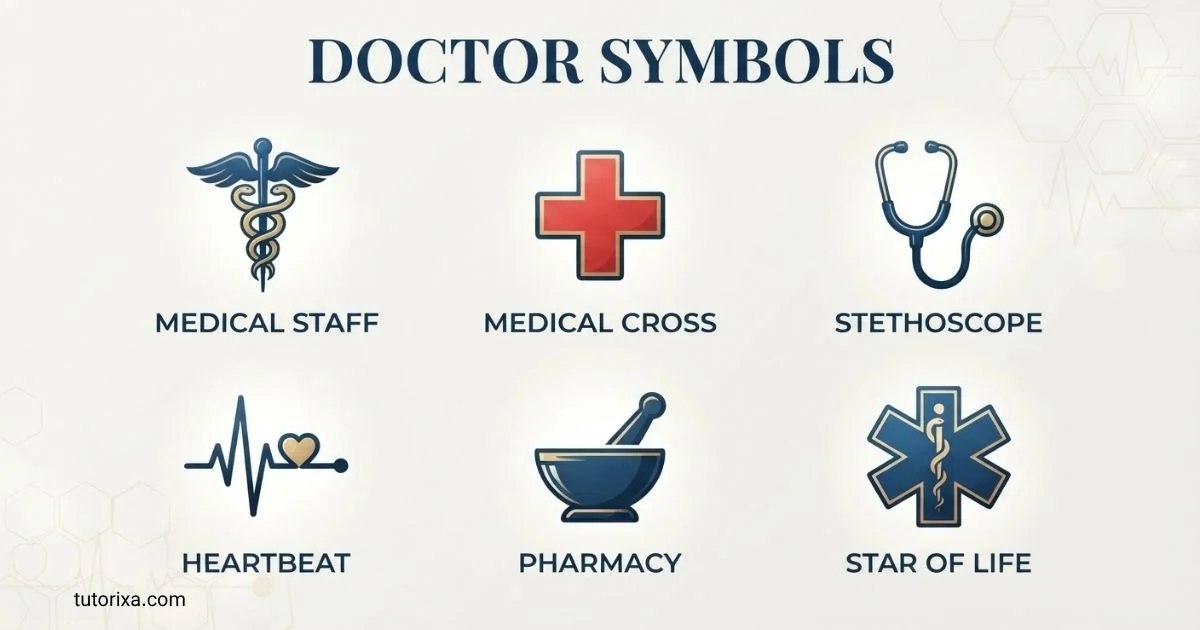
The most important doctor symbol is the Rod of Asclepius (⚕), representing medicine, healing, and the medical profession. It shows a single serpent coiled around a staff and comes from the ancient Greek tradition surrounding Asclepius, the god associated with healing. The Caduceus is related visually but originally represented Hermes and commerce rather than medicine.
Doctor Symbols Overview
| Symbol Name | Primary Meaning | Category | Origin | Common Usage | Modern Meaning | Unicode |
| Rod of Asclepius ⚕ | Medicine and healing | Medical | Ancient Greece | Physicians, medical organizations, healthcare | Medical profession and healing | U+2695 |
| Caduceus ☤ | Commerce, negotiation, communication | Mythological | Ancient Greece | Heraldry, organizations, some medical logos | Sometimes used for medicine, especially in the U.S. | No dedicated Unicode character for the traditional Caduceus |
| Star of Life | Emergency medical services | EMS | United States, 20th century | Ambulances, EMS equipment, road signs | Emergency medical care | No dedicated single Unicode character |
| Rx ℞ | Prescription or “take” | Medical writing | Latin prescription tradition | Prescriptions and pharmacy-related writing | Medication prescription | U+211E |
| Red Cross | Humanitarian and medical protection | Humanitarian | 19th-century Europe | Protected medical services and humanitarian work | Medical/humanitarian assistance in appropriate contexts | ✚ varies by character |
| Medical Cross | Healthcare or first aid | Medical | Modern European medical tradition | Clinics, first-aid signs, healthcare graphics | General health and medical assistance | Varies |
The Rod of Asclepius is formally encoded in Unicode as U+2695 STAFF OF AESCULAPIUS (⚕), while ℞ is Unicode U+211E, named PRESCRIPTION TAKE.
What Does the Doctor Symbol Mean?
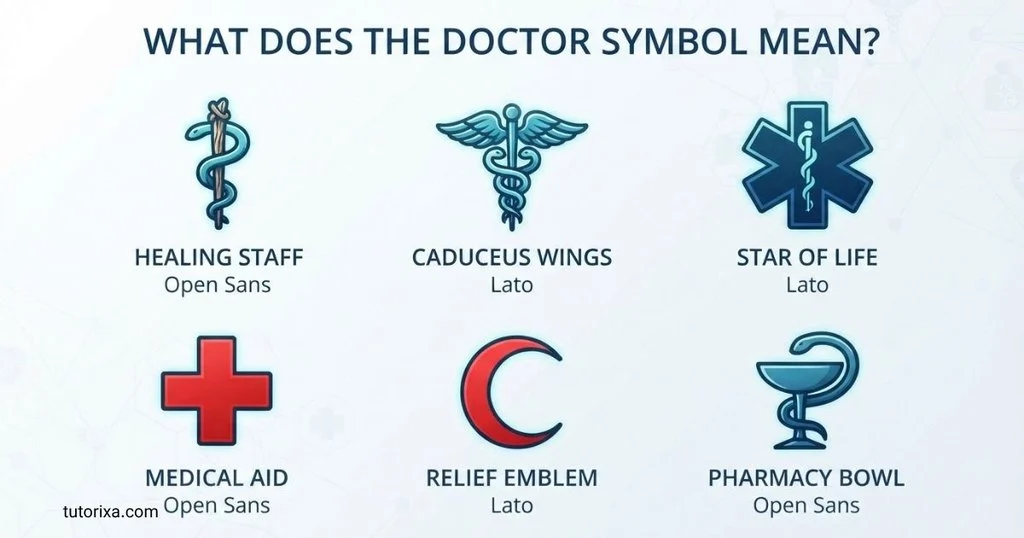
The doctor symbol most strongly associated with physicians is the Rod of Asclepius. It consists of a simple staff with one snake winding around it. Its meaning is connected to healing, medicine, care for the sick, and the long historical tradition of the medical profession.
The serpent is particularly important. In ancient Greek religious and medical traditions, snakes were associated with Asclepius, the deity of healing. The snake’s ability to shed its skin also made it a natural image for renewal and transformation.
The staff adds another layer of meaning. A staff is practical, familiar, and associated with support and guidance. Together, the staff and serpent became a recognizable emblem of healing.
Today, the symbol is used by medical associations, healthcare institutions, educational organizations, and other groups connected with medicine. It can communicate “medicine” without words.
Rod of Asclepius vs. Caduceus
One of the most common questions about doctor symbols is why some medical logos have one snake, while others have two snakes and wings.
The distinction is historically significant:
- Rod of Asclepius: one snake around a staff; associated with Asclepius and healing.
- Caduceus: two snakes around a winged staff; associated with Hermes, the Greek god of messengers, commerce, negotiation, and trade.
The Caduceus became widely associated with medicine in the United States during the 20th century, particularly after its adoption by the U.S. Army Medical Corps in 1902.
Therefore, seeing two snakes does not automatically mean the symbol is historically a medical symbol. Its modern medical use reflects a later development rather than its original Greek meaning.
History and Origin of Doctor Symbols
The history of doctor symbols reaches back to the ancient Mediterranean world, especially ancient Greece.
Asclepius and Ancient Greek Medicine
Asclepius was a Greek figure associated with healing and medicine. His cult became important in the ancient Greek world, and healing centers known as Asclepieia were established at various locations.
The Rod of Asclepius eventually became closely associated with his identity and with healing itself. Historical sources place the symbol’s roots in antiquity, with evidence of Asclepian traditions extending back well before the modern medical profession.
The importance of the symbol lies partly in its continuity. Modern medicine is scientifically very different from ancient healing traditions, yet the visual emblem survived because it became a powerful shorthand for the idea of healing.
The Caduceus and Hermes
The Caduceus has a separate origin. It belonged to Hermes, the Greek messenger god, whose Roman counterpart was Mercury.
Hermes was associated with communication, travel, trade, negotiation, and commerce. His staff traditionally contains two serpents and wings.
The similarity between the Caduceus and Rod of Asclepius eventually contributed to confusion. Their designs are visually related, but their historical meanings are not identical.
The Modern Medical Profession
During the 19th and 20th centuries, medical institutions increasingly adopted standardized visual identities. The Rod of Asclepius became especially important to professional medical organizations.
The American Medical Association, for example, incorporated the Rod of Asclepius into its emblem in 1910.
This helped reinforce the single-serpent staff as an established representation of medicine.
Symbolism and Interpretation
Doctor symbols communicate more than simply “a doctor works here.” They represent a collection of ideas surrounding health and healing.
Healing
The strongest traditional meaning of the Rod of Asclepius is healing. It connects modern medicine to the ancient figure associated with the healing arts.
Renewal
The serpent’s ability to shed its skin has often encouraged interpretations involving renewal, restoration, and transformation. This is especially appropriate for medicine because treatment aims to restore health and function.
This interpretation should be understood as symbolism rather than a literal historical definition of every ancient use of the serpent.
Knowledge
Medicine depends on accumulated knowledge, observation, training, and judgment. Modern writers sometimes interpret the medical staff as representing the knowledge and responsibility associated with physicians.
Care and Professional Responsibility
In modern contexts, the Rod of Asclepius can represent the physician’s responsibility to care for patients. The American Medical Association has specifically discussed the symbol as a visual representation of qualities expected from physicians, including competence, judgment, compassion, and empathy.
Commerce and Communication
The Caduceus carries different traditional associations. Because Hermes was connected with commerce, negotiation, and communication, the symbol can represent those subjects more accurately than medicine when considered in its original context.
Its later medical use illustrates an important principle of symbolism: a symbol’s modern association can differ from its historical origin.
Cultural Significance
Doctor symbols are interpreted differently depending on geography and institutional tradition.
In many countries, the Rod of Asclepius is recognizable as a medical emblem. International medical organizations and professional institutions commonly favor the single-serpent staff because of its historical connection with healing.
In the United States, however, the Caduceus became unusually prominent in medical imagery. Its adoption by the U.S. Army Medical Corps in 1902 helped establish the two-serpent design in American healthcare culture.
This difference does not mean Americans invented the Caduceus. Rather, an ancient symbol with a different original meaning acquired a strong secondary association with medicine through institutional use.
Iran provides another interesting example of regional symbolism. Scholarship on Iranian medical symbolism notes the importance of Simurgh, the mythical Persian bird, in associations with surgery and medicinal herbs, demonstrating that medical symbolism does not have to be derived from Greek traditions.
Religious or Spiritual Meaning
The Rod of Asclepius has religious roots in the ancient Greek world, but it is not a modern religious symbol in ordinary medical practice.
Asclepius was part of ancient Greek religious tradition and was honored through healing sanctuaries. Patients visiting these centers sought healing within a culture where medicine, ritual, religion, and mythology were not separated in the same way they generally are today.
The modern medical symbol should therefore be understood primarily as a historical and professional emblem, rather than as an indication that contemporary physicians practice an ancient religion.
The serpent itself has also carried different meanings across religious traditions. It can symbolize healing or renewal in one context and danger, temptation, or transformation in another. Its meaning depends heavily on cultural setting.
Scientific or Technical Meaning
Doctor symbols are not scientific formulas in the way that mathematical or chemical symbols are. Their primary purpose is visual identification.
The Rod of Asclepius identifies medicine or healthcare. The Star of Life identifies emergency medical services. The Rx symbol identifies prescriptions.
The Star of Life
The Star of Life is particularly important in emergency medicine. It was created by the U.S. National Highway Traffic Safety Administration to provide a recognizable symbol for emergency medical services.
Its six bars represent six stages of emergency medical service:
- Detection
- Reporting
- Response
- On-scene care
- Care in transit
- Transfer to definitive care
The Rod of Asclepius appears in the center, connecting emergency care with the broader tradition of medicine and healing.
Where Doctor Symbols Are Used
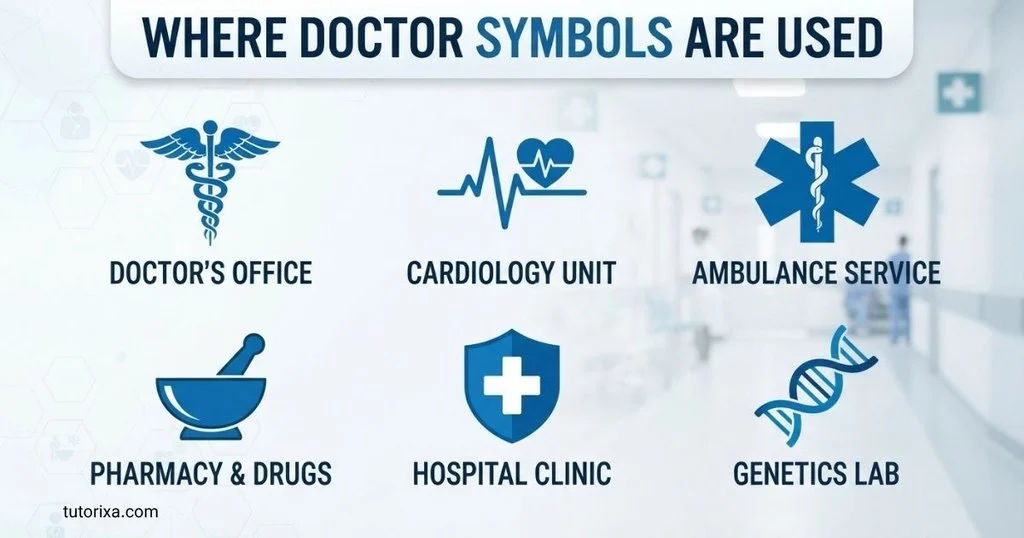
Doctor symbols appear in many everyday settings because visual recognition is often faster than reading a complete label.
Hospitals and Clinics
The Rod of Asclepius may appear on hospital signs, physician organization logos, clinic materials, medical publications, and professional insignia.
Ambulances and Emergency Vehicles
The Star of Life is strongly associated with EMS. It can identify ambulances, emergency equipment, EMS clothing, publications, and locations providing emergency medical services.
Prescriptions
The Rx symbol (℞) is associated with prescriptions. Unicode identifies ℞ as PRESCRIPTION TAKE, with “recipe” listed as a related meaning.
Maps and Road Signs
The Star of Life may appear on maps and highway signs to indicate locations or access points for qualified emergency medical care.
Medical Education
Medical textbooks, professional publications, university programs, and healthcare websites may use the Rod of Asclepius as a compact visual indicator of medicine.
Logos and Branding
Medical organizations sometimes incorporate staffs, serpents, crosses, hearts, stars, or other healthcare imagery into logos. These designs may be stylized considerably while retaining recognizable elements.
Jewelry, Tattoos, and Art
The Rod of Asclepius is sometimes used in jewelry, commemorative objects, artwork, and tattoos, particularly by people connected with medicine. In these contexts, the symbol can express professional identity, dedication to healing, or respect for the medical profession.
Common Variations of Doctor Symbols
Doctor symbols have many visual variations, but their basic structures remain recognizable.
Rod of Asclepius Variations
The staff may be straight, curved, plain, decorative, short, or long. The serpent may be represented realistically or in a highly simplified graphic style.
Caduceus Variations
The Caduceus generally contains two serpents and wings, but the artistic treatment can vary. Some versions use highly detailed wings, while others reduce the design to simple lines.
Star of Life Variations
The Star of Life normally consists of a six-barred blue star with the Rod of Asclepius in the center. Its use is closely associated with emergency medical services.
Medical Cross Variations
Cross-shaped healthcare symbols can differ in color, proportion, and design. A green cross is widely associated with pharmacies in many countries, while other cross designs may represent healthcare or first aid.
Common Misconceptions About Doctor Symbols
Myth 1: The Caduceus Is the Original Symbol of Medicine
Not exactly. The Rod of Asclepius has the stronger historical connection to medicine and healing. The Caduceus originally belonged to Hermes and was associated with commerce, negotiation, and communication.
Myth 2: Every Snake-and-Staff Symbol Means the Same Thing
The number of snakes matters historically. One snake usually identifies the Rod of Asclepius, while two snakes and wings identify the Caduceus.
Myth 3: The Caduceus Has No Medical Meaning Today
That is also too simplistic. Although its original meaning was not medical, the Caduceus has acquired a strong modern medical association, particularly in the United States. Its historical origin and modern use are simply different things.
Myth 4: Rx Is an Abbreviation for the English Word “Prescription”
The symbol ℞ has a long history in prescription writing and is associated with the Latin recipe, meaning roughly “take.” Unicode officially identifies the character as “PRESCRIPTION TAKE.”
Myth 5: The Star of Life Is Just a Decorative Medical Star
No. Its six bars have a defined relationship to the six functions of emergency medical services.
Interesting Facts About Doctor Symbols
- The Rod of Asclepius has only one snake.
This is the easiest visual clue for distinguishing it from the Caduceus. - The Caduceus originally belonged to Hermes.
Hermes was associated with communication, trade, negotiation, and travel rather than medicine. - The Caduceus became a medical symbol through modern institutional use.
Its adoption by the U.S. Army Medical Corps in 1902 helped strengthen its medical association in America. - The Rod of Asclepius has its own Unicode character.
The symbol ⚕ is Unicode U+2695 STAFF OF AESCULAPIUS. - The prescription symbol also has a Unicode character.
℞ is U+211E, officially named PRESCRIPTION TAKE. - The Star of Life has six functional meanings.
Its six bars correspond to the stages of emergency medical service from detection through definitive care. - The Star of Life contains the Rod of Asclepius.
This connects modern emergency medicine with the much older medical tradition represented by Asclepius. - The AMA adopted the Rod of Asclepius in 1910.
This helped establish the single-serpent staff as an important professional medical emblem in the United States. - Medical symbolism predates modern scientific medicine.
The imagery comes from cultures in which healing, religion, mythology, and early medical practice were closely connected. - A symbol can develop a new meaning without losing its old one.
The Caduceus demonstrates this clearly: its original connection to Hermes and commerce remains historically important even though it is now widely recognized as a medical image in some settings.
Related Symbols of Doctor Symbols
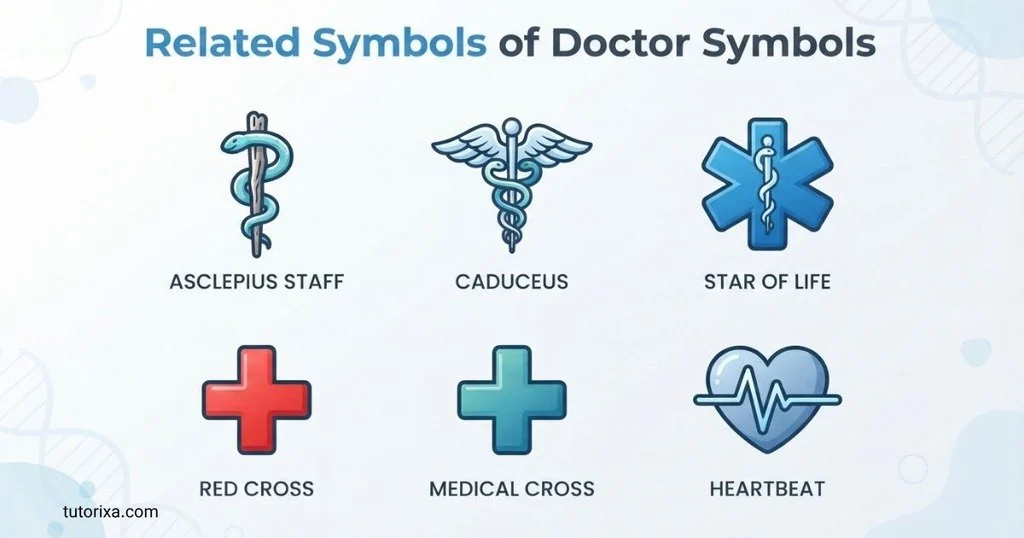
Rod of Asclepius
The Rod of Asclepius is the most historically appropriate symbol for medicine and physicians. Its defining feature is one serpent wrapped around a staff.
Caduceus
The Caduceus has two serpents and wings. It comes from Hermes and traditionally relates to commerce, communication, negotiation, and travel. Its medical use is a later development.
Star of Life
The Star of Life specifically identifies emergency medical services. It combines a six-barred star with the Rod of Asclepius.
Rx
Rx is primarily associated with prescriptions and medication instructions rather than the medical profession as a whole.
Red Cross
The Red Cross is an internationally recognized humanitarian emblem with specific legal and protective significance. It should not simply be treated as a generic decorative healthcare icon. The emblem’s origins date to the Geneva Convention era of the 19th century.
Heart Symbol
The heart is a modern visual shorthand for love, life, compassion, and sometimes cardiovascular health. Unlike the Rod of Asclepius, it does not have a direct origin in the mythology of a healing deity.
Frequently Asked Questions About Doctor Symbols
What is the main symbol for doctors?
The Rod of Asclepius is the principal historical symbol associated with doctors and medicine. It consists of a staff with one serpent wrapped around it. The symbol originates from the ancient Greek tradition surrounding Asclepius, a deity associated with healing. It continues to represent medicine, physicians, healthcare, and healing today.
What is the symbol for a doctor with a snake?
The traditional doctor symbol with a snake is the Rod of Asclepius. It has one snake wrapped around a staff. A two-snake staff with wings is the Caduceus, which historically belonged to Hermes rather than Asclepius. The two are frequently confused because of their similar appearance and later medical use.
What does ⚕ mean?
The character ⚕ represents the Staff or Rod of Asclepius and is commonly associated with medicine, healing, healthcare, and physicians. In Unicode, it is identified as U+2695 STAFF OF AESCULAPIUS. It is particularly useful when a person wants to represent medicine in digital text without using an image.
What is the difference between the Rod of Asclepius and Caduceus?
The Rod of Asclepius has one serpent and one staff and is historically connected with healing and medicine. The Caduceus has two serpents and wings and belongs to Hermes, whose traditional associations include commerce and communication. The Caduceus later became widely used in American medical imagery despite this distinction.
Why do doctors use a snake as a symbol?
The serpent became connected with medicine through ancient Greek traditions surrounding Asclepius. Snakes were part of the imagery associated with his healing cult, and the Rod of Asclepius became an enduring emblem. Modern interpretations sometimes connect the serpent’s shedding of skin with renewal, although individual symbolic interpretations can vary.
What does the Star of Life mean?
The Star of Life represents emergency medical services. Its six bars correspond to detection, reporting, response, on-scene care, care in transit, and transfer to definitive care. The Rod of Asclepius sits at its center to represent medicine and healing. It is commonly seen on ambulances, EMS equipment, uniforms, publications, maps, and road signs.
What does Rx mean in medicine?
Rx or ℞ is the traditional prescription symbol. The character is associated with the Latin recipe, meaning “take,” reflecting the wording of traditional prescriptions that instructed someone to take particular ingredients or medicines. Unicode identifies ℞ as U+211E, PRESCRIPTION TAKE.
Is the Caduceus a wrong medical symbol?
Calling it simply “wrong” can be misleading. Historically, the Caduceus was not a symbol of medicine; it belonged to Hermes and had associations with commerce and communication. However, modern institutions—especially in the United States—have used it as a medical emblem for more than a century, giving it a genuine contemporary medical association.
What symbol represents healing?
The Rod of Asclepius is the strongest traditional symbol of healing in Western medical symbolism. Its connection to Asclepius, the ancient Greek figure associated with medicine and healing, gives it a historical foundation that distinguishes it from more general symbols such as hearts or crosses.
Is there a doctor emoji?
There is not a single universal “doctor symbol” emoji that represents the entire medical profession in exactly the same way as the Rod of Asclepius. Unicode includes healthcare-worker emoji sequences built using a person character combined with the Staff of Aesculapius, while ⚕ itself represents the staff associated with medicine.
Key Takeaways
- ⚕ Rod of Asclepius is the principal historical symbol of medicine and healing.
- The Rod of Asclepius has one serpent around a staff.
- The Caduceus has two serpents and wings and originally belonged to Hermes.
- The Caduceus became associated with medicine through later institutional use, especially in the United States.
- The Star of Life represents emergency medical services.
- The Star of Life contains the Rod of Asclepius and has six bars representing EMS functions.
- ℞ is the traditional prescription symbol.
- Medical symbols developed across ancient mythology, professional traditions, written medicine, and modern emergency services.
- A symbol’s historical meaning may differ from its modern popular meaning.
- Understanding these differences helps explain why several seemingly similar doctor symbols appear in healthcare today.
Conclusion
Doctor symbols tell a much older story than the modern white coat, hospital, or prescription pad. At the center of that story is the Rod of Asclepius, whose single serpent and staff connect contemporary medicine with ancient Greek traditions of healing. Over centuries, other symbols developed or acquired medical associations, including the Caduceus, Star of Life, and Rx.
The distinction between these symbols is more than a design detail. The Rod of Asclepius represents the historical tradition of medicine, the Caduceus reflects the later evolution of symbolism and institutional use, the Star of Life identifies emergency medical services, and Rx belongs to the written language of prescriptions.
Together, these doctor symbols form a visual vocabulary for medicine. They allow people to recognize physicians, healthcare services, emergency care, and prescriptions quickly—even before reading a single word.

I’m Rowan Whitaker, a British writer fascinated by the symbols surrounding us every day. I explore their meanings, origins, cultural significance, and changing interpretations. From ancient marks to modern signs, I enjoy making symbolism easier to understand. My writing helps curious readers discover the hidden messages behind familiar shapes, images, and signs.
Books:
- The Meaning Behind Symbols
- A Modern Guide to Symbolism
 Freddie Beaumont
 Ellis Montgomery