
When I first started exploring note symbols, I realized how much meaning can be packed into a simple mark. You may recognize some of these symbols instantly, while others can seem confusing at first.
I’ll break down note symbols in a clear and practical way so you can understand what they mean and where they are used. Whether you are a student, writer, musician, or simply curious, you can find useful answers here.
As you explore the different symbols, I want you to feel confident recognizing and using them. By the end, you’ll have a simple reference you can return to whenever you need to understand a note symbol.
Quick Meaning
Note symbols are written signs used to represent musical notes and their rhythmic values. In standard Western notation, the appearance of a note—such as an open or filled notehead, stem, and flag—helps indicate how long it lasts, while its position on the staff indicates pitch. Modern Unicode also provides several musical note characters for digital text.
Note Symbols Overview
| Field | Details |
| Symbol Name | Musical note symbols |
| Primary Meaning | Represent musical sound, pitch, and rhythmic duration |
| Category | Music notation and musical symbols |
| Main Tradition | Western staff notation |
| Historical Development | Evolved through medieval and later European notation systems |
| Common Symbols | 𝅝 𝅗𝅥 ♩ ♪ 𝅘𝅥𝅯 𝅘𝅥𝅰 |
| Modern Usage | Sheet music, music education, notation software, digital communication, design |
| Unicode Examples | U+2669 ♩, U+266A ♪, U+266B ♫, U+266C ♬ |
| Emoji Equivalents | 🎵 Musical Note, 🎶 Multiple Musical Notes |
| Related Symbols | Rests, clefs, accidentals, ties, slurs, dots, time signatures |
What Do Note Symbols Mean?
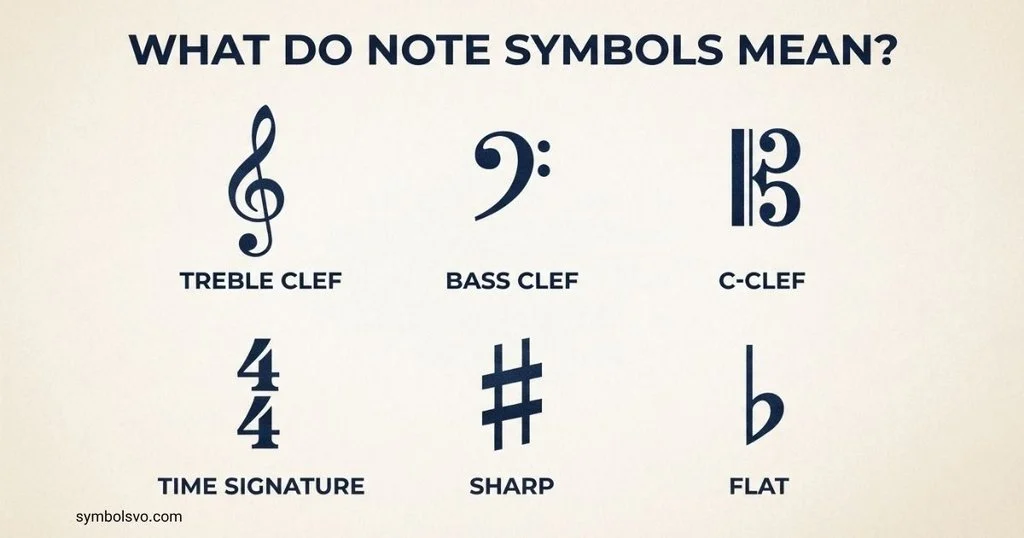
Note symbols primarily tell a musician what sound to produce and how long that sound should last. Their exact meaning depends on the notation system and musical context.
In conventional staff notation, a note has several visual components. The notehead is the oval-shaped part. A stem may extend upward or downward from it, and shorter rhythmic values can have one or more flags attached to the stem. Notes can also be connected with beams when several shorter notes occur together.
The most important distinction is between pitch and duration. The note’s position on the staff helps identify its pitch, while its visual form communicates its rhythmic value.
For example:
- 𝅝 Whole note — long rhythmic value
- 𝅗𝅥 Half note — half the duration of a whole note
- ♩ Quarter note — half the duration of a half note
- ♪ Eighth note — half the duration of a quarter note
- 𝅘𝅥𝅯 Sixteenth note — half the duration of an eighth note
These relationships are proportional rather than fixed in seconds. A quarter note does not always last the same amount of time. Its actual duration depends on the tempo and time signature.
In a common 4/4 meter, one whole note corresponds to four quarter-note units, while two half notes, four quarter notes, eight eighth notes, or sixteen sixteenth notes can occupy the same basic duration.
History and Origin of Note Symbols
The modern system of note symbols developed gradually rather than appearing as a complete system at one particular moment.
Early musical cultures used different ways to preserve or communicate music. Ancient civilizations, including ancient Greece, had forms of musical notation, but these systems differed substantially from modern Western staff notation.
A major development occurred during the Middle Ages in Europe, when musicians increasingly developed methods for recording melodies. Early notation often used signs called neumes, which provided information about melodic movement but did not initially provide the same precise pitch-and-duration system used today.
The work associated with Guido of Arezzo, an Italian Benedictine monk and music theorist active around the 11th century, was particularly influential in the development of staff-based music teaching and notation. The staff made it possible to represent pitch relationships visually.
Over subsequent centuries, musical notation became more standardized. Note shapes changed, rhythmic notation became more precise, and systems developed to communicate increasingly complex musical compositions.
The modern notehead, stem, flag, beam, staff, clef, and other notation elements are therefore the result of centuries of development.
Importantly, note symbols are not universal across every musical tradition. Western staff notation is only one way of representing music. Other cultures and musical traditions have developed their own notation and transmission systems.
Note Symbolism and Interpretation
Note symbols have two different kinds of meaning: technical meaning and cultural or visual meaning.
Technical Meaning
In sheet music, a note is functional. Its appearance and location provide information that performers use to reproduce a composition.
For example, changing a filled notehead to an open notehead can change its rhythmic value. Adding flags creates progressively shorter note values.
Modern Symbolic Meaning
Outside formal notation, musical notes often symbolize:
- Music
- Creativity
- Singing
- Rhythm
- Performance
- Happiness
- Artistic expression
- Entertainment
- Musical talent
- Celebration
- Emotion
A single eighth-note symbol such as ♪ may therefore be used decoratively even when no precise musical instruction is intended.
Positive Associations
Musical note symbols are commonly associated with creativity, harmony, expression, joy, inspiration, and artistic identity.
Negative or Alternative Associations
The symbols themselves generally do not have an inherently negative meaning. However, a particular musical symbol can acquire different associations depending on the surrounding artwork, lyrics, cultural context, or message.
This distinction matters because a decorative music note should not automatically be interpreted as having a hidden symbolic meaning.
Cultural Significance of Note Symbols
Musical notation has strong cultural significance because written music allows compositions to be preserved, taught, shared, analyzed, and performed across generations.
In Western classical music, notation became central to preserving large-scale compositions and communicating detailed instructions to performers. It also became important in music education, publishing, orchestral performance, choral music, and composition.
In popular culture, note symbols became recognizable beyond formal music education. They appear on posters, clothing, stationery, websites, advertisements, school materials, and social-media posts.
Different societies also use different musical notation traditions. For example, Indian classical music has long used systems such as sargam, while other traditions rely heavily on oral transmission, tablature, cipher notation, graphic notation, or other systems.
Therefore, it is more accurate to describe modern note symbols as part of particular notation traditions rather than claiming that one system represents all music worldwide.
Scientific and Technical Meaning
Note symbols have an important technical function in music because they represent relationships between time, pitch, rhythm, and performance.
Rhythm
The duration of a note is expressed through its rhythmic form. A whole note is longer than a half note, a half note is longer than a quarter note, and so forth.
Pitch
The position of a note on the staff indicates pitch within the relevant clef and notation system.
Tempo
Tempo determines how quickly rhythmic values occur. A quarter note at one tempo can sound much shorter in real time than the same quarter note at a slower tempo.
Time Signature
A time signature establishes the organization of beats into measures. For example, 4/4 commonly organizes four quarter-note beats per measure, while 3/4 commonly organizes three quarter-note beats.
Digital Technology
Music notation software, digital audio workstations, educational applications, MIDI systems, and electronic instruments all use digital representations of musical information.
Unicode also encodes a number of musical characters. The Unicode Standard identifies characters such as ♩ U+2669, ♪ U+266A, ♫ U+266B, and ♬ U+266C. More specialized musical notation characters are available in Unicode’s Musical Symbols block.
Where Are Note Symbols Used?
Note symbols appear in many environments.
Sheet Music
Their most important use is in written music. Notes are placed on staffs alongside clefs, rests, accidentals, dynamics, articulations, and other signs.
Music Education
Students learn note symbols to understand rhythm, pitch, sight-reading, and musical structure.
Songbooks
Printed songbooks use musical notation to preserve melodies and arrangements.
Music Software
Notation applications display and manipulate notes digitally, allowing musicians to compose, edit, print, and share scores.
Digital Communication
Characters such as ♪, ♫, and ♬ can be used in messages, captions, profiles, and other text-based communication.
Logos and Branding
Music-related organizations, teachers, studios, bands, and events may use musical notes as visual identifiers.
Jewelry and Tattoos
A musical note can represent a person’s connection to music, performance, songwriting, singing, or a meaningful musical experience. The personal interpretation is usually more important than any universal symbolic meaning.
Art and Design
Graphic designers frequently use note symbols to communicate a musical theme quickly.
Common Note Symbol Variations
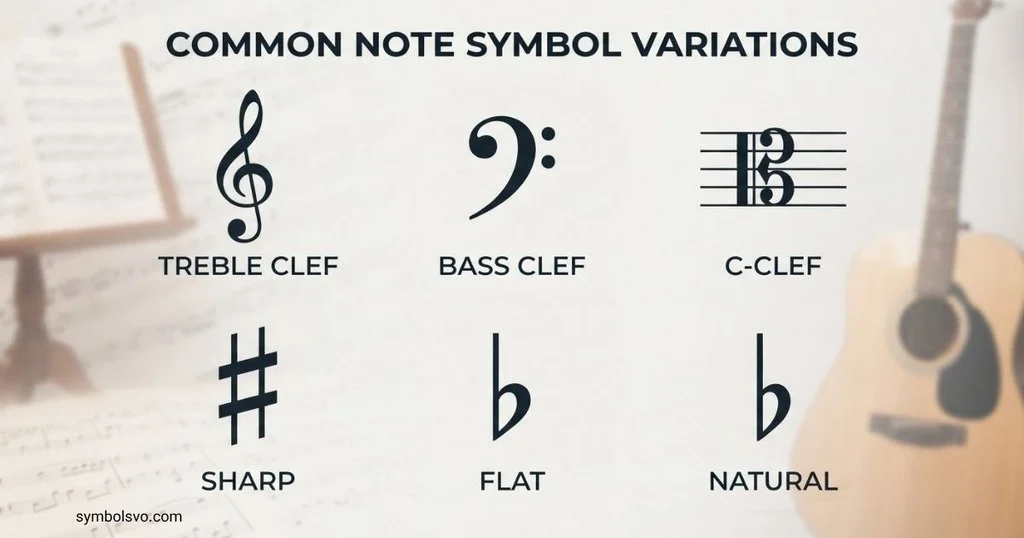
Note symbols vary according to their rhythmic value and the notation system in which they appear.
Whole Note
𝅝
A whole note has an open notehead without a stem. Its exact duration depends on the meter and context.
Half Note
𝅗𝅥
A half note has an open notehead with a stem.
Quarter Note
♩
A quarter note has a filled notehead and stem. Unicode encodes the common quarter-note character as U+2669, while a specialized musical-symbol version also exists.
Eighth Note
♪
An eighth note has a filled notehead, stem, and one flag when written individually. Unicode identifies U+266A as the eighth note.
Beamed Eighth Notes
♫
Two eighth notes can be connected by a beam. This is especially useful for grouping notes rhythmically.
Sixteenth Notes
𝅘𝅥𝅯
A sixteenth note contains a filled notehead, stem, and two flags when written individually. When multiple sixteenth notes occur together, beams can connect them.
Thirty-Second and Shorter Notes
Music can use even shorter values, including thirty-second, sixty-fourth, and one-hundred-twenty-eighth notes. Unicode includes dedicated characters for these specialized musical note values.
Common Misconceptions About Note Symbols
Myth 1: Every musical note symbol has one universal meaning
Not necessarily. A note’s meaning depends on its notation system and context.
Myth 2: A quarter note always lasts one second
Incorrect. A quarter note’s actual time duration depends on tempo.
Myth 3: The higher a note looks on a page, the louder it is
Not in standard notation. Vertical position primarily communicates pitch, while dynamics are indicated through separate markings.
Myth 4: ♪ is simply a decorative music icon
It can be decorative in digital communication, but within musical notation, an eighth note has a specific rhythmic function.
Myth 5: All cultures use Western note symbols
No. Musical notation varies across cultures and traditions, and many musical practices historically relied on oral transmission or other forms of notation.
Myth 6: A musical note automatically represents a particular emotion
The symbol itself does not universally mean happiness, sadness, love, or another emotion. Emotional interpretation comes from context.
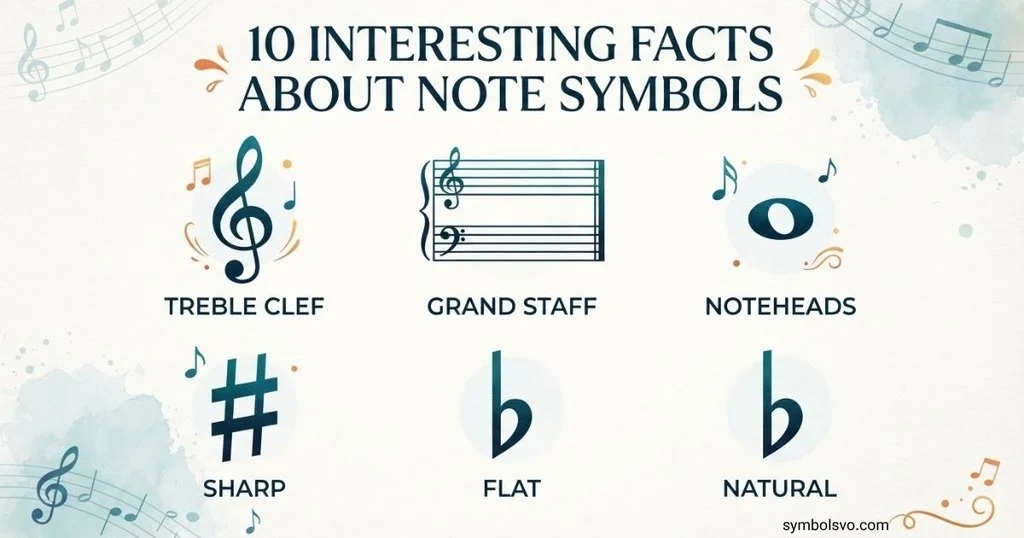
10 Interesting Facts About Note Symbols
- Note duration is relational.
A note’s rhythmic value is defined in relation to other note values rather than as a universal number of seconds. - The same symbol can have technical and decorative uses.
The character ♪ can represent an eighth note in text or simply suggest music in a casual message. - Noteheads are important information carriers.
Their filled or open appearance contributes to identifying rhythmic values. - Flags can indicate shorter durations.
Adding flags to a stem creates progressively shorter note values. - Beams improve readability.
Connected notes can be grouped visually so musicians can understand rhythmic patterns more easily. - Unicode contains specialized musical symbols.
Digital text can represent many musical signs, including note values beyond the familiar ♩ and ♪. - 🎵 and 🎶 are different from formal score notation.
They are emoji characters intended for general communication and visual expression rather than complete musical notation. Unicode describes 🎵 as a musical note and 🎶 as multiple musical notes. - A note does more than indicate duration.
In staff notation, its position also communicates pitch. - Rests are the silent counterparts of rhythmic notation.
Musical writing needs symbols for silence as well as sound. - Western notation is historically layered.
Today’s familiar system developed through changes in medieval and later European musical notation rather than being invented in its current form at once.
Related Symbols
Note symbols work together with many other musical signs.
Clef Symbols
Clefs establish how positions on the staff correspond to pitches. Common examples include the treble and bass clefs.
Rest Symbols
Rests indicate periods of silence with specific rhythmic values.
Sharp, Flat, and Natural Symbols
♯, ♭, and ♮ modify pitch. Unicode includes dedicated music sharp, flat, and natural signs.
Dotted Notes
A dot placed after a note increases its duration by half of its original value.
Tie
A tie connects notes of the same pitch so their durations are combined.
Slur
A slur connects notes to indicate a smooth musical phrase or legato treatment.
Time Signatures
Time signatures organize beats into measures and help establish the rhythmic framework.
Dynamic Symbols
Dynamic markings communicate changes in loudness, such as piano and forte.
Frequently Asked Questions
What are note symbols?
Note symbols are visual signs used to represent musical information in written notation. They can communicate rhythmic duration and, when placed on a staff, contribute to identifying pitch. Common examples include whole, half, quarter, eighth, and sixteenth notes. In everyday digital communication, simpler characters such as ♪ and ♫ are also commonly used to suggest music.
What does the symbol ♪ mean?
The symbol ♪ is the Unicode character for an eighth note. In formal musical notation, an eighth note represents a rhythmic value that is half the duration of a quarter note under the same rhythmic framework. In texting, captions, and graphic design, however, ♪ is often used more generally as a decorative symbol meaning music or singing.
What is the difference between ♩ and ♪?
The symbols ♩ and ♪ represent different rhythmic values. ♩ is a quarter note, while ♪ is an eighth note. An eighth note has half the rhythmic value of a quarter note. Their actual duration in seconds still depends on the tempo of the music.
What does ♫ mean?
♫ represents beamed eighth notes in Unicode. In formal notation, beaming connects shorter notes to make rhythmic grouping easier to read. Outside sheet music, ♫ is often used simply as a visual symbol for music, singing, melody, or a musical mood.
What does a musical note symbolize?
Outside technical notation, a musical note commonly symbolizes music, creativity, singing, rhythm, performance, artistic expression, and enjoyment. Its meaning can become more personal in tattoos, jewelry, artwork, or memorial designs. There is no single universal emotional meaning attached to every musical note symbol.
Are musical note symbols universal?
No. Musical notation differs between traditions. Western staff notation is widely used internationally, but other musical cultures have developed different systems for representing or teaching music. Some traditions also rely strongly on oral transmission rather than written notation.
What is the longest common note value?
In basic Western notation, the whole note is one of the standard note values commonly taught to beginners. Older and specialized notation systems also contain longer values, such as the breve and historical longa. Unicode includes a musical symbol for the breve as well as the whole note.
What is the Unicode symbol for a quarter note?
The commonly used text character ♩ is U+2669, named QUARTER NOTE. Unicode also includes a specialized musical-symbol character, U+1D15F, named MUSICAL SYMBOL QUARTER NOTE. The specialized musical symbols are intended for more formal musical notation contexts.
What is the difference between a note and a rest?
A note represents a musical sound, while a rest represents silence for a specified rhythmic duration. Both are essential to written music because rhythm depends on the relationship between sounds and intentional periods of silence.
Why do some notes have flags or beams?
Flags and beams help identify shorter rhythmic values and organize groups of notes visually. An individual eighth note has one flag, while shorter values can have additional flags. When multiple short notes occur together, beams can replace individual flags and make the rhythmic grouping easier to read.
Key Takeaways
- Note symbols represent musical information in written music.
- Their design can communicate rhythmic duration.
- Their position on a staff helps communicate pitch.
- Common examples include 𝅝, 𝅗𝅥, ♩, ♪, 𝅘𝅥𝅯, and 𝅘𝅥𝅰.
- ♩ represents a quarter note, while ♪ represents an eighth note.
- ♫ represents beamed eighth notes in Unicode.
- Actual note duration depends on tempo and musical context.
- Musical notation developed gradually over many centuries.
- Western staff notation is not the only musical notation system.
- Musical notes can have technical meanings in scores and broader symbolic meanings in art and communication.
- Unicode provides both common text characters and specialized musical notation characters.
- Related symbols include clefs, rests, accidentals, ties, slurs, dynamics, and time signatures.
Conclusion
Note symbols are much more than decorative musical shapes. In written music, they form part of a sophisticated visual language that communicates rhythm, pitch, timing, and performance. A small change in a notehead, stem, flag, or beam can alter the information a musician reads.
At the same time, note symbols have developed a broader cultural life. Characters such as ♪, ♫, and 🎵 are instantly recognizable ways to express music in digital communication, art, branding, and personal designs. Understanding both their technical function and their cultural use makes it easier to appreciate why these simple-looking symbols remain so widely recognized.
Whether you encounter them in sheet music, a classroom, a music application, a tattoo, a logo, or a text message, note symbols connect written language with one of humanity’s most universal forms of creative expression: music.
Meta Description: Explore note symbols, their meanings, types, history, Unicode characters, musical uses, cultural significance, and differences between common notes.

I’m Freddie Beaumont, a British author with a passion for discovering what symbols communicate without words. I write about their history, meanings, and everyday uses in an accessible way. I believe symbols tell fascinating stories about people, cultures, and ideas, and my work helps readers recognise and understand those stories more clearly.
Books:
- Symbols and Their Hidden Meanings
- Understanding Signs and Symbols
 Ellis Montgomery
 Rowan Whitaker