
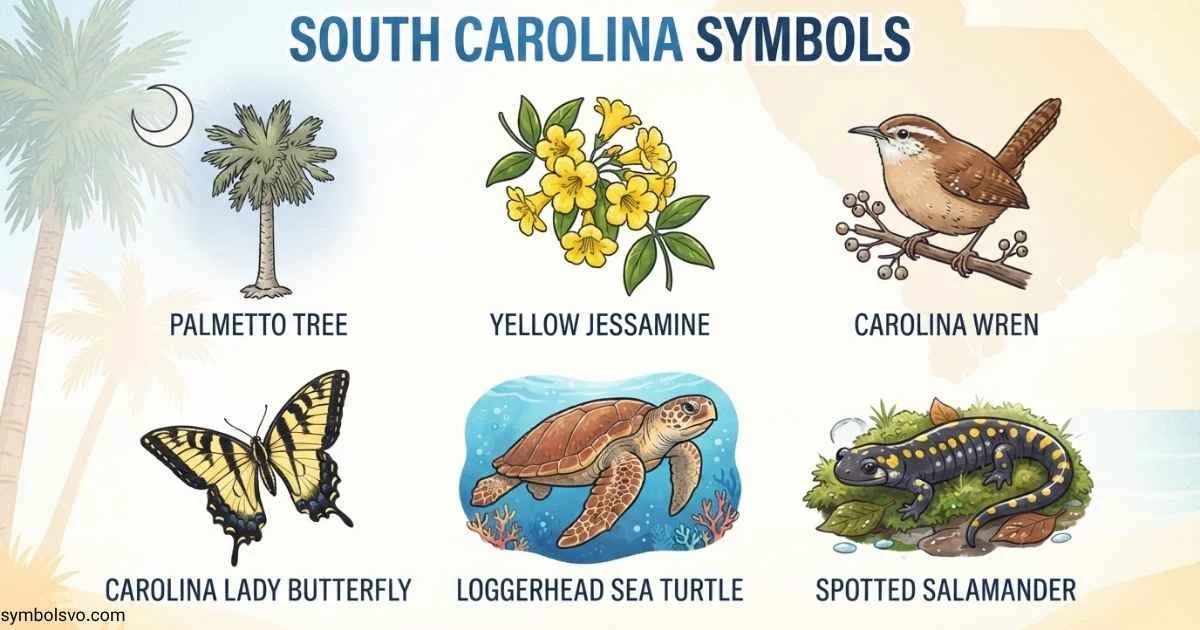
South Carolina has a rich identity shaped by history, nature, culture, and tradition. When I look at its official symbols, I see more than simple state emblems—they tell stories about the people and places that make the state unique.
If you want to understand South Carolina Symbols, you are in the right place. From the state flower and bird to animals, plants, and other important emblems, each symbol has a story and a reason behind its importance.
I’ll help you explore these symbols in a simple and engaging way, so you can quickly discover what they represent and why they still matter today.
Quick Meaning of South Carolina Symbols
South Carolina symbols are official emblems and culturally important images that represent the state’s history, natural environment, heritage, and identity. The most recognizable are the palmetto tree and crescent, featured on the state flag. Other official symbols include the yellow jessamine, Carolina wren, white-tailed deer, amethyst, blue granite, Boykin Spaniel, Venus flytrap, peach, and the shag dance.
South Carolina Symbols Overview Table
| Symbol | Meaning / Significance | Category | Origin or Adoption |
| Palmetto tree | Revolutionary defense and resilience | State tree / flag symbol | Official tree in 1939 |
| Crescent | Historic military emblem associated with South Carolina troops | Flag symbol | William Moultrie’s 1775 design |
| Indigo blue | Revolutionary-era military heritage | State color | Official color in 2008 |
| State seal | Government, independence, hope, and resilience | Government emblem | First used in 1777 |
| Yellow jessamine | Native beauty and state identity | State flower | Official in 1924 |
| Carolina wren | Native wildlife and distinctive song | State bird | Official in 1948 |
| White-tailed deer | Native wildlife | State animal | Official in 1972 |
| Amethyst | State mineral and gemstone heritage | State gemstone | Official gemstone |
| Blue granite | Geological identity | State stone | Official stone |
| Boykin Spaniel | South Carolina sporting heritage | State dog | Official in 1985 |
| Venus flytrap | Unique coastal plain ecology | Carnivorous plant | Official in 2023 |
| Eastern brown pelican | Coastal and maritime heritage | State seabird | Official in 2024 |
| Peach | Agricultural heritage | State fruit | Official state symbol |
| Shag | Coastal cultural tradition | State dance | Official in 1984 |
| Milk | Dairy and agricultural heritage | State beverage | Official in 1984 |
| Boiled peanut | Regional food tradition | State snack | Official in 2006 |
South Carolina’s official symbols are established through state law or official state resources, and the list has expanded over time. For example, the Venus flytrap became the official state carnivorous plant in 2023, while the eastern brown pelican became the official state seabird in 2024.
What Do South Carolina Symbols Mean?
South Carolina symbols collectively represent history, resilience, nature, agriculture, coastal culture, and state pride. There is no single symbol that explains every aspect of South Carolina. Instead, the state’s emblem system works like a collection of connected ideas.
The palmetto tree represents one of the state’s most important Revolutionary War associations. The crescent connects the flag to the military heritage of Colonel William Moultrie’s troops. The yellow jessamine and Carolina wren represent the state’s natural environment, while symbols such as the peach, collard greens, milk, and boiled peanut reflect agriculture and food traditions.
The state’s nickname, “The Palmetto State,” reinforces how central the palmetto has become to South Carolina’s identity. The official state motto, “Dum Spiro Spero,” means “While I breathe, I hope,” adding an important theme of hope and perseverance.
History and Origin of South Carolina Symbols
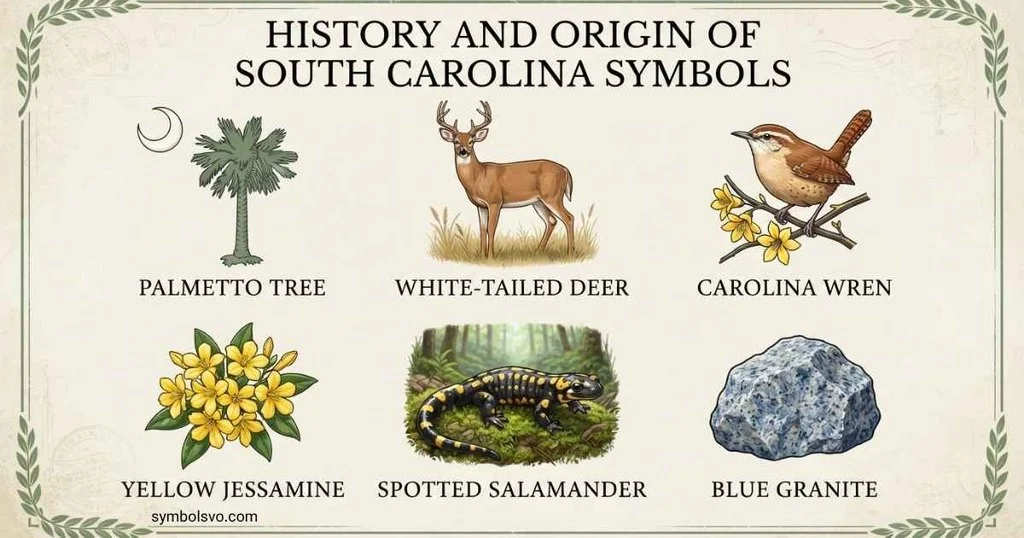
The strongest historical connection among South Carolina symbols comes from the American Revolutionary era.
The South Carolina Flag
The modern South Carolina flag developed from an earlier military design created by Colonel William Moultrie in 1775. Moultrie selected a blue background associated with the uniforms of South Carolina soldiers and used a crescent-shaped emblem connected to the silver emblem worn on their caps.
In 1861, the General Assembly adopted the current version by adding the palmetto tree to the earlier design. The tree refers to the defense of the fort on Sullivan’s Island during the Revolutionary War. The fort had been constructed largely from palmetto logs, which helped it withstand the British attack.
The Palmetto Tree
The palmetto is more than a tropical-looking plant on a flag. It became a historical symbol because of its association with the defense of Sullivan’s Island.
The state legislature officially designated the palmetto tree as South Carolina’s state tree in 1939. The South Carolina State House explains that the palmetto symbolized the defeat of the British fleet at Fort Moultrie, where the fort’s palmetto-log construction played an important role in its defense.
The State Seal
South Carolina’s Great Seal also dates to the Revolutionary period. On April 2, 1776, the state’s government authorized the creation of a Great Seal, with William Henry Drayton and Arthur Middleton identified as its principal designers. President John Rutledge used the seal for the first time on May 22, 1777.
The seal contains two oval designs. One features a palmetto tree and a fallen oak, while the other depicts Spes, the Roman goddess of Hope, walking along a beach at dawn. The imagery connects military struggle with hope for the future.
Symbolism and Interpretation
South Carolina symbols can be understood through several major themes.
Resilience and Defense
The palmetto is strongly associated with resilience because of its connection to Fort Moultrie. In symbolic terms, it represents the ability to withstand pressure and remain standing.
This historical meaning is particularly important because the palmetto is not simply a decorative element. Its place on the flag comes from a specific event in South Carolina’s Revolutionary history.
Hope and Perseverance
Hope is explicitly represented in the state’s seal and motto. “Dum Spiro Spero” translates as “While I breathe, I hope.” The second motto, “Animis Opibusque Parati,” means “Prepared in Mind and Resources.”
Together, these phrases emphasize preparedness and hope rather than portraying the state’s identity through history alone.
Nature and Place
Many South Carolina symbols come directly from the natural world. The Carolina wren, white-tailed deer, tiger swallowtail, loggerhead turtle, striped bass, spotted salamander, and palmetto tree all connect the state’s identity with its ecosystems.
The state’s newer symbols reinforce this relationship. The Venus flytrap reflects the unusual ecology of the southeastern coastal plain, while the eastern brown pelican represents the state’s coastal environment.
Cultural Significance of South Carolina Symbols
South Carolina’s symbols reflect several distinct cultural landscapes, including the Lowcountry, coastal communities, inland forests, agricultural regions, and urban centers.
The palmetto and crescent are especially recognizable throughout the state. Meanwhile, the shag is closely associated with South Carolina’s beach and coastal social culture. The state also recognizes agricultural traditions through symbols such as the peach, collard greens, milk, and boiled peanut.
These symbols demonstrate that state identity does not come from one historical event. It develops from many overlapping traditions: geography, food, wildlife, music, agriculture, architecture, military history, and community life.
Religious or Spiritual Meaning
South Carolina’s official symbols are primarily civic, historical, cultural, and natural symbols, rather than religious symbols.
The state seal does contain an important classical religious-cultural reference through Spes, the Roman personification or goddess of Hope. Her appearance should be understood in the context of classical symbolism used in Western political art rather than as evidence that the state seal represents a particular modern religion.
The phrase “While I Breathe I Hope” can have a spiritual or personal resonance for individual people, but its official role is as South Carolina’s state motto.
Where South Carolina Symbols Are Used
South Carolina symbols appear in many public and cultural settings.
State Flag
The palmetto tree and crescent are the most recognizable visual symbols. The flag is displayed at government buildings, educational institutions, and other official locations under state rules.
State Seal
The Great Seal is used in official governmental contexts and represents South Carolina’s governmental identity and historical heritage.
Schools and Education
Students encounter state symbols when learning about South Carolina history, geography, government, ecology, and culture. The state’s official educational resources also use the symbols to introduce young people to local wildlife and history.
Art and Design
The palmetto and crescent frequently appear in artwork, decorative objects, architecture, souvenirs, signs, and other designs associated with South Carolina.
Clothing and Jewelry
The flag’s crescent and palmetto are commonly adapted into decorative designs. Their popularity comes from their immediate association with South Carolina rather than from a universal symbolic meaning.
Tourism
Visitors encounter state symbols in museums, historical sites, coastal communities, parks, stores, and cultural events. The symbols provide a recognizable visual connection to the state.
Common Variations of South Carolina Symbols
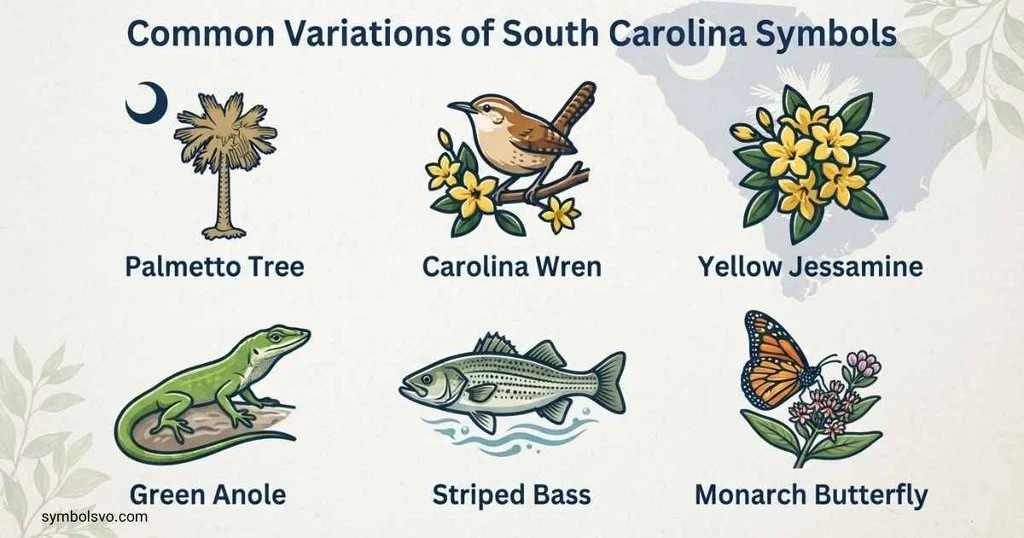
The most common variations involve the palmetto-and-crescent design.
The palmetto may appear alone, while the crescent may be used independently in decorative designs. Artists may simplify the tree, change proportions, or create stylized versions for clothing and graphic design.
The official flag itself should be distinguished from artistic adaptations. A simplified palmetto-and-crescent graphic may communicate “South Carolina” without being an exact reproduction of the official flag.
The crescent also has an interesting historical interpretation. Official state explanations connect Moultrie’s original crescent with the silver emblem worn on soldiers’ caps, although the shape is often popularly described as a moon. A South Carolina State Library educational resource specifically notes that the question of whether it represents a crescent moon or a gorget has been debated.
Common Misconceptions About South Carolina Symbols
The Crescent Is Definitely a Moon
Not necessarily. The crescent is frequently called a moon in popular descriptions, but South Carolina’s historical explanation connects Moultrie’s original design to the silver emblem worn on soldiers’ caps. The exact interpretation has remained a subject of discussion.
The Palmetto Represents Tropical South Carolina
The palmetto does fit the state’s coastal landscape, but its importance as a state symbol comes primarily from its Revolutionary War history, especially the defense of Fort Moultrie.
The Palmetto Became the State Tree Because It Was on the Flag
The timeline is more complicated. The palmetto was already associated with South Carolina’s Revolutionary history and flag imagery before the legislature formally designated it as the state tree in 1939.
South Carolina Has Only a Few State Symbols
South Carolina has a large collection of official symbols covering plants, animals, food, color, minerals, transportation-related heritage, music and dance, government emblems, and more. The list has also changed over time as new symbols have been adopted.
10 Interesting Facts About South Carolina Symbols
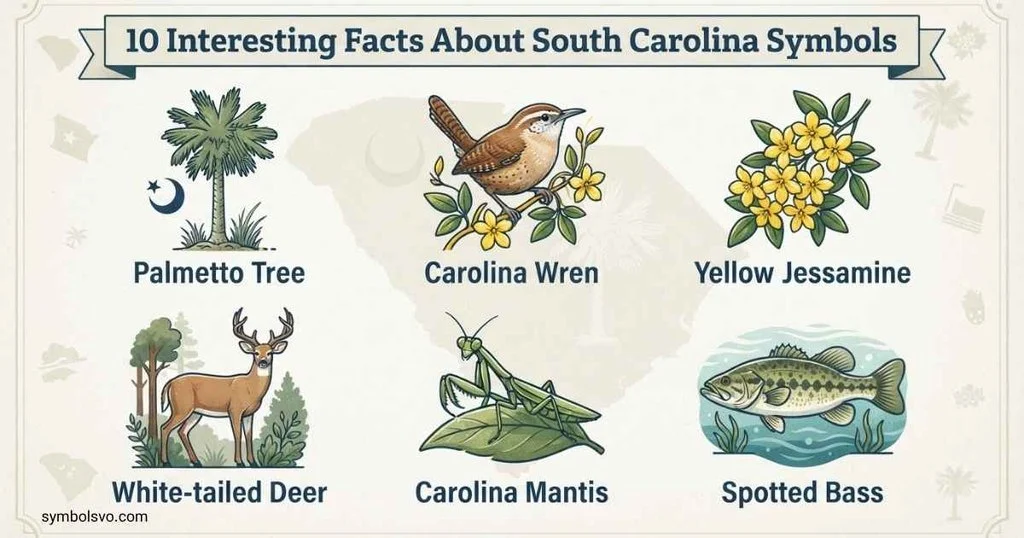
- The palmetto tree is central to South Carolina’s nickname. The state is widely known as the “Palmetto State,” showing how strongly one symbol can become associated with an entire place.
- The current flag dates to 1861. The General Assembly adopted the current version on January 28, 1861, adding the palmetto to Moultrie’s earlier design.
- The original flag design dates to 1775. Colonel William Moultrie’s military design provided the foundation for the later state flag.
- South Carolina has two official state mottos. “Dum Spiro Spero” means “While I Breathe I Hope,” while “Animis Opibusque Parati” means “Prepared in Mind and Resources.”
- The state seal includes Spes, the personification of Hope. Her presence reinforces the theme of hope found in South Carolina’s motto.
- The Venus flytrap became an official symbol recently. South Carolina designated it the official state carnivorous plant in 2023, reflecting the importance of the state’s unusual coastal ecosystems.
- The eastern brown pelican is South Carolina’s official seabird. It received that designation in 2024, adding a distinctly coastal species to the state’s official symbol collection.
- The Carolina wren became the state bird in 1948. An earlier designation of the mockingbird was repealed when the Carolina wren received official status.
- The spotted salamander became the state amphibian through a school campaign. A third-grade class in Spartanburg helped campaign for its designation in 1999.
- South Carolina’s official color is indigo blue. State law connects the color to the uniforms worn by Colonel William Moultrie’s soldiers and the background of the state flag.
Related South Carolina Symbols
Several symbols are especially useful for understanding the larger picture:
- Palmetto tree: Represents Revolutionary War heritage, resilience, and state identity.
- Crescent: Connects the flag to the military heritage of Moultrie’s troops.
- Yellow jessamine: Represents South Carolina’s native plant life and was adopted as the state flower in 1924.
- Carolina wren: Represents native birdlife and is found throughout the state.
- White-tailed deer: Represents South Carolina’s wildlife and was designated the official state animal in 1972.
- Tiger swallowtail: Represents pollinators and the state’s gardens, forests, and waterways.
- Loggerhead turtle: Represents South Carolina’s coastal ecosystem.
- Blue granite: Represents the state’s geological heritage.
- Amethyst: Represents the state’s official gemstone heritage.
- Boykin Spaniel: Represents a distinctive South Carolina dog breed and sporting tradition.
- Shag: Represents an important part of South Carolina’s coastal dance culture.
- Peach: Represents the state’s agricultural identity.
- Venus flytrap: Represents the unusual plant life of South Carolina’s coastal plain.
- Eastern brown pelican: Represents the state’s maritime environment.
Frequently Asked Questions About South Carolina Symbols
What is the most famous symbol of South Carolina?
The palmetto tree and crescent are the most recognizable South Carolina symbols. They appear together on the state flag and connect modern South Carolina with Revolutionary-era history. The palmetto specifically recalls the defense of Fort Moultrie on Sullivan’s Island, while the crescent comes from the earlier military design associated with Colonel William Moultrie’s troops.
Why is South Carolina called the Palmetto State?
South Carolina is called the Palmetto State because of the historical importance of the palmetto tree. Its strongest symbolic association comes from Fort Moultrie, which was constructed with palmetto logs during the Revolutionary War. The tree later became part of the state flag and was officially designated South Carolina’s state tree in 1939.
What does the crescent mean on the South Carolina flag?
The crescent is connected to the military history of South Carolina’s Revolutionary forces. Colonel William Moultrie’s 1775 design used a crescent-shaped emblem associated with the silver emblem worn on soldiers’ caps. Although many people call it a moon, official historical resources identify the military connection and note that its interpretation has been debated.
What is South Carolina’s state flower?
The yellow jessamine is South Carolina’s official state flower. It was adopted in 1924 and is a native climbing vine with evergreen leaves and fragrant yellow flowers. The plant occurs throughout the state, making it a natural choice for an emblem representing South Carolina’s landscape.
What is South Carolina’s state bird?
The Carolina wren is South Carolina’s official state bird. It was designated in 1948, replacing an earlier designation of the mockingbird. The Carolina wren is found throughout the state and is known for its distinctive appearance and energetic song.
What is South Carolina’s state animal?
The white-tailed deer is the official state animal of South Carolina. It was designated in 1972. The species is widespread in the state’s forests and other habitats, making it a familiar example of South Carolina’s native wildlife.
What is South Carolina’s state gemstone?
Amethyst is the official gemstone of South Carolina. It was designated through state law and forms part of the state’s collection of geological and mineral symbols. Blue granite is separately recognized as the official state stone.
What is South Carolina’s state motto?
South Carolina’s principal state motto is “Dum Spiro Spero,” which means “While I Breathe I Hope.” The state seal also includes “Animis Opibusque Parati,” meaning “Prepared in Mind and Resources.” Together, the mottos express hope, preparedness, and perseverance.
What is South Carolina’s newest state symbol?
Among South Carolina’s more recent official symbols are the Venus flytrap, designated the state carnivorous plant in 2023, and the eastern brown pelican, designated the state seabird in 2024. Their addition demonstrates how the state’s official symbols continue to evolve.
What does the South Carolina state seal represent?
The state seal combines historical imagery with themes of hope and resilience. One side features a palmetto tree and fallen oak, while the other shows Spes, the personification of Hope, walking along a beach at dawn. The two state mottos reinforce the ideas of hope and preparedness.
Key Takeaways
- South Carolina symbols represent the state’s history, environment, culture, and identity.
- The palmetto tree and crescent are the state’s best-known visual symbols.
- The palmetto recalls the Revolutionary War defense of Fort Moultrie on Sullivan’s Island.
- The current South Carolina flag was adopted in 1861, building on Colonel William Moultrie’s 1775 design.
- “Dum Spiro Spero” means “While I Breathe I Hope.”
- Yellow jessamine is the state flower.
- Carolina wren is the state bird.
- White-tailed deer is the state animal.
- Amethyst is the official state gemstone, while blue granite is the official state stone.
- The Venus flytrap became the official state carnivorous plant in 2023.
- The eastern brown pelican became the official state seabird in 2024.
- Food symbols such as the peach, collard greens, milk, and boiled peanut reflect South Carolina’s agricultural and culinary traditions.
Conclusion
South Carolina symbols form a visual and cultural history of the Palmetto State. The palmetto tree and crescent immediately evoke the state’s Revolutionary heritage, while the state seal adds the powerful themes of hope and preparedness. Other official emblems broaden that story to include wildlife, plants, agriculture, geology, food, music, and coastal life.
What makes these symbols meaningful is the connection between their official designations and the places, people, events, and natural environments they represent. From the palmetto associated with Fort Moultrie to the Carolina wren, yellow jessamine, Venus flytrap, and eastern brown pelican, South Carolina symbols preserve different pieces of the state’s identity while allowing that identity to continue evolving.

I’m Ellis Montgomery, a British writer interested in the powerful language of symbols. I explore everything from traditional emblems and cultural signs to contemporary symbols found in modern life. My aim is to explain their meanings clearly while revealing the stories and ideas behind them, making symbolism fascinating and accessible to everyone.
Books:
- The Complete Book of Symbols
- Hidden Messages in Everyday Symbols
 Rowan Whitaker
 Freddie Beaumont