
When I think about Holy Spirit Symbols, I see more than beautiful religious images—they can represent faith, guidance, power, peace, and God’s presence. You may already recognize some of these signs, but their deeper meanings can be surprisingly rich.
I want to help you discover the deeper meaning behind these sacred symbols and understand what they represent in Christian belief. You may be surprised by how much meaning a simple dove, flame, or breath of wind can carry.
As you explore these Holy Spirit Symbols, you’ll discover where they appear in Scripture and what they traditionally represent in Christian faith. I’ll walk you through their meanings in a simple and meaningful way.
Quick Meaning
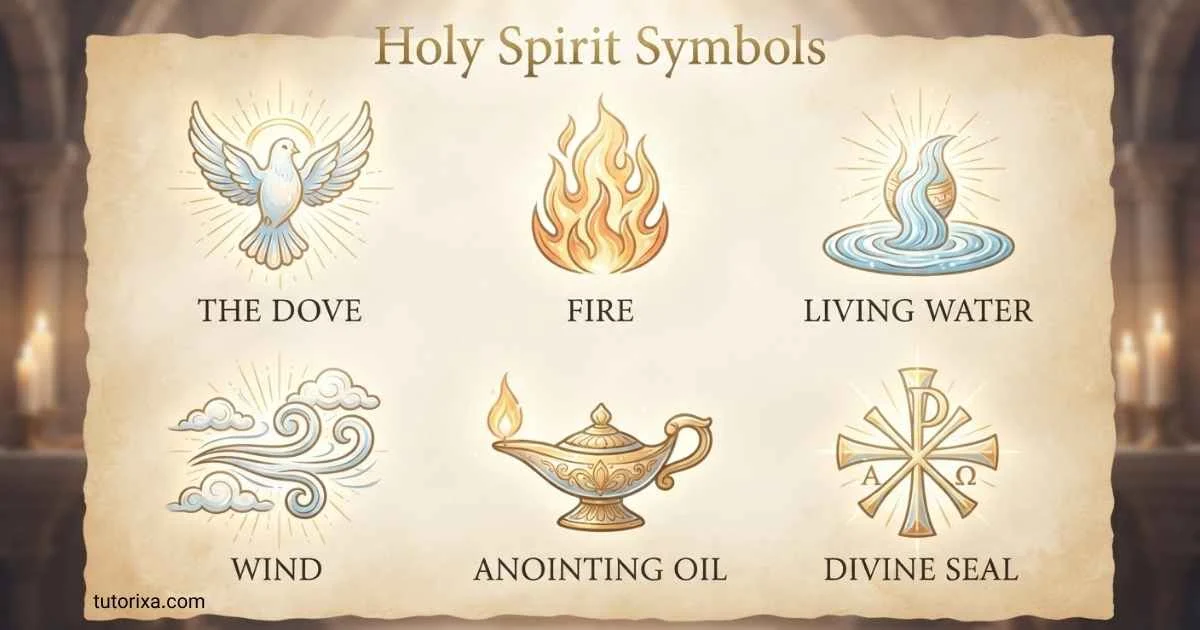
Holy Spirit symbols represent the presence and activity of the Holy Spirit in Christian belief. The dove commonly represents purity, peace, and the Spirit’s descent at Jesus’ baptism, while fire represents divine presence and power, and wind or breath represents the Spirit’s life-giving and dynamic nature. Other biblical images include water, oil, and a seal.
Symbol Overview Table
| Symbol Name | Primary Meaning | Biblical Connection | Common Christian Usage |
| Dove | Peace, purity, descent of the Spirit | Jesus’ baptism | Church art, stained glass, jewelry |
| Fire | Divine presence, power, transformation | Pentecost, Acts 2 | Pentecost artwork, church decoration |
| Wind/Breath | Life, movement, invisible power | Genesis, John 3, Acts 2 | Teaching, art, devotional imagery |
| Water | Baptism, cleansing, new life | Baptism and the Spirit | Baptismal ceremonies and artwork |
| Oil | Anointing, consecration | Anointing traditions | Christian rites and religious art |
| Seal | Belonging, assurance, spiritual identity | Ephesians 1:13–14 | Theology, teaching, Christian art |
| Sevenfold imagery | Fullness and perfection of the Spirit’s work | Isaiah 11:2–3; Revelation imagery | Art and Christian iconography |
| Light | Revelation and divine guidance | Associated biblical imagery | Art, worship, stained glass |
Unicode: There is no official Unicode character specifically representing the Holy Spirit. The dove emoji 🕊️ is sometimes used informally as a Christian symbol of the Holy Spirit, but Unicode officially identifies it simply as a dove.
What Does the Holy Spirit Symbol Mean?
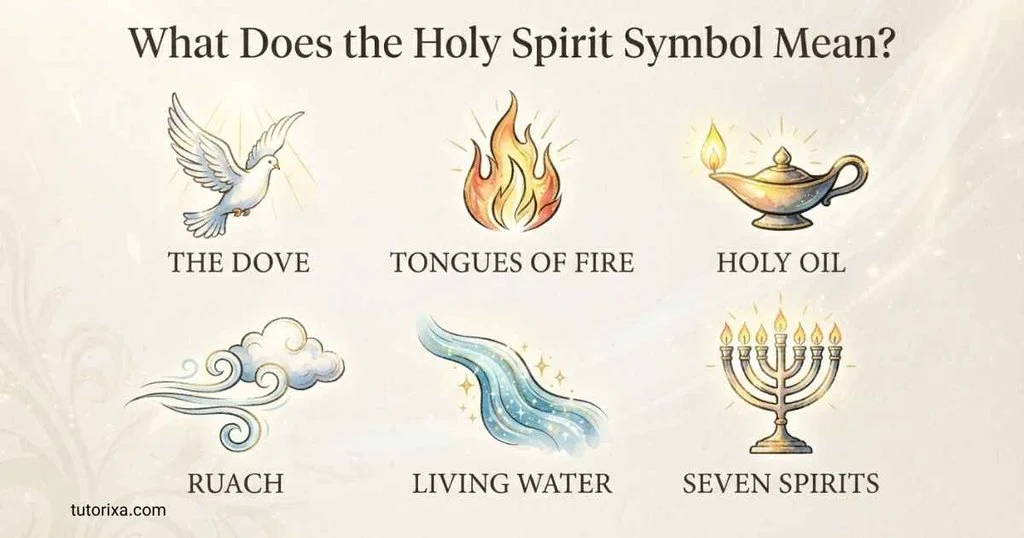
Holy Spirit symbols communicate ideas about God’s Spirit that are difficult to represent visually. In Christian theology, the Holy Spirit is not understood merely as an abstract force or emotion. The Spirit is the third person of the Trinity in mainstream Christian doctrine, alongside the Father and the Son.
Because the Spirit is described in Scripture through invisible or powerful phenomena, Christianity developed a rich visual vocabulary around those descriptions.
The dove is the most recognizable representation. In Matthew 3:16, Mark 1:10, Luke 3:22, and John 1:32, the Spirit is associated with Jesus’ baptism, with the Synoptic Gospels specifically describing the Spirit descending “like a dove.” This image became especially important in Christian art.
Fire has a different emphasis. In Acts 2, during Pentecost, the Holy Spirit comes upon Jesus’ followers, accompanied by what appear to be tongues of fire. Fire therefore became associated with divine presence, spiritual power, purification, proclamation, and transformation.
Wind and breath emphasize another aspect of the Spirit. The Hebrew word ruach can refer to wind, breath, or spirit depending on context, while the Greek pneuma similarly carries meanings connected with breath, wind, and spirit. These linguistic connections help explain why movement of air became an important Christian image for the Spirit.
These symbols should not be treated as literal descriptions of what the Holy Spirit “looks like.” They are visual metaphors or representations derived from biblical language and Christian interpretation.
History and Origin
Holy Spirit symbolism does not come from a single ancient symbol or one historical culture. Its roots are primarily found in the Bible, while Christian artists and theologians developed the visual tradition over many centuries.
Biblical Foundations
The Hebrew Bible frequently uses imagery involving breath, wind, fire, water, oil, and divine presence. The New Testament then gives particular significance to several of these images in relation to the Holy Spirit.
The dove became especially important through the baptism accounts of Jesus. At his baptism, the Spirit is described as descending upon him like a dove. This provided an unusually clear visual association between the Spirit and a recognizable creature.
Fire became strongly associated with the Spirit through Pentecost. Acts 2 describes the arrival of the Holy Spirit among Jesus’ disciples and compares the visible phenomenon to tongues of fire.
Wind is also important in Acts 2, where the coming of the Spirit is accompanied by a sound resembling a powerful wind. In John 3, Jesus uses the relationship between wind and the Spirit as part of his teaching about spiritual rebirth.
Development in Early Christianity
Early Christians used symbols because visual communication was especially valuable in worship spaces, manuscripts, tombs, and religious art. The dove became a recurring Christian image, while other forms of Christian symbolism developed around baptism, resurrection, Christ, the Eucharist, and the Trinity.
As Christian art became more elaborate, artists increasingly portrayed the Holy Spirit as a dove within scenes of the Trinity, the Annunciation, baptism, Pentecost, and other religious subjects.
Medieval and Renaissance Art
During the medieval period, the dove became firmly established as a visual representation of the Holy Spirit in Western Christian art. Artists also used rays of light, flames, and other visual elements to communicate divine activity.
Renaissance artists continued these conventions while incorporating the dove into paintings of the Trinity and other biblical scenes. The representation was generally symbolic rather than an attempt to claim that the Holy Spirit had a permanent physical form.
Symbolism and Interpretation
Holy Spirit symbols carry different shades of meaning because each biblical image highlights a different aspect of the Spirit’s work.
The Dove
The dove is the most widely recognized Holy Spirit symbol.
Its strongest Christian basis is the baptism of Jesus. The Gospel accounts connect the dove-like descent with the Holy Spirit, making the bird an established Christian emblem.
The dove can communicate:
- Peace
- Purity
- Gentleness
- Divine presence
- Spiritual renewal
- The descent of the Holy Spirit
It is important, however, not to assume that every ancient or modern meaning of a dove automatically belongs to Christian Holy Spirit theology. The biblical baptism narratives are the central reason the dove became connected with the Spirit.
Fire
Fire represents a more energetic dimension of Holy Spirit symbolism.
At Pentecost, Acts 2 describes tongues resembling fire resting upon the disciples. Christian interpretation therefore connects fire with:
- Divine power
- God’s presence
- Spiritual transformation
- Zeal
- Purification
- Proclamation
Fire can also carry destructive or dangerous meanings in other contexts. Christian symbolism therefore depends on context. A flame in a Pentecost painting usually communicates the Spirit, while fire elsewhere in the Bible may represent judgment or destruction.
Wind and Breath
Wind and breath emphasize the Spirit’s invisible yet powerful nature.
You cannot see wind itself, but you can see its effects. Likewise, Christian writers have used wind as an image for the Spirit’s activity: unseen, dynamic, and capable of producing visible change.
The connection is strengthened by biblical languages. Ruach in Hebrew and pneuma in Greek can relate to wind, breath, and spirit. These linguistic relationships are important to biblical interpretation, although a word’s possible meanings should always be determined by its specific context.
Water
Water is strongly connected with Christian baptism and spiritual renewal.
Christian baptism involves water, while the New Testament connects baptism and the Holy Spirit in several passages. Water can therefore represent cleansing, new life, renewal, and participation in Christian faith.
However, water is not as direct a Holy Spirit emblem as the dove or fire. It is better described as a related biblical symbol associated with baptism and spiritual life.
Oil
Oil has a long history in biblical religious practice. Kings, priests, and others were anointed with oil, and anointing became associated with consecration and divine calling.
Christian traditions later connected anointing with the work of the Holy Spirit. This connection is particularly important in traditions that practice anointing with oil in religious ceremonies.
Again, oil should not automatically be treated as a universal standalone symbol of the Holy Spirit. Its meaning depends on the biblical and liturgical context.
Seal
The New Testament uses the language of being “sealed” with the Holy Spirit. Ephesians 1:13–14 and related passages connect the Spirit with belonging, assurance, and God’s promise.
A seal represents identity, ownership, authentication, or confirmation. In Christian interpretation, the image therefore communicates that believers belong to God and have received the Spirit as part of God’s promise.
Cultural Significance
The meaning of Holy Spirit symbols varies somewhat among Christian cultures and denominations, although several major images are widely shared.
Western Christianity
Roman Catholic, Eastern Catholic, Anglican, Lutheran, and many Protestant traditions use the dove extensively in religious art. Stained-glass windows, paintings, church decorations, baptismal imagery, and depictions of the Trinity commonly feature the dove.
Pentecost traditions give particular importance to fire because of the biblical account in Acts 2.
Eastern Christianity
Eastern Orthodox iconography has distinctive rules and traditions concerning the depiction of sacred subjects. The Holy Spirit may be represented as a dove in appropriate biblical contexts, particularly baptismal scenes, but Orthodox iconography also carefully distinguishes between symbolic representation and claims about divine nature.
Pentecostal and Charismatic Christianity
Pentecostal and charismatic communities frequently use imagery of fire, wind, and spiritual gifts because of the importance of Pentecost and the New Testament accounts of the Spirit’s activity.
Flames and moving-air imagery can therefore be particularly prominent in worship materials and educational resources associated with these traditions.
Different Cultural Settings
A dove may carry broader cultural meanings such as peace or innocence outside Christianity. Fire may symbolize warmth, destruction, purification, or energy in different societies. Consequently, the same visual image can communicate different things depending on the viewer’s cultural and religious background.
Religious or Spiritual Meaning
The Holy Spirit holds a central position in Christian theology.
In Trinitarian Christianity, the Holy Spirit is understood as God, distinct in personhood from the Father and the Son while sharing the one divine nature. The symbols associated with the Spirit help Christians communicate aspects of this theological understanding.
The Spirit is described in the New Testament as active in:
- Giving life
- Guiding believers
- Empowering witness
- Inspiring spiritual gifts
- Bringing conviction
- Strengthening faith
- Uniting believers
- Dwelling with believers
- Supporting prayer
- Sanctifying or transforming believers
The symbols do not replace these theological teachings. Instead, they make abstract or invisible concepts easier to visualize.
In Christian worship, Holy Spirit imagery can appear during baptism, Pentecost celebrations, confirmation, ordination, prayer services, church festivals, and artistic depictions of biblical events.
Scientific or Technical Meaning
Holy Spirit symbols do not have a scientific or mathematical definition.
The dove, flame, wind, and related images are religious symbols rather than scientific notation. A flame does not scientifically represent the Holy Spirit, and wind is not evidence of a spiritual presence in a scientific sense.
There is, however, an interesting linguistic relationship between religious language and natural phenomena. Human cultures have often used breath and wind as metaphors for life because breathing is essential to living organisms and wind is invisible while producing observable effects.
Modern digital systems also do not contain an official “Holy Spirit” Unicode symbol. The character 🕊️ can be used as a dove emoji, but its use as a Holy Spirit symbol comes from users and religious convention rather than from the Unicode standard itself.
Where the Symbols Are Used Holy Spirit Symbols
Holy Spirit symbols appear in many forms of Christian culture and communication.
Churches and Architecture
Doves, flames, rays of light, and other imagery may appear in stained glass, mosaics, altarpieces, baptisteries, church furniture, and architectural decoration.
Religious Art
Paintings and icons often use the dove in scenes depicting Jesus’ baptism or the Trinity. Fire and light frequently appear in Pentecost artwork.
Jewelry
Crosses, dove pendants, flame designs, and combinations of Christian symbols are common forms of religious jewelry. A dove pendant may be chosen to represent faith, peace, or the Holy Spirit.
Books and Religious Literature
Christian books, Bible study materials, devotional publications, and educational resources may use dove and flame imagery to identify subjects involving the Holy Spirit.
Tattoos
Some people use dove, flame, or other Christian imagery as personal expressions of faith. The intended meaning is individual, although the biblical associations provide a recognizable religious context.
Logos and Graphic Design
Churches, ministries, schools, and religious organizations may incorporate doves, flames, rays, or combinations of these motifs into visual identities.
Common Variations
Holy Spirit symbols can appear in several artistic forms.
Dove With Open Wings
An open-winged dove often represents the descent or active presence of the Holy Spirit. This design is especially common in church artwork.
Dove With Rays
Artists may surround the dove with rays of light to emphasize divine glory or heavenly presence.
Flame or Multiple Flames
A single flame can symbolize spiritual fire, while multiple flames are especially associated with Pentecost’s description of tongues resembling fire.
Dove and Cross
Combining a dove with a cross links the Holy Spirit with Christ and the Christian faith as a whole.
Dove, Cross, and Flame
This combination can represent different aspects of Christian belief: Christ’s crucifixion, the Holy Spirit, and spiritual power.
Sevenfold Representation
Christian art sometimes portrays seven flames, seven rays, or related groupings connected with traditional interpretations of the Spirit’s fullness and with biblical passages such as Isaiah 11:2–3 and Revelation. These designs vary considerably between traditions.
Common Misconceptions
The Holy Spirit Is Literally a Dove
The dove is a symbolic representation. The Gospel accounts describe the Spirit descending like a dove in connection with Jesus’ baptism. This does not mean Christian theology teaches that the Holy Spirit’s permanent physical form is a bird.
The Dove Is the Only Holy Spirit Symbol
The dove is the best-known image, but it is not the only biblical representation. Fire, wind, breath, water, oil, and seal imagery are also connected with different aspects of the Spirit’s work.
Fire Always Means the Holy Spirit
Fire has several meanings in the Bible, including divine presence, purification, judgment, and destruction. Its connection with the Holy Spirit is particularly clear in Acts 2.
Every Dove Symbol Is Christian
Doves have meanings outside Christianity. They can represent peace, love, innocence, or other ideas in secular art and different cultural traditions. Context determines meaning.
There Is an Official Holy Spirit Emoji
There is no Unicode character officially named “Holy Spirit.” The dove emoji 🕊️ is sometimes used to represent the Holy Spirit, but its standardized identity is simply a dove.
Interesting Facts About Holy Spirit Symbols
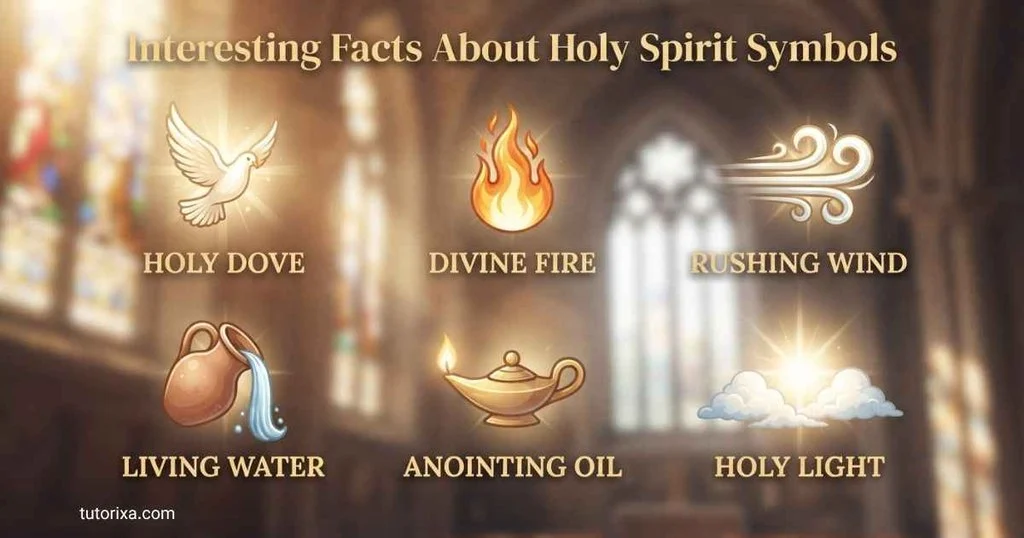
- The dove became prominent through Jesus’ baptism.
The New Testament baptism narratives provide the clearest biblical foundation for the dove as a Holy Spirit image. - Fire has a special connection with Pentecost.
Acts 2 describes something resembling tongues of fire appearing when the Holy Spirit came upon Jesus’ followers. - Wind and Spirit are connected linguistically.
Hebrew ruach and Greek pneuma can carry meanings associated with wind, breath, and spirit, depending on context. - The dove predates many modern church logos.
Christian artists used dove imagery for centuries before modern branding turned religious symbols into simplified graphic marks. - The dove is not unique to Christianity.
Doves have broader associations in ancient Mediterranean and Near Eastern cultures, so their Christian meaning developed within a larger cultural environment. - Holy Spirit imagery is especially visible at Pentecost.
Christian churches may use red decorations, flames, and other imagery during Pentecost because fire is prominent in Acts 2. - The Spirit has several biblical metaphors.
Scripture does not limit discussion of the Holy Spirit to one visual image, which explains the diversity of Christian symbolism. - The seal is a less visible but important symbol.
New Testament passages use sealing language to communicate belonging and assurance connected with the Holy Spirit. - Water has a related but distinct meaning.
Water is closely associated with Christian baptism and spiritual renewal, but it should not automatically be treated as an exclusive symbol of the Holy Spirit. - There is no single universal Christian design.
Catholic, Orthodox, Protestant, Pentecostal, and other Christian traditions may emphasize different aspects of Holy Spirit imagery.
Related Symbols of Holy Spirit Symbols
Several symbols are closely connected with Holy Spirit symbolism but should not be treated as identical.
- Cross: Represents the crucifixion and Christian faith, rather than specifically the Holy Spirit.
- Ichthys (fish): An ancient Christian symbol associated with Jesus Christ and Christian identity.
- Chi-Rho: A Christological monogram formed from Greek letters associated with Christ.
- Alpha and Omega: Symbolic of God’s eternal nature and biblical language concerning beginning and end.
- Crown: Can represent Christ’s kingship, heavenly authority, or Christian victory depending on context.
- Lamb: Commonly represents Jesus Christ, particularly through the biblical image of the Lamb of God.
- Light: Frequently represents divine revelation, truth, holiness, and God’s presence.
- Olive branch: Often represents peace and can accompany a dove, but it is not itself an exclusive Holy Spirit symbol.
- Seven-pointed or sevenfold imagery: May communicate completeness or fullness in particular Christian traditions and interpretations.
The important distinction is that related Christian symbols can share themes without having identical meanings.
Frequently Asked Questions
What is the main symbol of the Holy Spirit?
The dove is the most widely recognized symbol of the Holy Spirit in Christianity. Its importance comes especially from the Gospel accounts of Jesus’ baptism, where the Spirit is described as descending like a dove. Christian art subsequently adopted the dove as a recognizable visual representation of the Spirit.
What does the dove symbolize in Christianity?
In connection with the Holy Spirit, the dove commonly represents the Spirit’s presence and descent at Jesus’ baptism. It may also suggest peace, purity, gentleness, and spiritual renewal. These additional meanings are common Christian interpretations, while the strongest biblical basis is the baptism narrative itself.
What does fire symbolize for the Holy Spirit?
Fire represents the Holy Spirit’s powerful and transformative activity, particularly because Acts 2 describes tongues resembling fire appearing when the Spirit came upon Jesus’ disciples at Pentecost. Fire can also symbolize divine presence and purification, although its biblical meaning varies by context.
Is the dove an official symbol of the Holy Spirit?
The dove is a widely established Christian symbol of the Holy Spirit, but there is no universal official emblem that every Christian denomination must use. The connection comes primarily from the biblical baptism accounts and centuries of Christian artistic and theological tradition.
What does wind symbolize in relation to the Holy Spirit?
Wind represents the invisible but active nature of the Holy Spirit. The biblical connection is especially clear in Acts 2, where the Spirit’s coming is accompanied by a sound like a powerful wind. The relationship is also reflected in the meanings of the Hebrew and Greek words associated with spirit, wind, and breath.
Is water a symbol of the Holy Spirit?
Water is a related Christian symbol, especially through baptism and biblical teachings about spiritual cleansing, renewal, and new life. However, water is not as direct a representation of the Holy Spirit as the dove in the baptism narratives or fire in the Pentecost account.
What does the Holy Spirit symbolize in Christianity?
The Holy Spirit is associated with God’s presence and activity in Christian life and theology. Biblical descriptions connect the Spirit with life, guidance, empowerment, spiritual gifts, prayer, transformation, and belonging to God. The specific symbolism depends on the biblical passage and Christian tradition being considered.
What does a flame symbolize in Christianity?
A flame can symbolize several things, including God’s presence, spiritual power, purification, zeal, and transformation. When a flame is used specifically in connection with Pentecost, it commonly refers to the Holy Spirit because Acts 2 describes tongues resembling fire.
Is there a Holy Spirit emoji?
There is no Unicode emoji specifically designated as the Holy Spirit. The 🕊️ dove emoji is sometimes used informally to communicate the Holy Spirit in Christian conversations, posts, and designs. Its official Unicode meaning, however, is simply a dove.
Why is the Holy Spirit shown as a dove?
The dove became the principal visual representation because the Gospel accounts of Jesus’ baptism connect the Holy Spirit’s descent with the appearance or likeness of a dove. Over time, Christian artists adopted this biblical image, making it one of the most recognizable representations of the Holy Spirit.
Key Takeaways
- The dove is the best-known symbol of the Holy Spirit.
- Its strongest biblical basis is found in the accounts of Jesus’ baptism.
- Fire is strongly associated with the Holy Spirit through Pentecost in Acts 2.
- Wind and breath symbolize the Spirit’s invisible but powerful activity.
- Water is closely connected with baptism, cleansing, renewal, and spiritual life.
- Oil represents anointing and consecration and became associated with the Spirit in Christian tradition.
- The seal represents belonging, assurance, and God’s promise through the Spirit.
- No single Holy Spirit symbol is universally required across all Christian traditions.
- Holy Spirit symbols are visual representations, not literal depictions of the Spirit’s physical appearance.
- The meaning of a symbol can change according to biblical, denominational, cultural, and artistic context.
- There is no official Unicode character specifically called the Holy Spirit.
- The dove emoji 🕊️ can be used informally for Christian Holy Spirit symbolism.
Conclusion
Holy Spirit symbols give visible form to ideas that Christian theology describes as spiritual, invisible, and active. The dove remains the most familiar image because of its connection with Jesus’ baptism, while fire recalls Pentecost and the Spirit’s powerful activity. Wind, breath, water, oil, and the seal add other dimensions, including life, renewal, anointing, movement, belonging, and assurance.
The most important point is that these symbols do not all mean exactly the same thing. Their significance comes from specific biblical passages, Christian theological traditions, artistic conventions, and cultural settings. Understanding those differences makes the symbolism more meaningful and prevents common misconceptions. Whether encountered in a church window, painting, Bible study, piece of jewelry, or digital design, holy spirit symbols are best understood as visual reminders of the Christian belief in God’s Spirit and the many ways that Spirit is described in Scripture and Christian tradition.

I’m Ellis Montgomery, a British writer interested in the powerful language of symbols. I explore everything from traditional emblems and cultural signs to contemporary symbols found in modern life. My aim is to explain their meanings clearly while revealing the stories and ideas behind them, making symbolism fascinating and accessible to everyone.
Books:
- The Complete Book of Symbols
- Hidden Messages in Everyday Symbols
 Rowan Whitaker