
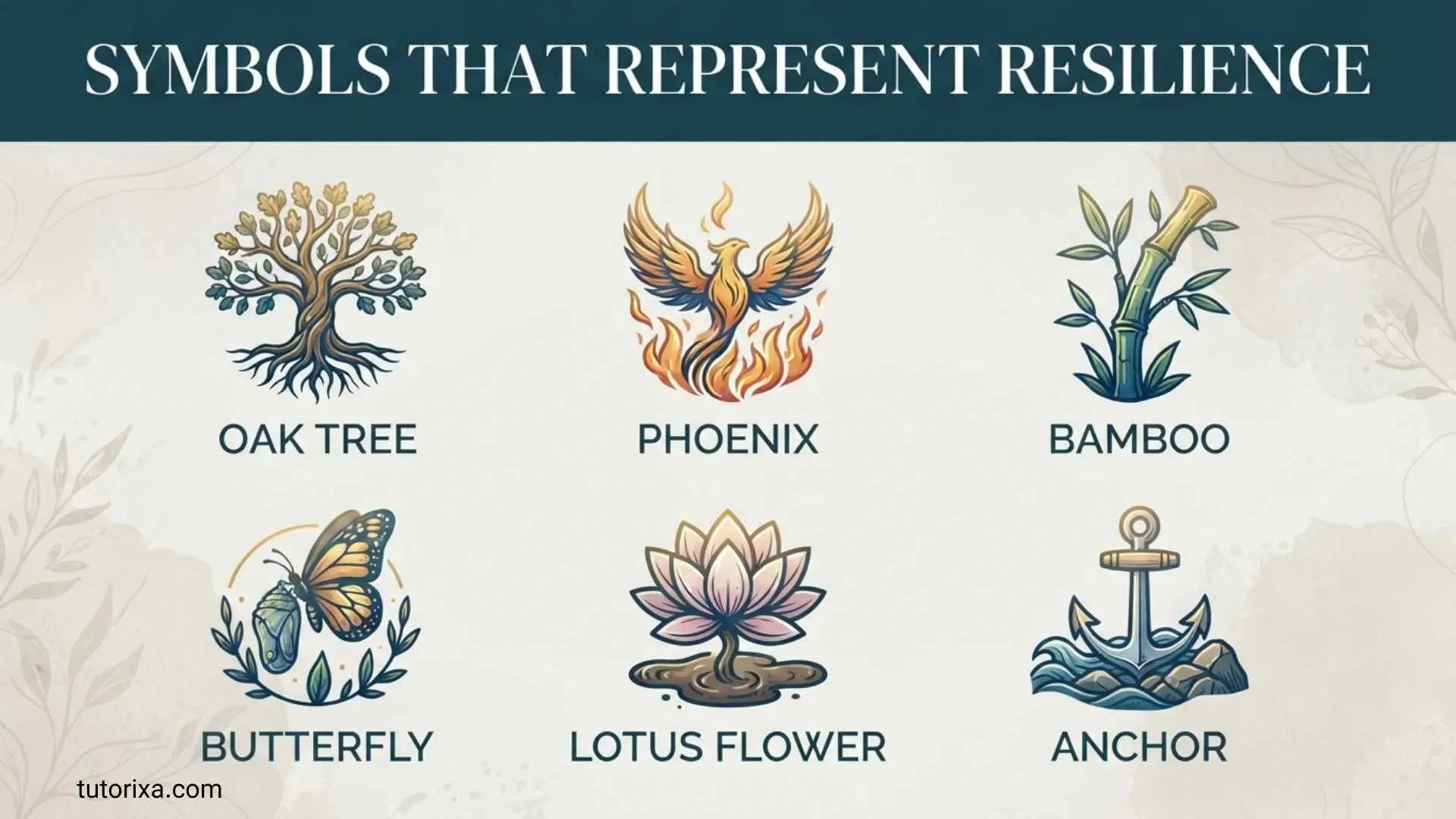
When life gets difficult, I look for reminders that strength can grow through challenges. You may be surprised by how many symbols represent resilience, courage, and the ability to keep moving forward.
I’ll help you discover the powerful meanings behind these symbols and why they continue to inspire people. From ancient traditions to modern designs, each symbol can tell a story of endurance and hope.
Whether you need inspiration, a meaningful tattoo idea, artwork, or simply want to understand symbolism, you’ll find practical answers here. Let’s explore the symbols that represent resilience and the stories behind them.
Quick Meaning
Symbols that represent resilience are visual images associated with endurance, recovery, adaptability, courage, and renewal. Common examples include the phoenix, lotus flower, oak tree, bamboo, mountain, anchor, spiral, butterfly, and kintsugi. Their meanings developed through mythology, nature, religion, philosophy, and cultural traditions, making them enduring symbols of strength and perseverance.
Symbol Overview Table
| Symbol | Primary Meaning | Category | Cultural or Historical Association | Common Modern Meaning |
| Phoenix | Rebirth and renewal | Mythological | Greek, Roman, Egyptian traditions and later European literature | Rising after hardship |
| Lotus | Renewal and spiritual endurance | Natural/Religious | Hinduism, Buddhism, ancient Egyptian symbolism | Growth through difficulty |
| Oak Tree | Strength and endurance | Natural | Greek, Roman, Celtic and European traditions | Stability and perseverance |
| Bamboo | Flexibility and resilience | Natural | Chinese, Japanese and wider East Asian traditions | Adaptability |
| Mountain | Endurance and overcoming obstacles | Natural | Global cultural symbolism | Strength and achievement |
| Anchor | Stability and steadfastness | Nautical | Maritime and Christian traditions | Staying grounded |
| Spiral | Growth and transformation | Geometric/Natural | Ancient and worldwide traditions | Continuous development |
| Butterfly | Transformation | Natural | Worldwide symbolic traditions | Personal change and renewal |
| Kintsugi | Repair and acceptance | Artistic | Japanese craft tradition | Strength through restoration |
| Tree | Life, endurance and continuity | Natural/Religious | Many world cultures | Growth and rootedness |
What Do Symbols That Represent Resilience Mean?
Symbols of resilience generally communicate one central idea: difficulty does not necessarily mean the end of growth, strength, or progress.
Resilience can take several forms. A person may remain steady during hardship, adapt to changing circumstances, recover after failure, or transform through an experience. Because of this, there is no single universal symbol of resilience.
Different symbols emphasize different aspects:
- Phoenix: beginning again after destruction or profound change.
- Lotus: emerging from difficult conditions while retaining beauty and purpose.
- Oak: remaining strong and deeply rooted.
- Bamboo: bending without easily breaking.
- Mountain: enduring challenges and reaching a difficult goal.
- Anchor: remaining stable when circumstances are turbulent.
- Spiral: continuing through cycles of change and development.
- Butterfly: transformation after a period of profound change.
- Kintsugi: treating repair as part of an object’s history rather than something that must be hidden.
This distinction matters because resilience is not always about simply “being strong.” Sometimes resilience means adapting, changing direction, accepting help, recovering, or growing in a new way.
History and Origin of Resilience Symbols
There is no single ancient civilization that created a universal symbol for resilience. Instead, resilience symbolism developed independently through observations of nature, mythology, religious teachings, craftsmanship, and storytelling.
The Phoenix
The phoenix is one of the best-known mythological images associated with renewal. Ancient descriptions of a remarkable long-lived bird appear in Greek and Roman writings, while the broader tradition has connections with earlier Egyptian ideas surrounding sacred birds and solar renewal.
Over time, European literature increasingly associated the phoenix with destruction followed by renewed life. That later interpretation made it a powerful metaphor for surviving major change and starting over.
The phoenix is therefore especially associated with rebirth rather than simple physical strength.
The Lotus
The lotus has deep symbolic importance in South Asian and East Asian religious traditions. In Hindu and Buddhist traditions, lotus imagery can represent purity, spiritual development, awakening, and transcendence.
The plant’s growth pattern contributes to its symbolism. Lotus plants grow in muddy or watery environments while producing flowers above the water. This natural contrast has made the lotus a compelling metaphor for developing positively despite difficult surroundings.
It is important, however, not to reduce Hindu or Buddhist lotus symbolism to a simple “resilience flower.” Its religious meanings are broader and can include purity, enlightenment, sacred beauty, and spiritual awakening.
The Oak Tree
The oak has long been associated with strength, longevity, authority, and endurance in European traditions. Ancient Greeks and Romans connected oak trees with powerful deities, while oak trees also held significance in various Celtic traditions.
Its symbolism is strongly connected to its physical characteristics. Mature oak trees can become extremely large and long-lived, with substantial trunks and deep root systems. As a result, the oak became a natural metaphor for strength that develops over time.
Bamboo
Bamboo is particularly important in Chinese cultural symbolism and also has significant associations in Japanese and other East Asian traditions.
Its ability to bend in strong winds without necessarily snapping provides a useful metaphor for adaptability. Traditional Chinese thought, poetry, painting, and art have frequently used bamboo as a symbol connected with qualities such as integrity, resilience, and flexibility.
The lesson differs from the oak: resilience can mean flexibility rather than immovability.
Symbolism and Interpretation
Positive Symbolism
Symbols of resilience commonly represent:
- Perseverance
- Courage
- Endurance
- Hope
- Recovery
- Adaptability
- Renewal
- Inner strength
- Patience
- Transformation
- Stability
- Determination
These meanings are especially common in memorial art, personal jewelry, inspirational artwork, literature, and symbolic gifts.
Resilience Does Not Mean Never Struggling
One common mistake is treating resilience as an expectation that someone should remain unaffected by hardship.
Symbolically, many resilience images communicate something more nuanced. The bamboo bends. The lotus grows from challenging surroundings. Kintsugi emphasizes repair. The phoenix undergoes destruction before renewal.
Together, these images suggest that resilience can include vulnerability, adaptation, restoration, and change.
Psychological Interpretation
From a psychological perspective, symbolic objects can serve as reminders of values or personal experiences. A person may choose a mountain because it represents a difficult goal, an anchor because it represents stability, or a butterfly because it represents transformation.
The meaning is personal rather than scientifically fixed. Psychology does not establish that a particular symbol automatically produces resilience. Instead, symbols can help people organize memories, express identity, communicate values, or create meaningful reminders.
Cultural Significance of Resilience Symbols
Resilience symbolism varies considerably between cultures.
East Asian Traditions
Bamboo is strongly associated with flexibility and upright character in Chinese cultural traditions. The lotus has important Buddhist significance across much of Asia, while Japanese art offers distinctive examples of transformation and repair through traditions such as kintsugi.
South Asian Traditions
The lotus is deeply embedded in Hindu and Buddhist religious imagery. Its symbolism includes spiritual purity and awakening, with specific meanings depending on the religious and artistic context.
Greek and Roman Traditions
The oak was associated with powerful deities and sacred spaces. The phoenix tradition also became influential through Greek and Roman writers, eventually contributing to later Western symbolism of rebirth.
Celtic and European Traditions
Oak trees held importance in several ancient European traditions. Their size, longevity, and perceived strength helped make them symbols of endurance and power.
Indigenous and Other Cultural Traditions
Trees, mountains, animals, plants, and celestial forms have symbolic roles in many Indigenous and traditional cultures. However, meanings differ significantly between individual peoples and communities. A symbol should not automatically be assigned one universal “Native American” meaning, because Indigenous cultures are diverse rather than a single symbolic tradition.
Religious or Spiritual Meaning
Several resilience symbols have religious dimensions.
Lotus in Buddhism
The lotus is closely associated with Buddhist teachings and imagery. It can represent purity, spiritual development, and awakening. The flower’s emergence from muddy water provides a visual metaphor for rising beyond difficult conditions.
Lotus in Hinduism
Lotus imagery appears extensively in Hindu art and religious traditions. It can be associated with deities, purity, beauty, creation, and spiritual consciousness. Its meaning depends on the deity, text, artwork, and ritual context.
Phoenix in Christianity
The phoenix became a Christian symbol in some early Christian writings and artistic traditions, where its legendary renewal was interpreted as a metaphor for resurrection and eternal life. This is a historical symbolic interpretation rather than evidence that the phoenix originated as a Christian symbol.
Anchor in Christianity
The anchor has also appeared in Christian symbolism, particularly in early Christian contexts, where it could represent hope and steadfast faith. Its religious meaning developed alongside its ordinary nautical meaning of stability.
Scientific or Technical Meaning
Most resilience symbols do not have a formal scientific definition. Their meanings are primarily cultural, artistic, or metaphorical.
However, some natural examples have characteristics that explain why humans use them metaphorically.
Bamboo can bend considerably under environmental forces, which helps explain its association with flexibility.
Oak trees can live for many decades or centuries depending on species and conditions, making longevity a natural basis for endurance symbolism.
Mountains withstand geological processes over extremely long periods, which helps explain their association with permanence and endurance.
Spirals appear throughout nature, mathematics, and biology, including certain shells, plant structures, and galaxies. Their cultural symbolism of growth and continuity should not be confused with a universal scientific meaning.
Where Are Resilience Symbols Used?
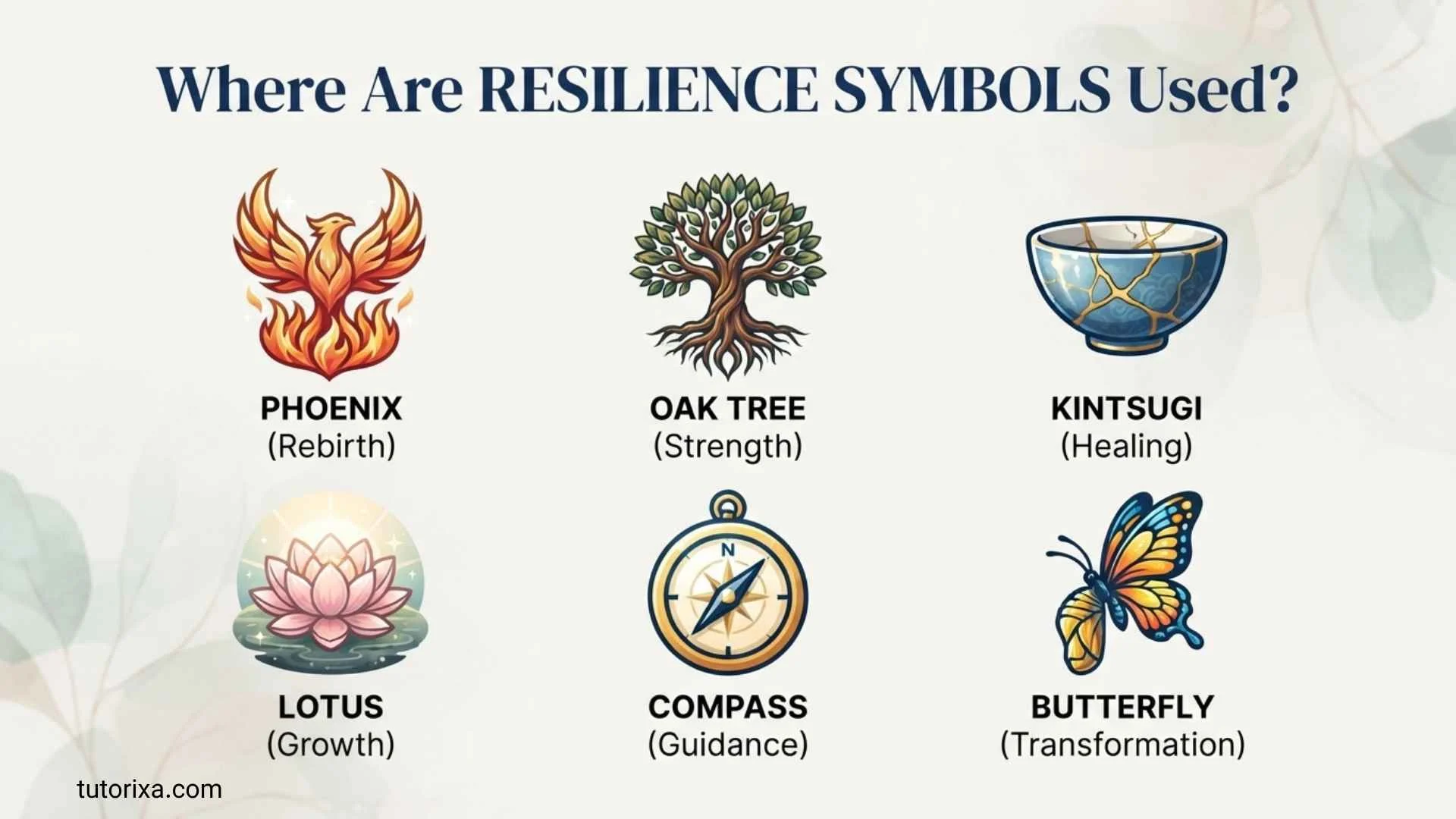
Symbols of resilience appear in many areas of everyday life and culture.
Jewelry
Phoenixes, mountains, anchors, trees, and lotus flowers are common choices for symbolic jewelry. People may select them to commemorate personal growth, celebrate a new chapter, or represent a meaningful value.
Tattoos
Resilience-themed tattoos often combine several images, such as a mountain with a sunrise, a tree with strong roots, or a phoenix with abstract geometric elements.
The meaning of a tattoo is ultimately personal. A design that represents endurance to one person may represent transformation or remembrance to another.
Literature
Writers frequently use symbolic objects to communicate character development. A tree may represent stability, a storm may represent adversity, and a mountain may represent an obstacle that must be confronted.
Art and Design
Resilience symbols are useful in posters, illustrations, memorial artwork, educational materials, and personal artwork because visual metaphors can communicate complex emotional ideas quickly.
Architecture
Trees, mountains, circles, columns, and other structural forms have sometimes been used metaphorically to communicate stability, continuity, permanence, or connection.
Logos and Organizations
Organizations may use mountains, trees, rising shapes, or circular forms to suggest qualities such as reliability, growth, endurance, and progress. A logo’s exact meaning depends on its creator and context.
Common Variations
Phoenix Variations
A phoenix may be shown:
- Rising from flames
- With extended wings
- Emerging from ashes
- In circular compositions
- With sun imagery
The fiery phoenix is a modern visual shorthand for rebirth, although historical phoenix traditions are more complex than the familiar “bird rises from ashes” image.
Lotus Variations
Lotus imagery can differ according to artistic and religious tradition. Different colors and numbers of petals may carry specific meanings in particular Buddhist or Hindu contexts, so color symbolism should not be treated as universal.
Tree Variations
A resilience tree may emphasize:
- Deep roots for stability
- Strong branches for growth
- New leaves for renewal
- Seasonal change for adaptation
- A large trunk for endurance
Mountain Variations
Mountains may be illustrated with:
- A rising sun
- Snow-covered peaks
- A pathway
- Clouds
- Multiple peaks
- A person reaching a summit
The mountain usually emphasizes perseverance toward a goal rather than recovery after destruction.
Common Misconceptions
“There Is One Universal Symbol of Resilience”
There is not. Different cultures and individuals use different images to communicate resilience.
“The Phoenix Always Comes From Ancient Egypt”
This is an oversimplification. Egyptian sacred-bird traditions influenced later interpretations, but the familiar phoenix tradition developed through multiple historical sources and became especially prominent in Greek and Roman literature.
“Kintsugi Means Broken Things Are Better”
Kintsugi is a Japanese craft tradition involving the repair of broken ceramics, traditionally using lacquer and metallic powders. It is often interpreted metaphorically as embracing repair and history, but the popular phrase “broken things are more beautiful” is a modern simplification rather than a complete definition of the craft.
“Bamboo Means Never Breaking”
Bamboo is associated with flexibility partly because it bends in wind, but it can certainly be damaged or broken. The symbolism is metaphorical, not a claim that bamboo is physically unbreakable.
“Every Symbol Has the Same Meaning Everywhere”
Symbols change meaning according to culture, historical period, religion, language, and context. A symbol should therefore be interpreted within its specific tradition.
Interesting Facts About Resilience Symbols
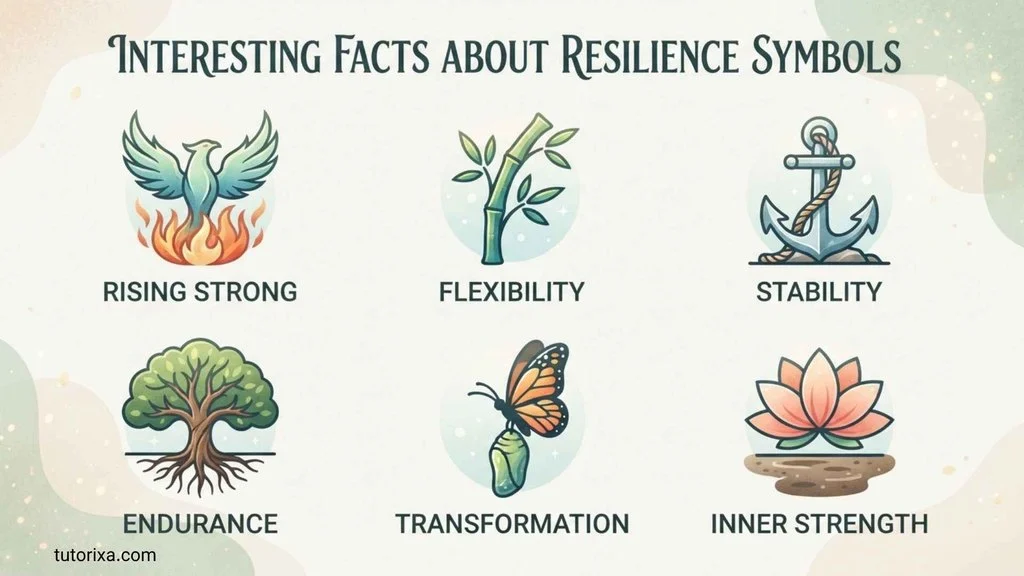
- The phoenix represents renewal more than physical strength. Its most important symbolic feature is the idea of returning to life or beginning again.
- Bamboo and oak communicate different forms of resilience. Bamboo suggests flexibility, while oak suggests rooted strength.
- The lotus connects natural observation with spiritual symbolism. Its growth above muddy water helped inspire powerful religious metaphors.
- The anchor has both practical and symbolic meanings. Physically, it helps stabilize a vessel; metaphorically, it can represent steadiness and hope.
- Mountains are symbols of endurance partly because of their scale. Their immense size and geological longevity make them natural metaphors for difficult challenges.
- Kintsugi turns repair into visible history. Rather than making a repaired ceramic object appear untouched, the repair can remain part of its appearance.
- Spirals often symbolize processes rather than fixed states. Their circular movement can suggest development, cycles, continuation, and transformation.
- Trees combine several resilience ideas in one image. Roots suggest grounding, trunks suggest strength, branches suggest expansion, and new leaves suggest renewal.
- Butterflies emphasize transformation. Their life cycle makes them especially useful symbols for major personal or symbolic change.
- Resilience symbols are often found in memorial art. Their meanings can help communicate remembrance, continuity, hope, and the passage through difficult experiences.
Related Symbols
Phoenix vs. Lotus
Both can symbolize renewal, but the phoenix emphasizes rebirth after destruction, while the lotus often emphasizes spiritual growth and purity despite difficult surroundings.
Oak vs. Bamboo
The oak represents strength and rooted endurance. Bamboo represents flexibility and adaptability. Together, they demonstrate two different approaches to resilience.
Mountain vs. Anchor
A mountain often represents overcoming a challenge or reaching a goal. An anchor represents stability and remaining grounded during uncertainty.
Butterfly vs. Phoenix
The butterfly represents transformation through a natural life cycle, whereas the phoenix represents mythological renewal after destruction.
Spiral vs. Circle
A circle commonly represents completeness, unity, or continuity. A spiral adds movement and progression, making it particularly useful for representing growth and ongoing transformation.
Tree vs. Lotus
A tree emphasizes roots, longevity, and connection to the earth. A lotus emphasizes emergence, purity, and development from challenging conditions.
Frequently Asked Questions
What is the strongest symbol of resilience?
The phoenix is one of the most recognizable symbols of resilience because it represents renewal after destruction. However, it is not objectively the “strongest” symbol. The oak, bamboo, lotus, mountain, anchor, and kintsugi can communicate different forms of resilience, including endurance, adaptability, spiritual growth, stability, and recovery.
What flower represents resilience?
The lotus is one of the most widely recognized flowers associated with resilience. Its growth from muddy water has contributed to symbolic associations with purity, spiritual development, and rising above difficult circumstances, particularly in Hindu and Buddhist traditions. Other flowers may also symbolize endurance depending on the cultural or personal context.
What animal symbolizes resilience?
The phoenix is the most famous mythological animal associated with resilience and renewal. Among real animals, butterflies can symbolize transformation, while certain animals may represent endurance in particular cultures. There is no scientifically or culturally universal animal symbol for resilience.
What plant represents resilience?
Bamboo is strongly associated with resilience because of its flexibility and its important role in East Asian cultural symbolism. The oak tree is another powerful example, representing strength, longevity, and endurance. The lotus also represents resilience through its association with growth and spiritual development.
What symbol represents overcoming hardship?
The mountain is a common symbol for overcoming hardship because climbing a mountain requires persistence toward a difficult destination. The phoenix provides another interpretation by representing renewal after destruction. Which symbol fits best depends on whether the intended message is overcoming an obstacle or beginning again.
What symbol represents strength and perseverance?
The oak tree is particularly suitable for strength and perseverance. Its substantial size, longevity, and historical associations with strength have contributed to its symbolic importance. A mountain can also represent perseverance, especially when the focus is on continuing toward a challenging goal.
What symbol represents healing and resilience?
Kintsugi is frequently used as a metaphor for healing and resilience because it involves repairing damaged ceramics while allowing the repair to remain visible. The lotus can also represent spiritual development and renewal. These meanings are interpretive and should not be confused with medical claims about healing.
What symbol represents starting over?
The phoenix is one of the clearest symbols of starting over. Its traditional literary and mythological associations with renewal have made it a widespread metaphor for beginning again after a major change. The butterfly can communicate a similar idea, but it emphasizes transformation rather than rebirth.
Is a mountain a symbol of resilience?
Yes. Mountains are commonly used as metaphors for resilience, endurance, and overcoming obstacles. Their immense size and apparent permanence make them powerful visual representations of strength. In personal symbolism, a mountain may represent a difficult goal, a challenge already overcome, or the determination required to keep progressing.
What symbol represents resilience and hope?
The anchor is often associated with stability and hope, while the phoenix combines hope with renewal. The lotus can also communicate hope through its association with emerging from difficult surroundings. The best choice depends on whether the intended message emphasizes stability, renewal, spiritual growth, or perseverance.
Key Takeaways
- Resilience has no single universal symbol.
- The phoenix represents rebirth, renewal, and beginning again.
- The lotus symbolizes spiritual growth, purity, and emergence from difficult conditions.
- The oak represents strength, longevity, and rooted endurance.
- Bamboo emphasizes flexibility and adaptability.
- The mountain represents perseverance and overcoming obstacles.
- The anchor symbolizes stability and steadfastness.
- The spiral can represent growth, transformation, and continuity.
- The butterfly represents transformation and change.
- Kintsugi provides a metaphor for repair, restoration, and accepting visible history.
- Symbolic meanings vary across cultures, religions, historical periods, and individuals.
- A symbol’s meaning should always be interpreted within its cultural and historical context.
Conclusion
The most meaningful symbols that represent resilience do not all tell the same story. The phoenix speaks of renewal, the lotus of growth through challenging conditions, the oak of rooted strength, bamboo of flexibility, the mountain of perseverance, and the anchor of stability.
Together, these symbols reveal an important idea: resilience is not simply refusing to bend or change. Sometimes strength means standing firm, while at other times it means adapting, repairing, transforming, or beginning again. That range of meanings is what makes resilience symbols so powerful in mythology, religion, art, literature, jewelry, tattoos, and everyday life.
When choosing a resilience symbol, its cultural origin matters as much as its visual appeal. Understanding the history behind the image allows it to become more than decoration—it can become a thoughtful representation of endurance, growth, hope, adaptability, and renewal.

I’m Ellis Montgomery, a British writer interested in the powerful language of symbols. I explore everything from traditional emblems and cultural signs to contemporary symbols found in modern life. My aim is to explain their meanings clearly while revealing the stories and ideas behind them, making symbolism fascinating and accessible to everyone.
Books:
- The Complete Book of Symbols
- Hidden Messages in Everyday Symbols
 Rowan Whitaker
 Freddie Beaumont