
Have you ever looked at a driver’s license and wondered what the star, symbol, or marking actually means? Understanding Real ID symbols by state can help you recognize important identification features and know what to look for on your own license.
I created this guide to make everything easier for you, whether you’re checking your driver’s license, preparing for a flight, or simply trying to understand how identification cards differ across the United States.
You will discover the common Real ID symbols, learn how states display identification markings, and find helpful information to clear up confusion. By the end, you’ll have a clearer idea of what these symbols mean and why they matter..
Quick Meaning of REAL ID Symbols by State
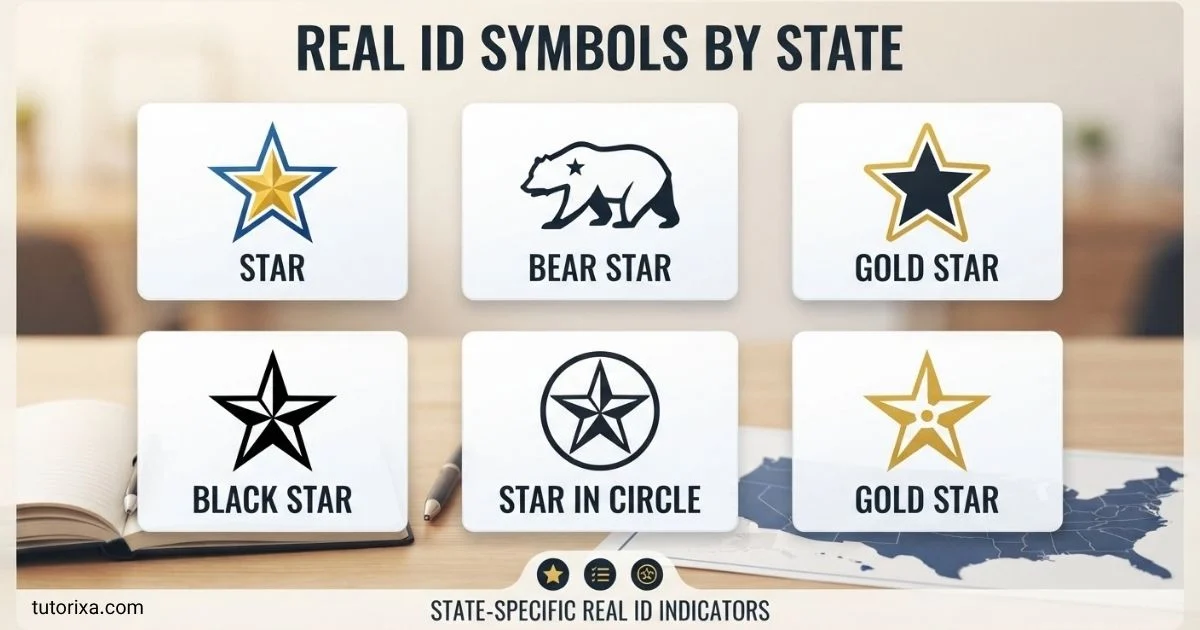
REAL ID symbols are markings on state-issued driver’s licenses and identification cards that indicate compliance with federal identification standards. Most compliant cards display a star, often inside a gold or black circle, while some states use distinctive designs, such as California’s bear-and-star emblem. The marking’s exact appearance depends on the state and card design.
REAL ID Symbol Overview Table
| Field | Details |
| Symbol name | REAL ID compliance marking |
| Primary meaning | Indicates that a state-issued license or ID meets applicable federal REAL ID standards |
| Category | Government identification symbol |
| Origin | REAL ID Act of 2005 |
| Country | United States |
| First known use | Introduced on compliant state credentials as states implemented the federal law |
| Common design | Star, star inside a circle, or an approved state-specific marking |
| Typical location | Upper portion of the driver’s license or ID card |
| Modern meaning | Federal identification compliance |
| Unicode | No dedicated official REAL ID symbol |
| Emoji equivalent | No official emoji equivalent |
| Related symbols | Gold star, black star, circled star, bear-and-star emblem, enhanced ID markings |
| Common applications | Domestic air travel and access to certain secure federal facilities |
The table describes the general REAL ID marking system rather than a single design used nationwide. Federal standards establish the compliance requirements, while states produce their own licenses and identification cards.
What Do REAL ID Symbols Mean?
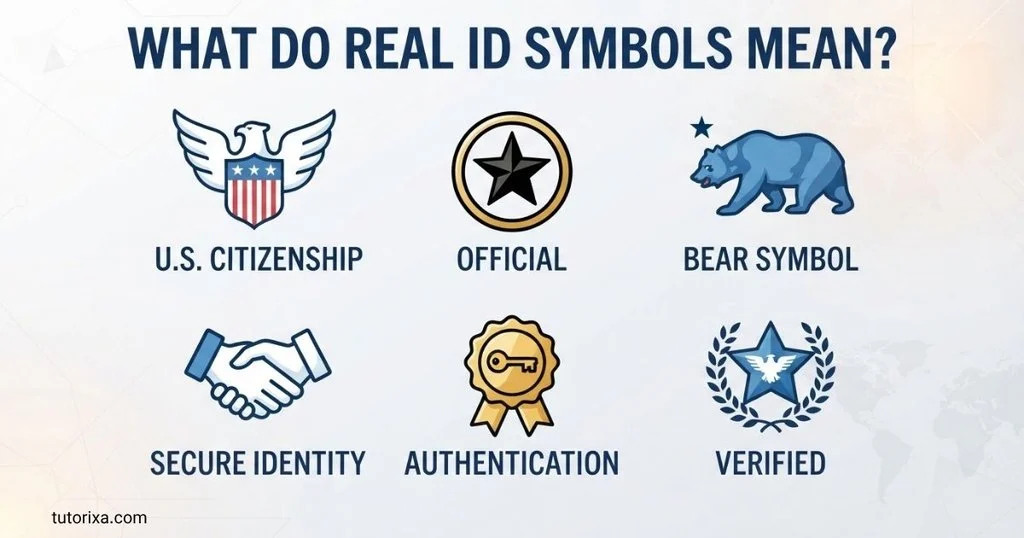
REAL ID symbols indicate that a driver’s license or state identification card has been issued under standards established by the federal REAL ID Act. The marking helps airport security personnel and other relevant officials identify credentials that meet those standards.
The most familiar marking is a five-pointed star. Depending on the state, it may appear in gold, black, or another approved design. It can be displayed by itself, inside a circle, or as part of a state-specific emblem.
For example, Texas uses a star inside a circle near the upper-right corner of compliant cards. California uses a bear-and-star marking, connecting its recognizable state emblem with the federal identification standard. Michigan has used both a star inside a gold circle and a star incorporated into a silhouette of the state on different compliant card designs.
What Does the Star Represent?
The star is a visual indicator of REAL ID compliance. It is not a rating of the cardholder, a security clearance, or a symbol of political or religious affiliation.
Its purpose is practical: it allows officials to recognize a compliant credential without having to interpret every element of the card’s artwork.
A star also does not mean that a person has a special driving privilege. A REAL ID driver’s license still serves as a driver’s license, subject to the normal requirements of the issuing state. The REAL ID marking concerns federal identification standards.
What Does a Star Inside a Circle Mean?
A star enclosed in a circle is one common way states distinguish compliant credentials from standard cards. The circle frames the star so the marking can be recognized easily.
Texas and Montana use a star-in-circle design, while other states use different layouts or visual treatments. The circle does not represent a separate level of identification or additional federal permission.
What Does a Bear and Star Mean on a California ID?
California’s bear-and-star marking identifies a REAL ID-compliant driver’s license or identification card. The bear references California’s state identity, while the star serves as the compliance marking.
The combination demonstrates how states can preserve recognizable local imagery while following a common federal identification framework. It does not mean that California’s REAL ID has different federal privileges from another state’s compliant card.
History and Origin of REAL ID Symbols
REAL ID symbols developed from a federal effort to establish minimum security standards for state-issued driver’s licenses and identification cards.
The REAL ID Act of 2005
Congress passed the REAL ID Act in 2005. The law established federal standards for state-issued identification documents accepted by certain federal agencies for official identity purposes.
The initiative addressed concerns about identity verification, document security, and the consistency of identification issued by different jurisdictions. Rather than replacing state licensing systems with one national license, the law established requirements that states could implement through their own credential programs.
How the Markings Developed
As states implemented REAL ID standards, they introduced compliant driver’s licenses and identification cards with markings that differentiated them from noncompliant credentials.
A star became the familiar design because it is compact, recognizable, and easy to place on an identification card. However, the federal framework also allows approved alternatives that clearly distinguish compliant cards.
This explains why REAL ID symbols by state are similar without being identical. States retain control over card layouts, background graphics, and many visual details, while the federal requirements determine whether the credential qualifies for designated purposes.
The Transition to Federal Enforcement
The federal REAL ID enforcement date for domestic air travel and relevant federal facilities was May 7, 2025. After that date, travelers generally need a REAL ID-compliant state credential or another acceptable form of identification for covered purposes.
The change did not make ordinary state driver’s licenses invalid. A noncompliant license may still be valid for driving and other state-authorized purposes, even if it cannot independently satisfy federal identification requirements.
REAL ID Symbolism and Interpretation
REAL ID symbols have a specific administrative meaning rather than the broad cultural symbolism associated with religious, historical, or decorative signs.
Traditional Meaning
The star functions as a mark of compliance. It communicates that the issuing state has produced the credential under the applicable federal standards.
Its meaning comes from government identification rules, not from ancient traditions or a universal symbolic language.
Modern Meaning
Today, a REAL ID marking helps distinguish a compliant identification card from a standard credential that does not meet the same federal requirements.
For travelers, the symbol can help answer an important practical question: whether a particular state-issued card is suitable for identification at a domestic airport security checkpoint.
Positive Associations
People may associate the marking with:
- Recognition: A visible indication of compliance.
- Standardization: A shared federal framework across state-issued credentials.
- Verification: A document issued through a qualifying identity-checking process.
- Convenience: A way to use one credential for driving and certain federal identification purposes.
These are practical associations, not additional legal guarantees.
Possible Misinterpretations
Some people may interpret the star as proof that a card is impossible to counterfeit or that every person holding one has undergone the same background investigation. Neither conclusion follows from the symbol alone.
REAL ID establishes standards for issuing and securing credentials. The marking does not eliminate fraud, replace every other identity check, or grant access to every government building.
REAL ID Symbols by State: How Designs Differ
REAL ID symbols by state vary in appearance, but the underlying compliance purpose remains consistent. The following examples illustrate some of the differences found on state-issued credentials.
| State or jurisdiction | REAL ID marking or design | What to know |
| Alabama | Star marking | Check the card’s current design and official state guidance. |
| California | Bear with a star | The state bear-and-star emblem identifies compliant cards. |
| Michigan | Star in a gold circle or state silhouette | Both designs can indicate compliance. |
| Montana | Star inside a circle | The marking distinguishes compliant credentials from standard cards. |
| North Carolina | Star in the upper-right corner | Standard cards may carry a federal-purpose restriction statement. |
| Texas | Star inside a circle | The marking appears near the upper-right corner. |
| Utah | Gold star | The star indicates REAL ID compliance. |
| Virginia | Star in the upper-right corner | The marking identifies a compliant license or ID. |
| West Virginia | White star inside a gold circle | The design is used on compliant credentials. |
| New York | Star on a REAL ID; flag on an enhanced license | Both REAL ID and enhanced credentials may satisfy applicable federal identification requirements. |
Sources: state motor vehicle agencies and TSA guidance.
This table is illustrative, not a complete inventory of every state’s current design. Card artwork and issuance policies can change, and older credentials may look different from newer ones. For a definitive answer about a particular card, consult the issuing state’s official motor vehicle agency.
Do All 50 States Use the Same REAL ID Symbol?
No. States follow the same federal compliance framework but can use different approved markings. A gold star is common, yet some credentials use a star inside a circle, a black star, or a distinctive emblem that incorporates state imagery.
The position, size, color, and surrounding artwork may also vary. Therefore, identifying a REAL ID solely by the color of its star is not a reliable method.
How Can You Identify a REAL ID in Your State?
Use these steps to check your card:
- Locate the upper portion of your driver’s license or state identification card.
- Look for a star, a star inside a circle, or another marking identified by your state as its REAL ID indicator.
- Check for wording such as “Not for Federal Identification” or a similar restriction on a noncompliant card.
- Confirm the card’s status through your state’s official motor vehicle agency if the marking is unclear.
- If traveling, review the Transportation Security Administration’s current list of acceptable identification documents.
These steps help avoid confusion caused by different designs and older card versions.
Cultural Significance of REAL ID Symbols
REAL ID symbols do not have a universal cultural or traditional meaning. Their significance comes primarily from American government administration and identification policy.
State Identity and Local Imagery
States often include recognizable local imagery on their driver’s licenses. Landscapes, animals, state outlines, historical figures, and official emblems may appear as background artwork.
California’s bear-and-star design illustrates how a state can combine a familiar regional symbol with a federal compliance marking. Michigan’s use of a star incorporated into a state silhouette provides another example of how state identity can coexist with standardized identification requirements.
Regional Differences
Differences in REAL ID designs reflect the separate licensing systems maintained by individual states and jurisdictions. They should not be interpreted as differences in the holder’s legal status, personal worth, or level of access to federal services.
The important distinction is whether the credential meets the applicable federal requirements, not whether its design looks more elaborate than another state’s card.
Scientific or Technical Meaning of REAL ID Symbols
REAL ID markings are administrative and security indicators, not scientific symbols. They do not represent a mathematical formula, medical condition, electrical property, or technical measurement.
However, they are part of a broader system of identity document security.
Identity Verification
REAL ID standards concern how credentials are issued, how identity information is verified, and how identification documents are protected against fraud and alteration.
The visible marking provides a quick indication of compliance, while other security features may be built into the card itself. The star is not the only security feature and does not independently establish that a presented document is authentic.
Digital and Machine-Readable Features
State identification cards may contain machine-readable information and other document security features. These features support the processes used to examine and verify credentials.
A visible REAL ID symbol should not be confused with a QR code, barcode, RFID symbol, or digital identity logo. Those elements have different technical purposes, and their presence alone does not establish REAL ID compliance.
Is There an Official Unicode REAL ID Symbol?
There is no dedicated Unicode character representing official REAL ID compliance. A star character, such as ★ or ☆, may resemble part of the marking, but typing one into a document does not create an official identification symbol.
The actual compliance marking is part of the physical or officially issued digital credential, not simply a character that can be copied and pasted.
Where REAL ID Symbols Are Used
REAL ID symbols are primarily found on government-issued identification documents and in informational materials explaining identification requirements.
Common places where you may encounter them include:
- Driver’s licenses: Compliant state-issued licenses display the appropriate marking.
- State identification cards: Non-drivers can obtain qualifying identification cards with the same federal compliance purpose.
- Airport guidance: TSA informational materials explain how to recognize compliant identification.
- Government information pages: State motor vehicle agencies display sample cards and explain their markings.
- Travel checklists: Airlines, airports, and travel information resources may remind passengers to bring acceptable identification.
- Federal access guidance: Some facilities explain which credentials satisfy their identity requirements.
The marking is not a substitute for every other access requirement. A compliant ID establishes eligibility for certain identification purposes, but entry into a restricted facility may still require additional authorization.
Does a REAL ID Work for Domestic Flights?
A REAL ID-compliant state driver’s license or identification card is an acceptable form of identification for domestic air travel under current TSA rules. Travelers can also use other accepted documents, such as a valid U.S. passport or an eligible enhanced driver’s license.
Passengers aged 18 and older should check the current TSA requirements before traveling. Rules can change, and the list of accepted identification documents is broader than state-issued REAL ID cards alone.
Can a REAL ID Be Used to Enter Any Federal Building?
No. A REAL ID-compliant card meets identification standards for specified federal purposes, but it does not automatically authorize entry into every federal building.
Individual facilities can have their own security procedures, access restrictions, and identification requirements. A compliant card may help establish identity, but it does not replace a visitor pass, security clearance, appointment, or other authorization when one is required.
Common Variations of REAL ID Symbols
REAL ID symbols appear in several visual forms. These variations generally reflect state-specific card designs rather than different levels of federal compliance.
Gold Star
A gold star is one of the most widely recognized REAL ID indicators. It may appear alone or as part of another design. Its presence is meaningful when it is printed on an officially issued credential in the manner specified by the issuing state.
Star Inside a Circle
Some states place a star inside a gold or black circle. The surrounding circle creates a distinct visual marker and helps separate the symbol from decorative background elements.
Black Star
A black star may be used on certain state-issued identification designs. The color alone does not indicate a lower or higher level of compliance.
State-Specific Emblems
Some cards integrate a star into an existing state symbol. California’s bear-and-star design and Michigan’s state-outline design illustrate this approach. These variations allow states to maintain distinctive identification card artwork.
Enhanced Driver’s Licenses
An enhanced driver’s license is not exactly the same thing as an ordinary REAL ID-compliant license, even though both can be accepted for relevant federal identification purposes.
Enhanced credentials issued by participating states may include a flag or other distinctive marking and provide additional functions related to border crossing. Their acceptance for REAL ID purposes depends on the credential meeting the applicable federal requirements.
Common Misconceptions About REAL ID Symbols
Several misunderstandings arise because the cards look different across states.
Misconception 1: Every REAL ID Has a Gold Star
Correction: Gold stars are common, but compliant credentials may use other approved markings. Some state designs incorporate a star into a circle or a state-specific emblem.
Misconception 2: Every Star on a License Means REAL ID Compliance
Correction: A star appearing as decorative artwork does not automatically establish compliance. Check the marking against the issuing state’s official guidance rather than relying on the shape alone.
Misconception 3: A Standard Driver’s License Becomes Invalid Without a Star
Correction: A noncompliant license can remain valid for driving and other state-authorized purposes. The distinction concerns its acceptance for specific federal identification purposes.
Misconception 4: REAL ID Is Required to Drive
Correction: REAL ID is not a separate driving qualification. A person can hold a standard, valid driver’s license without obtaining a REAL ID-compliant version, subject to state licensing requirements.
Misconception 5: A REAL ID Replaces a Passport for Every Journey
Correction: REAL ID is intended for designated federal identification purposes, including domestic air travel. It is not a replacement for a passport when a passport is required for international travel.
Misconception 6: A REAL ID Guarantees Entry to Secure Facilities
Correction: The marking indicates compliance with identification standards. It does not grant automatic access to military bases, restricted government offices, or other controlled locations.
Interesting Facts About REAL ID Symbols
These facts explain why the small marking on a driver’s license has a specific administrative role.
1. The system dates to 2005. The REAL ID Act was passed in 2005, establishing federal identification standards for state-issued credentials. The star marking became a familiar way to identify cards issued under those requirements.
2. There is no single national license design. States issue their own credentials, which is why the background artwork, typography, and placement of the compliance symbol can vary.
3. The star is not a security clearance. A REAL ID does not indicate that its holder has special government authorization or permission to enter restricted facilities.
4. State ID cards can also carry the symbol. People who do not drive may obtain REAL ID-compliant identification cards, depending on the state’s application process.
5. The symbol is not an emoji. Although a star character can be typed on a keyboard, an ordinary text star is not an official compliance marking.
6. Some states use recognizable local imagery. California’s bear-and-star design illustrates how a state’s visual identity can be incorporated into the federal identification framework.
7. Enhanced credentials are a separate category. Certain enhanced driver’s licenses can be accepted for REAL ID purposes while also serving additional border-crossing functions.
8. The marking does not eliminate document fraud. REAL ID standards support stronger issuance and document security practices, but no visible symbol by itself guarantees that a document is genuine.
9. The marking is usually easy to locate. Many states position the star near the top of the card, where it can be recognized without examining the entire design. However, placement varies.
10. The enforcement date did not cancel every standard license. May 7, 2025, marked the beginning of federal enforcement for covered purposes, not a universal expiration date for noncompliant state licenses.
Related Symbols and Identification Markings
Several symbols and credential types are associated with REAL ID, but they do not all mean the same thing.
| Symbol or credential | Meaning | Difference from REAL ID |
| Gold star | Common REAL ID compliance marking | Indicates compliance when used on an officially issued credential |
| Star inside a circle | State-specific compliance design | Uses a different visual arrangement of the star |
| Bear and star | California’s REAL ID marking | Combines state imagery with a compliance indicator |
| U.S. flag on an enhanced license | May identify an enhanced credential | Associated with a separate credential category that can provide border-crossing functions |
| Passport | Federal travel and identity document | Can be used as an alternative to a state-issued REAL ID for domestic air travel |
| Passport card | Wallet-sized federal travel document | Accepted for domestic air travel but has different international travel limitations from a passport book |
| Barcode or machine-readable zone | Encodes information for automated reading | Is a technical feature, not the visible REAL ID compliance symbol |
| Standard driver’s license | State-issued authorization to drive | May not meet federal REAL ID requirements |
TSA maintains a list of accepted identification documents, including passports, passport cards, certain enhanced credentials, and other eligible documents. Always verify current requirements before traveling.
Frequently Asked Questions About REAL ID Symbols by State
1. What symbol identifies a REAL ID?
A star is the most recognizable REAL ID symbol. Depending on the state, it may appear as a gold star, black star, star inside a circle, or part of a state-specific emblem. Always confirm the marking through the issuing state’s official motor vehicle agency if you are unsure.
2. Do all 50 states use the same REAL ID symbol?
No. States follow the same federal REAL ID standards but use different identification card designs. Some display a gold star, others use a star within a circle, and certain states incorporate local imagery into the marking. These differences generally reflect design choices rather than different levels of federal compliance.
3. Where is the REAL ID star located on a driver’s license?
The REAL ID marking is commonly found near the top of the driver’s license or identification card, often in the upper-right corner. However, the exact location depends on the state and card design. Check your issuing state’s official sample card if you cannot identify the marking.
4. What does a black star on an ID mean?
A black star may be used as a REAL ID compliance marking on certain state-issued credentials. Its color does not indicate a different security classification or additional privileges. To determine whether your particular card is compliant, check the state’s official identification guidance instead of relying on color alone.
5. Can I fly domestically without a REAL ID?
Yes, provided you have another form of identification accepted by the Transportation Security Administration. A valid U.S. passport, passport card, and certain other government-issued documents may qualify. Travelers aged 18 and older should review the current TSA identification list before departure to avoid unexpected delays.
6. Is a REAL ID mandatory for everyone?
No. People do not need a REAL ID simply to hold a driver’s license or state identification card. It is relevant for specific federal identification purposes, including domestic air travel. Someone who does not need those uses, or who has another acceptable form of identification, may not need to obtain one.
7. What does “Not for Federal Identification” mean on a license?
This wording generally indicates that the card is not REAL ID-compliant and cannot independently satisfy the applicable federal identification requirements. The card may still be valid for driving or other state-authorized purposes. Check your state’s guidance to understand the specific restrictions associated with your credential.
8. Does a REAL ID expire?
Yes. REAL ID-compliant driver’s licenses and identification cards have expiration dates determined by the issuing state and the holder’s circumstances. The star does not make the credential valid indefinitely. Check the expiration date printed on your card and follow the issuing agency’s renewal instructions.
9. Is an enhanced driver’s license the same as a REAL ID?
Not exactly. An enhanced driver’s license is a distinct type of state-issued credential that can provide additional border-crossing functions. Certain enhanced licenses are also accepted for REAL ID purposes. The precise features and eligibility requirements depend on the issuing state, so check the state’s official guidance.
10. How can I confirm whether my state ID is REAL ID-compliant?
Look for the compliance marking on your card and compare it with the examples published by your state’s motor vehicle agency. If the marking is missing or unclear, contact the issuing agency directly. For upcoming travel, also review the TSA’s official list of acceptable identification documents.
Key Takeaways
- REAL ID symbols indicate compliance with federal identification standards.
- A star is the most recognizable marking, but designs differ among states.
- Gold stars, black stars, circled stars, and state-specific emblems may appear on compliant credentials.
- California uses a bear-and-star design, while Michigan has used multiple star designs.
- The REAL ID Act was passed in 2005, and federal enforcement for covered purposes began on May 7, 2025.
- Standard driver’s licenses can remain valid for driving even when they are not REAL ID-compliant.
- REAL ID is not mandatory for every person or every activity.
- A valid passport or another TSA-accepted document can serve as an alternative for domestic air travel.
- An enhanced driver’s license is a separate credential category that may also satisfy REAL ID requirements.
- Your state’s official motor vehicle agency is the best source for confirming a card’s status.
Conclusion
REAL ID symbols by state provide a simple way to recognize whether a driver’s license or identification card meets federal identification standards. Although the familiar star appears in different colors, shapes, and designs, its purpose remains consistent: identifying credentials that qualify for specified federal uses.
Understanding these markings helps you distinguish compliant cards from standard licenses, prepare for domestic air travel, and avoid confusion about identification requirements. Because states can update their card designs, the most reliable way to verify a particular credential is to consult the issuing state’s official motor vehicle agency and the TSA’s current identification guidance.

I’m Rowan Whitaker, a British writer fascinated by the symbols surrounding us every day. I explore their meanings, origins, cultural significance, and changing interpretations. From ancient marks to modern signs, I enjoy making symbolism easier to understand. My writing helps curious readers discover the hidden messages behind familiar shapes, images, and signs.
Books:
- The Meaning Behind Symbols
- A Modern Guide to Symbolism
 Ellis Montgomery