
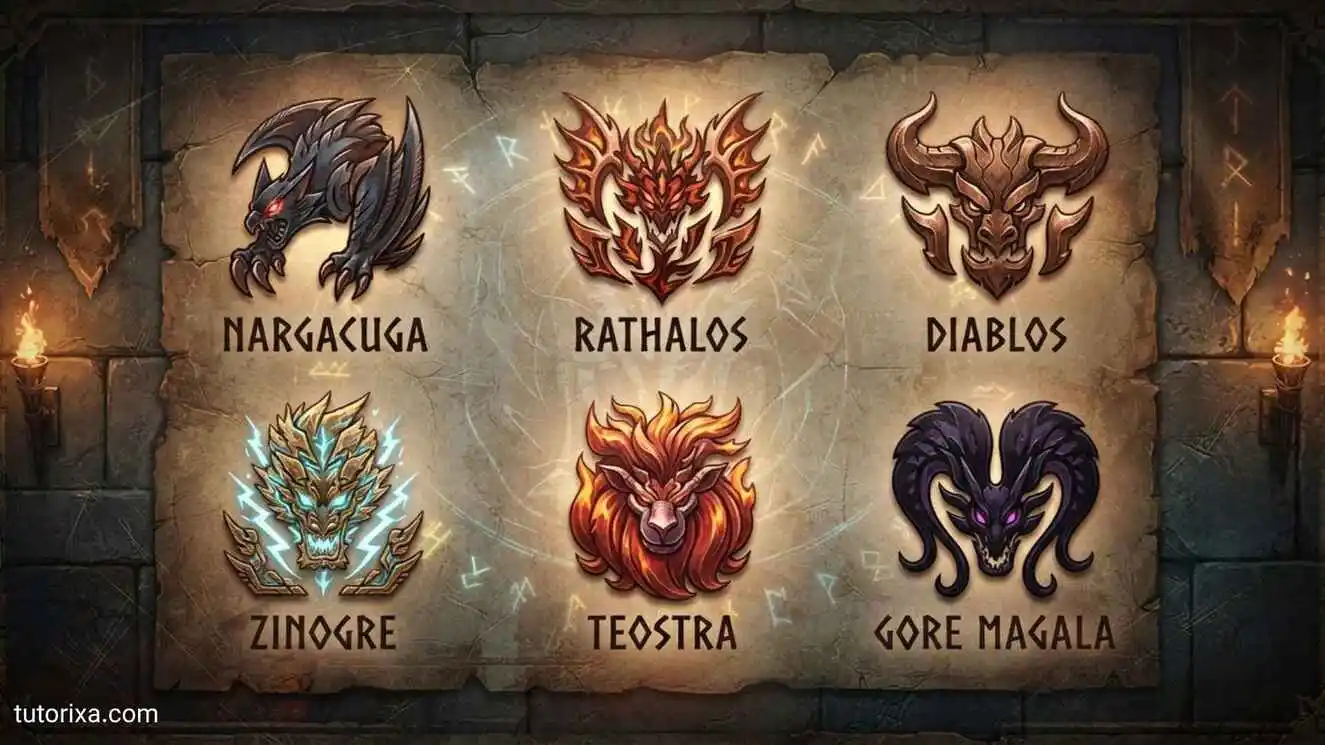
Monster Hunter Symbols can look confusing when you first enter the game, especially when different icons appear during hunts, quests, and battles. I know how frustrating it can feel when you see a symbol and have no idea what it means. You want clear answers without digging through endless menus.
I created this guide to make Monster Hunter Symbols simple and easy to understand. You can use it to quickly identify important icons, understand their meanings, and feel more confident while playing. I’ll break down the symbols in a straightforward way so you can focus on the hunt instead of guessing.
If you’re a beginner or an experienced hunter trying to understand a specific icon, you’ll find useful information here. I’ll help you recognize the most important Monster Hunter Symbols and explain why they matter during your gameplay.
Quick Meaning
Monster Hunter symbols are visual marks and icons used to communicate identity, status, information, and lore within the Monster Hunter universe. They include the Hunter’s Guild emblem, monster icons, elemental and status-effect icons, quest markers, and other recurring designs. Their meanings vary according to the game, location, and context in which they appear.
Symbol Overview Table
| Symbol / Symbol Type | Primary Meaning | Category | Origin | Common Usage | Modern Meaning |
| Hunter’s Guild emblem | Unity between people, nature, resources, and craftsmanship | Organizational emblem | Monster Hunter fictional world | Guild-related locations and objects | Identity, cooperation, and the Guild |
| Monster icons | Identification of individual monsters | Gameplay iconography | Monster Hunter games | Maps, target displays, quests | Monster recognition |
| Status-effect icons | Active beneficial or harmful effects | Gameplay symbols | Game interface design | Player status displays | Immediate gameplay information |
| Elemental blight icons | Elemental conditions affecting hunters | Gameplay symbols | Monster Hunter series | Combat status displays | Fire, water, thunder, ice, or dragon-related effects |
| Quest icons | Identify objectives or activities | Interface symbols | Game-specific design | Quest boards and menus | Task recognition |
| Village or organization emblems | Identify communities and institutions | Heraldic/world-building symbols | Individual games | Buildings, clothing, documents, equipment | Cultural and organizational identity |
| Monster-specific crests | Represent individual creatures or groups | Decorative/lore symbols | Individual game designs | Armor, artwork, locations | Association with a particular monster |
There is no single Unicode character or universal emoji for “Monster Hunter symbol.” These are primarily proprietary visual designs created for the games rather than standardized writing-system symbols.
What Do Monster Hunter Symbols Mean?
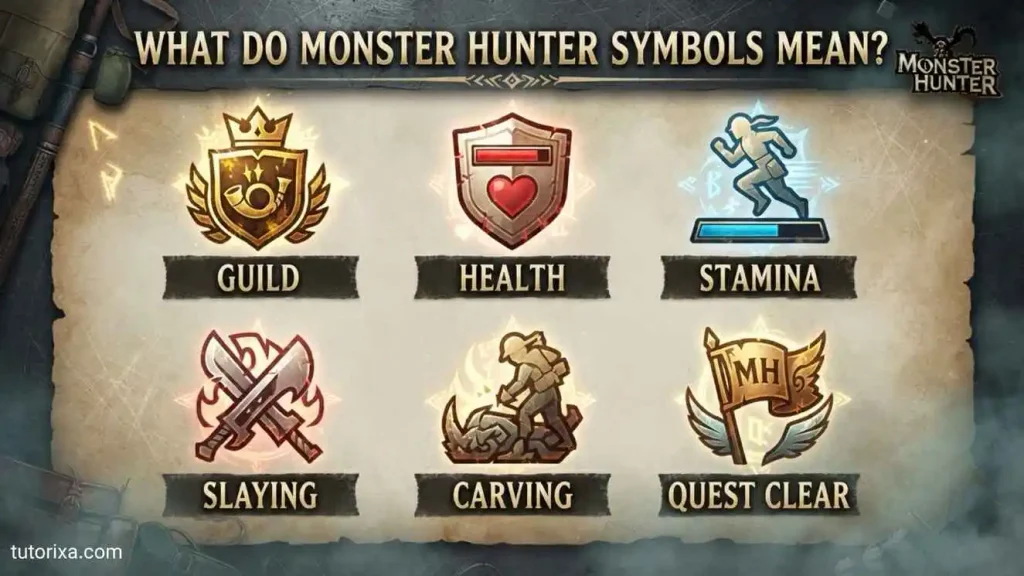
Monster Hunter symbols generally mean identity, information, or relationship. Their exact interpretation depends on the symbol.
The Hunter’s Guild emblem is the clearest example of a symbol with broader fictional-world meaning. The emblem is associated with the organization that coordinates hunting activities and connects communities throughout the series’ world. Sources describing the emblem identify four major visual ideas within it: reverence for nature, blessings or resources received from nature, things created through human craftsmanship, and peoples or communities. The intersecting structure represents the Guild’s role in bringing these elements together.
Other Monster Hunter symbols are much more practical.
A monster icon tells the player which creature is being represented. In Monster Hunter Rise: Sunbreak, for example, discovered monsters receive their own unique map icons, replacing the generic icon that appears before the monster has been encountered. The same official manual explains that discovered monsters can also appear as target icons during quests.
Status symbols communicate a different kind of information. They tell the player that a temporary condition is affecting a hunter. Official Monster Hunter 4 Ultimate documentation lists icons for effects such as increased attack, increased defense, increased affinity, resistance changes, and several elemental blights.
This distinction is important: not every Monster Hunter symbol is a lore symbol. Some exist primarily because players need information at a glance.
History and Origin
The history of Monster Hunter symbols begins with the series itself rather than with an ancient human civilization.
The Monster Hunter franchise was created by Capcom, and its fictional setting combines fantasy, ecological themes, invented cultures, hunting institutions, and technological craftsmanship. As the series developed, its visual language became increasingly important for identifying organizations, creatures, locations, and gameplay conditions.
The Hunter’s Guild emblem is especially significant because it has appeared in different forms across the franchise. A Japanese reference covering the fictional world’s heraldic designs describes the Guild emblem as one of the most frequently encountered crests in the series, appearing from the earliest games through later installments. It also describes simplified versions of the design.
The emblem’s structure reflects a recurring theme of Monster Hunter: people depend on nature, but they also transform natural resources through human skill.
This idea appears throughout the fictional setting. Communities gather resources, study monsters, create equipment, establish settlements, and organize hunting activities. The Guild provides a framework connecting those activities.
The symbols evolved alongside the games’ increasing complexity. Early symbols helped players recognize basic gameplay information. Later games introduced larger numbers of status effects, environmental conditions, organizations, locations, and monster categories. As a result, iconography became an essential part of the interface.
The history of Monster Hunter symbols is therefore both artistic and functional. The designs contribute to the fantasy setting while making complicated game information easier to understand.
Symbolism and Interpretation
Traditional Symbolism
The strongest documented symbolism belongs to the Hunter’s Guild emblem.
Its four-part structure has been interpreted as representing relationships between nature, natural resources, human craftsmanship, and communities. The intersecting elements emphasize that these concepts do not exist separately. The Guild operates at the meeting point between them.
That makes the emblem different from a simple corporate logo. Within the fictional world, it represents an institution and the philosophy surrounding that institution.
Modern Symbolism
For modern players, Monster Hunter symbols often represent recognition and belonging.
Seeing the Guild emblem can immediately suggest the Hunter’s Guild, its facilities, or the wider world of professional hunters. A monster crest can identify a particular creature. A status icon can instantly communicate a temporary condition.
This creates a visual vocabulary. Players gradually learn the vocabulary without needing to read a sentence every time an icon appears.
Positive Symbolism
Many Monster Hunter symbols can be associated with:
- Cooperation
- Knowledge
- Community
- Respect for nature
- Resourcefulness
- Craftsmanship
- Exploration
- Responsibility
- Discovery
These associations are especially relevant to the Hunter’s Guild emblem because its documented imagery connects natural resources, human communities, and craftsmanship.
Negative Symbolism
Some icons communicate danger or disadvantage rather than positive ideas.
Status icons can indicate harmful conditions, while monster icons can represent threats that require attention. Official documentation distinguishes beneficial status changes from harmful elemental blights, demonstrating how the same visual language can communicate both positive and negative gameplay states.
Psychological Interpretation
The symbols also work because humans naturally process familiar visual shapes quickly.
A recognizable icon reduces the need to read detailed text. Once a player learns that a particular mark represents a condition or monster, seeing that mark can trigger immediate recognition.
This is not unique to Monster Hunter. Maps, road signs, software interfaces, medical diagrams, and sports all use visual shorthand. Monster Hunter applies the same principle to its fictional ecosystem.
Cultural Significance
Monster Hunter symbols have cultural significance primarily through Japanese game design and fictional world-building, rather than through ancient religious traditions.
The series draws on a broad fantasy vocabulary that includes dragons, villages, guilds, craftsmanship, folklore-inspired creatures, natural environments, and community traditions. However, it is important not to claim that every Monster Hunter symbol comes directly from a specific historical Japanese or Asian religious symbol.
For example, the Guild emblem may look similar to heraldic or martial insignia because it uses symmetry, repeated elements, and a strong central structure. That visual resemblance does not automatically mean it has a historical connection to Japanese family crests, Buddhist symbols, Shinto imagery, or European heraldry.
Regional differences also matter because Monster Hunter games sometimes introduce their own cultures and organizations. Villages such as Kamura and Bherna have distinctive visual identities, while organizations such as the Wycademy and the Research Commission have their own institutional contexts.
The result is a fictional culture made from many visual influences without reducing every symbol to a single real-world source.
Religious or Spiritual Meaning
Monster Hunter symbols do not generally function as real-world religious symbols.
The franchise does contain themes that can feel spiritual, especially its repeated emphasis on nature, ancient creatures, balance, life cycles, and mysterious Elder Dragons. However, these themes belong to the fictional mythology of the games.
The Hunter’s Guild emblem is particularly associated with a philosophy of coexistence between communities and the natural world. That can invite spiritual interpretations, but the documented meaning is better understood as fictional world-building rather than a sacred religious tradition.
It is therefore useful to distinguish between:
- Religious symbolism: connected to an actual faith or sacred tradition.
- Spiritual themes: ideas about nature, life, balance, or existence.
- Fictional symbolism: meaning established inside a fictional universe.
Most Monster Hunter symbols belong to the third category.
Scientific or Technical Meaning
Monster Hunter symbols do not have standardized scientific meanings outside the game.
Inside the games, however, they serve a technical purpose. They turn complex gameplay information into compact visual signals.
For example, official documentation for Monster Hunter 4 Ultimate identifies status icons for attack, defense, affinity, sharpness-related effects, elemental resistance, and blights.
Elemental blight symbols are particularly useful because they distinguish different conditions. The official manual describes fireblight, waterblight, thunderblight, iceblight, and dragonblight as conditions with different gameplay effects.
The icons therefore function almost like a visual data system. Instead of displaying a long sentence such as “your stamina recovery is currently reduced,” the interface can provide a compact symbol that an experienced player recognizes immediately.
Where Monster Hunter Symbols Are Used
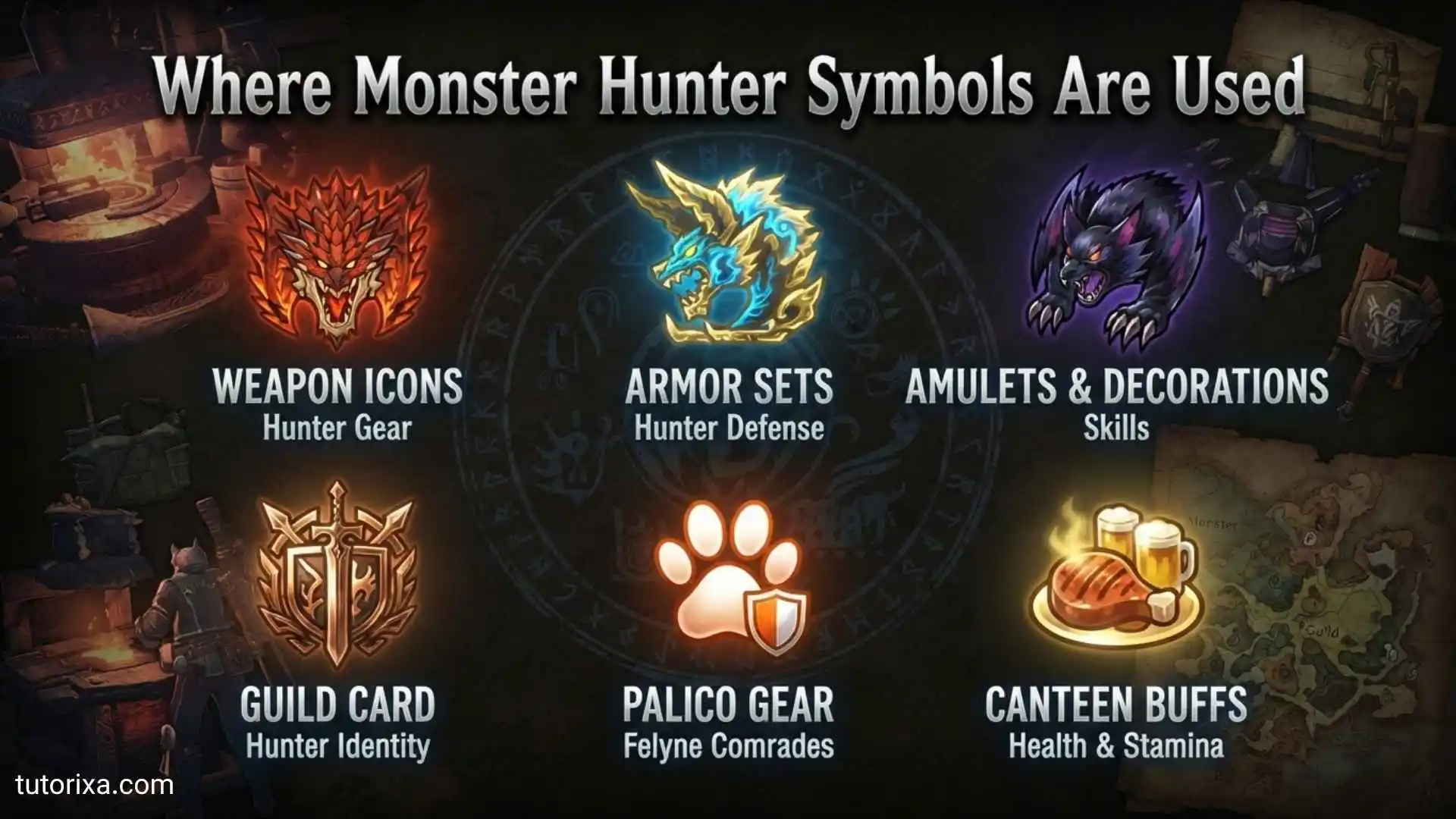
Monster Hunter symbols appear in many parts of the franchise.
Game Interfaces
Status icons appear near player information to communicate active effects. Official manuals specifically document status icons as part of the hunter’s on-screen information.
Maps
Monster icons can identify creatures on maps. In Monster Hunter Rise: Sunbreak, an unknown monster initially receives a generic map icon; after the player encounters it, its unique icon can be displayed.
Quests
Quest-related symbols help distinguish objectives, activities, and different types of tasks.
Guild Locations
The Hunter’s Guild emblem can identify locations, objects, and characters associated with the Guild.
Armor and Equipment Designs
Guild-related imagery can appear as decorative motifs on fictional equipment and clothing. The emblem’s recurring presence helps establish organizational identity.
Logos and Promotional Artwork
Monster Hunter imagery frequently combines creature silhouettes, fantasy typography, and recurring franchise motifs. Capcom’s official material for Monster Hunter: Legends of the Guild, for example, prominently features Monster Hunter branding and emblematic artwork.
Fan Art and Merchandise
Fans may use recognizable Monster Hunter symbols in artwork, collections, costumes, and themed designs. In these contexts, the symbol often communicates fandom and identification with the franchise.
Common Variations
Monster Hunter symbols vary considerably between games.
The Hunter’s Guild emblem can appear in detailed or simplified forms. Some versions preserve the major structure, while others reduce the design into a more compact mark.
Monster icons also vary according to the creature and game. A monster’s silhouette or visual characteristics can be transformed into a compact interface symbol.
Status icons may change visually between generations. The overall idea remains recognizable, but individual designs can be redrawn to match the interface style of a particular title.
There are also organization-specific symbols. The Wycademy, Research Commission, villages, and other groups have different visual identities.
These variations show why context matters. A symbol that looks similar to another may not have exactly the same meaning.
Common Misconceptions
Myth 1: Every Monster Hunter symbol has an ancient real-world origin
This is not supported. Many symbols were designed specifically for the fictional universe. Similarities to real-world heraldry or mythology do not prove direct historical borrowing.
Myth 2: The Guild emblem is a religious symbol
The Hunter’s Guild emblem is primarily an organizational emblem within the fictional setting. Its nature-focused themes can appear spiritual, but that does not make it a real-world sacred symbol.
Myth 3: All Monster Hunter icons are lore symbols
Many are simply interface tools. Status icons, map markers, and target icons exist mainly to communicate information efficiently. Official manuals explicitly describe these functions.
Myth 4: One symbol has exactly the same meaning in every game
Not necessarily. Designs and interface conventions can change between installments. Context and game version are important.
Myth 5: Monster icons are interchangeable
Monster icons are intended to help identify specific creatures. Their visual differences are part of the information system rather than meaningless decoration.
Interesting Facts
1. The Guild emblem connects nature and human activity
The documented design links natural resources, communities, and human craftsmanship. This reflects one of the central themes of the fictional world.
2. The emblem has appeared throughout the franchise
The Guild crest is not limited to one particular installment. Reference material describes it as a recurring emblem from the early series onward.
3. Some symbols are deliberately simplified
The Guild emblem has appeared in reduced forms, showing that its identity can survive even when visual detail is removed.
4. Monster icons can change after discovery
In Monster Hunter Rise: Sunbreak, an undiscovered monster may initially be represented by a generic map icon. Encountering it unlocks its distinctive icon for map recognition.
5. Status symbols can represent benefits
Not all status icons indicate danger. Official documentation includes positive effects such as increased attack and defense.
6. Elemental blights have separate identities
Fire, water, thunder, ice, and dragon blights are treated as distinct conditions, each with different gameplay consequences.
7. The eye icon has a practical meaning
In Monster Hunter 4 Ultimate, an eye icon beside the hunter’s name indicates that a large monster has spotted the hunter, with its appearance changing according to the situation.
8. Monster Hunter symbols function like a visual language
Players can learn an icon’s meaning through repeated exposure without reading a full explanation every time.
9. Symbols support both story and gameplay
The best designs do two jobs at once: they communicate information while making the fictional world feel consistent.
10. There is no universal “Monster Hunter symbol” character
The franchise uses custom graphical marks rather than a standardized Unicode character. This is why typing “Monster Hunter symbol” does not produce one official text symbol equivalent.
Related Symbols About Monster Hunter Symbols
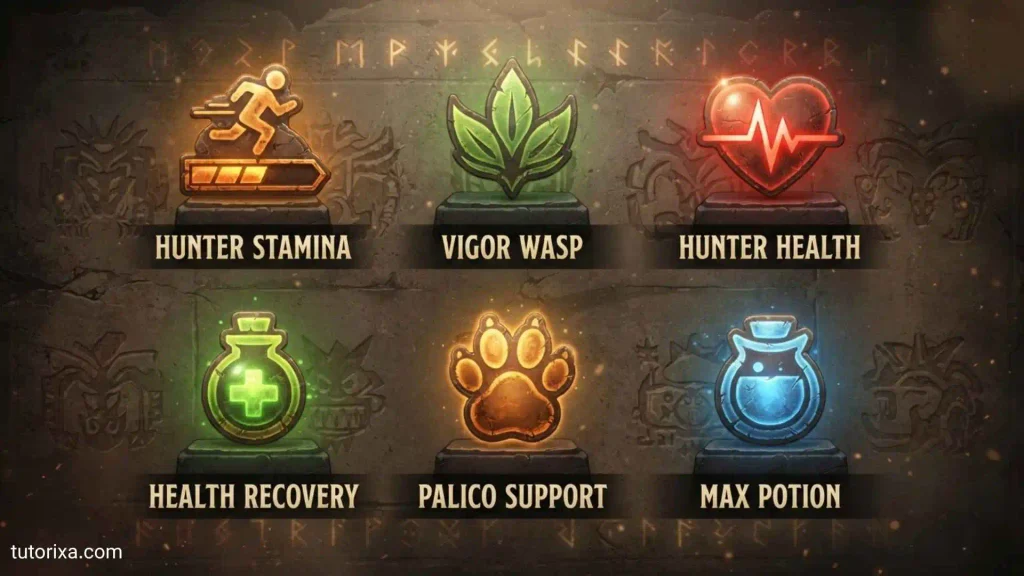
Several symbol categories are closely connected to Monster Hunter symbols:
- Hunter’s Guild emblem: Represents the central hunting organization and its relationship with nature and communities.
- Monster crests: Visually associate a design with a particular creature.
- Element icons: Identify elemental properties or effects.
- Status-effect icons: Communicate temporary conditions affecting hunters.
- Quest symbols: Help identify activities and objectives.
- Village emblems: Represent local communities and their individual identities.
- Faction symbols: Identify organizations such as research or educational institutions.
- Map markers: Provide geographic and navigational information.
The important difference is purpose. A Guild emblem primarily communicates organizational identity, while a status icon communicates temporary gameplay information.
Frequently Asked Questions
What is the main Monster Hunter symbol?
The Hunter’s Guild emblem is one of the most recognizable recurring symbols in the franchise. It represents the Guild and incorporates imagery associated with nature, natural resources, human craftsmanship, and communities. Its exact visual form can vary between games, but its organizational identity remains central.
What does the Monster Hunter Guild symbol mean?
The Guild symbol represents the relationship between the natural world and the communities that depend on it. Its documented four-part design connects respect for nature, benefits received from nature, human-made creations, and peoples or communities, with the Guild bringing these ideas together.
Are Monster Hunter symbols real religious symbols?
Generally, no. Monster Hunter symbols belong to a fictional universe. Some designs use themes such as nature, life, balance, and community that may resemble spiritual ideas, but they should not automatically be classified as symbols from an actual religion.
What do the icons beside a hunter’s name mean?
They normally indicate current status effects or conditions. Depending on the game, these can include positive effects, negative effects, elemental blights, resistances, and other temporary conditions. Official manuals explain that status icons are displayed alongside player information.
What does the Monster Hunter monster icon mean?
A monster icon identifies a particular creature in the game’s interface or map. In Monster Hunter Rise: Sunbreak, a generic icon can represent an unknown monster until the hunter encounters it, after which the creature receives its unique icon.
Do Monster Hunter symbols have Unicode characters?
There is no universal Unicode character representing the Hunter’s Guild emblem or the Monster Hunter symbol system. These designs are custom graphical assets from the games. Unicode includes many general symbols and emoji, but they should not be mistaken for official Monster Hunter symbols.
Why does Monster Hunter use so many symbols?
The games contain a large amount of information that players need to understand quickly. Symbols make maps, status conditions, monsters, quests, and other information easier to recognize. They also create a consistent visual identity across the fictional world.
Do Monster Hunter symbols change between games?
Yes. Individual designs can be redrawn or adapted for different interfaces and game settings. The meaning may remain similar while the visual presentation changes. The Guild emblem itself has documented detailed and simplified forms.
Is the Hunter’s Guild symbol the same as a monster symbol?
No. The Guild emblem identifies an organization, while monster symbols identify creatures. They belong to the same visual language but perform different roles. One communicates institutional identity; the other communicates creature identity.
Can Monster Hunter symbols have different meanings in different contexts?
Yes. Context is essential. A symbol on a map may identify a monster, while a similar-looking decorative mark on clothing may represent an organization or creature. The game’s interface, location, and surrounding imagery help determine the intended meaning.
Key Takeaways
- Monster Hunter symbols form a visual language used throughout the franchise.
- The Hunter’s Guild emblem is one of the most important recurring symbols.
- The Guild emblem connects themes of nature, resources, craftsmanship, and community.
- Monster icons help players identify discovered creatures on maps and interfaces.
- Status icons communicate positive and negative temporary conditions.
- Elemental blight icons distinguish different elemental effects.
- Not every Monster Hunter icon has a deep lore meaning; many are practical interface symbols.
- Monster Hunter symbols are fictional designs, not generally ancient religious symbols.
- Their visual forms can change between games.
- Context is essential when interpreting a particular symbol.
- There is no single Unicode character that represents the complete Monster Hunter symbol system.
- The strongest recurring theme is the relationship between people, nature, knowledge, and craftsmanship.
Conclusion
Monster Hunter symbols are an important part of how the franchise communicates its world. The most recognizable example, the Hunter’s Guild emblem, represents more than an organization: its documented design connects nature, natural resources, human craftsmanship, and communities.
Other symbols perform more immediate functions. Monster icons identify creatures, map markers provide location information, and status icons tell players about temporary conditions. Official game manuals show how extensively the series relies on this visual system to communicate information without requiring lengthy text.
The deeper significance of Monster Hunter symbols comes from the way these two purposes work together. A symbol can make gameplay easier to understand while simultaneously making the fictional world feel coherent and recognizable. When viewed as a complete system, the symbols of Monster Hunter reveal a consistent visual language built around discovery, community, nature, craftsmanship, and the many relationships that connect the people and creatures of its world.

I’m Freddie Beaumont, a British author with a passion for discovering what symbols communicate without words. I write about their history, meanings, and everyday uses in an accessible way. I believe symbols tell fascinating stories about people, cultures, and ideas, and my work helps readers recognise and understand those stories more clearly.
Books:
- Symbols and Their Hidden Meanings
- Understanding Signs and Symbols
 Ellis Montgomery
 Rowan Whitaker