
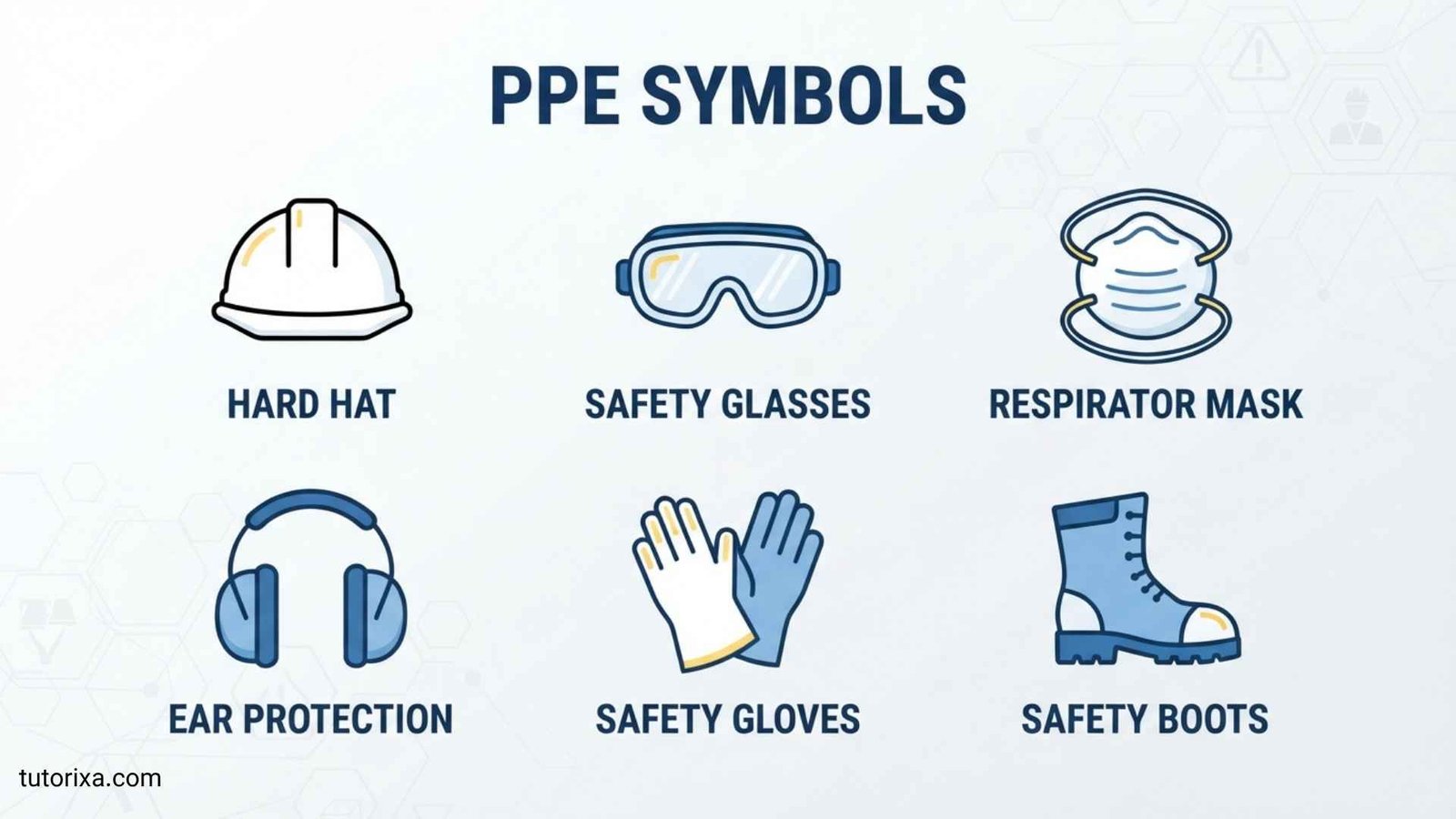
PPE Symbols can look simple at first, but each sign carries an important safety message. I know these symbols may seem confusing when you see several signs together, and you may wonder what each one really means.
You need to understand PPE Symbols because they help you recognize when protective equipment is required. I’ll break down the most common symbols in a simple way so you can quickly understand what your workplace or safety area is telling you.
By learning these signs, you can make smarter safety decisions and reduce confusion around protective equipment. You’ll discover what the symbols mean, where they are used, and why knowing them matters in everyday situations.
Quick Meaning of PPE Symbols
PPE symbols are graphical safety signs that indicate which personal protective equipment a person must use in a particular area. Common examples show mandatory head, eye, ear, respiratory, hand, foot, or full-body protection. In standardized systems, mandatory-action signs generally use a blue circular format with a contrasting white pictogram.
PPE Symbol Overview
| Field | Information |
| Symbol Name | PPE / Personal Protective Equipment Safety Symbols |
| Primary Meaning | Required protective equipment must be worn or used |
| Category | Mandatory safety signs |
| Main Standard | ISO 7010 and related ISO 3864 safety-sign principles |
| Typical Shape | Blue circle |
| Typical Pictogram | White representation of required PPE |
| Common Examples | Head, eye, hearing, respiratory, hand, foot, and body protection |
| Common Usage | Workplaces, construction, laboratories, industrial facilities, healthcare, workshops |
| Modern Meaning | A visual instruction to use specified protective equipment |
| Unicode | No single Unicode character represents the complete PPE sign system |
| Emoji Equivalent | No exact standardized emoji equivalent |
| Related Symbols | Warning, prohibition, emergency, fire-equipment, and safe-condition signs |
ISO 7010 establishes registered safety signs for accident prevention, fire protection, health-hazard information, and emergency evacuation. Its sign designs use the principles established by the ISO 3864 series for safety colors, shapes, and graphical symbols.
What Do PPE Symbols Mean?
PPE symbols tell people that a specific type of personal protective equipment is required in the marked area.
The important detail is that PPE symbols do not all communicate exactly the same instruction. The pictogram identifies the protective equipment involved.
For example:
- A safety helmet symbol indicates head protection.
- Eye-protection goggles indicate that suitable eye protection is required.
- An ear-protection symbol indicates hearing protection.
- A respiratory-protection symbol indicates appropriate respiratory protection.
- Protective gloves indicate hand protection.
- Safety footwear indicates protective footwear.
- A protective clothing symbol indicates that suitable protective clothing is required.
The surrounding safety-sign format also matters. A blue circular mandatory sign communicates required behavior rather than simply describing a hazard. UK Health and Safety Executive guidance, for example, distinguishes mandatory signs from warning signs and describes mandatory signs as signs that prescribe specific behavior, such as requiring eye protection.
This distinction is useful because a yellow warning sign might tell you that a hazard exists, while a blue PPE sign tells you what protective action is required.
Why PPE Symbols Exist
Written instructions can be useful, but workplaces often need communication that is fast and recognizable. Graphical symbols can help communicate across language barriers and can be displayed prominently without relying on lengthy text.
ISO has specifically described safety signs as combinations of color, shape, and graphical symbol, with each element helping users recognize the type of safety message.
A PPE symbol therefore works as part of a larger visual language:
Color + shape + pictogram = safety instruction.
History and Origin of PPE Symbols
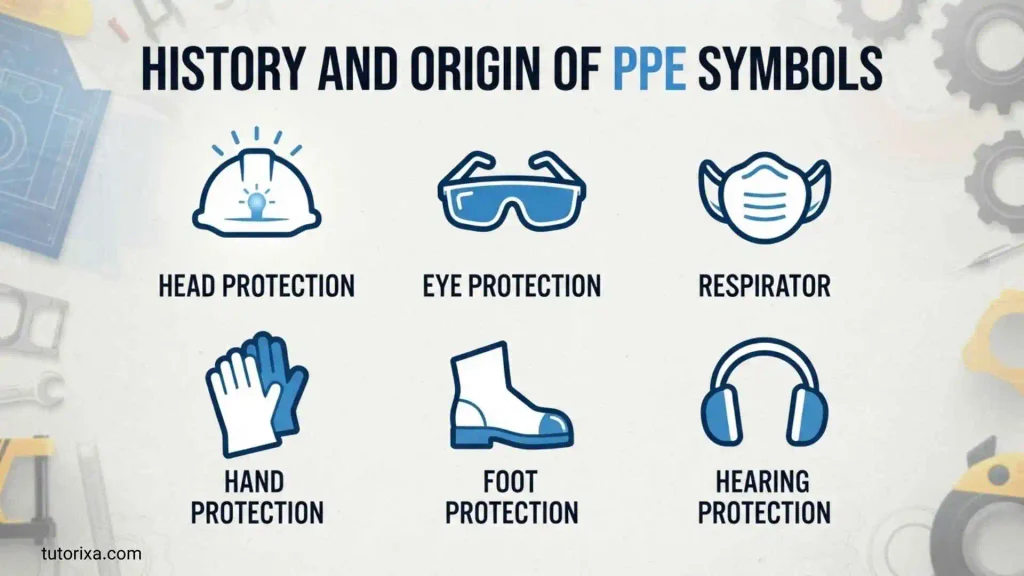
Modern PPE symbols developed from the broader standardization of safety signs rather than from one ancient civilization or a single historical symbol.
Early industrial workplaces relied heavily on written warnings, local conventions, and manually produced signs. As workplaces became more international and industrial processes became more complex, the need for consistent visual communication increased.
The International Organization for Standardization, commonly known as ISO, developed international systems for safety colors and graphical safety signs. ISO 7010 was created to establish registered safety signs for applications involving accident prevention, fire protection, health hazards, and emergency evacuation. Earlier editions included ISO 7010:2003 and ISO 7010:2011 before the 2019 edition became the current published edition.
The standard continues to evolve. ISO published an additional amendment to ISO 7010 in March 2026, while a new edition was under development at the time of writing.
This history shows an important point: PPE symbols are part of an evolving international visual communication system, not merely decorative workplace icons.
Symbolism and Interpretation of PPE Signs
Traditional Meaning
The traditional meaning of a mandatory PPE sign is straightforward:
Perform the protective action shown by the pictogram.
A helmet pictogram is therefore not primarily a symbol of bravery, strength, or authority. In a safety context, it represents the requirement for head protection.
Modern Meaning
Today, PPE symbols can represent several related ideas:
- Personal protection
- Hazard awareness
- Workplace responsibility
- Required behavior
- Risk control
- Occupational safety
- Prevention of injury or exposure
Their meaning depends on the environment in which they appear.
Positive Symbolism
PPE symbols can symbolize:
- Preparedness
- Responsibility
- Prevention
- Awareness
- Protection
- Professional safety culture
These are interpretations of the broader safety message rather than separate official meanings assigned to every pictogram.
Negative Interpretation
A PPE symbol itself does not normally mean that an accident is occurring. It indicates that protective equipment is required because the environment or activity may involve a relevant risk.
Confusing a mandatory sign with a warning sign is therefore a common interpretive mistake.
Psychological Interpretation
From a communication perspective, PPE symbols reduce the amount of language required to understand an instruction. Their effectiveness depends on recognizable imagery, consistent design, visibility, and appropriate placement.
However, a symbol cannot replace a complete safety program. Workers still need appropriate training, hazard information, equipment, and instructions.
Cultural Significance
PPE symbols have an unusual cultural role because their purpose is to reduce cultural and linguistic ambiguity.
A worker may not speak the language used on a workplace sign, but a recognizable helmet or goggles pictogram can communicate the intended action visually. This is one reason standardized graphical safety systems are useful in multinational workplaces.
Still, standardization does not mean every safety sign looks identical worldwide. Countries and industries can have additional legal requirements, local standards, or established practices.
ISO 7010 itself notes that its system applies broadly to locations where safety issues need to be addressed, while excluding certain regulated traffic-sign systems where other rules may apply.
Scientific and Technical Meaning
PPE symbols have a strong technical function in occupational health and safety.
They connect a workplace hazard with a required protective measure. For example, a workplace assessment might identify risks involving:
- Flying particles
- Excessive noise
- Falling objects
- Chemical exposure
- Dust or airborne contaminants
- Heat
- Cold
- Biological hazards
- Mechanical hazards
The appropriate PPE symbol then communicates the protective equipment expected in that location.
Importantly, the sign does not determine whether a particular item of PPE is technically adequate for every hazard. Equipment selection should be based on the actual risk, applicable regulations, manufacturer specifications, and workplace safety procedures.
Safety Sign Standards
ISO 7010 works together with the ISO 3864 family of standards. ISO explains that ISO 7010 uses safety-sign shapes and colors according to ISO 3864-1 and graphical-symbol design principles according to ISO 3864-3.
ISO/TS 20559 also provides guidance for developing and using safety-sign systems and complements standards including ISO 3864, ISO 7010, ISO 16069, ISO 23601, ISO 17398, and ISO 45001.
Where Are PPE Symbols Used?
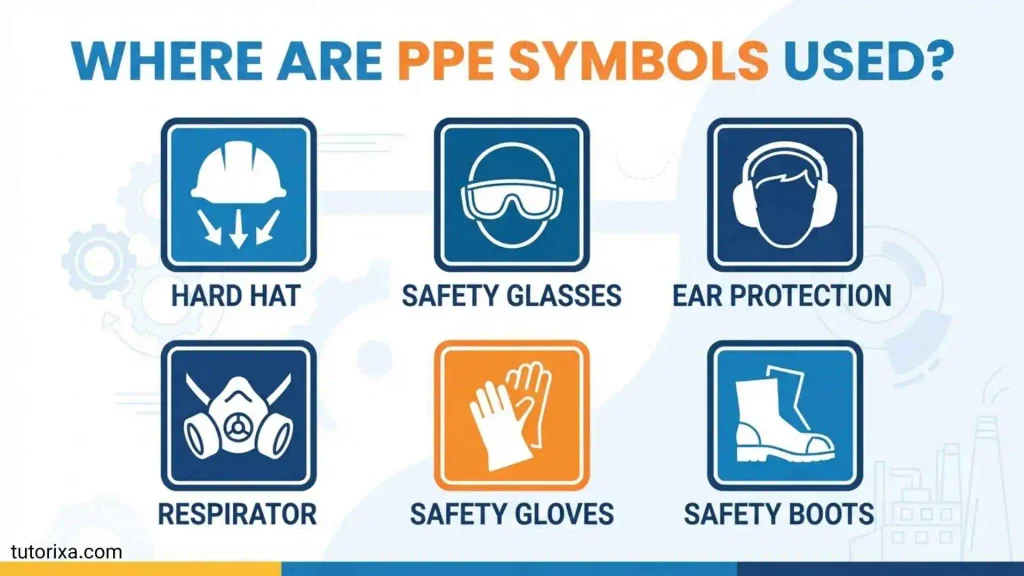
PPE symbols appear anywhere people may need clear instructions about protective equipment.
Construction Sites
Construction areas commonly use signs indicating requirements for helmets, safety footwear, eye protection, hearing protection, or other equipment.
Factories and Manufacturing Facilities
Manufacturing environments may use PPE signs near machinery, production lines, maintenance areas, and designated work zones.
Laboratories
Laboratories can display signs requiring appropriate eye protection, gloves, protective clothing, or other equipment based on the hazards present.
Hospitals and Healthcare
Healthcare environments may use protective-equipment signage where infection-control or other occupational hazards require specific protective measures.
Workshops
Mechanical, woodworking, metalworking, and technical workshops can use PPE symbols to identify required protective equipment.
Warehouses
Warehouses may display PPE requirements in areas involving vehicles, machinery, stored materials, dust, or other workplace hazards.
Public and Educational Facilities
Some schools, colleges, training centers, and public facilities may use mandatory PPE signs in laboratories, workshops, technical rooms, or restricted work areas.
Common PPE Symbol Variations
PPE signs can vary in visual details while communicating related protective actions.
Head Protection
A simplified human head wearing a protective helmet is commonly used to communicate mandatory head protection.
Eye Protection
The pictogram generally depicts protective eyewear worn over the eyes.
Hearing Protection
Ear defenders or other hearing-protection imagery communicates the need for hearing protection.
Hand Protection
A glove pictogram communicates a requirement for protective gloves.
Foot Protection
A protective boot or safety-footwear pictogram indicates the required use of protective footwear.
Respiratory Protection
A face or head-and-respirator representation indicates respiratory protection.
Full-Body or Protective Clothing
Some signs represent protective garments or full-body protection.
The exact artwork and permitted implementation should be checked against the applicable standard or national requirements rather than recreated from memory.
PPE Symbols vs. Other Safety Symbols
Understanding the categories helps prevent confusion.
| Sign Type | Typical Purpose | Typical Visual Convention |
| Mandatory | Required action | Blue circle |
| Warning | Hazard or danger | Yellow triangle |
| Prohibition | Action that is forbidden | Red circle with diagonal bar |
| Emergency/Safe Condition | Escape, first aid, or safe facility | Green sign |
| Fire Equipment | Fire equipment location | Red sign |
ISO describes safety signs as a combination of color, shape, and graphical symbol, while UK HSE guidance similarly distinguishes warning, mandatory, prohibition, and emergency/first-aid signs.
This means a helmet PPE sign is not the same thing as a falling-object warning sign. One communicates protective action; the other communicates a hazard.
Common Misconceptions About PPE Symbols
Misconception 1: Every Blue Circle Means PPE
Not necessarily. Blue circular signs generally belong to the mandatory-action category, but the pictogram determines the specific action required.
Misconception 2: The Sign Means Any PPE Is Acceptable
No. The symbol communicates the required protective category. The actual equipment must be appropriate for the identified hazard and applicable requirements.
Misconception 3: PPE Symbols Are Universal Emojis
They are not. There is no single Unicode character that represents the complete international PPE safety-sign system.
Misconception 4: A PPE Symbol Describes the Hazard
Usually, no. A PPE symbol primarily communicates the required protective action. A separate warning sign may identify the hazard.
Misconception 5: Every Country Uses Exactly the Same Sign
International standards promote consistency, but national laws and workplace regulations can add requirements or use particular implementations.
Misconception 6: A Sign Replaces Safety Training
It does not. Signs are one component of safety communication. Training, risk assessment, equipment selection, maintenance, supervision, and other controls remain important.
Interesting Facts About PPE Symbols
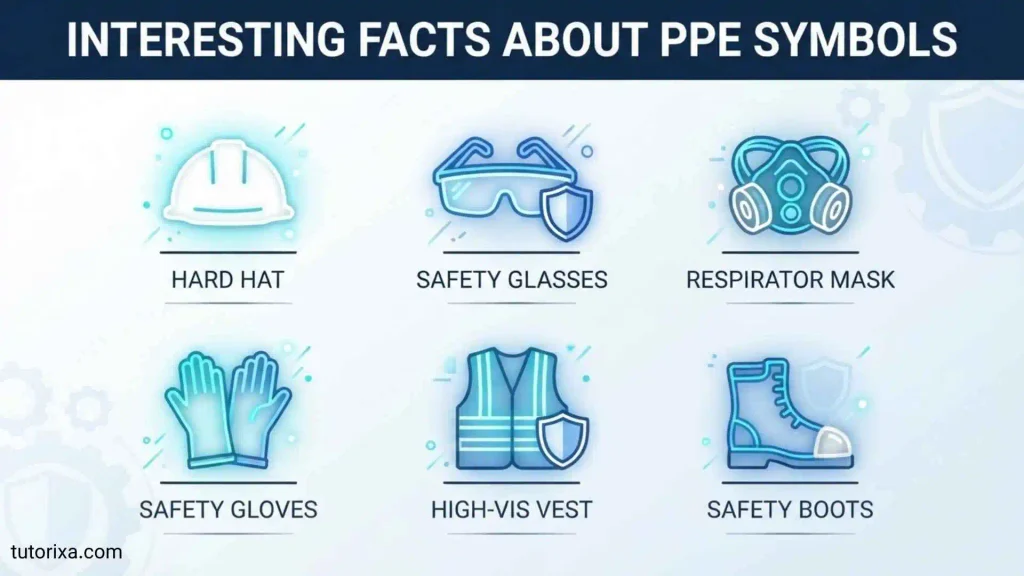
- PPE signs are part of a larger visual language.
Their meaning comes from the interaction of shape, color, and pictogram rather than from the image alone. - Blue commonly identifies mandatory action.
In standardized safety-sign systems, blue circular signs are associated with instructions that prescribe required behavior. - A helmet pictogram does not mean “danger.”
It specifically communicates the need for head protection. - Safety signs can work across languages.
Graphical communication can reduce dependence on written language, especially in multilingual workplaces. - ISO 7010 is not a static historical document.
It has received multiple amendments, including an amendment published in 2026. - PPE symbols belong to a broader family of safety signs.
Warning, prohibition, emergency, and fire-equipment signs use related principles. - A pictogram and a safety sign are not exactly the same thing.
The pictogram is the graphical representation, while the complete sign also involves its safety color, shape, and presentation. - Supplementary text can be used with graphical signs.
ISO’s earlier safety-sign material notes that additional text may improve comprehension when appropriate. - PPE symbols are practical rather than decorative.
Their primary purpose is to communicate behavior that supports safety. - Standards continue to change.
ISO’s 2026 draft edition indicates that the international safety-sign system remains under development.
Related Symbols
PPE symbols are closely connected with several other safety-symbol categories.
- Warning symbols: Identify potential hazards, such as electrical or chemical dangers.
- Prohibition symbols: Indicate actions that must not be performed.
- Emergency symbols: Identify escape routes, first-aid facilities, or rescue equipment.
- Fire-equipment symbols: Identify firefighting equipment and related facilities.
- Hazard pictograms: Communicate specific hazards, particularly in systems for chemicals and hazardous materials.
- First-aid symbols: Identify locations or facilities associated with medical assistance.
The key difference is the purpose of the message. PPE symbols tell people what protective action is required; warning symbols emphasize hazards; prohibition signs identify forbidden behavior; and emergency signs help people locate safety facilities.
Frequently Asked Questions
What are PPE symbols?
PPE symbols are graphical safety signs that indicate required personal protective equipment. They can show helmets, goggles, hearing protection, gloves, safety footwear, respiratory protection, or protective clothing. Their purpose is to communicate mandatory protective actions quickly and clearly, particularly in workplaces where hazards require specific protective measures.
What color are PPE mandatory signs?
PPE mandatory signs commonly use a blue circular format with a contrasting white pictogram. The blue color and circular shape identify the sign as mandatory, while the pictogram shows the required protective action. Exact requirements can depend on the applicable national standard, regulation, and implementation.
What does a blue PPE sign mean?
A blue PPE sign generally means that the protective action shown by the pictogram is required. For example, a helmet image indicates mandatory head protection, while an eye-protection image indicates required eye protection. The pictogram is therefore essential for understanding exactly what the sign requires.
Are PPE symbols internationally standardized?
Many PPE safety symbols are standardized through international safety-sign systems such as ISO 7010. ISO 7010 establishes registered safety signs and works with principles from the ISO 3864 series. However, national laws, industry rules, and local requirements can affect how safety signs are implemented.
Are PPE symbols the same as hazard symbols?
No. PPE symbols primarily communicate required protective action, while hazard symbols communicate the presence or nature of a hazard. A workplace may use both together: a warning sign can identify a hazard, while a mandatory PPE sign tells people what protective equipment they must use.
Do PPE symbols have Unicode characters?
There is no single Unicode character representing the complete PPE symbol system. Individual emojis may resemble certain protective items, but they are not substitutes for standardized occupational safety signs. Official workplace signage should follow the relevant safety-sign standards and legal requirements.
Why are PPE symbols important in workplaces?
PPE symbols provide quick visual instructions about required protective equipment. They are especially useful in environments where workers, visitors, contractors, or other people may speak different languages. Standardized signs can make safety instructions more recognizable, although they should complement rather than replace training and other safety controls.
Can PPE signs replace written instructions?
PPE signs can communicate a required action visually, but they do not replace detailed safety information. Written procedures may be necessary to explain hazards, equipment selection, correct use, limitations, maintenance, emergency procedures, and other requirements. A sign is best viewed as one part of a broader safety communication system.
What is the difference between a PPE sign and a warning sign?
A PPE sign generally tells someone what protective action is mandatory. A warning sign tells someone that a hazard or danger exists. For example, a warning sign may identify an electrical hazard, while a PPE sign may specify protective equipment required in the relevant work area.
Are PPE symbols used outside factories?
Yes. PPE symbols can appear in construction, laboratories, hospitals, workshops, warehouses, educational facilities, industrial plants, maintenance areas, and other environments where personal protective equipment is required. Their use depends on the hazards present and the applicable safety requirements.
Key Takeaways
- PPE symbols communicate required personal protective equipment.
- They are commonly associated with mandatory safety signs.
- Blue circular signs commonly indicate mandatory action.
- The pictogram identifies the specific protective equipment required.
- Common examples include head, eye, ear, hand, foot, respiratory, and body protection.
- PPE signs are different from hazard-warning and prohibition symbols.
- ISO 7010 is an important international reference for standardized safety signs.
- Safety signs use combinations of color, shape, and graphical symbols.
- National laws and workplace requirements may supplement international standards.
- PPE signs support safety communication but do not replace training, risk assessment, or proper equipment selection.
- ISO’s safety-sign system continues to evolve through amendments and revision work.
Conclusion
PPE symbols are a practical visual language for communicating required protective actions. A simple helmet, goggle, glove, boot, hearing-protection, or respiratory-protection pictogram can deliver an important instruction without relying entirely on written language.
Their significance goes beyond appearance. Standardized safety signs connect hazards, protective behavior, workplace rules, and human decision-making through recognizable visual communication. Understanding the difference between mandatory PPE signs, warning signs, prohibition signs, and emergency signs makes these symbols much easier to interpret correctly.
As international safety standards continue to develop, PPE symbols remain an important part of modern workplace communication. Knowing what each symbol means helps workers and visitors recognize required protection and understand the safety expectations of the environment around them.

I’m Ellis Montgomery, a British writer interested in the powerful language of symbols. I explore everything from traditional emblems and cultural signs to contemporary symbols found in modern life. My aim is to explain their meanings clearly while revealing the stories and ideas behind them, making symbolism fascinating and accessible to everyone.
Books:
- The Complete Book of Symbols
- Hidden Messages in Everyday Symbols
 Rowan Whitaker
 Freddie Beaumont