
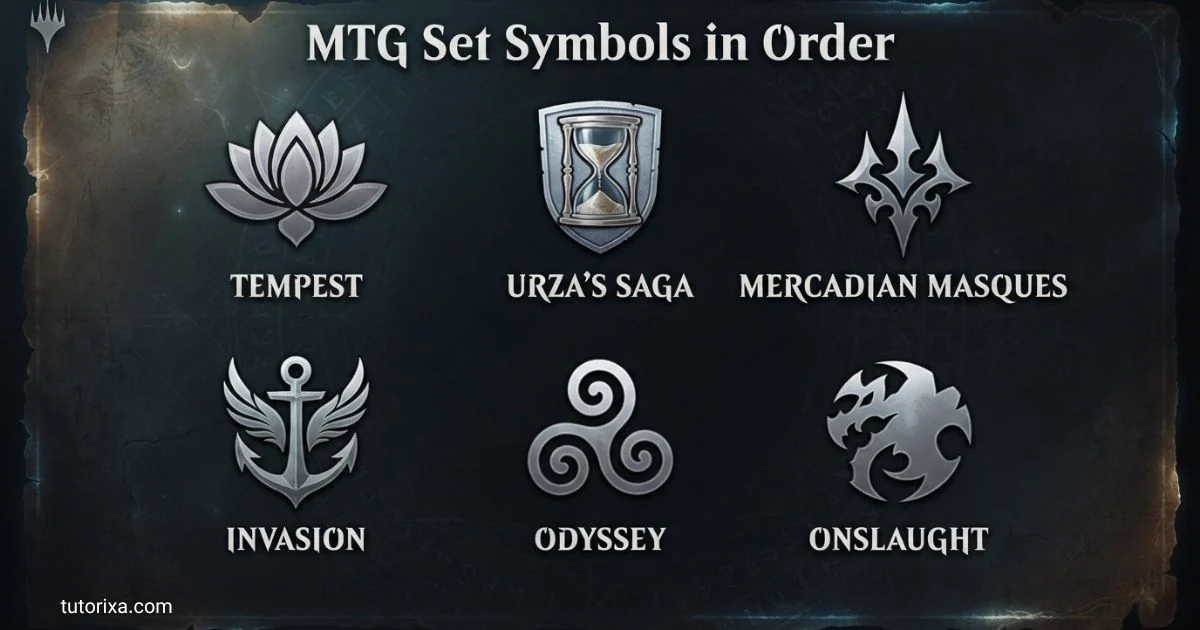
I know how confusing Magic: The Gathering set symbols can become, especially when you are trying to identify cards or understand where each set fits. With so many releases, it is easy to lose track.
You can use this guide to explore MTG Set Symbols in Order and quickly understand how the symbols connect to different Magic sets. I’ll keep things simple, clear, and useful for both new players and collectors.
Whether you are sorting a collection, identifying an older card, or simply curious about MTG history, you will find an easy reference here. You can follow the symbols in order and make card identification much easier.
Quick Meaning
An MTG set symbol is the small icon printed on a Magic: The Gathering card to identify its printing set. Each expansion, core set, and many supplemental products have their own symbol and set code. Set symbols have changed considerably since 1993, making them useful for identifying cards, editions, collections, and printings.
MTG Set Symbol Overview
| Detail | Information |
| Symbol Name | MTG Set Symbol / Expansion Symbol |
| Game | Magic: The Gathering |
| Creator | Wizards of the Coast |
| First Used | Arabian Nights in 1993 |
| Main Purpose | Identifies the card’s set |
| Location | Usually beside the type line |
| Related Identifier | Three-letter or alphanumeric set code |
| Rarity Connection | Important on many older cards |
| Modern Use | Set identification and collecting |
| First Expansion Symbol | Arabian Nights |
| Core Sets | Initially lacked symbols |
| Modern Sets | Generally use distinctive set symbols |
| Related Information | Set code, collector number, rarity, card frame |
What Do MTG Set Symbols Mean?
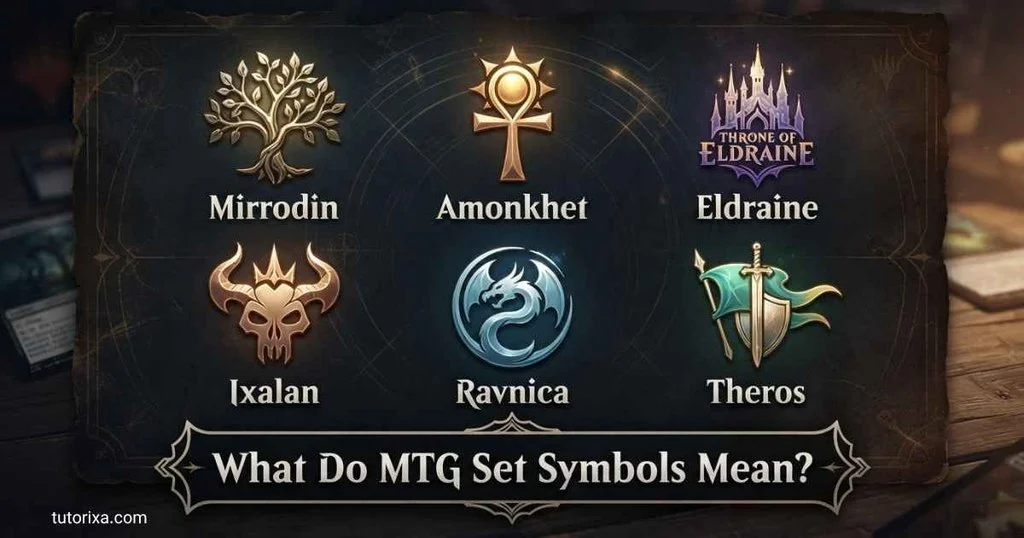
An MTG set symbol primarily tells you which Magic set a particular card belongs to.
For example, a card from Mirage has the Mirage set symbol, while a card from Tempest has the Tempest symbol. Modern sets follow the same basic principle, although the visual designs have become much more varied.
The symbol should not be confused with the five Magic mana symbols. The white, blue, black, red, and green mana symbols represent game resources, while an expansion symbol identifies a particular card set.
The set symbol can therefore help answer questions such as:
- Which MTG set is this card from?
- Is this an older or newer printing?
- Which expansion does this card belong to?
- Does this card come from a core set, expansion, or supplemental product?
- Which set code should I use when searching a card database?
The set code is particularly useful for digital searches. For example, Arabian Nights uses ARN, Ice Age uses ICE, Mirage uses MIR, and Tempest uses TMP.
Set Symbols and Rarity
Older Magic cards require extra care because the symbol’s color historically helped communicate rarity.
Wizards explains that cards before Exodus generally had black expansion symbols regardless of rarity. Beginning with Exodus, the expansion symbol’s color was used to distinguish common, uncommon, and rare cards.
Modern Magic cards use additional conventions, including the orange-red mythic rare color introduced with later sets.
MTG Set Symbols in Order: 1993–1999
The earliest period is especially important because Magic’s set-symbol system was still developing.
1993
Limited Edition Alpha — LEA
Released in August 1993. Alpha did not have a conventional expansion symbol.
Limited Edition Beta — LEB
Released in October 1993. Like Alpha, Beta did not use the modern set-symbol system.
Unlimited Edition — 2ED
Released in December 1993. It also did not have a conventional expansion symbol.
Arabian Nights — ARN
Released in December 1993. Its symbol is a scimitar, making it one of the most recognizable early Magic set symbols. Arabian Nights is generally regarded as the first Magic expansion to use an expansion symbol.
1994
Antiquities — ATQ — an anvil
Revised Edition — 3ED — no conventional expansion symbol
Legends — LEG — the capital of a Doric column
The Dark — DRK — a thin crescent moon
Fallen Empires — FEM — a crown
These early symbols often connect directly to the set’s theme. Antiquities, for instance, focuses heavily on ancient artifacts, making the anvil particularly appropriate.
1995
Fourth Edition — 4ED — no conventional expansion symbol
Ice Age — ICE — a snowflake
Chronicles — CHR — compilation set using symbols associated with the original cards
Renaissance — compilation set
Homelands — HML — the globe of Ulgrotha
1996
Alliances — ALL — a flowing banner
Mirage — MIR — a palm tree
Mirage’s palm-tree design reflects the set’s setting and atmosphere. The Mirage block continued with Visions and Weatherlight.
1997
Visions — VIS — a stylized V/Zhalfirin triangle design
Fifth Edition — 5ED — a Roman numeral V
Portal — POR
Weatherlight — WTH
Tempest — TMP
1998
Stronghold — STH
Exodus — EXO
Portal Second Age — P02
Unglued — UGL
Urza’s Saga — USG
Anthologies — ATH
By this period, the set-symbol system had become a standard part of identifying Magic expansions.
1999
Urza’s Legacy — ULG
Sixth Edition — 6ED — Roman numeral VI
Portal Three Kingdoms — PTK
Urza’s Destiny — UDS
Starter 1999 — S99
Mercadian Masques — MMQ
Wizards notes that most base sets did not receive expansion symbols until Sixth Edition, whose symbol was “VI.”
MTG Set Symbols in Order: 2000–2009
The 2000s introduced a large number of memorable symbols as Magic moved through increasingly distinct worlds and mechanical themes.
2000–2002
Nemesis — NMS
Prophecy — PCY
Invasion — INV
Planeshift — PLS
Seventh Edition — 7ED
Apocalypse — APC
Odyssey — ODY
Torment — TOR
Judgment — JUD
These sets belong to the period when Magic was developing increasingly elaborate block identities.
2002–2004
Onslaught — ONS
Legions — LGN
Scourge — SCG
Eighth Edition — 8ED
Mirrodin — MRD
Darksteel — DST
Fifth Dawn — 5DN
Champions of Kamigawa — CHK
Betrayers of Kamigawa — BOK
Saviors of Kamigawa — SOK
The Kamigawa block is especially recognizable because its symbols reflect the Japanese-inspired fantasy setting.
2005–2007
Ravnica: City of Guilds — RAV
Guildpact — GPT
Dissension — DIS
Coldsnap — CSP
Time Spiral — TSP
Planar Chaos — PLC
Future Sight — FUT
Tenth Edition — 10E
The Ravnica symbols are connected to the setting’s guild structure, while the Time Spiral-era symbols reflect the block’s themes of time, alternate histories, and fractured realities.
2007–2009
Lorwyn — LRW
Morningtide — MOR
Shadowmoor — SHM
Eventide — EVE
Shards of Alara — ALA
Conflux — CON
Alara Reborn — ARB
Magic 2010 — M10
Zendikar — ZEN
This period established a strong relationship between a set’s visual symbol, its world, and its storytelling identity.
MTG Set Symbols in Order: 2010–2019
2010–2012
Worldwake — WWK
Rise of the Eldrazi — ROE
Magic 2011 — M11
Scars of Mirrodin — SOM
Mirrodin Besieged — MBS
New Phyrexia — NPH
Magic 2012 — M12
Innistrad — ISD
Dark Ascension — DKA
Avacyn Restored — AVR
Magic 2013 — M13
The symbols during this era became particularly useful for distinguishing the increasingly large number of Magic releases.
2012–2014
Return to Ravnica — RTR
Gatecrash — GTC
Dragon’s Maze — DGM
Magic 2014 — M14
Theros — THS
Born of the Gods — BNG
Journey into Nyx — JOU
Magic 2015 — M15
2014–2016
Khans of Tarkir — KTK
Fate Reforged — FRF
Dragons of Tarkir — DTK
Magic Origins — ORI
Battle for Zendikar — BFZ
Oath of the Gatewatch — OGW
Shadows over Innistrad — SOI
Eldritch Moon — EMN
2016–2019
Kaladesh — KLD
Aether Revolt — AER
Amonkhet — AKH
Hour of Devastation — HOU
Ixalan — XLN
Rivals of Ixalan — RIX
Dominaria — DOM
Guilds of Ravnica — GRN
Ravnica Allegiance — RNA
War of the Spark — WAR
Throne of Eldraine — ELD
MTG Set Symbols in Order: 2020–2024
The 2020s brought an even wider variety of settings, products, and special releases.
2020
Theros Beyond Death — THB
Ikoria: Lair of Behemoths — IKO
Core Set 2021 — M21
Zendikar Rising — ZNR
Ikoria is particularly recognizable because of its monster-focused visual identity.
2021
Kaldheim — KHM
Strixhaven: School of Mages — STX
Modern Horizons 2 — MH2
Adventures in the Forgotten Realms — AFR
Innistrad: Midnight Hunt — MID
Innistrad: Crimson Vow — VOW
2022
Kamigawa: Neon Dynasty — NEO
Streets of New Capenna — SNC
Commander Legends: Battle for Baldur’s Gate — CLB
Dominaria United — DMU
The Brothers’ War — BRO
Phyrexia: All Will Be One — ONE
2023
Dominaria Remastered — DMR
Phyrexia: All Will Be One continued to define the early 2023 Standard environment, followed by:
March of the Machine — MOM
March of the Machine: The Aftermath — MAT
The Lord of the Rings: Tales of Middle-earth — LTR
Wilds of Eldraine — WOE
The Lost Caverns of Ixalan — LCI
2024
Murders at Karlov Manor — MKM
Ravnica: Clue Edition — CLU
Outlaws of Thunder Junction — OTJ
The Big Score — BIG
Modern Horizons 3 — MH3
Assassin’s Creed — ACR
Bloomburrow — BLB
Duskmourn: House of Horror — DSK
Magic: The Gathering Foundations — FDN
Wizards lists Foundations as a major Magic release and identifies FDN as its set code.
MTG Set Symbols in Order: 2025–2026
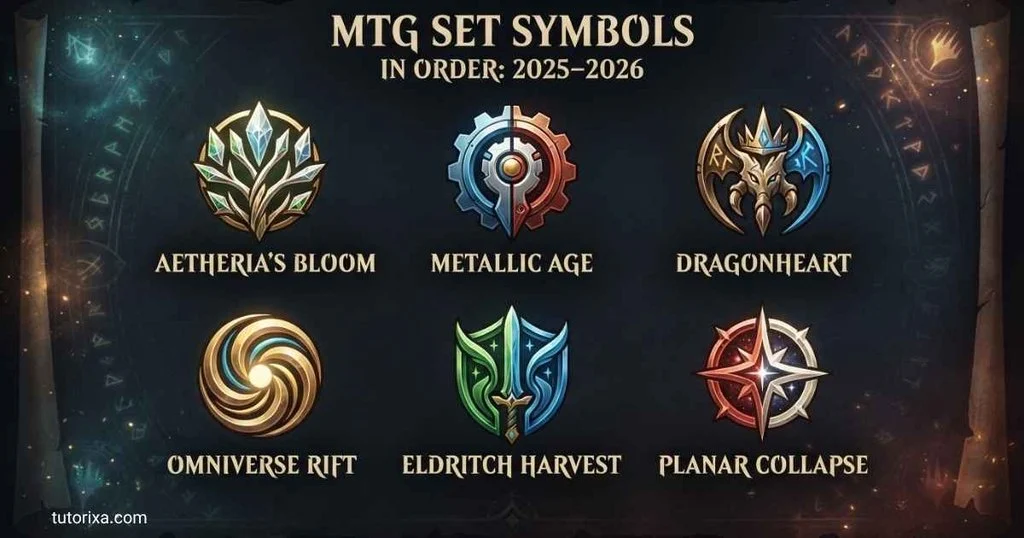
Magic’s recent release schedule has expanded beyond traditional plane-based expansions to include major Universes Beyond releases.
2025
Aetherdrift — DFT — February 14, 2025
Tarkir: Dragonstorm — TDM — April 11, 2025
Magic: The Gathering—FINAL FANTASY — FIN — June 13, 2025
Edge of Eternities — EOE — August 1, 2025
Marvel’s Spider-Man — SPM — September 26, 2025
Avatar: The Last Airbender — TLA — November 21, 2025
2026
Lorwyn Eclipsed — ECL — January 23, 2026
Magic: The Gathering® | Teenage Mutant Ninja Turtles — TMT — March 6, 2026
Secrets of Strixhaven — SOS — April 24, 2026
Magic: The Gathering® | Marvel Super Heroes — MSH — June 26, 2026
Magic: The Gathering® | The Hobbit™ — HOB — August 14, 2026
Reality Fracture — FRA — October 2, 2026
Magic: The Gathering® | Star Trek™ — TRK — November 13, 2026
As of October 1, 2026, Reality Fracture is scheduled for October 2, while Star Trek is scheduled for November 13, so those two belong at the end of the chronological 2026 list but have not both reached release yet.
Wizards’ 2026 announcement describes the year as an unusual seven-set schedule before Magic returns to a six-set cadence in 2027.
Why Are MTG Set Symbols Important?
MTG set symbols matter because Magic has thousands of cards with multiple printings.
The same card name can appear in several different sets. The symbol helps distinguish those versions quickly.
For collectors, the symbol can help establish:
- The card’s set
- Its approximate release period
- Its printing
- Its relationship to a particular block or setting
- Whether it belongs to a special product
- Which set code to use when searching databases
A symbol alone is not always enough to identify a specific printing, however. You may also need the collector number, card frame, copyright line, language, treatment, and set code.
History and Origin of MTG Set Symbols
MTG set symbols emerged as Magic’s number of expansions increased.
The earliest Alpha, Beta, and Unlimited cards did not use the familiar expansion-symbol system. Arabian Nights, released in December 1993, introduced the expansion-symbol concept. Its scimitar symbol helped distinguish the expansion from the original Limited Edition cards.
The following expansions adopted distinctive imagery. Antiquities used an anvil, Legends used a column capital, The Dark used a crescent moon, and Fallen Empires used a crown.
Core sets followed a different path. Wizards states that most base sets did not use expansion symbols until Sixth Edition.
Over time, symbols became a standard visual language for the game.
How MTG Set Symbols Changed Over Time
There are several important eras.
Early Magic
Early expansion symbols were often simple black silhouettes. They were primarily identifiers rather than elaborate pieces of branding.
Rarity-Colored Symbols
Starting with Exodus, expansion-symbol color became an important rarity indicator. Wizards specifically notes that earlier symbols were black regardless of rarity.
Modern Set Identity
Modern sets use more sophisticated symbols and combine them with:
- Set codes
- Collector numbers
- Rarity indicators
- Card treatments
- Special-frame designs
- Promotional symbols
- Commander and supplemental identifiers
This makes the symbol only one component of modern card identification.
Where Can You Find an MTG Set Symbol?
The standard location is near the right side of the type line on a traditional Magic card.
The symbol normally appears between the card’s rules text area and other identifying information associated with the card’s printing.
Wizards’ card anatomy guide specifically identifies the expansion symbol as information that tells players what set a card was printed in.
Digital card databases can provide additional information through the set code and collector number.
MTG Set Symbols vs. Set Codes
Set symbols and set codes are related but different.
The symbol is the visual icon printed on the card.
The set code is the short alphanumeric identifier used by databases and collectors.
Examples include:
| Set | Code |
| Arabian Nights | ARN |
| Antiquities | ATQ |
| Legends | LEG |
| The Dark | DRK |
| Ice Age | ICE |
| Mirage | MIR |
| Tempest | TMP |
| Urza’s Saga | USG |
| Ravnica: City of Guilds | RAV |
| Innistrad | ISD |
| Dominaria | DOM |
| Zendikar Rising | ZNR |
| Bloomburrow | BLB |
| Foundations | FDN |
| Aetherdrift | DFT |
| Tarkir: Dragonstorm | TDM |
| Final Fantasy | FIN |
| Edge of Eternities | EOE |
| Marvel’s Spider-Man | SPM |
| Lorwyn Eclipsed | ECL |
| Teenage Mutant Ninja Turtles | TMT |
| Secrets of Strixhaven | SOS |
| Marvel Super Heroes | MSH |
Current official Magic product information confirms the set codes for recent releases, including SOS, SOC, SOA, and SPG for the various Secrets of Strixhaven components.
Common MTG Set Symbol Variations
Not every Magic product follows exactly the same structure.
You may encounter symbols for:
- Main expansion sets
- Core sets
- Commander products
- Supplemental sets
- Remastered sets
- Jumpstart releases
- Universes Beyond sets
- Special Guests
- Promotional cards
- Compilation products
- Special treatments
For example, Magic: The Gathering Foundations includes FDN, while Foundations Jumpstart uses J25 and Foundations Commander uses FDC.
Secrets of Strixhaven similarly has separate identifiers for the main set and related components.
This is why “set symbol” and “set code” should not be treated as interchangeable terms.
Common Misconceptions About MTG Set Symbols
The Symbol Always Tells You the Rarity
Not necessarily.
Rarity-color conventions changed over Magic’s history. Older cards, particularly those from before Exodus, require different interpretation. Wizards explicitly notes that expansion symbols were black regardless of rarity before Exodus.
Every MTG Card Has a Set Symbol
No.
The earliest core sets such as Alpha, Beta, Unlimited, and Revised did not use the modern expansion-symbol system.
The Set Symbol Is the Same as the Set Code
No.
A symbol is a graphic. A code such as MIR, TMP, or FDN is a textual identifier.
The Symbol Identifies the Exact Printing
Usually it identifies the set, but additional information may be necessary to determine an exact printing or treatment.
Modern Sets Only Use Traditional Magic Worlds
No.
Recent Magic releases include Universes Beyond collaborations. Wizards’ 2026 product archive lists releases such as Teenage Mutant Ninja Turtles, Marvel Super Heroes, The Hobbit, and Star Trek alongside traditional Magic settings.
10 Interesting Facts About MTG Set Symbols
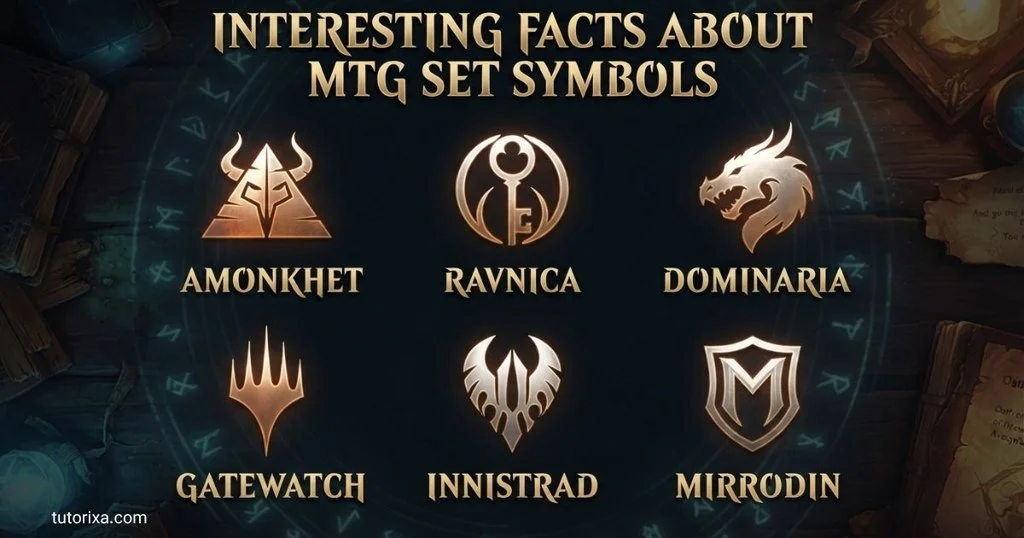
- Arabian Nights introduced the expansion-symbol tradition. Its scimitar is one of the earliest recognizable set symbols in Magic.
- Alpha had no modern expansion symbol. The symbol system developed after Magic’s initial release.
- Antiquities used an anvil. The design fits the set’s strong focus on artifacts and the history of Dominaria.
- Legends used a column capital. Its symbol reflects the classical visual language associated with the set.
- Ice Age uses a snowflake. It is one of the easiest early symbols to recognize from its theme.
- Mirage uses a palm tree. The symbol visually connects to the setting and atmosphere of the Mirage world.
- Sixth Edition introduced a core-set symbol. Its Roman numeral VI marked a major change in how core-set cards were identified.
- Exodus marked an important rarity-symbol transition. Its expansion symbol could use color to communicate rarity.
- Modern products can have multiple set identifiers. Foundations and Secrets of Strixhaven demonstrate how a major release can contain separately identified components.
- 2026 contains an unusually broad range of Magic properties. The year’s announced releases include traditional settings and several Universes Beyond collaborations.
Related MTG Symbols and Identifiers
If you are learning to identify Magic cards, several related markings are worth knowing.
Mana Symbols
These represent the game’s five basic colors:
- White
- Blue
- Black
- Red
- Green
They are gameplay symbols rather than set identifiers.
Tap Symbol
The tap symbol indicates that a permanent is being tapped as part of a game action.
Planeswalker Symbol
The Planeswalker symbol has appeared in Magic’s broader visual language and can be associated with particular card treatments or products.
Rarity Symbol
The color and appearance of the set symbol can communicate rarity, especially on modern cards.
Set Code
A short identifier such as MIR, MKM, or ECL provides a convenient textual way to identify a set.
Collector Number
The collector number helps identify a card’s position within a particular printing and is especially useful for modern sets with alternate versions.
Frequently Asked Questions
What is an MTG set symbol?
An MTG set symbol is the small graphic printed on a Magic: The Gathering card to identify the set in which that card was printed. It is normally found near the right side of the type line. The symbol is different from the card’s mana symbols and is primarily used for set identification.
What was the first MTG set with a symbol?
Arabian Nights, released in December 1993, is generally recognized as the first Magic expansion to use an expansion symbol. Its symbol is a scimitar. The original Alpha, Beta, and Unlimited cards did not have the familiar expansion-symbol system used by later sets.
What do the symbols on MTG cards mean?
The main purpose of an MTG set symbol is to identify the card’s set. On many older and modern cards, the symbol’s color can also provide rarity information. However, rarity conventions changed throughout Magic’s history, so the symbol should be interpreted according to the card’s era.
How do I identify an MTG set from its symbol?
Compare the symbol with a chronological MTG set list and then verify the card’s set code, collector number, frame, and other identifying details. A symbol can often identify the set quickly, but older cards and special products may require additional information.
Do MTG set symbols show rarity?
They can. On many Magic cards, symbol color communicates rarity. Wizards explains that before Exodus, expansion symbols were black regardless of rarity. From Exodus onward, colored symbols became an important rarity indicator.
What is the difference between an MTG set symbol and a set code?
The set symbol is a visual icon printed on the card. The set code is a short text identifier such as ARN, MIR, TMP, or FDN. Both identify the set, but they serve different purposes. Set codes are especially useful when searching digital databases or organizing a collection.
Why do some old MTG cards have no set symbol?
The earliest Magic core sets did not use the modern expansion-symbol system. Alpha, Beta, Unlimited, and Revised are examples of early products without conventional set symbols. Wizards later introduced symbols for core sets, with Sixth Edition using the Roman numeral VI.
Can one card have different MTG set symbols?
Yes. A card that was reprinted in several sets can have a different set symbol in each printing. The artwork may also change, and modern versions can have different frames or treatments. The symbol therefore helps distinguish which Magic set a particular physical card belongs to.
Are Universes Beyond sets included in MTG set symbols?
Yes. Modern Magic includes Universes Beyond releases alongside traditional Magic settings. Recent examples include The Lord of the Rings, Final Fantasy, Marvel Super Heroes, The Hobbit, and upcoming Star Trek products. Each release has its own set identifiers.
What is the newest MTG set symbol in 2026?
As of October 1, 2026, Reality Fracture (FRA) is scheduled for release on October 2, 2026. Magic: The Gathering | Star Trek (TRK) follows on November 13, 2026, so TRK is later chronologically but had not yet released on October 1.
Key Takeaways
- MTG set symbols identify the Magic set associated with a card.
- Arabian Nights introduced the expansion-symbol tradition in 1993.
- Alpha, Beta, Unlimited, and several early core sets did not use modern expansion symbols.
- Early symbols were often simple images connected to a set’s theme.
- Antiquities uses an anvil, Legends a column capital, The Dark a crescent moon, and Ice Age a snowflake.
- Set symbols and set codes are related but are not the same thing.
- Set codes such as ARN, MIR, TMP, and FDN are particularly useful for database searches.
- Symbol color has been used to communicate rarity, but the convention changed over Magic’s history.
- Modern Magic products can contain several related set identifiers.
- Universes Beyond has expanded the range of settings represented by MTG set symbols.
- For precise card identification, combine the symbol with the set code, collector number, frame, and other printing details.
- The chronological list continues to grow as new Magic expansions and supplemental products are released.
Conclusion
MTG set symbols in order provide a visual history of Magic: The Gathering, beginning with the scimitar of Arabian Nights and continuing through the increasingly diverse symbols of modern Magic releases. What began as a simple way to distinguish expansions has become an important part of identifying cards, understanding rarity, organizing collections, and recognizing different printings.
The most reliable way to identify an unfamiliar card is to use its set symbol together with its set code and collector number. Understanding how these identifiers evolved—from early expansion symbols to today’s complex ecosystem of Standard sets, supplemental products, and Universes Beyond releases—makes it much easier to navigate Magic’s enormous card history.

I’m Rowan Whitaker, a British writer fascinated by the symbols surrounding us every day. I explore their meanings, origins, cultural significance, and changing interpretations. From ancient marks to modern signs, I enjoy making symbolism easier to understand. My writing helps curious readers discover the hidden messages behind familiar shapes, images, and signs.
Books:
- The Meaning Behind Symbols
- A Modern Guide to Symbolism
 Ellis Montgomery