
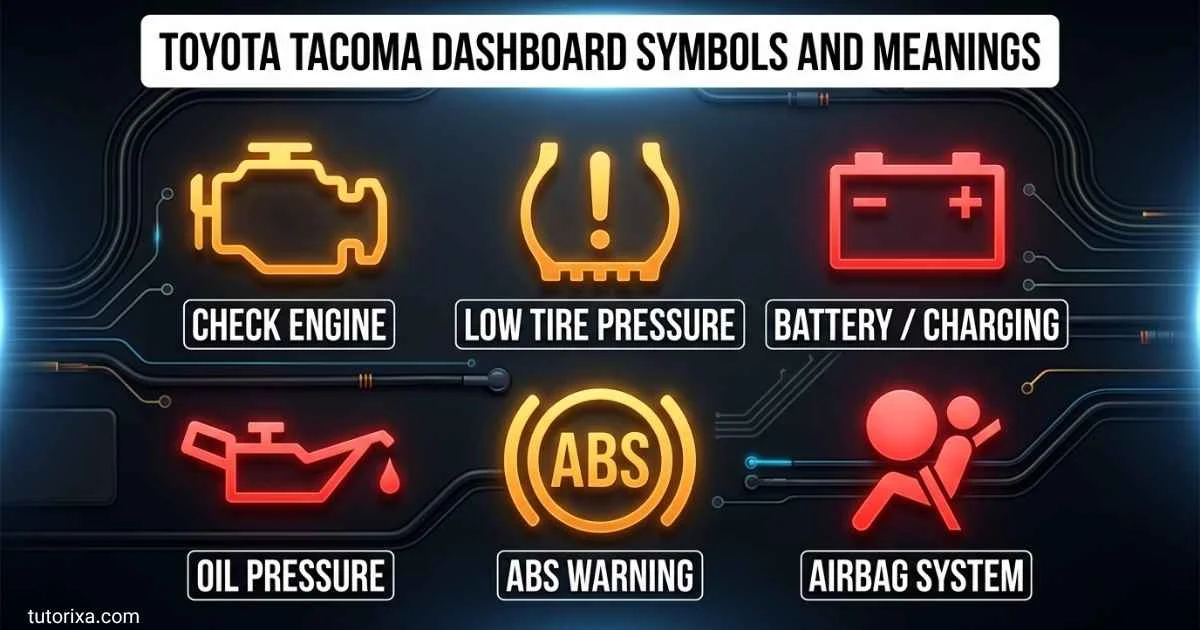
Seeing an unfamiliar light on your Toyota Tacoma dashboard can be stressful, especially when you’re unsure whether it signals a minor issue or a serious problem. I know how important it is to understand what your truck is telling you before deciding what to do next.
Every dashboard symbol has a purpose, and understanding it can help you recognize potential problems early. If you know what each warning light means, you can make smarter decisions and drive with greater confidence.
In this guide, you’ll learn about Toyota Tacoma dashboard symbols and meanings, including warning lights, indicator lights, and common alerts. I’ll help you understand what these symbols generally mean, when you should take action, and when your Tacoma may need professional attention.
Quick Meaning of Toyota Tacoma Dashboard Symbols
Toyota Tacoma dashboard symbols indicate the status of vehicle systems, including the engine, brakes, battery, tires, airbags, traction control, and driver-assistance features. Red warning lights generally require immediate attention, amber lights indicate a problem or caution, and green or blue indicators usually show that a feature is active. Always confirm the meaning in your Tacoma owner’s manual.
Toyota Tacoma Dashboard Symbols Overview Table
This table covers common warning lights and indicators found on many Tacoma models. Not every symbol appears on every truck, and the wording or design may differ by model year.
| Dashboard Symbol | Name | Meaning | Recommended Action |
| Oil can | Low engine oil pressure | Oil pressure may be too low | Stop safely and shut off the engine |
| Engine outline | Check engine light | Engine or emissions control fault | Arrange diagnosis; stop if severe symptoms occur |
| Battery | Charging system warning | Charging system may not be working correctly | Stop safely if the warning remains on and seek assistance |
| Thermometer over waves | Engine coolant temperature | Engine may be overheating | Stop safely, shut off the engine, and allow it to cool |
| Circle with exclamation mark | Brake warning | Parking brake may be engaged or a brake-system issue may exist | Check the parking brake; stop if the warning remains or braking feels abnormal |
| ABS in a circle | Anti-lock braking system | ABS fault may be present | Drive cautiously and arrange inspection |
| Horseshoe with exclamation mark | Tire pressure monitoring system (TPMS) | One or more tires may be underinflated, or the system may have a fault | Check tire pressures when safe |
| Person with airbag | SRS airbag warning | Airbag or supplemental restraint system fault | Arrange prompt inspection |
| Seat belt and person | Seat belt reminder | Seat belt is unfastened | Fasten seat belts |
| Steering wheel with exclamation mark | Electric power steering | Steering assistance fault may be present | Stop safely if steering becomes difficult |
| Skidding car | Traction control or stability control | System is operating or a fault may exist | Check whether the light flashes or stays on |
| TRAC OFF | Traction control disabled | Traction control has been switched off or is unavailable | Check the system setting and owner’s manual |
| Fuel pump | Low fuel | Fuel level is low | Refuel soon |
| Windshield with spray | Washer fluid or wiper-related indicator | Meaning depends on the exact icon and model | Check the displayed message and manual |
| Cruise control symbol | Cruise control status | Cruise control is active or available | Confirm the selected speed and road conditions |
| Blue headlamp | High-beam headlights | High beams are on | Switch to low beams when approaching other traffic |
| Green arrows | Turn signals or hazard indicators | Turn signals or hazard lights are active | Cancel the signal when appropriate |
| Door or tailgate symbol | Door or tailgate open | A door or tailgate may not be fully closed | Stop safely and check the closure |
| Master warning symbol | General warning | The truck has detected a condition needing attention | Read the accompanying message |
| Maintenance reminder | Scheduled maintenance | Maintenance is due or a reminder has been triggered | Check the maintenance schedule |
Toyota’s official warning-light guidance distinguishes indicators that show a feature is active from warnings that may indicate a malfunction. Use the manual for your exact model year to confirm the appropriate response.
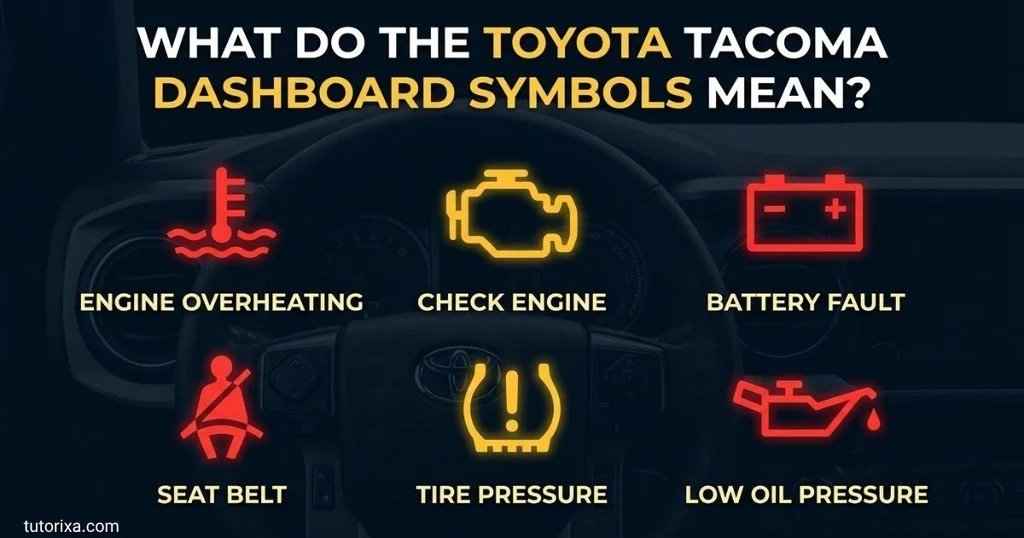
What Do the Toyota Tacoma Dashboard Symbols Mean?
1. Check Engine Light
The check engine light usually looks like the outline of an engine. It indicates that the engine control system has detected a condition that may affect engine performance or emissions.
Possible causes include a loose fuel cap on applicable models, an emissions-system fault, a sensor problem, or an engine-management issue.
- Light stays on: Arrange a diagnostic check soon.
- Light flashes: Reduce engine load and pull over safely if the engine runs roughly or loses power. A flashing light can indicate a fault that risks catalytic-converter damage.
- Light appears with other serious warnings: Follow the instructions for the most urgent warning.
The symbol alone cannot identify the failed part. A diagnostic scan is often needed to determine the cause.
2. Oil Pressure Warning Light
The oil pressure warning typically resembles an oil can with a drop. It warns that engine oil pressure may be too low to lubricate the engine properly.
This is one of the most important Tacoma dashboard warnings because continued engine operation with insufficient oil pressure can cause severe damage.
If the light comes on while driving, stop in a safe location and switch off the engine. Check the owner’s manual for the correct procedure. Checking the oil level may help, but a normal level does not rule out an oil-pressure problem. Do not continue driving while the warning remains active.
3. Battery and Charging System Warning
The battery-shaped light indicates a possible charging-system problem. It does not necessarily mean the battery itself is defective.
Potential causes include an alternator fault, a loose or damaged electrical connection, a belt problem on applicable engines, or another charging-system issue.
If the light remains on while the engine is running, electrical power may eventually become insufficient for normal vehicle operation. Turn off unnecessary electrical accessories, stop safely, and arrange professional assistance.
4. Engine Coolant Temperature Warning
The coolant temperature symbol often resembles a thermometer over waves. It indicates that engine temperature may be too high.
Overheating can result from coolant loss, a cooling-fan problem, a thermostat issue, or another cooling-system fault.
If the warning indicates overheating, stop safely and switch off the engine. Do not open a hot radiator or coolant reservoir because pressurized coolant can cause severe burns. Let the vehicle cool and follow the manual’s instructions before checking anything.
5. Brake Warning Light
The brake warning symbol commonly appears as an exclamation mark inside a circle, sometimes with curved brackets.
It may illuminate because the parking brake is engaged. If it stays on after you release the parking brake, it may indicate low brake fluid or another brake-system problem, depending on the model.
Check the parking brake first when safely parked. If the light remains on, the brake pedal feels unusual, or braking performance changes, stop driving and arrange assistance. Do not assume the warning is harmless.
6. ABS Warning Light
The anti-lock braking system warning usually displays the letters ABS inside a circle.
ABS helps prevent the wheels from locking during certain hard-braking situations. If the ABS warning stays on, the conventional braking system may still function, but anti-lock assistance may be unavailable.
Drive cautiously and have the system inspected. If the ABS warning appears together with a brake warning, or braking feels abnormal, stop safely and seek professional help.
7. Tire Pressure Warning Light
The tire pressure monitoring system symbol resembles a horseshoe-shaped tire with an exclamation mark.
It indicates that one or more tires may have low inflation pressure, or that the monitoring system may have a fault.
When safe, inspect the tires and measure their pressure with a gauge. Inflate them to the pressure specified on the driver’s door-jamb placard, not simply the maximum pressure printed on the tire sidewall.
If the light flashes before remaining illuminated, some Toyota TPMS systems use that pattern to indicate a system malfunction. The precise behavior depends on the model year and equipment.
8. Airbag or SRS Warning Light
The SRS warning symbol usually depicts a seated person with a circle representing an airbag.
SRS stands for Supplemental Restraint System. It includes airbags and related components; some models also integrate seat-belt pretensioners into the system.
If the warning remains on, parts of the restraint system may not operate as intended during a collision. Arrange an inspection promptly and do not attempt to repair airbag components yourself.
9. Steering and Power Steering Warning
A steering-wheel symbol with an exclamation mark may indicate a problem with the power steering system.
Depending on the Tacoma’s model year, steering assistance may be provided by an electric power steering system or a different configuration.
If the steering suddenly becomes heavy or difficult to control, slow down carefully, stop in a safe place, and seek assistance. A warning light without noticeable steering changes still warrants checking the owner’s manual and arranging inspection when required.
10. Traction Control and Stability Control Lights
A car with wavy lines underneath commonly represents traction control or vehicle stability control.
These systems help manage wheelspin and maintain control under certain driving conditions.
- Flashing while driving: The system may be actively intervening because wheel traction is limited.
- Steady warning light: A system fault or disabled feature may be indicated.
- TRAC OFF or VSC OFF: The associated system has been switched off or is unavailable.
The exact meaning depends on the displayed symbol and accompanying message. On loose surfaces, traction-control behavior can differ from what you experience on ordinary pavement.
11. Low Fuel Warning
The fuel-pump symbol indicates that the remaining fuel is low.
The distance you can drive after the light appears depends on fuel consumption, road conditions, driving style, terrain, and the remaining amount in the tank. Do not treat the warning as a precise estimate of how far you can travel.
Refuel as soon as practical, especially before entering remote areas or traveling through locations with limited fuel stations.
12. Seat Belt Reminder
The seat belt symbol depicts a seated person wearing a belt. It reminds the driver or passenger to buckle up.
Some Tacomas also provide an audible reminder. Depending on the model, the system may detect occupancy or other conditions.
Fasten your seat belt before moving and ensure that passengers do the same. A seat belt warning is a safety reminder, not an engine fault.
13. Turn Signal and Headlight Indicators
Green arrows usually indicate that a turn signal is active. A blue headlamp symbol commonly indicates that the high beams are on.
These are normally operational indicators rather than fault warnings. If a turn signal flashes unusually quickly, an exterior signal lamp may have failed on some configurations.
Use high beams only when appropriate for visibility and traffic conditions, and switch to low beams when required to avoid dazzling other drivers.
14. Master Warning Light
The master warning indicator draws attention to a message or condition that needs the driver’s review. Its appearance can vary between Tacoma instrument clusters.
Read the message on the multi-information display. The master warning light is not a diagnosis by itself; the accompanying text usually provides the more specific clue.
If the message concerns oil pressure, overheating, braking, or another critical system, follow the instructions for that warning rather than treating the master indicator as a minor reminder.
History and Evolution of Toyota Tacoma Dashboard Symbols
Toyota Tacoma dashboard symbols have evolved alongside changes in vehicle technology, safety systems, and instrument-cluster design.
The Tacoma debuted in the United States for the 1995 model year as a compact pickup truck. Later generations introduced updated engines, electronic controls, additional driver-assistance features, and more sophisticated dashboard displays.
Early Tacoma Models
Older Tacoma models generally use simpler instrument clusters with physical gauges and individual warning lights. Common indicators include the check engine light, oil pressure warning, battery warning, coolant temperature, and brake warning.
These symbols help drivers identify problems without requiring a digital display.
Newer Tacoma Models
Newer generations include more electronic vehicle systems and, depending on trim, digital instrument displays. Additional indicators may relate to lane assistance, collision warning, radar-based cruise control, parking assistance, and other driver-support features.
The fourth-generation Tacoma, introduced for the 2024 model year, brought a redesigned instrument panel and updated technology. The 2024, 2025, and 2026 models may display different layouts and equipment-specific indicators.
Why Dashboard Symbols Change
Manufacturers introduce new indicators when vehicles gain new features or when existing systems change. A newer Tacoma may show a message explaining a warning, while an older model may rely more heavily on a dedicated light.
This is why a dashboard symbol guide should always be matched to the truck’s model year and equipment.
Symbolism and Interpretation of Tacoma Dashboard Lights
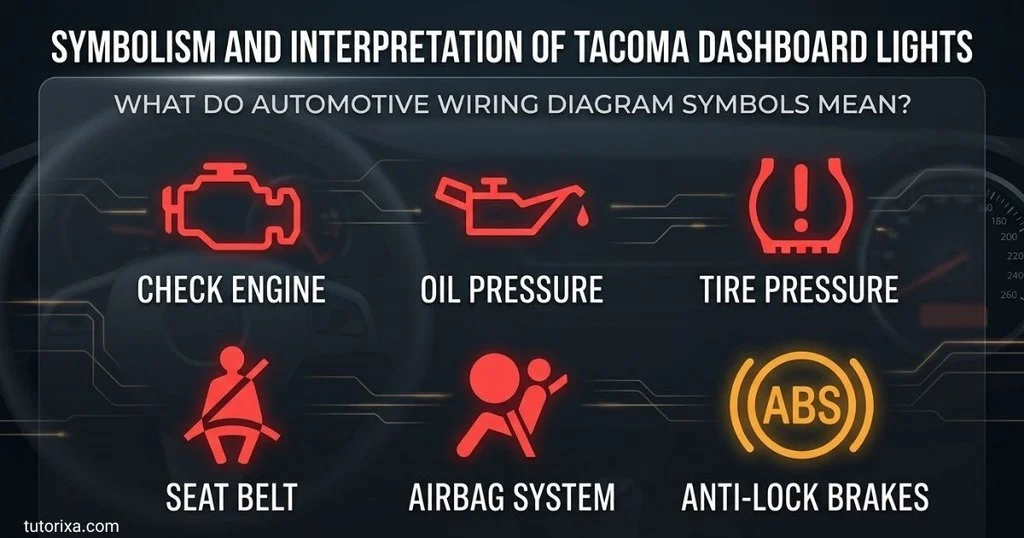
Dashboard symbols are primarily functional rather than cultural symbols. Their colors and shapes help drivers distinguish normal operation from conditions that may require action.
Red Dashboard Lights
Red commonly signals a condition that needs immediate attention. Examples include a low oil pressure warning or a serious brake-system warning.
A red light does not always mean the same thing across every vehicle, so read the accompanying message and owner’s manual. When a red warning concerns a critical system, stopping safely is often the correct response.
Amber or Yellow Dashboard Lights
Amber or yellow generally indicates caution, a detected fault, or a condition that needs checking.
The check engine, ABS, and tire pressure warnings may use amber illumination, depending on the system. Some amber lights permit cautious travel to a service location, while others require a different response.
Amber does not automatically mean it is safe to keep driving. Consider the exact warning, vehicle behavior, and instructions in the manual.
Green and Blue Indicators
Green and blue lights usually indicate that a feature is operating or selected.
Examples include turn signals, certain lighting indicators, and some cruise-control or driving-assistance displays. They are not generally emergency warnings, although you should still understand what feature is active.
Flashing Versus Steady Lights
The way a light behaves can change its meaning. A flashing check engine light, for example, can indicate a more urgent engine fault than a steady light.
Other systems use flashing lights to show normal intervention, such as traction control responding to wheelspin. Always check the specific indicator instead of assuming that flashing universally means danger.
Cultural and Technical Significance of Dashboard Symbols
Dashboard symbols use a visual language shared across the automotive industry. Their purpose is to help drivers recognize vehicle conditions quickly, even when they cannot read a long message while driving.
Oil cans, batteries, thermometers, and tire shapes are recognizable representations of vehicle components. Standardized or widely adopted designs reduce confusion, although manufacturers may use different layouts and details.
Unlike ancient cultural symbols, these icons have specific technical purposes. Their meanings are established through vehicle design, operating instructions, and safety requirements rather than spiritual or religious traditions.
Toyota’s owner’s manuals also distinguish warning lights from informational indicators and explain that some lights illuminate briefly during startup as part of a system check.
Where Toyota Tacoma Dashboard Symbols Appear
You can encounter Tacoma indicators in several parts of the vehicle.
- Instrument cluster: Displays warning lights, gauges, and vehicle-status indicators.
- Multi-information display: Shows messages, driving information, and additional explanations for some warnings.
- Center touchscreen: May display information from navigation, parking assistance, or other vehicle features.
- Headlight and control switches: Use symbols to identify lighting and vehicle functions.
- Overhead console: May contain indicators associated with specific equipment, depending on the truck.
The instrument cluster and multi-information display are the main places to check when a warning appears. A symbol on a touchscreen may describe an infotainment function rather than a mechanical fault.
Common Misconceptions About Toyota Tacoma Dashboard Symbols
Misconception 1: Every warning light means the truck must be towed.
Some warnings indicate a minor or manageable issue, while others require stopping immediately. The correct response depends on the symbol and the vehicle’s behavior.
Misconception 2: A warning disappears, so the problem is fixed.
Some faults occur intermittently. Even if a light goes out, the underlying issue may remain. Follow the manual’s guidance and arrange diagnosis when appropriate.
Misconception 3: The check engine light always means a bad engine.
The warning can relate to emissions controls, sensors, or other engine-management components. It does not identify one particular failed part.
Misconception 4: All dashboard lights should stay off during startup.
Many warning lights illuminate briefly when the ignition is switched on to confirm that the indicators and monitored systems are being checked. A light that never illuminates when expected, or remains on afterward, may require investigation.
Misconception 5: Every Tacoma has the same dashboard symbols.
Available equipment, model year, engine configuration, and trim affect which indicators appear. Some symbols are specific to particular systems.
10 Interesting Facts About Toyota Tacoma Dashboard Symbols
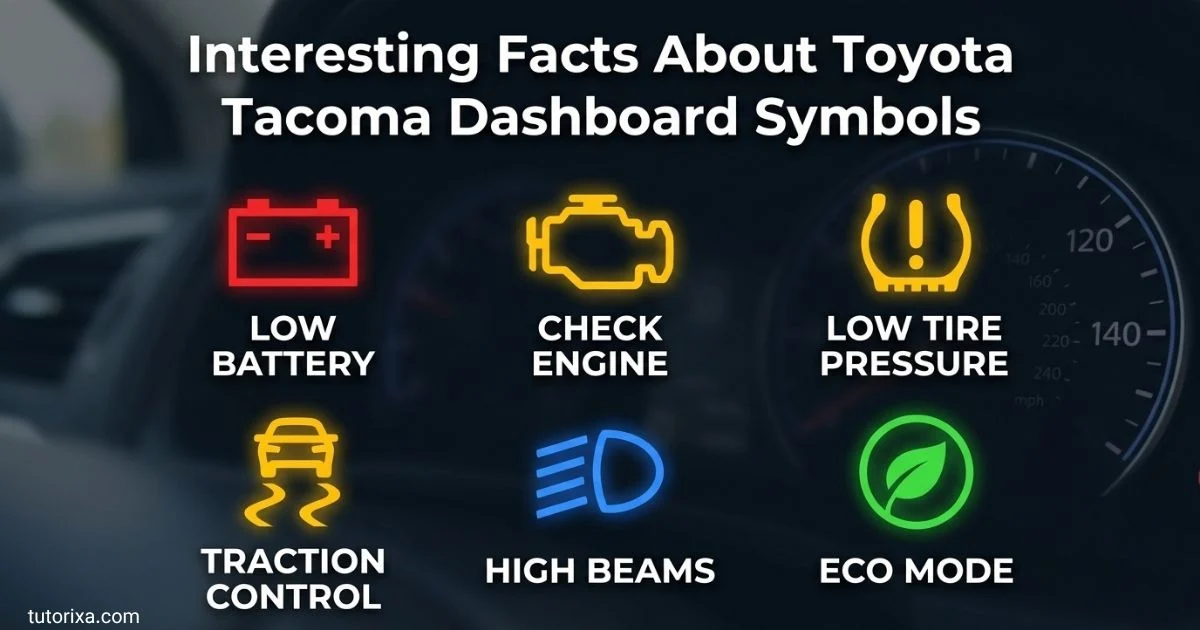
1. Warning lights can illuminate during startup by design. Many indicators briefly light up to show that a system check is taking place.
2. The check engine light does not identify a single component. Diagnostic trouble codes help technicians narrow down the cause.
3. A tire pressure light may indicate a system fault. Low pressure is one possibility, but a malfunction in the monitoring system can also trigger a warning.
4. Traction control can activate without a mechanical failure. A flashing indicator may simply show that the system is responding to reduced traction.
5. The brake warning can have more than one cause. An engaged parking brake is one possibility, while a persistent warning can indicate a brake-system problem.
6. Modern dashboards can display text alongside icons. The message often provides more specific information than the warning symbol alone.
7. Not all warning lights are emergencies. Maintenance reminders and low-fuel indicators require attention, but they differ from critical oil-pressure or overheating warnings.
8. A dashboard symbol can be equipment-dependent. Features such as advanced driver assistance may add indicators that do not appear on every Tacoma.
9. Color alone is not enough to diagnose a problem. The shape, label, flashing behavior, and vehicle symptoms all matter.
10. The owner’s manual is model-specific. Toyota provides digital manuals for individual model years, allowing owners to check the correct indicators and recommended actions.
Related Toyota Tacoma Dashboard Symbols
Some indicators are closely related and can be confused with one another.
| Symbol | Meaning | Difference |
| Check engine | Engine or emissions fault | Does not specifically identify oil pressure or temperature |
| Oil pressure | Possible low oil pressure | Requires immediate attention to protect the engine |
| Coolant temperature | Possible overheating | Relates to engine temperature rather than lubrication |
| ABS | Anti-lock braking system fault | Different from the general brake warning |
| TRAC OFF | Traction control disabled | Indicates system status, not necessarily a mechanical fault |
| TPMS | Tire pressure or monitoring fault | Relates to tire inflation or monitoring equipment |
| SRS airbag | Restraint-system fault | Relates to airbags and associated safety components |
| Maintenance reminder | Scheduled service due | Does not necessarily indicate an active mechanical failure |
| Cruise control | Cruise-control status | Usually indicates an active or available driving feature |
| Master warning | General warning requiring review | Often needs an accompanying display message to identify the issue |
Frequently Asked Questions About Toyota Tacoma Dashboard Symbols
1. What do the warning lights on a Toyota Tacoma mean?
Toyota Tacoma warning lights indicate the status of systems such as the engine, brakes, tires, charging system, airbags, and traction control. Red warnings often require immediate attention, while amber warnings indicate a fault or caution. Green and blue indicators generally show that a feature is active. The exact meaning depends on your model year.
2. Which Toyota Tacoma dashboard warning lights are most serious?
Oil pressure, engine overheating, and serious brake-system warnings deserve immediate attention. If one appears while driving, stop in a safe place and follow the owner’s manual. A flashing check engine light can also indicate a serious fault. Do not continue driving simply because the truck still seems to operate normally.
3. What does the check engine light mean on a Toyota Tacoma?
The check engine light indicates that the engine or emissions control system has detected a problem. Possible causes include sensor faults, emissions-system issues, or other engine-management problems. A diagnostic scan can help identify the cause. If the light flashes or the engine runs roughly, reduce engine load and seek assistance promptly.
4. Why is my Toyota Tacoma tire pressure light on?
The tire pressure warning may mean that one or more tires are underinflated. It can also indicate a fault in the tire pressure monitoring system. Check tire pressures when safe and use the recommended values listed on the driver’s door-jamb placard. If the warning persists despite correct pressures, the system may need inspection.
5. What does the ABS light mean on a Toyota Tacoma?
The ABS light indicates a possible problem with the anti-lock braking system. Conventional braking may remain available, but anti-lock assistance could be unavailable. Drive cautiously and arrange an inspection. If the ABS light appears with a brake warning or you notice reduced braking performance, stop safely and seek professional assistance.
6. Why does my Toyota Tacoma show a traction control light?
A flashing traction-control indicator can mean the system is actively responding to wheelspin or reduced traction. A steady light may indicate that the system is disabled or has detected a fault. Check the accompanying message and the owner’s manual to determine whether the indicator reflects normal operation or requires inspection.
7. What does a red exclamation mark mean on a Toyota Tacoma dashboard?
A red exclamation mark inside a circle commonly relates to the brake system, but its precise meaning depends on the surrounding symbol and model. The parking brake may be engaged, or a brake-system issue may exist. If the warning remains after releasing the parking brake, stop safely and investigate before continuing.
8. Why do Toyota Tacoma dashboard lights turn on when I start the truck?
Many dashboard lights illuminate briefly when you switch on the ignition. This startup check confirms that indicators are functioning and allows monitored systems to report their status. Many lights should go out after the engine starts or after a short period. A light that remains illuminated or never activates when expected may need attention.
9. Do Toyota Tacoma dashboard symbols change by model year?
Yes. Dashboard symbols, instrument-cluster layouts, and available features can vary by model year, trim, engine, and installed equipment. Newer trucks may display more driver-assistance indicators and text messages than older models. Use the owner’s manual for your exact Tacoma rather than relying exclusively on a generic dashboard chart.
10. Where can I find the official Toyota Tacoma dashboard symbol guide?
You can find the appropriate manual through the official Toyota Owners website. Select your Tacoma’s model year and consult the instrument-cluster and warning-light sections. Start with the Toyota Owners Manuals and Warranties page to locate the relevant documentation.
Key Takeaways
- Toyota Tacoma dashboard symbols communicate vehicle status, warnings, and feature activity.
- Red warnings involving oil pressure, overheating, or braking can require immediate action.
- Amber lights indicate caution or a potential fault, but their urgency varies.
- Green and blue indicators generally identify active vehicle functions.
- A flashing light can have a different meaning from a steady light.
- The check engine light requires diagnosis rather than guessing which part has failed.
- Tire pressure, ABS, traction control, and airbag warnings relate to different vehicle systems.
- Dashboard symbols vary by model year, trim, and equipment.
- Read accompanying messages and consult the correct owner’s manual.
- Never ignore a serious warning simply because the truck appears to drive normally.
Conclusion
Understanding Toyota Tacoma dashboard symbols and meanings helps you recognize normal indicators, identify potential faults, and respond appropriately when a warning appears. From the check engine light and oil pressure warning to tire pressure, ABS, and traction control indicators, each symbol provides information about a particular system or vehicle condition.
The most important step is to distinguish informational indicators from warnings that require immediate attention. Stop safely when a critical warning calls for it, avoid guessing at the cause, and consult the owner’s manual for your exact model year.
Whether you drive an older Tacoma or a newer model with a digital instrument cluster, learning the dashboard symbols can help you make better-informed decisions, protect your truck, and travel more confidently.

I’m Freddie Beaumont, a British author with a passion for discovering what symbols communicate without words. I write about their history, meanings, and everyday uses in an accessible way. I believe symbols tell fascinating stories about people, cultures, and ideas, and my work helps readers recognise and understand those stories more clearly.
Books:
- Symbols and Their Hidden Meanings
- Understanding Signs and Symbols
 Ellis Montgomery
 Rowan Whitaker