
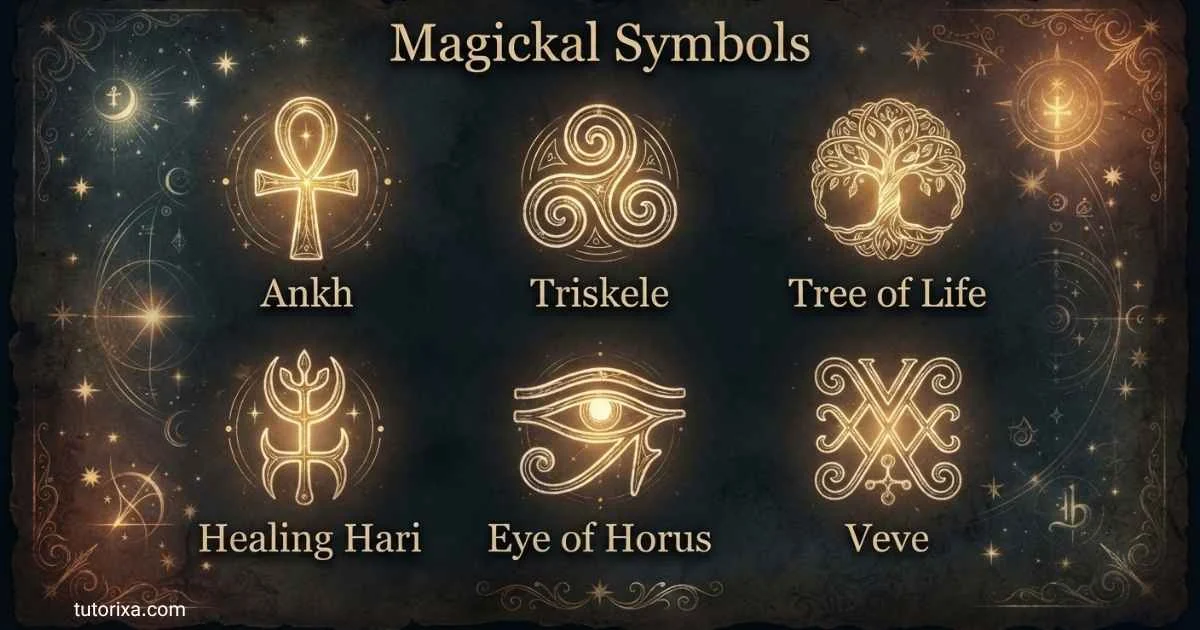
Magickal symbols have fascinated people for centuries, carrying meanings connected to intention, nature, spirituality, and tradition. If you have ever wondered what these mysterious signs mean, you are not alone.
I’ll help you explore the meanings and origins behind some of the most recognized magickal symbols in a simple, practical way. You can discover how different symbols have been used and why their meanings can vary across traditions.
Whether you are completely new to the subject or simply curious about symbolic meanings, this guide gives you a clear place to start. You can explore each symbol at your own pace and discover the stories and ideas behind these fascinating signs.
Quick Meaning of Magickal Symbols
Magickal symbols are visual representations used in magical, mystical, religious, or esoteric traditions to communicate ideas about spiritual forces, nature, protection, transformation, or personal intention. Common examples include pentagrams, planetary signs, alchemical symbols, elemental symbols, magical seals, sigils, and sacred geometric forms.
Magickal Symbols Overview
| Field | Information |
| Symbol Name | Magickal symbols |
| Primary Meaning | Visual representation of spiritual, magical, cosmic, natural, or esoteric concepts |
| Category | Esoteric, magical, religious, mystical, symbolic |
| Origins | Multiple traditions rather than one civilization |
| Major Cultural Contexts | Ancient Mediterranean, Egypt, Mesopotamia, Europe, Islamic world, South Asia, and modern Western esotericism |
| Historical Development | Antiquity through medieval, Renaissance, early modern, and modern periods |
| Common Types | Pentagrams, planetary symbols, elemental signs, alchemical symbols, sigils, magical seals, sacred geometry |
| Modern Usage | Art, jewelry, literature, spiritual movements, historical studies, popular culture |
| Unicode | Some individual symbols have Unicode characters; many historical sigils do not |
| Emoji Equivalent | No universal emoji exists for magickal symbols |
| Related Concepts | Magic, occultism, mysticism, alchemy, astrology, talismans, sigils, sacred geometry |
What Do Magickal Symbols Mean?
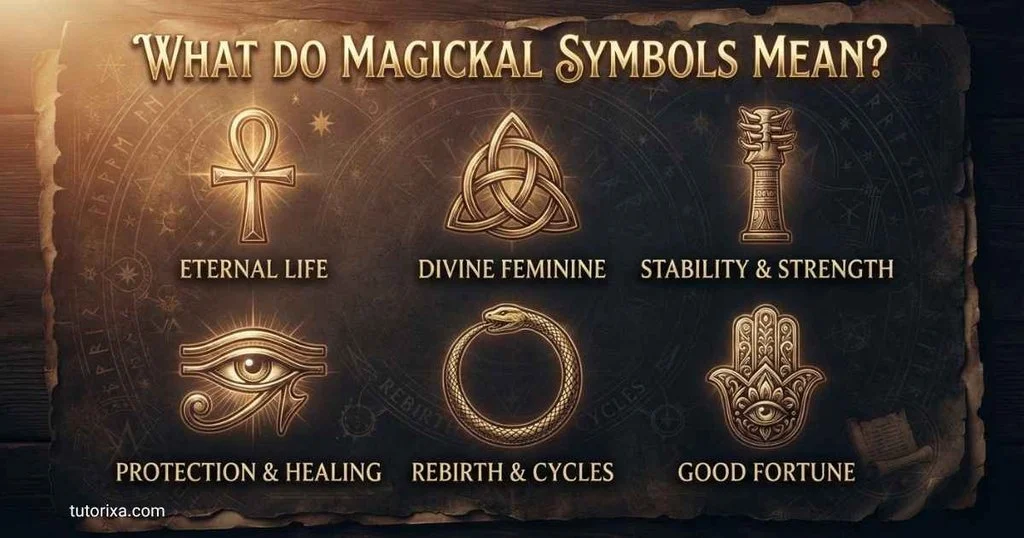
Magickal symbols generally function as compressed visual language. Instead of explaining an entire concept in words, a symbol can represent an element, planet, spiritual principle, deity, intention, or relationship between different forces.
However, there is no single dictionary that determines the meaning of every magical symbol. Historical systems developed independently and often borrowed from one another. A symbol’s meaning therefore needs to be interpreted within its specific tradition.
For example, the pentagram has been used in several historical contexts, including ancient Mesopotamia and Greek thought, and later became important in Western occultism. Its meaning has consequently changed considerably over time.
Similarly, alchemical symbols formed a visual notation system for substances, processes, planets, elements, and philosophical ideas. Different alchemists did not always use identical signs, so historical interpretation requires attention to the particular manuscript or author.
This is an important distinction: a symbol does not automatically possess one fixed meaning simply because it looks familiar.
History and Origin of Magickal Symbols
Magickal symbols do not have one point of origin. Symbolic systems developed across many civilizations as people attempted to represent invisible forces, natural phenomena, divine powers, cosmic relationships, and philosophical concepts.
The history of magic itself is extremely broad. The modern word magic ultimately traces through Greek mageia and magos and is connected with the Old Persian maguš, a term associated with a priestly class. Scholars also emphasize that the category of “magic” has been interpreted very differently across historical periods and cultures.
Ancient Mesopotamia
Some of the oldest written cultures used signs, images, numbers, celestial symbols, and protective objects in religious and ritual contexts. The pentagram, for example, appears in ancient Mesopotamian writing, although its historical meaning should not simply be equated with later European occult interpretations.
Ancient Egypt
Egyptian amulets provide another important example. The tit amulet, associated with the goddess Isis during the New Kingdom, was connected with protection and the afterlife. The Metropolitan Museum of Art notes that Egyptian knots could also be associated with the idea of binding and releasing magical power.
Greek and Hellenistic Traditions
Greek philosophy, astronomy, religious symbolism, and later Hermetic traditions contributed concepts that eventually influenced Western esoteric thought. Geometric figures, planetary associations, elemental ideas, and numerical relationships became particularly important.
Medieval and Renaissance Europe
During the medieval and Renaissance periods, magical manuscripts and grimoires incorporated combinations of letters, names, numbers, geometric diagrams, astrological signs, and seals. Surviving manuscripts demonstrate how complicated these visual systems could become.
For example, the British Library catalogs a seventeenth-century manual of ritual magic containing large magical diagrams, circles, squares, and symbols written in English, Latin, and Hebrew.
Islamic World
The history of magical and talismanic symbolism also extends into Islamic societies. Manuscripts and objects incorporated Arabic writing, numbers, astrological imagery, geometric forms, Qur’anic passages, and other motifs. The British Library preserves manuscripts containing magical formulas, signs, talismans, number and letter tables, and pentagram imagery.
The existence of these objects does not mean that all Muslims or Islamic scholars regarded magical practices in the same way. Religious attitudes toward magic and talismans varied, and historical objects can occupy a complicated boundary between religion, medicine, astrology, folk belief, and occult practice.
Major Types of Magickal Symbols
Magickal symbols can be grouped according to their historical function and tradition.
1. Pentagram
The pentagram is a five-pointed star. It has a long history extending far beyond modern occultism.
In different contexts, it has represented ideas such as harmony, cosmic order, the elements, human beings, or spiritual principles. Later Western occult writers assigned additional meanings to its orientation and surrounding symbolism.
Because the pentagram has been used by many cultures and movements, its meaning should always be interpreted according to context.
2. Planetary Symbols
Planetary symbols connect celestial bodies with mythology, astrology, alchemy, and esoteric traditions.
Common traditional associations include:
- ☉ Sun
- ☽ Moon
- ☿ Mercury
- ♀ Venus
- ♂ Mars
- ♃ Jupiter
- ♄ Saturn
These signs are particularly important in historical astrology and alchemy. In alchemical traditions, planets were also associated with metals, creating a symbolic relationship between the heavens, earthly substances, and philosophical transformation.
3. Elemental Symbols
Western esoteric traditions commonly associate four classical elements with geometric triangles:
- Fire — upward triangle
- Water — downward triangle
- Air — upward triangle with a horizontal line
- Earth — downward triangle with a horizontal line
These symbols belong to a historical philosophical system rather than modern scientific chemistry.
4. Alchemical Symbols
Alchemical symbols represented metals, substances, processes, equipment, and philosophical concepts. Historical alchemy developed from a mixture of Greco-Egyptian, Arabic, and European intellectual traditions.
The symbols were not completely standardized. Different writers could use different forms for similar substances, which is why historical manuscripts must be interpreted within their specific context.
5. Sigils
A sigil is a specially designed symbolic sign. Historically, the word derives from Latin sigillum, meaning a seal.
In medieval magical literature, sigils could represent angels, spirits, or other supernatural beings. In modern magical movements, particularly chaos magic, the term can also refer to a personalized symbolic representation of an intention.
6. Magical Seals
Magical seals are complex diagrams containing geometric forms, letters, numbers, names, or other signs. Their historical functions vary widely.
The Sigillum Dei, for example, is a medieval magical diagram incorporating circles, a pentagram, geometric structures, and sacred names. It belongs to a particular Western esoteric tradition rather than representing all magical symbolism.
7. Sacred Geometry
Circles, triangles, squares, stars, spirals, and other geometric forms have appeared in religious, philosophical, architectural, and esoteric traditions.
Their significance can involve ideas of order, balance, creation, unity, or the relationship between the human and cosmic worlds.
Symbolism and Interpretation
The meaning of a magickal symbol usually develops through association.
A symbol may become meaningful because people repeatedly connect it with a planet, element, deity, natural force, religious concept, number, or ritual tradition.
Positive Symbolism
Depending on context, magical symbols may represent:
- Protection
- Wisdom
- Transformation
- Balance
- Healing
- Spiritual awareness
- Strength
- Purification
- Knowledge
- Cosmic order
- Personal intention
Negative or Protective Symbolism
Some symbols have also been connected with danger, conflict, death, curses, demons, or hostile supernatural forces in particular traditions.
This does not mean that the symbol itself is universally “evil.” Historical symbolism is contextual. A symbol used as a protective emblem in one culture may be interpreted very differently elsewhere.
Psychological Interpretation
Symbols can also have psychological importance without assuming supernatural effects. A person may use a symbol as a reminder of a value, goal, belief, identity, or personal experience.
From this perspective, a symbol works partly through association and attention: its visual form helps a person remember an idea.
Cultural Significance
Magickal symbolism has never belonged exclusively to one culture.
Ancient Egyptian amulets, Mesopotamian signs, Greek philosophical symbolism, European grimoires, Islamic talismans, South Asian sacred diagrams, and modern esoteric movements all demonstrate different approaches to symbolic meaning.
One particularly important lesson is that similar-looking symbols do not necessarily share the same origin.
For example, a geometric circle may appear in religious art, magical diagrams, architecture, astronomy, and mathematics. Its shape alone cannot prove that two traditions influenced one another.
Historical context, written explanations, archaeological evidence, and manuscript traditions are needed before claiming a connection.
Religious or Spiritual Meaning
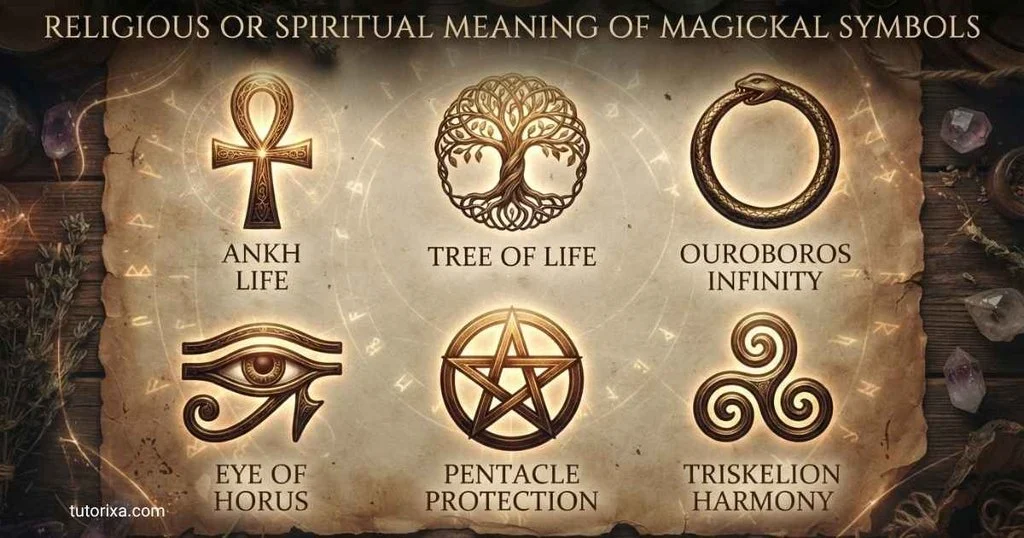
Magickal symbols sometimes overlap with religious symbolism, but magic and religion should not automatically be treated as identical.
Many societies used sacred writing, protective objects, prayers, amulets, diagrams, and religious images in ways that modern categories may find difficult to separate neatly.
Islamic talismanic objects, for instance, historically incorporated Qur’anic inscriptions, divine names, prayers, astrological imagery, and other protective motifs. The Metropolitan Museum documents talismans from different parts of the Islamic world and describes their relationship with protection, guidance, astrology, and religious belief.
Likewise, Christian Europe produced manuscripts containing magical diagrams alongside biblical, Hebrew, Latin, and theological material. These examples show that historical religious culture could contain overlapping categories that modern readers may classify separately.
Scientific or Technical Meaning
Magickal symbols generally do not have established supernatural meanings within modern science.
However, several historical magical symbols have connections to the development of scientific notation.
Alchemy and Chemistry
Before modern chemical notation became standardized, alchemists used symbols for metals, compounds, processes, and equipment. Some symbols were associated with planets; for example, gold was traditionally connected with the Sun and silver with the Moon.
Alchemy eventually diverged from modern chemistry, but its symbolic notation forms part of the history of scientific representation.
Astronomy
Planetary symbols continue to appear in historical astronomical and astrological materials.
Mathematics
Numbers and geometric relationships were important in many esoteric systems. Some historical magical manuscripts combined letters and numbers into diagrams, demonstrating how numerical symbolism could become part of ritual and talismanic traditions.
Where Are Magickal Symbols Used?
Magickal and esoteric symbols can appear in many settings, including:
- Historical manuscripts
- Grimoires
- Museums
- Religious and cultural artifacts
- Alchemical texts
- Astrology
- Esoteric literature
- Jewelry
- Tattoos
- Artwork
- Architecture
- Fiction and fantasy
- Films and television
- Video games
- Modern spiritual movements
- Academic studies of religion
- Historical collections
Their modern appearance in popular culture often differs substantially from their historical meaning.
Common Variations of Magickal Symbols
A single symbol can have numerous visual forms.
Design Variations
Differences may include:
- Number of surrounding circles
- Added letters
- Hebrew or Latin inscriptions
- Planetary signs
- Geometric patterns
- Decorative borders
- Orientation
- Color
- Number sequences
Regional Variations
The same concept may be represented differently in European, Middle Eastern, African, South Asian, or other cultural contexts.
Modern Adaptations
Contemporary artists and spiritual communities often redesign historical symbols. These versions may be aesthetically inspired by older traditions without being historically authentic reproductions.
That distinction matters when identifying an image as “ancient.” A modern design can resemble an old magical emblem without actually being found in historical sources.
Common Misconceptions About Magickal Symbols
Myth 1: Every magical symbol is ancient
Not true. Some symbols have ancient roots, while others were created or substantially redesigned during medieval, Renaissance, nineteenth-century, twentieth-century, or contemporary periods.
Myth 2: Every pentagram means the same thing
The pentagram has had different meanings across history. Its interpretation depends on the culture and period.
Myth 3: A symbol automatically has supernatural power
Historical users may have believed particular symbols had protective or magical effects, but that belief is different from scientifically demonstrating supernatural power.
Myth 4: All occult symbols come from one tradition
They do not. Esoteric symbolism developed through many cultures, religions, philosophies, and historical movements.
Myth 5: A complicated symbol must be more powerful
Complexity does not establish historical importance or supernatural significance. Some simple symbols have extremely long and influential histories.
Myth 6: Similar symbols must have the same origin
Visual similarity alone does not establish historical connection. Independent cultures can develop similar geometric forms.
10 Interesting Facts About Magickal Symbols
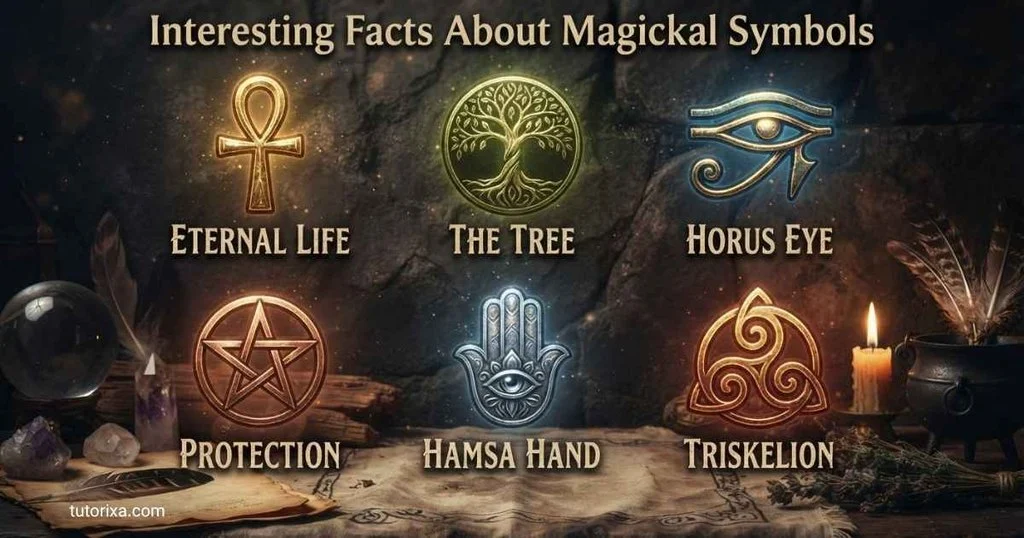
- There is no single universal magical alphabet. Different traditions developed their own signs, scripts, seals, and symbolic systems.
- The pentagram is much older than modern occultism. It appears in ancient Mesopotamian contexts, while later cultures assigned additional meanings to it.
- Alchemy used an extensive symbolic vocabulary. Historical alchemists employed signs for substances, processes, planets, and philosophical concepts.
- Some magical manuscripts combine multiple languages. A seventeenth-century European ritual-magic manuscript cataloged by the British Library contains English, Latin, and Hebrew material alongside diagrams and symbols.
- Magical symbolism existed in Islamic manuscripts too. British Library collections include Arabic manuscripts containing magical diagrams, letter and number tables, and talismanic material.
- Egyptian amulets could have very specific meanings. The tit amulet became associated with Isis and protection in the afterlife during Egypt’s New Kingdom.
- Sigils were historically connected with seals. The word comes from the Latin sigillum, helping explain why medieval magical literature often treated sigils as identifying signs.
- Magical symbolism overlaps with the history of science. Alchemical notation was used for substances and processes before modern chemical notation became dominant.
- A symbol’s meaning can change dramatically. Historical symbols are repeatedly reinterpreted by different religions, scholars, artists, and spiritual movements.
- Museums preserve evidence of symbolic practices. Objects such as amulets and talismans provide physical evidence that symbolic systems were incorporated into personal objects, clothing, weapons, and other artifacts.
Related Magickal Symbols
Ankh
The Egyptian ankh is associated with life and appears extensively in ancient Egyptian art. Its religious and cultural history is distinct from later European occult symbolism.
Eye of Horus
The Eye of Horus is an ancient Egyptian symbol associated with protection and well-being. Its modern use often extends beyond its original Egyptian context.
Triquetra
The triquetra is a three-part knot-like design with complex historical associations. Modern interpretations sometimes connect it with concepts of unity or spirituality.
Ouroboros
The ouroboros depicts a serpent or dragon forming a circle by biting its own tail. It became associated with cycles, renewal, eternity, and transformation in several esoteric traditions.
Hexagram
The six-pointed geometric form has appeared in multiple religious, cultural, and esoteric contexts. Its interpretation depends heavily on historical setting.
Planetary Signs
Planetary symbols connect celestial bodies with astrology, mythology, and historical alchemy.
Alchemical Signs
Alchemical signs represent substances and processes within historical alchemical systems and are among the most recognizable forms of Western esoteric notation.
Frequently Asked Questions
What are magickal symbols?
Magickal symbols are visual signs associated with magical, mystical, esoteric, or spiritual traditions. They can represent elements, planets, deities, intentions, protection, transformation, or philosophical concepts. Examples include pentagrams, planetary signs, elemental symbols, alchemical signs, sigils, and magical seals.
What is the most famous magickal symbol?
The pentagram is among the most recognizable symbols associated with Western magic and occult traditions. However, calling it the single most important magical symbol would be misleading because magical symbolism is culturally diverse. The pentagram also has historical uses that predate modern occultism and meanings unrelated to contemporary magical practice.
What does a pentagram symbolize?
A pentagram has carried different meanings throughout history. In various contexts it has been associated with geometric harmony, cosmic relationships, elements, spiritual ideas, and occult philosophy. Its meaning depends on its orientation, surrounding imagery, cultural setting, and historical period rather than on the five-pointed shape alone.
What is the difference between a sigil and a symbol?
A symbol is a broad category of visual representation, while a sigil is a more specific type of sign traditionally used as a seal or identifying emblem. Historical sigils could represent spiritual beings or names. Modern magical traditions sometimes use the word for personalized symbols representing intentions.
Are magickal symbols ancient?
Some are ancient, but not all. Symbols such as certain Egyptian amulets and ancient geometric signs have very old histories, while many modern occult symbols were developed, modified, or popularized much later. A symbol should therefore be dated individually rather than described as “ancient” simply because it appears mysterious.
Do magickal symbols have the same meaning everywhere?
No. Meaning is strongly influenced by culture, religion, language, historical period, and intended use. A geometric sign can represent one concept in an alchemical manuscript and something completely different in a religious artifact or modern artwork.
Are alchemical symbols magickal symbols?
Alchemical symbols can be considered part of the broader history of esoteric and magical symbolism, but alchemy was not simply “magic.” Historical alchemy included practical experimentation, medicine, philosophy, cosmology, metallurgy, and spiritual ideas. Its symbols represented substances and processes as well as philosophical concepts.
What are planetary symbols?
Planetary symbols are traditional signs representing celestial bodies such as the Sun, Moon, Mercury, Venus, Mars, Jupiter, and Saturn. They became important in astrology and were also incorporated into alchemical systems in which planets were associated with particular metals and qualities.
Are magical symbols scientifically proven to have supernatural powers?
There is no scientific basis for claiming that a symbol itself possesses supernatural powers. Historically, however, people genuinely believed particular symbols, amulets, or talismans could protect or influence events. Studying those beliefs is valuable for understanding religion, history, art, and culture.
Why do magical symbols appear in jewelry and tattoos?
Modern jewelry and tattoos often use symbols because they communicate identity, aesthetics, personal beliefs, historical interests, or cultural associations. Their contemporary meaning may differ significantly from the original meaning of the historical symbol, so context is important when interpreting modern designs.
Key Takeaways
- Magickal symbols are visual representations connected with magical, mystical, esoteric, religious, and philosophical ideas.
- They do not come from one civilization or single magical tradition.
- Common examples include pentagrams, sigils, planetary signs, elemental symbols, alchemical signs, and magical seals.
- A symbol’s meaning changes according to culture, period, tradition, and context.
- Ancient Egypt, Mesopotamia, Greece, medieval Europe, the Islamic world, and other cultures contributed to the wider history of symbolic practices.
- Alchemical symbols form an important bridge between historical esotericism and the history of scientific notation.
- A modern interpretation should not automatically be presented as the historical meaning.
- Similar shapes do not necessarily prove that two cultures shared the same symbolic tradition.
- Historical manuscripts and museum objects provide valuable evidence for understanding how people actually used symbols.
- Magickal symbolism remains influential in art, literature, spirituality, popular culture, jewelry, and contemporary symbolic design.
Conclusion
Magickal symbols are best understood as a vast visual language rather than a single collection of mysterious signs. Their history stretches across civilizations, religions, philosophies, manuscripts, scientific traditions, and artistic movements. A pentagram, planetary sign, alchemical emblem, sigil, or talisman can carry very different meanings depending on the historical community that created and used it.
The most reliable way to understand magickal symbols is to look beyond appearance and ask where a symbol came from, when it was used, what tradition shaped it, and what its original users believed it represented. That approach separates documented history from modern reinterpretation while revealing why these symbols have remained culturally fascinating for centuries.

I’m Ellis Montgomery, a British writer interested in the powerful language of symbols. I explore everything from traditional emblems and cultural signs to contemporary symbols found in modern life. My aim is to explain their meanings clearly while revealing the stories and ideas behind them, making symbolism fascinating and accessible to everyone.
Books:
- The Complete Book of Symbols
- Hidden Messages in Everyday Symbols
 Rowan Whitaker
 Freddie Beaumont