
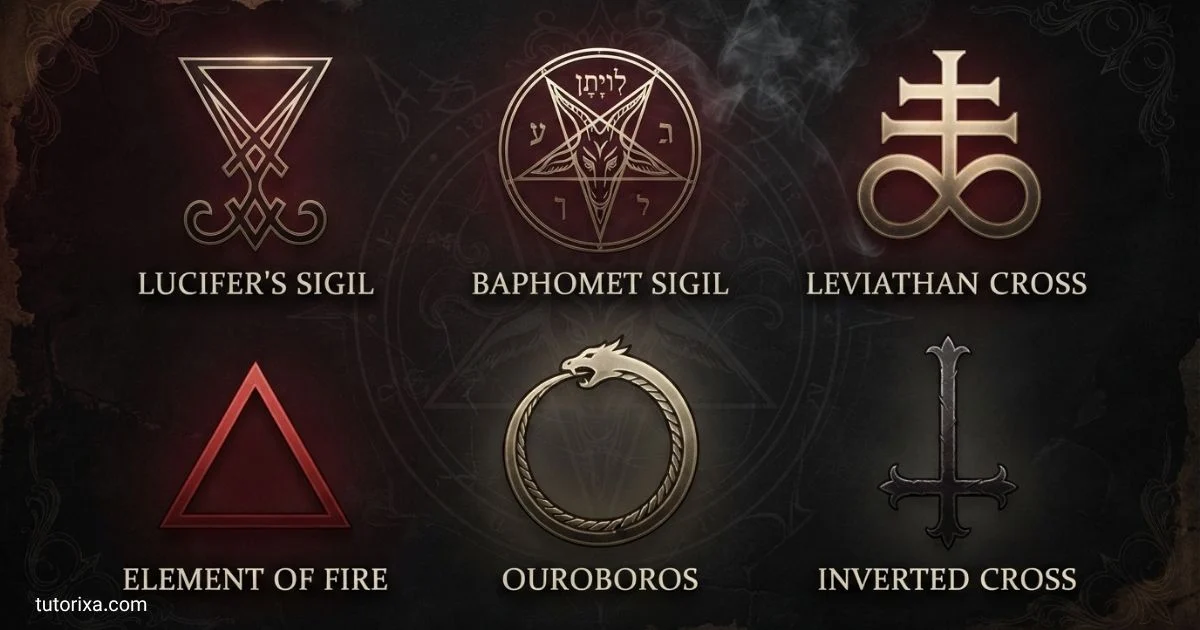
Satanism symbols can look mysterious, powerful, or even confusing at first. I want to help you understand what these symbols actually mean without relying on myths or assumptions.
You may have seen symbols like the Sigil of Baphomet, inverted pentagrams, or other occult imagery and wondered where they came from. In this guide, I’ll explain their meanings, history, and modern uses in a simple way.
Whether you are researching Satanism symbols for knowledge, history, art, or curiosity, you’ll find clear explanations here. By the end, you’ll have a better understanding of what these symbols represent and why they continue to attract attention.
Quick Meaning of Satanism Symbols
Satanism symbols are visual representations connected with Satan, Satanism, rebellion, individualism, occult traditions, or particular Satanist organizations. The Sigil of Baphomet is especially associated with the modern Church of Satan, while the inverted pentagram has broader occult and popular-culture associations. An inverted cross is not exclusively Satanic and has older Christian meanings, particularly its association with Saint Peter.
Satanism Symbols Overview Table
| Symbol Name | Primary Meaning | Historical Background | Modern Association | Category |
| Sigil of Baphomet | Satanic identity, iconoclasm, carnal nature | Modern occult and 20th-century Satanism | Church of Satan | Religious/occult |
| Inverted Pentagram | Often associated with the goat’s head and Satanism | Developed through European occult symbolism | Satanic and occult imagery | Occult |
| Pentagram | Varies widely: protection, harmony, spirituality, occultism | Ancient and medieval uses | Sometimes Satanic when inverted or combined with Baphomet imagery | Religious/occult |
| Baphomet | Modern symbol of occultism and, in some contexts, Satanism | Popularized visually by Éliphas Lévi in the 19th century | Satanic, occult, and secular symbolism | Religious/occult |
| Inverted Cross | In some contexts, anti-Christian symbolism | Older Christian association with Saint Peter | Sometimes used as Satanic imagery | Religious |
| 666 | Number associated with the Beast in Revelation | Early Christian biblical tradition | Popularly linked with Satanism | Religious/cultural |
| Leviathan Cross | Occult and sulfur symbolism | Alchemical and occult traditions | Sometimes used in Satanic contexts | Occult |
| Satanic Organization Logos | Group identity and philosophy | Mostly modern | Used by individual organizations | Organizational |
Because Satanism is not a single tradition with one universally accepted doctrine, there is no universal list of Satanic symbols. Different groups and individuals may assign different meanings to the same image.
What Do Satanism Symbols Mean?
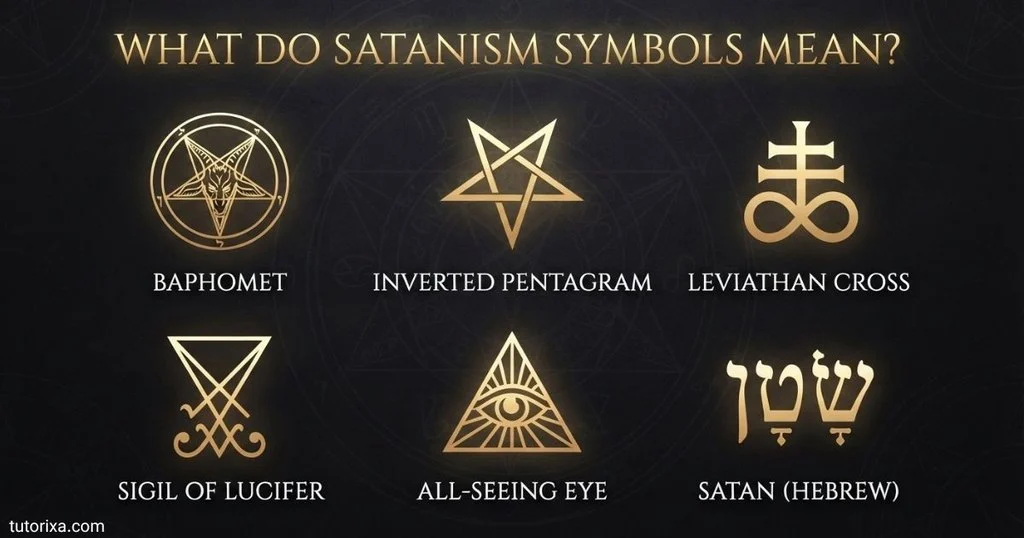
Satanism symbols generally communicate ideas associated with Satan as a figure of opposition, individualism, transgression, skepticism, freedom, or rejection of conventional authority, depending on the tradition.
The meaning becomes clearer when the symbol is connected to a specific movement.
For example, the Church of Satan, founded by Anton Szandor LaVey in 1966, describes Satan as a symbol rather than a supernatural being and identifies the Sigil of Baphomet as its principal symbol. The organization describes its philosophy in terms including individualism, pride, liberty, and a materialistic view of human nature.
Other modern Satanist organizations can use different imagery and emphasize different philosophical ideas. Consequently, seeing a particular symbol does not automatically tell you exactly what the person displaying it believes.
This distinction is important because popular culture often treats all Satanism symbols as interchangeable. Historically, they are not.
History and Origin of Satanism Symbols
The history of Satanism symbols is complicated because many symbols now associated with Satanism predate modern Satanism by centuries or even millennia.
The Pentagram Before Satanism
The five-pointed star, or pentagram, has a long history across different cultures. It has appeared in religious, philosophical, magical, artistic, and decorative contexts.
The symbol has been associated with Pythagorean traditions, medieval Christian symbolism, Jewish mystical traditions, Renaissance occultism, and later Western esotericism. A pentagram therefore cannot automatically be classified as a Satanic symbol.
Historical artwork demonstrates that pentagrams could have completely different meanings from those commonly associated with Satanism today. For example, the Metropolitan Museum of Art notes that pentagrams and hexagrams appeared in sixteenth-century contexts connected with Jewish communities and mystical traditions.
Éliphas Lévi and the Inverted Pentagram
A major turning point came in 19th-century Western occultism.
French occultist Éliphas Lévi discussed the pentagram in Dogme et Rituel de la Haute Magie, published in the 1850s. Lévi described different orientations of the pentagram and associated the inverted form with the goat imagery of the Sabbath. His writings became highly influential in later occult symbolism.
This is one reason the inverted pentagram eventually became connected with Satanic imagery.
However, the modern association should not be projected backward onto every historical pentagram. The five-pointed star existed in many contexts long before modern Satanism.
The Rise of Modern Satanism
Modern organized Satanism emerged much later.
Anton LaVey founded the Church of Satan in 1966. The organization helped establish the visual language now strongly associated with modern Satanism.
The Church of Satan’s adoption and popularization of the Sigil of Baphomet made that image one of the most recognizable Satanism symbols in modern culture. According to the organization’s historical account, its version appeared publicly with The Satanic Mass in 1968 and on The Satanic Bible in 1969.
The Sigil of Baphomet
The Sigil of Baphomet is probably the most recognizable modern symbol associated with Satanism.
It normally consists of:
- An inverted pentagram
- A goat’s head inside the pentagram
- Two concentric circles
- Hebrew letters spelling “Leviathan” around the circles
The modern symbol should not be confused with an ancient artifact from a prehistoric Satanic religion. Its recognizable modern form developed through 19th-century occult imagery and was later adopted and standardized by the Church of Satan.
The Church of Satan describes the symbol as its principal insignia. Its historical explanation connects elements of the design with different streams of occult symbolism, including the pentagram, goat imagery, and Leviathan.
Does Baphomet Mean Satan?
Not exactly.
Baphomet and Satan are historically distinct concepts. The name Baphomet has a complicated medieval and occult history, and its exact origin remains debated.
The famous goat-headed figure associated with Baphomet was illustrated by Éliphas Lévi in the 19th century. Lévi’s image combined human, animal, masculine, feminine, and symbolic elements into a complex occult figure.
Later Satanists adopted Baphomet-related imagery, which strengthened its modern association with Satanism. That does not mean the original historical concept was simply another name for Satan.
The Inverted Pentagram
The inverted pentagram is a five-pointed star with two points directed upward and one point downward.
Its meaning depends heavily on context.
In modern Western occultism, an inverted pentagram can symbolize the inversion or reversal of conventional spiritual symbolism. In Satanic contexts, it can represent the goat’s head and ideas associated with carnality or opposition to traditional religious authority.
The Church of Satan’s historical account specifically connects the inverted pentagram with the goat imagery used in the development of its Sigil of Baphomet.
Yet an inverted pentagram should not automatically be interpreted as proof that someone practices Satanism. Symbols can be used for artistic, musical, theatrical, historical, or personal reasons.
The Pentagram
The pentagram is much older and broader than Satanism.
A five-pointed star has been used to express ideas such as:
- Harmony
- Protection
- Balance
- The five elements
- Human form
- Spiritual concepts
- Mathematical relationships
- Occult knowledge
Its orientation can change its interpretation, but even that is not absolute.
A normal pentagram is therefore not inherently Satanic. The surrounding imagery, cultural setting, organization, and stated meaning matter.
Baphomet and the Goat’s Head
The goat’s head is another important part of modern Satanic symbolism.
Goat imagery has accumulated many different meanings in Western history. It has been associated with fertility, wilderness, animals, pagan imagery, the Greek god Pan, the medieval imagination of the Devil, and occult traditions.
The goat’s head in the Sigil of Baphomet is a modern symbolic construction rather than evidence that an ancient civilization worshiped a figure identical to modern Satanism’s Baphomet.
The Church of Satan’s own historical explanation identifies the goat imagery with the “Goat of Mendes” within its interpretation of the symbol.
The Inverted Cross
The inverted cross is often presented in movies and popular culture as a direct Satanic symbol, but its history is more complicated.
In Christianity, an upside-down cross can be associated with Saint Peter, who according to longstanding Christian tradition was crucified upside down. For that reason, the symbol can have a Christian meaning rather than an anti-Christian one.
The Church of Satan itself acknowledges this distinction, noting that the reversed cross has historically been associated with Saint Peter while also explaining that Satanists may use it in an anti-Christian or personally symbolic context.
Therefore, an inverted cross does not automatically prove Satanic belief.
The Number 666
The number 666 is frequently connected with Satanism, but its primary historical origin is Christian scripture rather than modern Satanism.
In the Book of Revelation, 666 is associated with the “number of the beast.” Over centuries, this passage became central to Christian interpretations of evil, the Antichrist, and apocalyptic symbolism.
Modern Satanic and popular-cultural uses of 666 developed partly because of this association.
The Church of Satan, for example, notes that 666 is not inherently a part of Satanism, although its association with the Antichrist has made it culturally useful within Satanic imagery.
Leviathan Cross
The Leviathan Cross, sometimes called the Satanic cross, is another symbol frequently associated with Satanism.
Its design generally consists of a traditional cross with a double horizontal bar and an infinity-like lower element.
It has connections to alchemical and occult symbolism and is sometimes interpreted as representing sulfur. Modern Satanic culture has helped popularize it, but its history should not be simplified into the claim that it was originally invented by modern Satanists.
As with the pentagram, the surrounding context determines its meaning.
Religious or Spiritual Meaning
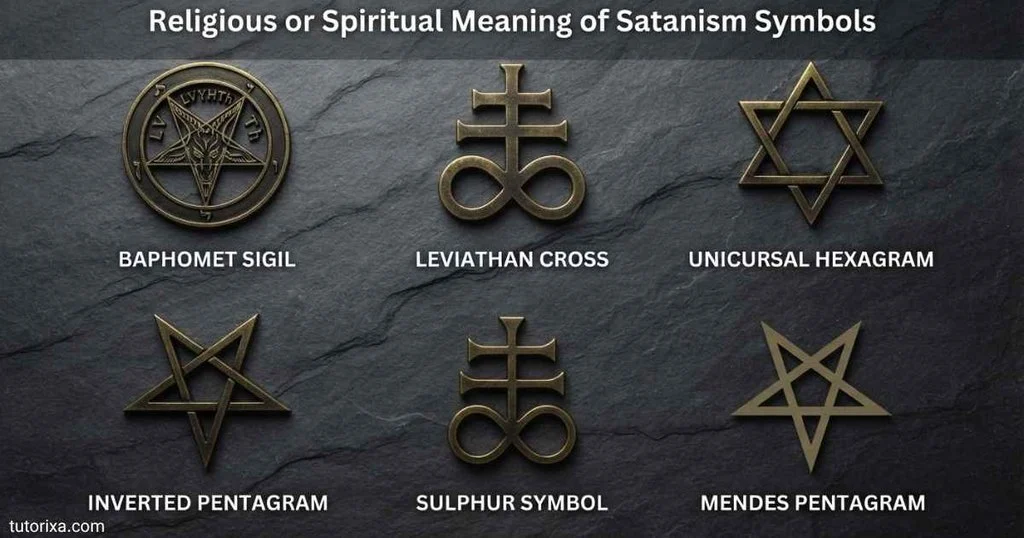
Satanism symbols have religious or philosophical significance for some modern Satanists, but Satanism is not a single unified religion.
One major distinction is between forms of Satanism that treat Satan primarily as a symbolic figure and forms of religious Satanism that understand Satan in a more literal or spiritual manner.
The Church of Satan explicitly describes its Satanism as atheistic and uses Satan as a symbol representing qualities such as pride, liberty, and individualism.
The Satanic Temple is another modern organization with its own philosophy, symbolism, and institutional identity. Its official legal information identifies its logo and Baphomet statue as organizational intellectual property.
This illustrates an important point: a Satanism symbol can communicate the identity of a particular organization without representing every Satanist.
Where Satanism Symbols Are Used
Satanism symbols can appear in many forms of modern culture and historical discussion.
Books and Literature
Occult books, religious studies, horror literature, and works about modern Satanism frequently use pentagrams, Baphomet imagery, devils, serpents, and related designs.
Music and Popular Culture
Heavy metal, rock, horror films, television, video games, and album artwork have frequently used Satanic imagery because these symbols create themes of rebellion, darkness, mystery, or transgression.
Jewelry and Fashion
Pentagrams, goat-head designs, crosses, and occult-inspired motifs can appear on necklaces, rings, artwork, and clothing. Their use does not necessarily indicate a person’s religious beliefs.
Tattoos and Art
Artists sometimes use Satanism symbols to represent rebellion, individualism, mystery, anti-authoritarianism, or interest in occult history.
Organizational Identity
Specific Satanist organizations use distinctive symbols to communicate membership, philosophy, or institutional identity.
Common Variations of Satanism Symbols
Satanism symbols have many visual variations.
The Sigil of Baphomet may differ in:
- Goat-head proportions
- Lettering
- Circle thickness
- Pentagram geometry
- Line weight
- Color
- Decorative details
However, not every variation belongs to the same organization.
The Church of Satan specifically distinguishes its official Sigil of Baphomet from unrelated artistic variations.
Other modern groups may use different Baphomet imagery, logos, or graphic styles. This is why identifying the exact design is important when researching a particular symbol.
Common Misconceptions About Satanism Symbols
Myth 1: Every pentagram is a Satanic symbol
False. Pentagrams have been used in many religious, cultural, magical, mathematical, and decorative contexts.
Myth 2: Baphomet is simply another name for Satan
Not historically. Baphomet has a separate and complicated history. The goat-headed image became especially influential through 19th-century occultism and later Satanic adoption.
Myth 3: An inverted cross always means Satanism
False. The inverted cross has an important Christian association with Saint Peter.
Myth 4: 666 was invented by Satanists
False. Its famous religious association comes from the Book of Revelation.
Myth 5: All Satanists use the same symbols
False. Satanism contains different movements, organizations, and interpretations.
Myth 6: Satanic symbols are always ancient
Many familiar Satanic images are actually modern developments, especially those standardized during the 19th and 20th centuries.
10 Interesting Facts About Satanism Symbols
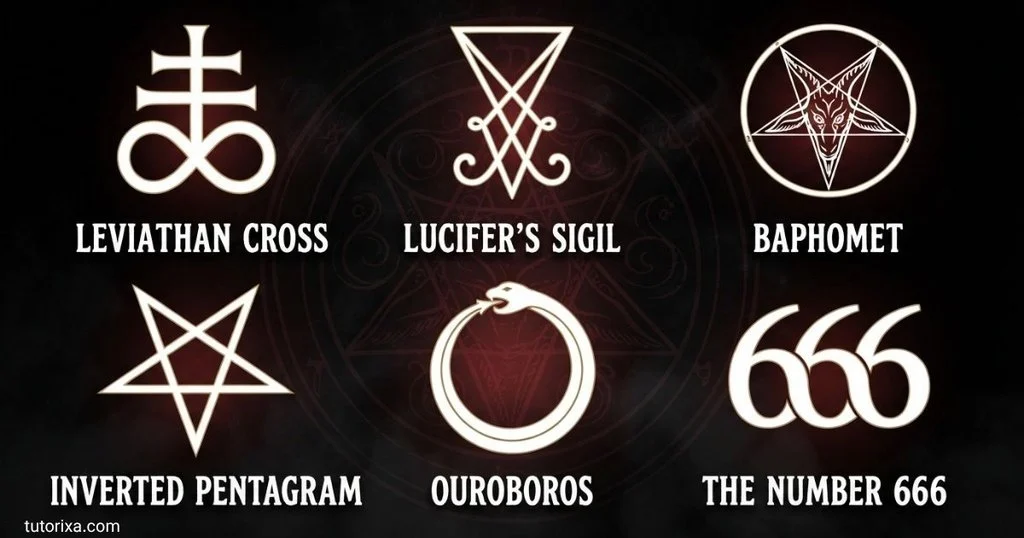
- The Sigil of Baphomet is a modern Satanic emblem. Its recognizable form became strongly associated with the Church of Satan during the late 1960s.
- The pentagram is much older than modern Satanism. It has appeared in multiple cultures and religious traditions with meanings unrelated to Satanism.
- Baphomet has a debated history. The medieval name and the later goat-headed image should not be treated as though they originated from exactly the same historical tradition.
- Éliphas Lévi influenced modern occult symbolism. His 19th-century writings helped establish important associations between pentagram orientation and goat imagery.
- The inverted cross has Christian roots. Its connection with Saint Peter predates its use as an anti-Christian symbol in modern popular culture.
- 666 is a biblical number before it is a Satanic one. Its cultural meaning developed from Christian interpretations of the Book of Revelation.
- A symbol can have multiple meanings simultaneously. A pentagram, for example, can represent very different ideas depending on its culture and historical setting.
- Modern Satanism has organizational symbols. Groups can develop distinctive emblems that communicate their own philosophies and identities.
- Not every Baphomet image is the Church of Satan’s symbol. Artists and other organizations have created different versions over time.
- Symbolism changes with context. The same image can mean religion, rebellion, historical interest, artistic expression, or something personal depending on who uses it and why.
Related Symbols
Several symbols are closely connected with Satanism or the broader history of Western occult imagery.
- Pentagram: A five-pointed star with many historical meanings.
- Inverted pentagram: Particularly associated with modern occult and Satanic imagery.
- Baphomet: A complex occult figure later strongly connected with modern Satanism.
- Sigil of Baphomet: The goat-head pentagram emblem associated especially with the Church of Satan.
- Leviathan Cross: An occult symbol sometimes associated with Satanism and sulfur.
- Inverted cross: A Christian symbol associated with Saint Peter that has also been adopted in anti-Christian imagery.
- 666: The biblical number of the Beast, later adopted into Satanic and popular culture.
- Goat imagery: A recurring motif in European occult, religious, artistic, and Satanic representations.
- Serpent imagery: A symbol with diverse meanings involving knowledge, transformation, danger, healing, and religious mythology.
The key difference is that none of these symbols has one universal meaning outside its context.
Frequently Asked Questions
What is the main symbol of Satanism?
The Sigil of Baphomet is one of the most recognizable symbols associated with modern Satanism, particularly the Church of Satan. It combines an inverted pentagram, goat’s head, concentric circles, and Hebrew lettering. It became strongly established as a Satanic emblem through the Church of Satan’s use of it during the late 1960s.
What does the Satanic pentagram mean?
The inverted pentagram is commonly associated with Satanic and occult symbolism, especially when it contains a goat’s head. Its interpretation developed through Western occult traditions and later modern Satanism. However, pentagrams in general are not inherently Satanic because five-pointed stars have been used across many cultures and religions for different purposes.
Is Baphomet the same as Satan?
No. Baphomet and Satan have different historical backgrounds. The name Baphomet appears in medieval records, while the famous goat-headed Baphomet image was developed by the French occultist Éliphas Lévi in the 19th century. Later Satanists adopted Baphomet imagery, giving it a powerful modern connection with Satanism.
Is an upside-down cross a Satanic symbol?
It can be used as a Satanic or anti-Christian symbol, but it is not exclusively Satanic. Christianity has long associated an inverted cross with Saint Peter, who according to tradition was crucified upside down. Therefore, its meaning depends strongly on historical, religious, and cultural context.
What does 666 mean in Satanism?
The number 666 is popularly associated with Satanism because of its connection with the Beast in the Book of Revelation. Historically, however, 666 is a biblical Christian symbol rather than something invented by Satanism. Some modern Satanists use it because of its established cultural association with the Devil, evil, or religious opposition.
Are all pentagrams Satanic?
No. Pentagrams have existed in many cultures and have represented different concepts, including protection, balance, spirituality, and mystical ideas. The pentagram became particularly associated with Satanism when inverted and combined with goat imagery. Context is essential when interpreting a five-pointed star.
What does the goat represent in Satanic symbolism?
The goat can represent several ideas depending on the tradition, including carnality, nature, rebellion, occultism, and opposition to conventional religious symbolism. In the Sigil of Baphomet, the goat’s head is incorporated into a larger symbolic design rather than functioning as an isolated universal symbol.
Why is Baphomet associated with Satanism?
Baphomet became associated with Satanism because modern Satanists adopted imagery derived from Western occult traditions. Éliphas Lévi’s 19th-century goat-headed figure was particularly influential. The Church of Satan later incorporated a goat, inverted pentagram, and Leviathan lettering into its Sigil of Baphomet.
Are Satanism symbols ancient?
Some components are ancient, but many recognizable modern combinations are not. The pentagram has a long history, while the familiar goat-head pentagram design associated with modern Satanism developed much more recently. This distinction prevents modern meanings from being incorrectly projected onto ancient civilizations.
Do Satanism symbols have the same meaning everywhere?
No. Their meanings vary according to religion, organization, historical period, culture, and personal interpretation. A pentagram used in an ancient or religious context may have nothing to do with Satanism, while the same basic geometric form in a modern Satanic emblem can have a completely different meaning.
Key Takeaways
- Satanism symbols do not have one universal meaning.
- The Sigil of Baphomet is one of the best-known modern Satanic symbols.
- The Church of Satan adopted and popularized its distinctive Baphomet emblem in the late 1960s.
- The pentagram predates modern Satanism and has appeared in many cultures and religious traditions.
- An inverted pentagram became strongly connected with modern occult and Satanic imagery.
- Baphomet is not historically identical to Satan.
- The inverted cross has a Christian connection with Saint Peter and is not inherently Satanic.
- 666 originated in Christian biblical tradition, particularly the Book of Revelation.
- Different Satanist organizations can use different symbols and interpret them differently.
- Symbolism should always be understood through historical context, cultural context, and the identity of the group using it.
Conclusion
Satanism symbols are best understood as a changing visual language rather than a single fixed code. The Sigil of Baphomet, inverted pentagram, goat imagery, Leviathan-related designs, inverted cross, and 666 all carry different histories and cannot accurately be reduced to one meaning.
The most important distinction is between ancient symbols, medieval religious imagery, 19th-century occult developments, and modern Satanist adaptations. Understanding that timeline explains why a symbol such as the pentagram can have meanings that range from protection and spirituality to occultism and modern Satanism.
Ultimately, studying satanism symbols is also a study of how cultures reinterpret images. Symbols acquire new meanings as religions, philosophers, artists, organizations, and popular culture reuse them. Looking at the historical context behind each symbol provides a much more accurate understanding than assuming every dark or inverted image represents the same belief.

I’m Rowan Whitaker, a British writer fascinated by the symbols surrounding us every day. I explore their meanings, origins, cultural significance, and changing interpretations. From ancient marks to modern signs, I enjoy making symbolism easier to understand. My writing helps curious readers discover the hidden messages behind familiar shapes, images, and signs.
Books:
- The Meaning Behind Symbols
- A Modern Guide to Symbolism
 Ellis Montgomery
 Freddie Beaumont