
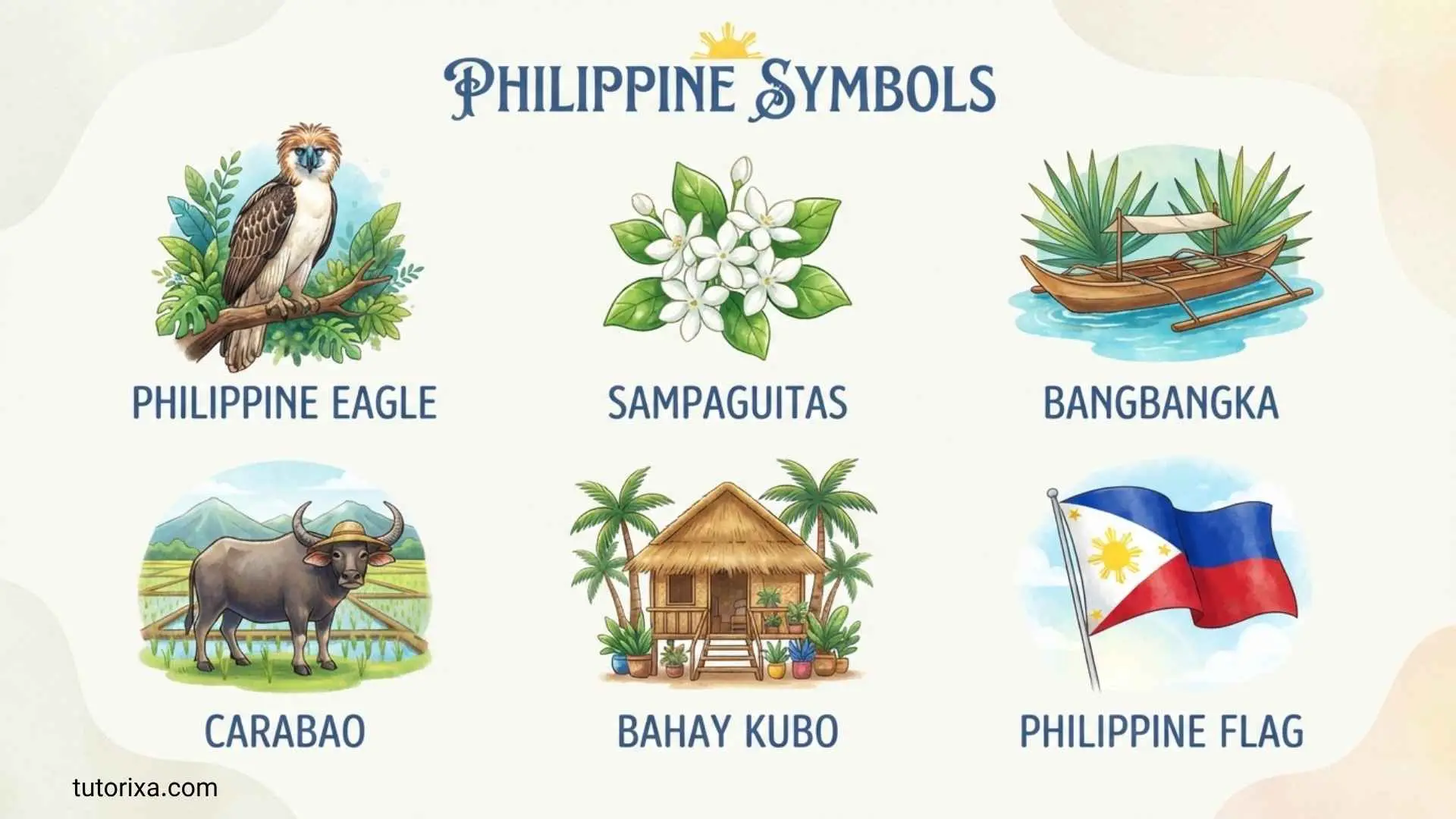
Philippines symbols tell powerful stories about the country’s history, culture, identity, and people. When I explore these symbols, I see more than simple images—they reveal traditions and values passed down through generations.
You may already recognize some famous Philippines symbols, but do you know what they really mean? From national emblems to meaningful cultural symbols, each one has a story worth discovering.
In this guide, I’ll help you understand the most important Philippines symbols, their meanings, origins, and cultural significance in a simple and easy-to-follow way.
Quick Meaning of Philippines Symbols
Philippines symbols are visual, natural, cultural, linguistic, and historical representations associated with the Filipino nation and its identity. Major official symbols include the national flag, national anthem, coat of arms, national motto, Philippine eagle, sampaguita, narra, and arnis. Other widely recognized cultural symbols include the carabao, jeepney, Philippine tarsier, bahay kubo, and Philippine pearl.
Philippines Symbols at a Glance
| Symbol | Primary Meaning | Category | Origin or Recognition | Common Usage |
| Philippine Flag | Sovereignty, unity, independence | National emblem | Philippine national tradition; governed by RA 8491 | Government, schools, celebrations |
| Philippine Sun | Freedom and national identity | Heraldic symbol | Incorporated into the national flag | Flag, coat of arms |
| Three Stars | Luzon, Visayas, Mindanao | National emblem | National flag | Flag, government imagery |
| Eight-Rayed Sun | Historic provinces associated with the struggle against Spain | Historical symbol | National flag tradition | Flag and coat of arms |
| Lupang Hinirang | Patriotism and national identity | National anthem | Music by Julian Felipe | Ceremonies and official events |
| Coat of Arms | State authority and national identity | Heraldry | Philippine heraldic tradition | Official government documents |
| Maka-Diyos, Maka-tao, Makakalikasan at Makabansa | Faith, humanity, environment, country | National motto | RA 8491 | Government and civic contexts |
| Philippine Eagle | Strength, freedom, conservation | National bird | Proclamation No. 615, 1995 | Conservation and national identity |
| Sampaguita | Purity, simplicity, humility | National flower | Proclamation No. 652, 1934 | Garlands, ceremonies, religious settings |
| Narra | Strength and endurance | National tree | Proclamation No. 652, 1934 | Cultural and environmental symbolism |
| Arnis | Filipino martial heritage | National martial art and sport | RA 9850, 2009 | Sports and cultural education |
| Philippine Pearl | Marine heritage and natural wealth | Natural/cultural symbol | Widely recognized national symbol | Jewelry and cultural representation |
| Carabao | Rural life, agriculture, hard work | Cultural symbol | Long-standing Filipino culture | Art, agriculture, education |
The legal status of these symbols is not identical. For example, the flag, anthem, motto, coat of arms, and other heraldic devices are specifically addressed by Republic Act No. 8491, while arnis was declared the national martial art and sport by Republic Act No. 9850.
What Do Philippines Symbols Mean?
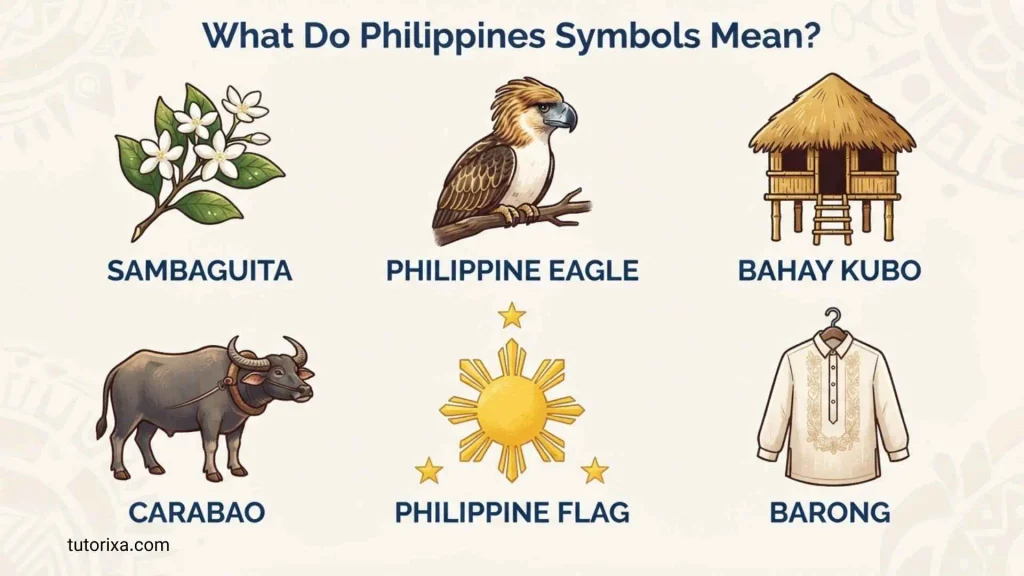
Philippines symbols collectively represent the country’s sovereignty, history, environment, cultural diversity, and national aspirations. No single object can express every part of Filipino identity, so different symbols emphasize different values.
The national flag is perhaps the most recognizable example. Its blue, white, and red fields, golden sun, and three stars form a compact visual statement of Philippine nationhood. Philippine law describes the flag as blue, white, and red with an eight-rayed golden-yellow sun and three five-pointed stars.
The three stars are commonly understood as representing the country’s three major island groups: Luzon, Visayas, and Mindanao. The sun represents the country’s struggle and aspiration for freedom, while its rays have historical associations with the provinces involved in the uprising against Spanish colonial rule.
The white triangle contributes another important idea: equality and national unity. Together, the flag’s elements communicate that the Philippines is a sovereign country whose identity is rooted in a shared historical experience.
History and Origin of Philippine National Symbols
Philippine symbols developed through several historical periods rather than appearing at one moment. Indigenous traditions, Spanish colonial rule, the Philippine Revolution, American colonial administration, the Commonwealth, independence, and the modern republic all influenced the country’s visual and cultural vocabulary.
Before modern national institutions existed, communities across the archipelago already used distinctive patterns, clothing, plants, animals, religious objects, oral traditions, and artistic forms to express identity. The Philippines is culturally diverse, so national symbolism developed alongside many local traditions.
The national flag became particularly important during the revolutionary period. Its design was eventually established as a central emblem of the Philippine Republic and remains one of the country’s strongest expressions of sovereignty.
Modern legal protection and ceremonial rules were consolidated through Republic Act No. 8491, also known as the Flag and Heraldic Code of the Philippines. The law establishes rules concerning the national flag, anthem, motto, coat of arms, Great Seal, and other heraldic devices.
Natural symbols were also formally recognized. Governor-General Frank Murphy declared the sampaguita the national flower and narra the national tree in 1934 through Proclamation No. 652. The Philippine eagle later became the national bird through Proclamation No. 615 in 1995.
Arnis represents a later stage in the formal recognition of Filipino cultural heritage. Republic Act No. 9850 declared arnis the Philippine national martial art and sport in 2009.
Symbolism and Interpretation
The Philippine Flag
The Philippine flag symbolizes national sovereignty, unity, history, and independence. Its design is especially meaningful because it combines geographical representation with historical memory.
The three stars connect the nation to Luzon, Visayas, and Mindanao. The sun gives the design a strong sense of light and national awakening. The colors have specific historical and legal significance rather than simply serving as decorative choices.
An important feature is that the flag can communicate a different political condition depending on how it is displayed. Under Philippine law, the arrangement of the blue and red fields has ceremonial significance during wartime. The Flag and Heraldic Code therefore treats the flag as more than an ordinary national decoration.
The Philippine Eagle
The Philippine eagle symbolizes strength, freedom, uniqueness, and environmental responsibility. Proclamation No. 615 describes the bird as a natural treasure found only in the Philippines and associates it with the uniqueness, strength, power, and love of freedom of the Filipino people.
Its symbolism has therefore expanded beyond patriotism. Today, the eagle also represents the importance of protecting Philippine forests and wildlife.
Sampaguita
The sampaguita, or Jasminum sambac, symbolizes purity, simplicity, humility, and strength. Its small white flowers and pleasant fragrance have made it important in Filipino social and ceremonial life.
Sampaguita garlands are commonly associated with welcoming visitors, honoring people, celebrations, and religious practices. The National Commission for Culture and the Arts describes its use in garlands and offerings and connects it with purity, simplicity, humility, and strength.
Narra
Narra represents durability, strength, and endurance. Its hardwood has long been valued for furniture and construction, giving the tree a practical connection with Filipino life as well as a symbolic one.
Its status as the national tree links environmental heritage with qualities that are often associated with resilience and permanence.
Arnis
Arnis represents Filipino martial heritage, discipline, skill, and cultural continuity. It is also known by names such as Eskrima and Kali in different contexts.
Republic Act No. 9850 formally recognizes arnis as the national martial art and sport. The law describes it as an indigenous Filipino martial art characterized by striking, thrusting, parrying, blocking, locking, and grappling techniques.
Cultural Significance of Philippines Symbols
Philippines symbols are especially meaningful because the country contains many languages, ethnic communities, islands, regional traditions, and historical experiences.
A national symbol therefore does not necessarily replace local identity. Instead, it can provide a shared reference point among different communities.
The three stars on the national flag are a useful example. Luzon, Visayas, and Mindanao contain enormous internal diversity, yet the three-star design presents them as parts of one republic.
Natural symbols work in a similar way. The Philippine eagle connects national identity with endemic wildlife. Narra connects national identity with forests and useful natural resources. Sampaguita connects national identity with everyday cultural practices.
This combination of political, natural, and cultural imagery gives Philippine symbolism unusual breadth.
Religious and Spiritual Meaning
Some Philippine symbols have religious associations, although they should not automatically be classified as exclusively religious symbols.
The sampaguita is an important example. Its flowers may be used as offerings to religious icons and in ceremonies, but the flower is also used for secular welcomes, celebrations, graduations, and public events. Its meaning therefore changes according to context.
The national motto also contains the phrase “Maka-Diyos,” meaning oriented toward or devoted to God. The complete motto is “Maka-Diyos, Maka-tao, Makakalikasan at Makabansa,” expressing values connected with God, humanity, nature, and country. Republic Act No. 8491 establishes this as the national motto.
The motto demonstrates that Philippine national identity includes spiritual values while also emphasizing social responsibility, environmental stewardship, and patriotism.
Where Are Philippines Symbols Used?
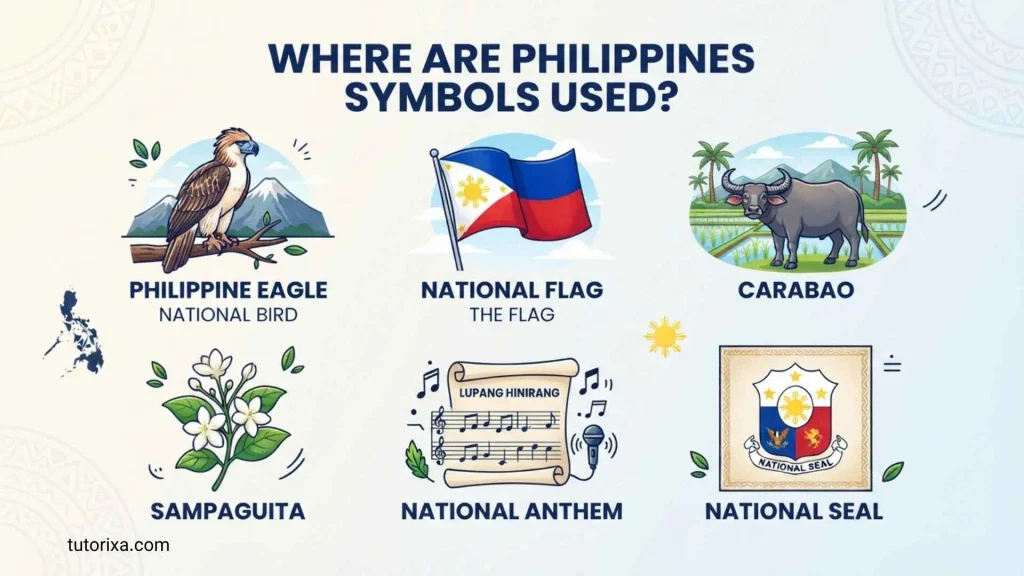
Philippine symbols appear in many areas of public and private life.
Government
The national flag, coat of arms, Great Seal, and official heraldic devices appear in government settings. The coat of arms and Great Seal have specific legal functions, so their use is more restricted than ordinary decorative imagery.
Schools
Students encounter national symbols during flag ceremonies, history lessons, civic education, cultural programs, and national celebrations.
The national anthem, Lupang Hinirang, is officially recognized under Philippine law, and its performance is governed by the Flag and Heraldic Code.
Public Celebrations
National symbols appear during Independence Day, National Flag Day, National Heroes Day, and other civic occasions.
Art and Design
Artists frequently incorporate the Philippine sun, stars, eagle, sampaguita, narra leaves, weaving patterns, indigenous motifs, and regional imagery into paintings, illustrations, architecture, clothing, and graphic design.
Jewelry
Philippine symbols may appear in pendants, pins, bracelets, commemorative pieces, and other jewelry. The Philippine pearl is particularly associated with the country’s marine environment and jewelry traditions.
Literature
Writers use national symbols to explore freedom, colonial history, home, identity, nature, migration, and belonging. The flag, islands, sea, eagle, and native landscape can function as literary symbols even when they are not being used as official emblems.
Common Variations of Philippine Symbols
National symbolism can appear in formal and informal versions.
The Philippine flag, for example, has prescribed proportions and design requirements. Informal artwork may simplify the sun, stars, or colors, but an artistic interpretation is not necessarily an official flag.
The Philippine sun is also reproduced independently in logos, illustrations, educational materials, tattoos, crafts, and cultural designs. Its appearance may vary significantly outside official heraldic contexts.
Regional symbolism is even more diverse. Provincial and municipal seals may contain mountains, rivers, agricultural products, animals, historical structures, and indigenous motifs representing local characteristics. Philippine heraldic rules specifically recognize the role of geographical, industrial, and historical characteristics in local heraldry.
Common Misconceptions About Philippines Symbols
Is everything commonly called a national symbol officially recognized?
No. This is one of the most important distinctions.
People often describe the carabao, mango, anahaw, tarsier, jeepney, bahay kubo, and other objects as “national symbols.” They can be powerful cultural symbols, but being widely associated with Filipino identity is not necessarily the same as having a formal legal designation.
Is the carabao officially the national animal?
The carabao is deeply associated with Philippine agriculture and rural life, and the government has established institutions and laws dedicated to its propagation and promotion. However, that does not automatically mean it has the same formal national-symbol status as the Philippine eagle or sampaguita.
Are the three stars simply three islands?
No. The three stars represent Luzon, Visayas, and Mindanao, the country’s three major island groups. Each group contains many islands and diverse communities.
Is the Philippine eagle the same as the American bald eagle?
No. The Philippine eagle is a distinct species endemic to the Philippines. It became the country’s national bird in 1995.
Does every symbolic meaning have a legal definition?
No. Some meanings are explicitly stated in laws or proclamations, while others develop through historical use, cultural interpretation, literature, art, and public tradition.
10 Interesting Facts About Philippines Symbols
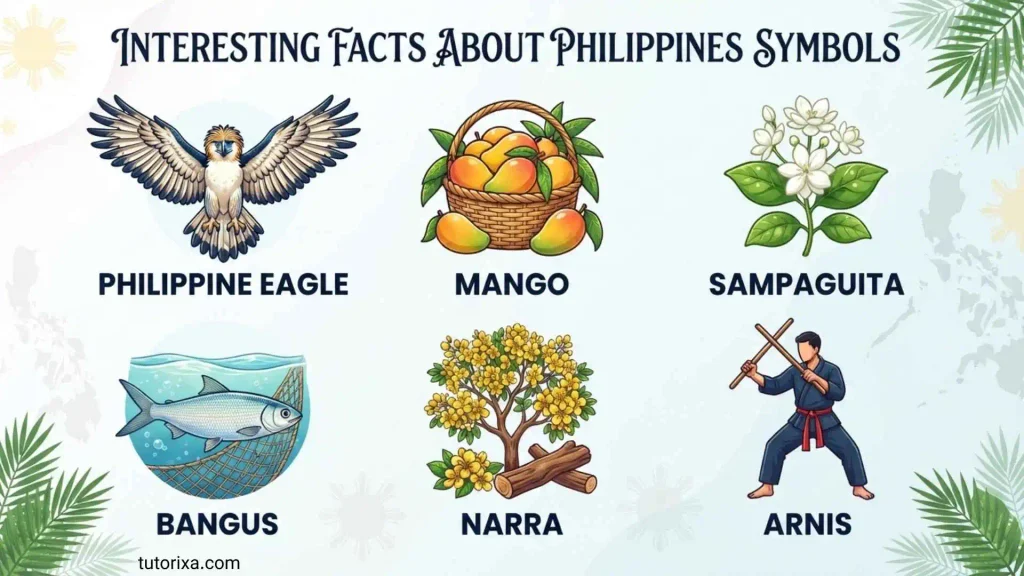
- The national flag contains three stars. They represent Luzon, Visayas, and Mindanao, making geography part of the country’s most recognizable national emblem.
- The flag has an eight-rayed sun. The eight principal rays have historical associations with the provinces involved in the early revolutionary struggle against Spanish rule.
- The Philippine eagle is endemic. It naturally occurs only in the Philippines, which makes its national symbolism closely connected to biodiversity and conservation.
- Sampaguita is not originally unique to the Philippines. Jasminum sambac occurs naturally in South and Southeast Asia, yet it developed a distinctive cultural role in the Philippines.
- Narra has practical as well as symbolic importance. Its durable wood has historically been used for furniture and construction, giving the national tree a direct connection to everyday material culture.
- Arnis has several regional names. Republic Act No. 9850 identifies names including Eskrima and Kali and notes other regional terminology, showing the diversity surrounding the martial art.
- The national motto has four themes. It connects spirituality, humanity, environmental responsibility, and patriotism through the phrases Maka-Diyos, Maka-tao, Makakalikasan, and Makabansa.
- The national anthem has a legal title. It is officially called Lupang Hinirang, and its musical arrangement and composition are attributed to Julian Felipe under the Flag and Heraldic Code.
- Local seals can tell regional stories. Philippine local heraldry may incorporate geographical, industrial, and historical features that distinguish one province or city from another.
- Philippine symbolism combines living and nonliving elements. Flowers, trees, birds, words, music, colors, flags, and heraldic designs can all participate in national identity rather than relying on a single type of symbol.
Related Philippine Symbols
Philippine Carabao
The carabao is strongly associated with agriculture, rural labor, endurance, and farming communities. It has major cultural importance, although its popular status should not be confused with the formally proclaimed national bird or national flower.
Philippine Tarsier
The Philippine tarsier is an iconic native animal associated particularly with biodiversity in the central Philippines. Its cultural importance comes largely from its distinctive appearance and conservation value.
Jeepney
The jeepney has become one of the most recognizable representations of Philippine urban transportation and creative design. Its colorful decoration and practical history have given it strong cultural symbolism.
Bahay Kubo
The bahay kubo, or traditional nipa hut, is commonly associated with rural life, community, simplicity, and traditional Philippine architecture.
Philippine Pearl
The pearl is closely associated with the country’s extensive marine environment and has an important place in Philippine jewelry and natural heritage.
Anahaw
The anahaw palm is widely recognized in Philippine cultural imagery and is often associated with tropical landscapes, traditional materials, and local craftsmanship.
Philippine Sun
The golden sun connects the flag and national coat of arms and represents an important part of Philippine revolutionary and national symbolism.
Frequently Asked Questions
What are the main symbols of the Philippines?
The main official national symbols include the Philippine flag, national anthem, national motto, national coat of arms, Great Seal, Philippine eagle, sampaguita, narra, and arnis. Other objects such as the carabao, jeepney, tarsier, bahay kubo, pearl, and anahaw are widely recognized cultural symbols, although their legal status differs.
What do the three stars on the Philippine flag represent?
The three stars represent the three major island groups of the Philippines: Luzon, Visayas, and Mindanao. Their inclusion emphasizes national unity across a geographically scattered archipelago. They are one of the most recognizable elements of the national flag and help distinguish Philippine symbolism from other national flags.
What does the Philippine sun symbolize?
The Philippine sun is associated with freedom, national awakening, and the country’s revolutionary history. Its eight principal rays have historical associations with the provinces involved in the early uprising against Spanish colonial rule. The sun appears prominently on both the national flag and the national coat of arms.
What is the national flower of the Philippines?
The national flower of the Philippines is the sampaguita, scientifically known as Jasminum sambac. It was declared the national flower in 1934. Its white, fragrant flowers are associated with purity, simplicity, humility, and strength and are used in garlands, welcomes, ceremonies, and religious settings.
What is the national tree of the Philippines?
The narra, scientifically known as Pterocarpus indicus, is the national tree of the Philippines. It was declared national tree alongside the sampaguita in 1934. Narra is valued for durable wood and has become associated with strength, endurance, and the country’s natural heritage.
What is the national bird of the Philippines?
The Philippine eagle (Pithecophaga jefferyi) is the national bird. It was officially proclaimed in 1995 because of its uniqueness, strength, power, freedom-associated symbolism, and importance to Philippine wildlife conservation. Its national status also highlights the need to protect its forest habitat.
What is the national sport of the Philippines?
Arnis is officially the Philippines’ national martial art and sport under Republic Act No. 9850, enacted in 2009. It is also associated with names such as Eskrima and Kali. The law recognizes it as an indigenous Filipino martial art and establishes its national status.
What does the Philippine national motto mean?
The national motto is “Maka-Diyos, Maka-tao, Makakalikasan at Makabansa.” Its four parts express values connected with God, humanity, nature, and country. The motto presents national identity as more than patriotism alone by linking civic responsibility with spiritual, social, and environmental values.
Why are Philippine symbols important?
Philippine symbols preserve and communicate shared memories, values, and identity. They connect citizens with the country’s geography, revolutionary history, biodiversity, cultural traditions, and national institutions. They are particularly important in a country with many islands, languages, ethnic communities, and regional traditions because they provide common national references without eliminating local identities.
Are all Philippine cultural symbols officially recognized?
No. This distinction is essential. Some symbols have clear legal or governmental recognition, while others are widely accepted cultural representations. For example, the Philippine eagle has a formal proclamation as the national bird, while the jeepney is culturally iconic without being equivalent to a legally designated national symbol. Treating every popular symbol as legally official can create historical inaccuracies.
Key Takeaways
- Philippines symbols express national identity, history, culture, nature, and civic values.
- The Philippine flag is one of the country’s most important national emblems.
- The three stars represent Luzon, Visayas, and Mindanao.
- The Philippine sun is strongly connected with freedom and revolutionary history.
- Lupang Hinirang is the national anthem.
- Maka-Diyos, Maka-tao, Makakalikasan at Makabansa is the national motto.
- The Philippine eagle is the national bird and a major conservation symbol.
- Sampaguita is the national flower.
- Narra is the national tree.
- Arnis is the national martial art and sport.
- The carabao, jeepney, tarsier, bahay kubo, pearl, and anahaw are important cultural symbols, but their formal status differs.
- Not every commonly described “national symbol” has been officially designated by law.
- Philippine symbolism reflects the country’s geographic diversity and layered history.
Conclusion
The meaning of Philippines symbols extends far beyond recognizable pictures and objects. The flag represents sovereignty and shared history; the three stars connect the nation to Luzon, Visayas, and Mindanao; the eagle expresses strength and environmental responsibility; the sampaguita and narra connect national identity with nature; and arnis preserves an indigenous martial tradition.
Together, these symbols show how Filipino identity has developed through geography, history, culture, nature, spirituality, and the pursuit of national independence. They also demonstrate why it is important to distinguish official national symbols from popular cultural icons. Each has value, but each tells a slightly different story.
Understanding these symbols means understanding the Philippines itself: a diverse archipelago whose national identity is expressed through living traditions, historical memory, natural heritage, artistic creativity, and a continuing sense of unity.

I’m Freddie Beaumont, a British author with a passion for discovering what symbols communicate without words. I write about their history, meanings, and everyday uses in an accessible way. I believe symbols tell fascinating stories about people, cultures, and ideas, and my work helps readers recognise and understand those stories more clearly.
Books:
- Symbols and Their Hidden Meanings
- Understanding Signs and Symbols
 Ellis Montgomery
 Rowan Whitaker