
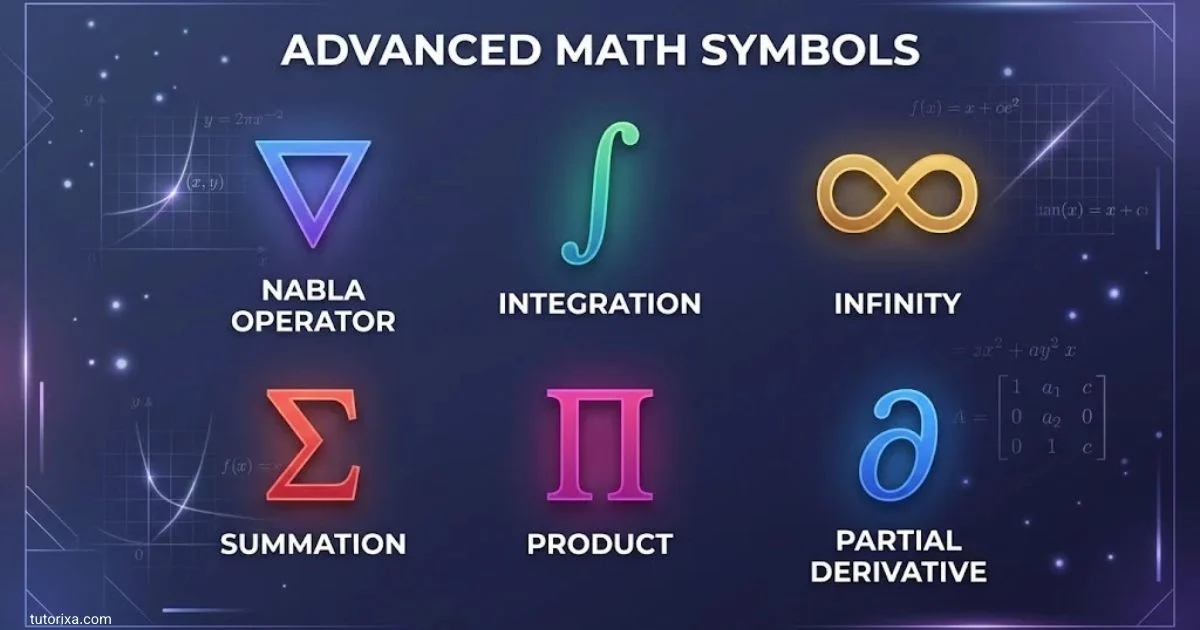
Advanced math symbols help express complex ideas in algebra, calculus, geometry, statistics, and other branches of mathematics. They make equations shorter, show relationships between numbers, and help mathematicians explain problems clearly. Learning these symbols makes advanced mathematical concepts easier to understand.
If you are looking for advanced math symbols to copy and paste, this guide includes commonly used characters, their names, meanings, and practical examples. You will find symbols such as ∑, ∫, ∂, ∇, ∞, ∈, and ∀, along with explanations of how they work in mathematical expressions.
You will also discover the symbols used in algebra and calculus, explore the origins of selected mathematical notation, and find examples that show how different characters are used. Whether you are studying mathematics, preparing notes, writing equations, or creating educational content, this collection will help you identify and use the right symbols.
Advanced Math Symbols And Meanings
Advanced mathematical notation can look complicated at first, but most symbols have a specific purpose. Some represent operations, others describe relationships between values, and some express ideas such as infinity, limits, or changes in functions.
Here are useful advanced math symbols and their common meanings.
| Symbol | Name | Meaning |
| ∑ | Summation | Adds a sequence of values |
| ∏ | Product notation | Multiplies a sequence of values |
| ∫ | Integral | Represents integration |
| ∬ | Double integral | Integrates over a two-dimensional region |
| ∭ | Triple integral | Integrates over a three-dimensional region |
| ∂ | Partial derivative | Represents a derivative with respect to one variable |
| ∇ | Nabla or del operator | Used for gradient, divergence, and curl |
| ∞ | Infinity | Represents an unbounded quantity or infinite process |
| ∝ | Proportional to | Shows proportional relationships |
| ≈ | Approximately equal to | Indicates an approximate value |
| ≡ | Identically equal to or equivalent to | Depends on mathematical context |
| ≠ | Not equal to | Shows that two values differ |
| ≤ | Less than or equal to | Represents a value that is smaller or equal |
| ≥ | Greater than or equal to | Represents a value that is larger or equal |
| ∈ | Element of | Shows that an object belongs to a set |
| ∉ | Not an element of | Shows that an object does not belong to a set |
| ⊂ | Subset of | Often indicates that one set is contained in another |
| ⊆ | Subset of or equal to | Includes the possibility of equal sets |
| ∪ | Union | Combines elements of sets |
| ∩ | Intersection | Identifies shared elements of sets |
| ∀ | For all | Applies to every element in a domain |
| ∃ | There exists | Indicates that at least one object satisfies a condition |
| ∴ | Therefore | Introduces a conclusion |
| ∵ | Because | Introduces a reason |
| ⊥ | Perpendicular to | Indicates perpendicularity in geometry |
| ∥ | Parallel to | Indicates parallel lines or objects |
Copy-and-paste symbols: ∑ ∏ ∫ ∬ ∭ ∂ ∇ ∞ ∝ ≈ ≡ ≠ ≤ ≥ ∈ ∉ ⊂ ⊆ ∪ ∩ ∀ ∃ ∴ ∵ ⊥ ∥
The meaning of a symbol sometimes depends on the subject. For example, ≡ can indicate an identity, congruence, or equivalence relation. Similarly, ⊂ is used differently across mathematical conventions, so check how a textbook or course defines it.
Mathematical Symbols With Names
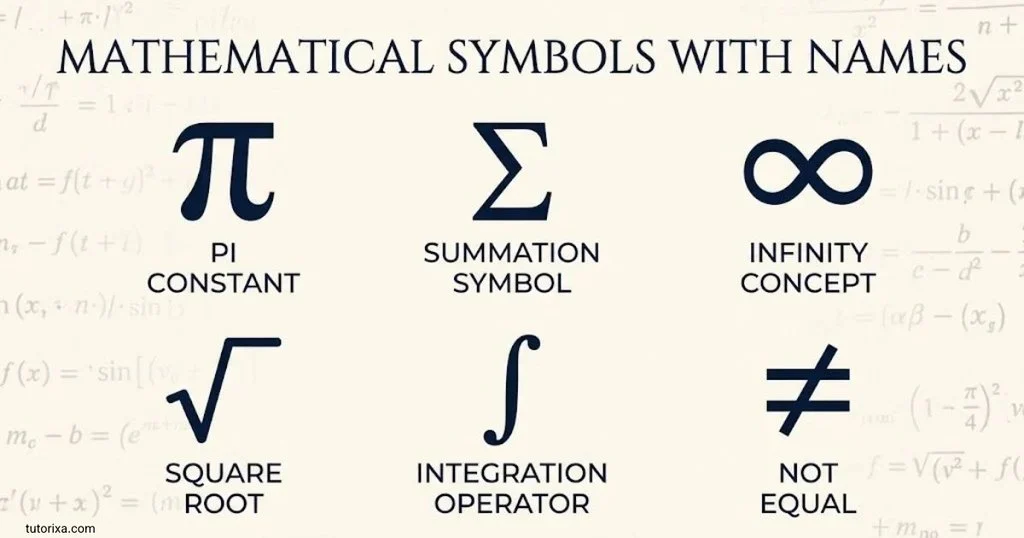
Knowing the names of mathematical symbols helps you read equations, search for specific characters, and communicate mathematical ideas accurately. The following collection includes common advanced symbols alongside their names and Unicode code points.
| Symbol | Mathematical name | Unicode code point |
| ∑ | N-ary summation | U+2211 |
| ∏ | N-ary product | U+220F |
| √ | Square root | U+221A |
| ∛ | Cube root | U+221B |
| ∜ | Fourth root | U+221C |
| ∫ | Integral | U+222B |
| ∬ | Double integral | U+222C |
| ∮ | Contour integral | U+222E |
| ∂ | Partial differential | U+2202 |
| ∇ | Nabla | U+2207 |
| ∞ | Infinity | U+221E |
| ∝ | Proportional to | U+221D |
| ∴ | Therefore | U+2234 |
| ∵ | Because | U+2235 |
| ∀ | For all | U+2200 |
| ∃ | There exists | U+2203 |
| ∅ | Empty set | U+2205 |
| ∈ | Element of | U+2208 |
| ∉ | Not an element of | U+2209 |
| ∩ | Intersection | U+2229 |
| ∪ | Union | U+222A |
| ∧ | Logical AND | U+2227 |
| ∨ | Logical OR | U+2228 |
| ⊕ | Circled plus | U+2295 |
| ⊗ | Circled times | U+2297 |
| ≠ | Not equal to | U+2260 |
| ≈ | Almost equal to | U+2248 |
| ≅ | Approximately equal to or congruent to | U+2245 |
| ≤ | Less than or equal to | U+2264 |
| ≥ | Greater than or equal to | U+2265 |
Note: Unicode code points identify individual characters. They do not necessarily determine how a character looks in every font or application.
Copy-And-Paste Advanced Math Symbols
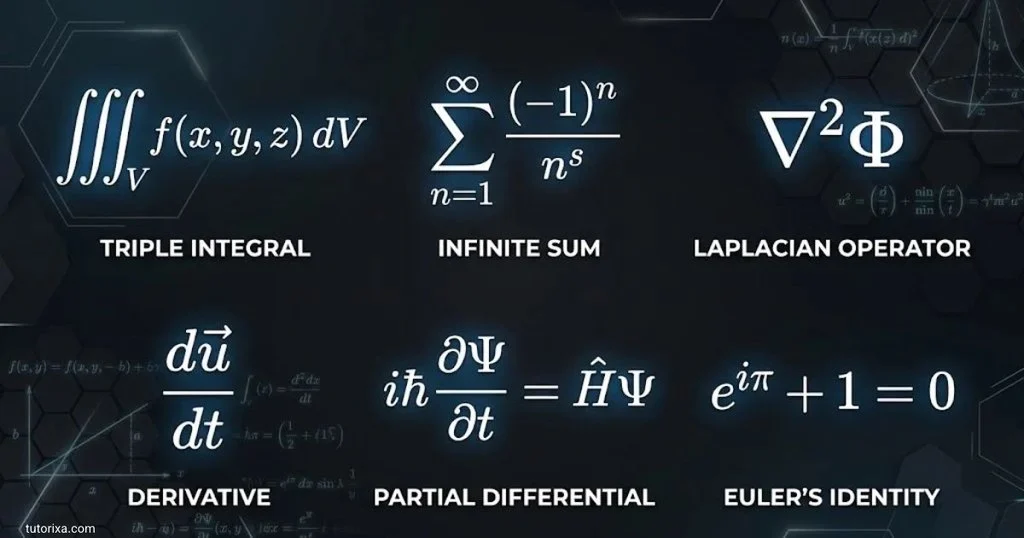
You can copy these symbols directly into notes, documents, messages, or supported equation editors.
- Calculus: ∫ ∬ ∭ ∮ ∂ ∇
- Algebra: √ ∛ ∜ ∑ ∏ ∝
- Logic: ∀ ∃ ∧ ∨ ¬ ⇒ ⇔
- Set theory: ∈ ∉ ∅ ∪ ∩ ⊆ ⊇
- Comparison: ≠ ≈ ≡ ≤ ≥ ≪ ≫
- Geometry: ∠ ⊥ ∥ △ ∴ ∵
- Infinity and limits: ∞ lim → ↦
- Complex numbers: ℂ ℑ ℜ
Some symbols, such as ℂ, ℑ, and ℜ, are specialized letter-like mathematical characters rather than ordinary operators. They are useful in advanced equations and technical writing.
Advanced Math Symbols With Examples
Understanding a symbol is easier when you see it in an equation. The examples below show how common advanced symbols work in practice.
| Symbol | Example | Explanation |
| ∑ | k=14k=10 | Adds 1 + 2 + 3 + 4 |
| ∏ | k=14k=24 | Multiplies 1 × 2 × 3 × 4 |
| ∫ | 02xdx=2 | Calculates a definite integral |
| ∂ | fx | Measures change with respect to x while other independent variables are held fixed |
| ∇ | f | Represents the gradient of a scalar function |
| ∞ | x1x=0 | Describes a limit as x grows without bound |
| ∝ | yx | Indicates direct proportionality |
| ≈ | 3.14159 | Gives an approximate value |
| ∈ | 3{1,2,3} | Shows that 3 belongs to the set |
| ∀ | \(\forall x\in\mathbb R,\ x^2\geq0\) | States that every real number has a nonnegative square |
| ∃ | \(\exists x\in\mathbb R,\ x^2=4\) | States that at least one real number satisfies the equation |
| ⇒ | x>2x>0 | Shows that the first condition implies the second |
| ⇔ | x=2x-2=0 | Shows logical equivalence |
| ∩ | {1,2,3}{2,3,4}={2,3} | Finds the shared elements |
| ∪ | {1,2}{2,3}={1,2,3} | Combines the elements of both sets |
How To Read Advanced Equations
Consider this expression:
k=15k2=55
Read it as the sum of the squares of the integers from 1 through 5. The expression expands to:
12+22+32+42+52=55
The lower limit k=1 tells you where to start, and the upper limit 5 tells you where to stop.
Now consider a calculus example:
ddx(x3)=3×2
The symbol d/dx indicates differentiation with respect to x. The result, 3×2, describes the rate at which x3 changes as x changes.
These examples show why mathematical notation is useful: a small symbol can communicate an operation or relationship that would otherwise require several words.
20 Mathematical Symbols With Their Origin, Meaning, And Use
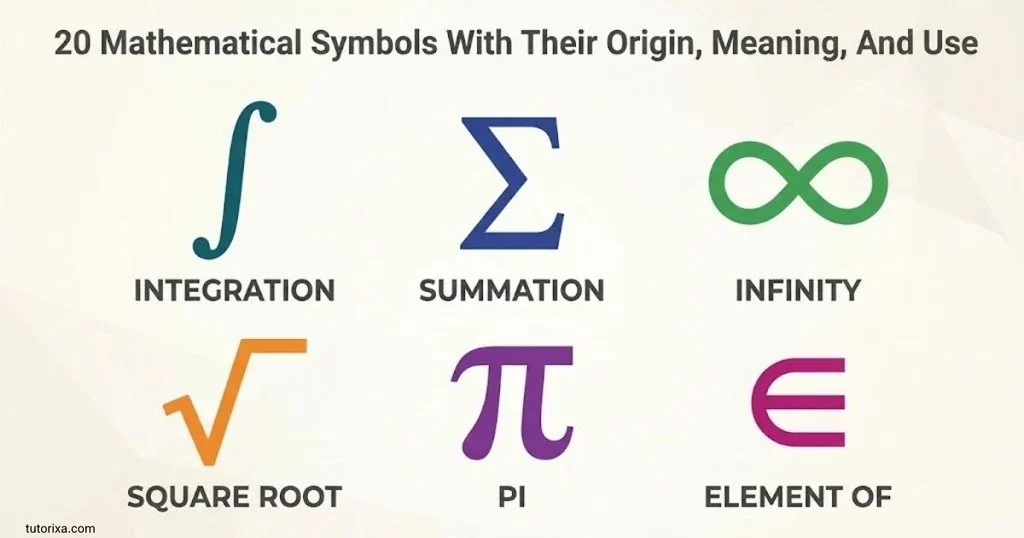
Mathematical notation developed over centuries as scholars searched for shorter, clearer ways to express calculations and relationships. Some symbols have well-documented histories, while others evolved through different conventions.
The table below explains 20 important symbols, their meanings, practical uses, and selected historical details. The historical notes are intentionally brief because the development of mathematical notation is not always attributable to a single person.
| Symbol | Meaning and use | Origin or historical note |
| + | Addition; for example, 3+4=7 | The plus sign appeared in European mathematical writing during the late Middle Ages. |
| − | Subtraction; for example, 8-3=5 | The minus sign developed alongside early European arithmetic notation. |
| × | Multiplication; for example, 45=20 | William Oughtred used the cross-shaped multiplication sign in the 17th century. |
| ÷ | Division; for example, 123=4 | The obelus was used as a division sign in early modern European arithmetic. |
| = | Equality; for example, 2+3=5 | Robert Recorde introduced the equality sign in 1557. |
| √ | Square root; for example, 25=5 | The radical sign developed from a stylized form of the letter r associated with the Latin word radix, meaning root. |
| π | The ratio of a circle’s circumference to its diameter | The Greek letter was popularized for this constant by William Jones in 1706 and later widely adopted through Leonhard Euler’s work. |
| ∞ | Infinity; for example, an unbounded limit | John Wallis introduced the familiar infinity symbol in a mathematical publication in 1655. |
| ∑ | Summation; for example, k=13k=6 | The symbol is based on the Greek capital letter sigma, associated with the word sum. |
| ∏ | Product of a sequence of values | It uses the Greek capital letter pi, chosen to represent product notation. |
| ∫ | Integration; for example, 01xdx=12 | Gottfried Wilhelm Leibniz introduced the integral sign as an elongated form of an S, referring to a sum. |
| ∂ | Partial derivative | The symbol became part of mathematical notation for derivatives of functions with multiple variables. |
| ∇ | Nabla or del operator | The name comes from a harp-like ancient instrument; the symbol was introduced in 19th-century mathematical writing. |
| ∈ | Is an element of | Giuseppe Peano introduced the membership symbol in his work on mathematical logic in the late 19th century. |
| ∅ | Empty set | The empty-set symbol was introduced by André Weil in the 20th century and was inspired by the Norwegian letter Ø. |
| ∀ | For all | The inverted-A notation was introduced by Gerhard Gentzen in mathematical logic in the 1930s. |
| ∃ | There exists | The existential quantifier became established in modern symbolic logic during the development of formal logical notation. |
| ∩ | Set intersection | The cap-shaped symbol became standard in set-theory notation as modern set theory developed. |
| ∪ | Set union | The cup-shaped symbol became standard in set-theory notation as modern set theory developed. |
| ≠ | Not equal to | The crossed equality sign developed as a clear way to distinguish inequality from equality. |
Why Mathematical Symbols Have Different Origins
Not every symbol has a single inventor or a precise introduction date. Some arose from abbreviated words, while others were adapted from Greek letters, existing mathematical marks, or shapes that made equations easier to read.
For example, ∑ uses a Greek letter to represent summation, whereas ∫ resembles an elongated S to suggest adding infinitely many small contributions. These choices helped make mathematical expressions more compact.
The meaning of a symbol can also change with context. The letter π represents a famous circle constant, while the same character can appear as an ordinary variable in other settings. Always read a symbol in relation to the equation and subject in which it appears.
Algebra Advanced Math Symbols
Algebra uses symbols to represent unknown values, describe relationships, simplify expressions, and solve equations. Advanced algebra also includes matrices, complex numbers, inequalities, and abstract structures.
Basic And Advanced Algebra Symbols
| Symbol | Name | Example or use |
| x,y,z | Variables | Represent unknown or changing values |
| a,b,c | Constants or coefficients | Appear in expressions such as ax+b=0 |
| = | Equal to | x+2=5 |
| Not equal to | x0 | |
| Plus or minus | x=3 | |
| x | Square root | 49=7 |
| \(\lvert x\rvert\) | Absolute value | \(\lvert-5\rvert=5\) |
| Proportional to | yx | |
| Element of | \(x\in\mathbb R\) | |
| Not an element of | \(x\notin\mathbb Z\) | |
| \(\mathbb N\) | Natural numbers | Commonly used for counting numbers |
| \(\mathbb Z\) | Integers | Negative whole numbers, zero, and positive whole numbers |
| \(\mathbb Q\) | Rational numbers | Numbers expressible as fractions of integers with nonzero denominators |
| \(\mathbb R\) | Real numbers | Numbers on the real number line |
| \(\mathbb C\) | Complex numbers | Numbers of the form a+bi, where i2=-1 |
The exact definition of natural numbers can vary by convention. Some authors include zero, while others begin with one.
Matrix And Linear Algebra Symbols
Matrices organize numbers into rows and columns. They are useful for solving systems of equations, representing transformations, and studying vector spaces.
| Symbol | Name | Meaning |
| AT | Transpose | Interchanges the rows and columns of a matrix |
| A-1 | Inverse matrix | Reverses a matrix transformation when the inverse exists |
| (A) | Determinant | A scalar associated with a square matrix |
| \(\operatorname{tr}(A)\) | Trace | Sum of the diagonal entries of a square matrix |
| Lambda | Often represents an eigenvalue | |
| \(\mathbf v\) | Vector | Represents a quantity with components |
| \(\mathbf 0\) | Zero vector | A vector whose components are all zero |
| \(\langle u,v\rangle\) | Inner product | Generalizes the dot product in suitable spaces |
| Tensor product | Combines mathematical objects in a tensor-product construction | |
| Direct sum or exclusive OR | Meaning depends on the mathematical setting |
For example, the determinant of a two-by-two matrix is calculated as follows:
\[ A=\begin{pmatrix}a&b\\c&d\end{pmatrix} \]
(A)=ad-bc
If the determinant is nonzero, the matrix has an inverse. This makes the determinant useful when solving linear systems and studying transformations.
Logic And Proof Symbols In Algebra
Algebraic proofs use logical symbols to express conditions and conclusions precisely.
- — Implies. If x>3, then x>0.
- — If and only if. Two statements imply each other.
- — For all. A statement applies to every value in the specified domain.
- — There exists. At least one value satisfies the stated condition.
- \(\therefore\) — Therefore. Introduces a conclusion.
- \(\because\) — Because. Introduces a reason.
These symbols are especially useful in formal proofs, set theory, and abstract algebra.
Calculus Advanced Math Symbols
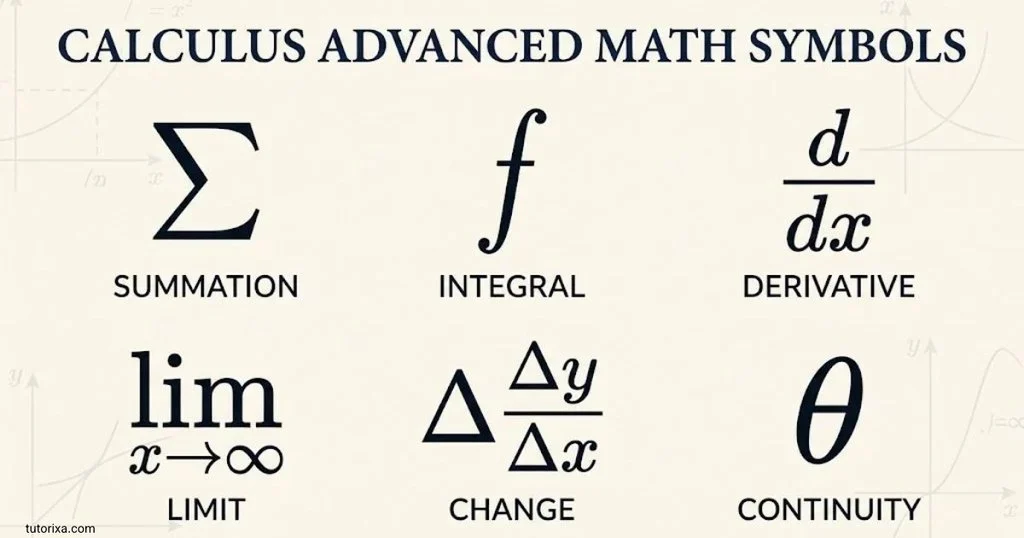
Calculus studies change, rates, accumulation, and limits. Its notation makes it possible to describe how functions behave, calculate derivatives, and determine areas or volumes.
Derivative Symbols
A derivative measures how a function changes with respect to a variable.
| Symbol | Name | Example |
| dydx | First derivative notation | ddx(x2)=2x |
| f'(x) | Prime notation | If f(x)=x3, then f'(x)=3×2 |
| d2ydx2 | Second derivative | Measures the change in the first derivative |
| fx | Partial derivative | Differentiates a multivariable function with respect to x |
| f | Gradient | Points in the direction of greatest increase for a differentiable scalar field |
| \(\nabla\cdot\mathbf F\) | Divergence | Measures the local outward flow of a vector field |
| \(\nabla\times\mathbf F\) | Curl | Describes local rotational behavior of a vector field |
For example, if f(x)=x2+4x, then:
f'(x)=2x+4
At x=3, the derivative is 10. This means the instantaneous rate of change of the function at that point is 10.
Integral Symbols
Integration is used to calculate accumulated quantities, areas under curves, and many other mathematical values.
| Symbol | Name | Typical use |
| Integral | General integration | |
| ab | Definite integral | Calculates accumulation over an interval |
| \(\iint\) | Double integral | Integrates over a two-dimensional region |
| \(\iiint\) | Triple integral | Integrates over a three-dimensional region |
| Contour or closed-line integral | Integrates along a closed path | |
| C | Line integral | Integrates along a curve |
| \(\iint_S\) | Surface integral | Integrates over a surface |
For example:
032xdx=9
The result represents the signed area under y=2x from x=0 to x=3.
Limits And Infinite Series
Limits describe what a function approaches as its input moves toward a particular value. Infinite series add terms from a sequence, potentially without an end.
| Symbol | Name | Example |
| Limit | x0x2=0 | |
| Approaches | x0 | |
| Infinity | x | |
| Summation | n=14n=10 | |
| n=0 | Infinite series notation | Represents a sum with infinitely many indexed terms |
| Product notation | Multiplies indexed terms | |
| x | Change in x | Difference between two values of x |
A symbol such as does not represent an ordinary real number. It describes unbounded behavior or appears in mathematical systems that define infinite quantities.
Advanced Math Symbols Clipart
Advanced math symbols clipart is useful for worksheets, classroom posters, presentations, educational websites, and study materials. You can use individual symbols as text or select graphical versions when you need a more decorative appearance.
Mathematics Mathematical Notation Computer Icons Mathematician PNG
Calculus symbol clipart
Common choices include ∫, ∑, ∂, ∇, and ∞. These work well for calculus notes, lesson slides, and mathematics-themed designs.
Introducción | Portal Académico del CCH
Algebra symbol clipart
Use √, ±, =, ≠, and variable letters in equation worksheets, classroom displays, or learning resources.
Mathematical Symbols Modern flat vector illustration Education theme Set of colorful flat math icons with long shadows
Decorative math symbol graphics
Decorative graphics can add visual interest to posters, thumbnails, and educational social media posts.
Text Symbols Vs. Clipart Images
Text symbols and clipart serve different purposes. A Unicode symbol such as ∑ can be copied into a document and resized using the font settings. Clipart is an image, often available as PNG or SVG, that may have its own colors, shapes, and decorative elements.
For equations, choose actual mathematical characters whenever possible. For posters or graphics, an image may be more suitable. If you use a downloaded graphic, check its license before including it in commercial work, and verify that the symbol is mathematically correct.
Frequently Asked Questions
What Are The Most Common Advanced Math Symbols?
Some widely used advanced math symbols include ∑ for summation, ∫ for integration, ∂ for partial derivatives, ∇ for the del operator, ∞ for infinity, and ∈ for set membership. Their meanings depend on the mathematical context.
How Can I Copy And Paste Advanced Math Symbols?
Find the symbol you need in a symbol table, select it, and copy it using Ctrl+C on Windows. Paste it into your document with Ctrl+V. You can also use your word processor’s symbol menu or equation editor for more complex notation.
What Is The Difference Between ∑ And ∏?
The symbol ∑ represents summation, which means adding a sequence of values. The symbol ∏ represents a product, which means multiplying a sequence of values. For example, k=13k=6, while k=13k=6. They produce the same result in this example, but they represent different operations.
Which Symbols Are Used Most Often In Advanced Calculus?
Calculus frequently uses ∫ for integration, ∂ for partial derivatives, ∇ for vector calculus operations, lim for limits, and d/dx for differentiation. Summation notation, written as ∑, is also common in series and approximation methods.
Do Advanced Math Symbols Work On All Devices?
Many standard mathematical characters are supported by modern devices, but their appearance depends on fonts, applications, and operating systems. Some specialized characters may display as empty boxes if the required font is unavailable. For complex equations, use a mathematical equation editor to improve formatting and readability.
Conclusion
Advanced math symbols make complicated equations easier to write, read, and understand. From basic algebraic notation to calculus operators and set theory, each symbol has a purpose that helps explain a mathematical relationship or operation.
Learning the names and meanings of symbols such as ∑, ∫, ∂, ∇, and ∞ can help you study mathematics, prepare assignments, create educational materials, and communicate mathematical ideas more clearly. Examples are particularly helpful when two symbols look similar but perform different functions.
Keep this collection as a reference when you need to identify a symbol, understand its meaning, or copy it into your work. For accurate results, check the context of each symbol and use an equation editor when plain text cannot display the notation correctly.

I’m Rowan Whitaker, a British writer fascinated by the symbols surrounding us every day. I explore their meanings, origins, cultural significance, and changing interpretations. From ancient marks to modern signs, I enjoy making symbolism easier to understand. My writing helps curious readers discover the hidden messages behind familiar shapes, images, and signs.
Books:
- The Meaning Behind Symbols
- A Modern Guide to Symbolism
 Freddie Beaumont
 Ellis Montgomery