
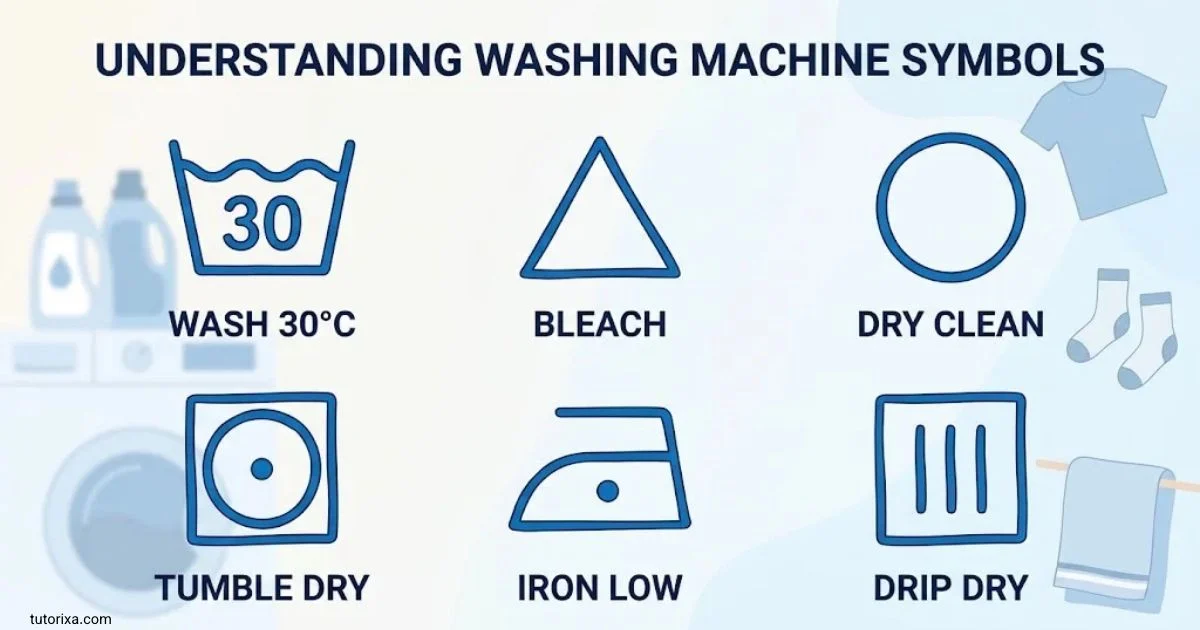
Washing machine symbols on clothes labels help you understand how to wash, dry, iron, and care for your garments without damaging the fabric. These small symbols may look confusing at first, but each one provides useful instructions for keeping clothes clean and in good condition.
From the machine wash 30 symbol to drying instructions and special washing machine settings, learning these symbols can help you avoid shrinking, fading, stretching, and other common laundry problems. You do not need to memorize every symbol to get started.
This guide explains the most common laundry symbols and their meanings, including washing temperatures, machine washing instructions, drying symbols, and care label basics. Use the tables to identify the symbols on your clothes and choose the right washing method for each garment.
Washing machine symbols on clothes meaning
Washing machine symbols on clothes labels indicate how a garment should be washed and which methods are safe for its fabric. Most care labels follow an internationally recognized system in which the shape of the symbol tells you the type of care, while dots, lines, and crosses provide additional instructions.
A wash tub represents washing, a triangle represents bleaching, a square represents drying, an iron represents ironing, and a circle generally represents professional textile care.
Here are the main washing symbols and what they mean.
| Symbol description | Meaning | What to do |
| Tub with water | Machine or hand washing instructions | Check the temperature and other markings |
| Tub with 30 | Wash at a maximum of 30°C | Select a 30°C wash cycle |
| Tub with 40 | Wash at a maximum of 40°C | Use a suitable 40°C cycle |
| Tub with a hand | Hand wash | Wash gently by hand |
| Crossed-out tub | Do not wash | Follow the label’s alternative care instructions |
| Tub with one line underneath | Mild washing process | Choose a gentle or reduced-action cycle |
| Tub with two lines underneath | Very mild washing process | Use a delicate cycle with minimal agitation |
The number inside the wash tub indicates the maximum washing temperature in degrees Celsius. It does not mean that you must wash the garment at that exact temperature.
For example, a garment marked 40°C can often be washed at a lower temperature if the clothing is suitable for the selected cycle and the cleaning requirements allow it.
Tip: Always check the complete care label rather than relying on the washing symbol alone. A garment may be machine washable but still require a low spin speed, gentle handling, or special drying instructions.
What do the symbols on clothes labels mean
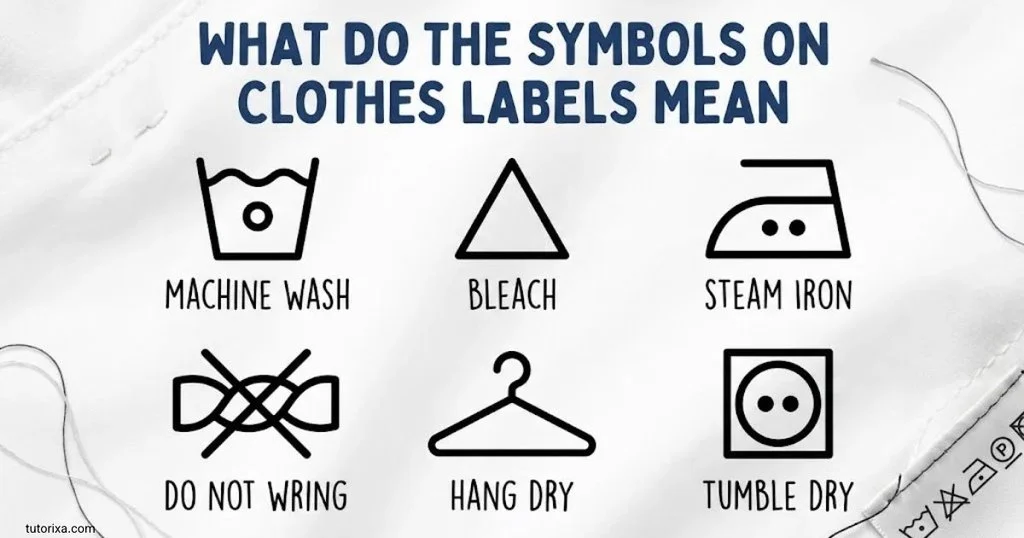
Clothing care labels tell you how to clean a garment safely. They cover washing, bleaching, drying, ironing, and professional cleaning. Each symbol has a specific purpose, and extra marks can change the recommended treatment.
GINETEX+1
Here is a quick guide to the five main care label categories.
| Symbol shape | Care category | What it tells you |
| Tub | Washing | Whether and how to wash the garment |
| Triangle | Bleaching | Which bleaching treatments are allowed |
| Square | Drying | How to dry the fabric safely |
| Iron | Ironing | The maximum suitable ironing heat |
| Circle | Professional cleaning | Whether professional dry or wet cleaning is suitable |
Washing symbols
The wash tub is the most useful symbol when choosing a washing machine cycle. Look at the number inside it and check for any lines underneath.
- Tub with a number: Shows the maximum washing temperature.
- Tub with one underline: Calls for a gentler washing process.
- Tub with two underlines: Indicates a very gentle process.
- Tub with a hand: Means hand washing is required.
- Crossed-out tub: Means the garment should not be washed.
Bleaching symbols
The triangle indicates whether bleach is safe for the garment.
- Empty triangle: Bleaching is permitted under the applicable care instructions.
- Triangle with two diagonal lines: Use oxygen-based, non-chlorine bleach only.
- Crossed-out triangle: Do not bleach the garment.
Ironing symbols
The iron symbol tells you how much heat the fabric can tolerate.
- One dot: Low heat.
- Two dots: Medium heat.
- Three dots: High heat.
- Crossed-out iron: Do not iron.
Professional cleaning symbols
A circle indicates professional textile cleaning. Letters inside the circle provide instructions for the cleaner about suitable cleaning processes or solvents. A crossed-out circle means the specified professional cleaning treatment is not permitted.
Remember that care symbols indicate the treatments a garment is designed to tolerate. Following them helps reduce the risk of damage, although it cannot guarantee that every stain will come out.
GINETEX+1
List of laundry symbols
The following laundry symbol list brings the most common washing and clothing care instructions together in one place. Use it as a quick reference when sorting clothes or choosing a washing machine program.
| Laundry symbol description | Meaning | Recommended action |
| Tub with 30 | Maximum wash temperature of 30°C | Choose a 30°C cycle |
| Tub with 40 | Maximum wash temperature of 40°C | Choose a suitable 40°C cycle |
| Tub with 60 | Maximum wash temperature of 60°C | Use 60°C only when permitted |
| Tub with one line underneath | Mild washing process | Use a gentle cycle |
| Tub with two lines underneath | Very mild washing process | Use a delicate or wool cycle |
| Tub with a hand | Hand wash | Wash carefully by hand |
| Crossed-out tub | Do not wash | Follow alternative care instructions |
| Empty triangle | Bleaching permitted | Check the label and bleach product |
| Triangle with diagonal lines | Oxygen bleach only | Avoid chlorine bleach |
| Crossed-out triangle | Do not bleach | Use bleach-free products |
| Square with a circle | Tumble drying | Check the dots inside |
| Square with a circle and one dot | Low-temperature tumble drying | Select low heat |
| Square with a circle and two dots | Normal-temperature tumble drying | Use the permitted heat setting |
| Crossed-out tumble dryer symbol | Do not tumble dry | Air-dry the garment |
| Square with a vertical line | Line drying | Hang the garment to dry |
| Square with a horizontal line | Dry flat | Place the garment flat |
| Iron with one dot | Low-temperature ironing | Use a cool iron |
| Iron with two dots | Medium-temperature ironing | Use moderate heat |
| Iron with three dots | High-temperature ironing | Use high heat only if permitted |
| Crossed-out iron | Do not iron | Avoid ironing |
| Circle | Professional textile care | Check any letters or extra marks |
These descriptions follow the general care-symbol system used in ISO 3758. Exact instructions depend on the complete symbol and any additional markings.
GINETEX+1
Quick tip: If you are unsure about a garment, follow its own care label rather than relying on the fabric name or a general laundry chart. Two garments made from similar materials can have different care requirements.
Machine wash 30 symbol
The machine wash 30 symbol is a wash tub containing the number 30. It means the garment should be washed at a maximum water temperature of 30°C (86°F). This is a common instruction for clothes that need a cooler wash.
Machine wash at 30°C
Maximum recommended washing temperature
A 30°C wash can help reduce unnecessary heat exposure and is often suitable for everyday clothing, dark colors, and some delicate fabrics. However, the symbol alone does not tell you which detergent to use or whether a long, intensive cycle is appropriate.
How to wash clothes marked 30°C
- Separate whites, darks, and colors to reduce color transfer.
- Check the label for an underline beneath the wash tub.
- Select a 30°C program on your washing machine.
- Use a suitable detergent and avoid overloading the drum.
- Follow the garment’s drying instructions after the wash.
What if your washing machine has no 30°C option?
Check the available temperature settings and program instructions. If the machine does not offer 30°C, a genuinely cooler cycle may be suitable, provided it cleans the garment adequately. Avoid choosing a higher temperature just because it is the closest labeled option.
Also, remember that 30°C is a maximum, not a requirement to wash at exactly 30°C. A lower temperature may be suitable when the garment and cleaning needs allow it. The number and any lines beneath the tub should guide your choice.
GINETEX+1
Front load washing machine symbols meaning
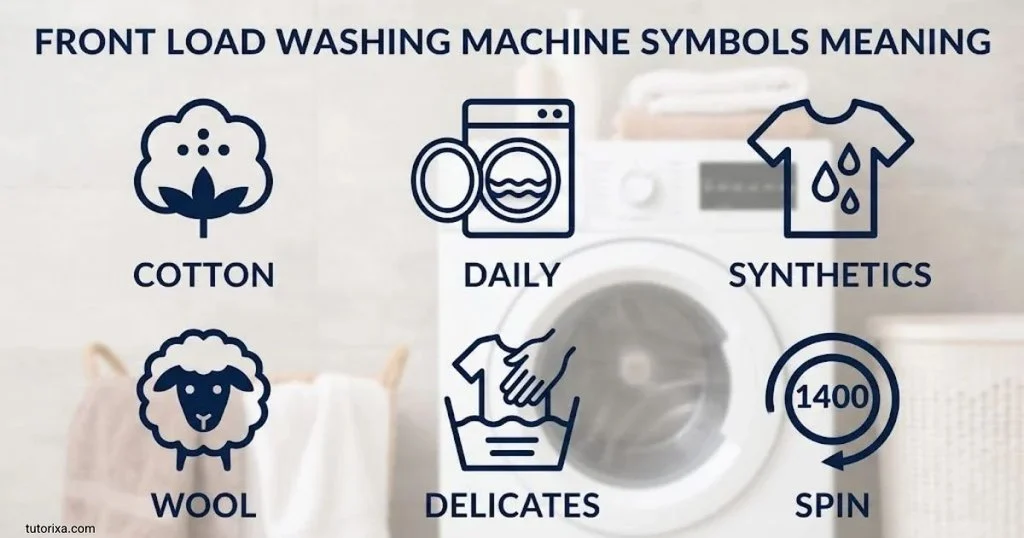
Front-load washing machines use a combination of program icons, temperature settings, spin controls, and special-function symbols. Their exact appearance varies by manufacturer and model, so the control panel on your machine may not look exactly like another brand’s panel.
The following table explains common front-load washing machine symbols and their typical uses.
| Common symbol or label | Meaning | When to use it |
| Cotton or cotton-flower icon | Cotton program | Suitable cotton garments permitted by their care labels |
| Wool or yarn-ball icon | Wool program | Machine-washable wool items |
| Feather icon | Delicate program on some machines | Fragile fabrics requiring gentle handling |
| Spiral | Spin cycle | Removes water after washing |
| Water tub or rinse icon | Rinse program | Rinses detergent from clothes |
| Clock | Time or delay setting | Adjusts cycle time or delayed start |
| Water-drop icon | Water-related function | Check the model manual for its exact purpose |
| Thermometer or temperature display | Temperature selection | Sets the wash temperature |
| Shirt icon | Everyday or shirt program on some models | Shirts and similar garments, subject to the manual |
| Quick or rapid label | Short wash program | Lightly soiled clothes suitable for a quick cycle |
| Crossed speaker or sound icon | Sound control on some models | Turns certain machine sounds on or off |
| Child-lock symbol | Control lock | Prevents accidental changes to settings |
These are common examples, not a universal symbol set. Some icons differ significantly between brands, and the same basic picture can represent different special functions.
Common washing machine programs
- Cotton: Usually designed for cotton items such as towels, sheets, and everyday cotton clothing.
- Synthetics: Often intended for polyester and mixed-fiber garments.
- Delicates: Uses gentler movement for suitable fragile fabrics.
- Wool: Designed for wool garments labeled as machine washable.
- Quick wash: Reduces washing time, generally for smaller or lightly soiled loads.
- Rinse and spin: Rinses clothing and removes water without running a complete wash program.
How to identify the correct symbol on your machine
Look for the brand name and model number, usually printed near the door or on the rating label. The user manual will explain the exact icons and available settings. If you cannot find the paper manual, search the manufacturer’s official website using the model number.
Most importantly, distinguish between symbols on clothing labels and symbols on the washing machine. The garment label tells you what treatment the fabric can tolerate; the machine’s controls tell you which programs are available.
Drying symbols on clothes
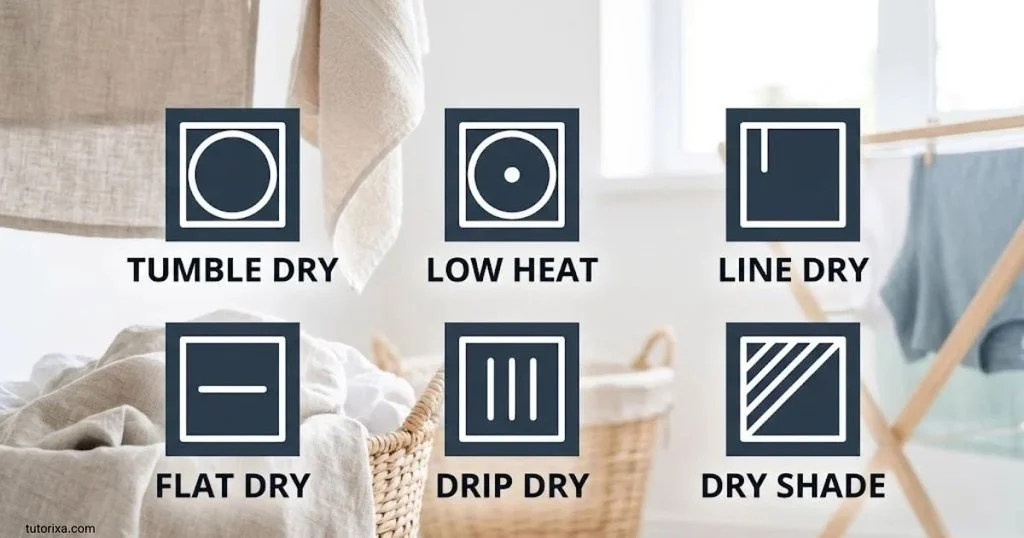
Drying symbols explain how to remove moisture from clothes after washing. Choosing the correct method helps reduce shrinkage, stretching, wrinkles, and heat damage.
The main drying symbol is a square. A circle inside the square represents tumble drying, while lines inside the square indicate natural drying methods.
GINETEX+1
Tumble dry
The garment may be dried in a tumble dryer. Check for dots inside the circle to determine the permitted heat level.
Tumble dry on low heat
One dot inside the dryer circle indicates a low-temperature drying process.
Tumble dry on normal heat
Two dots indicate a higher permitted temperature than one dot.
Do not tumble dry
The crossed-out symbol means you should not use a tumble dryer for the garment.
Natural drying symbols
| Symbol description | Meaning | Best method |
| Square with one vertical line | Line dry | Hang on a washing line |
| Square with two vertical lines | Drip dry | Hang without wringing, allowing water to drip |
| Square with one horizontal line | Dry flat | Lay on a flat surface |
| Square with two horizontal lines | Drip dry flat | Lay flat and allow water to drip |
| Square with a diagonal line in the corner | Dry in the shade | Keep away from direct sunlight |
| Square with a vertical line and a diagonal corner line | Line dry in the shade | Hang in a shaded area |
| Square with a horizontal line and a diagonal corner line | Dry flat in the shade | Lay flat away from direct sunlight |
Extra lines and diagonal markings can change the drying method. Look at the complete symbol rather than interpreting a single line on its own.
Why drying symbols matter
High heat can shrink certain fabrics, damage elastic, and affect prints or decorative details. Some knitwear can stretch out of shape if hung while wet, which is why a dry-flat instruction matters.
If the label says not to tumble dry, choose an appropriate air-drying method instead. If it specifies drying in the shade, avoid strong direct sunlight that could affect sensitive colors. Always check the full care label before putting an item in the dryer.
List of laundry symbols and meanings
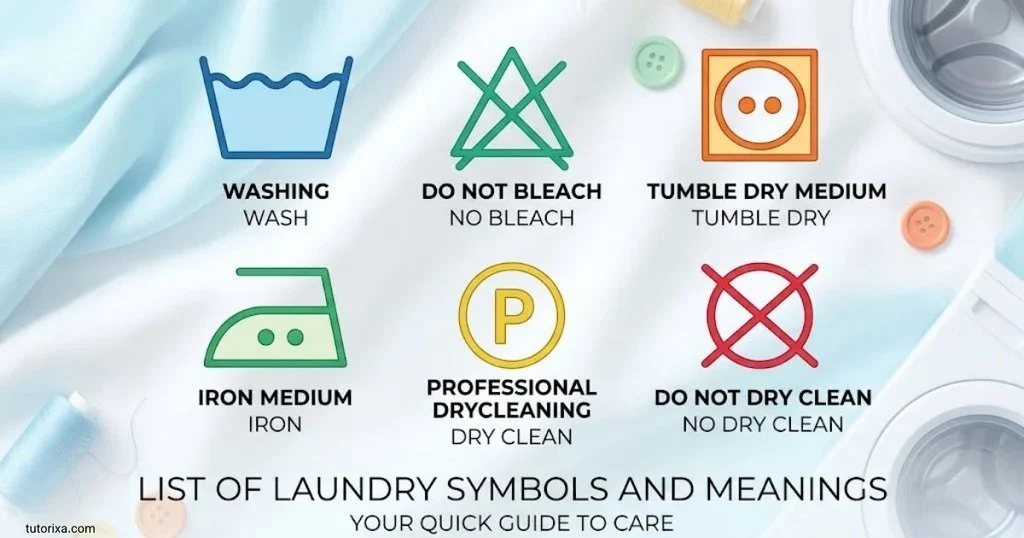
This expanded laundry symbol reference covers the main stages of clothing care, from washing and bleaching to drying, ironing, and professional cleaning.
Washing symbols and meanings
| Symbol description | Meaning |
| Wash tub with 30 | Maximum temperature of 30°C |
| Wash tub with 40 | Maximum temperature of 40°C |
| Wash tub with 50 | Maximum temperature of 50°C |
| Wash tub with 60 | Maximum temperature of 60°C |
| Wash tub with 70 | Maximum temperature of 70°C |
| Wash tub with 95 | Maximum temperature of 95°C |
| Wash tub with one line underneath | Mild washing process |
| Wash tub with two lines underneath | Very mild washing process |
| Wash tub with a hand | Hand wash |
| Crossed-out wash tub | Do not wash |
These numbers indicate maximum temperatures in the standardized care-symbol system. Do not assume that every washing machine offers all these temperature settings.
GINETEX+1
Bleaching symbols and meanings
| Symbol description | Meaning |
| Empty triangle | Bleaching permitted |
| Triangle with two diagonal lines | Oxygen-based, non-chlorine bleach only |
| Triangle with a cross | Do not bleach |
Check your detergent and bleach packaging before using a bleaching product. A garment that permits oxygen bleach may still be damaged by chlorine bleach.
Drying symbols and meanings
| Symbol description | Meaning |
| Square with a circle | Tumble drying permitted |
| Square with a circle and one dot | Low-temperature tumble drying |
| Square with a circle and two dots | Normal-temperature tumble drying |
| Square with a circle and three dots | Higher-temperature tumble drying, where specified by the applicable label system |
| Crossed-out square with a circle | Do not tumble dry |
| Square with one vertical line | Line dry |
| Square with two vertical lines | Drip dry |
| Square with one horizontal line | Dry flat |
| Square with two horizontal lines | Drip dry flat |
| Square with a diagonal corner marking | Dry in the shade |
The complete symbol determines the recommended method. Some drying symbols are less common on everyday clothing, but recognizing them can be helpful when caring for delicate garments.
Ironing symbols and meanings
| Symbol description | Meaning |
| Iron with one dot | Low heat, up to 110°C |
| Iron with two dots | Medium heat, up to 150°C |
| Iron with three dots | High heat, up to 200°C |
| Crossed-out iron | Do not iron |
| Iron with a crossed-out steam marking | Do not use steam, where this marking appears |
The dots indicate the maximum permitted iron temperature in the care-symbol system. If a garment has a special finish, print, or decoration, follow any additional instructions on its label.
Professional cleaning symbols and meanings
| Symbol description | Meaning |
| Circle with P | Professional dry cleaning using permitted processes indicated by P |
| Circle with F | Professional dry cleaning using permitted hydrocarbon solvents |
| Circle with W | Professional wet cleaning |
| Crossed-out circle | Do not use the prohibited professional cleaning treatment |
| Circle with an underline | A restricted professional cleaning process |
| Circle with two underlines | A more restricted professional cleaning process |
The letters inside a professional cleaning symbol are intended primarily for cleaning professionals. They identify permitted processes or solvents rather than ordinary home-washing instructions.
GINETEX+1
FAQ
What is the most common washing machine symbol on clothes?
The wash tub is the main washing symbol. A number inside it indicates the maximum washing temperature, while a hand or crossed-out marking changes how the garment should be cleaned.
What does a washing machine symbol with 30 mean?
A wash tub containing 30 means the garment should be washed at a maximum temperature of 30°C (86°F). Choose a suitable 30°C program and check for any lines underneath the tub.
Can I put clothes in the washing machine if the label shows a hand?
A hand inside the wash tub means hand washing is required. Do not assume that an ordinary machine cycle is suitable. If your machine has a dedicated hand-wash program, check the garment instructions and machine manual before using it.
What does a crossed-out washing symbol mean?
A crossed-out wash tub means the garment must not be washed using the prohibited washing treatment. Check the remaining care instructions to determine whether professional cleaning or another method is recommended.
What is the difference between washing and drying symbols?
Washing symbols use a tub to explain how a garment can be cleaned in water. Drying symbols use a square to show how it should be dried, including tumble drying, line drying, or laying it flat.
Conclusion
Washing machine symbols on clothes labels make laundry easier when you know what each marking means. The wash tub explains washing temperatures and cycle requirements, while the triangle, square, iron, and circle provide instructions for bleaching, drying, ironing, and professional cleaning.
Pay close attention to numbers, dots, underlines, and crossed-out symbols. Small differences can change how you should care for a garment. The machine wash 30 symbol, for example, sets a maximum temperature of 30°C, while drying symbols help you choose between a tumble dryer and air drying.
Keep this laundry symbol guide handy whenever you wash unfamiliar clothes. Checking the care label before starting a cycle can help protect your favorite garments, maintain their shape, and reduce avoidable fabric damage.

I’m Ellis Montgomery, a British writer interested in the powerful language of symbols. I explore everything from traditional emblems and cultural signs to contemporary symbols found in modern life. My aim is to explain their meanings clearly while revealing the stories and ideas behind them, making symbolism fascinating and accessible to everyone.
Books:
- The Complete Book of Symbols
- Hidden Messages in Everyday Symbols
 Rowan Whitaker
 Freddie Beaumont