
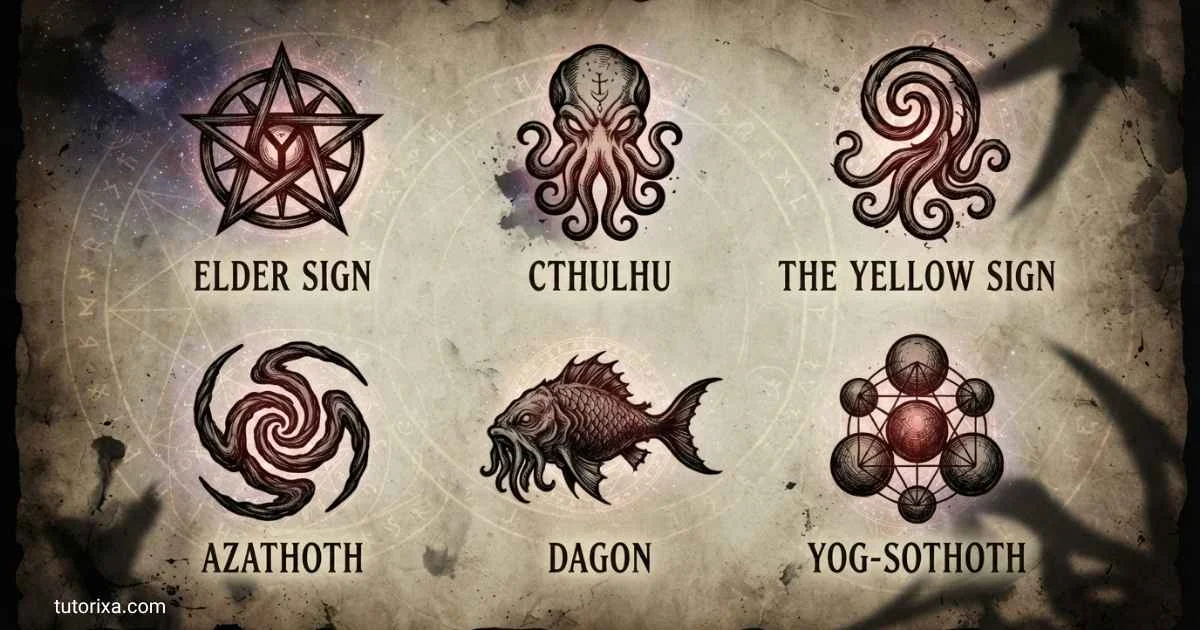
Lovecraft symbols can make ordinary images feel mysterious, unsettling, and strangely powerful. I find that their appeal comes from the way a simple sign can suggest an entire world of hidden knowledge, ancient forces, and cosmic mystery.
If you are exploring Lovecraftian horror, you may wonder what these symbols represent and why they appear so often in stories, artwork, and modern pop culture. You do not need to be an expert to understand them; with the right context, their meanings become much easier to recognize.
In this guide, I’ll help you explore the most important Lovecraft symbols, their meanings, origins, and connections to cosmic horror. You’ll discover what makes these signs so memorable and how you can interpret them without confusing fictional mythology with historical symbols.
Quick Meaning
Lovecraft symbols generally represent ancient knowledge, supernatural forces, cosmic mystery, forbidden wisdom, and humanity’s small place in an incomprehensibly vast universe. Some are protective within fictional stories, while others signify dangerous entities or secret cults. Their meanings vary because the Mythos developed across multiple authors and adaptations.
Symbol Overview Table
| Symbol Name | Primary Meaning | Category | Origin | Common Usage | Modern Meaning |
| Elder Sign | Protection and warding | Fictional occult symbol | H. P. Lovecraft’s fiction | Mythos stories, games, art | Protection against cosmic entities |
| Yellow Sign | Association with forbidden horror | Fictional literary symbol | Robert W. Chambers; later Mythos use | Horror fiction, games, art | Madness, mystery, supernatural danger |
| Cthulhu Glyphs | Association with Cthulhu and his cult | Fictional glyphs | Lovecraft and later adaptations | Games, artwork, merchandise | Cosmic horror and alien power |
| Necronomicon Imagery | Forbidden knowledge | Fictional book/literary motif | H. P. Lovecraft | Horror fiction, games, films | Dangerous or secret knowledge |
| Great Old One Symbols | Identification of supernatural entities | Fictional signs | Mythos authors and adaptations | Games, fiction, artwork | Ancient cosmic forces |
| Cosmic/Occult Glyphs | Mystery and incomprehensible forces | Fictional visual language | Mythos tradition | Games, tattoos, illustrations | Dark mystery and cosmic horror |
Important: There is no single historically authentic “Lovecraft symbol.” The term refers to a broad collection of fictional signs and visual motifs connected with Lovecraft’s stories and the wider Cthulhu Mythos.
What Do Lovecraft Symbols Mean?
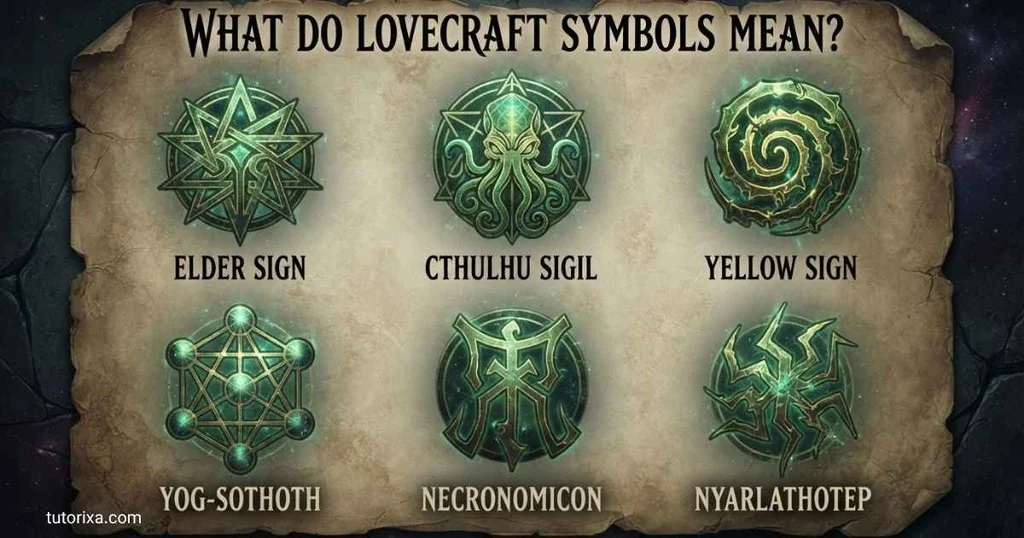
Lovecraft symbols primarily represent the unknown, forbidden knowledge, supernatural entities, ancient forces, and cosmic insignificance.
Lovecraft’s horror differs from traditional monster stories because his central fear often comes from discovering that the universe is far larger, older, and stranger than humans understand. A symbol therefore does more than identify a monster. It can suggest that a character has encountered knowledge that ordinary human society was never meant to possess.
The meaning depends heavily on the specific symbol.
For example, the Elder Sign is commonly interpreted as a protective mark. In modern Mythos fiction and games, it is frequently presented as something that can repel or restrain dangerous supernatural beings.
Cthulhu-related imagery, by contrast, usually represents an ancient extraterrestrial or cosmic entity and the cults devoted to it.
Other fictional glyphs represent secret societies, ancient civilizations, magical rituals, or beings whose existence challenges conventional ideas about nature and reality.
This makes Lovecraftian symbolism different from a traditional symbolic system such as Egyptian hieroglyphics or Christian iconography. There is no universally agreed dictionary in which every glyph has one fixed meaning.
History and Origin of Lovecraft Symbols
The history of Lovecraft symbols begins with the fiction of H. P. Lovecraft, who lived from 1890 to 1937.
Lovecraft created fictional mythology through stories such as The Call of Cthulhu, The Dunwich Horror, The Shadow Over Innsmouth, The Whisperer in Darkness, and At the Mountains of Madness. His stories introduced strange beings, mysterious cults, ancient civilizations, forbidden books, and fragments of imaginary supernatural knowledge.
However, the modern collection of “Lovecraft symbols” did not come from Lovecraft alone.
Lovecraft corresponded with and was influenced by other writers, while later authors expanded his fictional universe. Writers such as August Derleth and others developed ideas that became associated with the broader Cthulhu Mythos.
The Yellow Sign is an especially important example of this development. It did not originate as a Lovecraft creation. It comes from Robert W. Chambers’s 1895 collection The King in Yellow. Lovecraft admired Chambers’s work, and later Mythos creators connected the Yellow Sign with Lovecraftian horror.
Visual representations became even more diverse during the twentieth and twenty-first centuries. Artists, role-playing games, comics, films, video games, and tabletop games created new glyphs and standardized designs that readers sometimes assume came directly from Lovecraft.
Therefore, when studying Lovecraft symbols, it is useful to separate three layers:
- Symbols found in Lovecraft’s original fiction
- Ideas and symbols developed by later Mythos writers
- Modern designs created for games, films, art, and popular culture
That distinction prevents fictional modern artwork from being mistaken for historical evidence.
Symbolism and Interpretation
Lovecraft symbols are strongly associated with mystery, fear, forbidden knowledge, and humanity’s limited understanding of existence.
Forbidden Knowledge
Knowledge is one of the most important themes in Lovecraftian horror.
Characters often discover information through ancient books, manuscripts, inscriptions, dreams, archaeological discoveries, or secret cult traditions. Symbols can function as visual markers for that dangerous knowledge.
A mysterious glyph may therefore suggest that someone has crossed a boundary between ordinary knowledge and something forbidden.
Cosmic Horror
Lovecraft’s fiction popularized a form of horror now commonly called cosmic horror or Lovecraftian horror.
The underlying idea is that humanity may not occupy a central or privileged position in the universe. Cosmic beings can be ancient, powerful, and indifferent to human concerns.
Symbols associated with these entities reinforce that idea. Their strange shapes can feel difficult to interpret because they are designed to appear unfamiliar and outside ordinary human traditions.
Protection
Some Lovecraftian symbols have protective meanings within fictional stories.
The best-known example is the Elder Sign. Modern interpretations often portray it as a magical or supernatural protective emblem used against hostile beings.
Its protective meaning should not be confused with a real-world religious or occult tradition. It belongs primarily to fictional Mythos lore.
Fear and Madness
Another common interpretation involves psychological instability.
Lovecraft repeatedly connects encounters with supernatural truths to fear, confusion, obsession, and the collapse of familiar assumptions about reality. Symbols therefore can represent not only an external threat but also the terrifying realization that the world is not what it appears to be.
Cultural Significance
Lovecraft symbols have had a significant influence on modern horror culture, although their cultural meaning is primarily literary and fictional rather than religious.
The Cthulhu Mythos became particularly influential in horror literature, tabletop gaming, comics, cinema, music, illustration, and video games.
The name Cthulhu itself has become recognizable far beyond readers of Lovecraft. Tentacled imagery, ancient-looking glyphs, mysterious stars, forbidden books, and fictional occult markings are now common visual shorthand for cosmic horror.
Different communities also interpret these symbols differently.
A horror fan may view an Elder Sign as a recognizable Mythos reference. A gamer may associate it with a particular rule system. An artist may use an invented glyph simply to communicate an atmosphere of ancient mystery.
This flexibility explains why the same symbol can have different meanings outside its original literary context.
Religious or Spiritual Meaning
Lovecraft symbols do not have established religious authority or universally recognized spiritual meanings.
Lovecraft deliberately created fictional gods and supernatural entities, including Cthulhu, Yog-Sothoth, Nyarlathotep, and Azathoth. These beings belong to fictional mythology rather than historical religion.
Some Mythos stories describe fictional cults performing rituals or worshipping these entities. Such descriptions are part of the horror setting and should not be treated as evidence of an actual ancient religion.
Modern individuals may use Lovecraftian imagery for personal artistic, philosophical, or aesthetic reasons. That modern use is separate from the symbols’ original literary function.
Where Lovecraft Symbols Are Used
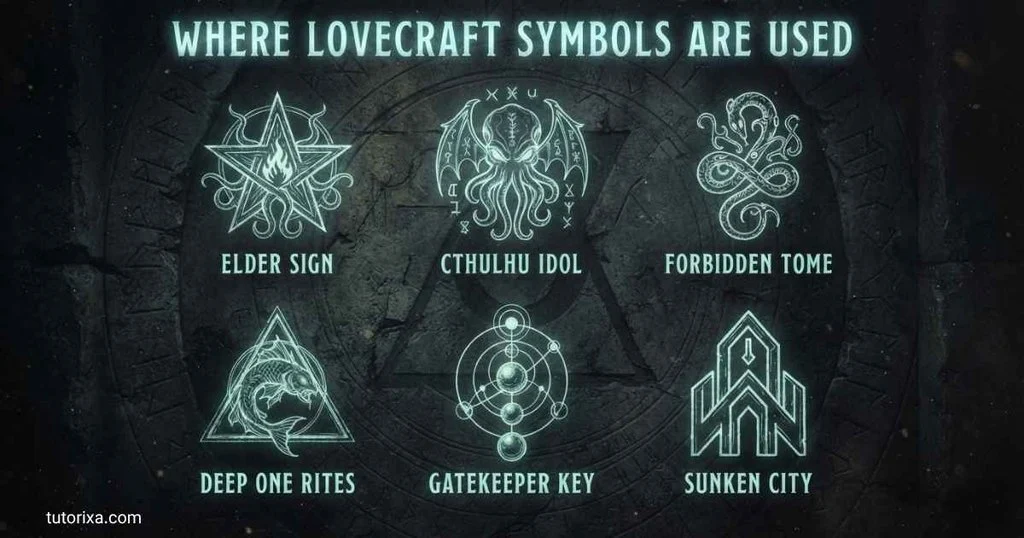
Lovecraft symbols appear in many forms of modern popular culture.
Books and Literature
Authors use mysterious glyphs to create the impression of ancient manuscripts, secret societies, supernatural languages, and forbidden knowledge.
Tabletop Games
Role-playing games have been particularly influential in establishing recognizable Mythos imagery. Games based on cosmic horror often use fictional symbols to represent monsters, artifacts, cults, spells, or protective powers.
Video Games
Lovecraft-inspired video games frequently use invented symbols in environments, menus, documents, weapons, architecture, and character designs.
Films and Television
Filmmakers use strange geometric marks and fictional writing to communicate supernatural mystery without explaining everything immediately.
Art and Illustration
Artists often incorporate tentacles, stars, circular glyphs, eyes, ancient-looking scripts, and unusual geometric designs into Lovecraft-inspired artwork.
Tattoos
Some people choose Lovecraftian imagery because they enjoy cosmic horror literature or want a design representing mystery, the unknown, imagination, or the vastness of the universe.
The meaning of such a tattoo is personal rather than universally established.
Jewelry and Merchandise
Elder Sign pendants, Cthulhu-inspired jewelry, posters, clothing, collectibles, and decorative objects have become common expressions of horror fandom.
Logos and Graphic Design
Fictional glyphs can create an ancient, mysterious, or supernatural visual identity. However, using a particular symbol commercially may connect a design with a specific game, franchise, or copyrighted artwork, so its origin should be checked before commercial use.
Common Variations
One of the biggest complications with Lovecraft symbols is that design variations are extremely common.
Elder Sign Variations
The Elder Sign is perhaps the clearest example. Modern audiences may recognize a stylized five-pointed or branching emblem, but depictions differ considerably between publications and adaptations.
Some designs resemble a hand or branching shape, while others use a star-like form.
The famous modern version should therefore not automatically be presented as the exact symbol Lovecraft originally described.
Cthulhu Symbols
There is no single universally authoritative Cthulhu alphabet or official glyph system shared across all Mythos works.
Artists and game designers have created numerous versions of Cthulhu-related writing and insignia.
Fictional Occult Scripts
Modern creators frequently invent circular markings, angular characters, geometric diagrams, and pseudo-ancient writing. These can look convincingly historical even though they were created specifically for a modern fictional work.
Common Misconceptions
Myth 1: Lovecraft symbols are ancient occult symbols
They are not generally ancient historical symbols. Most recognizable Lovecraftian glyphs belong to fictional literature or later adaptations.
Myth 2: Every Cthulhu symbol was created by Lovecraft
Not necessarily. Many designs familiar today were created by later writers, artists, publishers, game designers, and filmmakers.
Myth 3: The Yellow Sign was invented by Lovecraft
The Yellow Sign originated with Robert W. Chambers’s The King in Yellow. It was later incorporated into the wider tradition of Lovecraftian horror.
Myth 4: There is an official Lovecraft alphabet
There is no single canonical alphabet covering every Lovecraftian symbol.
Myth 5: Lovecraft symbols have fixed spiritual meanings
Their meanings depend on the fictional work and the creator’s interpretation. They are not equivalent to established religious symbols.
Myth 6: The Elder Sign always has the same design
Different authors and artists have depicted it differently. Modern popular culture has contributed heavily to the visual forms people recognize today.
Interesting Facts About Lovecraft Symbols
- The Elder Sign has changed visually over time.
Different publications and creators have represented it in different ways, making it difficult to identify one design as universally definitive. - The Yellow Sign predates Lovecraft.
Robert W. Chambers introduced it in The King in Yellow in 1895, decades before many modern Cthulhu Mythos adaptations. - Cthulhu is not simply a traditional monster.
The character represents a broader idea of cosmic horror: humanity encountering something vastly older and more powerful than itself. - The Necronomicon is fictional.
Lovecraft created the mysterious book as a recurring literary device. Despite numerous claims and jokes about its existence, it is not a genuine ancient manuscript. - Lovecraftian symbols often work because they are ambiguous.
A symbol that cannot be immediately understood can create a stronger feeling of mystery than an ordinary recognizable sign. - Modern games greatly expanded the visual vocabulary.
Tabletop and video games needed practical visual systems for creatures, spells, artifacts, factions, and locations, leading to many new Mythos-inspired symbols. - The Mythos was never completely controlled by one author.
Later writers expanded and modified the fictional universe, which is one reason contradictory versions of symbols and mythology exist. - Lovecraft’s influence extends far beyond literature.
His ideas helped shape modern horror games, films, comics, music, visual art, and internet culture. - Tentacles became a powerful visual shorthand for Cthulhu.
The distinctive appearance of Cthulhu has become one of the most recognizable images associated with cosmic horror. - Not every mysterious-looking glyph is a Lovecraft symbol.
A modern artist may create an occult-looking design without any connection to Lovecraft or the Cthulhu Mythos.
Related Symbols
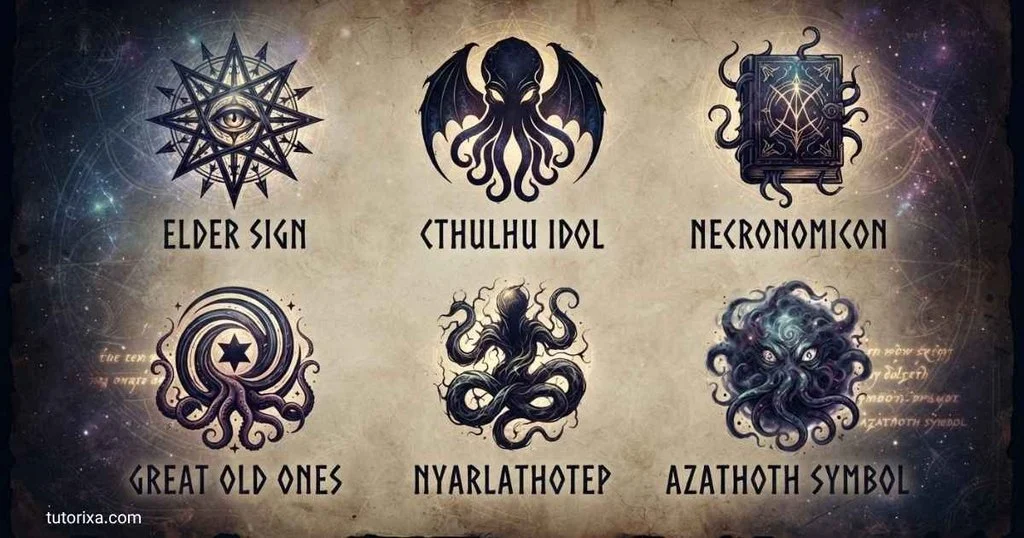
Several symbols and motifs are closely connected with Lovecraftian horror.
- Elder Sign: Usually associated with protection and the Elder Gods in later Mythos traditions.
- Yellow Sign: A mysterious emblem originating with Robert W. Chambers and later connected with Mythos fiction.
- Cthulhu imagery: Represents Cthulhu, his cult, and cosmic horror.
- Necronomicon imagery: Represents forbidden books and dangerous supernatural knowledge.
- Pentagrams: Sometimes appear in horror and occult-inspired artwork, but they are not inherently Lovecraftian.
- All-seeing eyes: Frequently used in modern horror artwork but are not uniquely associated with Lovecraft.
- Ancient glyphs: Fictional writing systems are commonly used to suggest lost civilizations and extraterrestrial knowledge.
- Yellow imagery: In Mythos-related contexts, yellow can evoke the Yellow Sign and The King in Yellow, although yellow itself has many unrelated symbolic meanings.
Frequently Asked Questions
What are Lovecraft symbols?
Lovecraft symbols are fictional signs, glyphs, and visual motifs associated with H. P. Lovecraft’s stories and the wider Cthulhu Mythos. They can represent supernatural beings, forbidden knowledge, secret cults, protective forces, or ancient civilizations. Some originated with Lovecraft, while others were introduced by later writers and adaptations.
What is the most famous Lovecraft symbol?
The Elder Sign is probably the most recognizable protective symbol associated with Lovecraftian fiction. However, Cthulhu imagery is arguably more famous among the general public. The exact appearance and meaning of the Elder Sign have varied across different stories, authors, artists, and adaptations.
Is the Elder Sign a real ancient symbol?
No. The Elder Sign belongs to fictional Mythos literature rather than an established ancient civilization or historical religious tradition. Modern versions may look ancient or occult, but that appearance is part of their artistic design. Later games and adaptations have also developed their own interpretations of the symbol.
What does the Cthulhu symbol mean?
A Cthulhu-related symbol generally represents Cthulhu, his fictional followers, or the broader idea of cosmic horror. There is no single universally accepted Cthulhu glyph used throughout every Mythos story. Modern games, artists, and other creators have produced numerous variations.
Is the Yellow Sign a Lovecraft symbol?
The Yellow Sign is strongly associated with Lovecraftian horror today, but it did not originate with Lovecraft. Robert W. Chambers introduced it in The King in Yellow in 1895. Later writers, including Mythos authors, helped connect Chambers’s imagery with the broader tradition of cosmic and weird fiction.
Is the Necronomicon a real book?
No. The Necronomicon is a fictional grimoire created by H. P. Lovecraft. He used it as a recurring element in his stories, giving characters access to mysterious and forbidden knowledge. Numerous real books have subsequently been published under the name, but they are modern creations rather than the fictional ancient manuscript.
Do Lovecraft symbols have religious meanings?
They do not have established religious meanings comparable to symbols from Christianity, Islam, Hinduism, Buddhism, ancient Egyptian religion, or other historical traditions. Lovecraft’s supernatural mythology is fictional. People can assign personal meanings to these designs, but those interpretations should be distinguished from historical religious symbolism.
Why do Lovecraft symbols look ancient?
They are often designed to look unfamiliar, mysterious, and difficult to interpret. Ancient-looking shapes support Lovecraft’s themes of forgotten civilizations and knowledge that predates humanity. Modern artists also use irregular geometry, invented writing, circles, stars, and unusual forms to create the impression of an unknown civilization.
Can I use a Lovecraft symbol as a tattoo?
You can choose a fictional Lovecraft-inspired design for personal artwork or a tattoo, but it is worth researching exactly where the design originated. Some modern versions were created for particular games, artists, or franchises rather than Lovecraft himself. If you want historical accuracy, compare the design with the original literary source.
Are all Lovecraft symbols evil?
No. Their fictional meanings vary. Some symbols are associated with dangerous entities or forbidden knowledge, while others, particularly the Elder Sign in later interpretations, are portrayed as protective. More broadly, Lovecraftian symbolism is less about simple good-versus-evil morality and more about humanity confronting powerful and incomprehensible forces.
Key Takeaways
- Lovecraft symbols are primarily fictional, not ancient historical symbols.
- They are associated with H. P. Lovecraft and the wider Cthulhu Mythos.
- The Elder Sign is commonly interpreted as a protective symbol.
- The Yellow Sign originated with Robert W. Chambers, not Lovecraft.
- Cthulhu imagery represents cosmic horror and ancient supernatural power.
- The Necronomicon is fictional, despite modern books using the same name.
- Many popular glyphs were created or modified by later authors, artists, and game designers.
- There is no single official Lovecraftian alphabet.
- Meanings can change depending on the story, adaptation, or artistic context.
- Lovecraftian symbolism commonly explores fear, mystery, forbidden knowledge, and humanity’s limited understanding of the universe.
Conclusion
Lovecraft symbols are powerful because they turn abstract ideas—such as cosmic mystery, forbidden knowledge, ancient power, and the unknown—into recognizable visual forms. Their strange appearance creates the feeling that a hidden language or forgotten civilization exists just beyond ordinary understanding.
The most important point is that these symbols belong primarily to fiction and modern popular culture, not to an ancient occult tradition. Some come directly from Lovecraft’s stories, while others emerged through Robert W. Chambers, later Mythos writers, artists, games, films, and other adaptations.
Understanding that history makes the subject more fascinating. Whether you encounter an Elder Sign in a game, a Cthulhu glyph in artwork, or a mysterious fictional inscription in a horror story, its meaning becomes clearer when you know the literary tradition behind it. Ultimately, Lovecraft symbols endure because they visually express one of cosmic horror’s central ideas: there are mysteries in the universe far beyond what humanity can easily understand.

I’m Freddie Beaumont, a British author with a passion for discovering what symbols communicate without words. I write about their history, meanings, and everyday uses in an accessible way. I believe symbols tell fascinating stories about people, cultures, and ideas, and my work helps readers recognise and understand those stories more clearly.
Books:
- Symbols and Their Hidden Meanings
- Understanding Signs and Symbols
 Ellis Montgomery
 Rowan Whitaker