
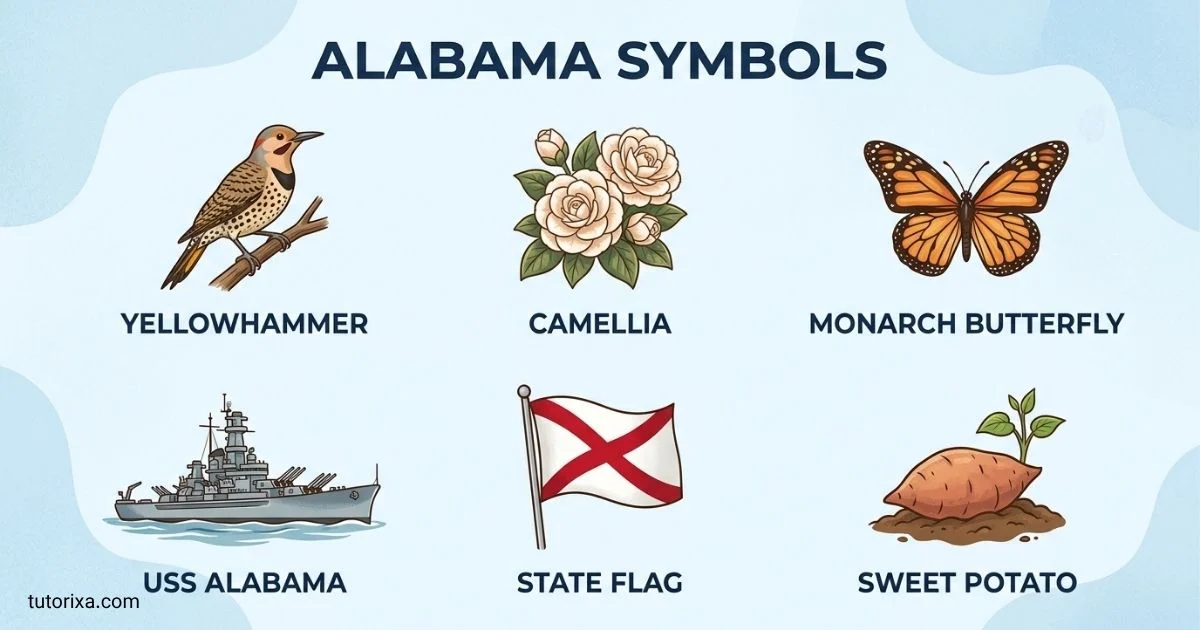
Alabama is more than just a state on the map; its symbols tell fascinating stories about its history, culture, nature, and traditions. I find these emblems interesting because each one reveals something special about what makes Alabama unique.
From the state bird and flower to the flag and other official emblems, every symbol has a story worth discovering. If you want to understand what these symbols mean and why they matter, you’re in the right place.
In this guide, you’ll discover Alabama’s official symbols, their meanings, and the history behind them. Whether you’re a student, a curious reader, or simply exploring American state symbols, I’ll help you understand them in a simple and engaging way.
Quick Meaning of Alabama Symbols
Alabama symbols are official state emblems and widely recognized representations of Alabama’s history, culture, geography, and natural environment. They include the state flag, Great Seal, state bird, flower, tree, mammal, fish, and other designated symbols. Each represents a particular part of Alabama’s identity, from its forests and wildlife to its government and historical heritage.
Alabama Symbols Overview Table
The following table highlights major official Alabama symbols and their commonly understood meanings. Designations and official names should be distinguished from informal cultural associations.
| Alabama Symbol | Official Designation | Primary Meaning or Association | Category |
| Alabama state flag | State flag | State identity and historical heritage | Government |
| Great Seal of Alabama | State seal | Government authority and the state’s geography | Government |
| Yellowhammer | State bird | Alabama’s nickname and historical identity | Wildlife |
| Camellia | State flower | Beauty and ornamental horticulture | Plant |
| Longleaf pine | State tree | Forest heritage and natural resources | Plant |
| Black bear | State mammal | Native wildlife and conservation | Wildlife |
| Largemouth bass | State freshwater fish | Freshwater ecosystems and recreational fishing | Wildlife |
| Tarpon | State saltwater fish | Coastal waters and marine life | Wildlife |
| Monarch butterfly | State insect | Pollination, migration, and biodiversity | Insect |
| Eastern tiger swallowtail | State butterfly | Native butterfly diversity | Insect |
| Alabama red-bellied turtle | State reptile | Native wildlife and wetland conservation | Reptile |
| American alligator | State reptile, alongside the Alabama red-bellied turtle | Wetland ecosystems and southeastern wildlife | Reptile |
| Alabama state horse | State horse | Equestrian heritage | Animal |
| Pecan | State nut | Agriculture and regional food traditions | Food and agriculture |
| Conecuh Ridge Alabama Fine Whiskey | State alcoholic beverage | State legislative designation and distilling history | Beverage |
| State motto | Official state motto | Government and civic identity | Language |
| State song | Official state song | Music and civic heritage | Music |
Note: Alabama has numerous official symbols, and the table is a selected overview rather than an exhaustive legal inventory. For formal research, check the current Alabama Legislature or state government references for the exact designation and any amendments.
What Do Alabama Symbols Mean?
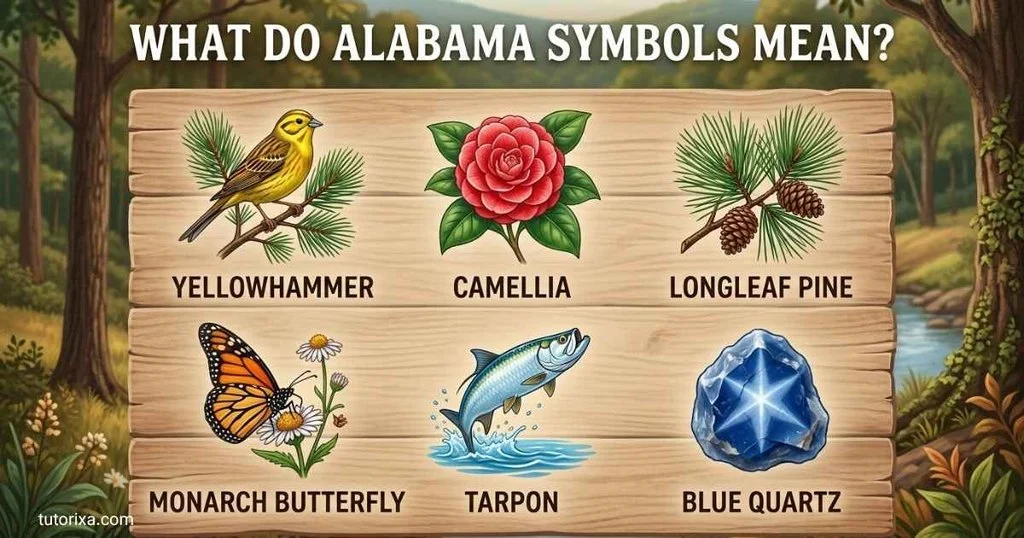
Alabama symbols communicate different aspects of the state rather than sharing one universal meaning. Government emblems represent public authority, state animals and plants reflect the natural environment, and cultural symbols preserve historical memories.
The Alabama State Flag
The Alabama state flag features a red diagonal cross on a white field. The cross is commonly described as a St. Andrew’s cross, also known as a saltire.
Alabama adopted the flag in 1895. Its design is simple enough to remain recognizable on buildings, official documents, and public displays.
The flag is a government emblem, but its historical interpretation requires context. Alabama adopted it during the Jim Crow era, when white political leaders across the South were reinforcing racial segregation and white supremacy. Its design and adoption therefore belong to a complex period in Alabama’s history.
The flag’s current function is to identify the state. Understanding its history means recognizing both its official role and the circumstances surrounding its adoption.
The Great Seal of Alabama
The Great Seal of Alabama is an official emblem used to authenticate state government documents and represent the authority of the state.
Alabama’s seal features a map of the state, emphasizing its territorial identity and geographic position. Its history dates to the early period of statehood, when Governor William Wyatt Bibb selected a design showing Alabama’s boundaries and neighboring territories.
The seal is different from the state flag. The flag is a public symbol that can be displayed broadly, while the Great Seal serves a formal governmental purpose.
The Yellowhammer: Alabama’s State Bird
The yellowhammer is Alabama’s official state bird. It is also known as the northern flicker, a woodpecker found across much of North America.
The bird became connected with Alabama during the Civil War. A popular account links the nickname “Yellowhammer” to Alabama soldiers whose clothing included yellow trim or details. The precise historical development of the nickname is more complex than a single story, but the association became part of Alabama’s military and cultural identity.
Today, the yellowhammer represents a recognizable link between wildlife and state history.
The Camellia: Alabama’s State Flower
The camellia is Alabama’s state flower. It is an ornamental flowering plant valued for its attractive blooms and evergreen foliage.
Camellias are not native to Alabama; many cultivated varieties originated in East Asia. Their popularity in Southern gardens helped make them familiar across the region.
The flower represents horticultural beauty and the state’s long tradition of ornamental gardening. Its designation also demonstrates that a state symbol does not need to originate within state borders to become an important part of local identity.
The Longleaf Pine: Alabama’s State Tree
The longleaf pine is associated with Alabama’s forests and the ecological history of the southeastern United States.
Longleaf pine ecosystems once covered extensive areas of the Southeast. They support a range of plants and animals, including species adapted to open, fire-influenced landscapes.
The tree symbolizes natural resources, forest conservation, and the importance of Alabama’s woodland heritage. Its ecological significance is particularly important because longleaf pine ecosystems have declined substantially from their historical extent.
The Monarch Butterfly
The monarch butterfly is Alabama’s official state insect. Known for its orange-and-black wings and remarkable migration, the monarch is widely recognized throughout North America.
Monarchs depend on milkweed plants during their caterpillar stage. Their life cycle connects Alabama’s gardens, roadsides, meadows, and other habitats with a much broader migratory system.
As a state symbol, the monarch can encourage interest in pollinators, native plants, and habitat conservation. These environmental associations are interpretations of its significance rather than a separate official legal meaning.
History and Origin of Alabama’s State Symbols
Alabama’s state symbols developed over more than a century through legislation, government traditions, and public recognition of the state’s natural resources.
Alabama became the 22nd state of the United States on December 14, 1819. Its early government established emblems that represented the state’s territory and authority, while later generations selected symbols connected with wildlife, agriculture, arts, and local traditions.
The Great Seal and Early Statehood
Alabama’s original territorial seal dates to 1817, before statehood. Governor William Wyatt Bibb proposed a map-based design showing the territory’s boundaries, rivers, and neighboring areas. The seal changed during Reconstruction, but the original design was restored in 1939.
This history demonstrates how government symbols can change alongside political circumstances. The seal’s primary function remains official identification and authentication, even as its historical background continues to interest researchers.
The State Flag and Historical Context
Alabama adopted its state flag on February 16, 1895. Its red diagonal cross on a white field is commonly described as a St. Andrew’s cross, or saltire. Historical accounts also connect the design with Confederate symbolism.
The flag’s adoption occurred during the Jim Crow era, when racial segregation and white supremacy shaped Southern politics. A balanced historical account should acknowledge that setting rather than describing the flag only as a neutral representation of state pride.
The Growth of Natural and Cultural Symbols
During the twentieth and twenty-first centuries, Alabama added symbols representing plants, animals, minerals, music, food, crafts, and other cultural traditions.
For example, the yellowhammer became the state bird in 1927, the longleaf pine became the state tree in 1949, and the camellia became the state flower in 1959. Later designations recognized Alabama’s distinctive wildlife, agricultural products, and cultural activities.
These choices reflect the idea that a state’s identity includes more than its government. Landscapes, local industries, artistic traditions, and community life also shape how residents understand their home.
Symbolism and Interpretation of Alabama’s Emblems
Alabama’s symbols represent several overlapping ideas: civic identity, historical memory, biodiversity, agriculture, and cultural continuity.
Positive Symbolism
Many state emblems encourage appreciation of Alabama’s natural environment and cultural heritage.
- Yellowhammer: Connects the state with a historic nickname and a familiar bird.
- Camellia: Represents ornamental gardening and floral beauty.
- Longleaf pine: Highlights forests and ecological conservation.
- Black bear: Recognizes native wildlife.
- Monarch butterfly: Draws attention to insect diversity and migration.
- Pecan: Connects Alabama with agriculture and regional food traditions.
These are reasonable interpretations of the symbols’ associations, but they should not be confused with official legislative definitions unless a law explicitly provides one.
Historical and Contested Symbolism
Not every emblem carries an uncomplicated meaning. Alabama’s flag, in particular, has historical connections to the Confederacy and the racial politics of the late nineteenth century.
For some people, the flag represents state identity and tradition. For others, its historical associations evoke slavery, the Confederacy, segregation, and racial exclusion. These interpretations arise from different experiences and understandings of the state’s past.
Recognizing this complexity does not change the flag’s legal status. It helps explain why a symbol can represent different things to different communities.
Psychological and Social Meaning
State symbols help people recognize shared places and traditions. A bird, flower, or familiar seal can become a shorthand for a much larger story about a community.
This process is not unique to Alabama. People often connect visual emblems with family memories, school lessons, local landscapes, sports, or public celebrations. The meaning develops through repeated exposure and shared experience rather than through the image alone.
Cultural Significance of Alabama Symbols
Alabama’s emblems connect its official identity with its regional cultures, communities, and natural environment.
The Yellowhammer State
The nickname “Yellowhammer State” is widely associated with Alabama. It grew from the yellowhammer nickname applied to Alabama soldiers during the Civil War and later became a lasting part of the state’s public identity.
The nickname is historically significant, but its origins also belong to the Confederacy’s military history. Explaining that context is more accurate than presenting the name as an entirely modern wildlife reference.
Music, Dance, and Community Traditions
Alabama’s cultural emblems include music and folk traditions. The state song, “Alabama,” uses a poem by Julia S. Tutwiler with music by Edna Gockel-Gussen. Alabama law formally recognizes the song.
Square dancing is another example of a cultural tradition recognized in Alabama’s state-symbol collection. Such designations acknowledge activities that have become part of the state’s public and community life.
Agriculture and Food Heritage
Agricultural symbols connect Alabama’s official identity with the plants and products associated with its farms and food traditions.
The pecan, blackberry, and peach represent different aspects of regional agriculture and cuisine. These symbols can be used in educational materials to explain farming, plant biology, food history, and local economic traditions.
Religious or Spiritual Meaning of Alabama Symbols
Alabama has an official state Bible, designated in 1853, and an official state creed, adopted in 1953. These designations make religion and faith part of the state’s formal symbolic history.
The existence of these symbols should be understood as a historical and governmental fact, not as evidence that every Alabamian follows the same religion or interprets state identity in the same way.
The state flag, bird, flower, and tree do not inherently carry a universal religious meaning. Although a cross appears in the state flag, its historical and political context must be considered rather than automatically assigning it a religious purpose.
More broadly, Alabama’s religious landscape includes different Christian traditions, other faiths, and people with no religious affiliation. State emblems cannot fully represent that diversity.
Scientific and Technical Meaning of Alabama Symbols
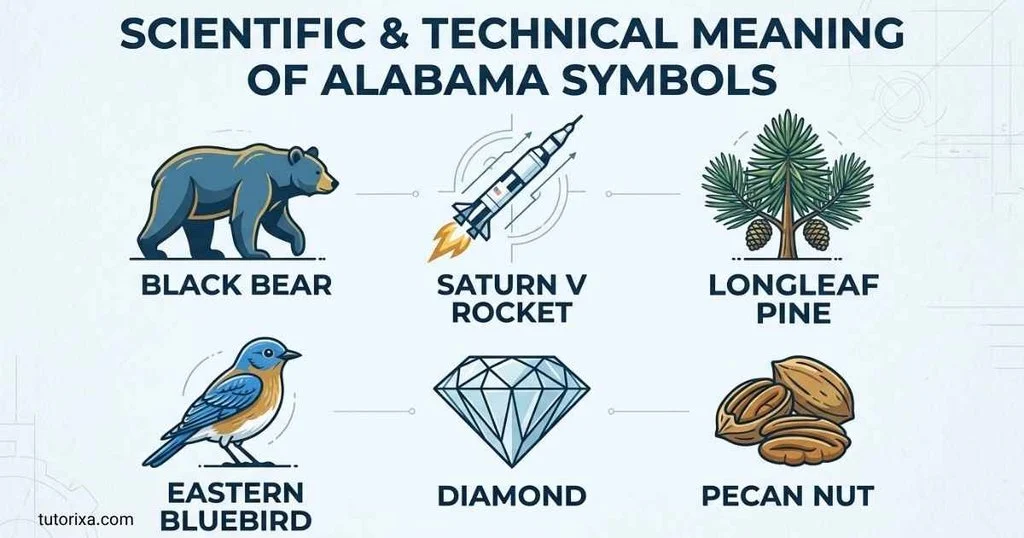
Alabama’s natural symbols have scientific value because they identify species, ecosystems, geological resources, and agricultural products found in or associated with the state.
Longleaf Pine and Forest Ecology
The longleaf pine (Pinus palustris) is important to the ecology of the southeastern United States. Longleaf pine ecosystems support a range of plant and animal species and are adapted to periodic fire.
Historically, these forests covered large areas of the Southeast. Land conversion, logging, and changes in land management reduced their extent. Recognizing the longleaf pine as a state symbol provides an opportunity to discuss forest restoration and biodiversity.
Yellowhammer and Bird Biology
The yellowhammer, commonly known as the northern flicker, is a woodpecker. Unlike many other woodpeckers, northern flickers frequently forage on the ground, including for ants and other insects.
Its official status connects a real animal with Alabama’s history. The bird can also introduce students to migration, habitat, feeding behavior, and the ecological roles of native birds.
Monarch Butterfly and Migration
Monarch butterflies are known for their long-distance seasonal migrations in North America. Their caterpillars depend on milkweed plants, making milkweed availability important to their life cycle.
The monarch’s designation as Alabama’s state insect provides a useful connection between state symbols and environmental education. It can encourage people to learn about pollinators, native plants, habitat loss, and conservation.
Geological Symbols
Alabama also recognizes geological resources through symbols such as hematite, marble, and star blue quartz. These designations connect the state’s identity with mineralogy, geology, and the natural materials used in construction and ornamentation.
Geological symbols can help explain how minerals form, how rocks differ from minerals, and why certain natural resources have economic or historical importance.
Where Alabama Symbols Are Used
Alabama symbols appear in government, education, tourism, art, and community life.
Government Buildings and Official Documents
The state flag, Great Seal, and coat of arms appear in official settings. The Great Seal has a formal governmental role, while the flag is displayed in public spaces and at civic events.
The coat of arms is distinct from the Great Seal. Alabama’s coat of arms was adopted in 1939 and includes imagery representing governments that exercised sovereignty over the territory at different times.
Schools and Educational Materials
Teachers use Alabama symbols to introduce state history, geography, biology, government, and cultural traditions.
A lesson about the yellowhammer can cover birds and historical nicknames. A lesson about the camellia can explain horticulture, while the state seal can introduce the development of Alabama’s government.
Tourism and Local Branding
Symbols appear on souvenirs, postcards, signs, educational displays, and tourism materials. The state outline, flag, and yellowhammer are recognizable ways to identify Alabama.
However, the use of a symbol in commercial branding does not necessarily make that use an official government designation. A local business may use a familiar Alabama motif without representing the state government.
Art, Crafts, and Cultural Heritage
Alabama’s recognized cultural emblems include the pine burr quilt, a craft tradition connected with the state’s textile and quilting heritage.
The state also recognizes cultural venues and events, demonstrating that its official emblems are not limited to plants and animals.
Artists, historians, and craftspeople may draw on these traditions to explore family history, local identity, and the relationship between culture and place.
Common Variations of Alabama Symbols
Alabama symbols may appear in different visual styles, but their official identity depends on the designation rather than the artistic treatment.
Flag and Seal Variations
The state flag retains its red diagonal cross on a white field, although printed versions may differ slightly in proportions or presentation.
The Great Seal and coat of arms are separate emblems. The seal serves an official governmental function, while the coat of arms presents Alabama’s historical identity through heraldic imagery.
Common Names and Scientific Names
Some symbols have several names. The yellowhammer is commonly called the northern flicker, while its scientific name is Colaptes auratus.
Common names may vary by region, but scientific names help researchers identify the same species consistently.
Official Symbols and Informal Nicknames
Alabama is often called the Yellowhammer State and has also been associated with the phrase “Heart of Dixie.” However, the Encyclopedia of Alabama notes that the state does not have an official nickname.
This distinction matters because popular nicknames and official legislative designations are not the same thing.
Common Misconceptions About Alabama Symbols
Misconception 1: Every Alabama symbol represents the entire population in the same way.
Symbols can carry different meanings for different communities. Historical experiences and cultural backgrounds influence how people interpret an emblem.
Misconception 2: Alabama has only a handful of official symbols.
The state has dozens of officially designated emblems covering wildlife, plants, geology, music, food, crafts, and other subjects. The Alabama Department of Archives and History describes a collection of 41 official symbols.
Misconception 3: The state flower is native to Alabama.
The camellia is Alabama’s state flower, but its cultivated varieties have origins in East Asia. A state can adopt a plant as an emblem because of its popularity and cultural significance rather than its native range.
Misconception 4: The state bird’s nickname originated only from its appearance.
The yellowhammer nickname has a historical association with Alabama soldiers during the Civil War. Its significance is therefore connected with state history as well as bird identification.
Misconception 5: The Great Seal and coat of arms are interchangeable.
They are distinct emblems with different designs and purposes. The Great Seal is associated with government authentication, while the coat of arms presents a heraldic representation of Alabama’s history.
Misconception 6: A state symbol always has a legally defined symbolic meaning.
A law may designate a bird or flower without specifying a deeper interpretation. Descriptions such as “beauty,” “freedom,” or “resilience” may be reasonable cultural interpretations, but they should not automatically be presented as statutory definitions.
Misconception 7: The state flag has no controversial historical associations.
The flag was adopted in 1895, during the Jim Crow era, and historical accounts connect its design to Confederate symbolism. An accurate explanation should acknowledge this context alongside its current status as the state flag.
10 Interesting Facts About Alabama Symbols
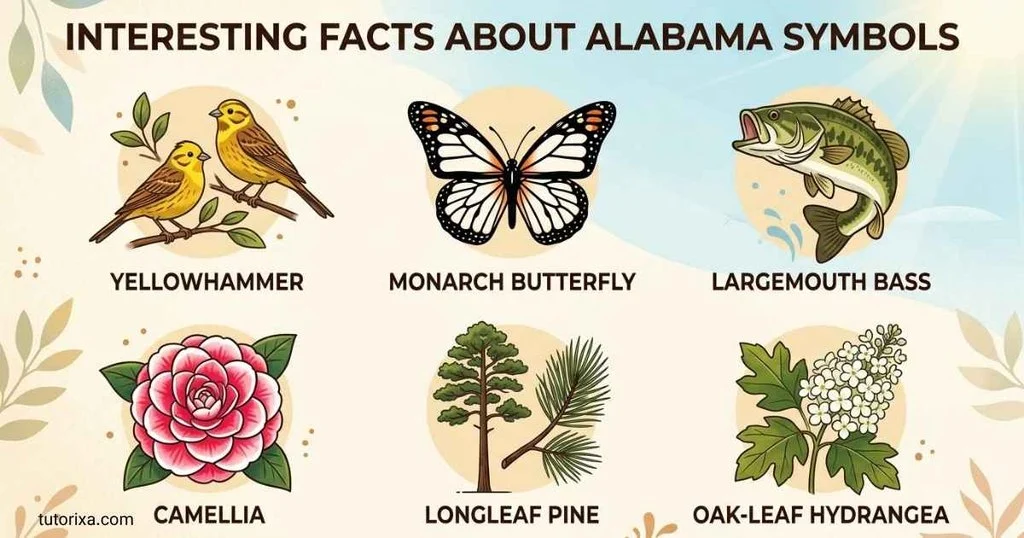
1. Alabama has dozens of official emblems. The state recognizes natural and cultural symbols, including animals, plants, geological resources, music, and crafts. This makes its collection a useful introduction to the state’s diverse heritage.
2. The state bird inspired a famous nickname. Alabama became known as the Yellowhammer State because of the historical nickname associated with Alabama soldiers during the Civil War.
3. The state seal predates statehood. Alabama’s original territorial seal was created in 1817, two years before Alabama joined the United States as a state.
4. Alabama’s flag dates to 1895. Its red diagonal cross on a white field has remained a recognizable feature of the state’s public identity, although its historical context remains important to understanding it.
5. The camellia is not originally from Alabama. The flower’s East Asian origins demonstrate how a plant can become closely associated with a region through gardening and cultural popularity.
6. The longleaf pine has ecological importance beyond its symbolic status. Its native ecosystem supports distinctive biodiversity and is a significant focus of conservation efforts across the Southeast.
7. Alabama has separate freshwater and saltwater fish symbols. The largemouth bass represents freshwater fishing, while the tarpon represents saltwater fishing.
8. The state recognizes an official amphibian. The Red Hills salamander became Alabama’s state amphibian in 2000. It is a distinctive species associated with a limited region of the state.
9. The state coat of arms records several periods of sovereignty. Its shield represents the governments that held sovereignty over Alabama, including Spain, France, Great Britain, the Confederacy, and the United States.
10. Alabama recognizes cultural symbols as well as natural ones. Its official emblems include traditions and institutions connected with music, dance, crafts, and community events, illustrating how state identity extends beyond wildlife and geography.
Related Symbols of Alabama
Several related emblems help explain the state’s identity and how its official symbols fit together.
| Related Symbol | What It Represents | How It Differs |
| Alabama coat of arms | Historical governments and state heritage | Uses heraldic imagery rather than the flag’s simple cross |
| Great Seal of Alabama | Government authority and state geography | Serves a formal governmental purpose |
| Yellowhammer State nickname | Alabama’s historical identity | A popular nickname rather than an official nickname |
| State motto | Civic identity and determination | Expresses an idea through language |
| State song, “Alabama” | Music and cultural heritage | Represents the state through a musical composition |
| Longleaf pine | Forest ecology and natural heritage | Represents plant life and conservation |
| Camellia | Ornamental horticulture | Represents a cultivated flowering plant |
| Monarch butterfly | Insect life and migration | Connects the state’s identity with biodiversity |
| Alabama state mineral, hematite | Mineral resources and geology | Represents a natural geological material |
| Alabama state rock, marble | Geological heritage and building materials | Represents a rock rather than a mineral species |
These symbols complement one another. The flag and seal identify the state through government traditions, while the natural and cultural emblems reflect the environment and activities that help distinguish Alabama from other states.
Frequently Asked Questions About Alabama Symbols
1. What are the official symbols of Alabama?
Alabama’s official symbols include the state flag, Great Seal, coat of arms, yellowhammer bird, camellia flower, longleaf pine tree, black bear, fish, butterfly, amphibian, and numerous cultural and geological emblems. The Alabama Department of Archives and History provides a reference collection of state symbols and their adoption dates.
2. What is Alabama’s state bird, and what does it symbolize?
Alabama’s state bird is the yellowhammer, commonly known as the northern flicker. It became the official state bird in 1927. The bird is also associated with Alabama’s historical nickname, the Yellowhammer State, which developed from a Civil War-era nickname for Alabama soldiers.
3. What is Alabama’s state flower?
Alabama’s state flower is the camellia, officially designated in 1959. It is an ornamental flowering plant known for its attractive blooms and evergreen foliage. Although camellias originated in East Asia, they became popular in Southern gardens and developed a strong association with Alabama’s horticultural traditions.
4. What does the Alabama state flag represent?
The Alabama state flag features a red diagonal cross on a white background. Adopted in 1895, it is commonly described as a St. Andrew’s cross or saltire. Historical accounts connect the design with Confederate symbolism, so understanding the flag requires considering both its official status and its late nineteenth-century political context.
5. What is Alabama’s state tree?
Alabama’s state tree is the longleaf pine, a species native to the southeastern United States. Longleaf pine forests are important habitats for numerous plants and animals. The tree’s designation connects Alabama’s identity with its forest heritage and offers an opportunity to explore conservation and the ecological importance of native ecosystems.
6. What is the difference between Alabama’s Great Seal and coat of arms?
The Great Seal is a governmental emblem used for formal state purposes and is associated with Alabama’s geography and territorial identity. The coat of arms is a separate heraldic emblem depicting historical influences on Alabama. Both represent the state, but they have different designs, histories, and functions.
7. Does Alabama have an official state motto?
Yes. Alabama’s official motto is “Audemus jura nostra defendere,” commonly translated as “We dare defend our rights.” It appears in the state’s coat of arms and expresses a theme of defending rights. The motto is a linguistic emblem, unlike the state’s visual symbols such as its flag or bird.
8. What is Alabama’s state mammal?
Alabama’s state mammal is the American black bear (Ursus americanus). The designation recognizes a native North American mammal found in Alabama. Black bears are associated with forest and other suitable habitats, making the species relevant to discussions of native wildlife and conservation.
9. Does Alabama have an official state nickname?
Alabama is widely known as the Yellowhammer State and has also been called the Cotton State and the Heart of Dixie. However, the Encyclopedia of Alabama notes that the state has no official nickname. These familiar names are part of its cultural and historical identity rather than a single formally established designation.
10. Why does Alabama have so many state symbols?
Alabama’s symbols recognize different aspects of its identity, including wildlife, plants, geology, government, music, agriculture, and traditional crafts. State designations also provide educational opportunities, helping students and residents learn about the state’s history, natural resources, and cultural heritage. Together, the symbols offer a broader picture of Alabama than any single emblem could provide.
Key Takeaways About Alabama Symbols
- Alabama’s symbols represent its government, history, wildlife, plants, geology, agriculture, and cultural traditions.
- The state flag features a red diagonal cross on a white field and was adopted in 1895.
- The Great Seal and coat of arms are separate official emblems.
- The yellowhammer is Alabama’s state bird and inspired the Yellowhammer State nickname.
- The camellia is the state flower, and the longleaf pine is the state tree.
- The black bear, largemouth bass, tarpon, and monarch butterfly are among Alabama’s designated animal symbols.
- Alabama’s motto is “Audemus jura nostra defendere.”
- Some symbols have complicated histories, particularly the state flag, whose adoption occurred during the Jim Crow era.
- Popular nicknames are not necessarily official legal designations.
- Official state-symbol records provide the best reference for exact names and adoption dates.
Conclusion
Alabama symbols tell a story that extends beyond a flag or a list of official emblems. They connect the state’s government and history with its forests, wildlife, agriculture, music, crafts, and community traditions.
The yellowhammer recalls a historic nickname, the camellia reflects a long-standing gardening tradition, and the longleaf pine highlights an ecosystem that remains important to the southeastern United States. The Great Seal and coat of arms preserve different aspects of Alabama’s governmental and historical identity.
Understanding these symbols also means examining their origins honestly. Some reflect natural beauty and cultural achievements, while others carry complicated historical associations that deserve thoughtful explanation.
Together, Alabama symbols offer a meaningful guide to the state’s history, environment, and cultural identity. Learning what each emblem represents helps readers appreciate not only the symbols themselves but also the people, places, and events that have shaped Alabama.

I’m Rowan Whitaker, a British writer fascinated by the symbols surrounding us every day. I explore their meanings, origins, cultural significance, and changing interpretations. From ancient marks to modern signs, I enjoy making symbolism easier to understand. My writing helps curious readers discover the hidden messages behind familiar shapes, images, and signs.
Books:
- The Meaning Behind Symbols
- A Modern Guide to Symbolism
 Freddie Beaumont
 Ellis Montgomery