
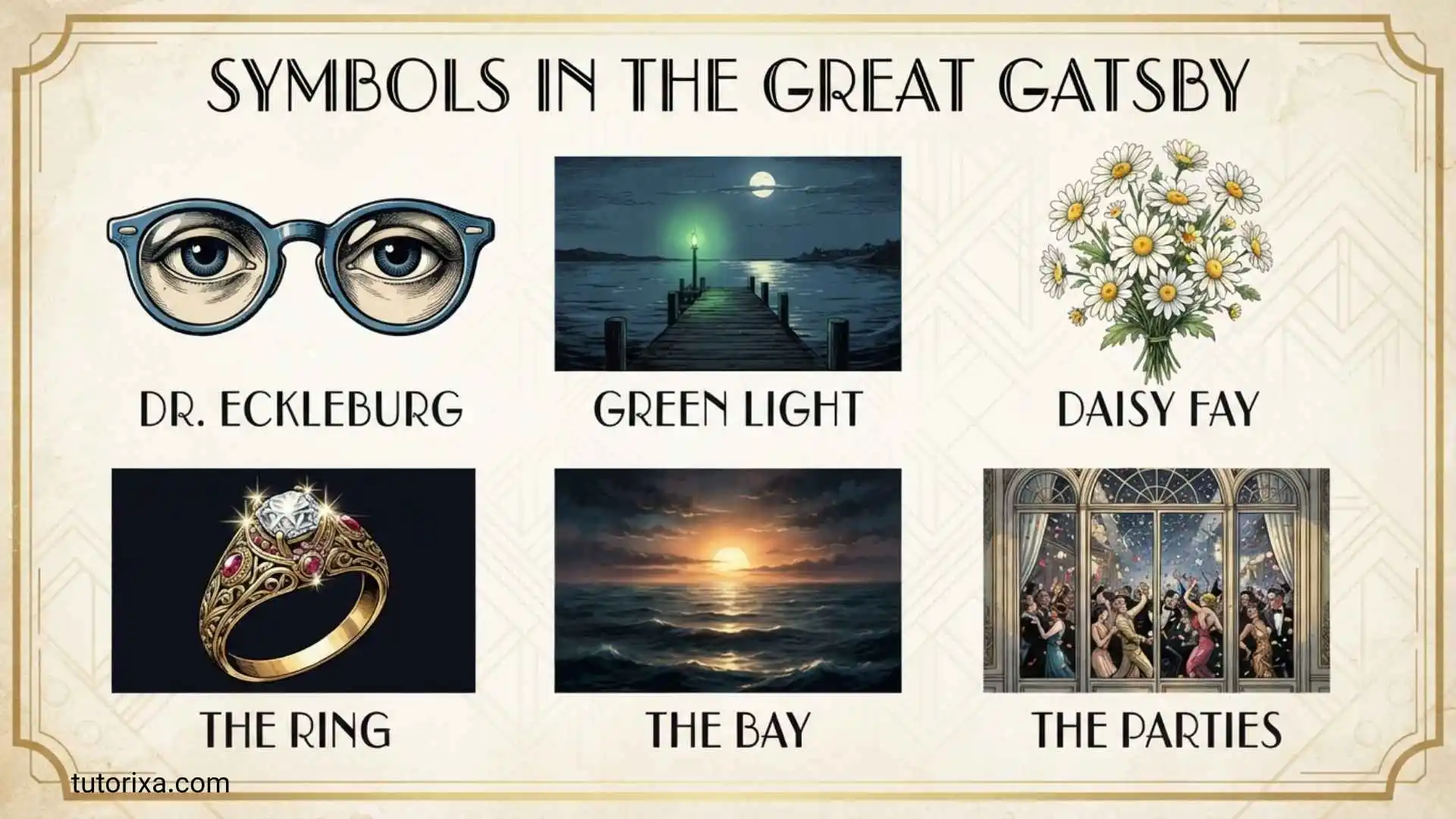
Symbols in The Great Gatsby give the novel deeper meaning and reveal ideas about dreams, wealth, love, and identity. I find that these symbols make Fitzgerald’s story much more powerful because ordinary objects and places often carry important messages.
As you read, you’ll notice that the green light, the eyes of Doctor T. J. Eckleburg, the Valley of Ashes, and Gatsby’s parties are more than simple details. I’ll help you understand what these symbols represent and why Fitzgerald uses them so effectively.
You don’t need to be an expert in literature to understand the symbolism. By the end, you’ll be able to recognize the major symbols, explain their meanings clearly, and see how they connect to the novel’s bigger themes.
Quick Meaning
The symbols in The Great Gatsby represent major ideas such as hope, the American Dream, moral decay, wealth, social class, illusion, judgment, and the impossibility of recreating the past. The green light represents Gatsby’s distant dream, while the Valley of Ashes represents the human and moral cost hidden beneath the glamour of wealth.
Symbol Overview Table
| Symbol Name | Primary Meaning | Category | Origin/Context | Common Usage in the Novel | Modern Interpretation |
| Green Light | Hope, desire, distant dreams | Object/Color | Daisy’s dock | Gatsby looks toward it from West Egg | Hope that remains just out of reach |
| Eyes of Dr. T. J. Eckleburg | Watching, judgment, moral uncertainty | Image/Advertisement | Billboard in the Valley of Ashes | Characters pass beneath the eyes | Surveillance, conscience, or a vanished moral authority |
| Valley of Ashes | Poverty, waste, moral decay | Setting | Industrial landscape between Long Island and New York | Wilsons live and work nearby | Hidden cost of prosperity |
| East Egg | Old money and inherited privilege | Setting | Fictional Long Island community | Home of Daisy and Tom | Established wealth and social status |
| West Egg | New wealth and social ambition | Setting | Fictional Long Island community | Gatsby’s home | Wealth without full social acceptance |
| Gatsby’s Mansion | Wealth, performance, loneliness | Architecture/Setting | Gatsby’s extravagant home | Hosts large parties | The emptiness behind material success |
| Colors | Different emotional and social associations | Color Symbolism | Recurring imagery | Green, yellow, white, gray, gold, blue | Mood, illusion, wealth, decay, innocence, or loss |
| Gatsby’s Car | Wealth, status, danger | Object | Gatsby’s public image | Associated with his luxurious lifestyle | Material success with destructive consequences |
| The Clock | Time and the past | Object | Gatsby and Daisy’s reunion | Gatsby nearly knocks it over | Desire to recover lost time |
What Do the Symbols in The Great Gatsby Mean?
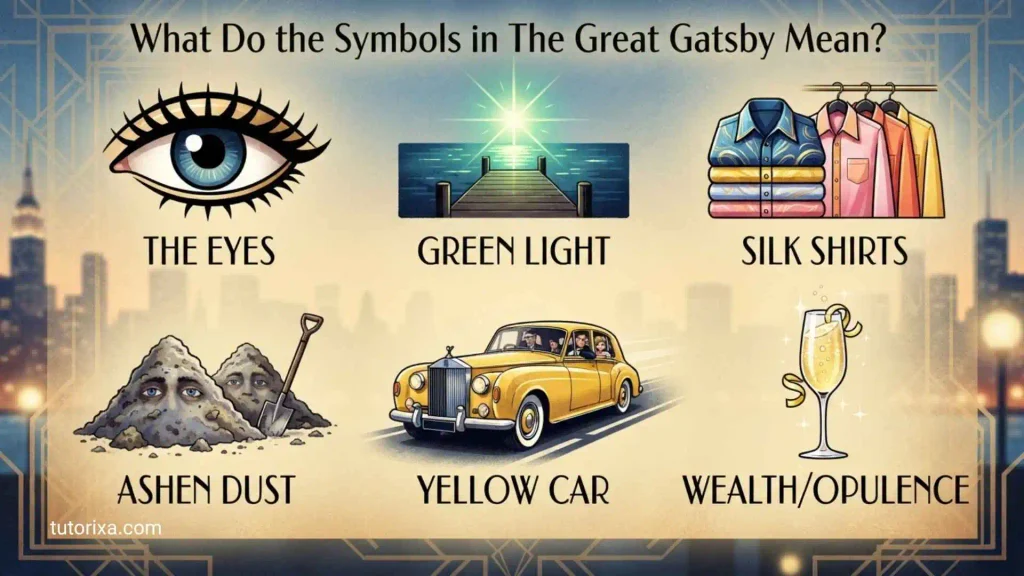
The symbols in The Great Gatsby collectively show the conflict between dreams and reality. Fitzgerald rarely uses symbolism simply for decoration. His images repeatedly connect personal desire with larger social problems.
The Green Light
The green light is the novel’s best-known symbol. It appears at the end of Daisy Buchanan’s dock, visible across the water from Gatsby’s home in West Egg. Gatsby associates the light with Daisy and the future he imagines with her.
Its meaning develops beyond romantic love. At first, it represents a goal that Gatsby believes he can eventually reach. As the story progresses, it becomes a symbol of hope, longing, ambition, and the American Dream.
The important point is distance. Gatsby can see the light, but he cannot simply possess what it represents. The physical distance across the water mirrors the emotional and social distance between Gatsby and Daisy.
The green light also connects the personal dream to the larger American ideal of creating a better future. Near the novel’s conclusion, Fitzgerald connects Gatsby’s longing with the broader history of American aspiration. The Library of America similarly identifies the green light with hopes, dreams, possibility, and disappointment.
Why it matters: The green light demonstrates how a dream can motivate someone while also becoming an illusion. Gatsby does not merely want Daisy as she actually exists; he wants the perfect future he has imagined.
The Eyes of Doctor T. J. Eckleburg
The eyes of Doctor T. J. Eckleburg appear on a faded billboard overlooking the Valley of Ashes. They belong to an advertisement for an eye doctor whose practice has disappeared.
The eyes can symbolize watchfulness, judgment, conscience, or the absence of reliable moral authority. However, it is important not to treat “the eyes = God” as the only correct interpretation.
George Wilson interprets the eyes in religious terms, believing they represent a divine presence watching human behavior. Other readings emphasize advertising and commercial culture: the image is not actually a supernatural being but a decaying commercial sign.
That ambiguity is important. Fitzgerald allows characters to project their own beliefs onto the billboard. Literary interpretations commonly connect the eyes with moral judgment, spiritual emptiness, and the tension between seeing and failing to understand.
Why it matters: The eyes ask whether anyone is truly watching over a society increasingly shaped by money, desire, and dishonesty.
The Valley of Ashes
The Valley of Ashes is the gray industrial area between the wealthy communities of Long Island and New York City. It contrasts sharply with Gatsby’s parties and the luxury of East Egg.
Symbolically, it represents poverty, waste, social inequality, and moral decay. The setting also reveals what the wealthy world can hide: prosperity exists alongside people who struggle with the consequences of an unequal society.
The ashes are particularly significant because they suggest something left behind after useful material has been burned. The landscape therefore becomes a powerful image of a society that produces wealth while leaving human and moral waste behind.
The Valley of Ashes is introduced early in the novel and serves as a physical link between wealthy Long Island and New York.
Why it matters: It prevents readers from viewing the glamorous world of the novel as complete. Behind the parties and expensive homes is a harsher social reality.
East Egg and West Egg
The two Eggs symbolize different forms of wealth.
East Egg represents established or inherited wealth. Tom and Daisy Buchanan belong to this world, where social position is connected to family background and long-standing privilege.
West Egg represents newer wealth. Gatsby is extremely rich, but his wealth does not automatically give him the social acceptance associated with old money.
The geographical division therefore becomes a symbol of class hierarchy. Money alone cannot erase social boundaries.
Why it matters: Gatsby discovers that becoming wealthy is not necessarily the same as becoming accepted by the social class he admires.
Gatsby’s Mansion
Gatsby’s enormous mansion symbolizes wealth, performance, ambition, and loneliness.
He fills the house with extravagant parties, hoping that Daisy might eventually appear. The mansion is impressive, but Gatsby himself often remains emotionally isolated.
His house therefore exposes a contradiction: he has acquired the material signs of success, yet the emotional goal behind his success remains unattained.
History and Origin
The symbolism of The Great Gatsby originates in Fitzgerald’s literary construction of a fictional world rather than in an ancient symbolic system or a single historical civilization.
Fitzgerald published the novel in 1925, during the American Jazz Age. The story reflects a period associated with changing social values, consumer culture, new wealth, extravagant entertainment, and tensions surrounding class. The National Endowment for the Arts describes the novel as a 1925 work centered on wealth, honesty, and the struggle to escape the past.
Many symbols also emerge from Fitzgerald’s descriptions of the physical world. The green light comes from Daisy’s dock. The eyes come from an advertising billboard. The Valley of Ashes comes from an industrial landscape. East Egg and West Egg are fictional settings that allow Fitzgerald to turn geography into social symbolism.
The novel’s famous first-edition cover is also connected to its symbolism. Francis Cugat designed the cover, featuring large eyes above a city-like scene. Fitzgerald reportedly saw the artwork before publication and wrote that he had incorporated its imagery into the book.
This relationship between visual art and literary imagery is unusual and historically significant because the cover itself became strongly associated with the novel’s symbolic world.
Symbolism and Interpretation
The traditional interpretation of the major symbols can be summarized simply:
- Green light: hope, longing, dreams, and the American Dream.
- Eckleburg’s eyes: observation, judgment, conscience, or spiritual uncertainty.
- Valley of Ashes: poverty, waste, inequality, and moral decay.
- East Egg: inherited wealth and established privilege.
- West Egg: new wealth and social ambition.
- Mansion: material success mixed with loneliness.
- Clock: time, memory, and Gatsby’s desire to restore the past.
- Colors: shifting associations with wealth, innocence, decay, desire, and illusion.
These meanings are not completely fixed. For example, green can suggest growth and hope, but its recurrence can also become connected with money, desire, and destructive ambition. This makes Fitzgerald’s color symbolism deliberately complex.
The novel repeatedly contrasts seeing with understanding. Characters observe one another, but they often misunderstand motives or refuse to face reality. The eyes of Eckleburg therefore connect naturally with the novel’s wider concern with perception.
Cultural Significance
The cultural significance of The Great Gatsby comes partly from its portrayal of American ideas about success.
The American Dream traditionally suggests that individuals can improve their lives through opportunity and effort. Fitzgerald complicates that idea. Gatsby acquires enormous wealth, but his dream is still blocked by class, time, and reality.
The novel also captures tensions associated with the 1920s, including consumerism, social mobility, changing relationships, and the attraction of luxury. Its symbols remain recognizable because modern societies continue to debate the relationship between wealth and happiness.
Different readers can therefore interpret the symbols through different cultural experiences. A reader focused on economics may see the Valley of Ashes as a class symbol. A reader interested in religion may emphasize the eyes as an image of judgment. A reader focused on psychology may see the green light as an example of idealization.
None of these interpretations automatically cancels the others.
Religious or Spiritual Meaning
Religious symbolism is most strongly associated with the eyes of Doctor T. J. Eckleburg.
George Wilson connects the eyes with God, giving the billboard a spiritual meaning. Yet Fitzgerald deliberately complicates this interpretation because the eyes are actually part of an abandoned advertisement.
This creates a striking contrast between spiritual belief and commercial culture. The image looks like something capable of seeing and judging, but it is ultimately an old advertisement.
The green light can also have a spiritual or transcendent interpretation because Gatsby treats it as something distant that gives direction to his life. However, the novel does not present the green light as a sacred object. Its significance comes from Gatsby’s personal projection onto it.
Where the Symbols Are Used
The symbols in The Great Gatsby appear primarily within literature, but their influence extends beyond the novel.
Literature
Teachers and students frequently study the symbols to understand themes such as the American Dream, class, illusion, and time.
Art and Book Design
The original cover by Francis Cugat is closely associated with the novel and reinforces the importance of eyes and visual perception.
Film
Film adaptations use visual techniques to emphasize recurring colors, locations, parties, cars, and the green light.
Education
The symbols provide a framework for literary essays because each one connects specific scenes with larger themes.
Popular Culture
The green light has become a widely recognized shorthand for unreachable goals, while the phrase “Valley of Ashes” can be used metaphorically for places marked by poverty or industrial decline.
Common Variations
The symbols can appear differently depending on the edition, adaptation, or interpretation of the novel.
The green light may receive strong visual emphasis in stage and screen adaptations. Directors can use lighting and camera distance to make Gatsby’s longing more obvious.
The eyes of Eckleburg may also look different in adaptations, but their basic role as an unsettling billboard image remains.
Color symbolism varies especially strongly among readers. Some interpretations associate gold and yellow with wealth or corruption, while others focus on the colors’ visual and emotional effects rather than assigning each color a single meaning.
This variation is useful because literary symbols do not work like mathematical formulas. A symbol can support several related ideas at once.
Common Misconceptions
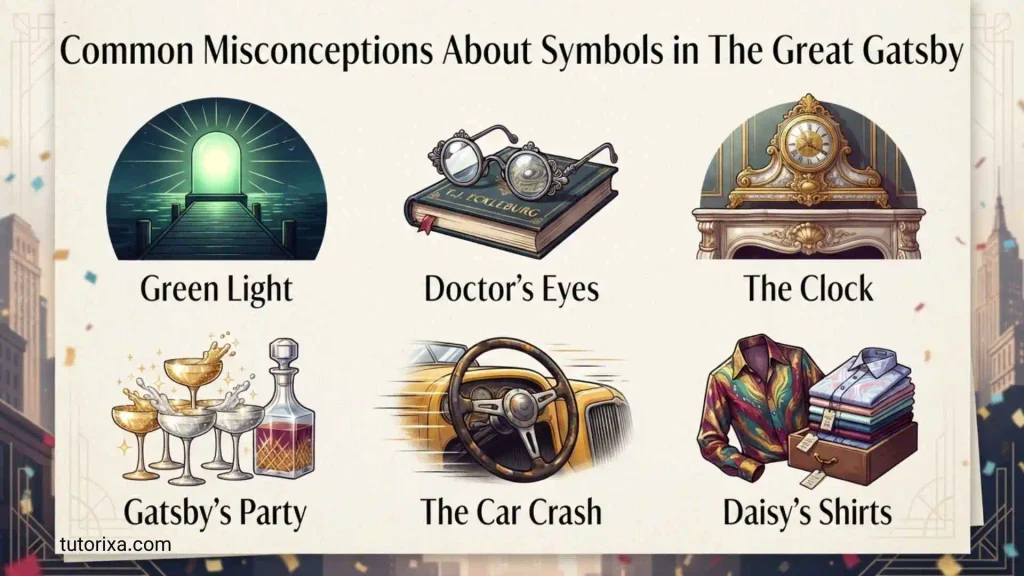
Misconception 1: The green light only means love
The green light is strongly connected with Daisy, but its meaning is broader. It also represents Gatsby’s hopes, future aspirations, and the American Dream.
Misconception 2: The eyes definitely represent God
George Wilson interprets them that way, but the novel does not establish that the billboard literally represents God. The religious reading is an interpretation created within the story.
Misconception 3: Every color has exactly one meaning
Fitzgerald uses colors repeatedly, but their meanings shift according to context. Treating every appearance of green, yellow, white, or blue as a fixed code can oversimplify the novel.
Misconception 4: Gatsby’s wealth proves he achieved the American Dream
Gatsby becomes wealthy, but his social and emotional goals remain unresolved. His experience suggests that money cannot automatically provide love, acceptance, or control over time.
Misconception 5: Symbols are separate from the plot
The symbols are closely connected to the story. The green light relates to Gatsby’s desire, the Valley of Ashes to social inequality, and the eyes to the novel’s concerns about morality and perception.
Interesting Facts
- The Great Gatsby was published in 1925.
The novel appeared during the Jazz Age, the historical period that forms its cultural background. - The green light is physically connected to Daisy’s home.
Its symbolic power comes partly from its real location across the water from Gatsby. - The Valley of Ashes is a fictional setting with an industrial character.
Fitzgerald transforms a bleak landscape into a symbol of social and moral consequences. - The Eckleburg eyes began as an advertisement.
Their symbolic power grows because the original commercial purpose has faded while the image remains. - The eyes are linked to the novel’s concern with seeing.
Characters constantly observe, judge, hide, and misunderstand one another. - Gatsby’s mansion has symbolic value beyond luxury.
Its size contrasts with Gatsby’s emotional isolation. - The clock symbolizes Gatsby’s relationship with time.
His reunion with Daisy shows how strongly he wants to recover what has already happened. - East Egg and West Egg turn geography into class symbolism.
The fictional locations make social divisions visible. - The first-edition cover has its own connection to the novel’s imagery.
Francis Cugat’s famous design features enormous eyes, and Fitzgerald indicated that he had incorporated the artwork into the book. - The symbols become more powerful when considered together.
The green light represents the dream, while the Valley of Ashes exposes the cost of a society obsessed with wealth.
Related Symbols About Symbols in The Great Gatsby
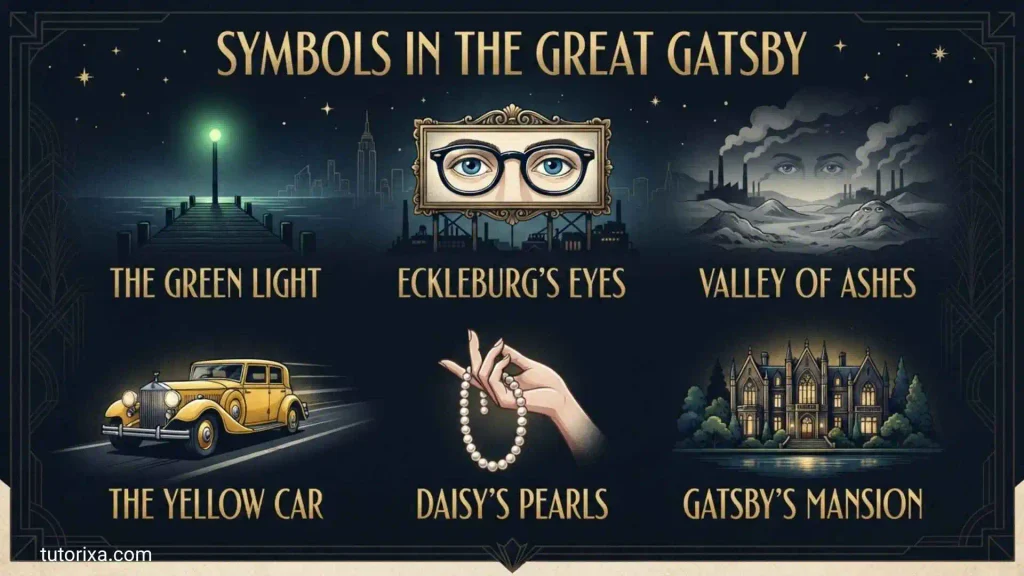
Several symbols and recurring images are closely connected:
- Green light and water: Water separates Gatsby from Daisy while also creating a visual space between dream and reality.
- Eyes and sight: The eyes connect with the novel’s repeated concern with observation, blindness, and misunderstanding.
- Valley of Ashes and gray imagery: Both reinforce ideas of lifelessness, poverty, and decay.
- Gatsby’s car and wealth: The automobile displays his success but also becomes associated with destructive consequences.
- The clock and the past: The clock captures Gatsby’s wish to make time behave as if it can be reversed.
- Gatsby’s parties and mansion: Both represent the performance of wealth and Gatsby’s attempt to attract Daisy.
- East Egg and West Egg: Together they symbolize the divide between inherited and newly acquired wealth.
The key difference is that these symbols do not operate independently. Fitzgerald builds a network in which dreams, money, time, class, and morality repeatedly overlap.
Frequently Asked Questions
What is the most important symbol in The Great Gatsby?
The green light is generally considered the novel’s central symbol because it connects Gatsby’s personal desire for Daisy with larger ideas about hope, ambition, the future, and the American Dream. Its distance from Gatsby also represents the gap between what he imagines and what reality can provide.
What does the green light symbolize in The Great Gatsby?
The green light symbolizes Gatsby’s hopes and dreams, especially his desire to reunite with Daisy. More broadly, it represents the American Dream and the human tendency to pursue a future that always seems just beyond reach. Its meaning becomes more complicated as Gatsby’s idealized vision encounters reality.
What do the eyes of Doctor T. J. Eckleburg symbolize?
The eyes can symbolize watching, judgment, conscience, or spiritual emptiness. George Wilson views them as the eyes of God, but the novel identifies them as part of an old advertising billboard. This ambiguity makes them one of the most debated symbols in the book.
What does the Valley of Ashes symbolize?
The Valley of Ashes symbolizes poverty, industrial waste, social inequality, and moral decay. It stands between wealthy Long Island and New York City, making it a visual reminder that the glamorous world of the novel exists alongside people who experience the harsher consequences of economic inequality.
What do East Egg and West Egg symbolize?
East Egg represents established, inherited wealth, while West Egg represents newer wealth. The distinction shows that financial success does not automatically provide social acceptance. Gatsby may possess enormous wealth, but he remains outside the social world represented by Tom and Daisy.
What does Gatsby’s mansion symbolize?
Gatsby’s mansion symbolizes material success, ambition, performance, and loneliness. Although the house is constantly associated with parties and luxury, Gatsby’s real purpose is more personal: he hopes his wealth and social display will help bring Daisy back into his life.
What does the clock symbolize?
The clock symbolizes time and Gatsby’s desire to recover the past. His reunion with Daisy reveals his belief that their earlier relationship can be recreated exactly. The clock therefore becomes an image of his struggle against the irreversible nature of time.
Why does Fitzgerald use so many colors?
Fitzgerald uses colors to create mood and reinforce ideas about wealth, desire, innocence, decay, and illusion. However, colors should not be treated as a rigid code. Their meanings depend on the surrounding scene and can change as the novel develops.
Are the symbols in The Great Gatsby connected?
Yes. The symbols form a connected system. The green light represents an idealized dream, while Gatsby’s mansion represents the wealth he uses to pursue it. The Valley of Ashes exposes the darker social world beneath that wealth, and the eyes of Eckleburg introduce questions about morality and judgment.
Why are symbols important in The Great Gatsby?
Symbols allow Fitzgerald to communicate large ideas through concrete images. Instead of explaining the American Dream only through abstract discussion, he gives readers the green light, the Eggs, the Valley of Ashes, and other recurring images. These symbols make the novel’s themes easier to visualize while allowing several interpretations.
Key Takeaways
- The green light represents Gatsby’s hope, desire, and the American Dream.
- The eyes of Doctor T. J. Eckleburg suggest watching, judgment, conscience, and spiritual uncertainty.
- The Valley of Ashes represents poverty, waste, inequality, and moral decay.
- East Egg symbolizes inherited wealth and established privilege.
- West Egg symbolizes newer wealth and social ambition.
- Gatsby’s mansion represents material success mixed with loneliness and performance.
- The clock symbolizes time and Gatsby’s desire to recreate the past.
- Colors reinforce themes but do not have one fixed meaning in every scene.
- Fitzgerald’s symbols are interconnected rather than isolated.
- Many symbols deliberately support more than one interpretation.
- The symbols help connect Gatsby’s personal tragedy to wider questions about American society.
- Understanding the symbols makes the novel’s themes of wealth, love, class, illusion, and the American Dream clearer.
Conclusion
The symbols in The Great Gatsby turn a story about Gatsby, Daisy, and the world of 1920s New York into a much larger examination of American life. The green light captures the attraction of a dream that always seems slightly beyond reach. The Valley of Ashes reveals the poverty and decay hidden beneath wealth and glamour. The eyes of Doctor T. J. Eckleburg raise difficult questions about morality, judgment, and the disappearance of meaningful authority.
The power of Fitzgerald’s symbolism comes from its connections. Gatsby’s mansion, the green light, the clock, the two Eggs, the automobiles, colors, and the Valley of Ashes all contribute to the same larger tension between dream and reality.
Ultimately, Fitzgerald suggests that people can build extraordinary visions of the future, but they cannot simply purchase the past or turn an idealized dream into reality. That is why the symbols remain central to understanding The Great Gatsby nearly a century after its publication.

I’m Ellis Montgomery, a British writer interested in the powerful language of symbols. I explore everything from traditional emblems and cultural signs to contemporary symbols found in modern life. My aim is to explain their meanings clearly while revealing the stories and ideas behind them, making symbolism fascinating and accessible to everyone.
Books:
- The Complete Book of Symbols
- Hidden Messages in Everyday Symbols
 Rowan Whitaker
 Freddie Beaumont