
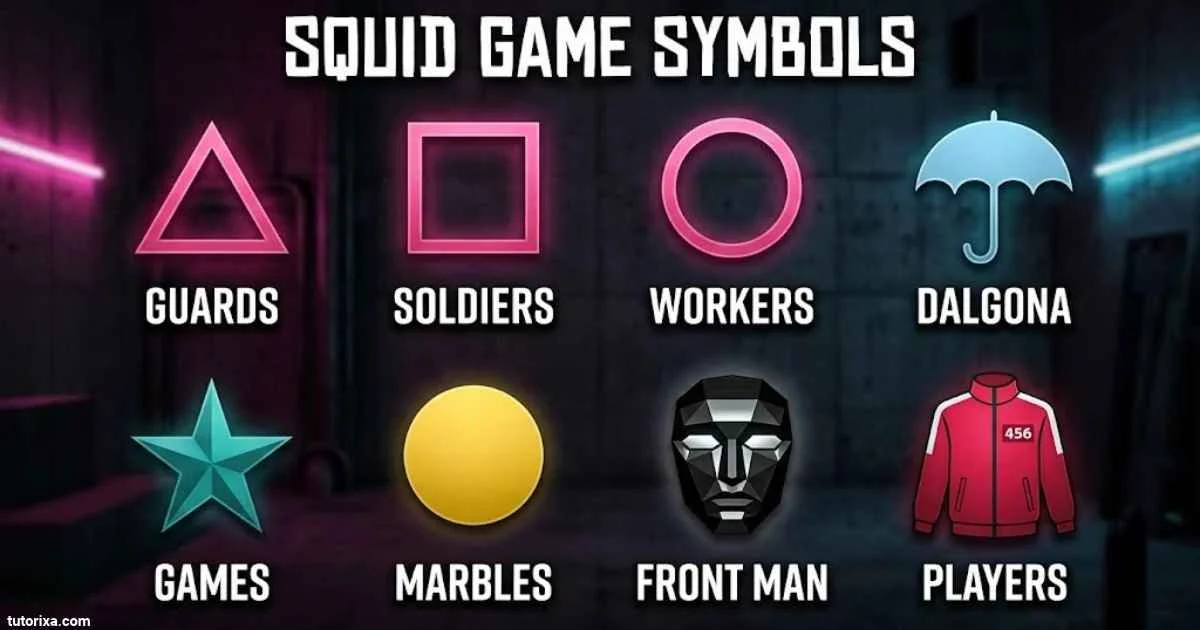
Squid Game symbols are among the most recognizable visual elements of the popular Korean survival drama. The mysterious circle, triangle, and square shapes appear on guards’ masks, uniforms, doors, and other parts of the games. Each shape has a connection to the show’s rules, characters, and hidden power structure.
The symbols are more than simple geometric designs. They help viewers understand the difference between workers, soldiers, and managers while representing themes such as control, inequality, survival, and authority. Even the colors used in the series have symbolic meanings that add depth to its story.
If you want to understand what these symbols represent, this guide explains their meanings, the Korean title, guard hierarchy, character symbolism, game designs, and cultural influence. You will also find Squid Game symbols and emojis that you can copy and paste into messages, social media posts, and creative designs.
What Does the Original Korean Squid Game Mean?
The original Korean title of the series is 오징어 게임 (Ojingeo Geim). It translates directly into English as Squid Game.
The name comes from a traditional Korean children’s playground game called Ojingeo Geim. The game is played on a court drawn on the ground, with a shape that resembles a squid. Players use different movements and strategies to compete against one another.
The traditional game involves two teams: attackers and defenders. The attacking team tries to reach a designated area while following the rules of the game. The defending team tries to stop them. The court’s unusual outline is the reason for its squid-related name.
The series uses this childhood game as the foundation for its fictional survival competition. It connects familiar childhood activities with much darker ideas about human behavior, desperation, and competition.
There is also a visual connection between the Korean title and the show’s three famous geometric shapes:
- Circle (○): Represents the circular parts of the traditional game design.
- Triangle (△): Appears in the central and connecting areas of the game court.
- Square (□): Represents the square-shaped area of the playing field.
These shapes became the central visual identity of the series, appearing on character masks, invitation cards, game equipment, and promotional designs.
What Does Squid Game Symbolize in Real Life?
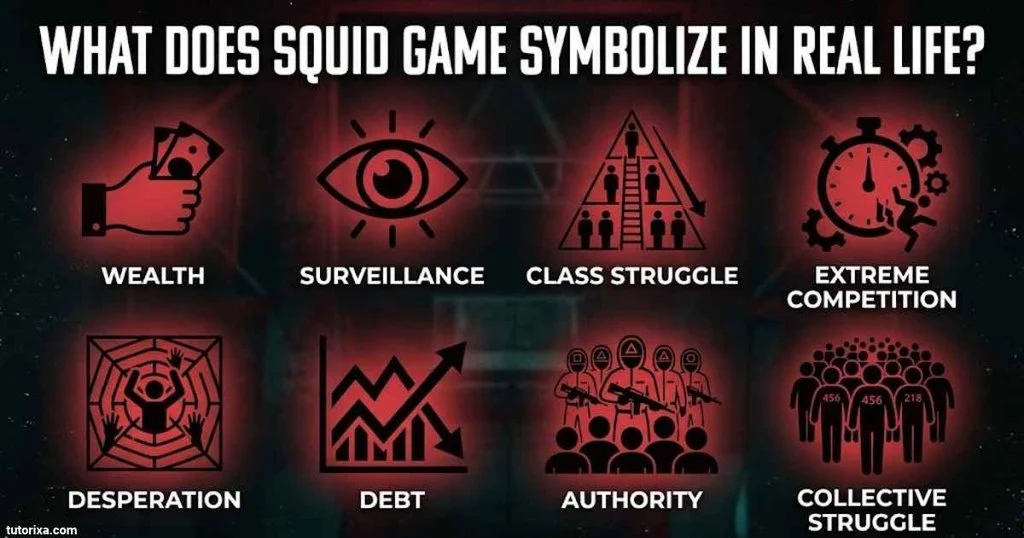
Squid Game uses a fictional competition to explore problems that exist in real society. Its biggest themes include economic inequality, debt, greed, social class, and the struggle to survive.
The contestants enter the competition because they face serious financial problems. They see the prize money as a chance to change their lives, even though the games put their lives at risk.
Here are the main real-life ideas represented by the series:
Economic Inequality
One of the strongest themes is the difference between wealthy people and those struggling financially. The contestants risk everything for money, while the wealthy VIPs watch their suffering as entertainment.
This reflects how financial power can create an unfair balance between different social groups.
Social Class and Power
The guards, managers, contestants, and VIPs occupy different positions within the fictional system. Their clothing, masks, and access to information help show who has power and who must follow orders.
The hierarchy reflects the way social systems can separate people according to their wealth, authority, and status.
Human Greed
The prize money creates conflict between contestants. Some characters choose personal gain over friendship, trust, and compassion.
The story explores how greed can influence decisions when people feel they have nothing left to lose.
Survival and Competition
The games turn ordinary childhood activities into dangerous challenges. The contestants must compete against one another instead of working together.
This can be interpreted as a criticism of systems where people feel forced to defeat others to secure their own future.
Loss of Human Identity
Players are identified by numbers instead of their names. This reduces their individuality and makes them easier to control.
The numbered tracksuits show how the organization treats contestants as participants in a system rather than as individual human beings.
The central message: Squid Game symbolizes a society where money and power can determine people’s opportunities, while those with fewer resources are pushed into difficult and sometimes desperate situations.
Squid Game Symbols Meaning
The most recognizable Squid Game symbols are the circle, triangle, and square. These shapes appear throughout the series and help viewers understand its fictional organization.
They also connect the story to childhood games and the larger theme of competition.
Here is a quick explanation of the main symbols:
| Symbol | Name | Main meaning in the series |
| ○ | Circle | Lowest-ranking workers |
| △ | Triangle | Armed guards or soldiers |
| □ | Square | Managers and supervisors |
| 🦑 | Squid | Childhood game and competition |
| 🎭 | Mask | Hidden identity and authority |
| 🔺 | Triangle emoji | Visual representation of the triangle |
| ⭕ | Circle emoji | Visual representation of the circle |
| ◼️ | Black square emoji | Visual representation of the square |
The three geometric shapes have a practical purpose within the story. They identify different ranks and help maintain order inside the game facility.
The squid represents the traditional Korean children’s game that inspired the series. Masks represent the secrecy surrounding the organization, as the guards hide their identities and personal lives.
The shapes also have a broader connection to the show’s social commentary. Creator Hwang Dong-hyuk has explained that they represent limitless competition in late capitalism and the different classes within the guards’ organization.
Dexerto+1
Circle, Triangle, Square Symbol Meaning in Squid Game
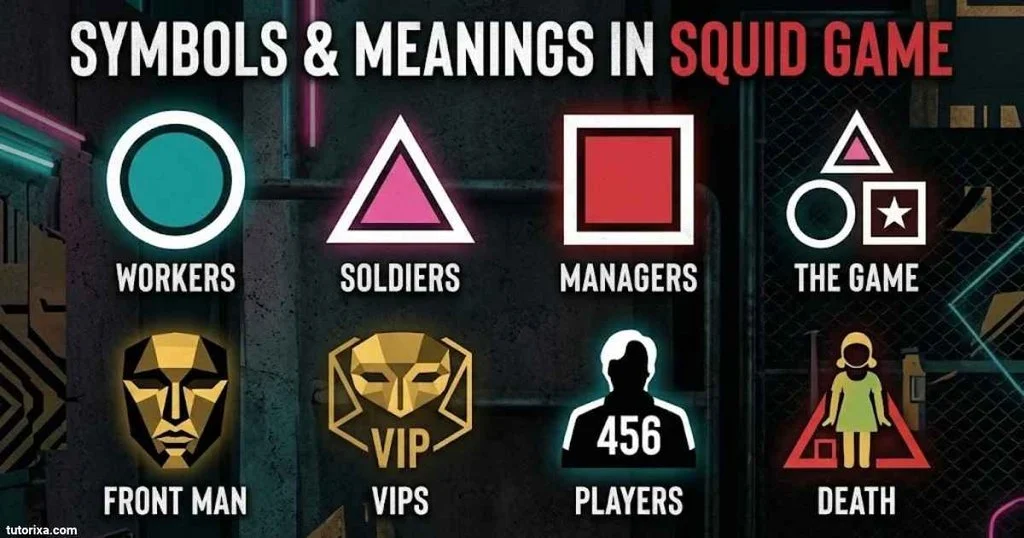
The circle, triangle, and square are the three main symbols of Squid Game. They are simple geometric shapes, but each one has a specific role in the fictional organization.
Circle (○) – Workers
Symbol: ○
Name: Circle
Role: Basic workers
Circle-masked workers occupy the lowest position in the guard hierarchy. They perform routine duties, such as cleaning, preparing food, and moving the bodies of eliminated contestants.
The circle has no corners or sharp edges. It can be seen as a visual representation of basic tasks and a lower position in the organization.
Triangle (△) – Soldiers
Symbol: △
Name: Triangle
Role: Armed soldiers
Triangle-masked guards carry weapons and enforce the rules. They are responsible for controlling contestants and carrying out punishments when players break the rules or fail a challenge.
The triangle’s sharp points give it a more aggressive appearance. Its three corners also distinguish it visually from the other two ranks.
Square (□) – Managers
Symbol: □
Name: Square
Role: Managers and supervisors
Square-masked workers occupy a higher position. They supervise lower-ranking guards, communicate with the Front Man, and help manage the games and facility.
The square has four corners and a balanced appearance. Within the fictional hierarchy, it represents greater authority and responsibility.
Why Are These Three Shapes Used Together?
The shapes are connected to the traditional squid game court. Their simple designs also make it easy to recognize different ranks without displaying names or complicated badges.
An interesting detail is that the production designer explained the hierarchy through the number of corners: circle, triangle, and square, moving from fewer corners to more.
koreajoongangdaily+1
Squid Game Guard Hierarchy Explained
The guard hierarchy in Squid Game is organized into different levels. Each level has specific responsibilities, and the symbols on the masks help identify the position of each worker.
The system keeps the guards anonymous while making their authority easy to recognize.
Here is how the main hierarchy works:
| Rank | Mask symbol | Main responsibility |
| Workers | ○ Circle | Cleaning, serving, and basic duties |
| Soldiers | △ Triangle | Security, weapons, and enforcement |
| Managers | □ Square | Supervision and organization |
| Front Man | Black geometric-style mask | Overall control of the game operation |
| VIPs | Animal masks | Wealthy spectators who finance and watch the competition |
Circle Guards
Circle guards perform basic jobs around the facility. They follow instructions from higher-ranking guards and have limited authority.
They are generally responsible for everyday tasks rather than directly controlling the competition.
Triangle Guards
Triangle guards have more authority than circle guards. They carry weapons and enforce the rules during the games.
Their job includes controlling contestants, guarding important areas, and eliminating players who fail challenges.
Square Guards
Square guards are supervisors who manage other workers. They have access to more information and can issue instructions to lower-ranking guards.
They also help coordinate different parts of the competition.
The Front Man
The Front Man is the central authority figure responsible for overseeing the competition. Unlike regular guards, he wears a distinctive black mask and dark clothing.
He communicates with the guards, monitors the games, and manages the overall operation. His position places him above the ordinary circle, triangle, and square ranks.
The VIPs
The VIPs are wealthy spectators who watch the games for entertainment. Their animal masks distinguish them from the regular guards and hide their identities.
They represent the extreme influence of wealth in the series. While contestants risk their lives, the VIPs enjoy the competition from a position of safety and privilege.
Remember: The circle, triangle, and square form the main worker hierarchy. The Front Man and VIPs occupy separate positions of authority and influence.
Squid Game Color Symbolism
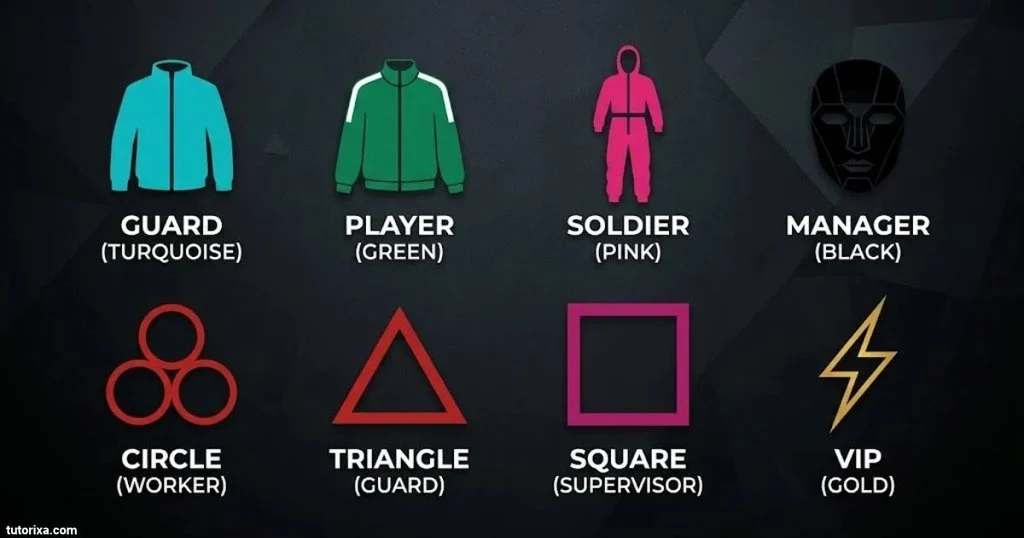
Colors play a major role in the visual identity of Squid Game. The contrast between the green tracksuits worn by contestants and the bright pink uniforms worn by guards is especially noticeable.
The production team selected these colors to create a childlike, almost fairy-tale appearance while showing the power difference between the two groups.
koreajoongangdaily+1
Green – Contestants and Survival
Green
Players’ tracksuits
Green is the main color of the contestants’ tracksuits. It connects to school sportswear and childhood memories.
Within the story, it represents the players, their vulnerability, and their struggle to survive. The green outfits also make the contestants look like members of one group rather than separate individuals.
Pink – Guards and Control
Pink
Guards’ uniforms and stairways
Pink is the signature color of the guards’ uniforms and many parts of the facility.
Although pink often has cheerful associations, the series uses it to create an unsettling contrast. The guards wear bright pink while carrying out frightening duties.
The production designer specifically described the relationship between green and pink as one of suppression and control.
Black – Mystery and Authority
Black
Front Man’s clothing and mask
Black is strongly associated with the Front Man. His dark clothing and mask separate him from the ordinary guards.
The color adds a sense of mystery, secrecy, and authority to his character.
White – Uncertainty and Isolation
White
Waiting and game spaces
White appears in several important spaces throughout the competition. It creates a blank, unfamiliar environment that can make contestants feel isolated and uncertain.
The production designer described the white waiting room as having a chaotic and dreamlike quality.
Korean Film Archive
Other Colors in Later Seasons
Later seasons introduce additional colors into the show’s visual design.
- Orange: Adds warmth, energy, and a sense of caution.
- Purple or violet: Creates a striking atmosphere and is associated by the production designer with ultimate power.
These colors expand the visual language of the series beyond its original green-and-pink contrast.
Definition+1
Squid Game Logo Shapes and Their Significance
The Squid Game logo is built around a distinctive visual identity. Its lettering and geometric shapes help make the series recognizable even without showing a character or scene.
The logo’s most recognizable elements are:
- Circle: A simple rounded shape that appears throughout the show’s branding.
- Triangle: A pointed geometric design associated with the guard hierarchy.
- Square: A balanced shape that represents the highest regular guard rank.
Why Does the Logo Use Simple Shapes?
The use of basic geometric shapes makes the logo easy to recognize. The same visual elements appear on the invitation cards, guards’ masks, and other objects throughout the series.
The shapes also connect the logo to the traditional Korean squid game.
The Korean-language logo uses the Hangul writing system, while international versions use localized lettering. The geometric design remains a recognizable part of the show’s identity.
What Makes the Logo Recognizable?
Three main design features help the logo stand out:
- Simple geometry: Basic shapes are easier to remember than complicated designs.
- Distinctive typography: The lettering gives the title a recognizable appearance.
- Repeated visual identity: The shapes connect the logo with the costumes, game settings, and promotional material.
The result is a visual identity that viewers can recognize across different languages and media.
Squid Game Characters and Their Symbolic Roles
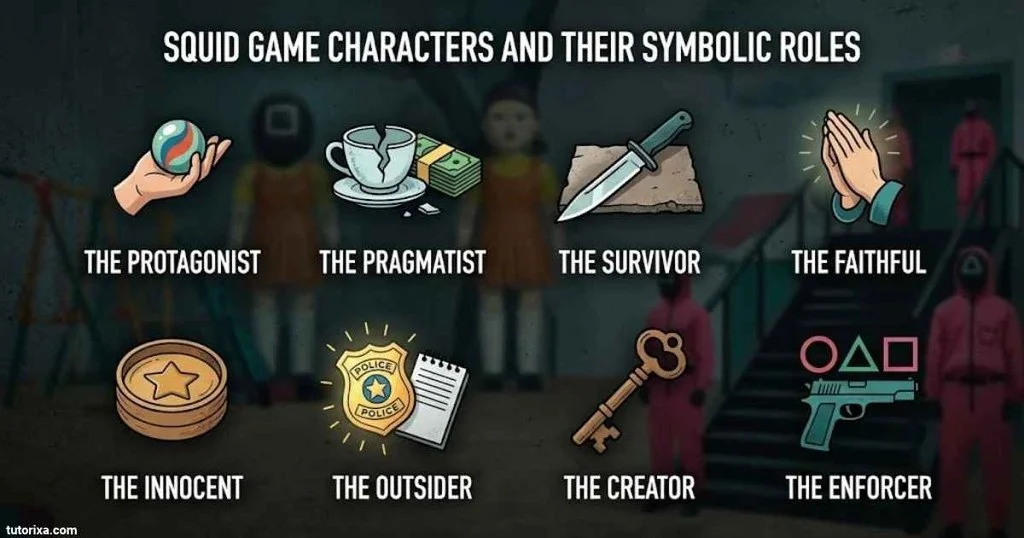
The characters in Squid Game represent different human qualities and social positions. Their decisions reveal how fear, greed, loyalty, friendship, and survival can influence people under extreme pressure.
Here are some of the most important characters and what they represent.
Seong Gi-hun – Humanity and Compassion
Gi-hun represents compassion, emotional struggle, and the desire to do what is right. Despite his financial problems, he often shows kindness toward other contestants.
His character explores the conflict between survival and humanity.
Cho Sang-woo – Ambition and Moral Conflict
Sang-woo represents ambition, social pressure, and the consequences of desperate decisions. His education and former success contrast with his financial collapse.
His actions show how fear and the desire to survive can change a person’s moral choices.
Kang Sae-byeok – Hope and Freedom
Sae-byeok represents independence, determination, and hope for a better future. Her main motivation is to create a safer life for her family.
Her story highlights the struggles of people who face social and economic barriers.
Abdul Ali – Trust and Kindness
Ali represents generosity, honesty, and trust. He often helps others despite facing difficult circumstances himself.
His character also shows how trusting the wrong person can lead to painful consequences.
Oh Il-nam – Nostalgia and Hidden Power
Il-nam represents childhood nostalgia and the complicated relationship between wealth and power.
His connection to the games reveals how innocent childhood memories can be transformed into something disturbing.
Hwang In-ho – Authority and Contradiction
The Front Man represents control, authority, and the ability to enforce a system even when its rules are cruel.
His character also explores the conflict between personal relationships and institutional power.
Hwang Jun-ho – Truth and Justice
Jun-ho represents curiosity, justice, and the search for truth. His investigation exposes parts of the hidden organization.
His story shows the importance of questioning systems that operate in secrecy.
These characters give the series emotional depth. Their different personalities show that the same difficult situation can lead people to make very different choices.
Spoiler note: The character interpretations above include themes and developments from the series.
Squid Game Games and Their Symbols
The games in Squid Game are based on familiar childhood activities. However, the series changes their rules and turns them into dangerous survival challenges.
Each game has its own visual design, objects, and symbolic meaning. The contrast between colorful playground settings and life-threatening consequences is one of the show’s most memorable features.
Here are the major games and the ideas associated with them.
Red Light, Green Light
Main symbol: 🚦 Traffic light
This game uses a giant doll named Young-hee. Contestants must move when the doll faces away and stop when it turns around.
The game symbolizes obedience, attention, and the consequences of breaking rules. A simple childhood activity becomes a test of fear and self-control.
2. Dalgona (Honeycomb Candy)
Main symbol: 🍪 Honeycomb candy
Players must carefully remove a stamped shape from a thin honeycomb candy without breaking it.
The four available designs are:
- ○ Circle
- △ Triangle
- ☆ Star
- ☂ Umbrella
The game symbolizes patience, precision, and the importance of making decisions under pressure. The umbrella is especially challenging because of its more complicated outline.
Tug-of-War
Main symbol: 🪢 Rope
Tug-of-war requires two teams to pull against each other. The winning team must use strength, coordination, and teamwork.
Its symbolism goes beyond physical power. It shows how cooperation and strategy can help people overcome opponents who appear stronger.
Marbles
Main symbol: 🔵 Marbles
Contestants are paired and given marbles to compete against one another.
The game symbolizes trust, friendship, betrayal, and emotional sacrifice. It forces players to confront the painful possibility of competing against someone they have come to care about.
Glass Stepping Stones
Main symbol: 💎 Glass panels
Players must cross a suspended bridge made of glass panels. Some panels are strong enough to hold their weight, while others break.
The game represents uncertainty, risk, and the pressure of making decisions without having complete information.
Squid Game
Main symbol: 🦑 Squid-shaped playground court
The final traditional game gives the series its name. Players compete on a court marked with geometric shapes.
It symbolizes the ultimate struggle for survival and victory. It also brings the story back to the childhood game that inspired the entire competition.
Six-Legged Pentathlon
Main symbol: 👣 Teamwork and linked legs
In the second season, teams of five players compete while their legs are tied together. They must complete several traditional mini-games.
The challenge represents cooperation, coordination, and the difficulty of depending on other people.
Mingle
Main symbol: 🎠 Carousel
Players move around a rotating platform and must form groups of a required size when instructed.
It represents social pressure, exclusion, and the fear of being left without a group.
Jump Rope
Main symbol: 🪢 Jump rope
This game requires contestants to cross a narrow path while avoiding a moving rope.
It symbolizes timing, balance, coordination, and the pressure to move forward despite danger.
Sky Squid Game
Main symbols: □ △ ○
The final competition uses three elevated towers shaped like a square, triangle, and circle.
Contestants must survive each stage and follow the rules to advance. The three shapes bring the series’ central geometric imagery back into its final competition.
The progression from simple childhood activities to increasingly dangerous challenges reinforces the show’s criticism of competition and inequality. Netflix’s official game guide provides further details about the rules and challenges across the seasons.
Netflix Tudum+1
Squid Game Shapes Honeycomb
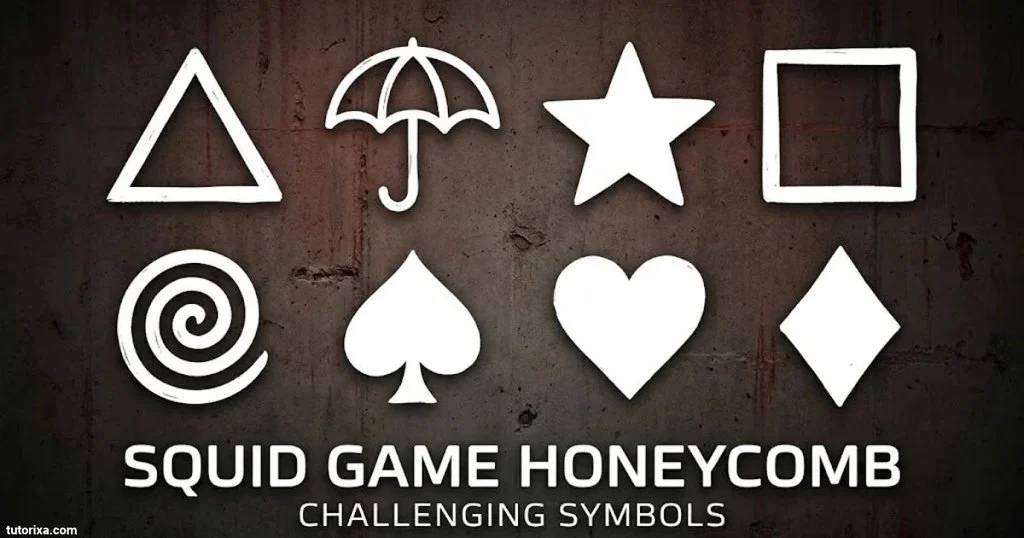
The honeycomb challenge is one of the most recognizable scenes in Squid Game. It features traditional Korean dalgona candy, a thin sugar treat with a shape stamped into its surface.
Players must separate the stamped design from the candy without breaking it. The challenge looks simple, but even a small mistake can cause the candy to crack.
The Four Squid Game Honeycomb Shapes
| Symbol | Shape name | Challenge difficulty |
| ○ | Circle | Relatively easy |
| △ | Triangle | Easier than complex designs |
| ☆ | Star | More detailed edges |
| ☂ | Umbrella | Particularly challenging |
Circle Honeycomb (○)
The circle is a simple rounded design without sharp corners. It is generally easier to remove because it has a smooth outline.
Symbolic meaning: Simplicity and an easier path.
Triangle Honeycomb (△)
The triangle has three straight sides and three corners. Players must carefully follow each edge to avoid breaking the candy.
Symbolic meaning: Precision and controlled movement.
Star Honeycomb (☆)
The star has multiple pointed sections. Its design requires more careful work than the circle or triangle.
Symbolic meaning: Complexity and attention to detail.
Umbrella Honeycomb (☂)
The umbrella has a more complicated outline, including a curved upper section and a handle. It is widely remembered as the most difficult of the four choices in the first season.
Symbolic meaning: Pressure, patience, and difficult decisions.
Why Is the Honeycomb Game So Popular?
The dalgona challenge became a major part of Squid Game’s cultural impact because it combines a familiar childhood treat with an intense survival challenge.
It also became a popular real-world activity. People recreated the candy, tried removing its shapes, and shared their results on social media.
You can use these shape characters to represent the honeycomb challenge in messages and designs:
○
Circle
△
Triangle
☆
Star
☂
Umbrella
Copy all four shapes
Squid Game Symbols and Emojis: Copy and Paste
If you want Squid Game symbols for Instagram, TikTok, WhatsApp, Facebook, gaming usernames, or messages, you can copy the characters below.
The original guard masks are visual designs from the television series, not three official Unicode characters. However, ordinary Unicode geometric symbols and emojis can be used as text-based alternatives.
Main Squid Game Symbols
○
Circle
Circle symbol
Copy
△
Triangle
White up-pointing triangle
Copy
□
Square
White square
Copy
🦑
Squid
Squid emoji
Copy
🎭
Masks
Performing arts emoji
Copy
🔺
Red Triangle
Red triangle emoji
Copy
⭕
Red Circle
Hollow red circle emoji
Copy
◼
Black Square
Black medium square
Copy
More Geometric Symbols
These additional characters can help you create different combinations and decorative designs.
| Symbol | Name |
| ● | Black Circle |
| ⚪ | White Circle |
| ◯ | Large Circle |
| ▲ | Black Up-Pointing Triangle |
| ▼ | Black Down-Pointing Triangle |
| ▽ | White Down-Pointing Triangle |
| ■ | Black Square |
| ▪ | Black Small Square |
| ▫ | White Small Square |
| ◆ | Black Diamond |
| ◇ | White Diamond |
| ★ | Black Star |
| ☆ | White Star |
Squid Game Symbol Combinations
You can combine the shapes to create simple designs inspired by the series.
○ △ □
Classic three-shape combination
Copy
○○○
Circle guard-inspired design
Copy
△ △ △
Triangle guard-inspired design
Copy
□ □ □
Square manager-inspired design
Copy
🦑 ○ △ □
Squid Game-inspired combination
Copy
🎭 🔺 ⭕ ◼
Mask and shape combination
Copy
Squid Game Text and Social Media Ideas
Here are some text combinations you can use in captions, bios, and messages:
- ○ △ □ Squid Game
- 🦑 The Game Begins
- 🎭 Trust No One
- △ Player 456
- ○ Player 001
- □ Game Master
- 🔺 Red Light, Green Light
- 🦑 Survival Mode: ON
A quick compatibility tip: The geometric characters are Unicode text symbols, while colorful emoji versions may look different depending on the device, operating system, and application. If you want a design that looks exactly like the original show, use an image or custom graphic rather than relying on text characters.
Squid Game Symbols in Pop Culture and Design
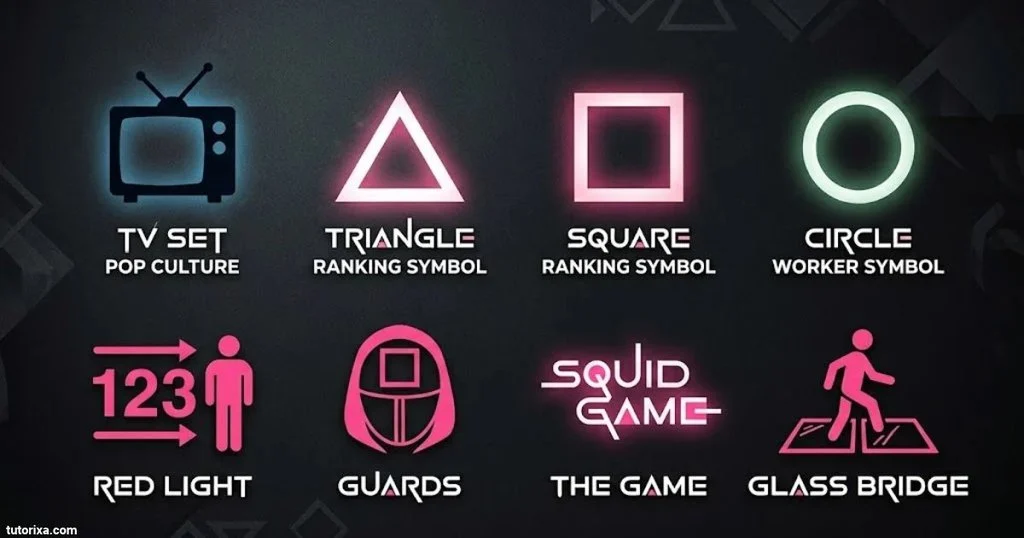
Squid Game symbols have become recognizable beyond the television series. The circle, triangle, and square are frequently used in fan art, Halloween costumes, graphic designs, social media posts, and gaming communities.
Their simple appearance makes them easy to reproduce. Even people who have never watched the show may recognize the pink guard uniforms and geometric masks.
Social Media Graphics
The geometric shapes work well in simple social media designs. Creators use them in Instagram posts, TikTok videos, profile pictures, and themed stories.
For example:
- ○ △ □ — A recognizable three-shape combination.
- 🦑 — A simple reference to the series.
- 🎭 — A mask-inspired visual for themed posts.
Halloween Costumes
The pink guard costume is one of the most recognizable Squid Game-inspired outfits.
People recreate the look using pink or red jumpsuits and black masks decorated with circles, triangles, or squares.
Each shape can represent a different guard position, making the costumes easy to distinguish.
Gaming Usernames
Players also use geometric symbols in gaming names and profile descriptions.
Some examples include:
- ○CircleGuard
- △TrianglePlayer
- □SquareMaster
- Squid🦑456
- Masked🎭Player
Not every game or platform supports every Unicode character, so it is worth checking your username before saving it.
Graphic Design and Branding
Designers use geometric shapes because they are simple, clear, and easy to recognize. The Squid Game visual style demonstrates how three basic shapes can create a memorable identity when used consistently.
You can take inspiration from the show’s visual approach by combining:
- Basic geometric shapes.
- Bold pink, green, and black colors.
- Minimal typography.
- Repeated visual patterns.
- Strong contrast between foreground and background.
However, if you are creating a commercial logo or brand identity, avoid copying Netflix’s official logo, artwork, or protected character designs without the necessary permissions.
Memes and Fan Art
Squid Game has inspired countless memes and fan-made designs. The guard masks, player numbers, and childhood games are especially popular subjects.
Fans often use the shapes to communicate ideas about competition, teamwork, survival, and mystery.
The popularity of these designs shows how a small group of visual elements can become a recognizable part of modern entertainment culture.
Frequently Asked Questions About Squid Game Symbols
What Are the Three Main Squid Game Symbols?
The three main symbols are the circle (○), triangle (△), and square (□). They appear on the guards’ masks and represent different positions in the organization’s hierarchy.
What Does the Circle Mean in Squid Game?
The circle represents the lowest-ranking workers. They perform basic duties, including cleaning, serving food, and removing eliminated contestants from the game areas.
Why Do Squid Game Guards Wear Pink?
The guards wear bright pink uniforms to create a strong visual contrast with the contestants’ green tracksuits. The color also contributes to the show’s unusual combination of childlike imagery and frightening events.
What Is the Meaning of the Squid Game Logo?
The logo uses distinctive lettering and geometric shapes associated with the traditional Korean children’s game. Its visual identity connects the series to its childhood-game inspiration and guard hierarchy.
Can I Copy and Paste Squid Game Symbols?
Yes. You can copy and paste Unicode alternatives such as ○, △, □, 🔺, ⭕, ◼, and 🦑 into supported messaging apps, social media posts, and text fields. Their appearance may vary across devices.
Conclusion
Squid Game uses simple geometric shapes, colorful costumes, and familiar childhood games to communicate deeper ideas about society. The circle, triangle, and square are more than decorative designs because they help explain the guard hierarchy and connect the story to its original Korean playground game.
The series also uses colors, characters, and game settings to explore economic inequality, greed, survival, authority, and human relationships. These visual elements work together to create an identity that viewers can recognize even outside the show.
If you want to use Squid Game symbols in your social media posts, usernames, messages, or graphic designs, you can copy the Unicode shapes and emojis shared in this guide. Remember that text symbols are alternatives to the original mask artwork, so their appearance may differ across platforms.

I’m Ellis Montgomery, a British writer interested in the powerful language of symbols. I explore everything from traditional emblems and cultural signs to contemporary symbols found in modern life. My aim is to explain their meanings clearly while revealing the stories and ideas behind them, making symbolism fascinating and accessible to everyone.
Books:
- The Complete Book of Symbols
- Hidden Messages in Everyday Symbols
 Rowan Whitaker
 Freddie Beaumont