
The Aztec calendar symbols are a fascinating visual language used by the Mexica and other Nahua-speaking peoples to organize time, record dates, connect ceremonies with the cosmos, and express ideas about creation and the movement of the sun. Today, these symbols are most commonly seen in reproductions of the famous Aztec Sun Stone, museum collections, books, artwork, jewelry, tattoos, and educational materials. Understanding them requires looking beyond the familiar circular stone: the symbols belong to several interconnected calendrical and religious systems.
The best-known monument associated with these symbols is the Piedra del Sol, or Sun Stone, a monumental basalt sculpture created during the late Postclassic period. It was discovered in Mexico City in 1790 and is now one of the most recognizable works of Mexica art. The National Institute of Anthropology and History (INAH) describes its imagery as representing the myth of the Five Suns, Nahui Ollin (“Four Movement”), the sun deity Tonatiuh, and calendrical signs.
Quick Meaning of Aztec Calendar Symbols
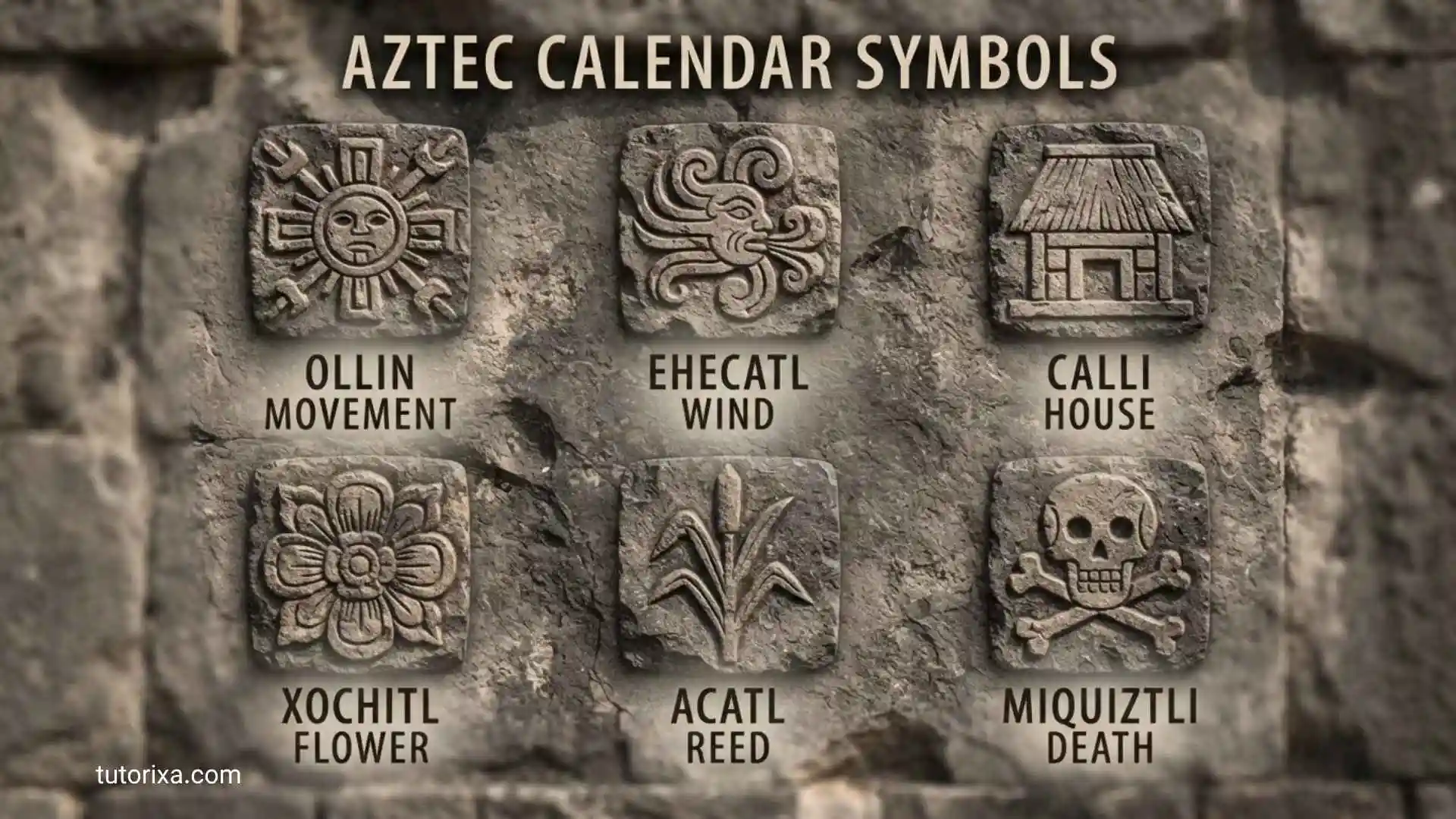
Aztec calendar symbols are signs representing days, years, cosmic eras, directions, natural forces, and religious concepts within Mexica calendrical traditions. The most important include 20 day signs such as Crocodile, Wind, House, Serpent, Death, Rabbit, Water, Monkey, Movement, Rain, and Flower. These signs worked with numbers to identify dates in the 260-day tonalpohualli and interacted with the 365-day solar calendar.
Aztec Calendar Symbols at a Glance
| Symbol or System | Meaning or Function | Category | Culture | Main Context |
| Cipactli | Crocodile-like earth creature | Day sign | Mexica/Nahua | Tonalpohualli |
| Ehecatl | Wind | Day sign | Mexica/Nahua | Tonalpohualli |
| Calli | House | Day sign | Mexica/Nahua | Tonalpohualli |
| Coatl | Serpent | Day sign | Mexica/Nahua | Tonalpohualli |
| Miquiztli | Death | Day sign | Mexica/Nahua | Tonalpohualli |
| Tochtli | Rabbit | Day sign | Mexica/Nahua | Tonalpohualli |
| Atl | Water | Day sign | Mexica/Nahua | Tonalpohualli |
| Ozomatli | Monkey | Day sign | Mexica/Nahua | Tonalpohualli |
| Ollin | Movement | Day sign | Mexica/Nahua | Tonalpohualli |
| Xochitl | Flower | Day sign | Mexica/Nahua | Tonalpohualli |
| Nahui Ollin | Four Movement | Cosmic sign | Mexica | Five Suns |
| Tonatiuh | Sun deity | Divine figure | Mexica | Sun Stone |
| Xiuhmolpilli | 52-year cycle | Calendar cycle | Mexica/Nahua | New Fire ceremony |
| Unicode | No dedicated complete Aztec calendar symbol set | Digital | Modern | Not applicable |
What Do Aztec Calendar Symbols Mean?
Aztec calendar symbols primarily identify days and dates, but their significance extends much further. A day was not simply a neutral unit of time. Its name and number could carry religious, ritual, and divinatory associations.
The 260-day tonalpohualli combined 20 named day signs with numbers from 1 through 13. This produced 260 unique number-and-sign combinations before the cycle repeated. A date could therefore be expressed through a combination such as a number plus a day sign rather than through a month-and-day arrangement like the modern Gregorian calendar. The Metropolitan Museum of Art notes that Mexica dates could appear as combinations such as “1 Crocodile,” “2 Reed,” or “4 Movement.”
The 20 principal day signs are:
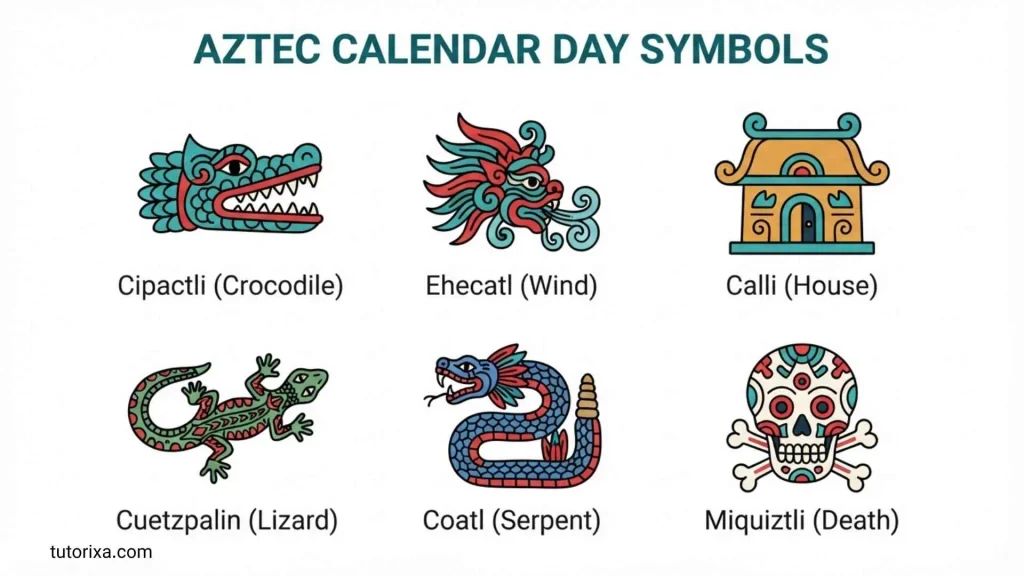
- Cipactli — Crocodile or earth creature
- Ehecatl — Wind
- Calli — House
- Cuetzpalin — Lizard
- Coatl — Serpent
- Miquiztli — Death
- Mazatl — Deer
- Tochtli — Rabbit
- Atl — Water
- Itzcuintli — Dog
- Ozomatli — Monkey
- Malinalli — Grass or twisted plant
- Acatl — Reed
- Ocelotl — Jaguar
- Cuauhtli — Eagle
- Cozcacuauhtli — Vulture
- Ollin — Movement
- Tecpatl — Flint or obsidian blade
- Quiahuitl — Rain
- Xochitl — Flower
This sequence is documented in scholarship on Mexica art and the Sun Stone.
It is important, however, not to assign a simplistic personality meaning to every sign. Modern websites sometimes present the 20 signs as if each were equivalent to a modern horoscope sign. The historical evidence is more complicated. These signs were components of a calendrical and divinatory system whose interpretation depended on the complete date, ritual context, deities, and other factors.
History and Origin of the Aztec Calendar Symbols
The calendar system used by the Mexica did not appear suddenly with the Aztec Empire. Calendrical traditions were widespread across Mesoamerica, and different cultures developed related systems over many centuries.
The Mexica inherited and adapted traditions that had deeper Mesoamerican roots. Other cultures, including the Maya, used their own forms of interlocking calendars. The Maya Tzolk’in, for example, also combined 20 day names with numbers from 1 to 13, producing a 260-day cycle. Similarities demonstrate a broad Mesoamerican calendrical tradition, although the Maya and Mexica systems should not be treated as identical.
Among the Mexica, the 260-day ritual calendar worked alongside a 365-day solar calendar, often called the xiuhpohualli in modern descriptions. The solar year consisted of 18 periods of 20 days plus five additional days known as nemontemi.
The two systems interacted over a longer 52-year cycle. This cycle is associated with the xiuhmolpilli, literally a “binding of the years.” INAH describes the xiuhmolpilli as a bundle representing a 52-year period and connects it with the New Fire ceremony.
The famous Sun Stone was carved much later than the earliest Mesoamerican calendars. INAH dates its completion to approximately 1479, during the reign of Axayacatl, based partly on the date 13 Reed carved on the monument.
Understanding the Aztec Sun Stone
The Sun Stone is the object most people have in mind when they search for Aztec calendar symbols. Yet calling it simply an “Aztec calendar” can be misleading.
The sculpture is a highly complex monument combining calendrical signs, cosmological imagery, solar symbolism, and mythological themes. INAH describes the central imagery as including Tonatiuh, the sun deity, and Nahui Ollin, the “Four Movement” sign associated with the Fifth Sun, or present cosmic era.
The stone also contains the signs of the 20-day cycle around its central imagery. Its design therefore communicates ideas about time, cosmic order, movement, creation, destruction, and renewal rather than functioning merely as a wall calendar.
Its exact original function remains debated. Because the stone was found face-down in 1790, its original placement is uncertain. INAH notes that researchers have proposed ceremonial functions, including a possible connection with ritual sacrifice, while emphasizing the monument’s calendrical and cosmological imagery.
The Meaning of Nahui Ollin
Nahui Ollin, meaning “Four Movement,” is one of the most important symbols associated with the Sun Stone.
Ollin means movement, and the sign is traditionally connected with the Fifth Sun in Mexica cosmology. According to the cosmological framework represented on Mexica monuments, previous cosmic ages had ended through catastrophic transformations. The present age was understood as the Fifth Sun.
The importance of movement reflects a central idea: the sun must move through the sky, and cosmic order must be maintained. INAH specifically identifies Nahui Ollin as the symbol of the Fifth Sun and the present era, while connecting it with the unstable balance of the cosmos.
This makes the symbol more complex than the modern idea of a generic “sun symbol.” It represents motion, cosmic continuity, time, and the vulnerability of the current world order.
Symbolism and Interpretation
Aztec calendar symbols connect several concepts that modern calendars usually separate.
Time and Order
Calendar signs transformed the passage of time into a structured system. Dates could identify ceremonial occasions, historical events, and ritual periods.
Movement and Renewal
The concept of movement was particularly important to Mexica cosmology. The sun’s daily movement was tied to broader ideas about cosmic continuity.
Life and Death
Symbols such as Miquiztli, or Death, demonstrate that the calendar did not avoid difficult concepts. Death existed within a larger cyclical understanding of existence, rather than being treated simply as an isolated opposite to life.
Nature
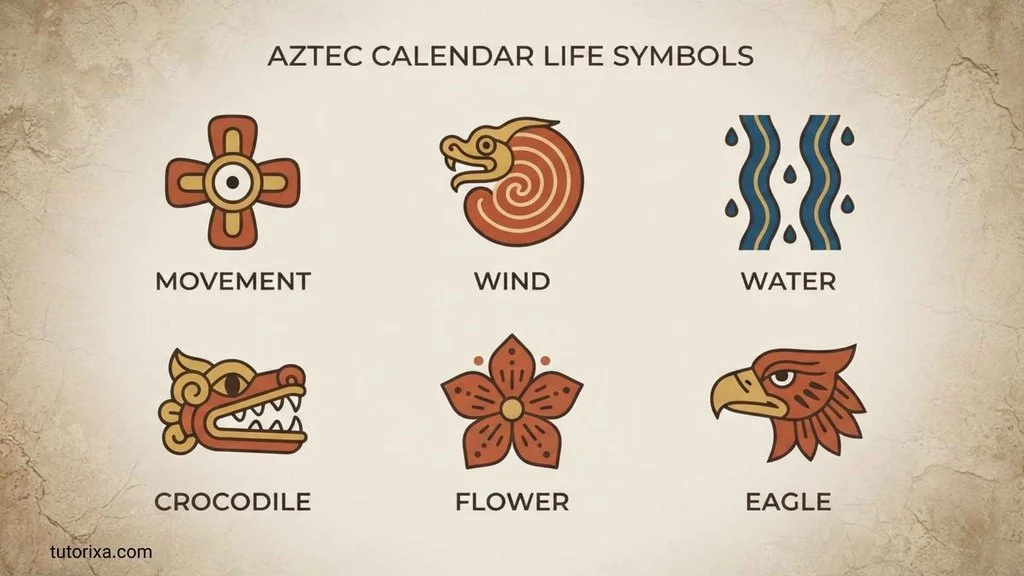
Animals, plants, water, wind, rain, and celestial forces appear throughout the calendar signs. This reflects a worldview in which human life, agriculture, weather, religion, and cosmic events were closely connected.
Divination
The 260-day tonalpohualli was associated with divination. A person’s calendrical date could be considered meaningful in determining ritual circumstances or personal destiny. Mexica divinatory traditions included tonalamatl, or books of days, used to preserve and interpret calendrical information.
Modern interpretations should distinguish these historical associations from contemporary spiritual systems that may assign simplified personality traits to individual signs.
Cultural Significance of Aztec Calendar Symbols
The symbols are significant because they reveal how the Mexica understood time as part of a living cosmic order.
The calendar was not merely an administrative tool. Dates were connected with festivals, ceremonies, rulers, gods, agricultural cycles, and cosmological stories.
The 52-year cycle was particularly important. At the end of a cycle, the Mexica performed the New Fire ceremony, an important ritual marking renewal. INAH describes the ceremony as involving the extinguishing of household and temple fires before a new sacred fire was kindled at Huixachtlan, the Hill of the Star.
Calendar symbols could also appear outside circular calendar monuments. Mexica monuments, sculptures, and ritual objects incorporated individual day signs and dates. The Metropolitan Museum notes that sequences of day signs appear in “celestial belts” on Postclassic monuments and may have had astrological significance among Nahua- and Mixtec-speaking peoples.
Religious and Spiritual Meaning
Aztec calendar symbolism was deeply connected with religion because Mexica ideas about time were inseparable from gods and cosmic events.
The Five Suns tradition described successive cosmic eras. The Mexica regarded their present era as the Fifth Sun, represented through Nahui Ollin. Other monuments also show the importance of dates in religious mythology.
For example, the Teocalli of the Sacred War contains calendrical glyphs connected with major religious and historical themes. INAH identifies dates including “1 Flint,” “1 Death,” “2 House,” and “2 Reed,” with some associated with deities, the founding of Mexico-Tenochtitlan, and the New Fire ceremony.
This demonstrates why a calendar symbol should not be interpreted separately from its context. A single glyph could identify a date while also connecting that date to a deity, ceremony, myth, or historical event.
Scientific or Technical Meaning
Aztec calendar symbols do not have a modern scientific meaning in the way that mathematical or chemical symbols do. Their importance lies instead in astronomical observation and timekeeping.
The Mexica calendar reflects systematic organization of recurring time cycles. The 260-day and 365-day systems interacted mathematically, while the 52-year cycle provided a larger period of calendrical synchronization.
These systems show that ancient Mesoamerican societies developed sophisticated methods for organizing recurring temporal patterns. Related Mesoamerican traditions also demonstrate close relationships between calendrical calculation, astronomy, architecture, ritual, and agriculture.
However, the calendars should not be described as identical to modern astronomy. Their purpose was cultural and religious as well as observational.
Where Aztec Calendar Symbols Are Used Today
Today, Aztec calendar symbols appear in many settings:
- Museums: The original Sun Stone is preserved and displayed in Mexico City.
- Books: Archaeology and Mexican history books frequently reproduce the stone.
- Educational materials: Calendar signs are used to teach Mesoamerican history.
- Art: Artists adapt day signs and solar imagery into contemporary designs.
- Jewelry: Circular reproductions of the Sun Stone are commonly sold as cultural motifs.
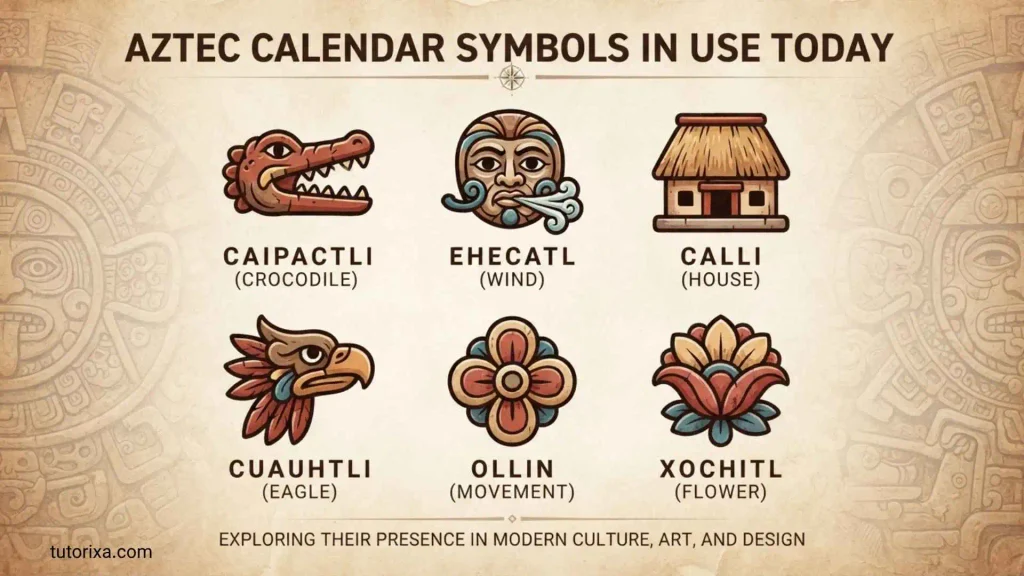
- Tattoos: Individuals sometimes choose individual signs such as Ollin, Ocelotl, or Xochitl.
- Architecture: Mexica-inspired designs may incorporate geometric and calendrical motifs.
- Decorative objects: Reproductions of the Sun Stone are widely used as Mexican cultural imagery.
- Digital graphics: Simplified versions appear in websites, illustrations, and educational diagrams.
A modern design, however, should not automatically be presented as an authentic ancient glyph. Contemporary artists frequently simplify or reinterpret historical imagery.
Common Variations of Aztec Calendar Symbols
There are several ways the symbols appear depending on the object and period.
Individual Day Signs
A single symbol such as Ocelotl or Cuauhtli can appear independently, particularly when identifying a calendrical date.
Number-and-Sign Combinations
The complete calendrical identity of a day required both a number and a sign. A carved animal alone may therefore be only part of the original date.
Sun Stone Designs
The Sun Stone combines multiple concentric zones of imagery. Modern reproductions often simplify these areas, remove details, or change proportions.
Contemporary Adaptations
Modern Mexican and Indigenous-inspired art may use historical symbols for decorative, cultural, or identity-related purposes. These designs can be meaningful today without necessarily representing their original ritual function.
Common Misconceptions About Aztec Calendar Symbols
“The Sun Stone is simply an ancient calendar.”
Not exactly. It contains calendrical signs, but it also represents cosmology, mythology, solar imagery, and the Five Suns. Its original function remains a subject of scholarly discussion.
“The Aztec calendar predicts the future like a modern horoscope.”
This is an oversimplification. The 260-day calendar was associated with divination, but its interpretation involved a complex system of numbers, day signs, ritual knowledge, and religious concepts.
“Every Aztec symbol has one fixed meaning.”
Historical symbols could have multiple associations depending on context. An animal or natural element could function as a day sign while also carrying mythological or religious associations.
“Aztec and Maya calendars were the same.”
They were related Mesoamerican calendrical traditions, but they belonged to different cultures and had different names, writing systems, histories, and conventions.
“The calendar predicted the end of the world in 2012.”
This modern claim confused different Mesoamerican calendrical traditions and their cycles. It should not be used as an interpretation of Mexica calendar symbolism.
“The symbols are a form of modern Unicode writing.”
They are historical glyphic and pictorial signs, not a standardized modern digital writing system. There is no single Unicode block containing the complete traditional Aztec calendar.
10 Interesting Facts About Aztec Calendar Symbols
- The Sun Stone was discovered in 1790.
The monumental stone was uncovered during construction work in Mexico City and had been buried with its relief facing downward. - The stone weighs about 24 tons.
INAH describes it as an enormous monolith weighing approximately 24 metric tons, demonstrating the extraordinary scale of Mexica stoneworking. - The Sun Stone carries a historical date.
Its inscription includes “13 Reed,” corresponding to 1479, generally regarded as the year of its completion under Axayacatl. - There are 20 principal day signs.
They include animals, natural phenomena, objects, plants, and abstract concepts such as Movement. - Ollin means movement.
This sign has exceptional importance because Nahui Ollin is connected with the Fifth Sun and the present cosmic era. - Monkey had cultural associations beyond the calendar.
The Mexica day sign Ozomatli means monkey, while monkey imagery was also associated with music, dance, and clowning. - The calendar used both numbers and names.
A date was not simply a picture. Number-and-sign combinations created a much larger cycle of distinct dates. - The 52-year cycle had major ceremonial importance.
The xiuhmolpilli was associated with the New Fire ceremony and the renewal of the calendar cycle. - The symbols occur beyond the Sun Stone.
Calendrical signs appear on monuments and ritual objects, showing that calendar imagery was part of a broader visual culture. - The stone is not a simple picture of the sun.
Its imagery brings together time, movement, creation, cosmic eras, ritual, and calendrical signs.
Related Symbols and Concepts
Several symbols and concepts help explain the Aztec calendar system:
- Nahui Ollin: Four Movement, associated with the Fifth Sun and the present cosmic era.
- Tonatiuh: The sun deity represented prominently in interpretations of the Sun Stone.
- Tonalpohualli: The 260-day ritual and divinatory calendar.
- Xiuhpohualli: The 365-day solar calendar.
- Xiuhmolpilli: The 52-year cycle created through the interaction of calendrical cycles.
- Nemontemi: The five additional days completing the 365-day solar year.
- New Fire Ceremony: A major ritual marking the renewal of the 52-year cycle.
- Ollin: The day sign meaning movement.
- Tecpatl: Flint or obsidian, another important calendrical sign.
- Five Suns: A cosmological framework describing successive world eras.
These concepts are connected, but they should not be treated as interchangeable. A day sign is different from a calendar, a calendar is different from a cycle, and the Sun Stone is a monument containing several kinds of symbolism.
Frequently Asked Questions
What are the main Aztec calendar symbols?
The main calendrical symbols are the 20 day signs of the tonalpohualli. They include Cipactli (Crocodile), Ehecatl (Wind), Calli (House), Coatl (Serpent), Miquiztli (Death), Tochtli (Rabbit), Atl (Water), Ozomatli (Monkey), Ollin (Movement), Quiahuitl (Rain), and Xochitl (Flower), among others.
What does the Aztec calendar symbol mean?
There is no single “Aztec calendar symbol.” The term usually refers to the many signs appearing in Mexica calendrical systems or on the Sun Stone. Individual signs identify days, while larger imagery represents concepts such as the sun, movement, cosmic eras, directions, and ritual time.
What does Nahui Ollin mean?
Nahui Ollin means “Four Movement.” It is an important Mexica calendrical and cosmological expression associated with the Fifth Sun, the present cosmic era. INAH describes it as representing the present era and connecting the Sun Stone’s central imagery with movement and cosmic balance.
How many symbols are in the Aztec calendar?
The 260-day tonalpohualli uses 20 named day signs, combined with 13 numbers. The resulting 260 combinations form the complete cycle. The Sun Stone also contains other imagery, so counting every carved element as a “calendar symbol” would produce a different and less useful number.
What animals appear in the Aztec calendar symbols?
Animals among the 20 day signs include the crocodile or earth creature, lizard, serpent, deer, rabbit, dog, monkey, jaguar, eagle, and vulture. These animal names served as calendrical identifiers and could have broader cultural or religious associations depending on context.
Is the Aztec calendar the same as the Aztec Sun Stone?
No. The Sun Stone is a specific monumental sculpture that contains calendrical imagery among many other themes. The term “Aztec calendar” is often used popularly for the stone, but the actual Mexica calendar system consisted of interconnected cycles that existed independently of this monument.
What does the Aztec calendar say about time?
It presents time as cyclical, structured, and closely connected with cosmic and religious order. The 260-day and 365-day cycles interacted to create longer periods, including the 52-year cycle. This structure linked ordinary dates with ceremonies, agriculture, mythology, and ideas about cosmic renewal.
Did the Aztecs use the calendar for religion?
Yes. Calendrical cycles were closely connected with religious ceremonies, divination, festivals, and mythology. Specific dates could have ritual significance, while larger cycles culminated in ceremonies such as the New Fire ceremony. Religious monuments also incorporated dates and calendar signs.
Does every Aztec calendar symbol have a spiritual meaning today?
Not necessarily. Some modern people use these symbols for cultural, artistic, or spiritual purposes, but modern interpretations should not automatically be presented as ancient Mexica beliefs. Historical meanings depended on context, and scholars distinguish documented traditions from modern adaptations.
Where can I see the original Aztec Sun Stone?
The original Piedra del Sol is preserved in Mexico City at the Museo Nacional de Antropología, where it forms one of the best-known examples of Mexica monumental art. INAH identifies the museum as its current home.
Key Takeaways
- Aztec calendar symbols are part of a complex Mexica system for organizing and interpreting time.
- The famous Sun Stone is not simply a calendar; it combines calendrical, solar, mythological, and cosmological imagery.
- The 260-day tonalpohualli uses 20 day signs and numbers from 1 to 13.
- The 20 signs include Crocodile, Wind, House, Serpent, Death, Rabbit, Water, Monkey, Movement, Rain, and Flower.
- Nahui Ollin, or Four Movement, is strongly associated with the Fifth Sun and the present cosmic era.
- The Mexica also used a 365-day solar cycle.
- Interacting cycles produced a 52-year period associated with the New Fire ceremony.
- Calendar signs could identify dates while also connecting them with mythology, ritual, and religious ideas.
- Modern horoscope-style interpretations should not be confused with historical Mexica traditions.
- The symbols remain influential in Mexican art, museums, education, design, jewelry, and contemporary cultural expression.
Conclusion
The Aztec calendar symbols are much more than decorative designs carved into a famous stone. They form part of a sophisticated Mesoamerican tradition in which numbers, animals, natural forces, religious concepts, astronomical observations, ceremonies, and historical dates were woven into a single understanding of time.
The Sun Stone provides the most famous visual expression of this worldview, but its symbols make greater sense when viewed alongside the tonalpohualli, the solar calendar, the 52-year cycle, the Five Suns tradition, and the wider Mexica religious system. The result is a remarkable example of how a civilization could use symbols to turn the passage of time into a meaningful map of the natural and sacred world.
Today, these symbols continue to attract attention because they connect ancient history with questions that remain universal: How should time be understood? How does humanity relate to the sun and seasons? What does renewal mean? And how can images preserve the worldview of a civilization long after its political power has disappeared?
Understanding the original context makes the symbols more meaningful—not as a collection of mysterious icons, but as pieces of a carefully structured intellectual, religious, and artistic tradition.

I’m Freddie Beaumont, a British author with a passion for discovering what symbols communicate without words. I write about their history, meanings, and everyday uses in an accessible way. I believe symbols tell fascinating stories about people, cultures, and ideas, and my work helps readers recognise and understand those stories more clearly.
Books:
- Symbols and Their Hidden Meanings
- Understanding Signs and Symbols
 Ellis Montgomery
 Rowan Whitaker