
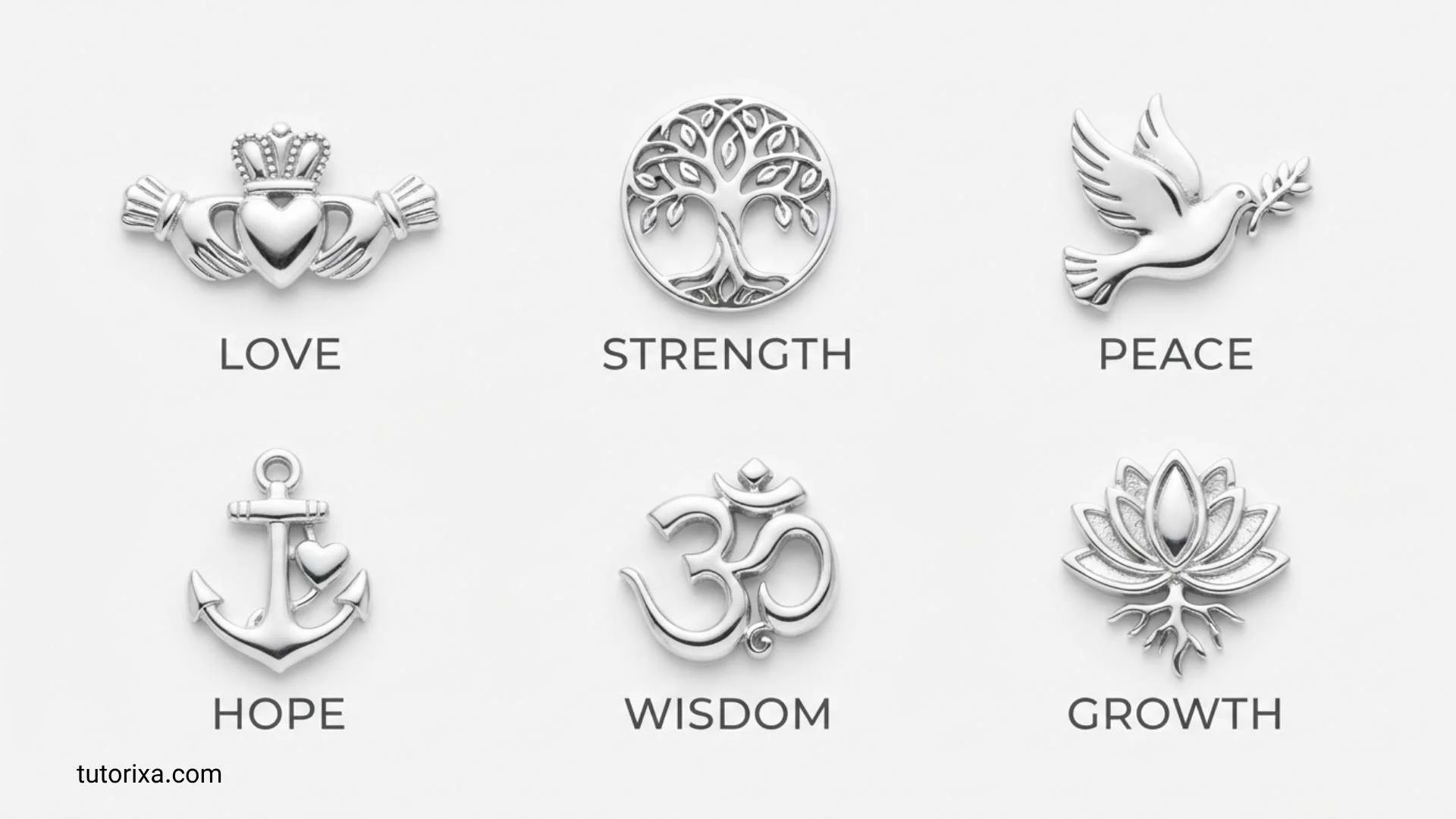
I’ve always found symbols fascinating because a simple shape can carry a powerful story, emotion, or tradition. Sterling silver makes these designs even more meaningful, turning symbols into pieces you can wear and treasure.
When you explore sterling silver symbols, you can discover meanings connected to love, protection, strength, spirituality, and personal identity.You may even find a symbol that perfectly reflects something important in your own life.
In this guide, I’ll help you understand what popular sterling silver symbols mean and why people choose them. You’ll discover their history, symbolism, and the ideas behind these beautiful designs.
Quick Meaning of Sterling Silver Symbols
Sterling silver symbols are identifying marks used to communicate the purity, maker, origin, date, or official testing status of silver objects. The number 925 is the most widely recognized purity indication for sterling silver because it represents 92.5% silver. Other marks, such as the British lion passant, sponsor’s marks, assay-office symbols, and date letters, can provide additional information depending on the country and period.
Sterling Silver Symbols at a Glance
| Symbol or Mark | Primary Meaning | Category | Common Context | Modern Significance |
| 925 | 92.5% pure silver | Fineness mark | Jewelry and silver objects | Common sterling silver indication |
| Sterling | Sterling silver | Quality description | Jewelry and tableware | Indicates sterling when used appropriately |
| Ster. | Abbreviation for sterling | Quality mark | Jewelry | Short form of “sterling” |
| Lion passant | Traditional British mark for 925 silver | Hallmark | UK silver | Associated with sterling-standard silver |
| Britannia | 958 fineness silver | Fineness/hallmark | UK silver | Higher silver content than sterling |
| Maker/Sponsor mark | Identifies responsible maker or sponsor | Identity mark | Hallmarked objects | Helps trace manufacture |
| Assay office mark | Identifies testing office | Hallmark | UK hallmarked goods | Indicates where an item was tested |
| Date letter | Indicates assay year in applicable systems | Date mark | British hallmarks | Useful for dating older objects |
| 800 | 800 parts silver per 1,000 | Fineness mark | Some European silver | Not the same as sterling 925 |
| Coin silver | Traditionally 90% silver in the U.S. | Quality description | Older American silver | Different from sterling |
A key distinction is that 925 describes fineness, while a hallmark system may use several different marks together. In the UK, for example, sponsor, fineness, and assay-office marks form the core compulsory marks in the modern hallmarking system, while some additional marks are optional.
What Do Sterling Silver Symbols Mean?
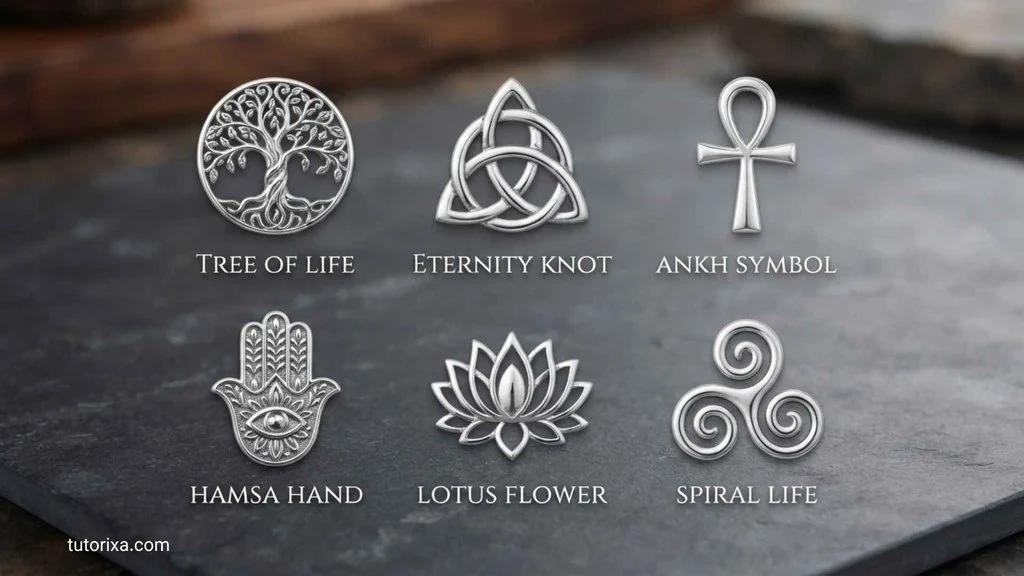
Sterling silver symbols primarily tell you what an object is made from and, in some cases, who made or tested it.
The number 925 is the easiest mark to understand. It means 925 parts per thousand are silver, equivalent to 92.5%. The remaining 7.5% consists of other metals used to create an alloy with properties suitable for practical objects and jewelry. The U.S. Federal Trade Commission recognizes “silver,” “sterling,” and “sterling silver” as descriptions associated with products containing 92.5% pure silver, subject to its Jewelry Guides.
The word sterling is therefore not simply a decorative term. It identifies a recognized silver standard.
However, not every silver-looking object marked with a symbol is automatically sterling. A mark can identify plating, a manufacturer, an artist, or another metal standard. This is why interpreting the whole group of marks is more reliable than looking at one symbol in isolation.
For example:
- 925 generally points to 92.5% silver.
- Sterling indicates sterling silver when used correctly.
- 800 indicates a different fineness standard.
- A maker’s mark identifies a person, company, or sponsor rather than silver purity.
- An assay-office mark identifies a testing or hallmarking authority in systems that use such marks.
- A date letter can help establish when an item was assayed in relevant hallmark systems.
History and Origin of Sterling Silver Hallmarks
The history of silver marks is closely connected with the need to establish trust in precious-metal objects.
Hallmarking developed as a form of quality control and consumer protection. The Sheffield Assay Office describes hallmarking as one of the oldest forms of consumer protection, with its history extending back to around 1300 in England.
Before modern manufacturing and global retail, buyers could not easily determine the composition of a silver vessel, spoon, cup, or piece of jewelry simply by looking at it. An official testing and marking system provided a way to communicate the metal standard.
British Silver Hallmarks
Britain developed one of the world’s most recognizable hallmark traditions. British silver marks can contain several separate pieces of information.
The lion passant became strongly associated with sterling-standard silver. In the modern UK system, the lion passant represents 925 silver, while the Britannia mark represents 958 silver.
The British hallmark tradition also includes:
- Sponsor’s or maker’s mark
- Fineness mark
- Assay-office mark
- Optional date letter
- Optional traditional symbols
The exact appearance and legal requirements have changed over time, so an antique hallmark should be interpreted according to its historical period rather than using modern rules alone.
The Development of 925
The concept behind 925 is straightforward: silver purity is expressed in parts per thousand.
A 925 alloy contains:
925/1,000 = 92.5% silver
This system makes it possible to express metal purity numerically and consistently.
The term sterling became associated with this level of silver fineness, particularly in English-speaking markets. In the United States, the FTC states that “silver,” “sterling,” and “sterling silver” describe products containing 92.5% pure silver, while products marked “coin silver” contain 90% pure silver.
Sterling Silver Symbolism and Interpretation
Sterling silver symbols have both technical meanings and cultural associations.
The technical meaning is usually the most important. A number such as 925 is intended to communicate metal fineness rather than a hidden spiritual message.
Silver itself, however, has accumulated symbolic associations throughout history.
Traditional Symbolism of Silver
Silver has often been associated with:
- Purity
- Clarity
- Reflection
- Value
- Refinement
- Moonlight
- Protection
- Wealth
- Craftsmanship
These associations come from the physical appearance and historical value of silver as much as from mythology and cultural traditions.
Its bright, reflective surface naturally encouraged connections with light, mirrors, the moon, and purification.
Modern Meaning
Today, sterling silver often symbolizes:
- Quality craftsmanship
- Elegance
- Personal expression
- Sentiment
- Durability
- Gift-giving
- Heritage
A sterling silver necklace, ring, bracelet, or keepsake may carry emotional meaning because of the occasion or relationship connected with it—not because the 925 mark itself has a universal symbolic message.
Positive and Negative Interpretations
There is no universally accepted negative meaning attached to the 925 symbol.
Claims that 925 itself represents a secret spiritual code, mystical warning, or universal religious message should be treated cautiously unless supported by a specific cultural or historical context.
The most reliable interpretation of 925 is simply silver fineness.
Cultural Significance of Sterling Silver Symbols
Sterling silver symbols differ across countries because hallmarking traditions developed independently.
United States
American silver commonly uses numerical or textual indications such as 925, sterling, or ster. The FTC notes that U.S. silver items described as sterling silver contain 92.5% pure silver, and silver products may be marked 925.
American jewelry can also carry a maker’s trademark or initials. That mark serves a different purpose from the purity mark.
United Kingdom
British silver has a particularly elaborate hallmark tradition. The lion passant is associated with 925 silver, while assay-office and sponsor marks can provide additional information.
British hallmarks are especially valuable to collectors because multiple marks can collectively provide clues about an object’s manufacture and history.
Europe
European silver objects may use numerical fineness standards such as 800, 835, 900, or 925, depending on the country, period, and marking system.
This means that seeing a number other than 925 does not automatically mean an item is fake. It may simply represent a different recognized silver standard.
Indigenous and Artisan Traditions
Silver jewelry made by individual artists or cultural communities can carry distinctive maker’s marks, initials, symbols, or signatures.
In alternative Indian arts and crafts, for example, artists may use a hallmark or signature to identify their work. The FTC specifically advises consumers to look for the artist’s hallmark when evaluating such jewelry.
The cultural identity of a mark should therefore be investigated separately from the metal’s purity.
Scientific and Technical Meaning of 925
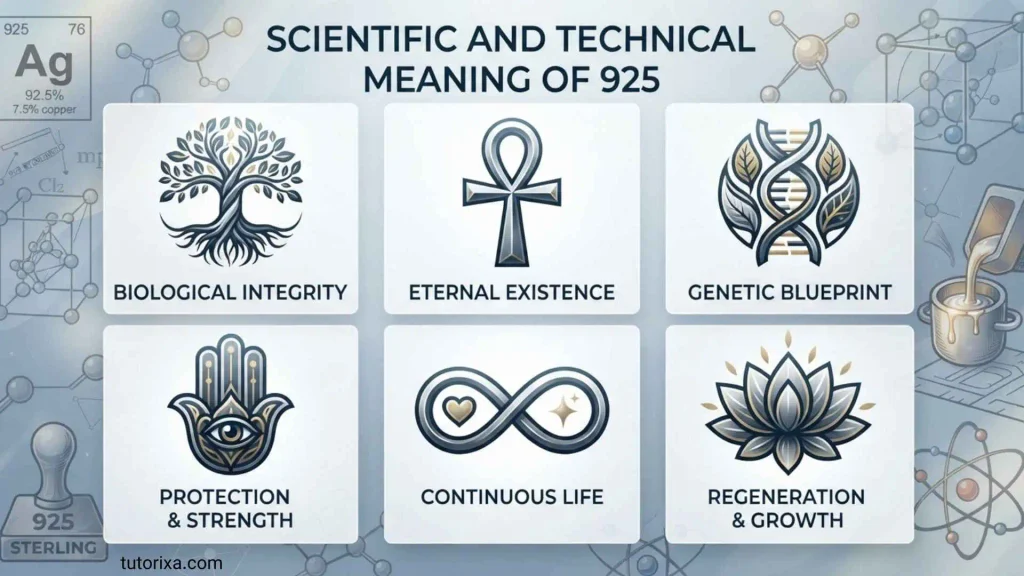
The technical meaning of 925 is the clearest part of sterling silver symbolism.
It is a fineness designation.
A fineness of 925 means:
92.5% silver + 7.5% other metals
The additional metal is part of the alloy rather than a surface coating.
This distinction matters because sterling silver is not the same thing as silver-plated metal. Silver-plated objects have a surface layer of silver applied over another material. The FTC specifically distinguishes silver products from items that merely have a silver coating.
Silver fineness can therefore tell you something about composition, but it does not by itself tell you:
- The exact alloy recipe
- The manufacturer
- The age of the object
- The country of manufacture
- The market value
- Whether the object is antique
- Whether gemstones are genuine
Those questions require additional evidence.
Where Are Sterling Silver Symbols Used?
Sterling silver symbols appear in many settings.
Jewelry
Jewelry is one of the most common places to find silver marks.
Look for them:
- Inside rings
- On bracelet clasps
- Near necklace clasps
- On pendant backs
- On earring posts or components
- On the underside of jewelry
Because marks are often tiny, magnification may be useful when examining an older or finely detailed piece.
Silverware
Spoons, forks, knives, serving pieces, trays, and other silver objects can contain purity and maker information.
British and European silverware may be particularly rich in hallmark information.
Decorative Objects
Silver cups, boxes, bowls, trophies, ornaments, and presentation pieces may carry multiple marks.
Antique Collecting
Collectors use hallmarks to help investigate an object’s:
- Material
- Maker
- Date
- Origin
- Historical context
A hallmark is evidence, but it should be interpreted alongside construction, style, provenance, and other physical characteristics.
Art and Artisan Jewelry
Contemporary artists may use personalized maker’s marks that function almost like signatures.
In these cases, the symbol may tell you more about who created the object than about its silver purity.
Common Sterling Silver Symbol Variations
Sterling silver marks vary considerably in appearance.
925
The simplest modern-looking version is:
925
It may appear alone or beside other marks.
.925
Some objects use:
.925
The decimal presentation communicates the same 925-parts-per-thousand concept.
Sterling
The word STERLING may be stamped onto American jewelry and other silver objects.
Ster.
The abbreviation STER. or STER can also occur.
British Lion Passant
The lion passant is a distinctive British silver hallmark. In the current UK system, it represents 925 silver.
Multiple Marks Together
A British hallmarked item can have several marks arranged in a sequence. Each mark can answer a different question.
This is an important principle:
Do not interpret every mark as a purity symbol.
One may identify the maker, another the assay office, and another the fineness.
Common Misconceptions About Sterling Silver Symbols
Misconception 1: Every silver item must say 925
Not necessarily.
Different countries and historical periods use different marking systems. An authentic silver object may carry another fineness mark or a traditional hallmark.
Misconception 2: 925 means the object is 92.5% valuable silver by weight in every component
The mark normally refers to the silver fineness of the relevant metal or article under the applicable marking rules. Composite objects can require more careful interpretation.
Misconception 3: A 925 mark proves an item is authentic
A stamp is evidence, not absolute proof.
Marks can be copied or misused. For expensive purchases or valuable antiques, independent professional assessment can provide stronger evidence.
Misconception 4: Silver-plated jewelry is sterling silver
It is not the same material standard.
Silver plate means silver has been applied as a coating over another material, whereas sterling silver refers to an alloy meeting the sterling silver fineness standard.
Misconception 5: Every animal symbol has a spiritual meaning
A lion, eagle, crown, or other image may be a hallmark, maker’s emblem, assay-office symbol, decorative element, or cultural symbol.
Its meaning depends on context.
Interesting Facts About Sterling Silver Symbols
- 925 is a parts-per-thousand measurement.
It is not a model number or jewelry collection code. The number expresses silver fineness. - Sterling silver is an alloy.
Pure silver is relatively soft, so sterling silver combines silver with other metals to create a more practical material for many objects. - The lion passant is connected with British silver.
In the UK hallmark system, it represents 925 silver. - Hallmarks can function like historical fingerprints.
A group of marks can help researchers narrow down an object’s maker, assay location, and date. - Not every mark identifies purity.
A maker’s mark and assay-office mark can sit beside a fineness mark while serving completely different purposes. - Date letters are not universal.
Their use depends on the hallmarking system and historical period. In the modern UK system, date letters became voluntary additional marks from 1999. - Coin silver and sterling silver are different standards.
The FTC identifies coin silver as 90% pure silver, compared with 92.5% for sterling. - Silver color does not establish silver purity.
An object can look silver-colored without being sterling silver. - A hallmark is different from a decorative symbol.
A flower or geometric design may have aesthetic meaning rather than metal-identification significance. - Hallmarking has a long consumer-protection history.
The Sheffield Assay Office traces hallmarking in England back to around 1300.
Related Silver Symbols and Marks
Several marks are closely connected with sterling silver.
925
This is the most direct numerical indication of sterling-level silver fineness.
800
An 800 mark indicates 800 parts silver per 1,000, or 80% silver. It represents a different fineness standard from 925.
900
A 900 mark represents 90% silver. In the United States, this level is associated with the term coin silver.
958
In the UK hallmarking system, Britannia silver has a fineness of 958 parts per thousand.
Silver-Plated Marks
Words and abbreviations associated with plating can indicate that silver exists only as a surface layer. These should not be confused with sterling silver marks.
Maker’s Marks
Maker’s marks identify the responsible manufacturer, sponsor, artist, or company. They answer a different question from “How pure is the silver?”
Frequently Asked Questions About Sterling Silver Symbols
What does 925 mean on sterling silver?
A 925 mark means that the metal is 925 parts silver per 1,000, or 92.5% pure silver. This is the standard commonly associated with sterling silver. The remaining portion consists of other metals forming the alloy. In the United States, the FTC recognizes 925 as a marking used for silver products containing 92.5% pure silver.
Is 925 the same as sterling silver?
Generally, yes, when the mark is accurately applied to the silver alloy. 925 describes the fineness numerically, while sterling silver describes the recognized silver standard. Both point to 92.5% silver. However, a mark alone should not be treated as conclusive proof of authenticity because marks can be copied or incorrectly applied.
What is the lion symbol on sterling silver?
The lion passant is a traditional British hallmark associated with 925 silver. It is part of the UK hallmarking tradition and can appear alongside other marks that identify the sponsor, fineness, assay office, or date. Its presence should be interpreted within the complete British hallmark rather than treated as a universal symbol for all silver worldwide.
What is the difference between 925 and 800 silver?
The numbers indicate different silver fineness levels. 925 means 92.5% silver, while 800 means 80% silver. Both can represent legitimate silver standards, depending on the country and period. Therefore, an 800 mark does not automatically mean an item is counterfeit; it may reflect a different national or historical standard.
Does sterling silver have a special spiritual meaning?
Sterling silver itself does not have one universal spiritual meaning. Silver has been associated with ideas such as purity, reflection, moonlight, protection, and value in different cultural traditions. However, the 925 mark specifically identifies metal fineness, not a universal spiritual message. Religious or spiritual interpretations should therefore be connected to the particular culture or tradition involved.
Where can I find sterling silver symbols on jewelry?
Marks are often placed where they can be seen without dominating the design. Common locations include the inside of rings, backs of pendants, bracelet clasps, necklace clasps, earring components, and other inconspicuous surfaces. On silverware and decorative objects, marks may appear underneath, on handles, or on less visible areas.
Does a sterling silver symbol prove jewelry is real?
A sterling silver symbol provides useful information, but it is not absolute proof of authenticity. A genuine hallmark or maker’s mark can be strong evidence, while a poorly documented or suspicious mark deserves further investigation. For valuable antiques or expensive jewelry, professional testing and examination provide more reliable confirmation than relying on a stamp alone.
What does a maker’s mark mean on sterling silver?
A maker’s mark identifies the person, company, sponsor, or artisan associated with an object. It is different from a fineness mark such as 925. In some hallmark systems, identifying the maker is an important part of tracing an item’s history. A maker’s mark can therefore be useful for researching provenance, attribution, and historical context.
Is sterling silver the same as silver-plated jewelry?
No. Sterling silver is a silver alloy with 92.5% silver, while silver-plated jewelry has a layer of silver applied to another material. The two products can look similar, but their construction and silver content are different. The FTC specifically distinguishes silver products from items that contain only a silver surface coating.
Why are there several symbols stamped together?
Several symbols can appear together because each one may provide different information. For example, a hallmark group may identify the maker, silver fineness, assay office, and sometimes the date. This is especially characteristic of British hallmarking. Reading the entire sequence gives a much more useful picture than interpreting one symbol independently.
Key Takeaways
- 925 is the best-known sterling silver fineness mark.
- 925 means 92.5% silver by fineness.
- Sterling silver is an alloy rather than chemically pure silver.
- Sterling, Ster., and 925 can identify sterling-standard silver when correctly used.
- The lion passant is a traditional British mark associated with 925 silver.
- Maker’s marks identify makers or sponsors rather than silver purity.
- Assay-office marks can identify where an item was tested or hallmarked.
- Date letters can help date certain British hallmarked objects.
- 800, 900, and 958 represent different silver fineness standards.
- Silver-plated objects should not be confused with sterling silver.
- A stamp is useful evidence but does not by itself guarantee authenticity.
- The meaning of a decorative symbol depends on its cultural, historical, and manufacturing context.
- Hallmarks have a long history as a form of quality identification and consumer protection.
Conclusion
Sterling silver symbols are more than tiny marks hidden inside jewelry or beneath silver objects. They form a visual language that can communicate purity, craftsmanship, identity, origin, and sometimes historical date.
The most important symbol to recognize is 925, which represents 92.5% silver and is widely associated with sterling silver. But a complete hallmark can reveal much more. British marks such as the lion passant, sponsor’s mark, assay-office mark, and optional date letter demonstrate how several symbols can work together to document an object’s identity.
The most reliable way to understand sterling silver symbols is to consider the entire marking system and historical context, rather than assigning a single meaning to every symbol. Whether you are examining a family heirloom, a piece of jewelry, silverware, or an antique, these small marks can provide valuable clues about the material and story behind the object.

I’m Ellis Montgomery, a British writer interested in the powerful language of symbols. I explore everything from traditional emblems and cultural signs to contemporary symbols found in modern life. My aim is to explain their meanings clearly while revealing the stories and ideas behind them, making symbolism fascinating and accessible to everyone.
Books:
- The Complete Book of Symbols
- Hidden Messages in Everyday Symbols
 Rowan Whitaker
 Freddie Beaumont