
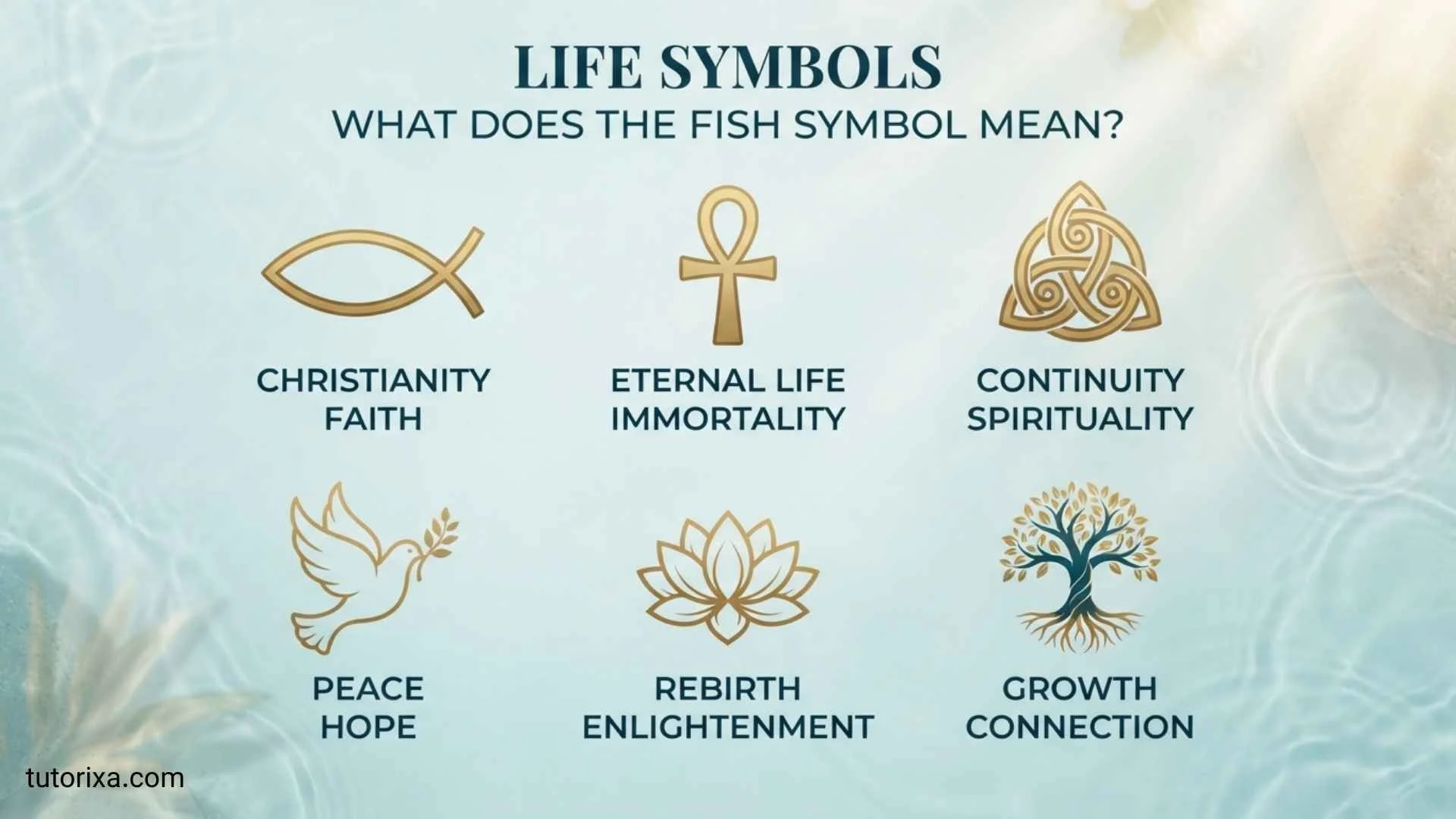
Fish Symbols can carry powerful meanings that reach across cultures, religions, history, and everyday life. I find them fascinating because a simple fish shape can represent ideas like abundance, transformation, faith, freedom, and good fortune. You may have seen these symbols without knowing the deeper story behind them.
I’ll help you explore the meanings behind popular fish symbols in a simple and easy-to-follow way. You’ll discover how different cultures and traditions interpret fish, why certain designs became important, and what these symbols can represent today.
If you’re curious about a fish symbol you’ve spotted in art, jewelry, tattoos, religion, or everyday designs, this guide can help. I’ll break down the most important meanings so you can understand what each symbol may communicate.
Quick Meaning
Fish symbols commonly represent life, abundance, fertility, renewal, spirituality, freedom, and transformation. In Christianity, the fish or Ichthys represents Jesus Christ and Christian faith. In Chinese traditions, paired fish can symbolize abundance and harmony, while ancient Egyptian imagery associated certain fish, particularly tilapia, with fertility and rebirth.
Symbol Overview Table
| Field | Details |
| Symbol Name | Fish symbol |
| Primary Meanings | Life, abundance, fertility, renewal, spirituality, freedom, transformation |
| Category | Animal, water, religious, cultural, symbolic |
| Major Historical Cultures | Ancient Egypt, Greek and Roman worlds, early Christianity, Chinese traditions, Mediterranean cultures |
| Christian Form | Ichthys / Ichthus (ΙΧΘΥΣ) |
| Christian Meaning | Jesus Christ, Son of God, Savior |
| Zodiac Connection | Pisces |
| Common Modern Uses | Art, jewelry, tattoos, logos, religious signs, digital communication |
| Unicode Emoji | 🐟 U+1F41F |
| Emoji Meaning | Fish; commonly used for aquatic life, fishing, food, or general fish references |
| Related Symbols | Koi, Pisces, Ichthys, Yin-Yang, lotus, water symbols |
The ordinary fish emoji 🐟 is officially encoded as U+1F41F. Unicode also includes separate emoji for tropical fish 🐠 and blowfish 🐡.
What Does the Fish Symbol Mean?
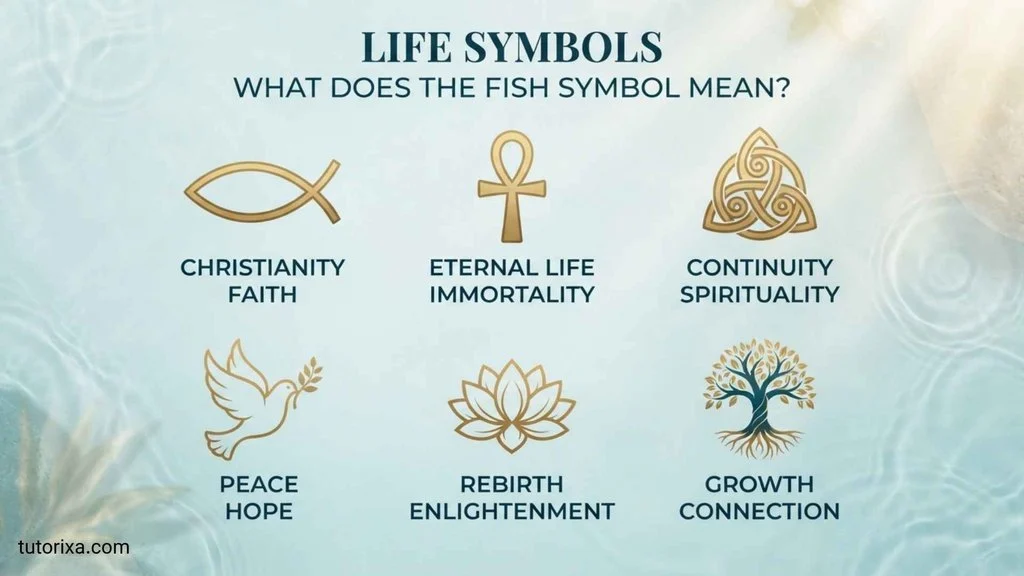
The fish symbol most broadly represents life, abundance, movement, and adaptation. These meanings arise naturally from the fish’s relationship with water and its importance as a source of food in many societies.
Fish live in an environment that humans cannot naturally inhabit for long. This has made them powerful images of another world, hidden knowledge, mystery, and movement between different realms. In symbolic traditions, water itself can represent life, cleansing, fertility, emotion, or renewal, giving aquatic animals additional layers of meaning.
Life and Renewal
Fish are closely associated with water, one of the essential conditions for life. Because of this connection, fish imagery can symbolize vitality and renewal.
Some cultures also connected particular fish with reproduction and rebirth. Ancient Egyptian art, for example, sometimes associated the Nile tilapia with fertility and rebirth. The Metropolitan Museum of Art notes that fish motifs appeared on New Kingdom scarabs and that the tilapia was traditionally interpreted as a fertility and rebirth symbol.
Abundance and Prosperity
A fish can also symbolize abundance because fish have historically provided an important food source for communities living near rivers, lakes, and seas.
The symbolic idea of abundance became particularly strong when fish appeared in groups or pairs. A single fish might represent life or provision, while many fish could suggest plenty, prosperity, or a successful harvest.
Freedom and Movement
Fish move freely through water, so they can represent independence, flexibility, and freedom.
Unlike land animals, fish are not restricted to roads or paths. Their movement through water can therefore serve as a metaphor for adapting to changing circumstances and finding a personal direction.
Transformation
Fish symbols may also represent transformation because water is frequently associated with change and renewal.
This interpretation appears in modern art, tattoos, literature, and spiritual symbolism. However, transformation is an interpretive meaning rather than a universal historical definition. The surrounding design should always be considered.
History and Origin of Fish Symbols
Fish symbolism does not have one identifiable point of origin. Fish were depicted by ancient societies long before the best-known Christian fish symbol developed.
Fish in Ancient Egypt
Ancient Egypt provides some of the clearest evidence for the symbolic importance of fish.
The Nile was central to Egyptian life, supporting agriculture, transportation, food supplies, and settlements. Fish therefore appeared naturally in everyday life as well as artistic and religious contexts.
Egyptian artists carefully depicted different fish species in tombs and temples. Fish also appeared on objects such as scarabs. The Metropolitan Museum of Art has a New Kingdom scarab, dated approximately 1479–1080 BCE, featuring a fish. The museum notes that fish were a popular theme on New Kingdom scarabs, particularly during the Eighteenth Dynasty.
This demonstrates an important principle: fish symbolism existed in multiple forms before Christianity. It should not be assumed that every ancient fish image was a Christian reference.
Greek and Roman Worlds
Fish were also familiar images in Greek and Roman cultures. They could appear as ordinary decorative or artistic motifs as well as carrying religious associations.
This wider cultural background is important for understanding early Christianity. The fish was not invented as a Christian image. Early Christians adopted and developed an existing image, giving it a specific theological meaning.
The Rise of the Christian Ichthys
The Christian fish became especially significant during the early centuries of Christianity.
The Greek word ichthys means “fish.” Early Christians connected the letters of ΙΧΘΥΣ with the phrase Iēsous Christos Theou Huios Sōtēr, meaning “Jesus Christ, Son of God, Savior.”
Christian archaeological evidence shows fish imagery appearing in early Christian contexts, including catacombs and funerary inscriptions. The Byzantine and Christian Museum describes the fish as one of the earliest and most popular Christian symbols and identifies its use as a symbol of salvation.
The fish also connected naturally with several New Testament themes. Jesus’ disciples included fishermen, Jesus used fishing imagery when speaking about discipleship, and the Gospels describe miraculous meals involving fish.
The Museum of the Bible identifies the fish as an early Christian symbol and explains its relationship to the Greek acronym.
From Early Christianity to Today
The fish remained part of Christian visual tradition, although its prominence changed over time. The cross eventually became the dominant Christian symbol in much of Christian art.
The Ichthys experienced a major revival in modern popular culture, particularly through Christian jewelry, stickers, artwork, and vehicle emblems.
Today, the Christian fish can communicate religious identity without requiring written words.
Symbolism and Interpretation
Fish symbols have both traditional and modern interpretations.
Traditional Meanings
Traditional meanings include:
- Life and fertility
- Food and provision
- Abundance
- Renewal
- Water and nature
- Spirituality
- Faith
- Salvation
- Adaptability
- Good fortune
The exact meaning depends on the culture and fish species involved.
Positive Symbolism
In many contexts, fish are associated with positive ideas such as:
Abundance: Fish can represent plentiful resources.
Fertility: Certain fish were associated historically with reproduction and renewal.
Faith: The Ichthys became an important Christian expression of belief.
Freedom: Swimming through open water can represent independence.
Adaptability: Fish survive in environments very different from human habitats, making them useful metaphors for adjustment and resilience.
Negative or Ambiguous Symbolism
Fish do not always have positive meanings.
In some literary and artistic contexts, fish can represent the unknown, danger beneath the surface, isolation, or something difficult to understand. A predatory fish such as a shark may communicate very different ideas from a koi or goldfish.
This is why a symbol should not be interpreted without considering its species, pose, color, surrounding imagery, and cultural setting.
Psychological Interpretation
Modern symbolic interpretation sometimes treats fish as representations of hidden emotions or thoughts because fish live beneath the surface of water.
This can be useful in literature and art analysis, but it should not be presented as a scientifically established universal psychological meaning. Symbolic psychology depends strongly on context and individual interpretation.
Cultural Significance
Different cultures developed distinctive meanings for fish.
Chinese Culture
Fish have a strong association with abundance and prosperity in Chinese cultural traditions. The Chinese word for fish, yú (鱼), is associated through pronunciation with the idea of surplus or abundance, which helped strengthen the fish’s auspicious associations.
Fish imagery may therefore appear in decorative art, celebrations, textiles, paintings, and objects associated with prosperity.
Paired fish can also carry meanings connected with harmony, partnership, or abundance, depending on the artistic context.
Japan and Koi
The koi fish is particularly important in Japanese visual culture. Koi are commonly associated with perseverance and determination in modern symbolic interpretations, partly because of their ability to swim against currents.
Koi imagery has also spread internationally through tattoos, paintings, gardens, clothing, and decorative design.
However, not every koi image has a fixed traditional meaning. Color, composition, number of fish, and surrounding elements can change the interpretation.
Ancient Egypt
Fish were closely connected with the Nile and Egyptian daily life. Beyond being an important food source, particular fish acquired symbolic associations. The Nile tilapia, for example, has been linked by scholars and museum interpretation with fertility and rebirth.
Mediterranean and Christian Culture
In Christian culture, the fish became strongly connected with Jesus Christ through the Ichthys acronym. Early Christian examples include fish imagery in catacombs, inscriptions, lamps, and other objects.
Religious or Spiritual Meaning
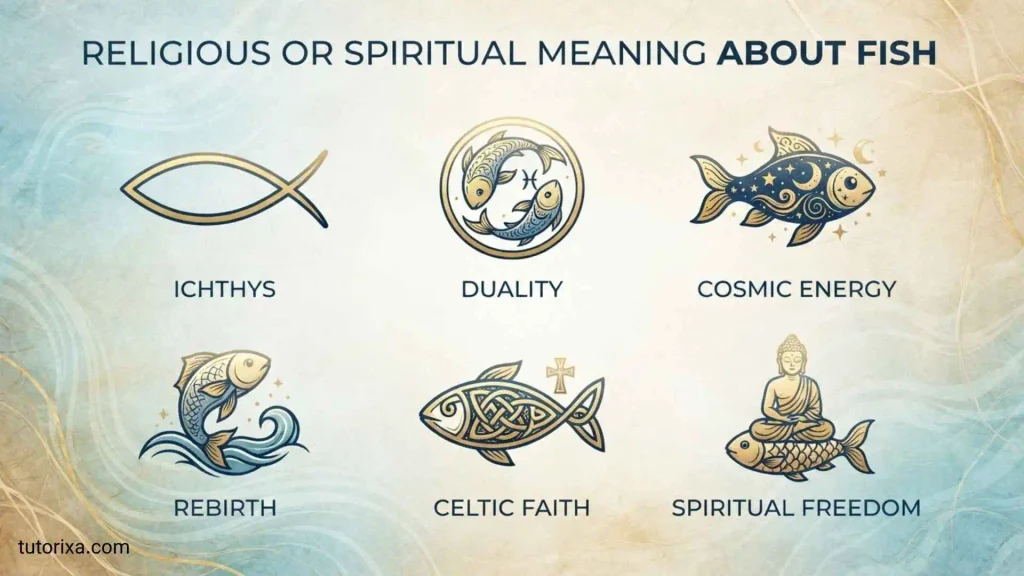
The fish has especially important religious symbolism in Christianity.
Christian Ichthys
The Ichthys is a stylized fish associated with Christian faith. Its Greek name, ΙΧΘΥΣ, was interpreted through an acrostic as:
- I — Iēsous, Jesus
- CH — Christos, Christ
- TH — Theou, of God
- Y — Huios, Son
- S — Sōtēr, Savior
Together, the phrase expresses a Christian confession about Jesus.
Early Christian fish imagery was used in catacombs and funerary settings, and historical sources connect it with themes of salvation and baptism.
The fish also has biblical associations with food, discipleship, and water. Early Christian writers connected believers with fish because of the relationship between Christianity, baptism, and water.
It is important, however, not to assume that every fish found in ancient art was a Christian Ichthys. Fish imagery existed widely in the ancient Mediterranean before Christianity.
Scientific or Technical Meaning
The ordinary fish symbol does not have one universal scientific definition, but fish-related symbols appear in scientific, educational, and digital contexts.
Unicode Fish Symbol
The standard fish emoji is:
🐟 U+1F41F
Unicode classifies it under the Miscellaneous Symbols and Pictographs block. It was added in Unicode 6.0 in 2010.
The emoji can represent a literal fish, aquatic animals generally, fishing, seafood, marine life, or sometimes Pisces-related conversation. Unicode’s related labels include animal, fishes, fishing, and Pisces.
Pisces
Fish also have a technical astronomical and astrological association through Pisces, the constellation and zodiac sign represented by two fish.
The two-fish image is distinct from the Christian Ichthys even though both use fish imagery. Their histories and meanings should not be automatically combined.
Where Fish Symbols Are Used
Fish symbols appear in many forms of visual communication.
Religion
The Christian Ichthys appears on church materials, jewelry, artwork, educational resources, and other Christian objects.
Jewelry
Fish pendants and charms may represent faith, nature, abundance, personal identity, or a connection with the sea.
Tattoos
Fish tattoos can express different ideas, including freedom, perseverance, spirituality, cultural heritage, or love of aquatic life.
A koi, shark, goldfish, or abstract fish can communicate very different messages.
Logos and Branding
Fish are common in logos connected with seafood, fishing, aquariums, marine conservation, restaurants, and water-related organizations.
Art and Literature
Artists and writers use fish to explore themes such as mystery, nature, transformation, isolation, survival, and the unknown.
Digital Communication
The fish emoji 🐟 provides a simple visual way to refer to fish, marine life, fishing, food, or aquatic environments. Unicode also provides 🐠 for tropical fish and 🐡 for blowfish.
Common Variations
Fish symbols vary significantly according to design and context.
Ichthys
The Ichthys is usually a simple two-curved-line fish shape and is specifically associated with Christianity.
Koi Fish
Koi are often shown in decorative, colorful designs and may symbolize perseverance, harmony, prosperity, or personal growth.
Two Fish
Two fish can represent paired concepts such as Pisces, harmony, partnership, or abundance, depending on the cultural setting.
Fish With Water
A fish combined with waves, droplets, lotus flowers, or other aquatic elements usually strengthens the connection with water, nature, life, or renewal.
Fish With Religious Elements
When a fish appears beside a cross, Christian inscription, or other Christian imagery, the interpretation is more clearly connected to the Ichthys tradition.
Common Misconceptions
“Every fish symbol means Christianity.”
False. Fish imagery existed in many ancient cultures before Christianity. Christianity gave the fish a specific and highly influential meaning through the Ichthys tradition, but fish symbolism is much broader.
“The fish was originally invented by Christians.”
Not supported. Fish were already common artistic and symbolic subjects in ancient societies, including Egypt and the wider Mediterranean world. Early Christians adopted the image and developed a distinctive theological interpretation.
“Every fish represents abundance.”
Not necessarily. Abundance is important in some traditions, especially in Chinese cultural symbolism, but a fish can also represent faith, fertility, nature, freedom, or other ideas.
“The fish emoji is a religious symbol.”
Usually not. 🐟 is simply Unicode’s fish emoji. Its meaning normally comes from the conversation and context rather than Christianity.
“Pisces and Ichthys are the same symbol.”
They are different traditions. Pisces belongs to astronomy and astrology, while Ichthys is specifically connected with early Christian symbolism.
Interesting Facts About Fish Symbols
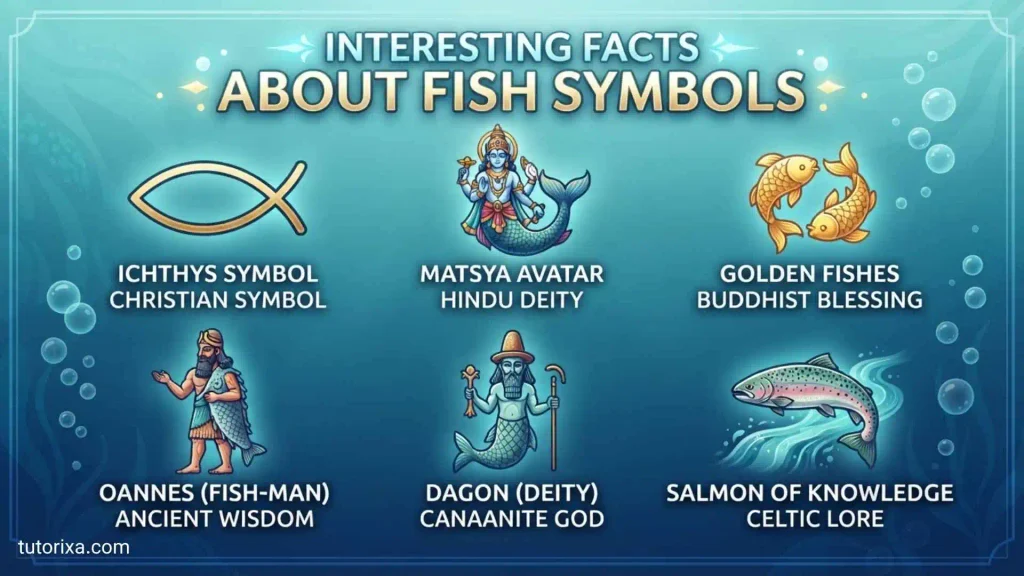
- The Christian fish is older in Christian art than the widespread use of the cross. The fish was an important early Christian symbol, while the cross became dominant later.
- Ichthys is an actual Greek word for fish. Its importance comes from the way its letters were connected with a Christian confession of faith.
- Fish imagery predates Christianity by centuries. Ancient Egyptian objects demonstrate that fish were already meaningful artistic subjects long before the Christian era.
- The Nile helped shape Egyptian fish symbolism. Fish were not abstract images separated from daily life; they were part of an economy and environment centered on the river.
- The fish emoji has a precise Unicode identity. Its code point is U+1F41F.
- Unicode distinguishes ordinary fish from tropical fish. 🐟 and 🐠 are separate encoded emoji characters.
- Early Christian fish imagery appeared in funerary settings. Archaeological and museum evidence connects fish representations with early Christian catacombs and inscriptions.
- A fish’s species can change its symbolic message. A koi, tilapia, shark, salmon, and generic fish may carry very different cultural associations.
- Fish symbolism is strongly connected with water. This helps explain why fish frequently become symbols of life, renewal, mystery, and movement.
- The same visual shape can have unrelated meanings. A fish-shaped design might refer to Christianity, Pisces, aquatic nature, prosperity, or simply an interest in fish.
Related Symbols
Ichthys
The Ichthys is the most important fish-related religious symbol in Christianity. Its defining feature is its connection with the Greek word for fish and the Christian acrostic.
Pisces
Pisces uses two fish and belongs to the zodiac tradition. It should be distinguished from the Christian Ichthys.
Koi Fish
Koi symbolism is strongly associated with East Asian artistic traditions and modern interpretations involving perseverance, prosperity, and harmony.
Lotus
The lotus frequently appears alongside aquatic imagery and can symbolize purity, renewal, or spiritual development in several Asian traditions.
Water Symbol
Water itself commonly represents life, cleansing, change, and renewal. A fish placed within waves or water imagery can therefore combine several layers of symbolism.
Yin-Yang
The yin-yang symbol is not a fish symbol, although its curved paired design is sometimes visually compared with paired fish motifs. Its philosophical background is specifically rooted in Chinese concepts of complementary forces.
Frequently Asked Questions
What is the main meaning of fish symbols?
Fish symbols commonly represent life, abundance, fertility, renewal, freedom, adaptability, and spirituality. Their meaning changes according to culture and context. A Christian fish may represent Jesus Christ and Christian faith, while a koi may suggest perseverance or prosperity. There is no single meaning that applies to every fish symbol.
What does the fish symbol mean in Christianity?
The Christian fish, known as the Ichthys or Ichthus, represents Christian faith through a Greek wordplay. ΙΧΘΥΣ means “fish,” while its letters were associated with the phrase “Jesus Christ, Son of God, Savior.” Early Christian sources and archaeological evidence document the symbol’s importance.
What does a fish symbolize spiritually?
Spiritually, fish may symbolize life, renewal, abundance, faith, transformation, or connection with the unseen. However, spiritual interpretations differ greatly between traditions. The Christian Ichthys has a specific theological meaning, while fish imagery in other traditions may focus more on fertility, prosperity, nature, or renewal.
What does a koi fish symbolize?
Koi fish are commonly associated with perseverance, determination, prosperity, harmony, and personal development. These meanings are especially common in modern Japanese-inspired art and tattoo symbolism. The exact meaning can vary according to color, number of fish, direction of movement, and the other elements included in the design.
What does a fish symbolize in ancient Egypt?
Fish had practical and symbolic importance in ancient Egypt because the Nile was central to Egyptian life. Particular fish could have specialized associations. The Nile tilapia, for example, has been interpreted as a symbol of fertility and rebirth in Egyptian art, including New Kingdom scarabs.
What does the fish emoji 🐟 mean?
The 🐟 emoji literally represents a fish. People commonly use it when discussing fish, marine life, fishing, seafood, aquariums, or aquatic environments. It does not automatically represent Christianity. Unicode identifies it as U+1F41F and separately lists tropical fish 🐠 and blowfish 🐡.
Are fish symbols always religious?
No. Fish symbols appear in religion, mythology, art, literature, jewelry, tattoos, branding, cultural traditions, and ordinary communication. The Christian Ichthys is religious, but a fish in a seafood logo, nature illustration, or emoji usually has no religious meaning.
What is the difference between Ichthys and Pisces?
Ichthys is an early Christian symbol connected with Jesus Christ, while Pisces is a constellation and zodiac sign represented by two fish. Although both involve fish imagery, they developed from different traditions and should not be treated as the same symbol.
Why are fish associated with abundance?
Fish have historically been an important source of food for communities living around rivers, lakes, and seas. Their availability made them natural symbols of provision and plenty. In Chinese culture, linguistic association also strengthened the fish’s connection with abundance and surplus.
Why do fish symbolize transformation?
Fish live beneath the water’s surface and move through an environment that is very different from human life on land. Artists and writers can therefore use fish to represent hidden worlds, change, adaptation, and movement. Transformation is a common modern interpretation, but it is not a universal historical meaning.
Key Takeaways
- Fish symbols do not have one universal meaning.
- Common meanings include life, abundance, fertility, renewal, freedom, spirituality, and transformation.
- The Christian Ichthys represents Jesus Christ and Christian faith.
- Fish imagery existed in ancient cultures long before Christianity.
- Ancient Egyptian art associated particular fish, including tilapia, with fertility and rebirth.
- Chinese fish symbolism is strongly connected with abundance and prosperity.
- Koi imagery is commonly associated with perseverance, harmony, and prosperity.
- Pisces and Ichthys are separate symbolic traditions.
- The ordinary fish emoji is 🐟 U+1F41F.
- Context, species, culture, and surrounding imagery are essential for interpreting fish symbols correctly.
Conclusion
Fish symbols have survived across thousands of years because the fish is both an ordinary part of human life and a powerful image for ideas that are harder to express. Ancient Egyptians connected fish with the Nile and, in some cases, fertility and rebirth. Chinese traditions developed associations with abundance. Koi became powerful visual symbols in East Asian-inspired art, while early Christians transformed the simple fish into the influential Ichthys.
Today, a fish can appear on a church sign, piece of jewelry, tattoo, painting, logo, book illustration, or phone screen and communicate a completely different message in each setting.
Understanding fish symbols therefore requires more than memorizing one definition. The most accurate interpretation comes from asking what kind of fish is shown, where the symbol appears, which culture produced it, and what other symbols surround it. That context turns a simple image of a fish into a meaningful window into history, religion, culture, art, and human imagination.

I’m Ellis Montgomery, a British writer interested in the powerful language of symbols. I explore everything from traditional emblems and cultural signs to contemporary symbols found in modern life. My aim is to explain their meanings clearly while revealing the stories and ideas behind them, making symbolism fascinating and accessible to everyone.
Books:
- The Complete Book of Symbols
- Hidden Messages in Everyday Symbols
 Rowan Whitaker
 Freddie Beaumont