
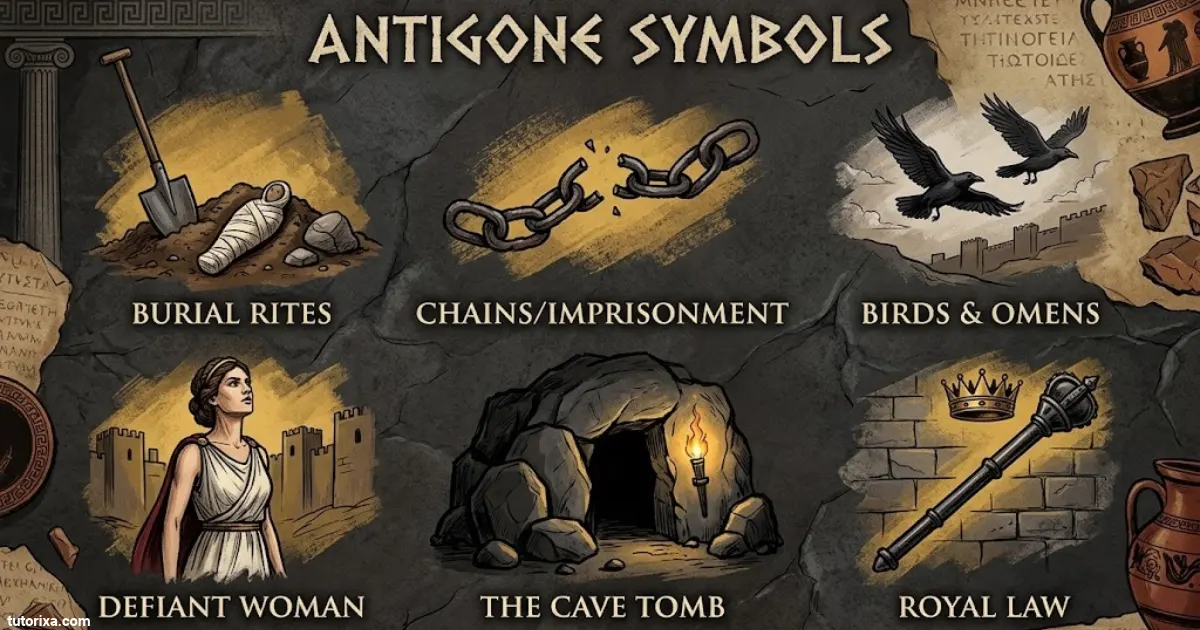
Sophocles’ Antigone is filled with powerful symbols that reveal the play’s deeper meanings. From the burial of Polyneices to the birds described by Tiresias, different objects, images, and events represent ideas such as justice, death, loyalty, family, and the conflict between human authority and divine law. Understanding these symbols makes the story easier to interpret.
The symbols in Antigone also help explain the struggles between Antigone and Creon. Antigone believes that family duties and the laws of the gods are more important than the king’s orders, while Creon believes that obedience to the state must come first. Their opposing beliefs create the central conflict of the tragedy.
In this guide, you’ll discover the major Antigone symbols and motifs, their meanings, important examples from Sophocles’ play, and the role of imagery, birds, and archetypes. Each section explains how these literary elements contribute to the story and its central themes.
What Is the Symbolism in Antigone?
The symbolism in Antigone refers to the objects, actions, characters, and images that represent deeper ideas throughout the play. Sophocles uses symbolism to explore moral responsibility, religious beliefs, political power, death, and the consequences of pride.
The most important symbols are connected to burial, darkness, light, imprisonment, and nature. They help readers understand the characters’ beliefs and the tragic results of their decisions.
For example, the burial of Polyneices represents more than a family member’s funeral. It represents respect for the dead, religious duty, and the belief that divine laws should be respected even when human rulers disagree.
Here are some major ideas represented through symbolism:
| Symbol or Element | Deeper Meaning |
| Polyneices’ unburied body | Denial of religious and burial rights |
| Burial dust | Respect for the dead and divine law |
| The tomb | Death, imprisonment, and isolation |
| Darkness | Death, suffering, and uncertainty |
| Light | Truth, understanding, and revelation |
| Birds | Nature, divine warnings, and the consequences of pollution |
| Blindness | Ignorance and failure to recognize truth |
| The palace | Political authority and power |
| Antigone’s death | The consequences of conflicting moral duties |
These symbols connect the personal struggles of the characters with larger questions about justice and human behavior.
Antigone Symbols and Motifs
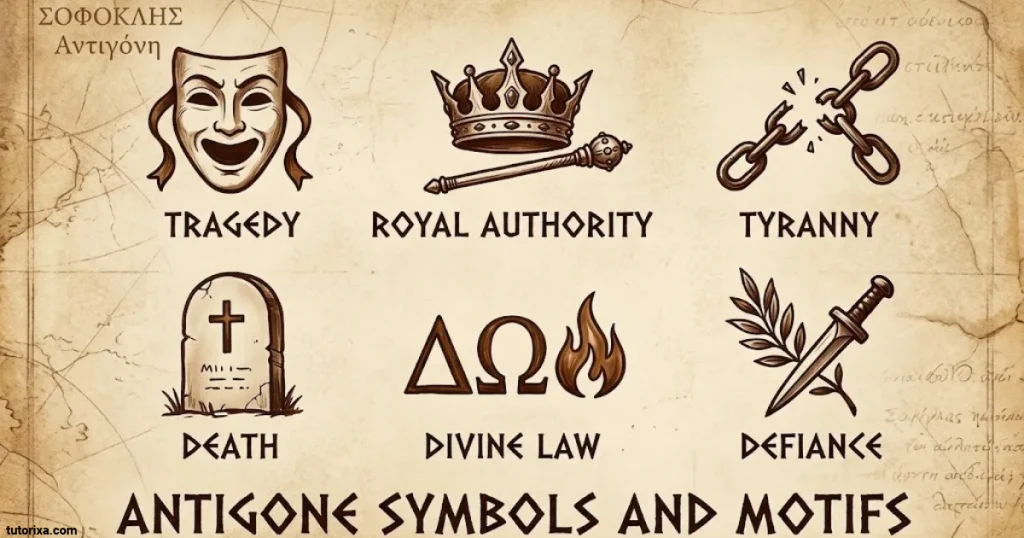
Sophocles uses several important symbols and recurring literary ideas to develop the central conflict. Some symbols represent specific objects or events, while motifs are repeated ideas that appear throughout the play.
The following symbols help explain the most important parts of Antigone’s story.
Burial Dust — Religious Duty and Respect
SYMBOL: ANTIGONE’S BURIAL ACT
Antigone’s act of covering Polyneices’ body with dust is one of the most important symbolic actions in the play.
Creon orders that Polyneices must remain unburied because he considers him a traitor. Antigone refuses to follow this order because she believes every dead person deserves proper burial according to divine law.
The dust represents:
- Respect for the dead.
- Religious responsibility.
- Loyalty to family.
- Resistance against unjust authority.
- The importance of divine law.
Even a small amount of dust becomes a powerful statement of Antigone’s beliefs. Her action shows that moral responsibility can be more important than obeying a powerful ruler.
The Unburied Body — Political Power and Human Dignity
Polyneices’ exposed body represents Creon’s attempt to control not only the living but also the dead.
By refusing burial, Creon wants to punish Polyneices even after his death. However, his decision violates religious traditions and creates a conflict between political authority and spiritual responsibility.
The body also becomes a symbol of the limits of human power. Creon can issue orders, but he cannot control the religious laws that govern death and burial.
The Tomb — Death and Imprisonment
The stone tomb where Antigone is confined represents both a prison and a grave.
Creon orders Antigone to be placed inside it while she is still alive. This creates a disturbing connection between life and death.
The tomb symbolizes:
- Antigone’s loss of freedom.
- The consequences of political oppression.
- Her separation from society.
- The connection between marriage and death.
- The tragic outcome of Creon’s decision.
Antigone’s imprisonment also reflects Creon’s inability to recognize the moral consequences of his actions.
Darkness — Death and Suffering
Darkness appears through the play’s repeated references to death, grief, and uncertainty.
It represents the emotional and moral confusion surrounding the characters. Creon cannot see the danger of his decisions until the consequences become unavoidable.
Darkness also connects with Antigone’s journey toward death. Her confinement in the tomb separates her from the living world.
Blindness — Ignorance and Understanding
Blindness is an important symbolic idea in Antigone, especially through the character of Tiresias.
Tiresias is physically blind, but he understands the religious and moral problems that Creon cannot recognize.
Creon, on the other hand, has physical sight but remains blind to the consequences of his pride.
This contrast suggests that true understanding does not depend entirely on physical vision. A person can see the world but still fail to recognize the truth.
Motifs in Antigone
A motif is a repeated idea, image, situation, or pattern that helps develop a literary work’s themes. In Antigone, Sophocles uses recurring motifs to connect the characters’ personal struggles with larger questions about society, religion, and justice.
Here are the major motifs found throughout the play.
Law and Justice
The conflict between human law and divine law is the central recurring motif.
Creon believes that the laws of the state must be obeyed. Antigone believes that religious and moral duties are more important than the king’s commands.
Their disagreement raises an important question: Should people always obey the law, even when they believe it is morally wrong?
Sophocles uses this conflict to show that authority does not automatically make a decision just.
Family Loyalty
Family loyalty appears throughout Antigone’s actions and conversations.
She believes she has a responsibility to honor her brother, even though Creon has forbidden his burial. Her relationship with Ismene also highlights the different ways people respond to family obligations and danger.
This motif shows that family relationships can create duties that conflict with public expectations.
Pride and Stubbornness
Pride influences both Antigone and Creon, although Creon’s stubbornness becomes especially destructive.
Creon refuses to change his decision because he believes doing so would weaken his authority. He treats disagreement as a challenge to his power.
His refusal to listen to others eventually leads to the deaths of Antigone, Haemon, and Eurydice.
Gender and Authority
The play repeatedly explores expectations about men, women, and political power.
Creon struggles to accept that a woman has openly challenged his authority. He considers Antigone’s resistance a threat to his position as king and as a man.
Antigone refuses to accept the idea that her gender should prevent her from following her beliefs.
This motif reveals the social expectations of ancient Greek society and the tension between individual courage and established authority.
Death and Mortality
Death is present from the beginning of the play because the conflict begins with the deaths of Eteocles and Polyneices.
Antigone’s willingness to die for her beliefs makes mortality a central part of the tragedy.
The repeated references to burial, graves, and the underworld remind the audience that human life is limited and that the dead deserve religious respect.
Sight and Knowledge
The contrast between physical sight and inner understanding appears through Tiresias and Creon.
Tiresias cannot physically see, but he recognizes the danger created by Creon’s actions. Creon initially refuses to understand the warning.
This motif reinforces the idea that wisdom requires humility and the willingness to listen.
Greek Antigone Symbols
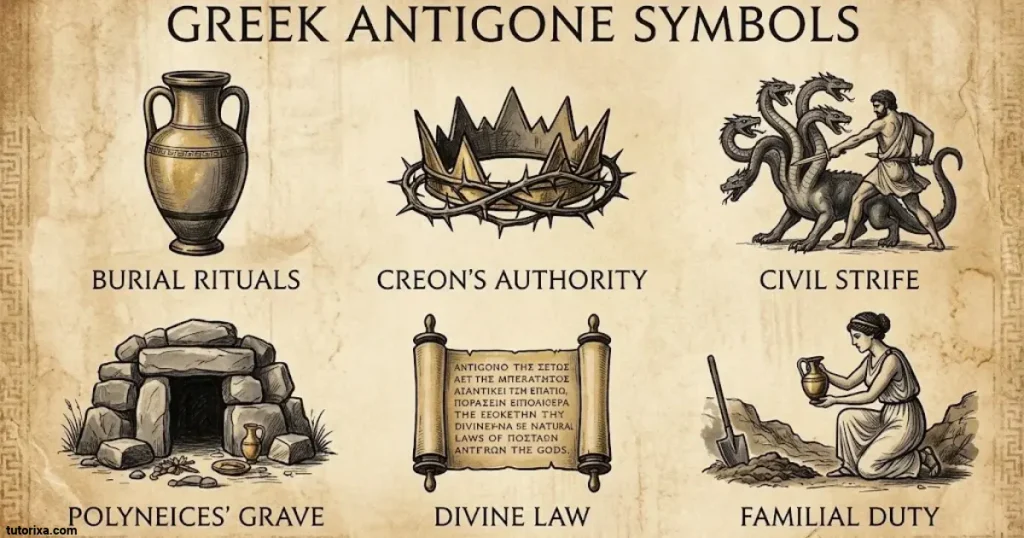
Antigone is an ancient Greek tragedy, so its symbols are closely connected to Greek religious traditions, mythology, burial customs, and beliefs about the gods.
Sophocles uses these cultural ideas to make the conflict between Antigone and Creon more meaningful. The audience would have understood that burial was not simply a personal choice. It was an important religious responsibility.
Greek Burial Customs
In ancient Greek culture, proper burial was associated with honoring the dead and allowing them to receive the appropriate funeral rites.
Creon’s decision to leave Polyneices unburied is therefore more serious than an ordinary punishment. It violates religious expectations and creates a problem that affects the entire community.
The burial dust represents Antigone’s attempt to fulfill this responsibility.
The Underworld and Hades
Hades is associated with the Greek underworld, where the dead go after death.
In the play, Antigone repeatedly connects her actions with the expectations of the dead and the gods below. She believes that honoring Polyneices is a duty that cannot be canceled by a human command.
The underworld represents the religious authority that exists beyond Creon’s political control.
Divine Law and Human Law
Ancient Greek religious beliefs included the idea that some obligations were established by the gods rather than by human rulers.
Antigone follows this belief when she chooses to bury her brother.
Creon represents political authority, while Antigone represents religious and family responsibility. Their conflict shows what happens when human rules contradict sacred obligations.
Greek Religious Pollution
In Greek religious thought, pollution could result from actions that violated important religious or moral expectations.
In the play, the unburied body of Polyneices creates a religious problem. Tiresias warns Creon that the gods are rejecting the sacrifices and prayers offered by the Thebans because of the situation.
This warning shows that Creon’s decision has affected more than one family. It has disturbed the religious order of the city.
Antigone Symbols in Sophocles
Sophocles uses symbolism to develop the tragedy beyond its basic storyline. His symbols help the audience understand the characters’ beliefs and recognize the consequences of their decisions.
Several symbolic elements are especially important in the structure of the play.
Antigone as a Symbol of Moral Resistance
Antigone represents the courage to stand against authority when personal conscience demands it.
She knows that burying Polyneices may result in her death, but she refuses to abandon her beliefs.
Her character symbolizes:
- Moral courage.
- Loyalty to family.
- Religious devotion.
- Resistance to injustice.
- Individual conscience.
However, Antigone is also a tragic character whose determination leaves little room for compromise.
Creon as a Symbol of Political Authority
Creon represents the power of the state and the responsibility of political leadership.
At first, he believes that strict obedience is necessary to protect Thebes. However, his unwillingness to consider other perspectives turns authority into oppression.
Through Creon, Sophocles explores the danger of leadership without humility.
The Chorus as a Symbol of Society
The Chorus of Theban elders represents the community’s reactions to the events.
Its members comment on the conflict, discuss religious beliefs, and reflect on human behavior.
They help connect the personal decisions of Antigone and Creon with the wider concerns of Theban society.
Tiresias as a Symbol of Wisdom
Tiresias represents spiritual knowledge and the ability to recognize truths that others overlook.
His blindness contrasts with Creon’s failure to understand the religious consequences of his decisions.
When Tiresias warns Creon, he provides an opportunity for the king to correct his mistake. Unfortunately, Creon acts too late.
The Gods as a Symbol of Higher Justice
The gods represent a form of authority that is greater than any human ruler.
Creon may control the laws of Thebes, but he cannot change the religious expectations that govern burial and respect for the dead.
The divine warnings throughout the play reinforce the limits of human power.
Antigone Symbolism: Birds
Birds have an important symbolic role in Antigone, particularly in the scene involving Tiresias.
In ancient Greek culture, birds could be associated with divine messages, omens, and religious signs. Their behavior was sometimes interpreted as a way for the gods to communicate warnings.
Sophocles uses bird imagery to reveal the religious consequences of Creon’s decision.
Birds Represent Divine Warnings
Tiresias describes how birds of prey behave strangely and violently around the unburied body of Polyneices.
The birds have fed on the corpse and carry its remains to sacred places. Their actions contaminate the altars and offerings used in religious rituals.
This imagery shows that Creon’s decision has disturbed the relationship between the human world and the divine world.
Birds Represent Religious Pollution
The birds carrying pieces of Polyneices’ body symbolize the spread of religious pollution.
The problem is no longer limited to the battlefield or the royal family. It has reached the sacred spaces where the people of Thebes worship their gods.
This is why Tiresias warns Creon that the gods are rejecting the city’s sacrifices.
Birds Represent the Consequences of Creon’s Actions
The bird imagery also reveals the results of Creon’s refusal to allow burial.
Instead of protecting Thebes through his strict command, he has created a situation that threatens the religious well-being of the entire city.
The birds become a visible sign of a problem that Creon initially refuses to recognize.
Important Bird Imagery in the Play
| Bird-Related Image | Symbolic Meaning |
| Birds feeding on Polyneices’ body | The consequences of denying burial |
| Birds carrying remains | Spread of religious pollution |
| Birds fighting and making disturbing sounds | Disorder and unnatural conditions |
| Birds contaminating sacred places | Disruption of religious rituals |
| Tiresias observing birds | Divine warnings and prophetic knowledge |
The bird imagery is especially important because it connects nature, religion, and political decisions. It also strengthens Tiresias’ warning that Creon must correct his mistake.
Creon and Antigone Symbols
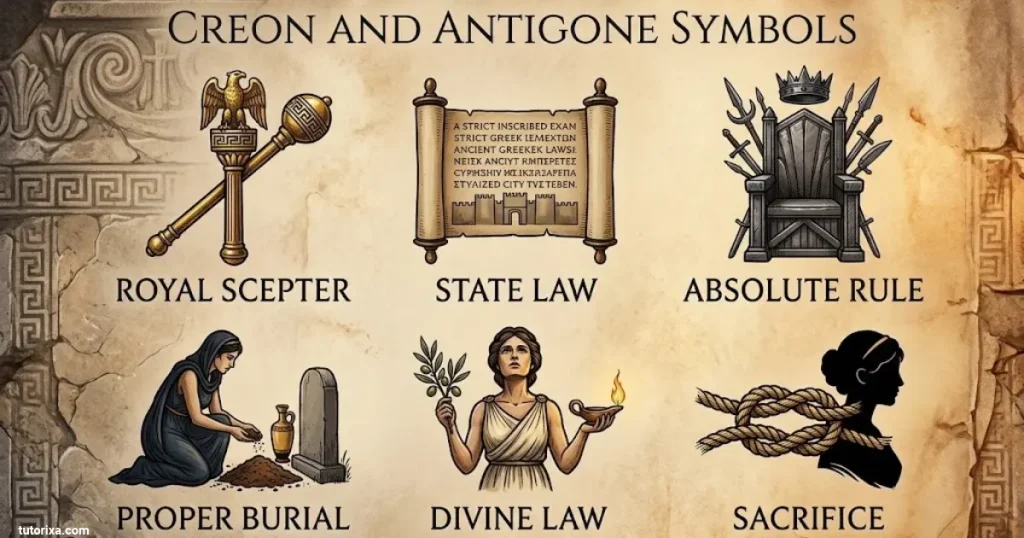
Antigone and Creon represent two opposing positions in the play. Their conflict is not only a disagreement between two family members or individuals. It represents a larger struggle between religious duty and political authority.
Their characters also carry different symbolic meanings.
Antigone: Symbol of Conscience and Loyalty
Antigone believes that some responsibilities are more important than human commands.
She chooses to bury her brother because she considers family loyalty and divine law permanent obligations.
Her actions symbolize the strength of personal conscience, even when following it comes with serious consequences.
However, her determination also shows how a person can become isolated when refusing to compromise.
Creon: Symbol of Authority and Pride
Creon believes that the stability of Thebes depends on obedience to the king’s orders.
He considers Polyneices an enemy of the state and believes that allowing his burial would weaken his political authority.
His position initially appears connected to public responsibility. However, his pride prevents him from recognizing when his leadership becomes unjust.
Comparison of Their Symbolic Roles
| Antigone | Creon |
| Religious duty | Political authority |
| Family loyalty | Loyalty to the state |
| Individual conscience | Public obedience |
| Resistance | Control |
| Moral conviction | Pride and stubbornness |
| Respect for divine law | Dependence on human law |
How Their Conflict Develops the Tragedy
Their disagreement becomes increasingly serious because neither initially accepts the other’s position.
Antigone refuses to deny her actions, while Creon refuses to reconsider his command.
Haemon attempts to encourage his father to listen to reason and public opinion. Tiresias later warns Creon about the consequences of violating religious duties.
Creon eventually changes his mind, but his decision comes too late.
Through these opposing characters, Sophocles shows that political power and personal conviction can become destructive when wisdom and understanding are missing.
Imagery in Antigone
Imagery refers to descriptive language that helps readers imagine scenes, emotions, and experiences. Sophocles uses visual, auditory, and religious imagery to create a strong atmosphere throughout the tragedy.
The imagery makes the characters’ suffering more powerful and helps communicate the play’s deeper themes.
Visual Imagery
Visual imagery helps the audience picture the most important events.
The exposed body of Polyneices, the dust used for burial, and Antigone’s dark stone tomb create strong mental images.
These scenes emphasize death, religious responsibility, and the conflict between freedom and imprisonment.
Bird Imagery
Bird imagery becomes especially important during Tiresias’ prophecy.
The descriptions of birds attacking one another and carrying pieces of the dead body create a disturbing picture of unnatural disorder.
This imagery communicates that the conflict has disturbed the religious balance of Thebes.
Darkness and Light Imagery
Darkness is associated with suffering, death, and uncertainty, while light can suggest understanding and revelation.
These contrasting images help communicate the difference between physical appearance and deeper knowledge.
Tiresias’ blindness makes this contrast particularly meaningful because he understands the truth that Creon cannot initially see.
Death and Burial Imagery
References to graves, funeral rites, corpses, and the underworld appear throughout the play.
This imagery reminds the audience that the conflict is connected to the treatment of the dead.
It also shows how closely death influences the lives of Antigone, Creon, and their families.
Marriage and Death Imagery
Antigone’s relationship with death is closely connected to her lost future as a young woman.
She should have been preparing for marriage, but instead she is sent to a tomb.
This creates a tragic contrast between the life she might have lived and the death she faces.
Her tomb becomes a symbolic replacement for the marriage and family life she will never experience.
Antigone and Creon
Antigone and Creon are the central characters in Sophocles’ tragedy. Their opposing beliefs create the main conflict and reveal the dangers of pride, inflexible leadership, and moral disagreement.
Although both characters are determined to defend their positions, their motivations are different.
Who Is Antigone?
Antigone is the daughter of Oedipus and the sister of Ismene, Eteocles, and Polyneices.
After her brothers die fighting against each other, Creon allows Eteocles to receive an honorable burial but orders that Polyneices remain unburied.
Antigone believes this command violates divine law. She decides to bury her brother even though she knows the punishment may be death.
Her character represents loyalty, courage, religious responsibility, and resistance against authority.
Who Is Creon?
Creon is the king of Thebes and the uncle of Antigone.
After the deaths of Eteocles and Polyneices, he takes control of the city and declares that Polyneices must not receive burial because he attacked Thebes.
Creon believes that the state must come before personal relationships. However, his determination to enforce his order makes him increasingly stubborn.
His character represents political power, pride, authoritarian leadership, and the danger of refusing advice.
Main Differences Between Antigone and Creon
| Feature | Antigone | Creon |
| Position | Member of the royal family | King of Thebes |
| Main belief | Divine law comes first | State law must be obeyed |
| Motivation | Family and religious duty | Political order |
| Personality | Courageous and determined | Authoritative and stubborn |
| Main conflict | Defending her brother’s burial | Preventing the burial |
| Tragic result | Dies in the tomb | Loses his family |
What Do Antigone and Creon Teach Readers?
Their conflict shows that following rules without considering morality can lead to terrible consequences.
Antigone demonstrates the importance of standing up for personal beliefs, while Creon demonstrates the dangers of pride and excessive control.
Their stories also suggest that strong leadership requires the ability to listen, recognize mistakes, and respect responsibilities beyond political authority.
Antigone Symbols and Archetypes
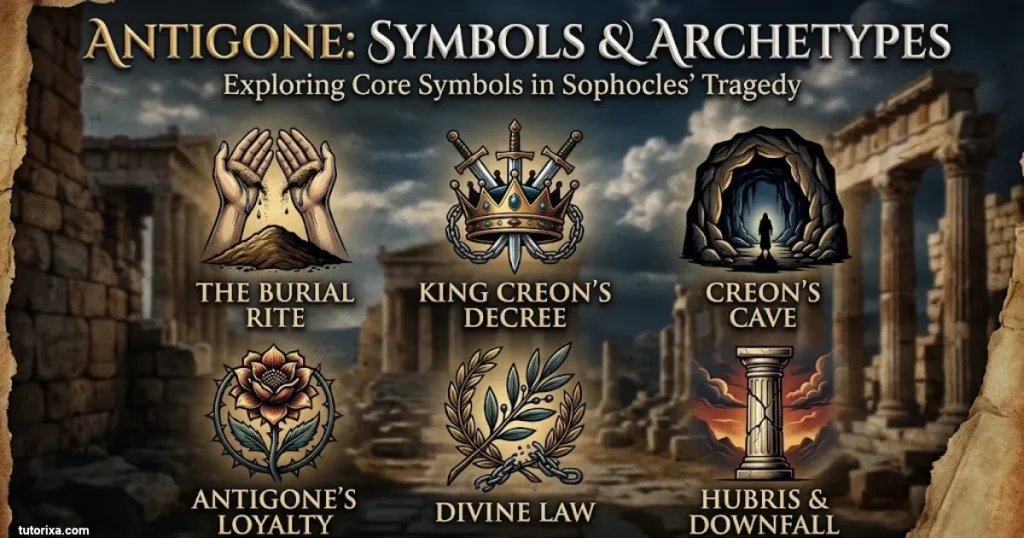
An archetype is a recognizable character type, situation, or symbolic pattern that appears across different stories and cultures.
Sophocles uses several archetypal characters and situations in Antigone. These archetypes make the tragedy easier to connect with broader human experiences.
Antigone as the Rebel Archetype
Antigone represents the rebel who challenges an established authority because of a deeply held belief.
She refuses to accept Creon’s command and chooses to follow her conscience.
This archetype appears in many stories where individuals challenge unfair rules or resist powerful institutions.
Creon as the Tyrant Ruler Archetype
Creon represents the ruler who becomes too attached to power.
He believes that his decisions must be followed without question. His unwillingness to accept criticism turns his leadership into a source of suffering.
This archetype warns against leaders who confuse personal authority with justice.
Tiresias as the Wise Prophet Archetype
Tiresias represents the wise prophet who understands truths hidden from others.
His physical blindness contrasts with his spiritual knowledge.
He warns Creon about the consequences of his decisions, but the king initially refuses to listen.
This archetype highlights the value of wisdom, experience, and humility.
Haemon as the Mediator Archetype
Haemon, Creon’s son and Antigone’s fiancé, represents the person who tries to bring opposing sides together.
He attempts to convince his father to reconsider his decision and listen to the people.
His role demonstrates the importance of communication and compromise.
Antigone as the Tragic Heroine
Antigone can also be understood through the archetype of the tragic heroine.
She acts according to her beliefs, but her determination leads her toward suffering and death.
Her tragedy comes from the conflict between her moral responsibilities and the political authority surrounding her.
Creon as the Tragic Ruler
Creon also follows the pattern of a tragic ruler.
His pride and refusal to listen contribute to his downfall. By the time he recognizes his mistake, he has already lost the people he loves.
His story shows that a powerful position cannot protect someone from the consequences of poor judgment.
Major Archetypes in Antigone
| Character | Archetype | Main Representation |
| Antigone | Rebel | Resistance and moral courage |
| Antigone | Tragic heroine | Loyalty and sacrifice |
| Creon | Tyrant ruler | Pride and excessive authority |
| Creon | Tragic ruler | Downfall caused by stubbornness |
| Tiresias | Wise prophet | Spiritual knowledge |
| Haemon | Mediator | Reason and compromise |
| Ismene | Cautious family member | Fear and self-preservation |
These archetypes help explain why the characters’ struggles remain meaningful beyond the historical setting of ancient Greece.
Frequently Asked Questions About Antigone Symbols
What Is the Most Important Symbol in Antigone?
The burial of Polyneices is arguably the most important symbolic action in the play. It represents religious duty, family loyalty, respect for the dead, and resistance against unjust political authority.
What Do Birds Symbolize in Antigone?
Birds symbolize divine warnings and religious disorder. In Tiresias’ prophecy, birds feed on Polyneices’ body and carry its remains to sacred places, contaminating religious offerings and revealing the consequences of Creon’s decision.
What Does the Tomb Symbolize in Antigone?
The tomb symbolizes death, imprisonment, isolation, and the loss of freedom. Antigone’s confinement inside it also creates a connection between marriage and death because she loses the future she might have shared with Haemon.
What Does Creon Symbolize in Sophocles’ Antigone?
Creon symbolizes political authority, pride, and the dangers of authoritarian leadership. His refusal to listen to advice shows how excessive control and stubbornness can destroy both personal relationships and public order.
What Is the Main Theme of Symbolism in Antigone?
The main symbolic theme is the conflict between human authority and divine law. Through burial, birds, darkness, the tomb, and prophetic warnings, Sophocles explores justice, morality, loyalty, pride, and the consequences of ignoring higher responsibilities.
Conclusion
The symbols in Antigone help readers understand the deeper meaning of Sophocles’ tragedy. Burial dust, Polyneices’ body, the tomb, birds, darkness, and blindness all represent important ideas connected to religious duty, death, justice, and human responsibility. These elements make the conflict between Antigone and Creon more meaningful.
The play also uses motifs and archetypes to explore family loyalty, political authority, pride, and the importance of wisdom. Antigone represents resistance and moral conviction, while Creon shows the dangers of excessive power. Tiresias reminds readers that true understanding requires more than physical sight.
Understanding these symbols makes it easier to recognize why the tragedy continues to be studied. Its central message is that power without wisdom can cause suffering, and ignoring moral responsibilities can lead to consequences that cannot easily be reversed.

I’m Ellis Montgomery, a British writer interested in the powerful language of symbols. I explore everything from traditional emblems and cultural signs to contemporary symbols found in modern life. My aim is to explain their meanings clearly while revealing the stories and ideas behind them, making symbolism fascinating and accessible to everyone.
Books:
- The Complete Book of Symbols
- Hidden Messages in Everyday Symbols
 Rowan Whitaker
 Freddie Beaumont